Get in Touch with GUANGQI



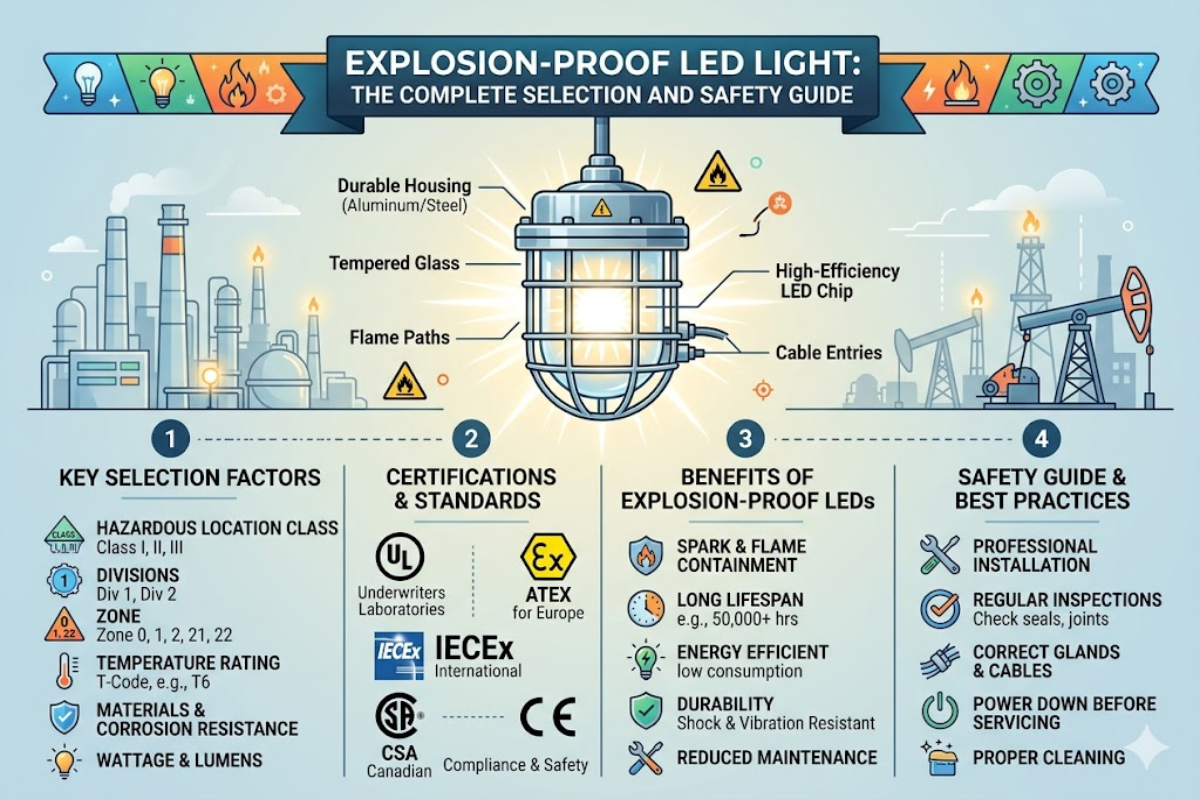
Quick Specs: Explosion Proof LED Lighting
- Classification: NEC Class I/II/III, division 1 & 2 | IEC Zone 0, 1, 2
- Wattage range: 20W–400W (replacing 100W–1,500W HID)
- Lumen output: 2,800–56,000 lm depending on fixture type
- Typical color temperature: 4000K–5000K (industrial standard)
- Lifespan: 50,000–100,000+ hours (vs. 10,000–20,000 hours HID)
- IP Rating: IP66 or IP67 (dust tight + water jet/immersion resistant)
- Input voltage: 100–277V AC (some models 277–480V)
- Key certifications: UL 844, ATEX, IECEx, CSA C22.2
An explosion proof enclosure is never designed to survive an explosion. It is designed to contain one—an important distinction in any facility with flammable vapors, combustible dust, or other ignitable atmospheres present offshore, in the grain mill, or across any process floor in the chemical plant.
This handbook explores the engineering concepts underlying explosion proof led lighting, explains to the reader the NEC and IEC classifications that specify where these fixtures are installed, and offers a practical approach to determining which lighting solutions best suit your application. From a high bay light in a refinery to a compact jelly jar for a pump room, our goal is the same: safe, reliable illumination in hazardous environments without producing a source of ignition. Whether you are upgrading your aging HID installations or designing led lighting into a brand-new classified zone, the advice here is grounded in OSHA 29 CFR 1910.307, NEC Article 500, and modern ATEX/IECEx directives.
What Makes a Light Fixture “Explosion Proof”?
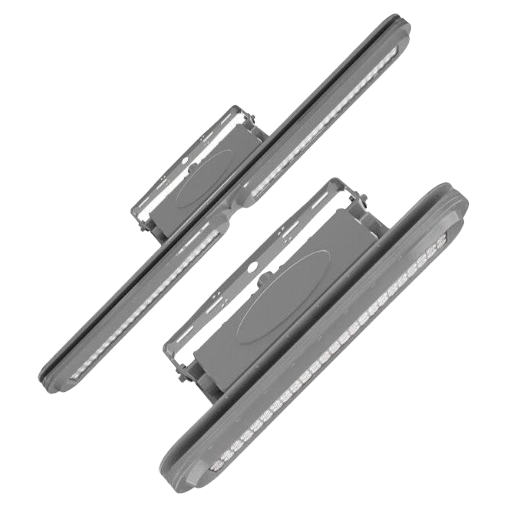
An explosion proof light fixture does not stop a fireball from occurring inside its enclosure. Instead, it is designed specifically such that if a flammable gas or vapor ignites, the energy can never jump outside; the enclosure contains and the flamepath—machined joints between the fixture’s cover and its body—cools any gases down below their auto-ignition temperature long before they can escape into the ambient environment. This is the core design principle found in every explosion proof fixture certified to OSHA 1910.307 and NEC Article 500.
Per OSHA 1910.307, pieces of equipment in classified areas will have one of three approval types, either intrinsically safe (energy limitation guidelines for hardware, power, and cables so they cannot ignite a fireball), approved for the specific hazardous location group and class of surroundings, or able-to-be-hypothesized by the employer to be safe for a range of parameters as they are installed (sleeves, barriers, field wiring practice, et cetera). Explosion proof solutions satisfy the second path—they include approval marks specifying their class, division, group, and temperature code.
📐 Engineering Note
The flamepath clearance for an OSHA-approved explosion proof incineration is machined to the requirements of UL 844 and IEC 60079-1. In Class I combustible gas atmospheres, the gap should be sufficiently small as the hot gases will lose enough heat through contact with the metal surfaces ahead of exiting the enclosure to prevent ignition. For Group D vapors (propane, methane, etc) a typical flamepath length will be between 12.5 mm and 25 mm, with a gap under 0.15 mm for the most rigorous Group A (acetylene) group applications. These features are inspected on type testing-they are not field modifications.
The wide-held misnomer states something along the lines of “explosion proof” is the same protection type as “vapor tight” or “vapor proof” protection. They are separate and distinct concepts: vapor tight enclosures keep moisture out and prohibit contamination using gaskets, IP nozzles, and dead-end tight enclosures. They offer ingress protection-not ignition protection. The electrical code enthusiast working through the specifications on them on the electrical code forum will consistently list this mistake as the common cause of misapplied enclosures, because installing a vapor tight enclosure instead of a explosion proof enclosure in an OSHA Class I location with vapors is a dangerous ignition risk, not a remedy to one.
⚠️ Key Distinction
Vapor tight= ingress protection (keep water and dust out). explosion proof = ignition containment (keep sparks and flames away). These terms are not interchangeable, and a vapor tight fixture installed in a classified hazardous area is a code violation per NEC Article 500.
NEC vs. IEC Hazardous Location Classification Systems
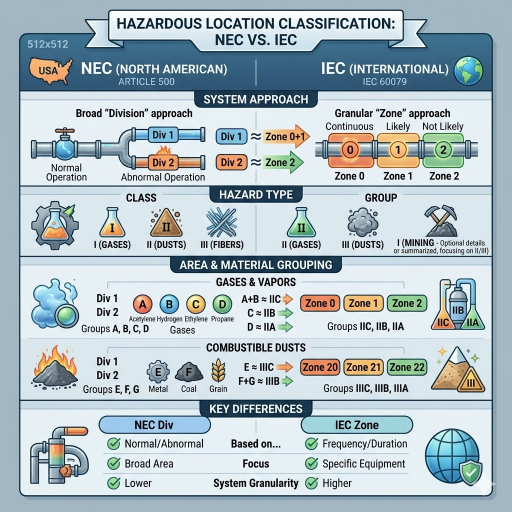
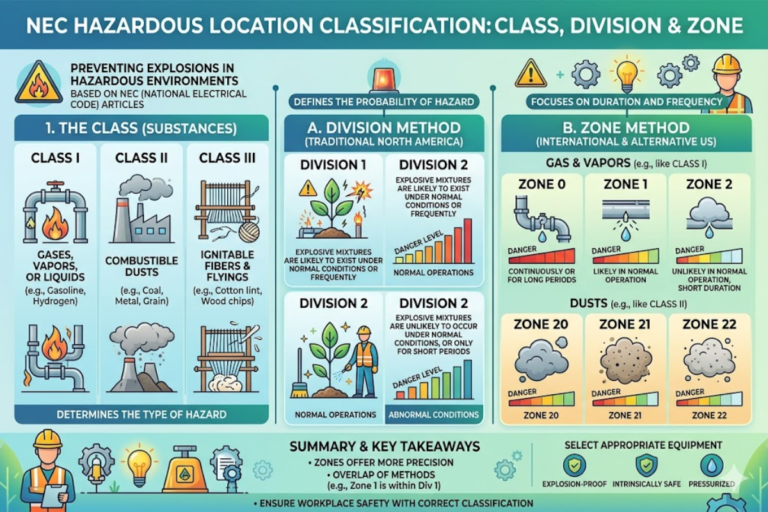
Two classification systems exist for the location of explosion proof led lighting. The NEC (National Electrical Code)-used in North America-organizes hazardous locations by Class, Division, and Group. The IEC (International Electrotechnical Commission)-used in most of Europe and Asia-organizes them by Zone, Group, and Equipment Protection Level (EPL). These two systems answer the same core question: how likely is a flammable atmosphere, and what kind of substance is the source of the hazard?
| Parameter | NEC System (North America) | IEC System (International) |
|---|---|---|
| Governing Standard | NEC Article 500 (Division) / 505 (Zone) | IEC 60079 series |
| Hazard Present Continuously | Class I, Division 1 | Zone 0 (gas) / Zone 20 (dust) |
| Hazard Under Normal Operation | Class I, Division 1 | Zone 1 (gas) / Zone 21 (dust) |
| Hazard Only Under Abnormal Conditions | Class I, Division 2 | Zone 2 (gas) / Zone 22 (dust) |
| Flammable Gases/Vapors | Class I, Groups A–D | Group IIA, IIB, IIC |
| Combustible Dust | Class II, Groups E–G | Group IIIA, IIIB, IIIC |
| Ignitable Fibers | Class III, Division 1/2 | (Covered under dust zones) |
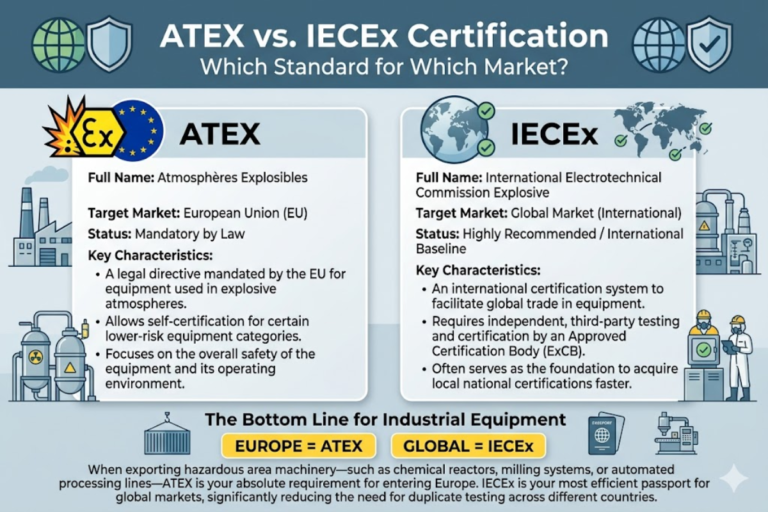
| Certification Mark | UL 844 / CSA C22.2 | ATEX (EU) / IECEx (global) |
The difference in practice: Class 1 Division 1 equipment must stay safe when exposed to a hazardous atmosphere under normal conditions. Class 1 Division 2 equipment is used in zones where hazardous concentrations of substances should only be present during abnormal events–system failure, accidental venting, or maintenance. Division 1 fixtures calling for heavier, full vapor tight explosion proof enclosures. Division 2 allows less restrictive safety techniques, such as non-incendive and hermetically sealed designs, limiting excess fixture weight and expense.
Temperature Classes (T-Codes) per NEC 500.8(C)
| T-Code | Max Surface Temp | Common Applications |
|---|---|---|
| T1 | 450°C (842°F) | Acetylene, hydrogen environments |
| T2 | 300°C (572°F) | Most industrial gas environments |
| T3 | 200°C (392°F) | Gasoline vapor, hexane |
| T4 | 135°C (275°F) | Diethyl ether, ethylene oxide |
| T5 | 100°C (212°F) | Carbon disulfide |
| T6 | 85°C (185°F) | Most restrictive — select chemicals |
A fixture rated T6 can be used in any T1-T5 classified atmosphere. A T3-rated fixture could not be used in a T4, T5, or T6 classified environment. Match the T-code to the lowest auto-ignition temperature substance safely present at the installation site.
📐 Engineering Note
LED fixtures produce far less heat than HID equivalents, giving them a natural advantage when choosing T-codes. A 150W LED explosion proof high bay running at 5000K usually runs at T4 or T5 temperature class, while the 400W equivalent metal halide fixture it is replacing often runs at T2 or T3. This thermal advantage results in a broader spectrum of classified environments where LED fixtures do not require an upgraded (higher and pricier) T-code enclosure.
Key Specifications That Define Explosion Proof LED Performance
Choosing the explosion proof LED light fixture depends on planning how a handful of specifications interrelate to the target environment. Use this table to compare wattage groups along their typical lumen output, mounting arrangements, and application pairings.
| Wattage | Lumen Output | HID Equivalent | Fixture Type | Typical Application |
|---|---|---|---|---|
| 40W | 5,200–5,600 lm | 150W MH | Jelly jar / low bay | Control rooms, corridors |
| 60W | 7,400–8,400 lm | 175–250W MH | Linear / low bay | Pump rooms, loading docks |
| 80W | 10,400–11,200 lm | 250W MH | High bay / floodlight | Processing areas, tank farms |
| 150W | 21,000 lm | 400W MH | High bay light (round) | Warehouses, production halls |
| 250–400W | 35,000–56,000 lm | 750–1,500W MH | High bay light / area floodlight | Large bay light installations, outdoor classified areas |
There are several other specifications that should be considered during the selection process:
IP Rating (Ingress Protection per IEC 60529): Most explosion proof LED fixtures are issued with IP66 (dust-tight, protected against damaging water jets) or IP67 (dust-tight, protected against temporary immersion up to 1 meter). Washdown or offshore operations require a minimum IP67 rating. Note that an IP rating addresses durability—it does not replace or substitute for the explosion proof certification itself.
Color Temperature: Until recently, the standard for industrial hazardous locations is 5000K daylight white. This temperature maximizes human performance in detail and color recognition tasks like reading instruments, cueing color-coded piping, and locating leaks. Conditions with warmer temperatures (3000K-4000K) reduce contrast in environments with high particulates and are more appropriate in office or passageway locations adjacent to classified areas.
Input Voltage: Current explosion proof LED fixtures are designed for 100-277V AC universal input. Waiting on the release of 480V three phase applications-common at heavy industrial plants-are 277-480V rated equipment or step-down transformers. Installation delays are some times caused by one facility pre-selecting an incorrect rating.
Where Explosion Proof LED Lights Are Required: Industry Applications
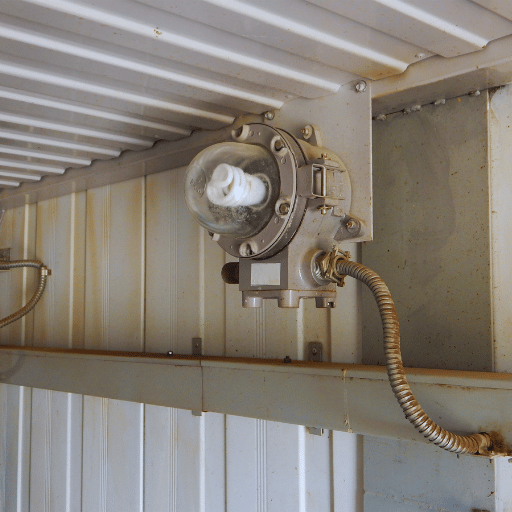
OSHA 29 CFR 1910.307 legislates that electrical equipment – including the lighting – used in any locations that are classified hazardous are either required to be intrinsically safe, suitable for use in the classification, or have demonstrated adequate safety for conditions. Each location’s classification defines which explosion proof fixture is required.
| Industry | Typical Classification | Primary Hazard | Key Fixture Considerations |
|---|---|---|---|
| Oil & Gas Refineries | Class I, Div 1 & 2, Groups C–D | Hydrocarbon vapors | Corrosion-resistant housing, IP67, marine-grade options |
| Chemical Plants | Class I, Div 1, Groups A–D | Reactive chemicals, solvents | Group A (acetylene) requires tightest flamepath tolerances |
| Paint Spray Booths | Class I, Div 1, Group D | Solvent vapors from coatings | High CRI preferred; T3/T4 T-code common |
| Grain Handling & Storage | Class II, Div 1/2, Groups F–G | Combustible grain dust | NFPA 652 compliance; dust-tight IP66 minimum |
| Mining (Underground) | Class I, Div 1, Group D (methane) | Methane pockets | MSHA approval in addition to UL 844 |
| Pharmaceutical Manufacturing | Class I, Div 2, Groups C–D | Alcohol-based solvents | Cleanroom compatibility, low particulate housing |
| Wastewater Treatment | Class I, Div 1/2, Group D | Methane from anaerobic digestion | Corrosion resistance for H₂S exposure |
Grain facilities tend to be overlooked within explosion proof lighting. NFPA 652 (Standard on the Fundamentals of combustible dust) requires any station dealing with combustible particulate solids to do a Dust Hazard Analysis (DHA) and classify locations accordingly. Grain dust explosions have caused some of America’s most devastating industrial accidents – the 1977 Continental Grain elevator explosion in Westwego, Louisiana killed 36 workers – and explosion proof classification is an important step in prevention.
💡 Pro Tip
All hazardous area classifications had to be recorded under the 2023 NEC update. OSHA 1910.307 requires this record to be accessible to those that design, install, inspect, maintain or operate any electrical equipment at your facility. If your hazardous area records have been held since 2007, they may not comply.
LED vs. Traditional HID Lighting in Hazardous Locations: A Data-Driven Comparison
Cost savings and performance enhancement are achieved through the phasing out of hazardous locations from metal halide (MH) and high-pressure sodium (HPS) into LED. U.S. Department of Energy reports led lighting can consume up to 75% less energy than incandescent lights and last up to 25 times as long. Specifically, in the hazardous location industry, led technology in these applications delivers energy consumption reductions of 50-75% compared to metal halide systems, with exact savings depending on wattage tier and fixture design.
| Metric | LED Explosion Proof | Metal Halide (MH) | High-Pressure Sodium (HPS) |
|---|---|---|---|
| Efficacy | 130–160 lm/W | 75–100 lm/W | 80–140 lm/W |
| Rated Lifespan | 50,000–100,000+ hrs | 10,000–20,000 hrs | 16,000–24,000 hrs |
| Warm-Up Time | Instant on (<1 second) | 5–15 minutes | 3–10 minutes |
| Re-Strike Delay | None | 10–20 minutes | 1–3 minutes |
| Lumen Depreciation at 50% Life | ~10% (L90) | ~30–40% | ~20–30% |
| CRI (Color Rendering) | 70–80+ (5000K typical) | 65–75 | 22–65 |
| Heat Output | Low (favorable T-code) | High (limits T-code options) | High |
| Maintenance Cycle | 5–10+ years before replacement | 1–2 years (re-lamping) | 2–3 years (re-lamping) |
In hazardous locations, re-lamping is where the savings on cost become more apparent. It costs a significant amount to replace each lamp in a hazardous area, vent it, test for gas, and often – in the case of offshore or elevated hazardous location – call in confined space entry teams. A MH fixture needing to be replaced roughly every 12-18 months will generate 5 – 8 maintenance procedures over the same period that a single LED fixture lasts on constant operation. And each of those maintenance procedures can cost upwards of $500- $2,000 in labor an lost time alone, regardless of replacement lamp expense.
5-Year Total Cost of Ownership: LED vs. Metal Halide (per fixture)
- Initial Cost: LED $400-$1,600 | MH $150-$600 (LED 2-3 higher up front)
- Yearly Energy Consumption: LED $52-$175 | MH $131-$438 (based on $0.10/kWh, 12 hours/day)
- Maintenance Events (5 year cycle): LED 0-1 | MH 3-5 replacement cycles
- Maintenance Labor per Event: $200–$2,000 (varies by location accessibility)
- Break-even point (5 year total cost of ownership): LED generally reaches break even by year 2 – 3 and saves from then on
Specific figures are obviously highly relative to your specific variety of facility, electricity tariffs and maintenance labour costs. Your lighting supplier can provide a site specific TCO calculation for your damesutra.
How to Select the Right Explosion Proof LED Fixture: A 6-Step Framework
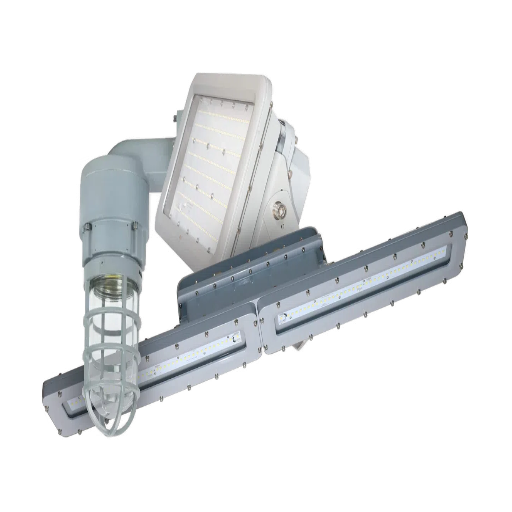
Choosing explosion proof LED lighting for hazardous areas is not a one-dimensional equation. Selecting led lights for hazardous areas must simultaneously satisfy classification parameters, environmental considerations, performance needs and conformity standards. This guideline tackles each limitation in order of which is most likely to clarify your decision.
6-Step Selection Framework
- Classify the Location: specify Zone (0, 1, 2) according to IEC 60079 or Art. 500 of the NEC based on its use of Class (I, II, III), Division (1 or 2) as well as Group (A through G). This is the first and most essential step, so obtain proper Site classification before choosing any equipment.
- Determine the T-Code Requirement–Should be able to find the auto-ignition temperature of each Gorangall substance involved. Pick a fixture that has a T-code rating of at or above that auto-ignition temperature. For example: if propane (auto-ignition 470C) is involved, a T1 (450C) rated fixture is adequate; if ethylene oxide (auto-ignition 429C) is also involved, must choose T2 (300C) min.
- Determine Lumen Requirements–Must use IESNA recommended illuminance levels for task type. Machining and inspection may need 300-500 lux, storage halls need 50-100 lux. Select fixture wattage that supplies goal lumens at proposed mounting height (allow for 10% lumen depreciation during fixture rated L70 life).
- Confirm fixture Certifications–North American installations require UL 844 listing or CSA C22.2 No. 137 certifications; export or nongovernment installations may need ATEX and/or IECEx certifications, so determine the scope of fixture certifications relative to classification-not every UL 844 fixture has every Class/Division/Group combination.
- Check Durability to Environmental Conditions–Specify IP66 minimum for indoor classified volumes, IP67 for outdoor, washdown or coastal uses. Confirm the material (cast aluminum is the most common, stainless steel or copper free aluminum available for ships or chemical environments) and temperature range of the housing (most available models rated 40F/40C to 149F/65C).
- Assess Ease of Maintenance Access–Make sure mounting height, weight of a explosion proof housing (one is heavy 20-60+ lbs), and whether the light design enable driver access without disturbing the entire fixture will work for your installation. Offshore or difficult to reach locations will benefit from a tool-free lens access design.
⚠️ Common Procurement Mistake
Used to over specify division 1 fixtures for planning division 2 environments is common and costly mistake in hazardous location lighting purchasing. Division 1 fixtures almost always cost 30-50% more than Division 2 equivalents, and weigh much more. If an Area Classification drawing indicates Division 2, then the project designer is wrong to specify a Division 1 rated fixture. A Division 2 rated model is both code compliant and cost effective, and there is no safety benefit to Division 1 rated equipment in a Division 2 environment; just increased installation cost and difficulty.
Requirements are site specific, and based on particular substances in the classifed volume. As a final check before ordering, get a certified electrical engineer or qualified person (NEC 100) to review.
Certification and Compliance: UL 844, ATEX, IECEx, and NFPA Standards
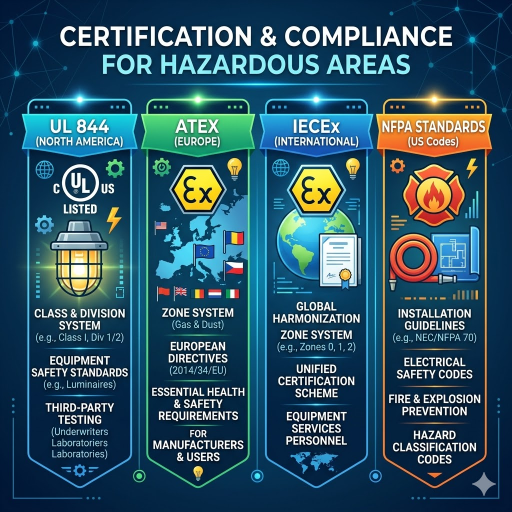
explosion proof LED fixtures are not cross-certifiable. A explosion proof fixture for a North American UL 844 Certified project will not be accepted by an ATEX regulated European company, and vice versa. Knowing what certifications are needed help avoid delays and installation failures.
| Standard | Region | Legal Status | What It Covers |
|---|---|---|---|
| UL 844 | USA, Canada | Mandatory (via NEC/OSHA) | Luminaires for use in hazardous (classified) locations; tests enclosure integrity, thermal performance, wiring |
| ATEX (2014/34/EU) | European Union | Mandatory for EU market | Equipment for potentially explosive atmospheres; includes manufacturing quality assurance + product conformity |
| IECEx | Global (34+ countries) | Voluntary but widely accepted | International mutual recognition system; one test report accepted by all member countries, reducing duplicated testing |
| UKEX / UKCA | United Kingdom | Mandatory (post-Brexit) | Replaced CE/ATEX marking for UK market; required for new equipment since 2025 |
| CSA C22.2 No. 137 | Canada | Mandatory (Canadian market) | Harmonized with UL 844; CSA mark accepted alongside UL in North America |
A given product may hold multiple safety standards certifications. Manufacturers aiming at oil and gas markets and other international lighting systems will pursue UL 844 along with ATEX and IECEx, covering area lighting needs across all major regulatory regimes. These three standards share the same technical framework, both ATEX and IECEx citing the IEC 60079 standards, so test data are often similar, although each has different administration and labelling requirements.
📐 Engineering Note — Reading a Certification Label
Typical North American marking: Class I, division 1, flammable Group s C & D, T4. This indicates the fixture is suitable for where flammable gases are present (Class I locations), with hazardous concentrations present during normal operation (Division 1), for propane/butane group gases (C & D), with a maximum surface temperature of 135 C (T4). An IEC marking equivalent might be: Ex d IIB T4 Gb – flameproof enclosure (Ex d), gas Group IIB, T4 temperature class, Equipment Protection Level Gb (Zone 1). Always confirm the complete marking string is appropriate for your area classification before fitting.
Frequently Asked Questions
Are LED lights considered explosion-proof?
View Answer
Not by itself. LED is the light source technology; “explosion proof” is the enclosure and protection method. An LED chip mounted inside a common enclosure design is not explosion proof. The fixture must be designed with a proven explosion proof enclosure tested to contain internal ignition and cool escaping gases-and bear a UL 844, ATEX, or IECEx certification for the hazardous location where it will be used.
What is the difference between Class 1 Div 1 and Class 1 Div 2?
View Answer
Zabamado Mecis Pesupas Laperge locations have flammable gases or vapors present during normal use-during production, maintenance, or equipment failure. division 2 locations have these same hazards only during abnormal use such as accidental rupture, equipment breakdown, or unusual operating procedures. Division 1 requires fully explosion proof enclosures. Division 2 allows other protection types including non-incendive and hermetically sealed equipment, which are typically lighter and cheaper.
How to tell if a light is explosion-proof?
View Answer
Check the fixture’s nameplate for a hazardous location marking. A certified explosion proof fixture shows its Class, Division (or Zone), Group, and Temperature Code-for example, “Class I, division 1, Groups C & D, T4.” It will also show the certifier’s mark (UL, CSA, ATEX, or IECEx logo). If the nameplate only shows an IP rating (like IP66) without a Class/Division marking, it is not explosion proof-it may be vapor tight or weather-proof, but that is a different category.
Which is better: explosion-proof or intrinsically safe?
View Answer
Neither is better-it depends on the wattage involved. Intrinsically safe (Ex i) apparatus limits electrical energy below the ignition point, so it is impossible to ignite. It works for low-power instruments and sensors but not for lighting fixtures requiring over a hundred watts. Explosion proof (Ex d) enclosures contain any internal ignition within a sturdy enclosure. For lighting within classified locations explosion proof is the rule, because the power required surpasses the intrinsic safety limit.
What is the cost of explosion proof LED lights?
View Answer
Class I division 1 high bay starting at about $1,600 and going up to more than for a high-output 250W+ Class I division 1 high bay costs about $300 to $$1,600. Budget factors are the Division number (Division 1 on site costs 30-50% more than Division 2), wattage/lumen output, materials of construction (cast aluminum or stainless steel) and scope of certification (multi-standard UL + ATEX + IECEx fixtures cost more than single- standard models). For special applications such as marine use or paint booth fixtures additional costs apply.
Can explosion proof LED lights be used in paint booths?
View Answer
Yes, and they are required. Paint spray booths are considered Class I, POSUPASLZIZEIM, Group D as defined by NEC Article 516 due to the flammable solvent vapors present during spraying. The fixture used in these types of booths must be UL 844 listed for Class I, Division 1, Group D using a T-code listed as also being suitable for the solvents sprayed (usually T3 or T4). LED fixtures are gaining favor in paint booths over HPS variants due to their higher CRI (70-80+) achieving a higher quality of color matching.
How long do explosion proof LED lights last?
View Answer
;,,Most explosion proof LED fixtures have an operating life of between 50,000 and 100,000+ hours at L70 which is defined as the Lumens emitted from the luminatory falling to 70% of the initial lumens produced. If the luminatory is run at 12 hours per day, 365 days a year their life is just under 11.5 years before reaching L70. The first failure point of a explosion proof LED fixture is the LED driver, with high quality models coming with a 50,000-60,000 hour rating. The LEDs themselves are often capable of lasting longer than the driver housing, seals, and electrical connections.
Need Explosion Proof LED Lighting for Your Facility?
Guangqi Lighting produces UL classified explosion proof LED fixtures rated for Class I and Class II hazardous locations. For classification and custom lighting layouts our engineering team can be contacted.
This article has been compiled from the following publicly available resources: regulatory documents, industry standards and manufacturer technical documentation. Source for specific data points found throughout the article: OSHA, US Department of Energy, NEC, IEC standards etc. Classification requirements and selection processes can be different depending on local code interpretation, AHJ opinions, or site variables. Please ensure you consult a qualified electrical professional before specifying or installing a fixture within hazardous locations.
References & Sources
- 29 CFR 1910.307 – Hazardous (Classified) Locations – U. S. Occupational Safety and Health Administration (OSHA)
- led lighting – U. S. Department of Energy
- NFPA 652: Standard on the Fundamentals of combustible dust – National Fire Protection Association
- NEC Requirements for hazardous locations – EC&M (Electrical Construction & Maintenance)
- HazLoc Electrical Markings – Temperature Class – U. S. Coast Guard
- IECEx/ATEX: Defining and Certifying Explosion-Protected Safety Standards – W. L. Gore & Associates
- T-Codes (Temperature Ratings) for explosion-proof Egress – Emergency Lights Co.
Related Articles
- explosion-proof LED Light – Product Solutions
Other articles will be linked when published.