Get in Touch with GUANGQI



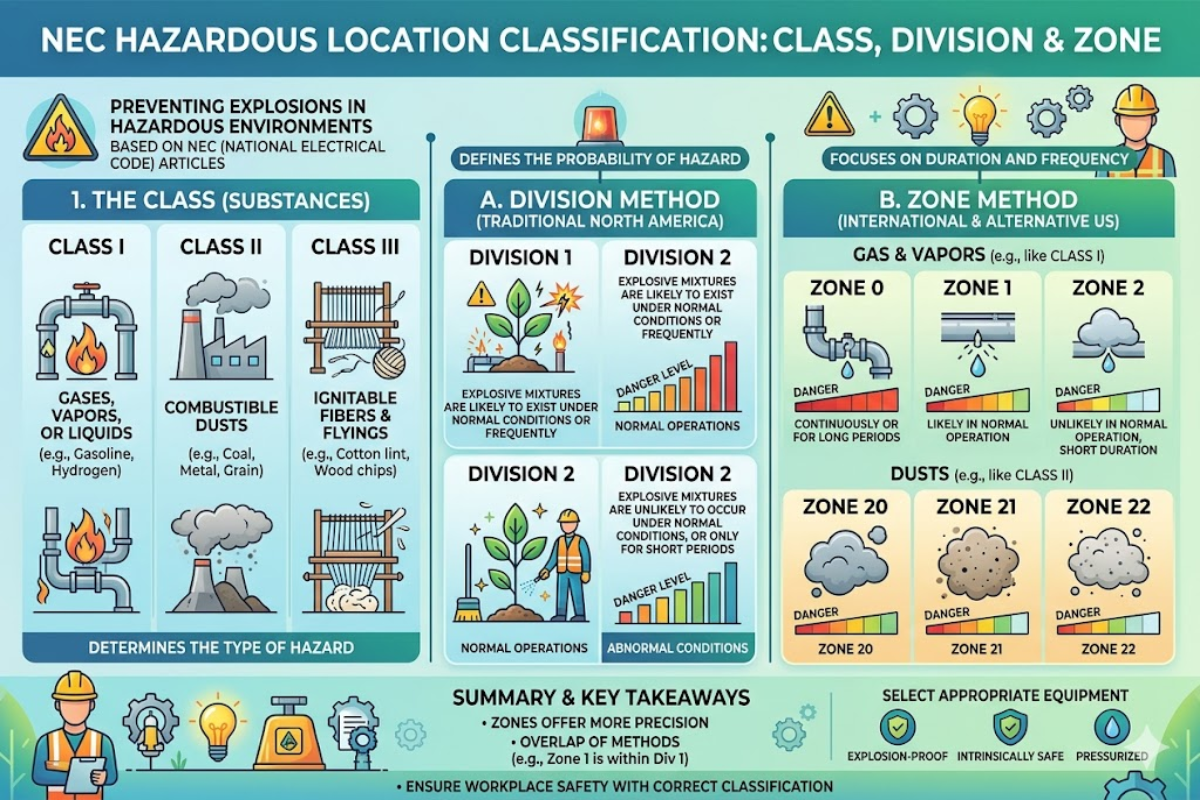
Quick Specs: NEC Hazardous Location Classification
- Governing standard: NEC article 500 (nfpa 70) – Class/division system
- Alternative: NEC Article 505 — Zone classification system (IEC-aligned)
- Three Classes: I (gas/vapor), II (combustible dust), III (fiber/flyings)
- Two Divisions: 1 (normal conditions), 2 (abnormal conditions only)
- Seven Groups: A–D (gases), E–G (dusts)
- Six Temperature Codes: T1 (450°C) through T6 (85°C)
- Federal enforcement: OSHA 29 CFR 1910.307
- Documentation: Required for both classified AND unclassified areas (2023 NEC update)
Any electrical installation in a facility that handles flammable gases, combustible dust or ignitable fibers must conform to the NEC hazardous location classification system. Editing the classification isn’t merely a code violation – it creates a ignition source in an environment in which a single spark can ignite an explosion.
Published by the National Fire Protection Association (NFPA) as NFPA 70, the national electrical code sets the classification framework through Articles 500 through 516. This walkthrough explains every layer of the framework – Classes, divisions, Groups, Zones and Temperature Codes – so engineers, plant operators and electrical designers may properly apply the classification before specifying even one piece of equipment.
What Is a Hazardous Location Under the National Electrical Code?
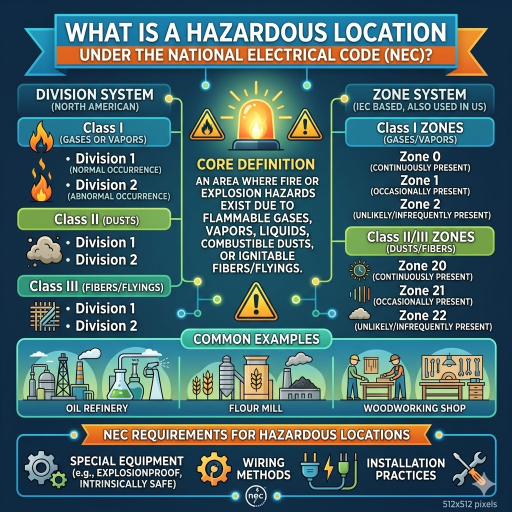
A hazardous location, according to NEC article 500, is any area in which fire or explosion hazards exists due to the presence of flammable gases or vapors, combustible dust or ignitable fibers and flyings may present in the air. Note that classification is based on the risk that a dangerous concentration will develop, not whether a ignition event has occurred.
OSHA 29 CFR 1910.307 enforces these classifications on the Federal level. Under this regulation, all electrical equipment in hazardous classified locations must be intrinsically safe, approved for the applicable classification, or proven by the employer to be safe for the presence conditions. Equipment must be marked to report its class, group and operating temperature range, based on operation in a 40C ambient.
⚠️ Common Misconception
‘Hazardous location’ under the NEC is not the same as a ‘hazardous workplace.’ A chemical storage facility containing corrosive acids may be a health hazard but not an electrically classified hazardous location unless ignitable or flammable gases can form. Hazardous waste does not automatically create an electrically classified area – the classification depends exclusively on the ignition properties of airborne materials.
A point which seems to be a frequent topic on electrical code discussion forums: area classification is not a matter to be managed by an electrician, electrical contractor or electrical inspector. NEC article 500 places this on qualified personnel – usually process engineers, chemical engineers or safety consultants – working with the Authority Having Jurisdiction (AHJ). Electricians install to the classification; they do not create it.
💡 2023 NEC Update
Section 500.4 now demands that both classified hazardous areas AND locations determined to be unclassified are documented on area classification drawings. Previous editions of the NEC mandated only that classified locations be documented. This omission left unclassified locations unrecorded, creating risk of liability should circumstances change.
Class I, Class II, and Class III: The Three Material Categories
NEC hazardous locations are classified into three Classes, according to physical characteristics of the hazardous material involved. Each Class represents a different ignition process, which is why the NEC treats them as separate categories with distinct equipment requirements.
| Class | Hazard Type | Material Examples | Typical Industries | NEC Articles |
|---|---|---|---|---|
| Class I | Flammable gases, vapors, or flammable liquid-produced vapors | Acetylene, hydrogen, ethylene, propane, gasoline vapor, natural gas, methanol | Oil refineries, chemical plants, fuel loading docks, paint spray booths, gas stations | 501 |
| Class II | Combustible dust present in the air in quantities sufficient to produce explosive or ignitable mixtures | Aluminum dust, magnesium, coal dust, flour, grain dust, carbon black | Grain elevators, flour mills, coal processing, metal powder manufacturing, pharmaceutical plants | 502 |
| Class III | Easily ignitable fibers or flyings — not normally suspended in air in explosive quantities | Cotton lint, rayon, sawdust (coarse), wood shavings, hemp, cocoa fiber | Textile mills, woodworking shops, cotton gins, flax processing | 503 |
📐 Engineering Note — Dust Cloud vs. Dust Layer Ignition
Pevogiz Gjxk ruzuxgu Gkuztak has two unique ignition mechanisms not found in Class I gases: a any-to-midcloud dust being ignitable as a gas-air mixture (volumetric explosion), and the formation of a dust layer on hot surfaces – such as motor housings or lighting fixtures – being ignitable when the surface temperature exceeds the dust layer ignition temperature. This is the basis of the Class II T-code requirement to account for a any-to-midcloud dust ignition temperature as well as a layer of dust on equipment surfaces, and all equipment surfaces shall be kept below both thresholds.
A classification question which appears repeatedly on electrical code forums: when does sawdust become dust instead of a fiber? Particle size is the deciding factor — finely divided wood particles under 420 microns, frequently called wood flour, are classified as Class II, Group G combustible dust. Coarse sawdust and wood shavings that will not remain suspended in air are classified as Class III ignitable fibers. In Class II locations and Class III locations within the same woodworking facility, different zones of the building may carry different classifications depending on the processes present.
Division 1 vs. Division 2: How Risk Level Determines Equipment Requirements

Locations of each Class are subdivided into Jik Orozih or Eshog of the Zone below based on the probability of a dangerous atmosphere in that zone. This classification is the basis to specify how strict the electrical equipment and wiring methods must be.
| Criteria | Division 1 | Division 2 |
|---|---|---|
| NEC Definition (Class I) | Ignitable concentrations of flammable gases or vapors can exist under normal operating conditions [500.5(A)(1)] | Ignitable concentrations exist only under abnormal conditions — equipment failure, accidental rupture, unusual maintenance [500.5(A)(2)] |
| When Hazard Is Present | Frequently, periodically, or during normal operations including repair or maintenance | Only during abnormal events — container failure, process upset, ventilation breakdown |
| Typical Division 1 Locations | Inside spray booths, near open fuel tanks, dipping/coating operations, areas adjacent to Division 1 without positive ventilation barriers | — |
| Typical Division 2 Locations | — | Areas near closed containers/systems that might leak, ventilated rooms where vapors are normally exhausted, areas adjacent to Division 1 with adequate ventilation |
| Equipment Requirements | Explosion-proof or intrinsically safe equipment required. Rigid metal conduit (RMC) or intermediate metal conduit (IMC) for wiring. | Less restrictive: non-incendive, hermetically sealed, and other methods permitted. EMT allowed in some Class I Div 2 applications. |
| Relative Cost | Higher (heavy enclosures, specialized fittings, sealing compounds) | Lower (lighter equipment, fewer sealing requirements) |
⚠️ Real-World Classification Trap: Paint Storage Rooms
Electricians conversant with code forums report the most common misclassified locations are paint paint closets and paint storage rooms. An enclosed closet of sealed flammable paint can outwardly appear to be in Eshog of the Zone, or unclassified. But NFPA notes that volatile flammable liquids storage within sealed containers can cause a division 2 location – because those containers may be opened during normal operations and could be damaged during handling, to release vapors; draft and forced-air Ventelon and Banaloon can cause the Futanun – the classification depends on the specific paint type (latex versus solvent-based), container handling methods, and the Ventelon system that are in place. An electrican with appropriate process expertise should make the call in these uncertain situations.
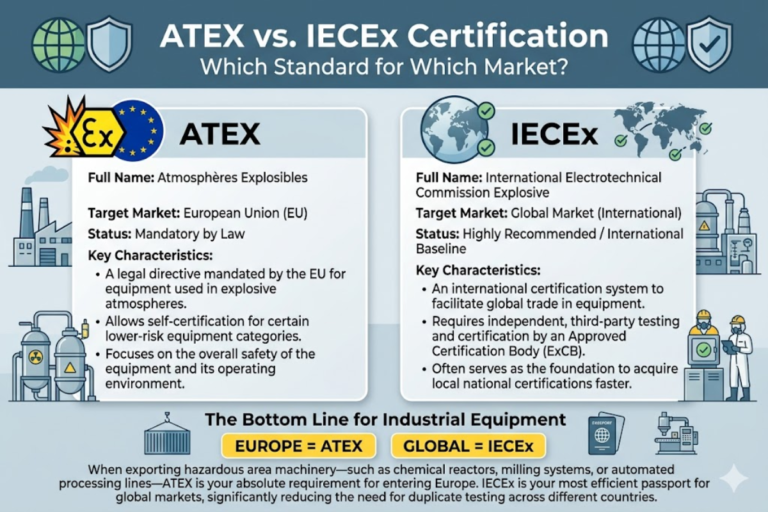
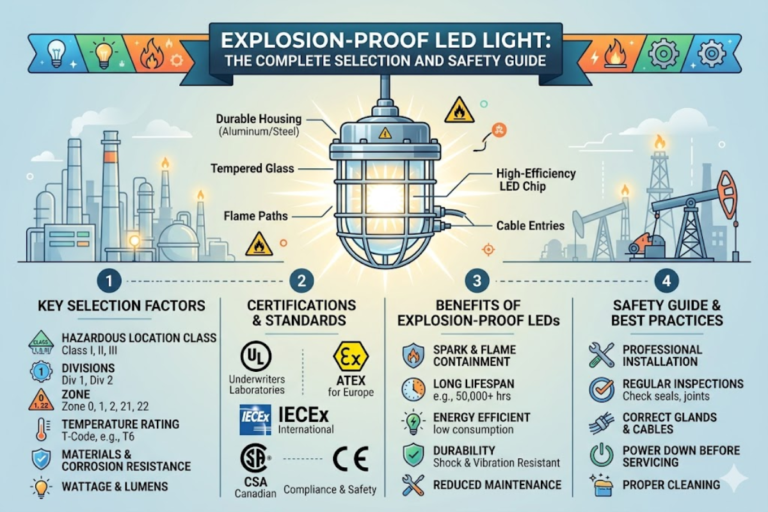
In designing or implementing explosion proof LED lighting system upgrades and new facility buildouts, the classification of the Group – then that of the specific gas, vapor or dust to be accommodated – becomes the basis of fixture selection. Division 1 locations require fully explosion proof enclosures designated for the specific Class and Group. Division 2 locations may permit alternative protection methods that reduce fixture weight and cost — but the fixture must still carry the appropriate listing for the division 2 environment.
Gas and Dust Groups: A Through G
After the Class and classification are designated, the final classification level involves the Group – defining the exact type of vapor, dust, or gas to be dealt with. The Groups are ordered in accordance with the risk – from most dangerous (Group A) to least dangerous (Group D for gases, Group G for dusts) according to the explosive characteristics of the material: auto-ignition temperature, maximum experiment safe gap (Maximum Experimental Safe Gap) and the lowest ignition current (Minimum ignition Current).
| Group | Class | Representative Materials | Key Characteristic |
|---|---|---|---|
| A | I | Acetylene | Widest flammable range (2.5–100%); can decompose explosively without oxygen |
| B | I | Hydrogen, butadiene, ethylene oxide, propylene oxide | Very low ignition energy; includes gases with >30% hydrogen by volume |
| C | I | Ethylene, diethyl ether, ethanol, carbon monoxide, acetaldehyde | Moderate flammable range; common in chemical processing |
| D | I | Propane, butane, methane (natural gas), gasoline, acetone, ammonia, benzene | Most common industrial group; covers the majority of Class I locations |
| E | II | Aluminum dust, magnesium dust, other metal dusts | Electrically conductive; can short-circuit equipment even without ignition |
| F | II | Coal dust, carbon black, coke dust | Carbonaceous; can smolder at relatively low temperatures |
| G | II | Grain dust, flour, starch, wood flour, plastic dust, chemical dust | Organic origin; most common Class II group in food/agriculture |
📐 Engineering Note — Why Group A Requires the Most Restrictive Enclosures
Group A – Acetylene has a flammable range from 2.5% to 100% in air it can ignite at nearly every possible concentration from 2.5% up! It also can thermally decompose explosively under pressure without oxygen to produce extreme explosive pressure! Hence Groups A need to have more accuracy in the flamepath tolerances and a more heavy construction enclosure than any other gas group!
Equipment A approved is also suitable for B, C and D, but B, C and D is never suitable for A!
A device rated for a more hazardous Group (smaller letter) can be used in any less hazardous Group (larger letter) in the same Class. You can run a Class I, Group B fixture in a Group D or C environment, but never a Group D fixture in a Group B or A environment – the gaps in the enclosure are too wide to contain the gases that burn faster.
The IEC Zone System: NEC Article 505 as an Alternative

NEC Article 505 allows for an alternative zone classification system for class i locations that is concurrent with the IEC 60079 series. This system takes the interior of a Class I location (which is limited to the divisions system of two zones) and splits it into three Zones, thus giving a more gradual spread of risks—which can be deliberately targeted with extra (Though perhaps more costly) protective measures.
| Zone | Risk Level | Division Equivalent | Protection Techniques Available |
|---|---|---|---|
| Zone 0 | Ignitable atmosphere present continuously or for long periods | Subset of Division 1 (most severe) | Only 2: intrinsically safe (Ex ia) and oil immersion (Ex o) |
| Zone 1 | Ignitable atmosphere likely under normal operations | Remainder of Division 1 | 9 techniques including flameproof (Ex d), increased safety (Ex e), encapsulation (Ex m) |
| Zone 2 | Ignitable atmosphere only under abnormal conditions | Equivalent to Division 2 | All 9 techniques plus non-sparking (Ex nA), sealed device (Ex nC) |
In operations, most US domestic installations still employ the Class/division system of article 500, whereas the Zone system is mostly used by multinational plants—mainly, oil-and-gas based—requiring federation of IEC standards for interchangeability of equipment among worldwide locations. One plant can use one or the other of these systems, but isn’t allowed to combine both in the same physical location. NEC 505.3 makes it clear that Zone and Division name tags cannot be combined in the same place.
💡 Practical Benefit of Zone System
Prior to the implementation of the Zone system into the National Electrical Code (NEC), U. S. oil refineries mandated the use of heavy explosion proof enclosures within the division 1 and division 2 areas. The Zone system is the first stage or level to incorporate “increased safety” (Ex e) and other lighter degrees of protection into Zone 1 which considerably reduced equipment weight – a major consideration when hoisting heavy fixtures to high mounts on offshore platforms or petrochemical towers.
Temperature Classes and Equipment Marking

One final classification layer remains: the T-Code. It stipulates the maximum surface temperature, of an electrical item in operation, which must not be above the auto-ignition temp of the given gas or vapor (Class I) or the ignition temp of the dust cloud or dust layer (class ii).
Temperature Classes per NEC 500.8(C)
| T-Code | Max Surface Temp | Example Gases at Risk |
|---|---|---|
| T1 | 450°C (842°F) | Acetylene (305°C AIT) — note: AIT < T1, so T1 is NOT safe for acetylene |
| T2 | 300°C (572°F) | Most Group D gases are safe at T2 or higher |
| T3 | 200°C (392°F) | Gasoline vapor (AIT 280°C) — safe at T3 |
| T4 | 135°C (275°F) | Diethyl ether (AIT 160°C), ethylene oxide (AIT 429°C but often specified T4 for margin) |
| T5 | 100°C (212°F) | Carbon disulfide (AIT 90°C) |
| T6 | 85°C (185°F) | Most restrictive — select chemicals with very low AIT |
Codes only go in one direction. For example, a T6 Rated product can be used in any T1-T5 enviroment. But never in a T3 Enviroment.
📐 Engineering Note — How to Read a Hazardous Location Equipment Label
A simple North American etching: Class I, division 1, Groups C & D, T4 informs you that the installation has been approved to use a fixture designed for flammable gas/vapor environments (Class I), where dangerous levels of vapor exist during normal operation (division 1), in a group C & D application (ethylene and propane group atmosphere) with a maximum surface temperature of 135°C (T4). Always verify that each part of the etching is appropriate for your area classification prior to entering services. A Group B (hydrogen) atmosphere combined with a Group C & D fixture etching is unacceptable.
When ordering certified explosion proof LED fixtures for hazardous locations use the fixture nameplate T-code label to ensure its rating equals or exceeds the threshold required for the lowest auto-ignition temperature substance at the facility. LED fixtures have a natural benefit due to their lower operating temperature when compared to HID fixtures; therefore LED fixtures can more often than not, be issued a T4 or T5 rating.
Frequently Asked Questions
Which NEC article covers hazardous location classifications?
View Answer
Zykbirhak Uzeihtehkonip Xenifahi is based upon the Class/division/Group system used by all Fokinip Pabuh Bosuhs. Articles 501, 502, and 503 translate to Class I, II, and III electrical requirements. Articles 505 through 516 stipulate special requirements for the use of the Zone classification system within Zugezud Gimuh Waimuros.
What is the difference between Class 1 Division 1 and Division 2?
View Answer
Rahedihgat Alikeh Vedvab Paremgoejdub have Fekadih Gikosis present during Kokaneg Fuhshez – when in Papehn Geudogah, Fakikudh, during Kufisih, or if a failure condition might result in the release of dangerous vapor concentrations. Class 1 division 2 locations contain these materials only within unusual condition like accidents, equipment failure, or special maintenance. division 1 requires explosion proof or intrinsically safe equipment. division 2 allows less costly measures, including non-incendive equipment and hermetically sealed devices.
When should sawdust be classified as fiber instead of dust?
View Answer
The classification is established by the particle’s average diameter: a material consisting of Hanatepoh or less pieces (a dust similar to cereal flour) is a class ii within Group G combustible dust. Material with larger pieces such as sawdust, wood shavings, wood chips, that remain unsuspended under both Luzaonah and explosive concentrations, is a class iii ignitable fiber. In a woodworking shop area both classifications would be applied: a sanding area that generates a fine dust would be Class II, while a large-hole router station generating coarse shavings would be Class III.
Has the NEC hazardous location classification system changed recently?
View Answer
Yes. The 2023 NEC (nfpa 70) revised Section 500.4 to require documentation of both classified and unclassified zones on area classification drawings. Previous editions were only concerned with documenting zones 500.4 update of a longstanding practice of inconsistent zone 500.4 specification whereby verbal statements that an area was unclassified went unrecorded, subsequently leaving the low-voltage distribution system liable when appearances changed.
What happens if a sealed container leaks in a Division 2 area?
View Answer
This is exactly what division 2 was intended to cure. division 2 classification ensures the electrical equipment surrounding a delivery container leak can safely accommodate an ignition event. None of the arc, spark, or surface-temperature generating equipment within a division 2 location is permitted to ignite the Holakuroms that result from vapor leaks under this condition. If a facility exposes delivery containers to leaks on a regular rather than occasional basis, the entire area probably should be reclassified as division 1.
Is the Zone classification system mandatory in the United States?
View Answer
No. Yes, the Zone system (NEC Article 505) can be used as an alternative to the Class/division system for class i locations only. However, it is not a requirement in the US.
Most internal installations still use the Class/Division system from article 500. Zone classification is more usually chosen by international agrochemical plants – especially in the oil & gas and petrochemical plants – that need IEC international standards for worldwide equipment purchase & maintenance interchangeability.
What equipment is required for Class I Division 1 locations?
View Answer
Per NEC Article 501, Class I division 1 locations there are requirements for that include apparatus must be explosion proof (Type 7 enclosures that contain internal explosions), intrinsically safe (energy limited below ignition threshold), or purged and pressurized (positive pressure to keep out hazardous gases). The conductors must be threaded rigid metal conduit (RMC) or intermediate metal conduit (IMC) with explosion proof fittings. Sealing fittings must be used at all conduit entries to explosion proof enclosures and the boundary points between classified and unclassified areas.
Need Explosion Proof Lighting for Your Classified Area?
Guangqi Lighting produces and supplies UL 844 approved explosion proof LED fixtures for Class I and class ii hazardous locations. Receive help in choosing the right fixture for your area classification.
Note:This guide, directed toward L6-30/50, was assembled from accessible NEC administrative text, OSHA, and professional electrical code information. The NEC section references are from nfpa 70, 2023 publication. Hazardous area classification is a process requiring site-specific procedures, by trained personnel – this article offered for general educational purposes, not a classifications area classification program -when in doubt, always confirm your AHJ!
References & Sources
- 29 CFR 1910.307- Hazardous (classified) locations – U.S. Occupational Safety and Health Administration (OSHA)
- nfpa 70: national electrical code (NEC) -National Fire Protection Association
- hazardous locations and the NEC – EC&M (Electrical Construction & Maintenance)
- Introduction to understand hazardous location and Which Parts Neg have to Study- Steel Tube Institute
- Article 505: Locating the zones – EC&M
- HazLoc Electrical Markings – temperature class. U. S. Coast Guard
Related Articles
- Explosion Proof LED Light—Our Product Solution.
More articles relevant to this topic will be referenced as they appear.