Get in Touch with GUANGQI


Facade Lighting Design
Building Facade Lighting Design — Custom LED Solutions for Every Building
Transform your building façade into a beacon for the night. Guangqi offers end-to-end façade lighting design with precision-machined LED fixtures, professional light calculations, and on-location commissioning support—all built on a foundation of 10+ years manufacturing experience in over 50 countries.
Get Instant Quote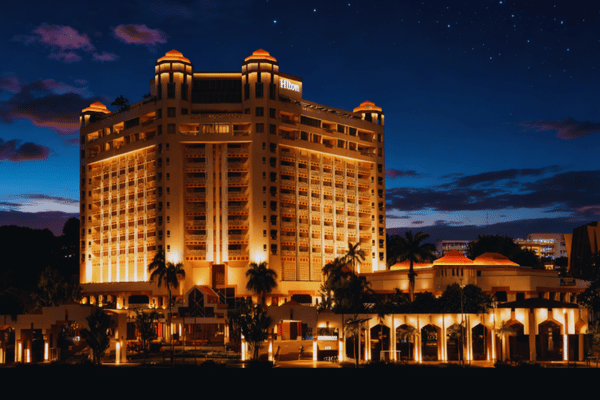
10+
Years Manufacturing
50+
Countries Served
IP65-IP67
Protection Rating
CE & RoHS
Certified
DMX / DALI
Control Protocols
120+ lm/W
Luminous Efficacy
Why Facade Lighting Matters — Challenges Every Project Faces
Building owners and lighting designers encounter the same dilemmas on virtually every façade lighting project: unnecessary energy use from antiquated metal halide or HPS outdoor lighting fixtures, uncontrolled glare that intrudes upon neighboring properties, starkly flat artificial light that removes – rather than accentuates – the building’s architectural nuance, and maintenance costs that escalate when lamps need replacing every 2-3 years at height—leading to skyrocketing planning and operating budgets. These issues impact the bottom line as surely as they do the night-time spectacle.
Guangqi considers a façade lighting design to be above all a system challenge, not a fixture procurement task. We develop a solution based on your building’s geometry, intended surface finishes, and sightlines, then engineer a scheme that optimizes aesthetic premium with quantitative energy savings, while including a DIALux virtual light plan, complete with illuminance maps, fixture schedules, wiring plans, and controls diagrams, so your installation progresses from verified data, not estimations.
That engineering-enabled approach enables our façade lighting solutions to reduce electrical use by 60-75% over legacy technologies, while creating more targeted illumination and substantially longer maintenance intervals, as reflected in our case studies and statistics.
Engineering Note — Facade Illumination Standards
Our recommended façade lighting types should fulfill ISO/IES recommendations for maintained illuminance, as established in the IES RP-33 document for Lighting for Exterior Environments, plus any necessary local code considerations. For most urban commercial surfaces (Lighting Zone 3), LED-based fixtures can deliver the 50-200 lux that represent common face-level vertical illuminance, while minimizing energy use and LPD emissions as required in ASHRAE 90.1.
Guangqi LED Facade Lighting Systems — Product Lines and Selection
We produce 6 standard fixture types—each optimized for particular façade lighting challenges and aesthetics—the bulk of which use aluminum carcass with several manufacturer’s-grade, application-engineered finishes, integrated thermal diffusers, and field-replaceable single-enclosure drivers. Our specifications include, but are not limited to, those below; custom color temperatures, beam spread, brackets, or finishes are available within 2 weeks lead-time for an additional charge.
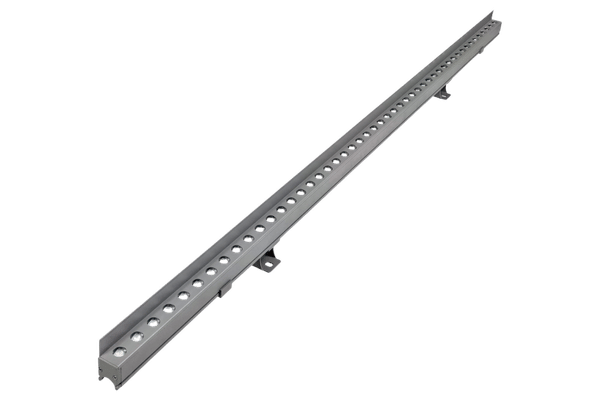
LED Wall Washers
- Power: 18W / 24W / 36W / 48W
- Efficacy: 120-140 lm/W
- Beam: 15° / 25° / 45° / 60° / Asymmetric
- CCT: 2700K-6500K / RGBW
- IP: IP65 / IP66
Best for: Uniform facade illumination, large flat surfaces
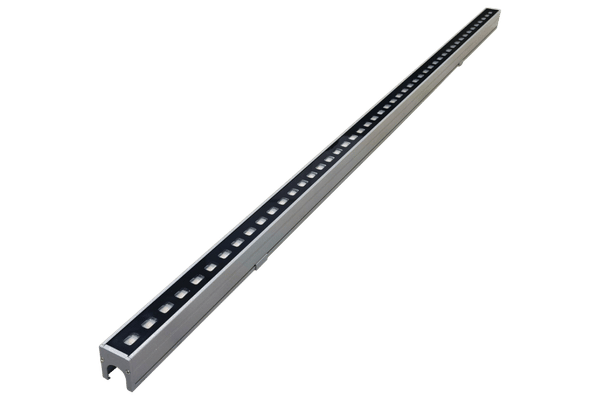
Linear LED Facade Lights
- Power: 12W/m / 18W/m / 24W/m
- Efficacy: 110-130 lm/W
- Beam: Asymmetric wall graze / 120° flood
- CCT: 3000K / 4000K / Tunable White
- IP: IP65 / IP67 (silicone filled)
Best for: Contour lighting, cornice lines, long runs
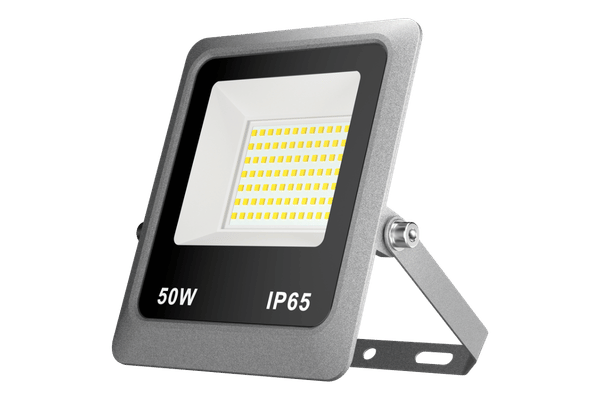
LED Floodlights
- Power: 50W / 100W / 150W / 200W
- Efficacy: 130-150 lm/W
- Beam: 30° / 60° / 90° / Asymmetric
- CCT: 3000K / 4000K / 5000K
- IP: IP66
Best for: Tall facades, wide-area flood illumination
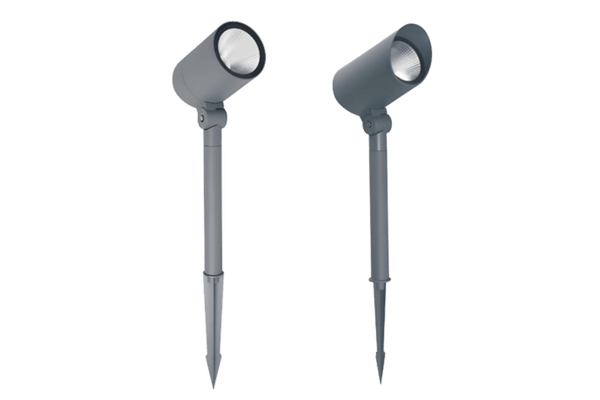
LED Spotlights
- Power: 6W / 12W / 18W / 36W
- Efficacy: 115-135 lm/W
- Beam: 8° / 15° / 25° (narrow spot to medium)
- CCT: 2700K / 3000K / 4000K
- IP: IP65 / IP67 (in-ground)
Best for: Accent lighting, sculptures, entrance features
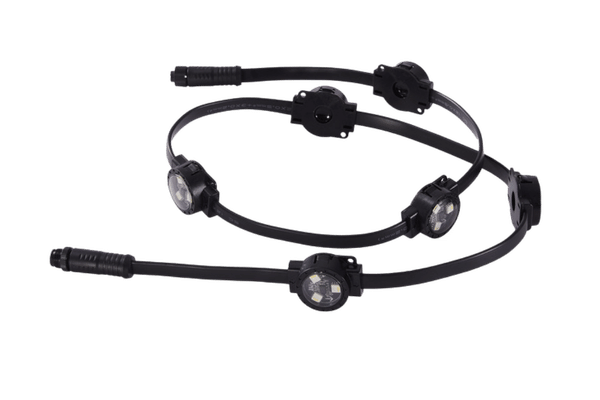
RGB/RGBW Dynamic Fixtures
- Power: 24W / 36W / 48W / 72W
- Colors: 16.7M (RGB) / Full spectrum + White (RGBW)
- Control: DMX512 / Art-Net / sACN
- Refresh: 25+ fps flicker-free
- IP: IP65 / IP66
Best for: Dynamic facade shows, branding, events
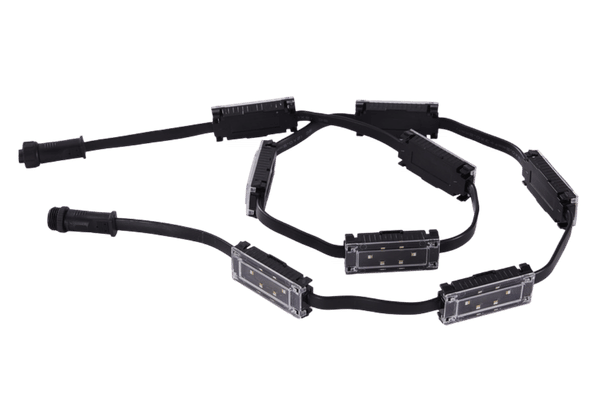
LED Media Facade Pixels
- Power: 1.5W-3W per pixel
- Pixel pitch: 25mm / 40mm / 60mm / 100mm
- Control: DMX512 / SPI / Ethernet
- Viewing angle: 160°
- IP: IP65
Best for: Building-scale video content, interactive installations
Fixture Selection by Application — Decision Matrix
The single biggest impact you will have on your façade lighting project is specifying the correct fixture. Installing a floodlight in the hopes of grazing the façade, or specifying a low-profile inground uplight where narrow, low glare beam would suffice, is no bargain—and that flaw can only be mitigated up to a point with the dial-in process. We offer this diagram to help you determine the most appropriate fixture selection for the desired result at the lowest installed cost.
| Application Scenario | Recommended Fixture | Power Range | Beam Angle | Mounting |
|---|---|---|---|---|
| Flat concrete/glass facade, uniform wash | Wall Washer | 36-48W | 45°-60° | Ground or parapet |
| Textured stone/brick, reveal texture | Linear LED (graze) | 18-24W/m | Asymmetric | 150-300mm from wall |
| Tall facade >20m, distance mounting | Floodlight | 100-200W | 30°-60° | Opposite structure or ground |
| Entrance columns, sculptures, signage | Spotlight | 12-36W | 8°-25° | Ground recessed or bracket |
| Building contour, roofline, cornice | Linear LED (flood) | 12-18W/m | 120° | Hidden channel mount |
| Dynamic branding, holiday displays | RGBW Wall Washer | 36-72W | 25°-45° | Ground or parapet |
| Full-facade video/media content | Media Facade Pixels | 1.5-3W/px | 160° viewing | Direct facade mount |
Procurement Advisory — Sampling Before Volume
We recommend ordering 2 or 4 fixtures for night time mockup testing before placing a larger order. A half-hour on-site mock enables better evaluation of beam width, color, potential glare issues, and other situational variations than any data sheet could. Guangqi offers specimen fixtures at production cost, with a 3-4 day lead time, creditable toward your project.
LED Facade Lighting vs Traditional — Performance and Cost Comparison
Shutting from legacy discharge lamps to LED facade lighting isn’t a choice—it’s an engineering and financial necessity. Metal halide and high-pressure sodium fixtures have ruled virtually every exterior building illumination for decades, but the inefficiency and uncontrollability of these older systems, combined with the unrelenting cost of maintenance, make their continuing use less and less tenable. Our analysis below, utilizing performance data from industry standards, puts hard numbers to the differences between the two in every relevant facet for specifiers, facility managers and purchasing engineers.
| Performance Metric | LED Facade Fixtures | Metal Halide (MH) | High-Pressure Sodium (HPS) |
|---|---|---|---|
| Luminous Efficacy | 120-150 lm/W | 65-100 lm/W | 80-140 lm/W |
| Rated Lamp/Fixture Life | 50,000-80,000 hrs (L80) | 6,000-15,000 hrs | 12,000-24,000 hrs |
| Color Rendering (CRI) | Ra >80 (up to 95) | Ra 65-93 | Ra 22-65 |
| Color Temperature Range | 2700-6500K + RGBW tunable | 3000-4200K (fixed) | 1900-2200K (fixed) |
| Warm-Up Time | Instant on | 3-10 minutes | 5-10 minutes |
| Dimming Capability | 0-100% (DALI/DMX/0-10V) | Limited (50-100%) | Limited (50-100%) |
| IP Rating (typical) | IP65-IP67 | IP65 | IP65 |
| Maintenance Cycle | 12-15 years | 2-3 year re-lamp | 3-4 year re-lamp |
| Mercury Content | Zero | Contains mercury | Contains mercury |
In practical terms, the efficacy level alone means that an LED facade installation that outputs the same illuminance on the target surface consumes 40-60% less energy from the mains. That adds up quickly when you consider a 2,000sqm commercial facade lit for 10 hours a night, 365 nights a year, with the energy costs multiplying all the time. Coupled with the exponential savings resulting from the elimination of regular re-lamping—in the case of a multi-storey façade requiring scaffolding/aerial lift equipment each cycle (roughly every 3 years)—the savings break down to the lowest cost of ownership being for LEDs within roughly 2-3 years.
60-75%
Typical energy reduction when replacing MH/HPS facade lighting with LED — based on equivalent maintained illuminance on target surface
Get Instant Quote
Facade Lighting Fixtures Techniques From Wall Washing to Dynamic RGB
The visual impact of a facade installation is primarily dependent upon technique rather than wattage: how the beams of light are delivered to and metered onto the surface. Each of these techniques creates a wholly unique nighttime perception of the building. We pattern modify two or three of these techniques on more or less every project—enriching the architectural language of the facade by creating visual depth and hierarchy: an even wash across the main facade planes; grazing across textured accent zones; and narrow-beam fixtures highlighting entranceways and signage. All six of these primary techniques are documented here to cover every common commercial or public architectonic application we see.
Wall Washing — Uniform Illumination for Flat Surfaces
Wall washing is the delivery of a neutral, even, uncannily shadowless luminance across one or more facade planes. Fixtures sit generally at a distance equal to roughly one third of the height of the wall, aimed at approximately a 45-degree angle downward or upward to create a smooth wash. This technique lends itself best to flat or doubly rounded surfaces like glass curtain wall systems, polished stone, painted render and metal panelifices. The result should be a luminous completeness that appears to the eye as one and the same united plane, especially with light backgrounds of reflectance value over 0.5.
Wall Grazing — Revealing Texture and Depth
Grazing is the polar opposite of washing—a construction deliberately animated by shadows and textures. Fixtures are mounted the near to the surface of the architecture, casting light at a primary angle of impact between 150 and 300mm, at a steep cast angle of near parallelity to the surface. The grazing light effect adds dimension and visual interest to what appears as a flat, daytime architecture: vivid expressed texture on brick, natural stone, board-formed concrete or ribbed metal cladding. Careful calibration of mounting parameters is required: Too far from the wall and you sacrifice the shadowing effect; too tight to the wall and your beam begins to saturate a too-wide band of surface.
Floodlighting — Wide-Area Coverage for Tall Facades
When mounting surfaces near the facade are not available, or when the building height exceeds 20m, remote floodlighting is the most practical option. 30-60 beam angle flood lights mounted on the ground or on a mast, flood entire facades or large sections of a facade from a plaza, street or landscape zone. There is a compromise: lacking the precision beam control of close-mount techniques, carefully aimed, individually shielded or lensed flood lights can contain unwanted light spill, upward waste light and light trespass toward neighboring properties. We usually require asymmetric reflectors for floodlight applications.
Accent and Spot Lighting — Highlighting Key Features
Narrow-beam-focus luminaires with an 8-25 beam angle isolate each feature for dramatic, visually distinctive focal points: entry canopies, relief sculpture, columns, corporate logos, ornamental features. Each tight beam creates a bright point that visually anchors the eye in relation to the building’s unique details. In ground-mounted uplights, the fixture installation itself should be flush with the landscape plane for absolutely clean detail; adjustable bracket-mounted up-lights give lighting designers greater flexibility at height. Best practice: limit accented features to 3-5 per facade elevation.
Contour and Linear Lighting — Defining Building Edges
LED linear fixtures and LED strip lights give the building a luminous outline – roof lines, cornice lines, window reveals, structural frames and floor lines. This works best on cutting edge architecture with precise geometric forms for the lucent outlines to become the building’s primary nighttime expression. Running linear runs of 10 to 50 meters is common and necessitate fixtures with gap-free mechanical and optical connections. Our linear facade fixtures feature pixel-matched LED modules that create powerful, uniform illumination which is reliable and consistent across all joints.
Dynamic RGB and Media Facade — Programmable Expression
RGBW fixtures and LED media facade pixel arrays can turn facades into digital canvases. Color changing wall wash fixtures can create transitions from winter to summer on the same building, from day to night or from holiday to holiday. A higher density media facade display system will let the building show video, kinetic effects and some interactivity directly on the building wall. Control is usually via DMX512 (up to 512 channels per universe), Art-Net or sACN protocols, with content management via a dedicated media server or cloud-hosted controller.
Technical Note
Mounting Distance Formula
For wall wash, the ideal fixture-to-wall distance a. h/3, with a tilt angle of about 55 from vertical, where h is facade height. For wall grazing, offset a minimum 150-300mm. Luminaire spacing d should be no greater than 1.2 a in order to maintain an acceptable uniformity ration Emin/Emax of greater than 0.6. These relationships apply to most commercial-grade asymmetric wall washers with a 25-60 beam angle.
Project Results: Commercial Facade Lighting Across Industries
Finally, value is what you get when you put a facade lighting fixture to work on real buildings with real limitations. These series of project examples show how the right type of luminaire employed in the ideal way can create dramatic improvement, with real paybacks, in both the visual and the energy categories.
Commercial Mixed-Use Tower — Southeast Asia
Building:
28-story mixed-use tower in glass curtain-wall with aluminum mullion grid
Challenge:
Remove aging 400W metal halide floodlights that are generating numerous complaints of glare from neighboring residential towers and burning excessive amounts of energy (more than 48,000 kWh per year)
Solution:
120 Guangqi 48W LED wall washes (4000K asymmetric beam) on roof parapet 40 36W RGBW units on podium facade, via DMX512 with astronomical clock scheduling
68%
Energy reduction (48,000 → 15,400 kWh/year)
Glare-complaints resolved with the use of asymmetric optics. RGBW system on the podium is capable of burning holiday programming 6 weeks per year and brand-color the balance of the year. Fixtures payback on energy savings alone is estimated at 2.8 years – without even counting the expense of re-lamping at height.
Glare-complaints resolved with the use of asymmetric optics. RGBW system on the podium is capable of burning holiday programming 6 weeks per year and brand-color the balance of the year. Fixtures payback on energy savings alone is estimated at 2.8 years – without even counting the expense of re-lamping at height.
Heritage Museum — Middle East
Building:
2-story limestone museum with carved facade details, arched windows, and ornamental cornices
Challenge:
Illuminate the building without causing thermal damage to heritage stone surfaces. Existing halogen spots exaggerated the thermal stress on the porous limestone. City legislation specified warm color temperature, approved CRI greater than 90 and zero upward spill.
Solution:
80 Guangqi 18W spots (2700K, CRI 95, 15 beam) on adjustable brackets for carved details 60m Guangqi linear LED (3000K asymmetrical graze) installed flush in level-grade channel for wall graze on the main facade
Zero
Thermal stress incidents post-installation
LED sources create insignificant infrared streams compared with the halogen predecessors. Zero upward light wastage – the LED lighting is dark sky friendly. The graze technique revealed stones’ textures that never could be seen before in the uniform flood light, earning favor from the local architecture review authority.
LED sources create insignificant infrared streams compared with the halogen predecessors. Zero upward light wastage – the LED lighting is dark sky friendly. The graze technique revealed stones’ textures that never could be seen before in the uniform flood light, earning favor from the local architecture review authority.
Corporate Headquarters — Europe
Building:
12-story glass tower with decorative spandrel bands of metal panels at each level
Challenge:
Design a noteworthy tourist-attracting identity that promoted corporate branding and fulfilled the newly enacted EU Energy Efficiency Directive, Dark Sky and other local regulations for this suburban location
Solution:
240m of Guangqi 24W/m RGBW linear LED integrated into continuous horizontal channel at each of the spandrel bands, and 30 12W narrow-bream uplights installed in the soffit of the roof for minimum-impact cascade wash from the top. Art-Net/DMX512 control, connected to media server via internet.
4.2 W/m²
Installed LPD — below EU directive limit
Horizontal channel lines are luminaires in the form of distinctive, 2-kilometer-high “stacked-heat” luminaire design. Outfitted with astronomical clock, lights sequences in 50% dimming until 11PM and turns off at 1AM. Total consumption of the system is 6.2kW at full roughly equivalent to 3 240W hair dryers turning on simultaneously to illuminate a 12-layer high commercial facade.
Horizontal channel lines are luminaires in the form of distinctive, 2-kilometer-high “stacked-heat” luminaire design. Outfitted with astronomical clock, lights sequences in 50% dimming until 11PM and turns off at 1AM. Total consumption of the system is 6.2kW at full roughly equivalent to 3 240W hair dryers turning on simultaneously to illuminate a 12-layer high commercial facade.
Project Advisory — Realistic Timeline Expectations
A typical commercial facade lighting project from first inquiry to commission takes 8-16 weeks: 1-2 weeks consultation and fixture specification, 1 week sample delivery and mockup, 2-4 weeks (standard catalog fixtures) or 4-6 weeks (custom fixtures) production, 2-4 weeks due to geographic location in transit, 1-3 weeks commissioning and installation. Projects producing custom optics, finishes or working with existing BMS can add 2-3 weeks to the production period.
Facade Lighting Design: Certifications, Standards, and Smart Control Integration
A handful of sample specifications for Guangqi facade fixtures in the context of an international project: 3rd-party safety, electromagnetic compatibility and photobiological declaration needed. Every Guangqi facade fixture shipped with current certifications for download or submission to your project’s governing body.
CE
EN 60598-1
EN 62471
RoHS
EU 2011/65/EU
Lead-free solder
IP65 / IP66 / IP67
IEC 60529
Dust-tight + water jet
IEC 62471
Photobiological Safety
Risk Group RG0/RG1
EMC
EN 55015
EN 61547
IK08
Impact Resistance
5 joule energy
Lighting Standards Reference
We compare facade lighting designs to illuminance and luminance targets published in IES RP-33 (Lighting for Exterior Environments), ASHRAE 90.1 (Energy Standard for Buildings), and where relevant, GB/T 50034-2024 (China Building Lighting Design Standard). For Dark Sky compliance, fixtures follow IDA/IES recommendations with BUG ratings fitting the project’s Lighting Zone classification. LPD calculations are part of all products, validating code compliance before installation or ordering.
Smart Control Protocols
Guangqi facade fixtures support the three standard industry control protocols, allowing you specify when ordering:
Protocol
Channels
Best For
Integration
DMX512 / RDM
512 per universe
Dynamic RGB/RGBW, pixel control, media facades
Lighting consoles, media servers, Art-Net gateways
DALI (IEC 62386)
64 per bus
Tunable white, scheduled dimming, static scenes
BMS/BACnet integration, KNX gateways
0-10V Analog
1 per circuit
Simple dimming, zone control
Timer switches, photocells, occupancy sensors
For projects needing IoT connections – remote monitoring, cloud planning, or smart building control – we provide Wi-Fi and Bluetooth gateways linking the DMX512/DALI field bus to your building management system. Our gateway supports OTA firmware upgrades, energy consumption metering, and fault alerts by email and API webhooks.
Outdoor Facade Lighting: Pricing, Lead Times, and How to Order
Our checkout systems are designed for how the reality of B2B lighting projects unfold; our flexible terms settle specifications, quantities, and delivery deadlines. Whether you are a single-building architect or contractor, or a multi-phase developer, the process below guarantees you’ll get the right fixtures, on-time, backed with technical support.
Standard B2B Fulfillment Process
01
Inquiry & Requirements
02
Design Consultation
03
Quotation & Spec Sheet
04
Sample & Mockup
05
Production
06
Shipping & Logistics
07
Installation Support
Commercial Pricing Factors
Single base price factors include lumen output and optical configuration, control mode (static / DALI / DMX512), ingress protection level and enclosure material, and your order quantity. By way of example, commercial-grade static white LED wall washers cost approximately $25-60 per fixture, when purchased in mass from the catalog. RGBW DMX models cost approximately 2-3 times that of their static-white peers. Custom optics, finishes (bronze anodizing, marine material), and non-standard lengths will be priced for delivery within 48 hours of order details.
Estimated Project Lead Times
| Order Type | Production | Shipping (Sea) | Total |
|---|---|---|---|
| Standard catalog, <500 pcs | 15-20 days | 15-30 days | 30-50 days |
| Standard catalog, >500 pcs | 20-30 days | 15-30 days | 35-60 days |
| Custom specification | 25-40 days | 15-30 days | 40-70 days |
| Sample / mockup units | 5-7 days | 3-5 days (air) | 8-12 days |
Facade Lighting Design & Engineering Tools
Streamline your commercial facade lighting projects. Utilize our suite of engineering calculators to specify optimal fixtures, forecast project budgets, and accurately calculate energy savings.
Fixture Selector
Identify the ideal luminaires for specific architectural textures and mounting requirements.
Energy Savings Calculator
Quantify ROI and long-term energy efficiency compared to traditional lighting systems.
Project Budget Estimator
Generate preliminary cost assessments for enterprise-scale facade installations.
Spacing Calculator
Determine exact fixture placement to achieve uniform surface illumination and desired lux levels.
Facade Lighting Design — Frequently Asked Questions
Six strategies address 99% of typical facade scenarios: uniform wall washing, surface grazing, floodlighting, building feature accenting, edge contour outlining, and media or color-changing “dynamic” lighting. Most projects combine two or three techniques in specific zones to create the desired visual language.
Selection depends on four parameters: facade finish (flat polish complements wall washing, rough or clinker bricks require grazing), projection distance (ground-mount-lighting needs narrow beam angles for tall walls, low-mount linear systems suffice for low-rise buildings), control system (automated static white for historical architecture; programmable DMX512 RGBW for commercial architecture), and environment (minimum waterproofing IP65 for open-air, protected environments, IP67 for ground tables or windy locations). When uncertainty remains, a test-fit mockup on the actual structure helps solidify the design choice on site.
Wall washing has fixtures placed at a distance equal to approximately 1/3 of the face height resulting in uniform, shadow-free light that makes textures, cracks and joints “disappear”, making the surface appears two-dimensional and flat. Wall grazing has fixtures suspended from the surface at 150 300mm or less at an oblique position resulting in typical, conspicuous three dimensional shadows at all facets and textures on the surface. Select washing for glass, smooth render, and corrugated metal panel situations. Select grazing for brick, stone, board-formed concrete, or any other situations where the three-dimensional surface character is part of the design and aesthetic.
Using a regular commercial grade LED fixtures in an unadjusted static white cycle with wall washing application is about $15-40 per m2 installed (only for fixtures) Dynamic RGBW systems with DMX512 controls can range in cost from about $40-120 per m2, depending on pixel density and complexity of programming. Total project including design, wiring, power supplies, controllers and install labor costs varies from about 40 60% above this number. For a 1000 m2 commercial podium with mixed static and dynamic zones, the total installed project cost generally falls in the 30,000 120,000 range +- depending greatly on the level of fixture tier used and complexity of the install.
For wall-mounted fixtures: IP65 minimum. Ground-recessed uplights: IP67 or IP68. Coasts: IP66 with a marine-grade corrosion treatment. Our entire application focused range has an IP65 minimum as a baseline, with IP67 silicone-filled options for in-ground, full siting and harsh-environment applications.
Yes. DMX512 for dynamic RGB and RGBW fixtures and DALI for static or tunable white backlit surfaces and BMS integration work together well in a single project. We can wire both control network into our fixtures, along with 0-10V for additional control functionality.
Optics is on the fore-front of the engine- we use asymmetric reflectors with as low as possible BUG rating to reflect output onto the face itself instead of into the sky. We specify pixelated fixtures with high color-rendering and match them to astronomical clock controllers which dim 50-70% after midnight. We fence off all upward-facing fixtures so beam-trace stops at the roofline. But beyond hardware selection, discipline in design matters: don’t over-light the facade, always adhere to IDA and IES dark-sky standards and verifiy local ordinance compliance… some cities have recently mandated relative upward light ratios with cut-off aftercurfew, and if not followed, fixtures must be relocated. We always include light trespass calculations and BUG ratings on every project to avoid any surprises.
Warm white (2700-3000K) is recommended to render the warm hues of natural stone, brick and wood. Neutral white (4000K) is recommended for modern, glass and steel architectures. Cool white (5000-6000K) are recommended strictly for industrial and high-security, utilitarian presentation settings. For unification and maximum flexibility: specify tunable-white (2700-6500K adjustable range) fixtures.
Expect 50,000-80,000 hours at L80 from those quality LED facade fixtures – that 12-15 years of nightly operation before they should be replaced. Metal halide: 6,000-15,000 hours, meaning re-lamp every 2-3 years. HPS hits 12,000-24,000 hours. On a multi-story building, each re-lamping cycle every 2-3 years includes rental of scaffolding or aerial lift, labor for maintenance, and at-height downtime. LED removes 4-6 of those costly at height service events over the useful life. It’s those cost advantages that really compound over and above just the energy savings. Existing installations from many of our earliest production years are still operating at original fixture and ballast levels with a validated lumen depreciation well within L80 specifications.
Ongoing innovations are IoT-enabled facades with cloud-enabled content management interfaces, human-oriented day/night tunable-white lighting that update color temperature during the nighttime hours, high density LED media floors for creative content display and responsive urban artworks, dark-sky compliant designs with indefinite curfew dimming, integration with building energy management systems for automated utility-power demand response, sensor-based interactive luminaires responding to pedestrian traffic for example and to environmental conditions. The technology trend drivers are: convergence- facade lighting is adopting the same IP platforms that are now used for HVAC controls, security and access management.