Get in Touch with GUANGQI



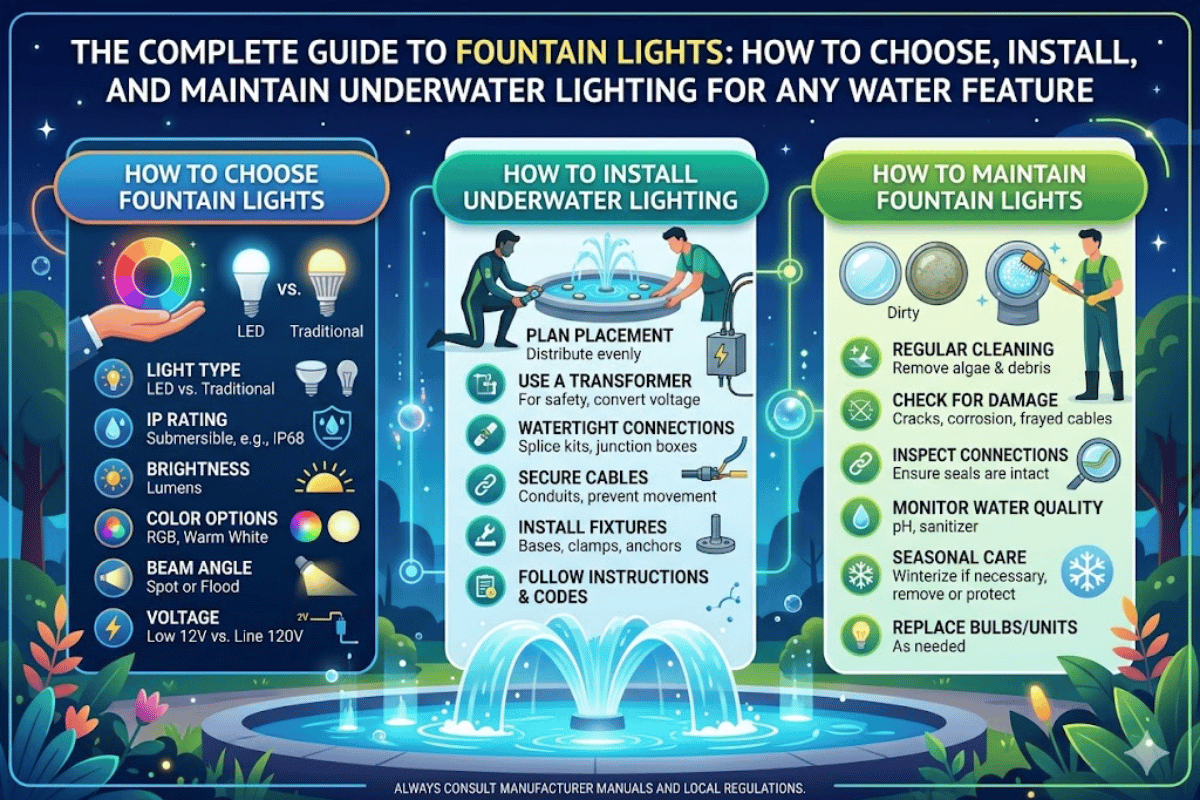
Quick Specs: Fountain Lights at a Glance
| Typical Wattage Range | 3 W – 36 W per fixture (LED) |
| LED Efficiency | 80 – 100 lumens per watt |
| Rated Lifespan | Up to 50,000 hours (LED) vs 2,000 – 4,000 hours (halogen) |
| Submersible Rating | IP68 (continuous submersion beyond 1 m per IEC 60529) |
| Operating Voltage | 12 V AC / 12 V DC / 24 V DC (low voltage) |
| Common Materials | 304 stainless steel, marine-grade aluminum, brass |
| Color Options | Warm white (3000 K), cool white (6000 K), RGB, RGBW |
A single fountain light has the ability to turn a stagnant basin or spray into a centerpiece that commands attention hours after sunset. But selecting the appropriate fixture is not simply a matter of choosing the color, it entails matching the voltage, waterproof qualifications, and beam dispersion to the unique needs of your water feature in pond, pool, or architectural fountain applications.
This document explains the science of fountain lighting, compares LED and halogen specifications with observed results, and details a step-wise installation plan according to NEC Article 680 standards. Whether designing a commercial display or re-lamping a backyard billowing pond fountain, every advised selection here is supported by an applicable electrical code, manufacturer data, or installer experience.
What Is a Fountain Light and How Does It Work?
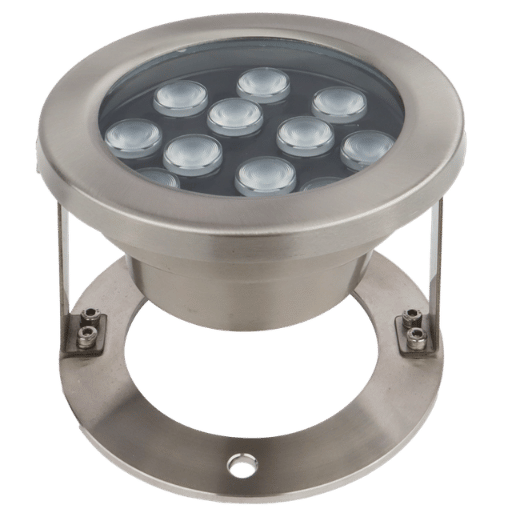
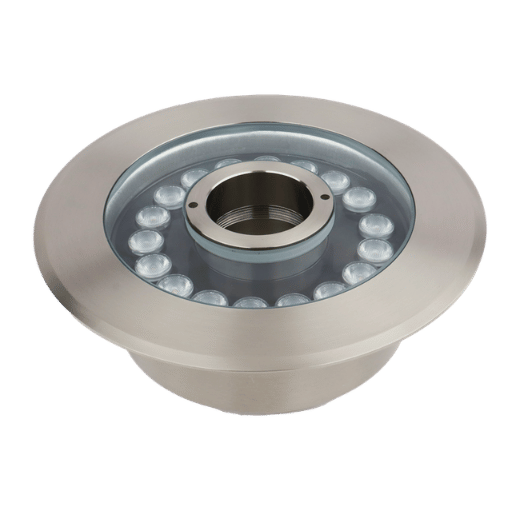
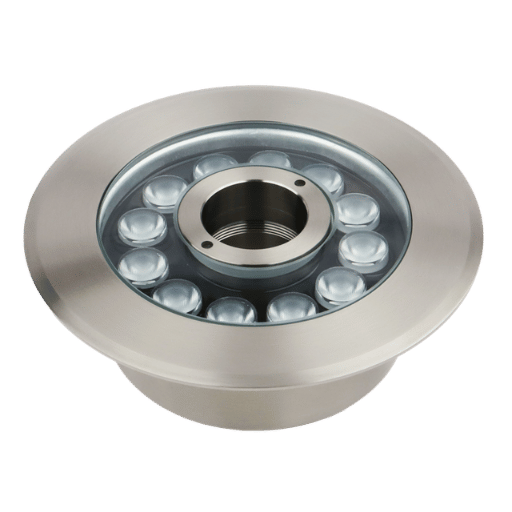
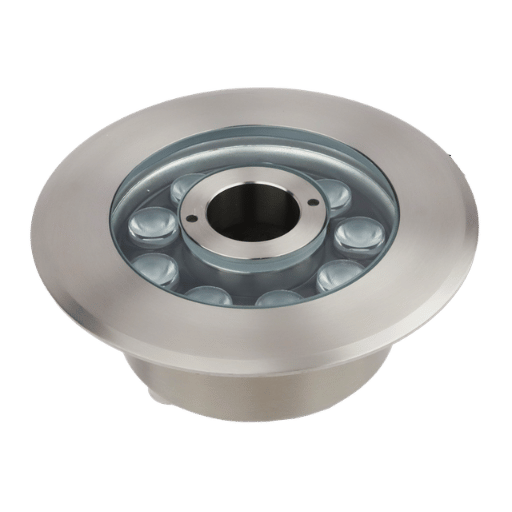
A fountain light is an enclosed fixture intended to be immersed at least partially underwater, illuminating a plume or basin from beneath the water level. This device contains an LED (or in older systems a halogen bulb), a driver circuit, and waterproof seals rated for continuous contact with water.
All modern LED fountain lights function by transforming low voltage (12 V usually) direct or alternating current into visible light via diodes mounted to an aluminum heat sink, the fixture is positioned under the water, which in this application serves as a highly efficient heat disipation system capable of reducing junction temperature to a greater degree than equivalent dry mounted luminaires-this thermal benefit can account for an LED’s extended lifespan of 50K hours observed in field studies.
📐 Engineering Note
Fountain luminaries’ waterproof quality is governed by IEC 60529 Ingress Protection levels. The first number (6) signifies total protection against particulate intrusion. The second number (8) signified total protection against moisture intrusion in continuous water immersion. Manufacturers are responsible for state the duration, tested submersion depth and pressure; no universal “IP68” exists. Confirm fixture is suited to the required application.
The overall lumen output of a fountain light is defined as the amount of light recorded, and beam spread is to the optics of the internal lens. Narrower coverage (15) will result in more concentrated illumination effects, wider coverage (45 to 60) results in broad-field wash effects. The typical LED appearance in the 3 to 12 watt range, ranges from 240 to 1,200 lumens – adequate for small residential ponds or fountains. Larger commercial grade applications require 24 to 36 watt fixtures delivering between 2,000 and 3,500 lumens.
Types of Fountain Lights: LED vs Halogen, Submersible vs Surface Mount
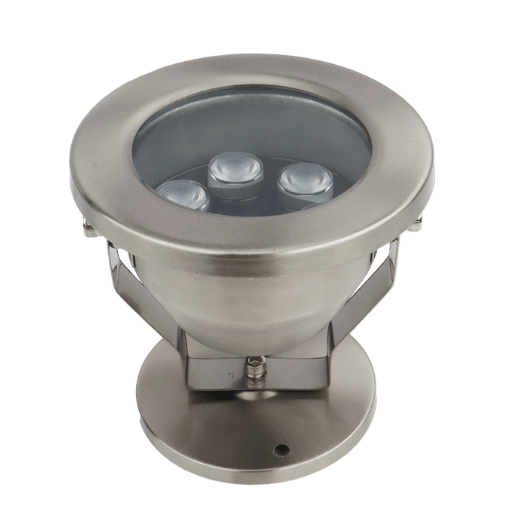
Fountain lights can be grouped along two axes of variable design. Both the light source (LED or halogen) and the attachment methodology (floating, submerged or surface-mounted) are both involved in choosing the right fixture.
LED Fountain Lights vs Halogen: A Data-Driven Comparison
| Specification | LED Fountain Light | Halogen Fountain Light |
|---|---|---|
| Luminous Efficacy | 80 – 100 lm/W | 16 – 24 lm/W |
| Typical Wattage (per fixture) | 3 W – 36 W | 20 W – 75 W |
| Rated Lifespan | Up to 50,000 hours | 2,000 – 4,000 hours |
| Heat Emission | ~10% of input energy | ~80% of input energy |
| Color Options | Warm white (3000 K), cool white (6000 K), RGB, RGBW | Warm white only (colored filters optional) |
| Bulb Replacement | Integrated module — replace entire fixture | MR16 bulb — field-replaceable |
| Initial Cost (per fixture) | 3 – 5× higher than halogen equivalent | Lower upfront cost |
| 10-Year Energy Cost (6 hrs/day, $0.16/kWh) | $10 – $38 per fixture (6 W avg) | $70 – $263 per fixture (50 W avg) |
Over a decade, cost estimates use a basic formula (Watts days h 365 days 10 years 1,000 $0.16/kWh). A 6 W LED fixture consumes about $21 worth of electricity in a decade if run for 6 hours each night. A 50 W halogen fixture under the same conditions costs roughly $175 to operate; however, this cost does not include bulb replacements (generally between 5 – 12 in that same time frame).
Mounting Types
Submersible (in-ground or basin-mount): Installed at the bottom of the fountain basin, would probably be bolted to a bracket or set into concrete. Require an IP68 rating. Ideal for architectural fountains or water features within pools. Housing would probably need to be stainless-steel or brass to resist corrosion in chlorinated or mineral-rich waters.
Surface mount (above-water): Mounted to the wall of the fountain or to a deck. Would probably aim the light downward or across the water surface. IP65 or IP67 would be sufficient, since the fixture itself would not be submerged. Easier to access for maintenance. Would give different visual effects, with surface reflection rather than internal glow.
Floating fountain lights: Integrated within the floating fountain platform, often as a ring of 3 – 6 fixtures surrounding the nozzle. Light kits would mount directly to the float, illuminating the spray column from the bottom. Each fixture needs to move with the fountain and thus be connected via a flexible, waterproof cable.
💡 Pro Tip
Color-changing RGB, RGBW water fountain lights enable programed light displays, but warmer white (3000 K) remains the most popular choice for residential landscape lighting because it produces a natural glow that is not too yellow, orange, or blue and works well with outdoor greenery.
How to Choose the Right Fountain Light for Your Project
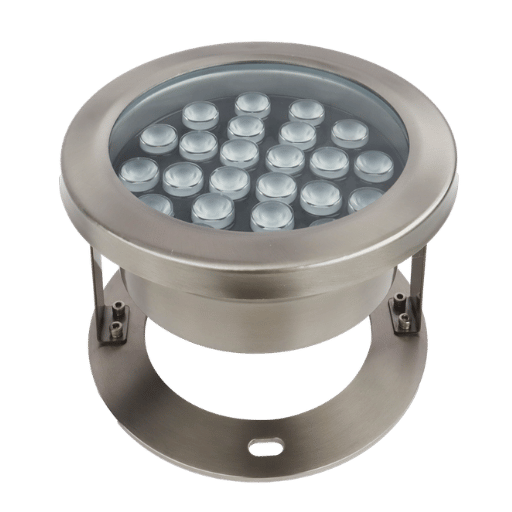
Choosing an underwater fountain light involves five important considerations that go far beyond choosing a wattage and color. Any single misstep among these five elements of selection could result in failures, code violations or disappointing visual effect.
5-Point Fountain Light Selection Checklist
- IP Rating – Fully submerged IP68. Splash or deck mounted IP67. Above-water accent IP65.
- Voltage and Transformer – The maximum secondary voltage permitted by the NEC 680 Article for swimming pool and water fountain applications is 15V. A standard compliant configuration is 12V AC with a UL 379 illuminating transformer.
- Beam Angle – 15for highlighting individual water jets. 30for medium-sized water bodies. 45 – 60 for large waterscapes or broad illumination over custom water walls.
- Material and Corrosion Resistance – 304 stainless steel in chlorinated waters. Marine-grade aluminum in freshwater ponds. Brass in applications tolerant of salt.
- Lumens – 300 – 600 lumens for residential ponds. 1,000 – 2,500+ lumens in commercial or architectural fountains.
⚠️ Important: Common Selection Mistake
According to industry sources, the material suppliers who deal with us seem to prefer IP67 fixtures because prices seem comparable, but in our experience the price difference is significant, and IP67 protect against temporary water submersion, like rain or a boat ride, but do not withstand permanent submersion, like resting at the bottom of a water basin with time. Be sure to check that the fixture is rated at least IP68, regardless of application.
Plan your lights and a total transformer load. Calculate the total wattage of all fixtures on the circuit and select a transformer size that provides at least 20% more power than your total wattage, to provide some margin for safety, most fixture manufacturers recommend this or 125% more in size. As always, keep wired lights a minimum of 5 feet (1.52 m) away from the edge of water; the transformer should be located a minimum of 5 feet (1.52 m) away from the water source
Fountain Light for Pool, Pond, and Outdoor Water Features
Not all water features have the same lighting needs. Pool fountain lights have to comply with more stringent electrical regulation than pond fountain lights, which are different from architectural outdoor fountain lights that also have considerable structural and aesthetic differences. Compare the key distinctions defined by the table below
| Factor | Swimming Pool | Pond / Lake Fountain | Architectural Fountain |
|---|---|---|---|
| Governing Code | NEC 680 Part II + Part V | NEC 680 Part V (if permanent) | NEC 680 Part V + local building code |
| GFCI Protection | Required on all circuits | Required for permanent installations | Required on all circuits |
| Typical Voltage | 12 V AC (UL 379 transformer) | 12 V DC or 24 V DC | 12 V – 24 V DC (commercial drivers) |
| Minimum IP Rating | IP68 | IP68 (submersible) / IP65 (above water) | IP68 |
| Installation Depth | 4 – 18 inches below water level (per NEC 680.22(B)(6)) | At basin floor (depth varies) | Project-specific |
| Suggested Lumens | 400 – 1,500 per fixture | 300 – 800 per fixture | 1,000 – 3,000+ per fixture |
| Bonding Requirement | 8 AWG solid copper (no aluminum) | Depends on installation type | 8 AWG solid copper (NEC 680) |
Pool fountain lights require the strictest regulation. According to NEC Article 680, voltage to the ground in any circuit of 150 V shall not exceed 150 volts. Any metal used for forming shells, mounting brackets, and other hardware shall be maintained at ground potential and bonded with solid copper conductors of a minimum size 8 AWG aluminum wiring is disallowed because of corrosion in the swimming pool environment. GFCI protection is required.
Pond fountain lights and aerators that form a floating fountain operate in a less demanding environment. Most pond fountain light kits use 12 V or 24 V DC with fixtures rated to IP68. The pond is not categorized as a swimming pool under the NEC, so some of the more demanding bonding and depth requirements don’t apply – although GFCI protection is still the best rule of thumb. Pond lights are also plagued by environmental factors: algae, trihalomethanes, abrasive minerals, and aquatic life, which all may have differing light sensitivities to various intensities of heat and light
Most architectural outdoor fountains have a dedicated landscape architect or lighting designer to specify the fixtures. These large projects often use adjustable beam angles and DMX-controlled RGBW light systems that incorporate synchronized programmed color and pattern sequences with spray nozzle patterns and arc waterspout nozzle changeouts
All the applications outlined can be distinguished by the kind of technical expertise required, so understanding which code details apply to your installation will point you in the right direction on choosing the right fountain lighting.
How to Install Fountain Lights: Step-by-Step
Though designing a submersible fountain light may seem daunting, an experienced DIYer can successfully undertake the task by adhering to the NEC and the proper materials. Below is a 6-step process applicable to many residential pond fountain and smaller pool fountain projects:
- Determine the circuit and pick your transformer. Total the wattage required by your fixtures. Select a low-voltage transformer(12 V AC, UL 379-licensed for pools and spas) rated 20% higher than your total wattage. Locate the transformer at least 5 feet (1.52 m) from the water from the edge of the pond or pool
- Feed the cable from the transformer to the desired fixture location. Use direct-burial 14 AWG outdoor rated low voltage cable. If the distance is greater than 50 feet, use 12 AWG or heavier cable to mitigate voltage reduction.
- Prepare the mounting point. If using bath-mount fixtures, mount the stainless steel mount pad at the desired location. Verify the fixture is at the correct mounting depth (NEC 680.22(B)(6) states that a luminaire in a pool application must be mounted at least 4″ below the normal water level. Headroom should be taken into consideration).
- Make waterproof wiring splices. Use waterproof connections rated for submersion (inside the waterproof housings). Fill the housing with silicone grease or dielectric compound. Do not use standard wire nuts underwater.
- Secure cable runs. Run conduit in areas subject to damage. For free-standing or submerged conduit, NEC wiring rules call for at least 6″ of burial for rigid metal conduit RMC and at least 18″ of burial for PVC Schedule 80 conduit. Run all cables to the fountain structure using UV resistant clips which can be attached to the structure.
- Test before filling basin. Power up the transformer and turn on each fixture to verify proper operation before filling. Using a multimeter, check voltage levels at each fixture – if the readings at any fixture are less than 10 V on a 12 V system, this indicates a large voltage drop.
⚠️ Important: Voltage Drop on Long Cable Runs
According to experienced pond-builders, when a 12 V system is powered through 125ft of under-size cable, the LED fixtures only receive 6 V. That’s not enough power to illuminate most LED fixtures, which require a minimum of 9 – 10 V. Here’s the fix. Use either 12 AWG (3.31 mm2) or 10 AWG (5.27 mm2) cable for long cable runs. Double-check the voltage level at the fixture before sealing the splices (if the fixture exhibits a voltage level of less than 10 V, this will lead to non-ideal operation).
📐 Engineering Note
Voltage drop in low-voltage lighting systems is caused by the cable wire resistivity and length of cable run. Because LED fixtures require less wattage than halogen fixtures, the allowable voltage loss on an LED lighting circuit is even less (on a 12 V system, the voltage loss should be no more than 5% of 12 V, or 0.6 V). The formula: Voltage Drop = (2 L Current Wire Resistance per foot) takes into account the current being delivered (I), the length of wire (L), and the wire resistivity. For example, a 100 FT (30.48 meter) runs of 14 AWG (2.10 mm2) cable on 4 amps will have a voltage drop of around 1.0 volt. This exceeds the allowable limit of 0.6 volt – so this is a bad plan. Use 12 AWG cable and the drop will only be around 0.6 volt, which is acceptable. For the next size up cable, this reduces to 0.37 volts. Any cable run that exceeds 75 ft (22.86 meter) should not go below 12 AWG.
Maintenance, Troubleshooting, and Lifespan Expectations
LED fountain lights don’t require frequent maintenance, but they are not completely maintenance-free. Water chemistry, biological growth, and electrical connections all require periodic attention to keep the fixtures functioning at their rated maximum brightness (L70 at 50,000 hours).
Seasonal Maintenance Schedule
| Season | Task | Frequency |
|---|---|---|
| Spring | Inspect all cable connections, clean lens surfaces, check GFCI function | Once (during spring clean-out) |
| Summer | Remove algae and mineral deposits from lens and housing | Every 2 weeks |
| Fall | Clear debris from around fixtures, verify seal integrity before winter | Once |
| Winter (freeze zones) | Remove pump and nozzle, store indoors in clean water to keep seals moist | Once (before first freeze) |
Troubleshooting Common Problems
| Symptom | Likely Cause | Fix |
|---|---|---|
| Light does not turn on | GFCI tripped, loose cable connection, or transformer overloaded | Reset GFCI, inspect connections, check transformer load vs rating |
| Dim or flickering output | Voltage drop from long cable run or corroded connections | Measure voltage at fixture (must be ≥10 V); upgrade cable gauge or shorten run |
| Reduced brightness over time | Mineral or algae buildup on lens | Clean lens with soft cloth and mild vinegar solution |
| Water inside fixture | Seal failure (exceeded IP rating depth or physical damage) | Replace fixture; do not attempt to re-seal submersible units |
| GFCI trips repeatedly | Ground fault from compromised cable insulation or flooded junction | Isolate each fixture individually to identify the faulty unit; replace damaged cable |
LED fountain lights are energy efficient over their entire service life, with a typical 2 – 5 year manufacturer warranty. Fixtures rated for 50,000 hours will retain approximately 70% of their initial lumen output (L70) at 50,000 hours. Assuming 6 hours of use per night, this means the fixture should provide adequate illumination for nearly 23 years. However, this doesn’t take the accessories into consideration—the waterproofing seals and cable connections—and they are usually the first components to fail.
Frequently Asked Questions
Q: How do fountain lights work underwater?
View Answer
Fountain lights are installed in a watertight fixture—usually, a sealed housing that adheres to the standard IP68 (per IEC 60529 specifications). Within the waterproof fixture, a LED module transforms the low-voltage electricity (often 12 V) into beam of light. Because the watertight seal and low-voltage transformer coupling keeps the not only the fixture but the user safe, the enclosure can be mounted under water. Surprisingly, because the surrounding water in most applications is taking the place of an air-cooled fins or heat sinks, in some cases you get a LED that would last even longer than dry mounting.
Q: Are fountain lights safe for fish and wildlife?
View Answer
LED fountain lights run cool — roughly 10% of input energy becomes heat, compared to 80% for halogen. At 12 V, there is no electrocution risk to fish or pond organisms. However, bright lights running all night can disrupt the day-night cycle for aquatic life. Pond keepers typically run fountain lights on a timer set to 4 – 8 hours in the evening. One additional consideration worth noting: certain fish species (particularly koi) may initially avoid brightly lit areas of a pond, but most acclimate within a few days once a consistent lighting schedule is established. Starting with lower-intensity warm white fixtures rather than full RGB color cycling gives fish a gentler adjustment period.
Q: Can you use fountain lights in a swimming pool?
View Answer
Yes, but it must also comply with the Electrical Code specifications for swim pools as outlined in Article 680 portions II and V. It must be GFCI-protected, connected to an UL 879-listed isolating transformer with a secondary of no more than 15 V, and the glow fixtures mounted between 4 and 18 inches below the normal water level. They also require bare (12 AWG) copper for all metal supports to be bonded together. FS type “pond lights” not rated specifically for use in connection with drinking (swimming) water can’t be installed in the pool.
Q: What IP rating do I need for a submersible fountain light?
View Answer
Permanently submerged fixtures need IP68 — continuous immersion beyond 1 meter. IP67 only covers temporary submersion (30 minutes at 1 meter) and will fail in permanent installations. Above-water splash-zone fixtures can use IP65.
Q: How much electricity do LED fountain lights use?
View Answer
In addition to just the amount of use involved, it has to do with the wattage involved. This can be cheap calculator. Assume the LED system is on during 6 hours a night, so it runs for 2190 hours a year, which is equivalent to 6 hours a day through the whole year. Considering 6 W LED fixture, 6 hours / 2190 hours would be 13.1 kilowatt hours per year at a cost of U.S. average per kilowatt hour of about $0.16 per. That is quite meager U.S. dollar number. The three fixtures we would be considering is 39.4 kilowatt hours per year and $6.30 U.S.. When put into perspective, the original halogen lamps are only 328.5 kilowatt hours, and U.S. cost of about $52.50.
Q: Do fountain lights need a transformer?
View Answer
Most of the time, yes. Unless, the generally operating on 12 V or 24 V power, compared that with a step down transformer to come from supply line voltage. Pools and fountains are governed by the NEC Code of Article 680, with transformer specifications, which means they must have an isolated winding transformer for a UL 879 listing. Which has an ungrounded secondary, with a maximum of 15 V; and have the fixture mounted at least between 4 to 18 inches below the normal water level. Going directly from the 120 V main power system to 12 V at the fixture without a transformer is not a good idea; but the ones who are solar type faucets, bypass the transformer.
Q: How long do LED fountain lights last?
View Answer
LED fountain lights have a rated life of 50,000 hours. This figure equates to a little over 22 years (if operated for 6 hours a night). At this L70 point of its life, an LED will still be emitting around 70% of its original brightness.
In the field it is likely to be the failure of seals or cable connections that causes a fixture to be removed from service before an LED module. Routine inspection of seals and connections is the best means of reaching the said life rating.
Ready to Light Your Water Feature?
Guangqi Lighting Co., ltd is the manufacturer of the IP68 rated LED fountains lights with 304 stainless steel custom beam angles, color temperature and wattages. We supply to single pond fixtures to multi-zoned architectural fountain systems – with over 10 years of the LED lighting manufacturing experience.
About This Guide
This guide to fountain lighting is produced by Guangqi Lighting. We have been machining Commercial and Outdoor LED lighting since 2010. Electrical code references cite the NEC 2017 or 2023 editions directly.
The LED rating data, uses published specifications from multiple manufacturers and industry testing sources. Due to specific model or site requirements we have listed the range rather than one figure.
Related Articles
- Fountain Light Products — Browse IP68-rated LED fountain lights for pool and pond applications
- Pool Water Lighting Collection — Underwater LED lights for swimming pools and water features
- Landscape Lighting Solutions — Outdoor LED landscape lighting for gardens and commercial properties
- Outdoor Lighting Products — Full range of commercial and residential outdoor LED fixtures
References & Sources
- NEC Article 680 — Swimming Pools, Fountains, and Similar Installations — National Electrical Safety Foundation / NFPA
- Ingress Protection (IP) Ratings — International Electrotechnical Commission (IEC)
- Explaining NEC Article 680 on Pools, Spas, and Water-Based Installations — Nassau National Cable
- NEC 680.22(B)(6) Low-Voltage Luminaires — Electrical License Renewal
- 12V vs. 120V Pool and Spa Lighting: Safety, Code, Cost and Insurance Impact — California Pool Association
- In the Deep End: Underwater Luminaires in Swimming Pools — Electrical Contractor Magazine