Get in Touch with GUANGQI


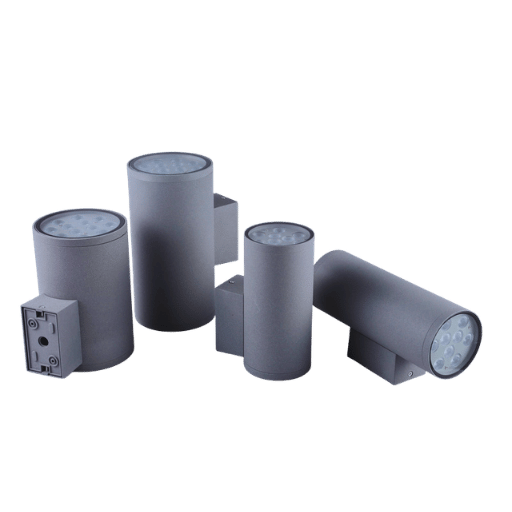
Picking the ideal exterior wall lights has one of the biggest impacts on the security, running costs and street level aesthetics of your property of any one lighting decision. This guide walks through every element of outdoor wall lighting — from fixture types and IP ratings to sizing rules and LED performance — so you can pick the right lights for your budget and property.
36%
Crime reduction with proper lighting
75%
Less energy with LED outdoor wall lights
25×
Longer lifespan vs incandescent bulbs
What Are Outdoor Wall Lights and Why Every Exterior Needs Them
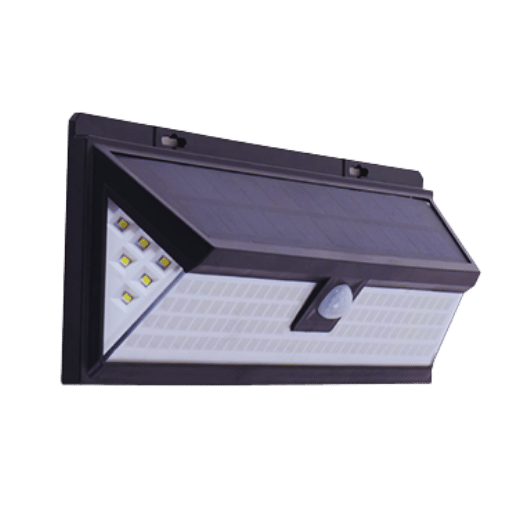
Outdoor wall lights are those attached to the exterior walls of a building—around doorways, on patios and near garage doors, and on building corners—to light the outside world. They perform three functions: defending the property, guiding pedestrians and driving up property values.
The security case alone makes wall lighting a strong investment. A landmark study by the National Bureau of Economic Research found that temporary lighting installations in New York City housing projects led to at least a 36% decline in serious crimes, with a cost-benefit ratio of roughly 4:1. Each housing complex saw approximately $770,000 in crime-reduction savings against just $200,000 in lighting costs.
Market numbers reflect this demand. Globally, security lighting is projected to grow from $4.5 billion in 2024 to $8.2 billion by 2033, driven by municipal safety programs and homeowner awareness. Residential exterior lighting — including porch lights, entryway sconces, and patio wall fixtures — accounts for a growing share of that figure.
In designing exterior lighting for commercial and residential projects, our most common piece of feedback is… “I wish I’d put in more.” One outdoor wall sconce next to the front door can be a good beginning. However, if you really want to create a fashionable and safe outdoor space, think perimeter—lighting along every pathway and doorway, and in particular near the garage door.
If you are looking at options, also explore our full range of outdoor wall lights (contemporary and traditional).
Types of Outdoor Wall Sconces, Lanterns, and Fixtures Explained
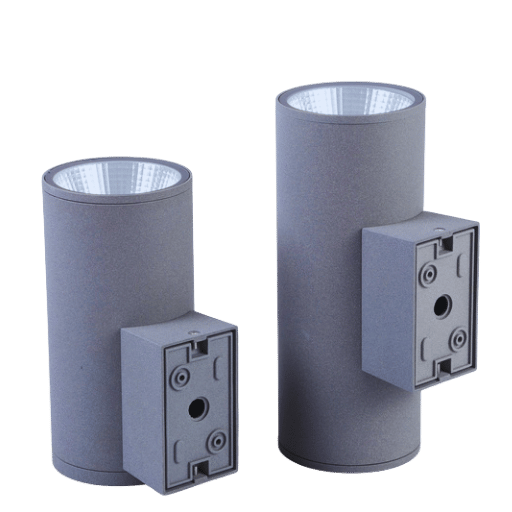
Outdoor wall sconces, lanterns, and flush-mounts serve distinct needs. Picking the wrong type of outdoor wall light is one of the most frequent mistakes we see on project sites. The factors that determine the best fit are where you want to mount the fixture and what style your building demands. Below are six common exterior wall light categories, their strengths, and materials.
| Fixture Type | Description | Best Location | Typical Materials | Style Match |
|---|---|---|---|---|
| Traditional Lanterns | Enclosed glass panels with a decorative frame, often with a tapered top | Front porch, entryway, garage pillars | Cast aluminum, brass, clear glass shade | Colonial, Cape Cod, Traditional |
| Modern Sconces | Geometric or cylindrical forms with clean lines, often up/down directional | Facades, entryways, patios | Powder-coated aluminum, frosted glass, stainless steel | Modern, Contemporary, Minimalist |
| Coach Lights | Carriage-era inspired, wall-mounted with an arm extending from the backplate | Front porch, garage flanks, entrance gates | Wrought iron, oil-rubbed bronze, beveled glass | Colonial, Traditional, English Country |
| Outdoor Barn Lights | Gooseneck arm with a wide, downward-facing shade — industrial roots | Garage door, workshop, farmhouse porch | Galvanized steel, matte black finish aluminum | Farmhouse, Industrial, Rustic |
| Up/Down Wash Lights | Compact fixtures that cast light both upward and downward against the wall surface | Architectural facades, pillars, patio walls | Die-cast aluminum, tempered glass lens | Modern, Commercial, Contemporary |
| Flush Mount | Low-profile fixtures that sit tight to the wall, minimal projection | Covered porches, overhangs, narrow walkways | ABS or aluminum housing, polycarbonate diffuser | Transitional, Modern, any space-limited area |
Choosing the appropriate kind: Begin by function and then make your selection by style. An outdoor wall lantern is going to be an attractive addition to the porch of a traditional residence! However, if you want to light a 20 foot high wall of a driveway, then an up/down wash or a line of contemporary outdoor wall sconce light fixtures are going to do the trick.
⚠️ Important
Often a common error is selecting style over function. For example, an attractive rated IP44 outdoor lantern will not perform on an exposed exterior wall orientated to receive prevailing rain. Never be tempted by good looks without confirming that the fixture weather rating is compatible with the mounting position.
Explore the various exterior light fixture choices available by browsing our complete selection of exterior wall sconces and lantern fixtures.
Sizing and Placement Rules for Outdoor Wall Lighting
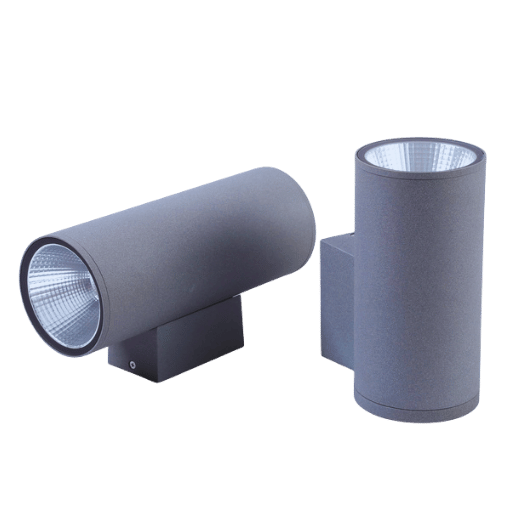
Choosing the right size and mounting height is the difference between a wall light that looks sharp and one that seems out of place or not bright enough. This tested data provides a useful baseline for all exterior wall light projects.
Fixture Sizing
The height of the fixture should be about 1/4 to 1/3 of door height. For an 80-inch entry way door, that translates to selecting an outdoor wall light that is between 20 to 26 inches tall. Too small and the fixture disappears.
Too large and it takes over.
Mounting Height
- ✔ Standard mounting center: 60 to 65 inches from the ground (approximately eye level)
- ✔ Front door flanking: Keep at least 6 inches of clearance from the door frame on each side
- ✔ Single light placement: Mount on the doorknob side of the entry; two lights flanking is the ideal layout
- ✔ Garage door: Position outdoor wall sconces on the outside pillars or framing members
- ✔ Patio wall mount: 6 to 6.5 feet for ambient wall lighting that doesn’t glare into seated guests’ eyes
All of our measurements from the exterior wall begin at the door, and then extend outward to the garage and patio, and then to additional outdoor spaces such as a side entrance or back gate.
💡 Pro Tip
Before drilling, tape a paper cutout of the fixture dimensions onto your wall. Step back to the sidewalk or driveway and gauge the proportion. This 30-second test will catch the most common sizing error.
Need help sizing your fixtures for your project?
Check out our wall lighting solutions for commercial and residential projects.
IP Ratings and Weather Resistance: What Actually Matters
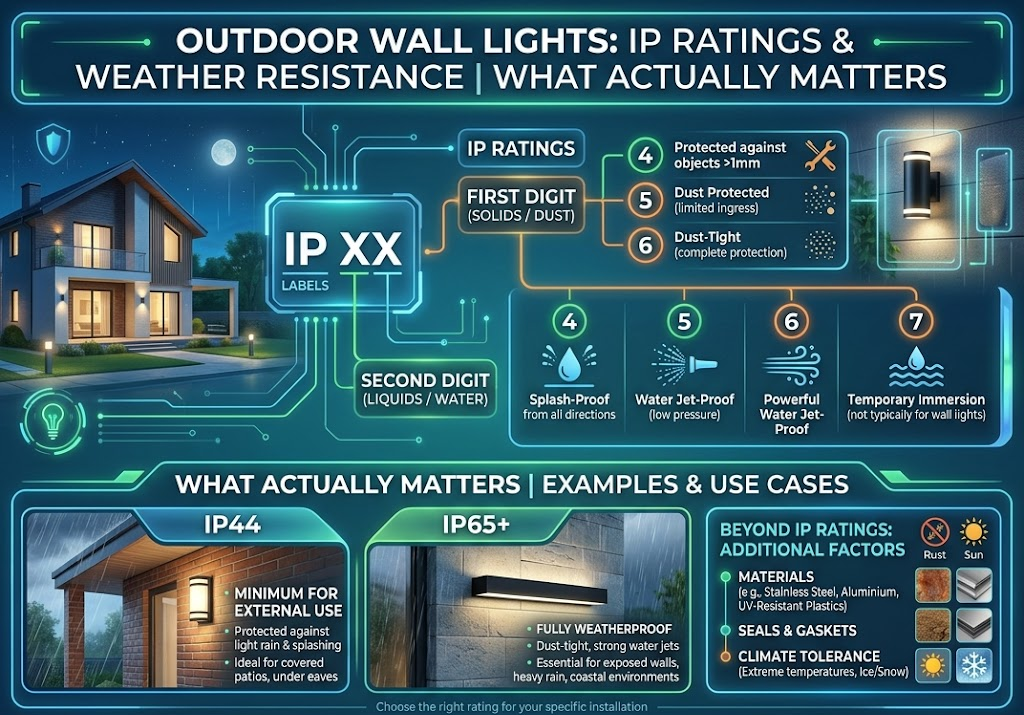
An IP (Ingress Protection) rating will give you the specific amount of resistance an outdoor wall light can handle from dust and water. Defined by the IEC 60529 standard from the International Electrotechnical Commission, the two-digit code breaks down into a first digit for solid particle protection (0–6) and a second digit for liquid ingress protection (0–9). Getting this wrong means premature fixture failure — so here is what the ratings actually mean.
| IP Rating | Solids Protection | Liquid Protection | Best Application |
|---|---|---|---|
| IP44 | Objects > 1mm | Splashing water from any direction | Sheltered porch, covered entryway |
| IP54 | Dust-protected (limited ingress) | Splashing water from any direction | Protected outdoor wall, semi-exposed patio |
| IP65 | Dust-tight (no ingress) | Water jets from any direction | Exposed exterior wall, open patio, coastal |
| IP67 | Dust-tight (no ingress) | Temporary submersion up to 1m | Ground-level fixtures, flood-risk zones |
For most residential front porch and entryway fixtures mounted under an overhang, IP44 is good enough. For any wall lamp or sconce installed on a fully exposed, roofless exterior wall (direct rain exposure), a minimum IP65 waterproof rating should be insisted upon.
Material Matters Too
IP rating addresses the seal design, but the long-term durability is in the housing material. Die-cast aluminum with a powder coat finish handles most climates well and resists corrosion with anti-rust properties. Harsher conditions call for 316 stainless steel or fiber-reinforced composite housings.
💡 Pro Tip
For all coastal properties within 5 miles of salt water: use marine grade 316 stainless steel or fiber reinforced composite housings. Even coated aluminum fixtures will pit and corrode in the salt air in 18 to 24 months.
⚠️ Important
Don’t think that “outdoor rated” is equal to “water proof”. A lot of cheaper outdoor wall sconces are only IP44; therefore won’t stand the downpour, always take the IP number off the product spec sheet.
LED vs. Traditional Bulbs for Outdoor Wall Lights
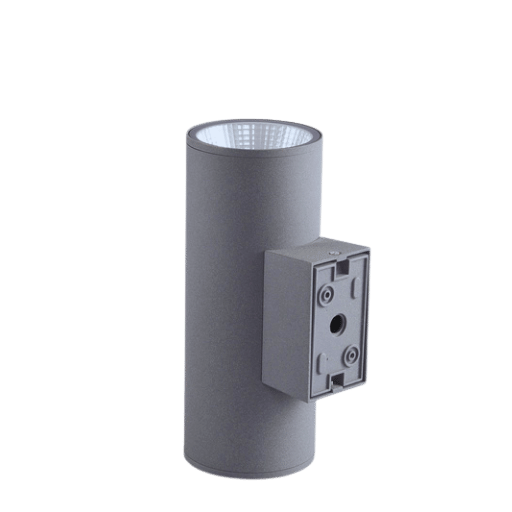
LEDs have earned their place as the go-to light source for outdoor wall lights, and the numbers back that up. The U.S. Department of Energy reports that LEDs use 75% less energy than incandescent bulbs and last up to 25 times longer. Widespread LED adoption is projected to save 569 terawatt-hours of electricity annually by 2035 — roughly the output of 92 large power plants.
Incandescent bulbs waste roughly 90% of their energy as heat instead of visible light. An outdoor wall sconce running through the night racks up wasted energy fast on your electric bill — and puts unnecessary heat into the fixture housing.
| Specification | LED | Halogen | CFL |
|---|---|---|---|
| Lifespan (hours) | 25,000–50,000 | 2,000–4,000 | 8,000–15,000 |
| Watts (for ~800 lumens) | 8–12W | 43W | 13–15W |
| Annual cost (8 hrs/day) | ~$1.50 | ~$6.50 | ~$2.00 |
| Cold weather performance | Excellent | Good | Poor (slow start) |
How Many Lumens Do You Need?
Lumens measure the amount of light emitted. Watts indicate the energy used. For outside wall lighting, aim for these lumens per zone:
- ✔ Ambient porch and patio: 150–300 lumens per fixture for warm ambiance
- ✔ Entryway and front door: 300–500 lumens for clear visibility
- ✔ Security and driveways: 700–1,300 lumens for strong illumination of outdoor areas
Color temperature also counts. For residential outdoor spaces, 2700K-3000K bulbs give a cozy appearance; for security lighting, 4000K appears brighter and more alert. Most modern outdoor wall fixture sockets are compatible with standard LED bulbs in either range.
See our LED outdoor wall sconce collection for fixtures with integrated high-efficiency LEDs.
Smart Features: Motion Sensors and Dusk-to-Dawn Controls
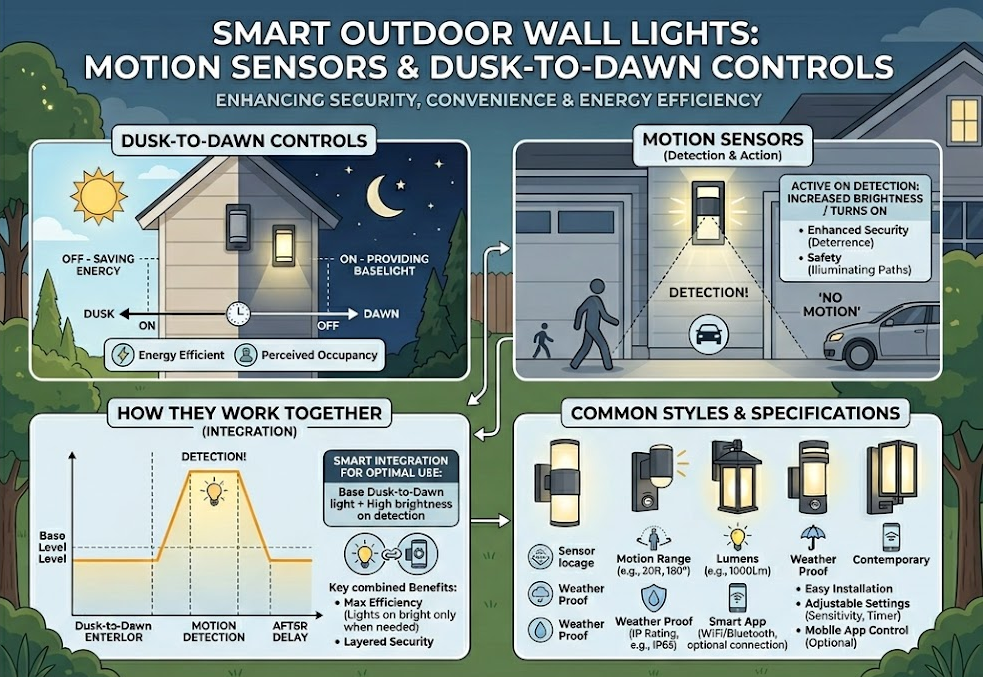
Inexpensive dusk-to-dawn outdoor lighting controls along with motion sensor outdoor wall lights make your exterior space safer and more secure. Knowing the three main control types can help you develop a layered lighting design that fits your needs while staying within budget.
| Control Type | How It Works | Energy Savings | Best For | Added Cost |
|---|---|---|---|---|
| Motion Sensor (PIR) | Passive infrared sensor detects body heat and movement, activates the light | 30–60% vs always-on | Driveways, side yards, garage door areas | $5–$20 per fixture |
| Dusk-to-Dawn (Photocell) | Ambient light sensor turns on at sunset, off at sunrise — runs 8–12 hours nightly | ~50% vs 24/7 operation | Front porch, entrance, outdoor living space | $3–$10 per fixture |
| Smart/WiFi Control | App-based scheduling, remote on/off, voice assistant integration | Variable — depends on programming | Full home automation, vacation scheduling | $15–$50 per fixture |
Combining both options is very effective. Use dusk-to-dawn porch lights at major entrances on your home or business so they’re on constantly at a low level, and use motion sensor fixtures on private walls and side paths so they only turn on when someone is around.
⚠️ Important
A common mistake is to have outdoor motion sensor wall lights detect too wide an area. If their PIR sensors can see far down a driveway or road, the motion sensors will stay activated whenever a car or cyclist passes by – a waste of electricity and a source of neighbor complaints about outdoor light pollution. Taper the detection angle down to just the edges of your property.
Dusk-to-dawn outdoor wall lights paired with LED bulbs typically cost less than $0.10 per night to run — a small price for continuous security lighting at your entrance and front porch.
Design Styles That Match Your Exterior Architecture
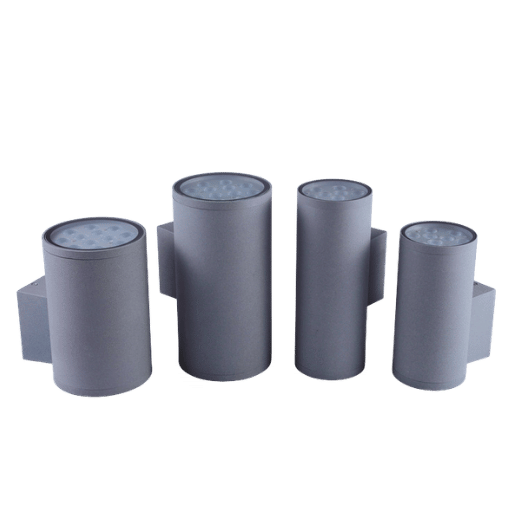
An effective outdoor wall light looks like it was part of the building all along. Matching design, finish, and glass type brings everything together, not against each other. This approach lends a professional finish to your project. Use this adaptable framework on private, commercial, and institutional settings to match your local architecture.
| Architecture Style | Fixture Style | Recommended Finish | Glass Type |
|---|---|---|---|
| Modern / Minimalist | Geometric or linear sconces | Matte black finish, brushed nickel | Frosted glass or opal diffuser |
| Farmhouse / Rustic | Outdoor barn light, wall lanterns | Oil-rubbed bronze, black finish | Seeded glass shades |
| Transitional | Blended lantern-sconce hybrids | Aged brass, satin black | Clear glass shade or light seeding |
| Colonial / Traditional | Coach light, outdoor wall lantern | Antique brass, copper | Beveled or clear glass panels |
| Contemporary | Up/down wash lights, cylinder sconces | Powder-coated aluminum, graphite | Clear tempered glass, no glass (open beam) |
Farmhouse design is still popular, with barn lights and seeded-glass wall lanterns in over thirty percent of 2025 house plans. Traditional styles – which invoke character by design but incorporate sleek materials and details for contemporary homeowners – continue to prove versatile for resale.
2025–2026 Design Trends
Exterior wall lighting trends to watch this year include:
- A shift toward warm tones: Aged brass and warm bronze are gaining ground on the decade-long dominance of matte black.
- DarkSky-compliant fixtures: Fully shielded, downward-directed sconces are now a selling point as much as a building-code compliance issue.
- Dimples, threads, and waves: Ribbed, fluted, and hammered glass for softened LEDs.
- Replaceable LED modules: Exterior fixtures with all-LED integrated units are phasing out for fixtures whose LED modules can be replaced.
Browse our complete outdoor wall light collection to find the right finish and glass combination for your project.
Frequently Asked Questions
Q: How bright should outdoor wall lights be?
View Answer
Ambient porch lighting – A range of 150-300 lumens per light offers a warm inviting glow without being too bright for the setting. Outdoor wall lights designed for security purposes – Should emit 700-1300 lumens a good range of light for dark driveways, side passages and rear entrances. Remember to always think about these lights in terms of lumens, not watts — wattage only measures energy consumption, not actual brightness. A 10-watt LED can match the output of a 60-watt incandescent bulb.
Q: Can you use outdoor wall lights indoors?
View Answer
Yes. An outdoor rated fixture far surpasses the safety requirements of indoor fixtures and functions just fine indoors. An IP65 waterproof wall sconce is suitable for use anywhere indoors including bathrooms, kitchens, and living rooms.
Remember that outdoor fixtures tend to be a bit bulkier looking than indoor sconces.
Q: How high should outdoor wall lights be mounted?
View Answer
The middle of the fixture should be between 60 and 65 inches from the floor–approximately eye level when standing for most adults. For doors that are taller (96 inches), you can raise the mount point 78-96 inches above the floor for a wider light distribution spread and a balanced proportional relation to the door height. On patio walls, you want to be positioned between 6 and 6.5 feet high so you don’t blind your guests sitting in the patio with direct glare.
Q: What is the best type of outdoor wall light?
View Answer
It really depends on the application. Consider the placement and use, upon your particular building style. On traditional front entrances, outdoor wall lanterns provide the most general and widest beam pattern, distributed through glass panels.
Contemporary outdoor wall sconces make the most appropriate modern building accents, with refined geometry. An outdoor barn light makes sense on a farm style house with a barn or garage. Up/down wash fixtures make fantastic accents to textured architectural facades.
The best fixture is one that compliments your particular building architecture, fulfills the IP rating required for your exposure, and outputs the desired lumen level for your zone.
Q: Are outdoor wall lights required by building code?
View Answer
Most residential building codes in the U.S. do not explicitly call out exterior wall lights, although many states and cities do require a switched light fixture at all outside doors. The International Residential Code (IRC) Section E3903.2 covers this for dwelling units. Commercial codes are more demanding: the International Building Code (IBC) and NFPA 101 Life Safety Code typically call for illuminated exit routes and outside egress lighting with an illumination level of at least 1 foot-candle at the ground level.
Some jurisdictions require even more: for instance, California’s Title 24 specifies high-efficacy fixtures with motion sensors or automatic controls on all outside lighting. Because requirements can vary greatly depending on state and city, it’s best to check with your local building department before designing your outdoor lighting. A licensed electrician familiar with local amendments should be able to catch code violations as they come up during the process of installation.
Q: Should you leave outdoor lights on all night?
View Answer
A dusk-to-dawn outdoor wall light with an LED bulb keeps low-level security illumination on through the night — often costing less than $0.10 per night. Where constant light is not needed, motion sensor outdoor wall lights save energy and still deliver a strong deterrent when triggered. The smartest approach layers both: dusk-to-dawn at primary entrances for steady ambiance, motion-activated fixtures on driveways and side walls for on-demand security.
Ready to Find the Right Outdoor Wall Lights?
Browse wall sconces, lanterns, up/down lights, and more — with IP65 ratings, integrated LEDs, and finishes to match any exterior style.
About This Guide
This guide has been produced and published by Guangqi Lighting (gqlamp.com), a professional outdoor and architectural lighting manufacturer with more than 15 years’ manufacturing experience in exterior and facade lighting. We export our products to more than 60 countries across the world, our team comprises industrial designers and field installation engineers who have ‘hands-on’ installation experience of hundreds of outdoor wall light projects. Every recommendation in this article reflects both published research and practical knowledge gained from specifying and installing exterior light fixtures in many different buildings and climates.
References & Sources
- Bright Lights, Fewer Serious Crimes in New York City Projects — National Bureau of Economic Research (NBER)
- LED Lighting — U.S. Department of Energy
- LED Adoption Report — U.S. Department of Energy
- More U.S. Homes Used LEDs in 2024 — U.S. Energy Information Administration
- IEC 60529: Ingress Protection Ratings — International Electrotechnical Commission (reference standard; no direct link available)
- The Next Wave of LED Lighting — International Energy Agency (IEA)