Contacte con GUANGQI



Actualizado en julio de 2026
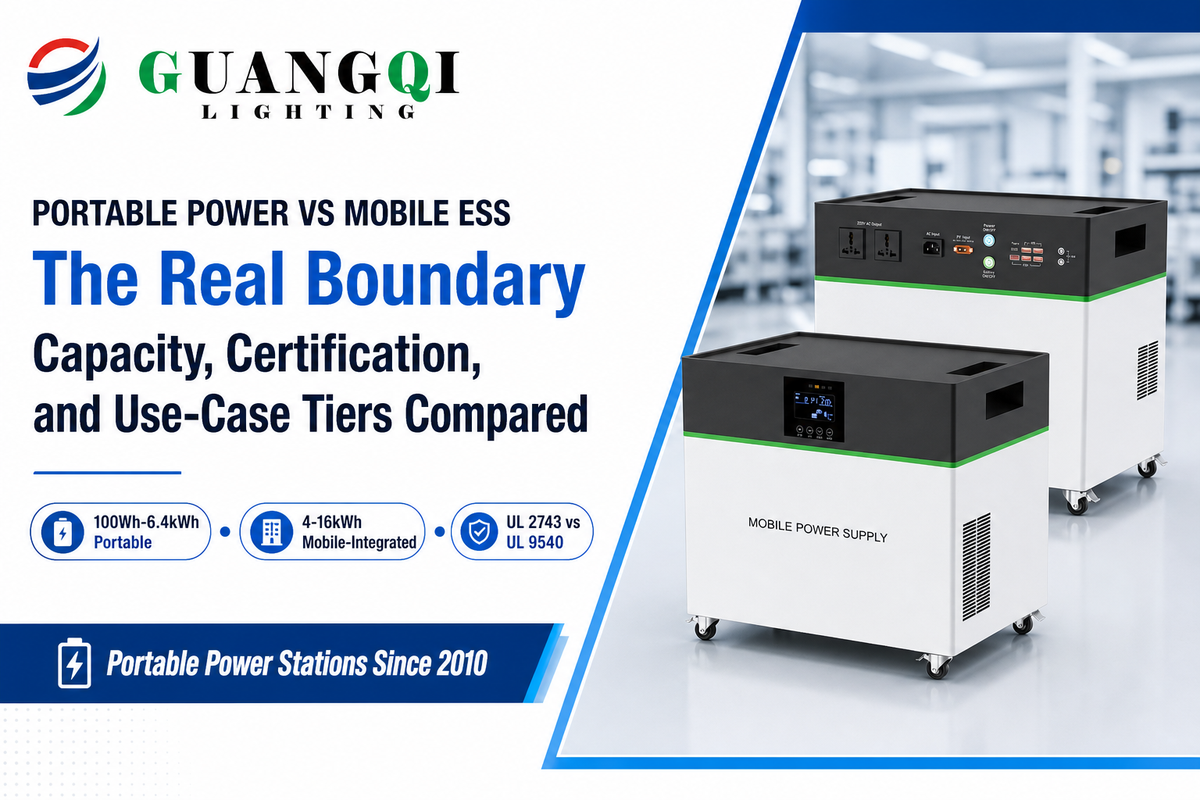
Al buscar «portable power station vs mobile energy storage system» aparecen dos productos que suelen tratarse como si fueran lo mismo, cuando en realidad pertenecen a categorías completamente distintas. Las estaciones de energía portátiles son unidades con batería e inversor dimensionadas para alimentar durante poco tiempo las cargas de una sola persona, mientras que los sistemas de mayor tamaño transportables en vehículo, a los que algunos fabricantes también llaman «almacenamiento móvil de energía», están diseñados para suministrar energía durante varios días o a escala industrial. Es comprensible que un comprador se confunda al ver la etiqueta «móvil» en una página de producto y «batería» en otra. Un equipo puede levantarse y meterse en el maletero de un coche para llevarlo a un camping; el otro, en su versión plenamente industrial, es un equipo montado en un remolque o contenedor, que se desplaza con una grúa o un camión articulado. Entre esos dos extremos existe una tercera categoría, poco reconocida, de sistemas móviles de varios fabricantes —entre ellos, los productos de Guangqi que se destacan en estos ejemplos—, a los que estas empresas llaman «almacenamiento móvil de energía».
«Los resultados para esta frase exacta mezclan actualmente una batería de camping de 200 $ y un remolque para obras de 200 000 $ en la misma página. A esto lo llamamos la trampa del nombre compartido».
Resumen de especificaciones
| Estación de energía portátil | 100Wh-6,4kWh, portátil a mano, la lleva una persona |
| Categoría de almacenamiento móvil integrado | 4-16kWh, con ruedas o montado en panel, transportable en un solo vehículo |
| Sistema MESS industrial propiamente dicho | De 10kWh a varios MWh, montado en remolque o contenedor marítimo |
| Norma aplicable | UL 2743 (portátil, ≤20kWh con iones de litio o sodio) frente a UL 9540 (estacionario o de mayor tamaño) |
| Confusión sobre el tamaño del mercado | Las estimaciones de las consultoras difieren en un factor de 14x sobre qué mide siquiera «sistema móvil de almacenamiento de energía» |
Estación de energía portátil frente a sistema móvil de almacenamiento: comparación en 60 segundos

Una estación de energía portátil es un conjunto completo con una batería, un inversor y puertos de salida, con una capacidad de entre 100Wh y 6,4kWh, que se puede levantar y meter en el maletero de un coche. Los sistemas móviles de almacenamiento de energía abarcan un rango más amplio: algunos fabricantes aplican el término a unidades de 4-16kWh con ruedas o montadas en panel, diseñadas para la propiedad o la obra de un solo comprador; en el extremo industrial, el término comprende sistemas de 10kWh a varios megavatios hora que se llevan a obras o rodajes en remolque, camión o grúa. A continuación se resumen las tres categorías para contextualizar las secciones posteriores de esta guía; el límite de certificación entre los dos primeros niveles se rige por UL 2743, que se explica más adelante.
| Nivel | Rango de capacidad | Cómo se transporta | Comprador habitual |
|---|---|---|---|
| Estación de energía portátil | 100Wh-6,4kWh | Se lleva a mano | Aficionado al camping, inquilino, preparacionista |
| Almacenamiento móvil integrado | 4-16kWh | Con ruedas o en panel, carga transportable en un solo vehículo | Comprador para cortes de suministro en casa o para obras |
| Sistema MESS industrial propiamente dicho | De 10kWh a varios MWh | En remolque, caja de camión o grúa | Construcción, eventos, servicios públicos |
Los catálogos de fabricantes como la propia Guangqi abarcan las dos primeras filas. Por ejemplo, la serie LK ofrece una potencia de salida de 300W-6000W y capacidades de 230Wh a unos 6,4kWh, mientras que la línea MS-T pertenece a la categoría de almacenamiento móvil integrado de 4,04-16,07kWh. Ninguno de los productos de estas dos series puede considerarse un sistema MESS industrial montado en remolque. Precisamente por eso existe esta guía: la mayoría de las demás se centran en uno solo de los extremos y dan a entender que representa toda la categoría. Equivocarse en esta distinción puede salir caro: se puede pagar por una capacidad propia de un remolque cuando una batería portátil habría cubierto la necesidad por una fracción del precio, o comprar una batería portátil demasiado pequeña para una carga que en realidad necesitaba la autonomía adicional del nivel móvil integrado. Como el catálogo de Guangqi incluye productos reales que abarcan exactamente las dos primeras filas de esta tabla, sus fichas técnicas son una referencia útil para identificar dónde empieza cada nivel.
Estación de energía portátil: definición, rango de capacidad real y para qué está diseñada
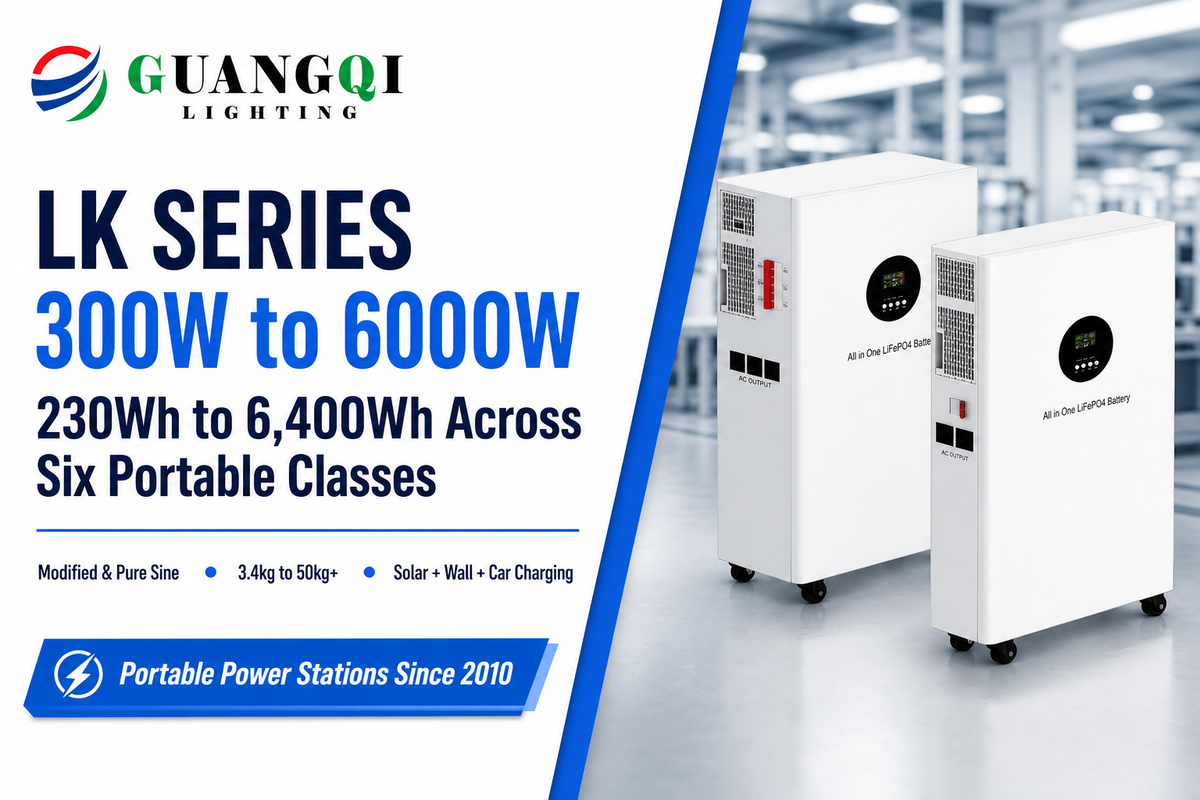
Una estación de energía portátil incluye una batería portátil, un inversor y varias salidas (CA, USB y CC), todo ello alojado en una carcasa portátil. Puede recargarse desde un enchufe, la toma de 12V de un coche o la energía solar almacenada mediante un panel plegable. Por ejemplo, la línea LK de Guangqi incluye modelos desde el LK-300W hasta el LK-6000W. El modelo básico, el LK-300W, pesa 3,4kg y ofrece una salida de onda sinusoidal modificada con una capacidad de 230Wh; en cambio, los LK-1000W y LK-1500W incorporan onda sinusoidal pura, con capacidades de 1.024Wh y 1.280Wh, respectivamente, y pesan aproximadamente 12,6-19,5kg. Los modelos Guangqi LK de mayor capacidad, LK-5000W/6000W, alcanzan entre 5.120Wh y 6.400Wh y superan los 50kg, aunque aún pueden levantarlos dos personas.
✔ Ventajas
- Sin instalación: basta con enchufar y usar al sacarla de la caja
- Se carga con energía solar, desde un enchufe o desde la toma del coche
- Funcionamiento silencioso y seguro para interiores
⚠ Limitaciones
- La onda sinusoidal modificada de los modelos básicos puede impedir el funcionamiento de cargas con compresor o motor
- La entrada para panel solar suele alcanzar un máximo de unos 200W en la mayoría de los modelos de menos de 1,5kWh
- No está homologada para alimentar una vivienda completa ni para uso industrial continuo
| Modelo / categoría | Potencia de salida | Capacidad de la batería | Forma de onda | Peso |
|---|---|---|---|---|
| LK-300W | 300W | 230Wh | Sinusoidal modificada | 3,4kg |
| LK-600W | 600W | 576Wh | Sinusoidal pura | 10,6kg |
| LK-1000W | 1.000W | 1.024Wh | Sinusoidal pura | 12,6kg |
| LK-1500W | 1.500W | 1.280Wh | Sinusoidal pura | 19,5kg |
| LK-2500W / LK-3500W | 2.500-3.500W | 2.432-3.072Wh | Sinusoidal pura | confirme antes de hacer el pedido |
| LK-5000W / LK-6000W | 5.000-6.000W | 5.120-6.400Wh | confirme antes de hacer el pedido | más de 50kg |
| MS-T04 (móvil integrado) | a nivel de sistema | 4,04kWh | revisión del sistema | con ruedas/panel |
| MS-T08 (móvil integrado) | a nivel de sistema | 8,03kWh | revisión del sistema | con ruedas/panel |
| MS-T12 (móvil integrado) | a nivel de sistema | 10,49kWh | revisión del sistema | con ruedas/panel |
| MS-T16 (móvil integrado) | a nivel de sistema | 16,07kWh | revisión del sistema | con ruedas/panel |
Una prueba práctica de CleanTechnica de una estación de energía de consumo de 2026 (la Bluetti Apex 300/B300K) muestra que sus prestaciones siguen centrándose en los mismos aspectos de siempre —el inversor, la forma de onda y la velocidad de carga—, como se aprecia en la ficha técnica de Guangqi. Sirve como comprobación útil si encuentra una unidad que parece barata para la capacidad en vatios-hora anunciada. Quienes comparan una estación portátil para camping con opciones de marcas de consumo —Jackery, Bluetti y EcoFlow son las tres marcas que más suelen comparar— están valorando los mismos aspectos fundamentales que se tratan aquí: capacidad, forma de onda y entrada fotovoltaica, con independencia de que en la etiqueta figure «generador eléctrico portátil» o «fuente de energía portátil».
Sistema móvil de almacenamiento de energía: dos productos muy distintos comparten un nombre

El término «sistema móvil de almacenamiento de energía» describe correctamente equipos de 10kWh a varios megavatios hora que se remolcan con un camión o una grúa para dar apoyo a la red, a obras y a eventos; no se refiere a una batería para llevar a mano. Un análisis temático de NeuronWriter sobre esa frase de búsqueda identificó de forma independiente «remolque (vehículo)», «camión» y «vehículo a red» como entidades reconocidas. Es la misma conclusión desde el punto de vista del procesamiento del lenguaje natural: los buscadores ya asocian la frase completa con equipos industriales móviles, aunque algunos vendedores la apliquen a productos mucho más pequeños.
Esta interpretación industrial no es ninguna exageración. Los sistemas de NextG Power montados en camiones de 10ft ofrecen 250-600 kWh, y sus remolques con contenedor de 20ft superan 1MWh. Hay publicaciones independientes de prensa especializada sobre este nuevo segmento industrial. Según ESS News, el MESS 2000 de Sunwoda se presenta como «el primer vehículo del mundo con un sistema móvil de almacenamiento de energía de 2MWh y 10 metros», mientras que las unidades móviles plug-and-play de Alfen se ofrecen en formatos de 360-540 kWh. Los registros públicos demuestran que este uso no es una invención de los fabricantes y que las empresas de servicios públicos están comprando esta tecnología: la Comisión de Servicios Públicos de California ha aprobado recientemente una subestación móvil en remolque de 28 MVA; el Departamento de Servicios Públicos de Nueva York cuenta con documentos sobre sistemas móviles BESS propiedad de empresas de servicios públicos para atender necesidades inmediatas de la red; y un informe de NREL sobre preparación de las empresas de servicios públicos describe el proyecto piloto de batería de 1 MW / 4 MWh de Con Edison, montada en un camión articulado, como un equipo que «se puede trasladar fácilmente allí donde resulta más útil».
📐 Nota técnica
Las unidades de la serie MS-T04 a MS-T16 de Guangqi (4,04-16,07 kWh) tienen una capacidad quizá dos órdenes de magnitud inferior a la de las unidades MESS más pequeñas montadas realmente en remolques que se han mencionado en este apartado. En sus materiales de marketing, Guangqi denomina sin rodeos a esta categoría «almacenamiento móvil de energía» y la presenta como el siguiente paso lógico en capacidad después de un sistema portátil individual, no como una alternativa a los sistemas montados en remolques o contenedores. Si una empresa contratista recibe una solicitud de oferta o un requisito de apoyo a la red que especifique un sistema en remolque con capacidad de almacenamiento superior a 10 kWh, debería consultar a un proveedor de MESS industrial y no un catálogo de estaciones portátiles.
En conversaciones de foros y redes sociales entre consumidores que viven en furgoneta y aficionados al todoterreno, los compradores suelen reducir todo esto a un solo término: se llama «estación de energía» a cualquier cosa, desde una instalación para cargar el móvil en un vehículo todoterreno hasta una batería doméstica para una emergencia durante un corte prolongado, sin pararse a distinguir entre el «nivel móvil integrado» y el «nivel de remolque». La clasificación en tres niveles que emplea esta guía aborda un problema real y vigente en la forma en que los compradores hablan de estos productos; no es un gancho SEO inventado.
Ni siquiera coinciden en dónde trazar el límite de la categoría. Fortune Business Insights publicó una estimación de 58.28 mil millones de $ para su «mercado de sistemas móviles de almacenamiento de energía» en 2025, repartido entre tres categorías: vehículos con almacenamiento propio (vehículos eléctricos), soluciones en contenedores y soluciones montadas en remolques. Su propio desglose muestra que el segmento de vehículos eléctricos con almacenamiento propio representará el 94,42 % en 2026; es decir, la mayor parte de esa cifra corresponde simplemente a vehículos eléctricos que funcionan como almacenamiento móvil mediante la conexión del vehículo a la red, no a enormes remolques o contenedores. Si se multiplica la parte restante para volver a situarla en los tres grandes tipos de mercado, ese segmento «restante» queda en torno a los 3-4 mil millones, una cifra curiosamente cercana a la estimación de 4.2 mil millones de $ de Grand View Research para su «mercado de sistemas móviles de almacenamiento en baterías». En cualquier caso, esta explicación es mejor que atribuir a dos consultoras cifras principales que difieren en un orden de magnitud: al eliminar la gran parte correspondiente a los vehículos eléctricos de la cifra más alta, lo que queda no dista mucho de la cifra principal de la otra consultora. Equivocarse no es una simple confusión semántica: un comprador que solicite presupuesto para «almacenamiento móvil de energía» sin especificar la escala se arriesga a recibir una propuesta con el precio de un sistema completo en remolque, cuando una unidad con ruedas que cuesta una pequeña fracción de ese importe bastaría; también puede ocurrir lo contrario. Como la línea MS-T de Guangqi ocupa honestamente el término medio y no ninguno de los extremos, ofrece una referencia concreta a quienes intentan situar correctamente sus propias necesidades en este espectro.
La tecnología de almacenamiento de energía no constituye una única categoría uniforme. Además de los sistemas con baterías de litio, el campo más amplio incluye el almacenamiento de energía térmica, el almacenamiento de hidrógeno y otros métodos de larga duración; sin embargo, para quienes buscan soluciones portátiles o móviles integradas, las baterías de fosfato de hierro y litio siguen siendo la opción práctica predominante. Conectada al sistema de distribución eléctrica de una vivienda o instalación, una instalación estacionaria de almacenamiento de energía desempeña una función distinta de la de una unidad portátil: puede combinarse directamente con la generación de energía renovable y almacenar durante el día el excedente de energía solar para usarlo después del anochecer, mientras que una batería portátil simplemente transporta la carga que recibió antes de ponerse en servicio. Esta diferencia importa a quienes evalúan soluciones energéticas a gran escala: la integración de energías renovables a gran escala y los sistemas de almacenamiento en baterías a escala de red resuelven un problema de oferta y demanda para el que nunca se diseñó una unidad portátil de mano o con ruedas.
Límite de certificación: UL 2743, UL 9540 y el umbral de 20 kWh

UL 2743 Edición 3 (publicada el 24 de septiembre de 2025 y aún vigente) es la norma para baterías portátiles y establece en la tabla 1.1 un límite de capacidad total de 20kWh para las químicas de iones de litio y sodio. La misma tabla establece un umbral de 70kWh para las baterías de plomo-ácido y de 3kWh para las unidades con condensadores electroquímicos. Además, excluye expresamente las baterías externas (cubiertas por separado por UL 2056), los sistemas cableados con conexión a la red y el cableado de carga de vehículos eléctricos. Si una batería de litio supera el umbral de 20kWh, el producto pasa a estar sujeto a UL 9540, edición 3, cuya última revisión fue el 7 de marzo de 2025 y que regula las instalaciones estacionarias y residenciales de almacenamiento de energía de mayor tamaño.
| Categoría de producto | Norma aplicable | Capacidad máxima |
|---|---|---|
| Batería portátil (iones de litio o sodio) | UL 2743 Ed.3 (2025-09-24) | 20 kWh en total |
| Batería portátil (plomo-ácido) | UL 2743 Ed.3 | 70 kWh en total |
| Sistemas estacionarios o residenciales de almacenamiento de energía de mayor tamaño | UL 9540 Ed.3 (rev. 2025-03-07) | Por encima del límite de UL 2743 |
Otro caso límite al que conviene prestar atención es la 5.ª edición de UL 9540A, que una presentación de IEEE PES a cargo de un ingeniero de UL Solutions señaló como prevista para 2025. Aunque es poco probable que esta revisión cambie el límite de 20kWh, otra guía sobre sistemas portátiles parece clasificar como portátiles sistemas de alrededor de 20kWh, lo que contradice UL 2743 en al menos una de las categorías del mercado.
Una vez que una instalación pasa del producto individual al ámbito de los MESS industriales propiamente dichos, la certificación es solo una parte del desafío. Por ejemplo, el Código Internacional de Incendios de 2024 establece una nueva serie de requisitos innegociables para el almacenamiento móvil temporal de energía en obra: limita la instalación a 30 días, exige un permiso de funcionamiento e impone normas propias sobre distancias de separación y vallado, además de los requisitos de UL 9540. Los compradores comerciales y las empresas de servicios públicos también deben contar con un conjunto de normas mucho más amplio que UL 2743/9540, que incluye las pruebas de propagación del fuego UL 9540A, NFPA 855 y normas de conexión a la red como IEEE 1547 si se conecta al suministro de la compañía eléctrica.
Elija el nivel adecuado según el uso (camping, batería de respaldo doméstica u obra industrial)

La prueba del fin de semana frente a la semana laboral permite resolver buena parte de esta confusión sobre los niveles con una pregunta sencilla: ¿la carga va a funcionar durante una escapada de fin de semana o durante una semana laboral completa? Si es lo primero, probablemente necesite un sistema portátil. Si es lo segundo —por ejemplo, alimentar herramientas eléctricas en una obra durante cinco días seguidos o hacer funcionar equipos de apoyo en un evento de varios días para la red—, probablemente necesite un sistema móvil integrado o un MESS industrial. Cuando una instalación entra en ese ámbito, empiezan a aplicarse las normas sobre permisos y el límite de 30 días del Código Internacional de Incendios, descritos en el apartado anterior sobre certificación.
| Uso | Nivel recomendado | Motivo |
|---|---|---|
| Camping, teléfono/portátil, corte breve del suministro | Batería portátil (categoría LK-300W-1500W) | Energía para un fin de semana, transportable por una persona |
| Circuitos concretos de la vivienda, suministro de respaldo durante un corte | Sistema móvil integrado (MS-T04-T16) | Autonomía de varios días para frigorífico/router/luces |
| Herramientas eléctricas en obras, eventos, apoyo a la red | MESS industrial propiamente dicho (remolque/contenedor) | Uso continuo durante una semana laboral, capacidad superior a 10kWh |
Un ejemplo de r/Generator muestra por qué conviene hacer estimaciones realistas de la autonomía en una emergencia, especialmente durante cortes prolongados: «Los huracanes suelen traer varios días de cielos nublados, algo que no favorece precisamente la recarga solar». La conclusión es que hay que prever recargas desde la red o con un generador para cualquier batería realmente portátil que deba aguantar durante un episodio prolongado. En r/prepping, un inquilino expresó una limitación de capacidad similar durante una evacuación: «el microondas sería lo último, porque nos llevamos [la electricidad]», lo que refleja más una limitación de capacidad disponible que un defecto del producto.
Para la mayoría de los hogares, planificar el suministro energético con una batería portátil o un sistema móvil integrado es más sencillo de lo que parece: basta con identificar los pocos consumos importantes durante un corte, dimensionar el sistema para ellos y considerar todo lo demás como un extra. Las baterías domésticas de mayor tamaño y las verdaderas soluciones solares portátiles (una batería más un conjunto de paneles plegables) amplían esa misma lógica para cubrir periodos más largos sin conexión a la red y sin supervisión. Nada de esto afecta al transporte de electricidad ni a la planificación energética integrada de las empresas de servicios públicos, y no requiere analizar la energía eólica y solar como en un proyecto a escala de red: lo que importa es el efecto sobre la energía que realmente necesita el hogar, no la combinación de fuentes de la red en general.
Capacidad y autonomía: ¿cuántos vatios-hora necesita realmente? (el precipicio de capacidad)

El marco de NREL para el despliegue de sistemas de almacenamiento distingue entre potencia (kW, la rapidez con la que se puede extraer energía) y capacidad energética (kWh, cuánto dura), una diferencia que PNNL, un informe de la GPO de Estados Unidos sobre la definición del almacenamiento y un estudio revisado por pares sobre la inversión en capacidad publicado en ScienceDirect también recogen por separado. Para los despliegues de larga duración, el programa Storage Innovations 2030 del DOE añade otro enfoque complementario: se centra en sistemas diseñados en función de la duración (más de 10 horas) y del coste nivelado del almacenamiento, en lugar de atender solo a los kW y kWh nominales. Este enfoque es más pertinente para un contrato de MESS móvil a escala de compañía eléctrica que para dimensionar una batería portátil, pero conviene conocerlo si la petición de un comprador empieza a parecerse a ese tipo de proyecto. Para dimensionar una estación de energía portátil, hay que multiplicar la potencia de funcionamiento en vatios por las horas de uso necesarias, añadir margen para la potencia de arranque que demanda un compresor o un motor y comprobar que la propia batería puede suministrarla, en lugar de fijarse únicamente en la cifra de potencia destacada en la caja.
Ejemplo práctico: frigorífico de camping de 150W en funcionamiento durante 8 horas, con un pico de arranque del compresor de 600W
| Paso | Cálculo | Resultado |
|---|---|---|
| Necesidad energética básica | 150W × 8h | 1.200Wh |
| Margen de planificación (85 % utilizable) | 1.200Wh ÷ 0.85 | Objetivo: ~1.412Wh |
| Comprobación del pico de arranque | Arranque del compresor a 600W frente a la potencia máxima nominal del inversor | se necesita onda sinusoidal pura, con capacidad para soportar un pico de ≥600W |
| Gama seleccionada | 1.412Wh + margen para el pico de arranque | La clase LK-1500W (1.280Wh) se queda justa; la LK-2500W (2.432Wh) ofrece un margen más seguro |
El mismo margen de planificación, de aproximadamente un 85 % de energía utilizable, sirve de base para la herramienta de cálculo de autonomía de Guangqi, que permite a los compradores comparar la potencia de sus cargas y las horas de uso deseadas con las gamas de modelos LK y MS-T de la empresa antes de recibir un presupuesto. Un debate en un foro de aficionados a los viajes todoterreno aporta una dosis de realismo útil para cualquier fórmula de dimensionamiento: la potencia de entrada de carga de la mayoría de las baterías portátiles tiene un límite bastante bajo, por lo que «usar simplemente la entrada de carga de CC habitual» quizá sea el único método de recarga práctico en el campo, en vez de desplegar una instalación solar completa.
Todas las unidades de esta comparación, tanto portátiles como integradas en sistemas móviles, dependen de un sistema de gestión de baterías para proteger cada batería de almacenamiento frente a la sobrecarga, la descarga excesiva y las temperaturas extremas. La misma lógica de gestión se aplica a cualquier escala, tanto si se trata de una unidad portátil como de un sistema de baterías más grande integrado en la categoría móvil. Para las compañías eléctricas, los operadores de la red valoran los equipos móviles por otro motivo: pueden suministrar energía temporal durante las paradas de mantenimiento programadas o ante cortes imprevistos, respaldar el funcionamiento del sistema eléctrico en momentos de máxima demanda y, en algunos proyectos piloto, proporcionar suministro de emergencia a una subestación de barrio. Este uso tiene poco que ver con la necesidad de un particular de mantener en funcionamiento un router y unas cuantas lámparas. La energía eólica y otras fuentes renovables también se incorporan a esa misma red; una batería conectada a paneles solares o a un parque eólico ayuda a estabilizar el suministro, pero ese equilibrio a escala de red plantea un problema distinto al de dimensionar una batería portátil para una escapada de fin de semana.
Comparación de costes entre gamas: cuánto cuesta dar el salto

Quienes hayan llegado hasta aquí buscando el precio o el coste de una estación de energía portátil frente a un sistema móvil de almacenamiento de energía encontrarán a continuación el desglose concreto. El coste por kWh suele bajar al aumentar la escala, pero no sigue una curva sencilla, y la Base tecnológica anual de NREL añade un matiz importante: el coste instalado por kWh disminuye con una mayor duración, mientras que el coste por kW puede aumentar. Por tanto, no es seguro asumir como regla general que «cuanto mayor sea el sistema, menor será siempre el coste por kWh». Cuatro fuentes independientes apuntan en la misma dirección general, aunque no coinciden en las cifras exactas; conviene tenerlo presente antes de esperar un gráfico sencillo. La instalación de baterías residenciales cuesta aproximadamente $700-1.300 por kWh; los sistemas en contenedor a escala de 100kWh o más rondan los $180-300 por kWh. Una media global de 2024, atribuida a datos de BNEF en una publicación secundaria de LinkedIn que no se ha verificado de forma independiente aquí, situó el precio de los sistemas de almacenamiento de energía llave en mano en torno a $165 por kWh, un 40 % menos que el año anterior. Considere estas cifras coherentes en términos generales, no una fórmula verificada.
La volatilidad del precio de la electricidad es uno de los motivos por los que las compañías eléctricas recurren al almacenamiento en baterías: almacenar energía cuando el precio es bajo y descargarla en los picos de demanda es una estrategia fundamental a escala de red, aunque importa mucho menos a quien compara soluciones energéticas portátiles o integradas en sistemas móviles. Para ese comprador, el cálculo más pertinente es el ahorro directo derivado de prescindir del combustible y del alquiler de generadores, no el arbitraje en la red. Una batería portátil, un conjunto de baterías de almacenamiento con un inversor y un panel solar plegable proporcionan energía limpia y suministro a demanda en una vivienda o un lugar de trabajo, sin depender de una cadena de suministro de combustible. El cálculo energético total es el mismo tanto si la fuente es un enchufe, una toma de carga de CC de un coche o un panel solar, como si la carga consiste en dispositivos móviles, un frigorífico o herramientas eléctricas. Un sistema de baterías más grande recurre a los mismos recursos energéticos y al mismo equilibrio entre capacidad y potencia que se explicó antes en esta guía: almacenar energía ahora para utilizarla más tarde, pero a una escala en la que el suministro y la generación de energía empiezan a importar tanto como la capacidad total. Las ventajas del almacenamiento móvil de energía van mucho más allá del suministro de emergencia cuando entran en juego las compañías eléctricas y los operadores de eventos. El crecimiento de los proyectos energéticos a gran escala y del consumo de energías renovables impulsa tanto el almacenamiento a escala de red como el despliegue móvil, pero planificar el almacenamiento de energía a esa escala es una cuestión aparte del respaldo eléctrico que busca quien compra para su vivienda o lugar de trabajo.
Coste total de propiedad a 5 años por gama (ejemplo orientativo, no es un presupuesto)
| Concepto de coste | Batería portátil (~1,3kWh) | Integrado en sistema móvil (~8kWh) |
|---|---|---|
| Precio de compra | ~$700-1,300/kWh × 1,3kWh ≈ $910-1.690 | ~$300-500/kWh × 8kWh ≈ $2.400-4.000 |
| Instalación y puesta en servicio | $0 (enchufar y usar) | Se recomienda revisar el conmutador de transferencia |
| Energía (5 años, recarga solar) | Coste marginal casi nulo | Coste marginal casi nulo |
| Mantenimiento y repuestos (5 años) | Bajo (unidad sellada) | Entre bajo y moderado (revisión del sistema de gestión de baterías y del inversor) |
| Riesgo de inactividad (5 años) | Bajo (sustitución por una batería de repuesto) | Moderado (un único equipo de mayor tamaño) |
Ejemplo de amortización: quien elige la gama integrada en un sistema móvil en vez de tres baterías portátiles para cubrir las mismas cargas domésticas de circuitos seleccionados durante un corte de suministro paga aproximadamente 1,5-2,5 veces más al principio, pero evita tener que manejar varias unidades pequeñas y sus ciclos de carga independientes.
Un debate en Reddit entre personas que se preparan para emergencias señala un factor de coste importante que podría afectar al precio de venta: en Estados Unidos, «las unidades de batería de 3kW o más pueden acogerse al crédito fiscal conforme a la IRA», un aspecto pertinente para los compradores que se encuentran en el tramo inferior del mercado de almacenamiento móvil integrado.
Desventajas y cuándo NO comprar ninguna de las dos opciones

Las limitaciones de una estación de energía portátil se relacionan con la autonomía y el tiempo de recarga: capacidad total limitada en vatios-hora, límite de capacidad del inversor cuando el consumo real del aparato conectado lo supera, recarga más lenta en situaciones de uso exclusivo de energía solar que con un enchufe y reducción de la capacidad de la batería tras años de uso. La mayoría de los errores de compra se deben a elegir una capacidad demasiado pequeña o demasiado grande «por si acaso».
Evite comprar una batería portátil para dar respaldo a toda la vivienda, para aparatos con compresores o motores cuyo pico de arranque supere la potencia máxima nominal, o para aplicaciones que necesiten funcionar varios días sin fuentes de alimentación externas. Tampoco dé el salto directo a sistemas móviles integrados o industriales para cargas de una sola persona durante un fin de semana: el peso, el coste y la capacidad adicionales no aportan ventajas.
Las reseñas de usuarios confirman la información comercial. En un hilo de Reddit se recomienda reducir la calefacción y el aire acondicionado para prolongar la autonomía de la batería, una técnica de gestión de cargas que tiene más efecto que la potencia nominal en vatios-hora. Superar la potencia continua o de pico de una batería, valores sometidos a ensayo conforme a UL 2743, puede activar los circuitos de seguridad o incluso provocar riesgo de incendio. La causa es sencilla: el inversor y el sistema de gestión de baterías de una batería portátil están diseñados para un límite fijo de potencia continua, y superarlo incluso durante unos segundos activa el circuito de protección o, si la unidad está envejecida, provoca una acumulación real de calor.
¿Cuál debería elegir? Un marco de decisión de 3 gamas

La guía utiliza datos sobre el tamaño del mercado y certificaciones procedentes de informes oficiales de analistas, documentación de las normas UL y registros gubernamentales, no materiales comerciales. Cuando las estimaciones diferían mucho, la guía aclaraba las diferencias de alcance —por ejemplo, si incluían vehículos eléctricos— en lugar de presentar cifras sin contexto.
Piense en el responsable de una obra que encarga una batería portátil pequeña para un vertido de hormigón de 5 días: se queda sin energía antes de la hora de comer del primer día. Quien compra un sistema del tamaño de un remolque para ir de camping los fines de semana comete el error opuesto y paga por una capacidad que nunca utiliza. La gama adecuada depende directamente de la duración y de la portabilidad necesarias, porque un sistema dimensionado para una escapada de fin de semana no ofrece la potencia de arranque ni la autonomía que requiere un despliegue de varios días en una obra. La oferta de tres gamas de Guangqi sirve de referencia concreta para tomar esa decisión. Esta es una guía simplificada para elegir un sistema: para cargas portátiles de fin de semana que pueda transportar una sola persona, es adecuada una batería de la serie Guangqi LK-300W a LK-3500W. Para respaldar durante más tiempo circuitos seleccionados de una vivienda o para utilizar el sistema en una única ubicación con un vehículo, el siguiente paso lógico es un sistema integrado en una solución móvil (MS-T04 a MS-T16); solicite una revisión profesional del sistema en lugar de un simple presupuesto de venta. Para necesidades a gran escala, como obras, eventos o contratos de respaldo que requieran transportar 10 kWh o más en un vehículo, se necesitan soluciones industriales de sistemas móviles de almacenamiento de energía, una categoría distinta de los sistemas portátiles e integrados de Guangqi.
Quienes estén valorando baterías portátiles o sistemas integrados en soluciones móviles y quieran conocer las características de las baterías lifepo4 de Guangqi —vida útil en ciclos, limitaciones con frío y seguridad frente a las baterías de ion-litio estándar— pueden consultar nuestra guía complementaria «Química de las baterías LiFePO4 frente a las de ion-litio para estaciones de energía portátiles», que ofrece información detallada sobre los sistemas portátiles de almacenamiento de energía basados en esta química.
Antes de solicitar un presupuesto: lista de especificaciones para evitar elegir una gama equivocada

Una buena gestión energética empieza por solicitar un presupuesto con datos precisos: si los compradores aportan la información correcta de antemano, evitan que su solicitud acabe en la gama equivocada. En instalaciones más grandes, un sistema de gestión de la energía automatiza parte de estas decisiones de equilibrio de cargas; en una compra puntual portátil o integrada en una solución móvil, el comprador debe hacer esos cálculos de potencia y energía manualmente antes de pedir presupuesto. Así puede comparar las necesidades de energía eléctrica —suministro móvil para un dispositivo o suministro constante para una obra— con las opciones de almacenamiento de gran capacidad, en lugar de hacer conjeturas. La lista de documentos de conformidad de Guangqi para pedidos de almacenamiento de energía portátil y móvil incluye cinco elementos que todos los compradores deberían preparar antes de solicitar un presupuesto:
Lista para solicitar presupuesto: copie estos datos en su solicitud:
| Parámetro | Intervalo recomendado | Por qué importa | Cómo verificarlo |
|---|---|---|---|
| Potencia de funcionamiento y de arranque | Placa de características + 2-3x para cargas de motores o compresores | Determina qué clase de inversor es adecuada | Foto de la placa de características del aparato |
| Autonomía prevista | Horas al día, días en total | Define el objetivo en Wh/kWh | Lista de cargas con su ciclo de trabajo |
| Uso | Camping / circuitos seleccionados de la vivienda / obra | Permite elegir la gama adecuada | Indíquelo expresamente; no dé nada por supuesto |
| Plan de entrada fotovoltaica | Potencia de los paneles + intervalo de tensión | Determina la compatibilidad con la velocidad de carga | Ficha técnica del panel |
| Certificados necesarios | UL 2743 / UL 9540 / documentación para el transporte de baterías | Confirma la gama o el modelo conforme; el transporte aéreo o de mercancías de celdas de litio de más de 160Wh requiere documentación sobre mercancías peligrosas | Solicite el informe de ensayo específico del modelo y su clasificación para el transporte |
Una lista de cargas con fotos de las placas de características, una autonomía prevista y una gama deseada expresada claramente convierten una solicitud que podría dar lugar a varios intercambios de correos en una elección de modelo de 5 minutos. Es, con diferencia, la forma más rápida de evitar que le presupuesten una gama equivocada. Las solicitudes de certificados deben indicar la norma concreta pertinente, ya sea UL 2743 para una batería portátil o UL 9540 cuando el pedido corresponda a equipos estacionarios o de mayor tamaño.
Preguntas frecuentes
P: ¿Cuáles son las desventajas de una estación de energía portátil?
Las principales desventajas de una estación de energía portátil son la capacidad total limitada en vatios-hora, el límite de potencia de salida del inversor, la recarga más lenta cuando depende exclusivamente de la energía solar y el envejecimiento de la batería tras años de ciclos de uso.
Como la batería y el inversor están integrados en una sola unidad, la estación de energía portátil no puede ampliar su capacidad más allá de los vatios-hora o vatios de salida indicados, como sí puede hacerlo un sistema modular. Las cargas con motor o compresor que superen la capacidad del inversor para soportar el pico de arranque activarán la protección en lugar de funcionar; además, los modelos sin salida de onda sinusoidal pura pueden afectar de forma imprevisible a los aparatos electrónicos sensibles. La velocidad de recarga en una configuración que dependa únicamente de la energía solar también está limitada por la capacidad de entrada fotovoltaica, normalmente inferior a 200W en los modelos de menos de 1,5kWh, lo que quizá no baste durante varios días nublados.
P: ¿Cuáles son las desventajas de un BESS o de un sistema móvil de almacenamiento de energía?
Pasar a un BESS más grande o a un sistema móvil de almacenamiento de energía conlleva un coste inicial mucho mayor, requiere revisar la instalación y los certificados, y supone depender de un único equipo de mayor tamaño, con más riesgo de inactividad que varias unidades pequeñas.
Al pasar de una batería portátil a un sistema integrado en una solución móvil o a un auténtico MESS industrial, la compra deja de ser un simple producto para enchufar y usar. En esta categoría hay que revisar el conmutador de transferencia, la compatibilidad de tensión e intensidad del conjunto fotovoltaico y, a partir del umbral de 20kWh de litio, el proceso de certificación UL 9540. Si un equipo grande deja de funcionar por una avería, se pierde toda la capacidad de una vez, en lugar de poder sustituirlo por otra unidad como ocurre con varias baterías portátiles pequeñas.
P: ¿Merece la pena comprar una estación de energía portátil?
Sí, para usos de fin de semana como acampadas, cortes de suministro breves o respaldo en una vivienda de alquiler, pero no es la compra adecuada para alimentar toda una vivienda o cubrir necesidades de suministro continuo durante varios días; para eso resulta más apropiado un sistema integrado en una solución móvil o de gama industrial.
Las estaciones de energía portátiles se dimensionan para usos concretos y limitados: cargar teléfonos móviles y ordenadores portátiles, alimentar luces LED, mantener en funcionamiento un frigorífico de camping o mantener un router y algunas lámparas durante un corte breve del suministro. Si una carga debe funcionar durante varios días seguidos o se necesita respaldo para toda la vivienda, una estación de energía portátil más grande deja de ser una solución adecuada: en ese caso, hay que recurrir a una gama integrada en una solución móvil o verdaderamente industrial, no limitarse a elegir una unidad portátil más grande.
P: ¿Puede una estación de energía portátil alimentar toda una vivienda?
No; solo puede alimentar circuitos seleccionados, no toda una vivienda.
Incluso el modelo más grande de Guangqi, el LK-6000W, alcanza un máximo de 6,4kWh, suficiente solo para alimentar aparatos como un frigorífico, un router y la iluminación, pero no para cubrir el consumo continuo de toda una vivienda. Para proporcionar respaldo a la vivienda completa hay que recurrir a soluciones móviles integradas o estacionarias.
P: ¿Qué es un sistema portátil de almacenamiento de energía en baterías (PBESS)?
PBESS es otra denominación del sector para la misma categoría que las estaciones de energía portátiles, que suele incluir unidades de aproximadamente 100Wh a 20kWh. En la práctica, quienes busquen cualquiera de los dos términos encontrarán un solapamiento considerable entre ambas denominaciones.
Aunque varios fabricantes pueden utilizar «estación de energía portátil» como sinónimo de «PBESS», algunos competidores amplían su propia definición de «PBESS de alta capacidad» hasta los 20kWh, justo en el límite de capacidad total establecido por UL 2743 para los dispositivos que siguen clasificándose como «portátiles». Esto puede generar confusión al comparar productos: una unidad PBESS que se encuentre en el extremo superior de su capacidad podría acercarse al umbral de certificación mencionado antes, por lo que quizá convenga solicitar documentación adicional al proveedor.
P: ¿Cuándo debería elegir almacenamiento móvil de energía en lugar de una estación de energía portátil?
Pase a un sistema móvil integrado cuando necesite una capacidad de varios kWh, más horas de respaldo, una mayor entrada fotovoltaica o alimentar circuitos completos seleccionados de la vivienda, necesidades que el inversor y la batería de una unidad portátil no pueden cubrir.
El criterio decisivo es la capacidad y el tiempo de uso, no la fidelidad a una marca: si necesita más de ~3 kWh, cubrir varios días o alimentar varios circuitos de la vivienda en lugar de unos pocos aparatos, una solución móvil integrada como la serie MS-T de Guangqi es un punto de partida más práctico que una batería más grande.
Por qué escribimos esta guía
Fabricamos luces LED desde 2010 y añadimos soluciones portátiles y móviles de almacenamiento de energía en 2026, así que cada semana los distribuidores nos preguntan si se trata de una batería portátil o de un sistema móvil. Escribimos esta guía porque nuestro propio catálogo recibía esa misma pregunta una y otra vez sin ofrecer una respuesta específica, y porque hoy una búsqueda en internet muestra una batería de camping y un remolque de obra en la misma página de resultados.
Referencias y fuentes
- UL 2743, 3.ª edición (2025-09-24) — UL Standards
- UL 9540, 3.ª edición (revisión del 2025-03-07) — UL Standards
- Las cuatro fases del despliegue de sistemas de almacenamiento — National Renewable Energy Laboratory (NREL)
- Definiciones de la capacidad de almacenamiento de energía — Pacific Northwest National Laboratory (PNNL)
- Expedientes de despliegue de subestaciones móviles — California Public Utilities Commission
- Sunwoda MESS 2000: vehículo móvil de almacenamiento de energía de 10 metros y 2MWh — ESS News
- Energía limpia sin conexión: el auge del almacenamiento móvil de energía — Energy-Storage.news
- Bluetti Apex 300 y B300K: estación de energía portátil puesta a prueba — CleanTechnica
- Informe sobre el tamaño del mercado de las estaciones de energía portátiles — Fortune Business Insights
- Informe sobre el tamaño del mercado de los sistemas móviles de almacenamiento de energía — Fortune Business Insights
- Método de programación de sistemas móviles de almacenamiento de energía (CN114117743A) — Google Patents
- Código Internacional de Incendios de 2024, capítulo 12 (sistemas energéticos) — International Code Council
- Storage Innovations 2030 — U.S. Department of Energy
- Almacenamiento de baterías a escala de compañía eléctrica, base tecnológica anual — National Renewable Energy Laboratory (NREL)
Artículos relacionados
- Gama de estaciones de energía portátiles de Guangqi — todas las familias de modelos LK y MS-T, especificaciones y herramientas para solicitar presupuesto
- Química de las baterías LiFePO4 frente a las de ion-litio para estaciones de energía portátiles — vida útil en ciclos, seguridad y profundidad de carga en climas fríos
- Calculadora de autonomía y selección de modelo — introduzca la potencia de sus cargas y la autonomía deseada para obtener una primera orientación sobre la gama de modelos
- Tabla comparativa de modelos — compare lado a lado las familias de modelos de Guangqi
El sitio de Guangqi agrupa estos recursos, por un lado, bajo estaciones de energía portátiles y opciones de baterías domésticas y, por otro, en páginas específicas de estaciones de energía y baterías domésticas diseñadas para obras. Es la misma división en tres gamas que se explica en esta guía, y ayuda a planificar el sistema eléctrico en cualquiera de los casos.