Get in Touch with GUANGQI



Updated July 2026
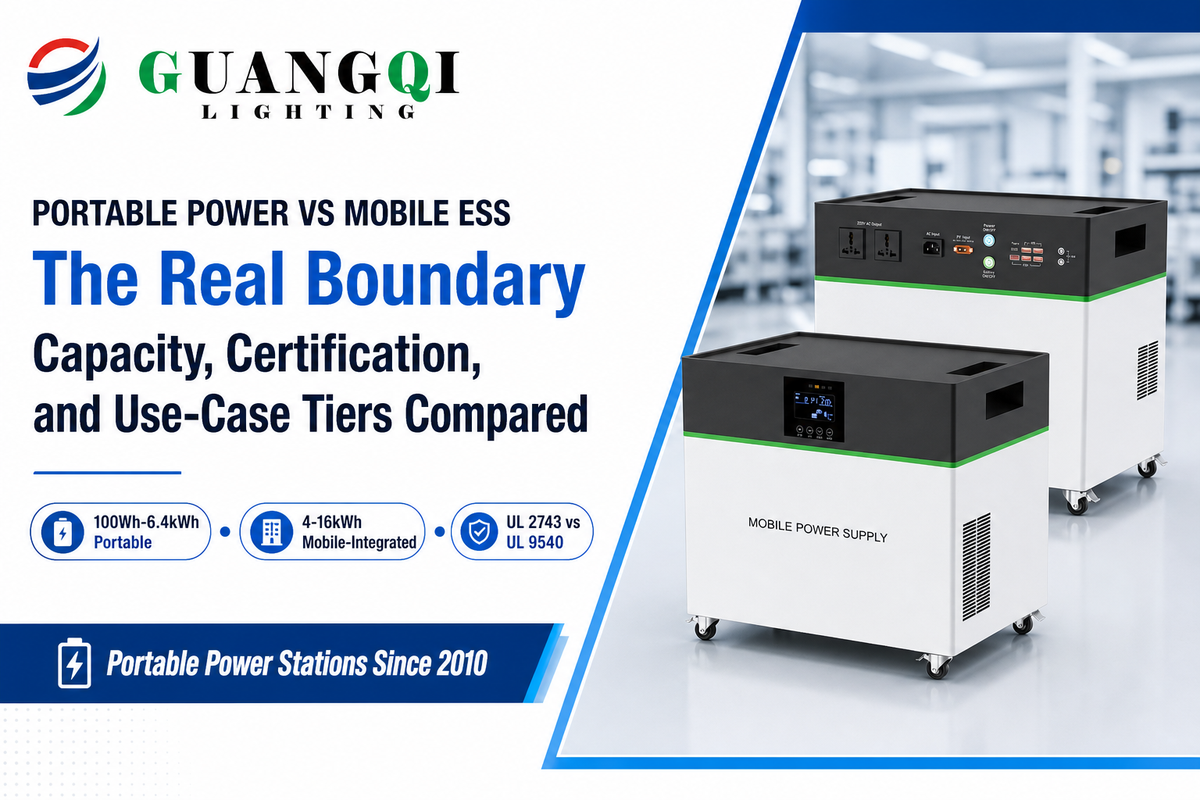
Searches for “portable power station vs mobile energy storage system” turn up two products that get treated as if they were the same thing, when in fact they sit in completely different product categories. Portable power stations are battery-and-inverter units sized for a single user’s short-duration loads, while the larger, vehicle-transportable systems some manufacturers also call “mobile energy storage” are built for multi-day or industrial-scale power. A shopper who sees a “mobile” label on one product page and a “battery” label on another reasonably can be confused. One item can be lifted into the trunk of a car and brought to a campsite; the other is, in its full industrial sense, a trailer or container-mounted apparatus to be moved by a crane or semi-truck. In between those two extremes is a third, largely unrecognized, category of mobile systems from multiple manufacturers-including the Guangqi products highlighted in the examples herein-that these firms call “mobile energy storage.”
“Search results for this exact phrase currently blend a $200 camping battery and a $200,000 construction-site trailer into the same results page, call it the Shared-Name Trap.”
Quick Specs
| Portable power station | 100Wh-6.4kWh, handheld, one-person carry |
| Mobile-integrated tier | 4-16kWh, wheeled/panel-mounted, still one-vehicle transport |
| True industrial MESS | 10kWh to multiple MWh, trailer or shipping-container mounted |
| Governing standard | UL 2743 (portable, ≤20kWh lithium/sodium-ion) vs UL 9540 (stationary/larger) |
| Market-size confusion | Analyst firms differ 14x on what “mobile energy storage system” even measures |
Portable Power Station vs Mobile Energy Storage System: The 60-Second Comparison

A portable power station is a complete package containing a battery, an inverter, and output ports in the 100Wh-to-6.4kWh capacity band that can be lifted into a car trunk. Mobile energy storage systems cover a broader span: some manufacturers apply the term to 4-16kWh wheeled or panel-mounted units built for a single buyer’s property or jobsite, while the industrial end of the term covers 10kWh-to-multiple-megawatt-hour systems delivered to construction sites or film shoots by trailer, truck, or crane. Below is an overview of the three categories, to provide a backdrop for the subsequent sections of this guide – the certification boundary between the first two tiers is itself governed by UL 2743, covered in full further down.
| Tier | Capacity range | How it moves | Typical buyer |
|---|---|---|---|
| Portable power station | 100Wh-6.4kWh | Carried by hand | Camper, renter, prepper |
| Mobile-integrated storage | 4-16kWh | Wheeled or panel, one-vehicle load | Home-outage / jobsite buyer |
| True industrial MESS | 10kWh-multiple MWh | Trailer, truck bed, or crane | Construction, events, utility |
The brochures from manufacturers such as Guangqi itself range over the first two rows; for instance, the LK series has 300W-6000W output and a capacity from 230Wh to about 6.4kWh, while the MS-T line falls into the 4.04-16.07kWh mobile-integrated category. None of the items in either series can claim to be trailer-mounted industrial MESS, and the accuracy here’s precisely why this guide exists – most other guides tend to focus on only one extreme and then imply it’s the entire category. Guessing wrong on this distinction is a real, costly mistake, not just a labeling headache: paying for trailer-tier capacity a portable pack could have covered at a fraction of the price, or under-buying a portable pack for a load that actually needed the mobile-integrated tier’s extra runtime. Because Guangqi’s own catalog provides real coverage of exactly the first two rows in this table, its spec sheet is a useful anchor for where each tier actually starts.
Portable Power Station: Definition, Real Capacity Range, and What It’s Actually Built For
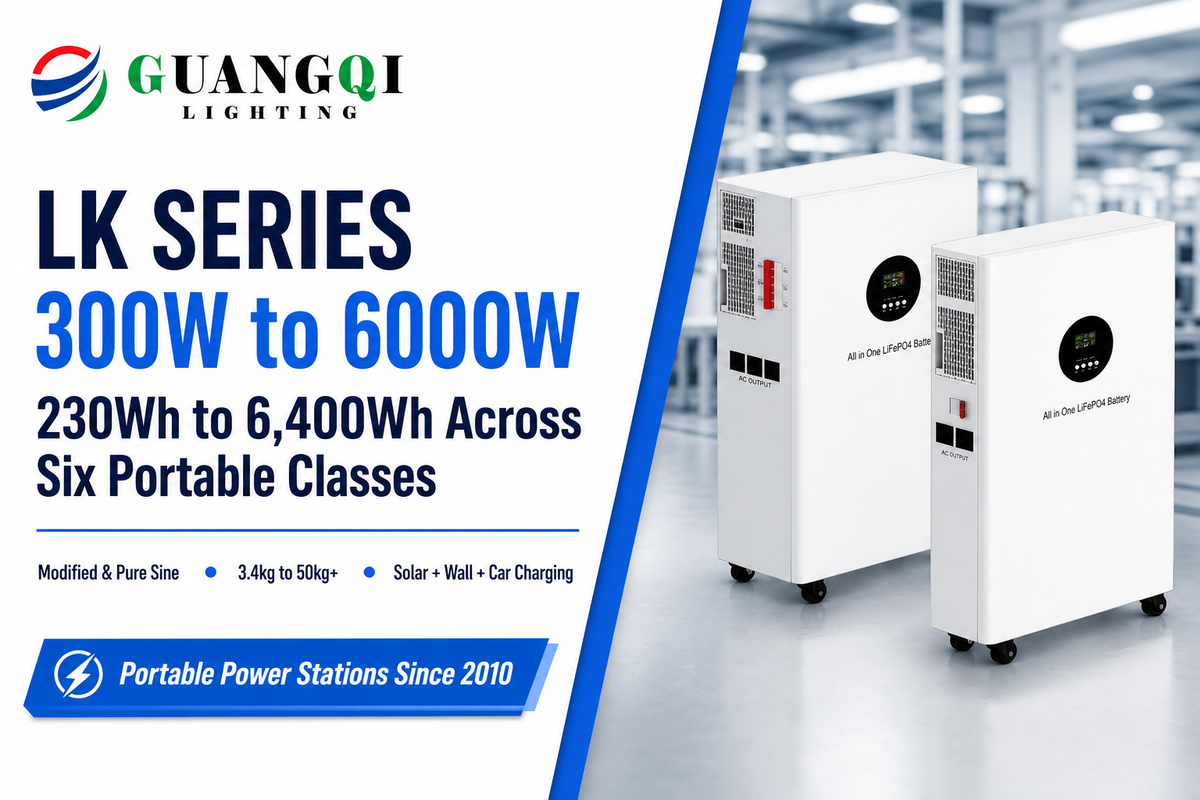
A portable power station includes a portable battery, an inverter, and various outputs (AC, USB, and DC), all housed in a portable casing. It can be recharged from a wall outlet, a car’s 12V port, or stored solar energy via a folding panel. For example, the Guangqi LK line has products from the LK-300W to the LK-6000W. The LK-300W, the entry product, comes in at 3.4kg and offers a modified sine wave output at a capacity of 230Wh, whereas the LK-1000W and LK-1500W feature a pure sine wave at capacities of 1,024Wh and 1,280Wh, respectively, and weigh approximately 12.6-19.5kg. The highest capacity Guangqi LK models-LK-5000W/6000W-at 5,120Wh to 6,400Wh capacity, top out at over 50kg, which still puts them within the range for a two-person lift.
✔ Advantages
- Zero installation, plug-and-run out of the box
- Charges from solar, wall, or car port
- Silent operation, safe for indoor use
⚠ Limitations
- Modified sine wave on entry models can stall compressor/motor loads
- Solar panel input tops out near 200W on most sub-1.5kWh models
- Not rated for whole-house or continuous industrial duty
| Model / class | Output | Battery capacity | Waveform | Weight |
|---|---|---|---|---|
| LK-300W | 300W | 230Wh | Modified sine | 3.4kg |
| LK-600W | 600W | 576Wh | Pure sine | 10.6kg |
| LK-1000W | 1,000W | 1,024Wh | Pure sine | 12.6kg |
| LK-1500W | 1,500W | 1,280Wh | Pure sine | 19.5kg |
| LK-2500W / LK-3500W | 2,500-3,500W | 2,432-3,072Wh | Pure sine | confirm before order |
| LK-5000W / LK-6000W | 5,000-6,000W | 5,120-6,400Wh | confirm before order | 50kg-plus |
| MS-T04 (mobile-integrated) | system-level | 4.04kWh | system review | wheeled/panel |
| MS-T08 (mobile-integrated) | system-level | 8.03kWh | system review | wheeled/panel |
| MS-T12 (mobile-integrated) | system-level | 10.49kWh | system review | wheeled/panel |
| MS-T16 (mobile-integrated) | system-level | 16.07kWh | system review | wheeled/panel |
A CleanTechnica hands-on test of a consumer 2026 power station (the Bluetti Apex 300/B300K) shows that the category’s features continue to center on the same elements as before – the inverter, waveform, and charging rate – as seen in Guangqi’s spec sheet, serving as a helpful confirmation if you stumble upon a unit that appears cheap for its rated Watt-hours. Shoppers comparing a portable power station for camping against consumer-brand options – Jackery power station, Bluetti power station, and EcoFlow lineups are the three most commonly cross-shopped – are really comparing the same fundamentals covered here: capacity, waveform, and PV input, regardless of which portable electricity generator or portable power source ends up on the label.
Mobile Energy Storage System: Two Very Different Products Share One Name

Mobile energy storage system properly describes 10kWh-to-multiple-megawatt-hour equipment towed by trailer, truck, or crane for grid support, construction, and events – it’s not a hand-carry pack. A NeuronWriter topical analysis of that exact search phrase independently surfaced “Trailer (vehicle),” “Truck,” and “Vehicle-to-grid” as recognized entities – the NLP-level version of the same finding, since search engines already associate the full phrase with rolling industrial hardware even when individual sellers apply it to something much smaller.
This industrial reading is no stretch. NextG Power’s 10ft truck-mounted systems run 250-600 kWh, and their 20ft containerized trailers are north of 1MWh. There are independent trade press publications on the topic of a new industry segment.
According to ESS News, Sunwoda’s MESS 2000 is labeled the “world’s first 10-metre, 2MWh mobile energy storage system vehicle” while Alfen’s plug-and-play mobile units come in 360-540 kWh packages. Public records demonstrate the use case isn’t a manufacturer invention and that utilities are purchasing the technology; the California Public Utilities Commission has recently approved a 28 MVA mobile trailer substation, New York’s Public Service Department has filings discussing utility-owned mobile BESS used to support immediate grid needs, and an NREL utility-readiness report describes Con Edison’s own 1 MW / 4 MWh tractor-trailer battery pilot as equipment that “readily relocates to where it’s most useful.”
📐 Engineering Note
Guangqi’s MS-T04 through MS-T16 series units (4.04-16.07 kWh) are perhaps two orders of magnitude below the lowest truly trailer-size MESS units discussed in this segment. Guangqi’s marketing materials candidly label this class of device “mobile energy storage,” describing it as the logical next step up in capability from an individual portable system — not a rival to trailerized or containerized systems. Any contracting company reviewing a bid request or grid support requirement for trailerized, >10 kWh of energy storage capacity should escalate that to an industrial MESS vendor, rather than consult a catalog of portable stations.
In forum and social-media conversations among van-life and overlanding consumers, buyers routinely collapse all of this down to a single term: a ‘power station’ gets applied to anything from a phone-charging setup in an overlanding vehicle to a home emergency battery during an extended power outage, with no pause to distinguish a ‘mobile-integrated tier’ from a ‘trailer tier.’ The three-tier classification this guide uses addresses a real, ongoing problem in how buyers actually talk about these products today – it is not an invented SEO hook.
They don’t even agree on where to draw the category line. Fortune Business Insights put out an estimate on their “Mobile energy storage system Market” as $58.28 billion for 2025 across three categories – self-mobile (EVs), containerized solutions, and trailer-mounted solutions – and their own breakdown shows the self-mobile/EV segment holding a 94.42% share by 2026; in other words, most of that figure is just EVs working as vehicle-to-grid mobile storage, not a giant trailer or container. Multiply what’s left by a factor to bring it back to the three major market types and that “other” chunk works out to be around $3-4 billion — which is strangely close to Grand View Research’s “Mobile battery energy storage systems Market” estimate of $4.2 billion.
It’s, at any rate, a better explanation than two market firms’ headline figures being different by an order of magnitude; after removing the large EV piece from the larger figure, what remains isn’t wildly far from the other firm’s headline. Getting this wrong is not just semantic confusion: a buyer who requests a quote for “mobile energy storage” without specifying scale risks a proposal priced for a full trailer system when a wheeled unit costing a small fraction of that would do, or the reverse. Because Guangqi’s MS-T line occupies the honest middle ground rather than either extreme, it provides a concrete reference point for buyers trying to place their own requirement correctly on this spectrum.
Energy storage technology is not one monolithic category. Beyond lithium battery systems, the wider field of storage technologies includes thermal energy storage, hydrogen energy storage, and other long-duration approaches – though for portable and mobile-integrated buyers, lithium iron phosphate battery packs remain the dominant, practical choice. Tied into a home or facility’s electrical distribution system, a stationary energy storage installation plays a different role than a portable unit: it can pair directly with renewable energy generation, storing excess solar energy during the day for use after sunset, while a portable pack simply carries whatever charge it received before deployment. That distinction matters for anyone evaluating energy solutions at scale – large-scale renewable energy integration and utility-scale battery energy storage systems solve a supply-and-demand problem that a handheld or wheeled unit was never designed to touch.
Certification Boundary: UL 2743, UL 9540, and the 20 kWh Ceiling

UL 2743 Edition 3 (published September 24, 2025, still the active edition) is the standard for portable power packs and sets a 20kWh aggregate capacity ceiling for lithium-ion and sodium-ion chemistries in Table 1.1, the same table sets a 70kWh threshold for lead-acid packs and 3kWh for electrochemical-capacitor units, and it explicitly excludes power banks (covered separately under UL 2056), utility-interactive hardwired systems, and EV-charging wiring. Cross the 20kWh line on a lithium pack and the product moves into UL 9540 territory, Edition 3, last revised March 7, 2025, which governs stationary and larger residential energy storage installations.
| Product class | Governing standard | Capacity ceiling |
|---|---|---|
| Portable power pack (Li/Na-ion) | UL 2743 Ed.3 (2025-09-24) | 20 kWh aggregate |
| Portable power pack (lead-acid) | UL 2743 Ed.3 | 70 kWh aggregate |
| Stationary/larger residential ESS | UL 9540 Ed.3 (rev. 2025-03-07) | Above the UL 2743 ceiling |
Another edge-case worth watching is UL 9540A’s 5th edition, which an IEEE PES presentation by a UL Solutions engineer flagged as anticipated for 2025; while this revision likely won’t move the 20kWh line itself, one other competitive portable guide seems to classify 20kWh-ish systems as portable, conflicting with UL 2743 on at least one category in the market.
Beyond the product level, once a deployment moves to true industrial MESS space, certification is only half the battle. The 2024 International Fire Code, for instance, lays a whole new non-negotiable layer for temporary mobile energy storage on site: they’re capped at 30 days, require an operational permit, and have their own set of separation-distance and fencing rules that must be observed in addition to the UL 9540 path. Commercial and utility purchasers should also anticipate a standards set much larger than UL 2743/9540, including UL 9540A fire propagation testing, NFPA 855, and grid interconnection standards such as IEEE 1547 if connecting to utility power.
Match Your Use Case to the Right Tier (Camping, Home Battery Backup, or Industrial Jobsite)

The Weekend-vs-Workweek Test eliminates most of this tiering confusion by asking one simple question: is the load going to run for a weekend trip or a workweek-long job? If the former, you probably need portable. If the latter – for example, powering power tools at a jobsite five days in a row, or running support equipment for a multi-day grid event – then you’re likely in the mobile-integrated or industrial MESS category – and once a deployment crosses into that territory, the International Fire Code’s 30-day/permit rules covered in the certification section above start to apply.
| Use case | Recommended tier | Why |
|---|---|---|
| Camping, phone/laptop, short outage | Portable pack (LK-300W-1500W class) | Weekend-length load, one-person carry |
| Selected home circuits, backup power during an outage | Mobile-integrated (MS-T04-T16) | Multi-day runtime, fridge/router/lights |
| Jobsite power tools, events, grid support | True industrial MESS (trailer/container) | Continuous workweek duty, 10kWh-plus |
An example from r/Generator shows why you may need to be realistic with runtime estimates in an emergency, especially during extended outages: “Hurricanes generally include a number of days of clouds, which isn’t really conducive with solar recharging” – the take-away being to budget for grid or generator top-offs for any truly portable pack that must endure an extended event. Likewise, on r/prepping, one renter expressed a similar capacity limitation during an evacuation where “the microwave would be the last one because we haul [power],” effectively articulating a capacity-budgeting constraint more than a product defect.
For most households, home energy planning around a portable or mobile-integrated pack is simpler than it sounds: identify the handful of loads that matter during an outage, size to those, and treat everything else as a bonus. Larger home battery systems and true portable solar setups (a pack plus a folding array) extend that same logic to longer, unattended stretches without grid power. None of this touches power transmission or integrated energy planning at the utility level, and it does not require wind and solar energy analysis the way a utility-scale project would – the impact on the power a household actually needs is what matters, not the wider grid’s supply mix.
Capacity & Runtime: How Many Watt-Hours Do You Actually Need? (The Capacity Cliff)

NREL’s storage-deployment framework separates power capacity (kW, how fast energy can be drawn) from energy capacity (kWh, how long it lasts) — a distinction PNNL, a U.S. GPO storage-definition report, and a peer-reviewed ScienceDirect capacity-investment study all restate independently. For genuinely long-duration deployments, the DOE’s Storage Innovations 2030 program adds a complementary lens on top of that: it targets systems built around duration (10-plus hours) and levelized cost of storage rather than raw kW/kWh alone, a framing more relevant to a utility-scale mobile MESS contract than to sizing a portable pack, but worth knowing if a buyer’s request starts sounding like one. Sizing a portable power station means multiplying running watts by hours needed, then adding headroom for the surge watts a compressor or motor draws at startup, and checking that the battery itself can deliver that surge, not just matching a headline watt number on the box.
Worked example: a 150W camping fridge running 8 hours with a 600W compressor-start surge
| Step | Calculation | Result |
|---|---|---|
| Base energy need | 150W × 8h | 1,200Wh |
| Planning margin (85% usable) | 1,200Wh ÷ 0.85 | ~1,412Wh target |
| Surge check | 600W compressor-start vs inverter peak rating | needs pure sine wave, ≥600W surge-rated |
| Tier landed on | 1,412Wh + surge headroom | LK-1500W class (1,280Wh) is tight; LK-2500W (2,432Wh) is the safer fit |
The same roughly-85%-usable-energy planning margin forms the basis of Guangqi’s own runtime calculator tool, which allows buyers to screen their load watts and desired hours against the company’s LK and MS-T model classes prior to receiving a quote. One overlanding forum discussion offers a pragmatic point of realism to build into any sizing equation: Most portable packs have a fairly low ceiling on charging input, meaning “just using the regular DC charging input” might be the only practical recharge method in the field as opposed to deploying a full solar setup.
Every unit in this comparison, portable or mobile-integrated, depends on a battery management system to protect its individual storage batteries from overcharge, over-discharge, and thermal extremes; the same battery management logic scales up whether the pack is a handheld unit or a larger battery system built into the mobile-integrated tier. On the utility side, a power grid operator values mobile assets for a different reason: the ability to provide temporary power during planned maintenance windows or an unplanned outage, support power system operation under peak load, and in some pilot programs provide emergency backup power to a neighborhood substation – a use case with little in common with a homeowner’s need to keep a router and a few lamps running. Wind power and other renewable energy power sources feed into that same grid, and a battery with solar panels or a wind farm attached helps smooth out supply, but that grid-scale balancing act is a different problem from sizing a portable pack for a weekend trip.
Cost Comparison Across Tiers: What You Pay for the Jump

Readers who landed here searching portable power station vs mobile energy storage system price or portable power station vs mobile energy storage system cost will find that exact breakdown below. Cost per kWh tends to drop as scale goes up, but not along one clean curve, and NREL’s own Annual Technology Baseline adds an important nuance: installed cost per kWh falls with longer duration while cost per kW can rise, so “bigger is always cheaper per kWh” isn’t a safe universal rule. Four independent sources point in the same general direction without agreeing on exact numbers, which is itself worth knowing before a buyer expects a tidy chart. Installed residential battery storage runs roughly $700-1,300 per kWh, containerized systems at 100kWh-plus scale run closer to $180-300 per kWh, and a 2024 global average cited from BNEF data (via a secondary LinkedIn repost, not independently confirmed here) put turnkey energy-storage pricing around $165 per kWh, down 40% year over year. Treat these as directionally consistent, not as one verified formula.
Electricity price volatility is part of why utilities pursue battery storage in the first place: storing power when the electricity price is low and discharging when demand peaks is a core power strategy at grid scale, though it matters far less for a buyer weighing energy solutions at the portable or mobile-integrated tier. For that buyer, the more relevant math is simple energy savings on eliminated fuel and generator-rental costs, not grid arbitrage. A portable pack, a set of storage batteries paired with an inverter, and a folding solar array give a household or jobsite clean energy and provide power on demand without a fuel supply chain; the same total energy math applies whether the source is a wall outlet, a car’s DC charging station, or a solar array, and whether the load is mobile devices, a fridge, or power tools. A larger battery system draws on the same energy resources and the same underlying capacity and power tradeoff covered earlier in this guide – store energy now, spend it later – just at a scale where power supply and power generation start to matter as much as raw capacity. The benefits of mobile energy storage extend well beyond emergency backup once utilities and event operators are involved. Large-scale energy projects and rising renewable energy consumption are why utility-scale storage and mobile deployment both keep growing, but that scale of storage energy planning is a separate conversation from the power backup a household or jobsite buyer is actually shopping for.
5-year total cost of ownership across tiers (illustrative, not a quote)
| Cost item | Portable pack (~1.3kWh) | Mobile-integrated (~8kWh) |
|---|---|---|
| Purchase price | ~$700-1,300/kWh × 1.3kWh ≈ $910-1,690 | ~$300-500/kWh × 8kWh ≈ $2,400-4,000 |
| Installation & commissioning | $0 (plug-and-run) | Transfer-switch review recommended |
| Energy (5-yr, solar-recharged) | Near-zero marginal | Near-zero marginal |
| Maintenance & spares (5-yr) | Low (sealed unit) | Low-moderate (BMS/inverter check) |
| Downtime risk (5-yr) | Low (swap-in spare pack) | Moderate (single larger asset) |
Payback example: a buyer choosing the mobile-integrated tier over three portable packs to cover the same selected-circuit home-outage load pays roughly 1.5-2.5x more upfront but avoids juggling multiple smaller units and their separate charge cycles.
A Reddit discussion among preppers highlights a significant cost factor that might affect sticker prices: In the U.S., “battery units of 3kW or greater can be claimed per the IRA” tax credit, a point that becomes relevant for buyers at the low end of the mobile-integrated storage market.
Disadvantages and When NOT to Buy Either One

The limitations of a portable power station revolve around runtime and charging time: limited total watt-hours, an inverter capacity cutoff when the actual draw of a connected appliance exceeds it, slower recharging in solar-only scenarios compared to wall charging, and diminishing battery capacity over years of use. Most buyer mistakes are related to capacity – undersizing or oversizing “just in case.”
Avoid buying a portable pack for whole-house backup, appliances with compressors or motor start surge above rated peak output, or applications requiring multi-day operation without external power sources. Don’t jump directly to integrated mobile or industrial systems for weekend-length, single-user loads; the additional weight, cost, and capacity aren’t beneficial.
User reviews confirm the marketing information. One Reddit thread advises cutting back on heating and cooling to extend pack runtime, which is a load management technique more impactful than the watt-hour rating. Exceeding a pack’s continuous or surge rating, the same rating tested under UL 2743, can lead to tripped safety circuits or even fire hazards. Root cause is straightforward: a portable pack’s inverter and BMS are engineered to a fixed continuous-watt ceiling, and pushing past it for even a few seconds is what trips the protection circuit or, in an aging unit, causes real heat buildup.
Which Should You Choose? A 3-Tier Decision Framework

The guide uses market size and certification data from official analyst reports, UL Standards documentation, and government filings – not marketing materials. When estimates varied widely, the guide clarified the differences based on scope (e.g., inclusion of EVs) instead of presenting raw figures without explanation.
Picture a jobsite manager who orders a small portable pack for a 5-day concrete pour: it runs out of power by lunch on day one. A buyer who over-buys a trailer-scale system for weekend camping makes the opposite mistake, paying for capacity that never gets used. The right tier follows directly from duration and portability needs, because a system sized for a weekend trip never has the surge capacity or runtime a multi-day jobsite deployment requires – Guangqi’s own three-tier lineup provides a concrete anchor for making that call. Here’s a simplified path for selecting a system: for a portable, weekend-length load carried by one person, a portable pack like the Guangqi LK-300W to LK-3500W series is appropriate. For extended outage backup of select home circuits or single-vehicle site deployment, a mobile-integrated system (MS-T04 to MS-T16) is the next logical step – seek professional system review rather than a simple retail quote. For large-scale needs like construction sites, events, or support contracts requiring 10 kWh+ transported via vehicle, industrial mobile energy storage system solutions are required, which fall into a different category than Guangqi’s portable or integrated systems.
For users considering portable batteries or mobile-integrated systems who wish to understand the specifics of Guangqi’s lifepo4 batteries (cycle life, cold weather limitations, and safety compared to standard lithium-ion), our companion guide, “LiFePO4 vs Li-ion battery chemistry for portable power stations,” provides detailed information on the portable energy storage systems built around this chemistry.
Before You Request a Quote: The Spec Checklist That Prevents a Wrong-Tier Purchase

Good energy management starts with an accurate quote request: buyers who send the right data up front keep their quote request from landing in the wrong tier. An energy management system on a larger installation automates some of this load-balancing decision-making, but for a one-off portable or mobile-integrated purchase, the buyer has to do that power and energy accounting manually before requesting a quote – matching electric energy needs (mobile power for a device, or standing power for a jobsite) against large storage options rather than guessing. Guangqi’s own compliance file checklist for portable and mobile energy storage orders includes five things all buyers should prepare in advance of their quote requests:
RFQ checklist — copy these into your quote request:
| Parameter | Recommended range | Why it matters | How to verify |
|---|---|---|---|
| Running + surge watts | Nameplate + 2-3x for motor/compressor loads | Caps which inverter class fits | Appliance nameplate photo |
| Target runtime | Hours per day, days total | Sets the Wh/kWh target | Load list with duty cycle |
| Use case | Camping / home-selected-circuit / jobsite | Routes to the right tier | Stated up front, not assumed |
| PV input plan | Panel wattage + voltage range | Controls charge speed match | Panel spec sheet |
| Certificate needs | UL 2743 / UL 9540 / battery transport papers | Confirms compliant tier/model; airline/freight shipment of lithium cells above 160Wh needs hazmat paperwork | Request model-specific test report + transport classification |
A load list with photos of appliance nameplates, a target runtime, and an explicit desired tier takes a quote request from a multi-email exercise to a 5-minute model match – and is by far the single fastest way to ensure you don’t get a quote for the wrong tier. Certificate requests should reference the specific standard in play, whether that’s UL 2743 for a portable pack or UL 9540 once the order crosses into stationary/larger territory.
Frequently Asked Questions
Q: What are the disadvantages of a portable power station?
Portable power station disadvantages center on limited total watt-hours, an inverter output ceiling, slower solar-only recharge, and battery capacity that ages over years of cycling.
Because the battery and inverter are integrated into a single unit, the portable power station cannot scale beyond its listed watt-hours or output watts in the same way a modular system can. Motor- or compressor-driven loads that are over the inverter’s surge capability will instead trip the protection rather than run, and models that don’t have pure sine wave output can have unpredictable effects on sensitive electronics. Recharge speed in a solar-only configuration is also constrained by PV input capabilities, typically below 200W in sub-1.5kWh models, which may not be adequate in multi-day cloudy periods.
Q: What are the disadvantages of a BESS or mobile energy storage system?
Moving to a larger BESS or mobile energy storage system carries a much higher upfront cost, needs an installation and certificate review, and represents a single larger asset with more downtime risk than several smaller units.
Once you transition beyond the portable pack into the integrated-mobile or true-industrial MESS category, the purchase is no longer simply plug-and-play. Here we start to discuss transfer switch review, PV array voltage and current compatibility, and (at or beyond the 20kWh lithium threshold) the UL 9540 certification process. Losing one larger device in the event of a malfunction means losing all of your capacity simultaneously, rather than the redundant swap-in capability that you get with multiple smaller portable units.
Q: Is it worth getting a portable power station?
Yes, for weekend-length loads like camping, short outages, or renter-friendly backup, but it’s the wrong purchase for whole-home or multi-day continuous power needs, where a mobile-integrated or industrial-tier system fits the job better.
Portable power stations are sized appropriately for specific and limited use cases: charging cell phones and laptops, running LED lights, keeping a camping fridge running, or maintaining a router and some lamps during short power outages. Once a load begins running for several consecutive days or when the requirement shifts to whole-home backup power, a larger portable power station simply is not the correct solution — the answer lies at the integrated-mobile or true-industrial tier, not simply a larger portable unit.
Q: Can a portable power station power an entire house?
No, selected circuits only, not a whole house.
Even Guangqi’s largest LK-6000W product maxes out at 6.4kWh – only large enough to handle appliances like a refrigerator, router and lighting, not a full home’s continuous consumption. Backing up a whole house becomes a matter of mobile-integrated or stationary solutions.
Q: What is a Portable Battery Energy Storage System (PBESS)?
PBESS is another industry label for the same portable power station category, typically covering roughly 100Wh to 20kWh-class units, and buyers researching either term should expect substantial overlap between the two labels in practice.
While “portable power station” is a term that a number of manufacturers may use synonymously with “PBESS,” there are also competitors that stretch their own definition of “PBESS high-capacity” to a full 20kWh, directly touching the aggregate capacity limit set by UL 2743 for devices still carrying the “portable” designation. This can lead to confusion when comparing listings: a PBESS unit at the high end of its capacity specification may be nudging against the certification threshold discussed above and may require the buyer to seek additional documentation from the vendor.
Q: When should I choose mobile energy storage instead of a portable power station?
Move up to mobile-integrated storage once the need involves multi-kWh capacity, longer backup hours, higher PV input, or selected whole-circuit home backup that a portable pack’s inverter and battery simply cannot sustain.
The real trigger is capability and time, not brand loyalty – if your need requires > ~3 kWh, spans multiple days, or touches multiple house circuits rather than a few appliances – a mobile-integrated solution like Guangqi’s MS-T series is a more practical beginning point than a bigger battery pack.
Why We Write This
We’ve manufactured LED lights since 2010 and added portable and mobile energy storage in 2026, so we field the same “is this a portable battery pack or a mobile system” question from distributors every week. We built this guide because our own product listing kept fielding that exact question without a dedicated answer, and because a web search for it today brings up a mix of a camping battery and a construction trailer on the same results page.
References & Sources
- UL 2743 Edition 3 (2025-09-24) — UL Standards
- UL 9540 Edition 3 (rev. 2025-03-07) — UL Standards
- The Four Phases of Storage Deployment — National Renewable Energy Laboratory (NREL)
- Energy Storage Capacity Definitions — Pacific Northwest National Laboratory (PNNL)
- Mobile Substation Deployment Filings — California Public Utilities Commission
- Sunwoda MESS 2000: 10-metre, 2MWh mobile energy storage vehicle — ESS News
- Clean power unplugged: the rise of mobile energy storage — Energy-Storage.news
- The Bluetti Apex 300 & B300K Portable Power Station, Tested — CleanTechnica
- Portable Power Station Market Size Report — Fortune Business Insights
- Mobile Energy Storage System Market Size Report — Fortune Business Insights
- Mobile Energy Storage System Scheduling Method (CN114117743A) — Google Patents
- 2024 International Fire Code, Chapter 12 (Energy Systems) — International Code Council
- Storage Innovations 2030 — U.S. Department of Energy
- Utility-Scale Battery Storage, Annual Technology Baseline — National Renewable Energy Laboratory (NREL)
Related Articles
- Guangqi Portable Power Station Lineup — full LK and MS-T model families, specs, and quote tools
- LiFePO4 vs Li-ion Battery Chemistry for Portable Power Stations — cycle life, safety, and cold-weather charging depth
- Runtime & Model Calculator — enter your load watts and target runtime for a starting model class
- Model Comparison Table — compare Guangqi model families side by side
Guangqi’s site groups these resources under portable power stations and home battery options on one side, and dedicated pages for power stations and home batteries built for jobsite duty on the other – the same three-tier split covered throughout this guide, enhancing power system planning either way.