Get in Touch with GUANGQI



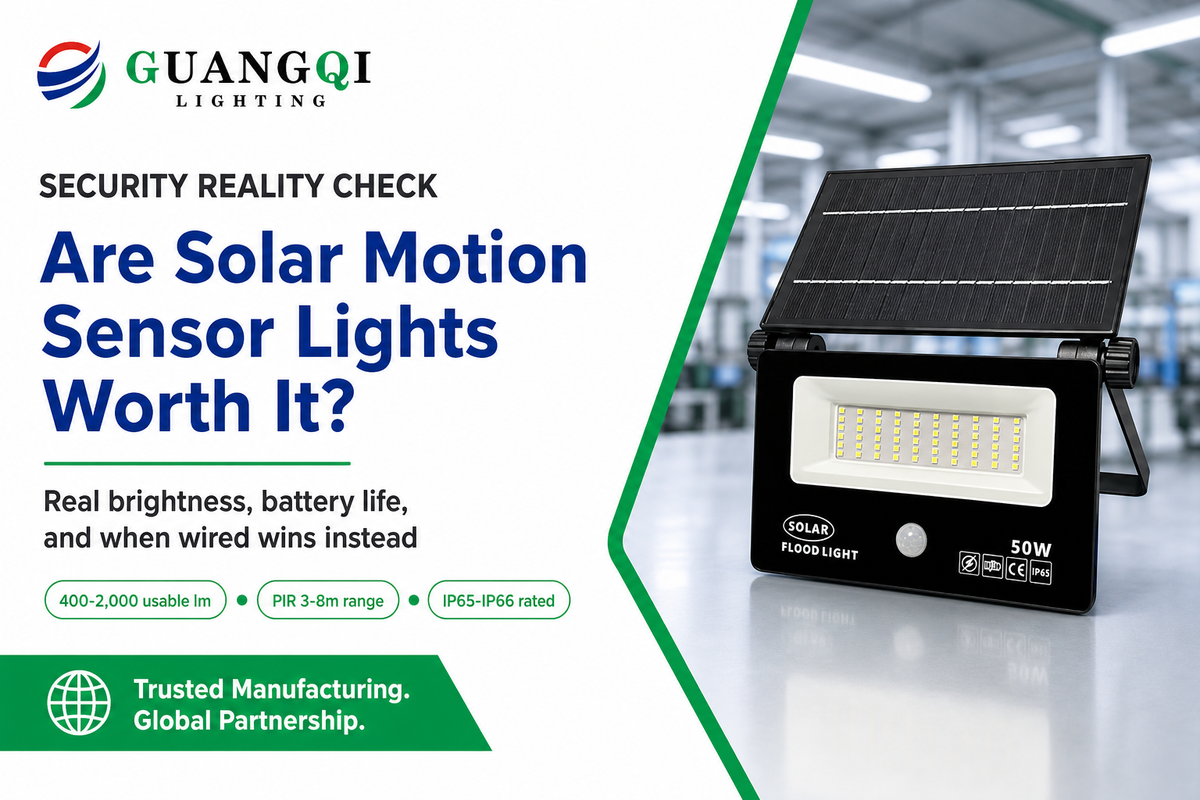
Solar motion sensor lights worth it is the question most buyers ask, and for most homeowners the answer is yes – provided you weigh your sun exposure, your security requirements, and how much light you really need. For around $12-$60, these motion-sensing solar units provide wireless, no-dig illumination to a driveway, backyard, or fence – but their greatest advantage, wireless convenience, is also their weakest point in low-cost units. Here, we’ll give you a grounded-in-engineering take rather than a marketing pitch. (Updated July 2026) These LED solar outdoor security lights automatically switch on when they sense motion, drawing no grid electricity at all.
Short answer: Solar motion sensor lights are worth it for most low-to-moderate security needs – a $12-$60 light produces 400-2,000 usable lumens when you need it, no wiring required. They’re not worth it if you require 3,000+ lumens of constant light, your area gets little sun, or you’ve a high-value target; in these cases, wired lights are better.
Key Takeaways
- The “6,000 lumen” figure printed on the box is just a sales number; actual security lighting output is closer to 400-2,000 lumens.
- Performance in shade and winter varies; a correctly-sized panel in direct sun will work well, but an undersized one in shade will be dead by January.
- Your battery, not your LED, determines light lifespan; plan on replacing it every 1-3 years, and avoid non-replaceable battery packs.
- Motion lights are now being favored under local dark-sky ordinances restricting outdoor light usage.
- Motion lights are more effective when they supplement a low level of ambient lighting.
Quick Specs — Typical Solar Motion Sensor Security Light
| Usable brightness | 400–2,000 lm (box claims 3,000–6,000 lm) |
| Detection range / angle | 10–26 ft (3–8 m) / 120–270° |
| Dwell (on-time per trigger) | 20–90 seconds |
| Battery | 1,200–3,000 mAh Li-ion / Ni-MH, 1–3 yr life |
| Solar panel | 1–6 W monocrystalline or polycrystalline |
| Weatherproof rating | IP65–IP66 (per IEC 60529) |
| Price band | $12–$60 |
| Unit lifespan | 2–5 years |
Are Solar Motion Sensor Lights Worth It? The Short Answer
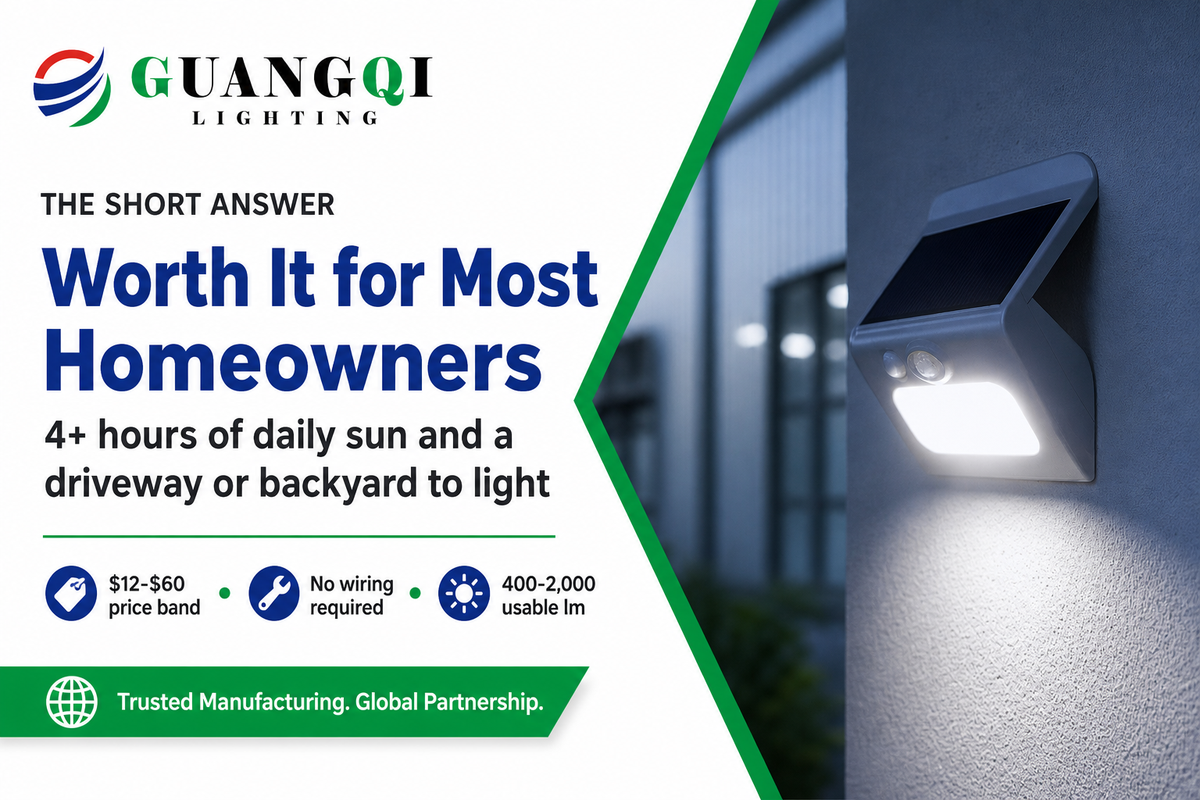
For the majority of homeowners, yes. If you get at least four hours of direct sun each day and need to illuminate a driveway, path, or backyard whenever motion is detected, without hiring an electrician to bury a wire, then a good quality mid-range solar security light is truly worthwhile.
The ease of installation alone can save you $150-$300 compared to running mains power to an outdoor area. The extremes where solar lighting fails to deliver include situations that demand consistent high-lumen floodlighting, very shady environments, and sites that require protection of high-value assets.
Customers are frequently disappointed because they focus on the wrong criteria. They look for the highest lumen number advertised and the cheapest price, only to discover the light is weak after only a few months. The key consideration is whether your specific needs and the site conditions are compatible with the capabilities of solar technology, which the test below addresses.
💡 The 4-Condition Worth-It Test
For each of the conditions below, check off yes or no. If you’ve three or four “yes” answers, then solar motion lights are suitable for your needs.
- Sun: The location where the solar panel will be mounted receives a minimum of four hours of direct sunlight per day.
- Security level: Your objective is primarily deterrence and convenience rather than protecting a high-value asset.
- Brightness: You’ll be satisfied with 2,000 lumens or less to cover the area you need lit.
- Wiring: You don’t have easy access to a nearby mains outlet, so the wireless setup is a significant advantage.
If you answer two or fewer questions “yes,” we recommend reviewing our comparison of solar flood lights versus wired security lights before making a purchase.
How Solar Motion Sensor Lights Actually Work (Panel → Battery → PIR)

The four components that go into making a solar motion sensor light work off the same energy budget: a solar panel by day to charge a rechargeable battery; a motion sensor (typically PIR – passive infrared – to sense a hot moving body) which triggers the LED light to turn on for a programmed duration.
If you understand that cycle, then any spec sheet becomes less of a marketing sheet and more a functional diagram you can take with a pinch of salt to the headline lumen number.
Put simply, a motion activated solar light pairs that panel with a pir motion sensor and an LED head, and knowing each part’s real-world limit is what separates buyers who are happy in year three from buyers who aren’t.
| Component | Typical spec | What to check |
|---|---|---|
| Solar panel | 1–6 W, mono or poly | Wattage and whether it detaches for a sunnier mounting spot |
| Battery | 1,200–3,000 mAh Li-ion / Ni-MH | Capacity and, critically, whether it is user-replaceable |
| PIR sensor | 10–26 ft, 120–270°, 20–90 s dwell | Range, angle, and adjustable sensitivity to cut false triggers |
| LED | Rated lumens vs usable lumens | Usable output, not LED count — more diodes is not more light |
Component values derived from reviewer testing and manufacturers data; refer to the individual spec sheet.
How far and wide do solar motion sensor lights detect motion?
A standard PIR sensor will reliably detect a walking human within 3 to 8 m (10-26 ft) in a typical arc from about 120 to 180 degrees (though ultra-wide angles reach up to 270) because the sensor responds to the changing levels of infrared heat from a human body passing through its detection zone.
Detection is typically strongest when someone is walking across the detection beam rather than straight towards it – this is why sensors positioned along a pathway or fence are more effective than those pointed at an approach.
Increasingly 2026-based motion sensors use radar instead of PIR for more object-piercing capability and false alarm immunity, at a price. Worth knowing before you buy: independent research on infrared detection has found it performs poorly for a person standing mostly still or moving only slightly, which is exactly the scenario a lingering intruder near a door might create – the U.S. Department of Energy’s lighting-controls guidance covers where motion versus photosensor versus timer control each make the most sense.
📐 Engineering Note
A critical factor the PIR trigger and charging budgets: any fixture which switches on a lot during the night will quickly drain the battery far faster than it will charge on a short winter day. That’s why a light with “all-night” on-paper runtime might die at 3am on a December night. A light’s panel/battery ratio should be dimensioned for your worst-case charging month, not the sunny brochure example. Consider the panel wattage versus number of nightly triggers your specific location can reasonably expect. ENERGY STAR’s fixture testing guidance applies the same charging-budget logic to any battery-backed light, solar or not.
🔢 Worked example — will a full charge outlast the night?
A 2,000 mAh 3.7-V lithium-ion cell can store approx 2.0 x 3.7 = 7.4 Wh of available energy. On motion detection alone, a 10 W light triggered for 30 seconds would use about 10 x (30 / 3600) = 0.083 Wh per event – so a charge would cover 89 triggers. On the other hand, that same 10 W light on a low-level dusk-to-dawn setting (say, 1 W for 8 hours) would need 1 x 8 = 8 Wh – which is more than the battery can store. Work out your own wattage and estimated trigger frequency.
Do They Actually Work? Real Brightness vs the Marketing
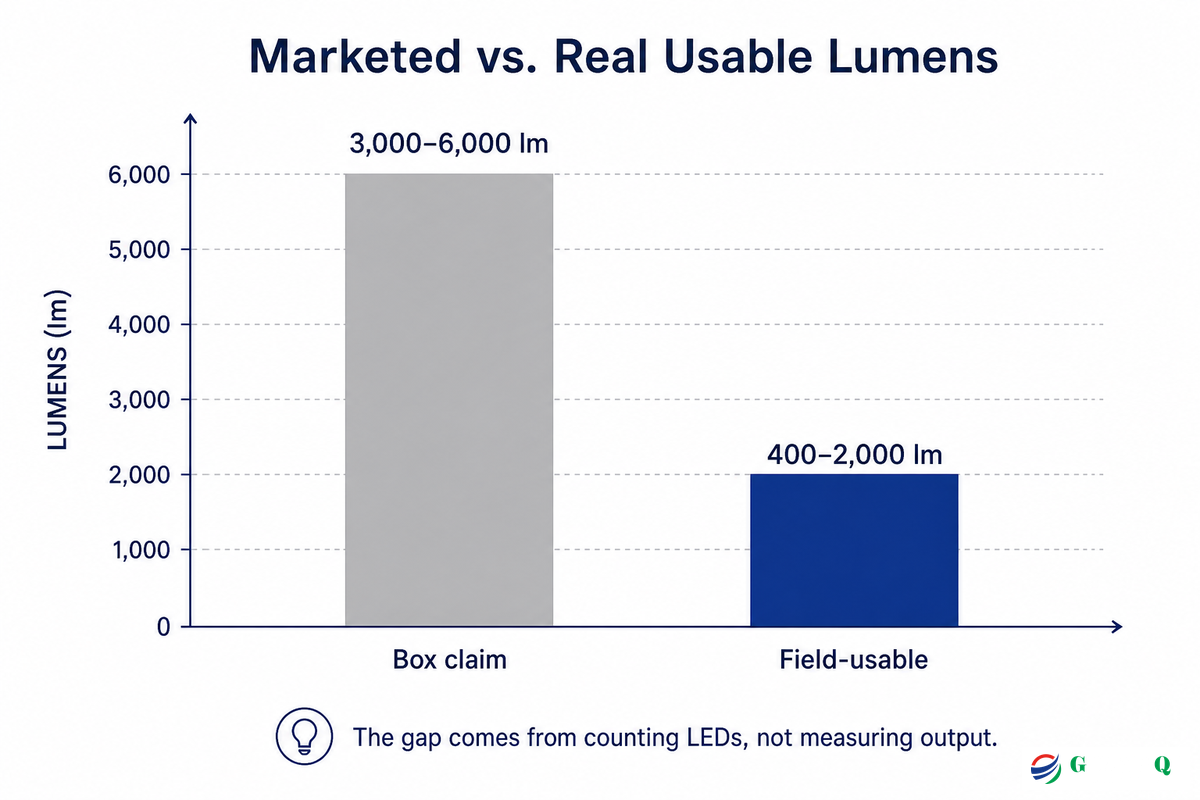
They work — but not according to their printed specs. On independent tests we see “super bright” 3,000-6,000-lumen units usually providing just 400-2,000 lumens of actual, security-usable output (a range to expect, not a guaranteed figure) and even that can only be maintained while the panel is actively charging. If you’re comparison-shopping for the brightest solar motion lights on the market, remember that usable lumens, not the number printed on the box, is the only spec worth trusting. This discrepancy typically come from two habits: simply counting individual LEDs to reach a headline figure, and stating a light output that can only be maintained for minutes at a time from a fully charged battery. The ENERGY STAR light fixture program applies the same claimed-vs-delivered lumens scrutiny to wired fixtures, and the gap it documents there mirrors what independent testers find in solar units.
| Marketing claim | Field reality | Why the gap |
|---|---|---|
| “6,000 lumens, 120 LEDs” | ~800–1,300 usable lm | LED count ≠ light output; small solar cells cannot drive them at full power |
| “All-night brightness” | Full bright 20–90 s, then dim/off | Peak output is a burst mode; steady output would flatten the battery |
| “Works all winter” | Conditional on panel size + sun | Short, overcast days cut charge to a fraction of summer capacity |
| “IP-waterproof” | True at IP65–IP66 | This one usually holds — IP65 resists water jets, IP66 handles heavier exposure |
The winter and shade question is something that needs a definitive answer as there’s such a disparity between sellers marketing the lights as “winter-unaffected” and the actual owner experiences found on forums like r/Lighting, where owners with low-end solar lighting say they “don’t charge enough when the weather isn’t perfect”. Both of those observations are real and true but based on conditional circumstances. In reality, the science doesn’t lie. During temperate latitudes a shorter and more overcast winter day yields much less sun light to a solar panel; roughly 1/3 to 1/2 less power production. This reduced power is multiplied with shade because it doesn’t just impact power production, it also impacts battery charging. As long as the solar panel is adequately sized for winter use and the panel get ample direct sunlight it can charge the battery enough to operate throughout the winter. However, an undersized panel will stop working during the winter.
Do solar motion sensor lights work in winter or partial shade?
Whether a solar light will work in winter and with shade is a Yes or No based on its solar panel sizing and installation location. Solar lighting works best in direct sun with sufficient panel and battery capacity to sustain usage over short winter days or when the weather is poor. Solar-hostile locations (like a north-facing wall, in dense shade, or in a valley that block low winter sun) are the best places for wired solar lighting solutions.
“The single most common mistake we see is buyers matching the panel to summer sun and the runtime to the brochure. Size both for your worst charging month and a modest solar unit will outlast the flashy one on the shelf next to it.”
— Guangqi Lighting technical team
How Long Do Solar Motion Sensor Lights Last?
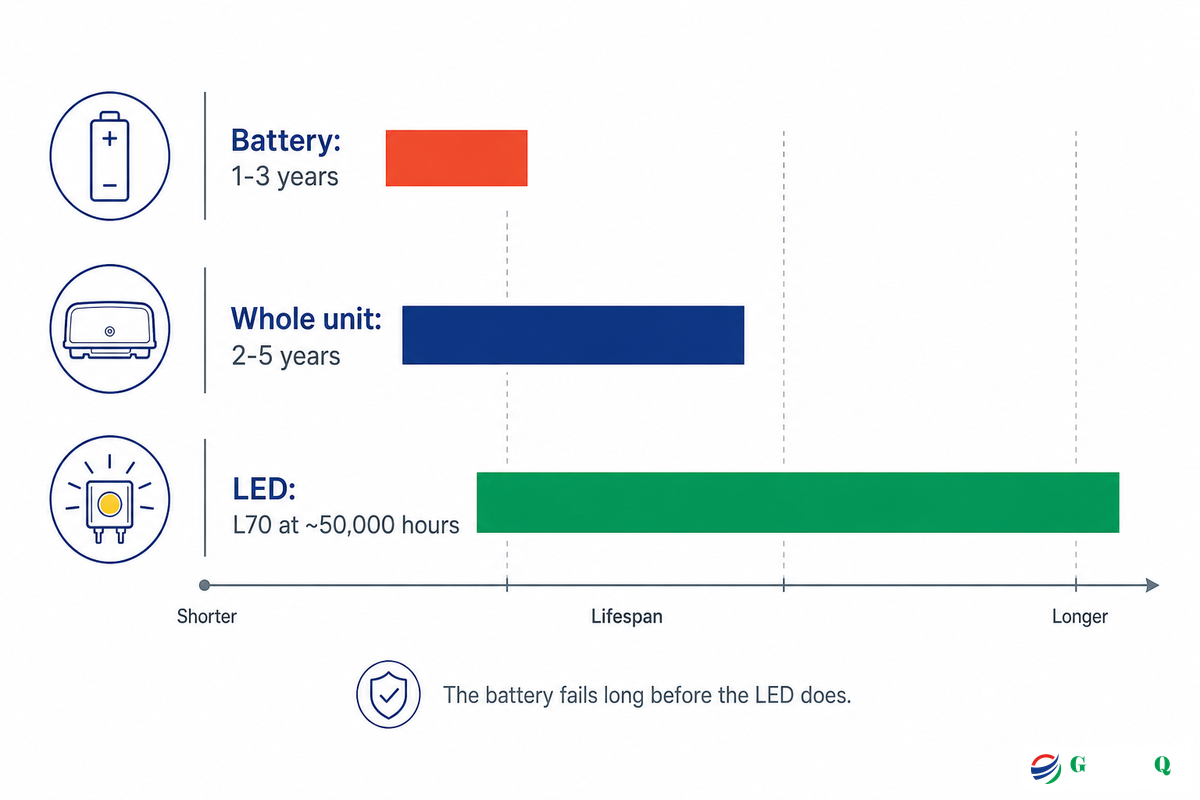
A solar motion sensor light has an operational life span of about 2-5 years, with its rechargeable battery typically being the first to degrade (1-3 years). The LEDs used in solar lights have long lifespans, but replaceable batteries (especially for user-repairable models) are key to the light’s longevity and to avoid e-waste. Owners on r/AusRenovation frequently ask if the light will last beyond a couple of years.
| Part | Typical life | Failure mode |
|---|---|---|
| Battery | 1–3 years | Loses capacity; shorter runtime, then won’t hold charge |
| LED | L70 at ~50,000 h (IES LM-80) | Very slow dimming; rarely the reason a unit dies |
| Solar panel | ~0.5% output loss per year | Gradual; also clouding of the plastic cover cuts harvest |
| Whole unit | 2–5 years | Usually retired when a sealed battery dies |
⚠️ The sealed-battery trap
If the battery is sealed or glued inside, the entire light is effectively disposable when the battery dies. Lights with easily replaceable 18650 or AA Ni-MH batteries offer a much longer service life, as replacing a battery is a simple and inexpensive fix. The LEDs in most solar lights use IES LM-80 method, which ensures their performance remains within L70 standards, making them rarely the cause of failure. Damaged lithium-ion batteries should be disposed of at an e-waste facility per EPA guidance to prevent fire hazards, not in household trash.
Solar vs Wired vs Battery Security Lights: Which Wins?
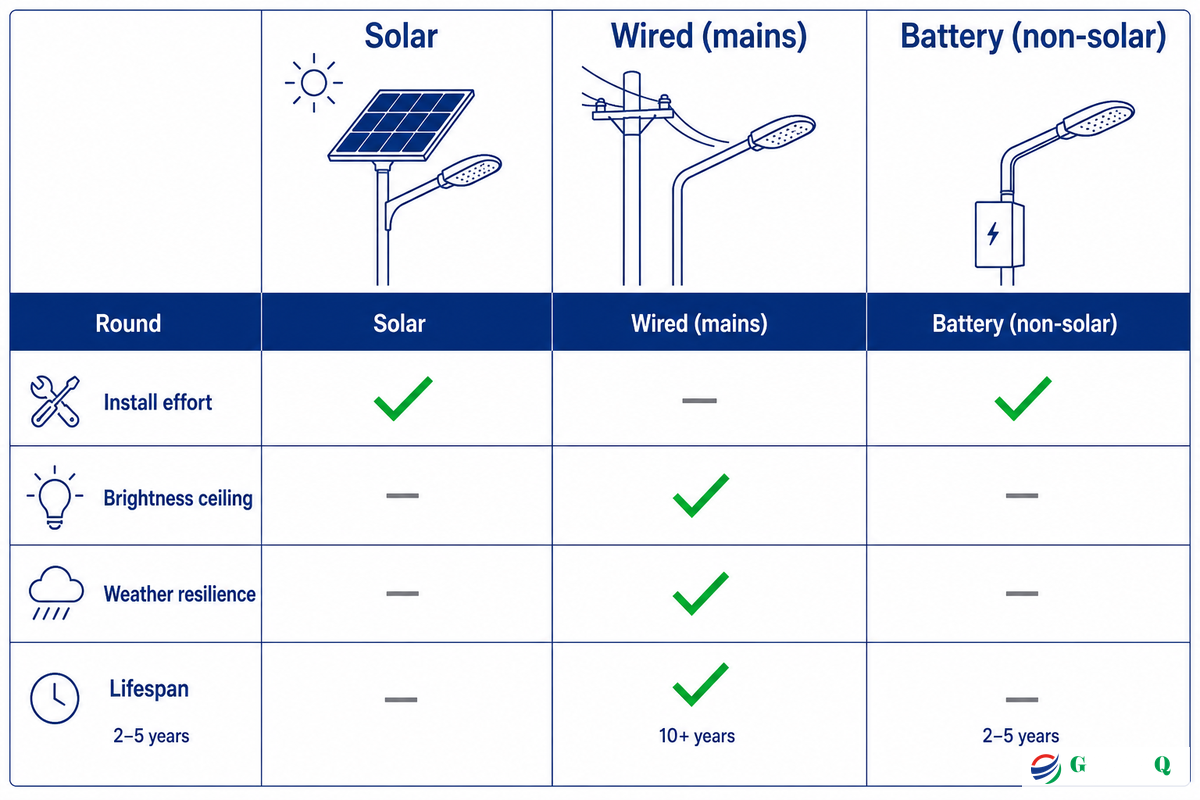
Solar reigns for wireless install and out-of-the-ground; wired triumphs for consistency and staying on late. Swappable-battery models fall between the two – for those spots where you’ve neither sun nor plug. No one winner, the source of light you should install is dictated by your location, not your preference for the new kid on the block.
The matrix here judges all three, as an installer would.
| Factor | Solar | Wired (mains) | Battery (non-solar) |
|---|---|---|---|
| Install effort | Screw or stake, no wiring | Cable run, often an electrician | No wiring; mount anywhere |
| Upfront cost | $12–$60 | Fixture + $150–$300 wiring | $15–$50 |
| Brightness ceiling | 400–2,000 lm usable | 3,000+ lm sustained | Low–moderate |
| Runtime reliability | Depends on charge | Constant | Until battery dies |
| Winter / weather | Weakest point | Unaffected | Cold shortens battery |
| Deterrence | Good for moderate needs | Best for high value | Good |
| Lifespan | 2–5 yr (battery limited) | 10+ yr | 2–4 yr |
| Best for | Driveways, fences, sheds, gardens | Entrances, high-value targets | Shaded spots with no outlet |
“Solar flood lights for security” would be the answer for one particular column of this table – a heavier-duty version to adequately illuminate expansive areas – but not the primary response. If your final decision is to outfit your garden with flood-style fixtures, evaluate the wire compromise by plugging in our solar versus wired 5-year ROI calculator and review the solar flood lights collection.
Motion-Activated vs Dusk-to-Dawn vs Hybrid: Picking the Mode
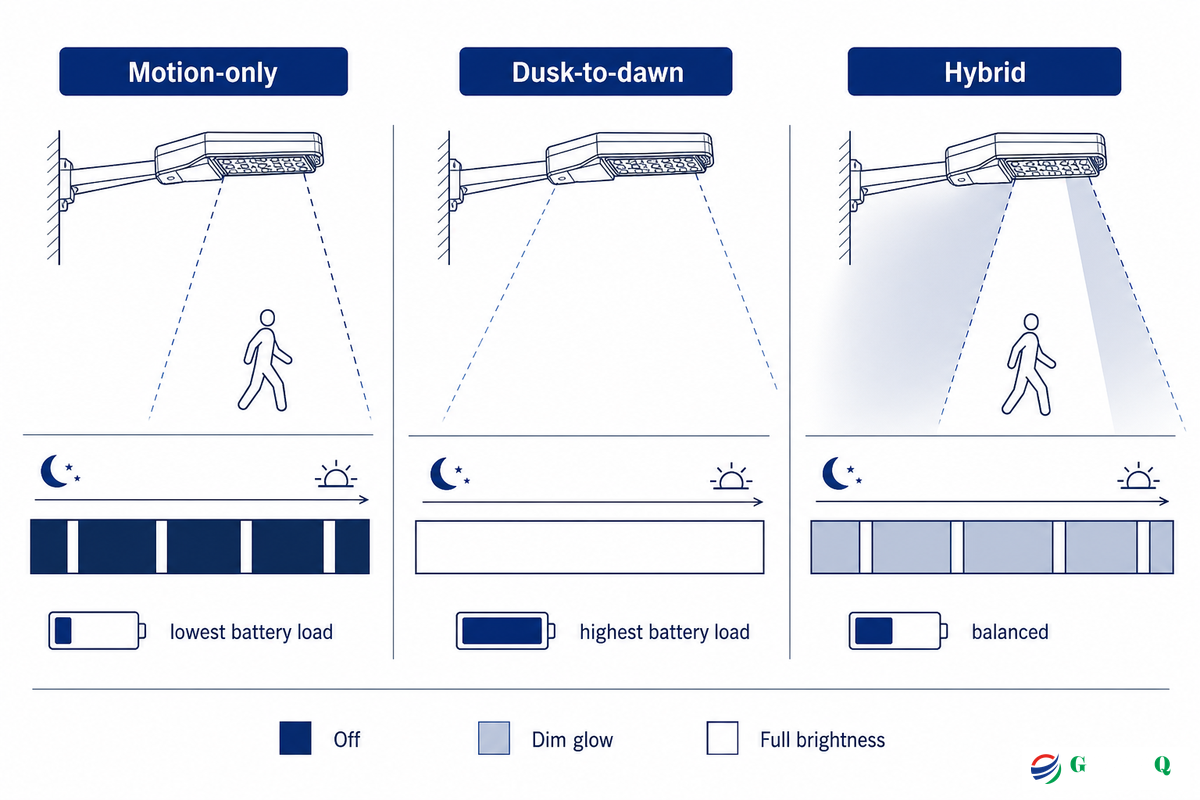
Which Mode is for You The operational mode you pick is about runtime vs presence. Motion-only saves battery power and provides the sudden-light, “startle” deterrent. Dusk-to-dawn offers consistent, subtle presence, but will give a solar battery the toughest workout. If you specifically want dusk to dawn solar lights that glow steadily all night rather than an outdoor solar light without motion sensor triggering at all, this dusk-to-dawn setting is the one built for that job – just budget for the extra battery drain.
Hybrid runs at low light throughout the night and surges to full brightness at the slightest movement – the optimal security setting when your light can reliably charge.
| Mode | Battery load | Best for |
|---|---|---|
| Motion-only | Lowest | Shaded or low-sun sites; pure deterrence |
| Dusk-to-dawn | Highest | Well-charged panels; constant ambience |
| Hybrid (dim → bright) | Medium | The security sweet spot when sun allows |
Match the zone sensitivity and dwell time to the situation. Set a driveway facing busy street to a lower setting so passing cars aren’t detected, but set your back gate up high. Adjust either setting on most units – most of the time – because a false trigger is the #1 complaint after a unit being too bright. Picking the wrong mode is a common risk and a real trap in practice: dusk-to-dawn on a shaded panel can drain 20-30% more nightly charge than the panel replaces, because constant low-level output competes directly with the sensor’s burst demand for the same battery. Crime-prevention guidance from agencies such as the Manchester NH Police Department favors motion-triggered surprise over constant dim glow for deterrence, which lines up with picking motion-only or hybrid over pure dusk-to-dawn.
What to Look For: The 7-Point Solar Security Light Buying Checklist

Seven specs make the difference between a five-year workhorse and trash in less than a year. Follow this guide, and you’ll avoid the pitfalls that lead to so many one-star reviews. This matters most for motion activated solar lights outdoor use, where weather and distance exposure are constant. The most important tech isn’t always advertised with the biggest print.
Whether you’re comparing basic solar led lights or premium units with remote control for manual mode override, an IP65 waterproof rating minimum should be non-negotiable.
- ✔Usable lumens, not LED count — don’t count LEDs; go by usable lumens. Get output figures, from the manufacturer’s testing or from third-party reviews.
- ✔Replaceable battery — a swappable 18650/AA cell extends the unit from a 2-year solution to a 5-year one.
- ✔Panel wattage vs runtime — the larger panel and a detachable panel option tackles shade much more effectively.
- ✔IP65 minimum — IP66 for direct-rain or pressure-wash conditions.
- ✔Detection range and adjustable sensitivity — to focus your coverage and eliminate false alerts.
- ✔Mounting hardware and height — screws or stake with mount to ensure it goes above anything else.
- ✔Mode options — motion-only, motion+hybrid mode gives you freedom to tweak run time later.
| Fixture type | Where to mount | Typical usable lumens |
|---|---|---|
| Path / deck light | Walkways, garden edges, patio | 50–200 lm |
| Wall pack | Doorways, side walls, fence posts | 400–1,000 lm |
| Flood | Driveways, backyards, wide zones | 1,000–2,000 lm |
| Spotlight | A specific gate, shed, or corner | 300–800 lm |
| Doorbell-integrated | Front entry (paired with camera) | 100–300 lm |
| Perimeter / string | Fences, long boundaries | Low, ambient |
| Bollard / post light | Driveway edges, gate posts | 100–400 lm |
| Step / deck-stair light | Stairs, deck edges, thresholds | 20–80 lm |
| Floodlight + camera | Key approaches needing recording | 800–2,000 lm |
Our editors maintain a constantly updated best solar flood light for security list of tried and true options, while the solar flood light selector tool filters your results by area and illumination level.
When Solar Motion Sensor Lights Are NOT Worth It (5 Honest Scenarios)
Solar makes sense for many yards, but saying it’s the right choice for all yards isn’t honest. In these five circumstances, a solar motion sensor light is a bad idea and a hard-wired fixture or heavier-duty solar system is a worthy investment of effort. The knowledge to step back is what distinguishes an ad from a buying guide.
For a genuinely high-value or critical target, agencies like the Manchester NH Police Department recommend layering constant wired lighting with cameras rather than relying on any single battery-backed fixture.
| Scenario | Why solar fails | Better alternative |
|---|---|---|
| Heavy shade | Panel can’t harvest enough to run reliably | Wired fixture, or a solar unit with a detached panel in sun |
| Sub-freezing climate | Cold cuts battery capacity; short days cut charge | Wired, or larger panel + Li-ion rated for cold |
| Need constant 3,000+ lm | Solar can’t sustain flood-level output all night | Wired flood light |
| High-value / critical target | Runtime depends on weather — too much to trust | Wired lighting plus cameras and alarm |
| Sub-$15 “bargain” unit | Tiny panel, sealed battery, dim within a year | Spend $30–$60 on a mid-range unit instead |
Here’s a real example of shade from the forums. A homeowner on r/HomeImprovement had budget solar units placed along the shaded, north-facing side of the yard, adjacent to a fence and a maple, but by the second winter most were dead most nights. Instead of buying more lights, the fix was running a short length of wired power to that one dark corner – exactly what the community recommended: “better to run power there.” Solar rewarded the sunny front yard and punished the shady side yard, and running power to the problem spot was the right, real-world call.
Where Solar Security Lighting Is Headed in 2026

More than technology, the single most important buying trend for residential customers in 2026 is regulation-dark-sky ordinances are clamping down on all-on exterior lights and making their use on a motion-controlled basis far more likely to be encouraged, especially in cities that have already updated their outdoor lighting codes this year.
The City of Palo Alto, California, adopted revised exterior lighting standards that took effect on February 20, 2026, with compliance required on February 20, 2027; it calls out the turning off of lights at certain times and replacing those lights with controls.
City Councils across the nation – in places like Frisco, Texas – spent much of 2025 wrestling over whether the standards apply to motion sensors and to flood lights. But here’s a caveat: motion controls aren’t the only factor in responsible lighting, according to DarkSky International and the Illuminating Engineering Society (IES); lights also need to be targeted, to emit low levels of light, be shielded against glare and light spill, and use warm color temperatures- so a bright white floodlight with a motion sensor might still run afoul of regulations.
Before buying any motion light, check your local ordinances for requirements; you’ll do best by choosing a warm, shielded unit with a motion detector. This creates a real compliance gap in practice for anyone who bought an always-on fixture years ago, because retrofitting motion control after the fact usually costs more than the original 1-2 year fixture itself.
In terms of technology, expect buying criteria to shift from the “How many lumens” approach to “What’s the sensor type and integration.” Look for microwave-radar sensors, which provide enhanced through-object detection and fewer false triggers and which have begun to filter into consumer-grade products; app control and camera integrations, typical of high-end models, are becoming more common even at the midtier. LiFePO4 is also becoming more prevalent in battery technology due to improved performance in cold conditions.
(Market data note only, this isn’t an endorsement) – overall, residential solar was a soft U.S. market in early 2026. Installations decreased significantly on an annual basis according to the Solar Energy Industries Association. This a systemic macro Headwind, rather than a market reason to buy or delay your purchase. Any market growth numbers or size statistics should be considered a rough indication only, and shouldn’t be a deciding factor. The deciding factors are your site and your security needs.
Frequently Asked Questions
Are solar motion sensor lights bright enough for security?
View Answer
Yeah for most residential deterring. A decent unit can produce 400 to 2,000 lumens when it’s activated, which is plenty to light a driveway or a backyard, and would certainly surprise any intruder expecting a darkened zone. A lower 2,000-lumen output will still deter casual prowlers, but wouldn’t flood a large commercial lot that needs more than 3,000 continuous lumens of sustained illumination from a hard-wired light. When judging brightness, always refer to actual measured usable lumens rather than the LED count or the high number on the packaging. Even a modest number will cover more ground if it’s mounted high and directed at a wide area rather than low and close up.
Do solar motion sensor lights work in winter or on cloudy days?
View Answer
It depends. An adequate sized solar panel will ensure the device continues to run even through the winter if it’s in full sun, since it stores up enough energy to operate the device a few times a night during shorter days. But the device won’t work in winter if the panel isn’t large enough or the mounting site isn’t in direct sunlight, because then it won’t have sufficient stored power. If your home has long, cloudy winters, consider a panel with a larger capacity or use a removable-panel unit in “motion-only” mode.
How long do solar motion sensor lights last before the battery dies?
View Answer
The average life expectancy of the rechargeable battery that powers most of these lights is one to three years, while the LEDs and panel are typically more durable and may last as long as five years. The device can extend beyond three years if you have the option to replace the battery yourself, instead of having to throw out the entire light fixture.
Can I place them in a shaded spot like the north side of the house?
View Answer
Only if the solar panel detaches, can sit outside in full sun, and the light is installed in a shady location. If a light with a fixed solar panel is on the shady side of your house, it can’t capture enough light for operation. In such instances, wired power is a better alternative.
How far do they detect motion?
View Answer
In most instances, the motion sensor can detect someone walking in front of it at 10-26 feet with an arc from 120-270 degrees. This motion detector will work most effectively when people walk across the detection field as opposed to straight through it.
Are solar or wired motion security lights better?
View Answer
Both have advantages, so the “better” option is dependent on your needs and installation site. Solar-powered lights are ideal for areas that are difficult to hard-wire and have abundant sun exposure (driveways, fences, gardens, etc.) Wired lights are best when you need constant illumination, the most light intensity or when you’re protecting expensive assets. Often the optimal solution is to combine both: wired power on important parts of your property and solar lights for other areas.
Do solar motion lights actually deter burglars?
View Answer
Yes, the motion activation alone is often enough to discourage intruders, and police agencies regularly advise that the installation of motion lighting is an effective deterrent. A home’s ability to thwart intruders can be significantly increased by installing motion lighting with other security devices, such as security cameras or low-level lighting that allows visibility in the immediate vicinity of your property.
How We Assessed This
Guangqi Lighting designs solar floodlights and solar-security lighting in-house, testing them with the IP65/IP66 weatherproof test and IES LM-80 lumen-maintenance measure. The test-results data we share here draws on this engineering knowledge, but also includes crowdsourced owner tests and field reports from solar motion-light users, rather than relying solely on our own home test.
When the data we present reflects a range or general trend, we report it that way, rather than a precise but invented number.
Written and vetted by Guangqi Lighting’s technical staff.
Lighting a driveway, fence, or perimeter?
Guangqi engineers in-house solar flood-and-security lighting, complete with IP66 weather-testing and advanced optical-design capabilities. Shop our wide selection or get free sample to determine for yourself if our bright security and solar floodlights perform on site.
References & Sources
- IP Ratings (IEC 60529) — International Electrotechnical Commission
- ENERGY STAR Light Fixtures — U.S. EPA / DOE ENERGY STAR
- Outdoor Lighting Ordinance (effective Feb 2026) — City of Palo Alto
- Responsible Outdoor Lighting & Motion Sensors — DarkSky International
- Crime Prevention Through Environmental Design — Manchester NH Police Department
- Used Lithium-Ion Battery Disposal — U.S. Environmental Protection Agency
- U.S. Solar Market Insight — Solar Energy Industries Association (SEIA)
Related Articles
- Best Solar Flood Lights for Security — tested top picks by zone and brightness
- Solar Flood Lights: The Complete Guide — specs, sizing, and placement
- Solar Flood Light vs Wired — when each power source wins
- How to Install Solar Flood Lights — mounting, angle, and sun placement
- IP Rating Guide for Outdoor Lighting — what IP65 vs IP66 really means
- Solar Street Lights — larger-scale solar lighting for driveways and lanes