Get in Touch with GUANGQI



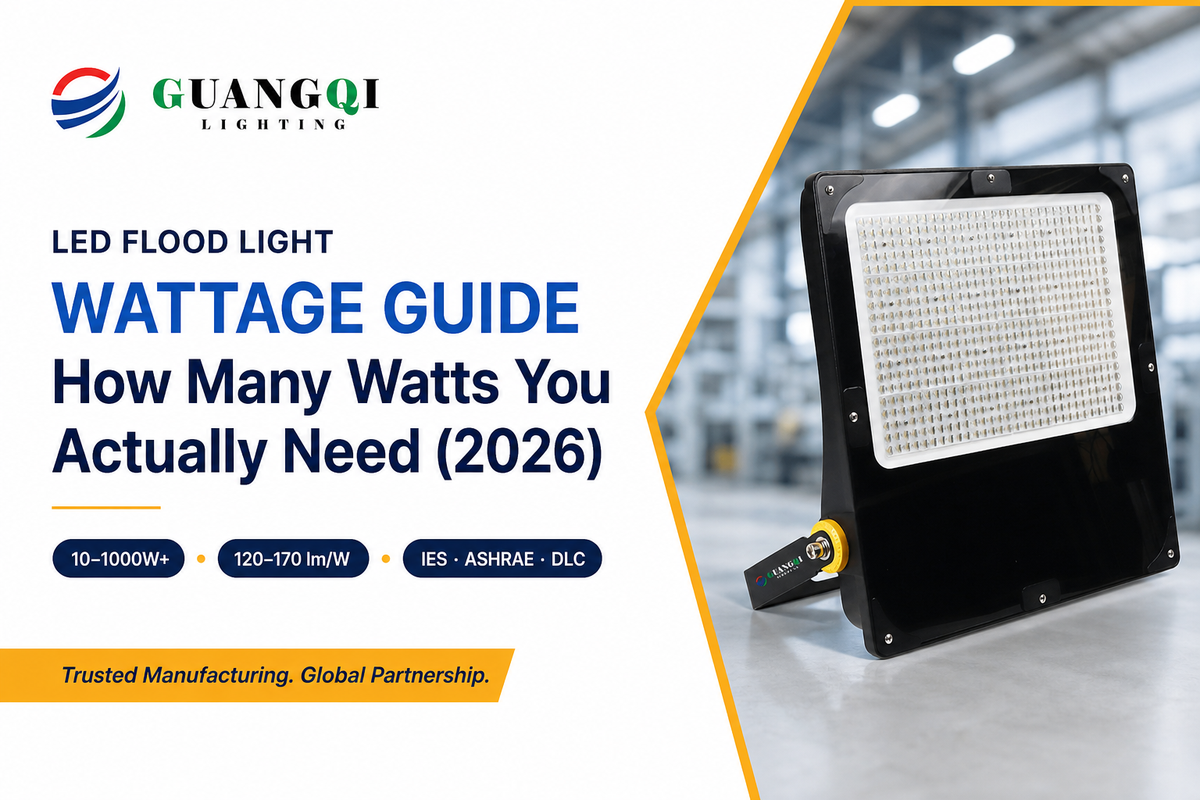
Selecting an LED flood light by its wattage number is the most costly mistake in outdoor lighting. LED flood light wattage is the electrical power a fixture draws, measured in watts — but it no longer correlates to brightness the way it did with halogen or metal halide. One brand’s 100W fixture can outperform another brand’s 150W one, and building codes now restrict how many watts you can install. This article explains how to size flood-light wattage the way commercial lighting professionals do: from target lumens, lux levels, and the application — not from the printed wattage on the box.
Quick Specs: LED Flood Light Wattage
| Residential wattage band | 10–50W (1,300–7,000 lm) |
| Commercial wattage band | 80–300W (10,000–45,000 lm) |
| Large-area / sports band | 300–1,000W+ (45,000–150,000 lm) |
| Efficacy (lumens per watt) | 120–170 lm/W typical; best-available to 230 lm/W |
| Ingress protection | IP65 sheltered, IP66 fully exposed (IEC 60529) |
| Beam angle range | 15°–30° long-throw, 60°–120° wall-wash |
| Color temperature (CCT) | 3000K / 4000K / 5000K (selectable-wattage models available) |
| Rated life / lifespan (L70) | 50,000h minimum (IES LM-80 / TM-21) |
How Many Watts Does an LED Flood Light Need? (Quick Answer)

A LED flood light fixture generally consumes 10-50W on residential entries and landscaping, 80-300W on commercial parking lots and building exteriors, and 300-1000W or more on sports fields and high-mast towers, but the appropriate wattage level should be selected based on target lumens and lux level, not inversely. Two fixtures of identical wattage can differ by 40% in light output, so the watt value alone is almost meaningless as a brightness indicator.
The reason behind this is efficacy. Power-to-light conversion efficiency of contemporary LED flood lights reaches 120-170 lumens per watt (lm/W), and the US Department of Energy categorizes fixtures through luminaire efficacy rating (LER) in lumens per watt for this reason. A simple 150W fixture at 100 lm/W produces 15,000 lumens; a well-optimized 100W fixture at 170 lm/W produces 17,000 lumens – more luminance from a third less energy. Hence, “how many watts” isn’t the first question. The correct procedure should be: determine the lux level for the outdoor environment, convert it to lumen, divide by efficacy to obtain wattage.
Why Lumens, Not Watts, Decide Brightness
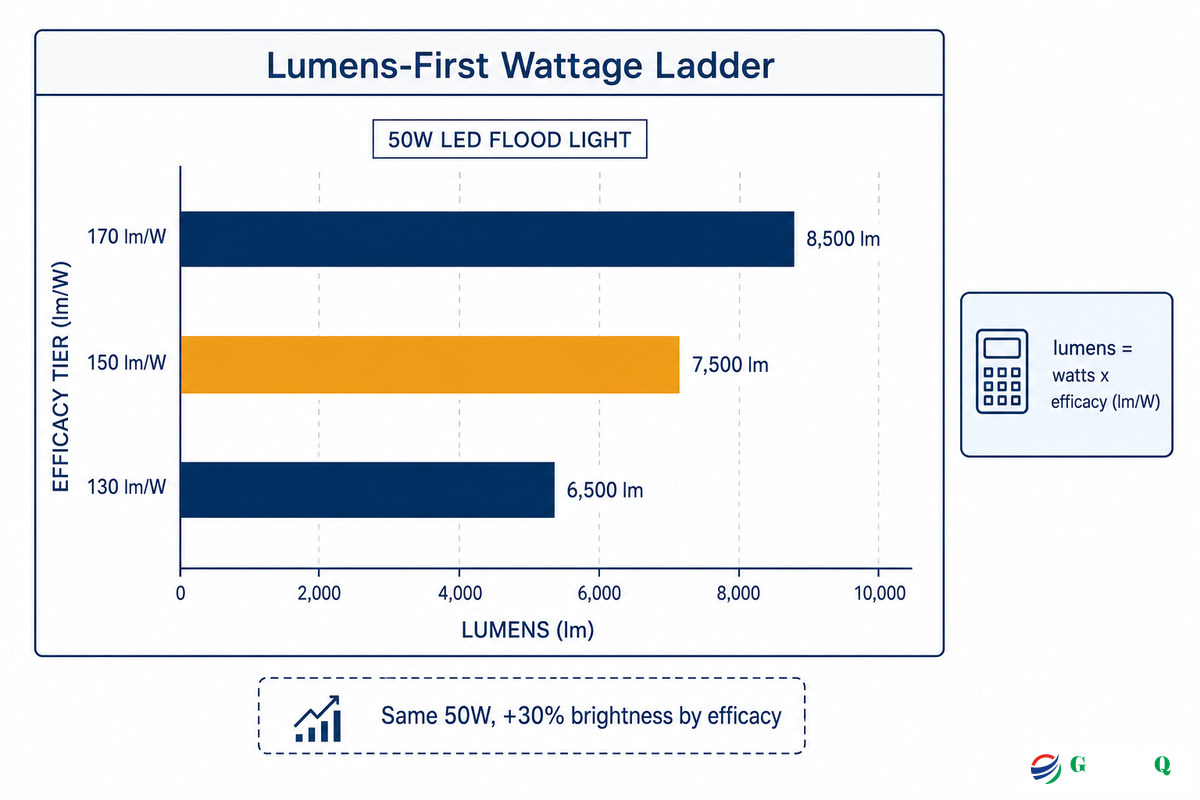
A watt equals the measurement of electrical power input; lumen indicates a measure of luminance output. Bridging them together is efficacy: lumens = watts × efficacy (lm/W). Once you absorb this simple equation, flood-light wattage will cease to be a brightness indicator and begin to be what it actually is – an energy consumption indicator.
📐 Engineering Note — The Lumens-First Wattage Ladder
An LED floodlight at 130 lm/W emits around 6,500 lumens at 50W. The same 50W LED floodlight at 150 lm/W emits 7,500 lumens. At 170 lm/W, it emits around 8,500 lumens, a 30% brightness swing between fixtures of equal wattage. The DesignLights Consortium establishes the minimum at 125 lm/W for a DLC Standard architectural flood/spot luminaire and 140 lm/W for DLC Premium under the SSL V6.0 specifications published in November 2025 (Premium = Standard + 15 lm/W). A generic “DLC listed” marking only assures for the 125 lm/W minimum – not the 160-170 lm/W that higher quality fixtures achieve.
This is the explanation why the traditional “watt-equivalent” label on retail shelves is inaccurate. A generally marketed “150W-equivalent” outdoor LED flood light consumes 50W and radiates 5,000 lumens (~100 lm/W); the “150W” number is a reference to the halogen lumen value it replaces, not to its power. Specify by lumens and confirm the LM-79 efficacy number, and the wattage number become an afterthought.
Every flood light we sell is integrated-sphere-measured from our line; all our spec sheets list watts in light units, and it reads measurable watts and lm/W, not a wattage equivalency catchphrase. If a customer calls for a “200-watt flood light,” we’ll first inquire how many lux (fc) they expect on the wall. Once that number’s established, the fixture’s wattage can be derived, and it’s usually lower than the customer imagined.
Guangqi Lighting photometry & engineering team
LED Flood Light Wattage by Application (2026 Selection Table)

The Illuminating Engineering Society (IES) publishes recommended maintained light levels in footcandles (fc) for outdoor tasks, and those IES targets, not a watt-equivalent rule of thumb, are what drive fixture selection. The table below pairs the standard IES lux/fc targets with the LED wattage and beam angle that deliver them at typical mounting heights. Read it as a starting point, then confirm with the calculation in the next section.
| Application | IES target (fc) | LED wattage | Lumens | Beam | Mount height |
|---|---|---|---|---|---|
| Doorway / porch | ~1 fc | 10–20W | 1,300–2,800 | 90°–120° | 2.5–3.5 m |
| Backyard / patio | 0.5–1 fc | 30–50W | 4,000–7,500 | 60°–120° | 3–5 m |
| Building safety / security | 1 fc (raise to 3 fc) | 50–100W | 7,000–15,000 | 60°–90° | 4–6 m |
| Commercial parking lot | 1.5 fc avg (0.5 min) | 100–200W | 15,000–30,000 | 60°–90° / Type III | 6–9 m pole |
| Building facade wash | scene-dependent | 50–150W | 7,000–22,000 | grazing 10°–30° | ground / 1–3 m offset |
| Gas-station canopy | 12.5 fc (10–15) | 100–150W | 15,000–22,000 | recessed / 90° | 4–5 m |
| Recreational sports field | 30–50 fc | 300–600W | 45,000–90,000 | 15°–60° | 9–18 m pole |
| Stadium / high-mast | 75–100 fc | 600–1,000W+ | 90,000–150,000 | 15°–30° narrow | 18–40 m mast |
| Warehouse perimeter / industrial yard | 3–5 fc | 150–300W | 22,000–45,000 | 60°–90° | 6–12 m pole |
Target Illuminance Level based on IES Recommend Levels and RP-20 for Parking Lots.
Notice that the gas-station canopy at 12.5 fc needs roughly the same wattage as a parking lot at 1.5 fc, because the canopy is small and bright while the lot is large and dim. Area and target lux move together, and wattage follows both. That’s the logic competitors collapse into a flat “every 50 m² = one 50W fixture” rule, which ignores lux entirely.
The wattage necessary grows proportionally as well. Unfortunately, all too many competitors “simplify” this process with something like ‘every 50 m equals one 50W fixture’ which completely ignores lux orfc”.
Replacing Metal Halide, HPS & Halogen: LED Wattage Equivalents
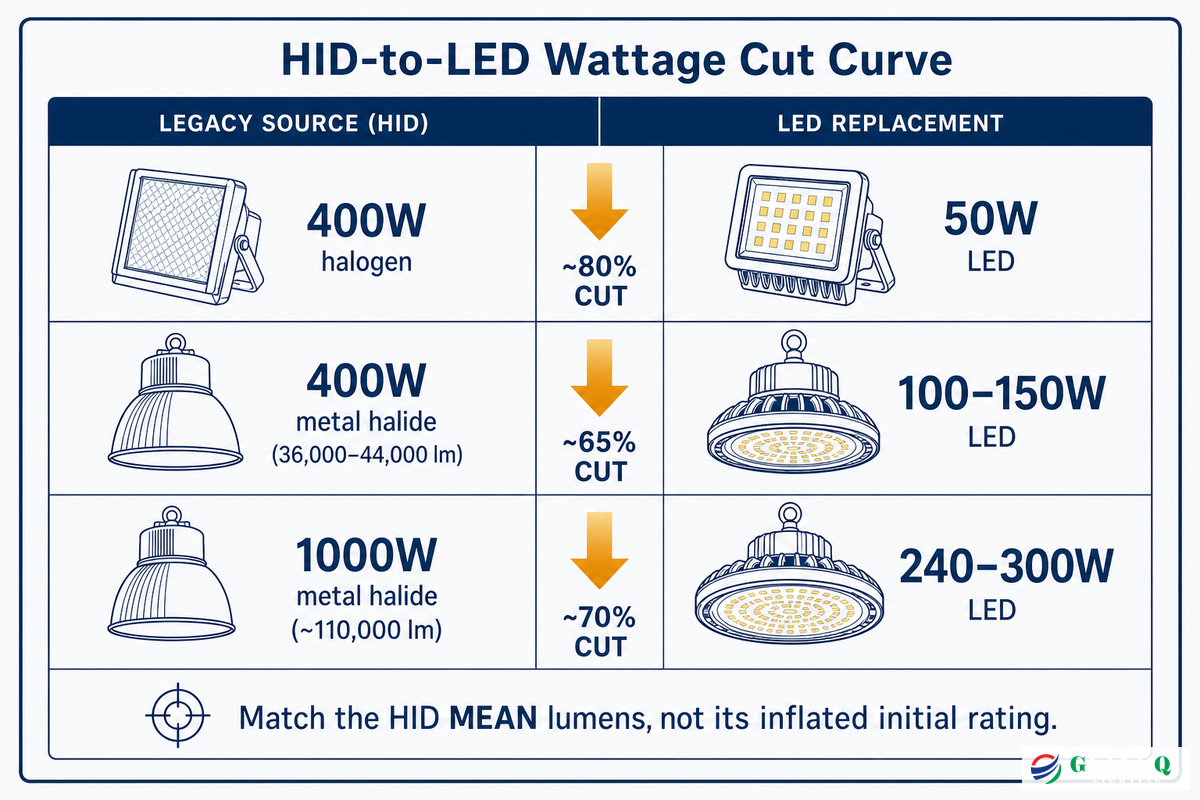
As a very general guide line, a50-watt LED floodlight can often replace a 400W-450W metal halide or incandescent fixture, a 150-watt LED may substitute a 400W metal halide, and 240-300-watt LED fixtures can replace 1000W metal halide units – a 60 to 75% reduction in wattage while producing at least as much light on the ground as the HID units did, thanks to modern LEDs higher energy efficacy, compared to metal halide that declines by 30 to 40% of initial lumen levels as the unit ages compared to less than 10% depreciation of an LED array.
In plain terms, a 50-watt LED flood does the job a 400-watt halogen once did; a 150-watt LED matches what a 400-watt metal halide produced; and a 300-watt LED takes over from a 1,000-watt metal halide lamp. Unlike screw-in LED bulbs or the old light bulbs they replace, integrated LED flood light fixtures seal all that illumination behind one tempered glass lens to weather the elements. That’s why sealed LED floodlights have largely replaced bulb-based units across commercial outdoor areas, from a single LED parking lot pole to a full LED area lighting layout.
| Legacy source | Initial lumens | LED replacement | Wattage cut |
|---|---|---|---|
| 100W incandescent flood | ~1,600 | 15–20W LED | ~80% |
| 150–500W halogen flood | 2,500–9,000 | 30–60W LED | ~80% |
| 175W metal halide | ~14,000 | ~60W LED | ~65% |
| 250W metal halide | ~20,000 | ~80–90W LED | ~65% |
| 400W metal halide / HPS | 36,000–44,000 | 100–150W LED | ~65% |
| 1,000W metal halide | ~110,000 | 240–300W LED | ~70% |
The replacement figures above come from data published in LED manufacturer catalogues, which confirm that fixtures in the 136–149 lm/W range replace a 400W metal halide, and a 148 lm/W array can substitute for a 1,000W metal halide. Size the LED to the HID’s mean (depreciated) output, not its inflated initial rating.
⚠️ Important
Don’t pick a fixture by matching watts. Choosing a 1000W LED to replace a 1000W metal halide triples the lumen output on the ground and usually pushes the fixture past the lighting-power limits covered in this guide. Set the target light level first, then choose the efficacy that hits it at the lowest wattage. As practitioners on lighting forums point out, anything sold as a “1000-Watt Equivalent” is a marketing label — always compare the measured lumen output. You can see the full cost-savings and lifecycle math in our LED vs metal halide comparison.
How to Calculate the Wattage You Actually Need — the 4-Factor Flood Light Sizing Formula
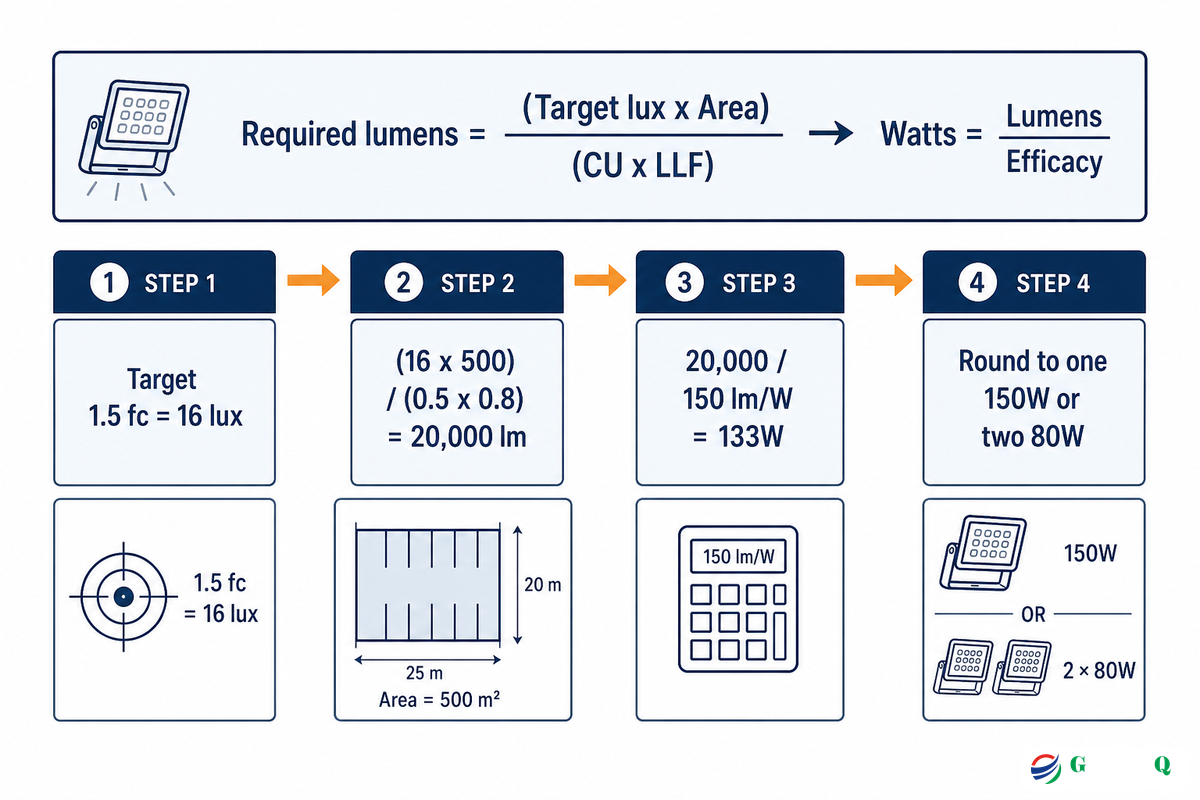
When you’re calculating your needed lumens the standard photometric method that lighting designers use takes four inputs — the 4-Factor Flood Light Sizing Formula:
Les lumens nous étant donné : Lumens nécessaires= (lux cibles surface en m) (CU LLF)
Wattage = Required lumens ÷ Efficacy (lm/W)
- Target lux – this value needs to be obtained from the IES table above (1 lux = 0.0929 fc; 1.5 fc = 16 lux).
- Area the area that you’re light up, in metres.
- CU (coefficient of utilization) – how many of the lumens actually hit the objects- for wide pole mounted area lighting, a range of 0.4-0.6; tighter wash down wall, higher than this.
- LLF – Light Loss Factor = “dirt depreciation and lumen depreciation over life time”, commonly it’s 0.8.
Worked example — a 500 m² commercial parking lot
- Target: 1.5 fc ≈ 16 lux (IES parking, Zone 3).
- Required lumens = (16 × 500) ÷ (0.5 × 0.8) = 8,000 ÷ 0.4 = 20,000 lumens.
- At 150 lm/W: wattage = 20,000 ÷ 150 = ≈ 133W.
- Round to a standard tier: one 150W fixture, or two 80W fixtures for better uniformity across the lot.
If the same lot were turned to a “seems bright” 300W estimate, it would more than double the energy cost and also exceed the allowable limit for lighting energy. Run the flood light wattage calculator with your own data.
Beam Angle & Mounting Height: Watts Are Only Half the Spec
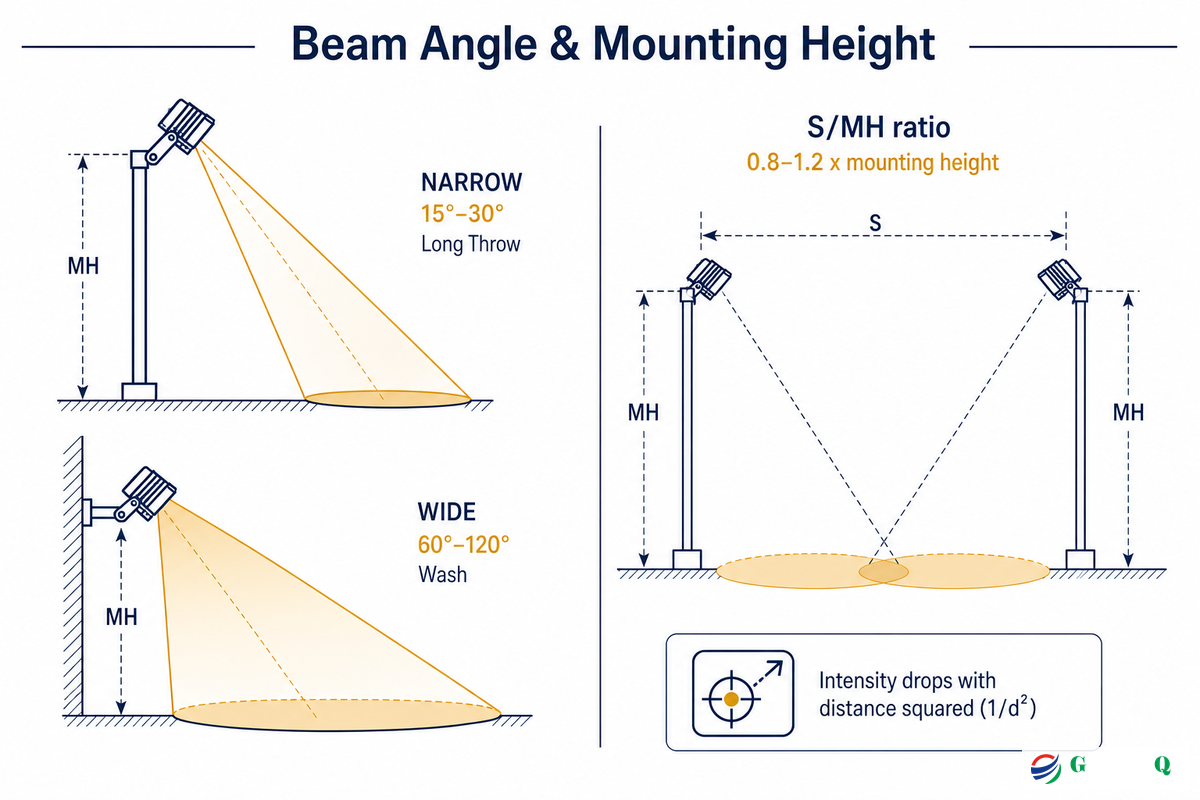
Even two identical luminaries (the same watts, lumens) can give dramatically different light patterns on the ground, depending on their beam angle and height of installation. since the inverse square law dictates that illumination will drop as the square of distance from a fixture – at 30ft high, a floodlight has about one-quarter of the light lux on the ground as does the same fixture when installed at 15ft. Therefore, for pole/high-mast installations high-watt luminaires are needed not because the luminaire is “less powerful,” but because the plane of installation is further away from the goal.
📐 Engineering Note — Spacing and beam by mounting height
For uniform coverage, space fixtures approximately 0.8-1.2 times the mounting height (called the spacing-to-mounting-height or S/MH ratio). Use a narrow 15-30 beam for long throw from high poles and wide 60-120 beam for close wall washing. Beam control is designed into the optic and thermal design of the luminaire, not the wattage, a fact that’s evidenced by fixture patents such as US10571101B2 which details flood-light assemblies with thermal-spreading elements combined with light-directing optics.
Some installers’ field experience: specifying wattage but leaving beam angle off usually leads to a hot spot directly at the base of the pole with large dark gaps in between. You got the right wattage, but the optics are bad.
Beyond Wattage: The Rest of the Flood Light Spec
While wattage and lumens actually determine a light’s output, a flood light need to do more than simply last in the elements. Check these factors off the list as you compare lighting options for outdoor light bulbs on a wall, or when planning new lot light positions:
- Adjustable Wattage and Color Temperature The good news about a lot of commercial LED area floods is that there’s a field-adjustable wattage, for example, 100, 150 or 200 Watts, and also a field-adjustable CCT of 3000, 4000 or 5000K. So one product SKU can fit a lot of outdoor lighting applications.
- Lumens/Watt efficacy – Make sure that the lumen efficacy number that you see come from LM-79; You don’t want a big round wattage number — you want high lumen output at a low actual wattage, not a fixed exact-wattage figure.
- Dimmable driver with photocell – 0-10V dimming plus a photocell trims energy and helps meet lighting-control codes.
- IP65 rating minimum (IP66 exposed), a powder-coated aluminum housing and a tempered glass lens – a powder coated aluminum housing survives dust and water and the weather conditions and types of weather of year-round outdoor use and harsh outdoor environments, including extreme temperature swings, where a traditional flood would corrode.
- Mounting hardware – a trunnion mount or yoke mount for aiming; confirm the beam give uniform coverage across the full coverage area, from small security walls to large parking lots and sports fields.
- 10kV surge protection and an L70 lifespan of at least 50,000 hours – the markers of long-term reliability and a long lifespan for any LED flood light replacement.
The Over-Lighting Trap: Energy Codes, LPD & Light Trespass
Here’s the part most wattage guides ignore entirely: more watts can be illegal. Outdoor lighting power is capped by energy code, expressed as lighting power density (LPD) in watts per square foot. Under ASHRAE/IES Standard 90.1-2022, the exterior allowance for a Lighting Zone 3 parking area is just 0.037 W/ft², cut roughly 30% from the 0.06 W/ft² that stood since 2016. The standard even slashed the line-voltage track allowance from 30 to 10 watts per linear foot, precisely because LED efficacy made the old budgets obsolete.
In California, Title 24 requires every outdoor luminaire emitting 6,200 lumens or more to meet Backlight-Uplight-Glare (BUG) ratings, with power allowances assigned by lighting zone (a Zone 0 dark-sky area permits only a single 15W luminaire). And the U.S. Green Building Council’s light-pollution rules cap vertical illuminance at the property boundary – for Zone 3, no more than 0.20 fc (2 lux) of trespass and 3% uplight.
⚠️ The Over-Lighting Penalty
Over-specifying wattage is not a safe default – it fails plan check, draws glare and trespass complaints, wastes energy, and can disqualify a project from utility rebates. The fixture that passes is the one sized to the lux target and the BUG rating, not the brightest one on the shelf. “Bright enough to be safe” is a lux specification, not a wattage one.
Wattage Tier Coverage Map: What 50W, 100W, 200W, 300W & 1000W Cover
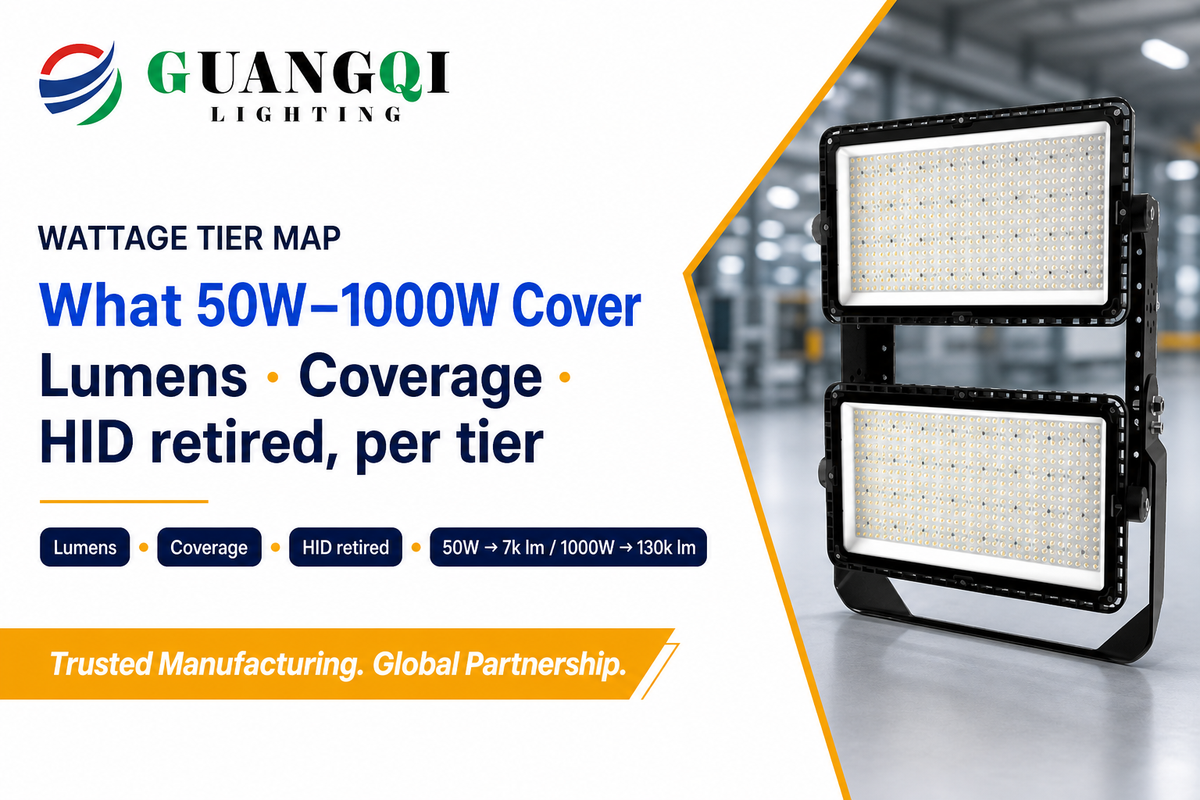
Once you know the lumen target, this Wattage Tier Coverage Map turns it back into a fixture choice – from a 50W unit for residential security lighting to a high-output 350W or 500W stadium head. Each tier assumes ~150 lm/W commercial-grade efficacy.
| Wattage | Lumens (~150 lm/W) | Typical application | Replaces |
|---|---|---|---|
| 10–30W | 1,500–4,500 | Doorways, paths, small yards | 70–150W halogen |
| 50W | ~7,000 | Driveways, small security | 175–250W MH |
| 100–150W | 15,000–22,000 | Parking, facades, loading docks | 400W MH |
| 200–300W | 30,000–45,000 | Large lots, security yards, rec sports | 750–1,000W MH |
| 500–1,000W+ | 75,000–150,000 | Stadiums, high-mast, ports | 1,500W+ MH banks |
For high-bay indoor versions of these same tiers, see our LED high bay buying guide; for IP-rated outdoor housings, the IP rating guide covers IP65 vs IP66 selection.
Where Flood Light Wattage Is Heading: Efficacy & Energy Codes (2026)
The biggest shift in 2026 is that efficacy and energy codes are decoupling watts from brightness faster than ever. According to the International Energy Agency, average LED efficacy has roughly doubled since 2015, and best-available products now reach 230 lm/W. The consequence: the ~20,000 lumens that needed about 200W in 2018 now needs roughly 120–140W, and the same job keeps shedding wattage every code cycle.
Energy codes are tracking that curve, not lagging it. ASHRAE 90.1-2022 cut exterior lighting power roughly 30% and pulled the track allowance from 30 to 10 W per foot; the DesignLights Consortium raised its efficacy thresholds about 14% in the latest revision. This reframes the whole question: stop asking “how many watts” and start specifying lumens, a target lux, and a lighting-power-density ceiling. A fixture spec written that way survives the next code update; a wattage spec doesn’t.
💡 Pro Tip for 2026 specifiers
Write your flood-light spec as a lumen package plus a target lux and a BUG/LPD ceiling, and ask the supplier for the LM-79 efficacy figure and a DLC listing. Then accept whatever wattage delivers it — it will be lower than last year’s equivalent, and it will pass plan check.
Frequently Asked Questions
Q: How many watts for an LED flood light?
View Answer
For most residential entries and yards, 10–50W is enough; commercial parking lots and building facades usually need 80–300W; sports fields and high-mast towers run 300–1,000W or more. But size by lumens and a target lux level rather than picking a wattage directly — at 120–170 lm/W, the same wattage can vary 30% in brightness between fixtures, so the watt figure alone is an unreliable guide.
Q: Is a 50W LED flood light bright?
View Answer
A 50W LED flood light typically produces 6,500–8,500 lumens depending on its efficacy, which is bright enough for a driveway, a small storefront, a loading bay, or a security wall at 4–6 m mounting height. That output is roughly equivalent to a 175–250W metal halide flood or a 400–450W halogen, while drawing a fraction of the power.
Q: What is an LED flood light equivalent to in metal halide or halogen?
View Answer
As a working guide: a 50W LED replaces a 400–450W halogen; 100–150W of LED replaces a 400W metal halide; and 240–300W of LED replaces a 1,000W metal halide. That is a 60–80% wattage cut for equal or greater light. Match the LED to the metal halide’s mean (depreciated) lumens, not its inflated initial rating, since HID loses 30–40% of its output over life while LED holds above 90%.
Q: How many lumens should a flood light have?
View Answer
Work backward from your lux target: required lumens = target lux × area ÷ (CU × LLF). A 500 m² parking lot at 16 lux needs about 20,000 lumens; a backyard might need 4,000–7,000.
Q: Can LED flood lights be dimmed?
View Answer
Yes — most commercial LED floods support 0–10V dimming, and many add photocell and motion control. Dimming and a late-night reduced mode also help meet lighting-power limits.
Q: Are higher-wattage flood lights more expensive to run?
View Answer
Yes — wattage is the direct measure of energy draw, so an over-specified fixture costs more every hour it runs and over a 10-year life that gap dwarfs the purchase price. The fix is not to fear wattage but to size it correctly: a 150W fixture sized to the lux target beats a 300W fixture chosen by guesswork on both bill and compliance.
Q: What wattage do I need for a 500 ft² (≈50 m²) yard?
View Answer
For a residential yard target of about 5–10 lux, a 50 m² area needs roughly 4,000–7,000 lumens, which a single 30–50W LED flood at 60–120° beam covers comfortably at 3–5 m mounting height. Add a second lower-wattage fixture rather than one oversized unit if the yard is long, to keep coverage even.
Q: What IP rating do outdoor flood lights need?
View Answer
IP65 is the minimum for sheltered outdoor mounting; IP66 is the working baseline for fully exposed elevations facing wind-driven rain. See our IP rating guide for the full decode.
Specifying flood lights for a commercial project?
Guangqi engineers a photometric (DIALux) layout and supplies CE / RoHS / IP66-rated LED flood lights with documented LM-79 efficacy. Send us your area, mounting height, and target lux, we return the wattage, beam angle, and fixture count.
About This Guide
This guide draws on Guangqi Lighting’s 14+ years of LED flood-light manufacturing in Guzhen, Zhongshan, including integrating-sphere photometry that records measured lm/W for every flood SKU, and project deployments across 50+ export markets. Wattage bands are cross-referenced to IES recommended illuminance, ASHRAE 90.1-2022 lighting power limits, and DLC efficacy thresholds, accurate as of June 2026. Reviewed by the Guangqi Lighting technical team.
References & Sources
- U.S. Department of Energy, Purchasing Energy-Efficient Exterior Lighting (luminaire efficacy rating, lm/W)
- International Energy Agency, The Next Wave of LED Lighting (efficacy up to 230 lm/W)
- ANSI/ASHRAE/IES Standard 90.1-2022, exterior lighting power density
- DesignLights Consortium, SSL technical requirements (architectural flood/spot efficacy)
- U.S. Green Building Council, Light Pollution Reduction (BUG ratings, trespass caps)
- California Energy Commission, Title 24 outdoor lighting (BUG, zone allowances)
- IES LM-80 / TM-21, LED lumen-maintenance test methods (via U.S. DOE)
Related Articles
- LED vs Metal Halide: Wattage Equivalents, ROI & Lumensthe full energy and lifecycle math behind the cut curve
- LED High Bay Light Buying Guideindoor high-bay wattage and lumen selection
- IP Rating Guide for LightingIP65 vs IP66 for outdoor flood housings
- Sports Lighting Design GuideIES lux targets and pole layouts for fields and stadiums
- Guangqi LED Flood Lightsoutdoor, solar, and stadium flood fixtures by wattage tier