Get in Touch with GUANGQI


Facade Linear Light — LED Architectural Facade Lighting
Aluminum-profile LED fixtures built for outdoor building exteriors. PC, tempered glass, and PMMA diffuser covers. DMX512, TTL, and RDM control for single-color, RGB, and RGBW facade illumination.
140
lm/W Efficacy
50k+
Hour Lifespan
IP66
Protection Rating
14+
Fixture Models
IP65 / IP66 • CE • RoHS • 3-Year Warranty
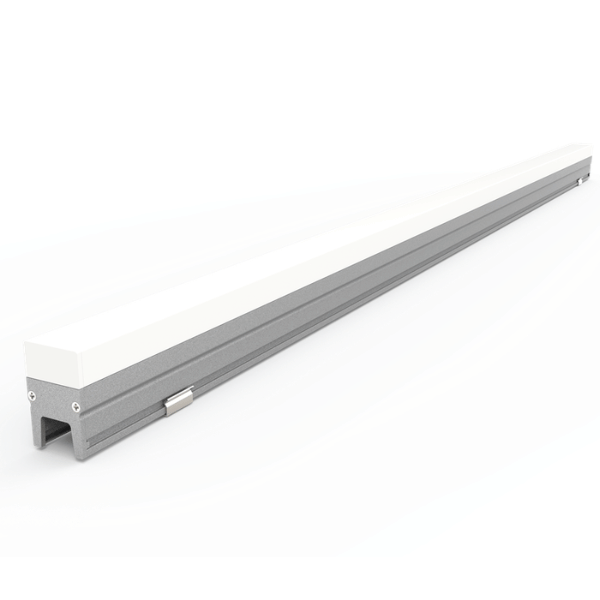
What Is Facade Linear Lighting and How Does It Work?
A facade linear light is an elongated LED fixture designed to mount along building exteriors and project controlled light onto architectural surfaces. Four primary components comprise a facade linear light: an extruded aluminum housing that functions as both the structural element and the heat sink, an LED array (single-color or RGB/RGBW), optics that focus and shape the streaming beam, and a protective cover that seals the casting for outdoor use.
The operating principle is simple. LEDs inside the fixture emit light through precision optics that control the distribution angle, usually between 15 and 60. Mounting the fixture close to the wall surface at a narrow angle creates a grazing effect that enhances texture. Positioning it further away with a wider beam produces a highly uniform wall washing result. Power is supplied to the LEDs via constant-voltage drivers at 24V DC, 36V DC, or 48V DC, and each fixture receives addressing and color instructions via DMX512, TTL, or RDM control protocols.
In our view, the aluminum extrusion does two things that specifiers sometimes fail to appreciate. In addition to adding structural stability, the profile acts as a passive heat management system. Aluminum pulls heat from the LED junction, which directly affects lumen maintenance and lifespan. A properly-vented extrusion keeps the LED junction temperature below the level where accelerated lumen depreciation begins, which is why we build into the profile and do not rely on active cooling fans that can fail in outdoor installations.
Facade linear lighting has effectively become the standard exterior lighting format for commercial, institutional, and hospitality buildings. Its popularity comes from how LED linear light fixtures follow the horizontal and vertical lines inherent in architectural design, establishing clean, unbroken bands of light that reinforce the building’s geometry instead of competing with it. Unlike a floodlight or a spotlight that illuminates a single target area, a facade light distributes the lighting evenly over the full length of the surface, creating continuous outdoor lighting coverage without any dark zone between individual units.
Types of LED Facade Linear Lights by Cover Material
The cover material is the only element that most distinguishes facade linear light models. It affects light efficacy, diffusion quality, structural strength, and the nature of the fixture appearance during daylight hours. Guangqi Lighting offers four separate cover classes, each optimal for a range of project environments.
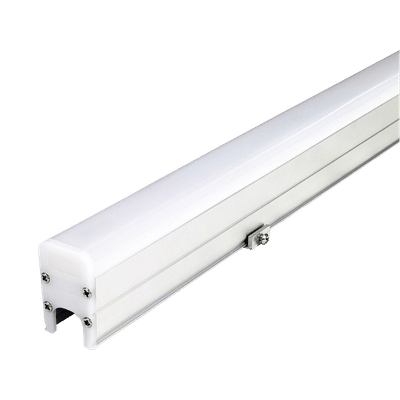
PC Cover
Polycarbonate (PC) Series
Polycarbonate covers deliver about 88% light efficacy with high impact strength. Its practicality makes polycarbonate the material of choice for contiguous runs where weight is a consideration and the fixture may be subjected to wind or other mechanical vibration.
- Models: GQ-L1636, GQ-L3047, GQ-L3048
- Light transmission: ~88%
- Impact resistance: high
- Best for: extended continuous runs, vibration-prone areas
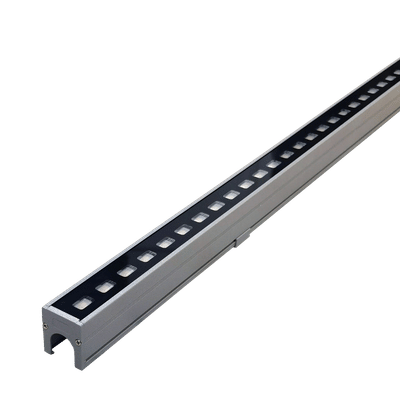
Tempered Glass
Glass Cover Series
Tempered glass results in the best optical clarity at roughly 92% transmission and stands up well to scratching. Weight is the main tradeoff. Most specifiers overlook the beam angle when comparing models, but glass covers also affect the optical path differently than PC, yielding slightly sharper beam edges.
- Model: GQ-2831
- Light transmission: ~92%
- Scratch resistance: excellent
- Best for: premium facades, close-viewing applications

PMMA Diffuser
PMMA Diffuser Series
In our work with facades, we have discovered that PMMA diffusers are most effective at producing evenly washed effects on stone facades in applications requiring the suppression of visible LED hotspots. Its diffusion layer blends each LED point into a continuous line of light, which matters greatly at close viewing distances under 3 meters.
- Models: GQ-L1730, GQ-L1840, GQ-L2845H, GQ-L2845X, GQ-L2845XB, GQ-L3053, GQ-L3846
- Diffusion: excellent uniformity
- Best for: stone/brick facades, close-range viewing, hospitality
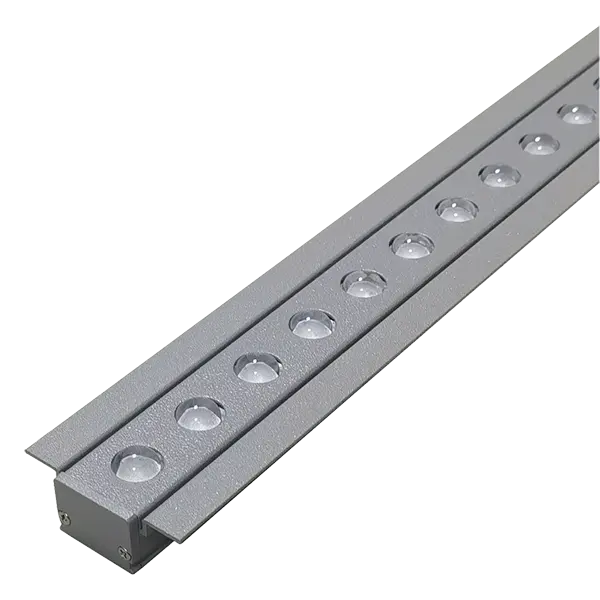
Embedded / Recessed
Perforated Aluminum Series
Embedded models use a perforated aluminum cover that integrates the fixture flush with the facade surface. Each cover becomes an architectural element in its own right, providing controlled light output through precision-cut apertures while remaining almost invisible in the daytime.
- Models: 2842A, 2845A, 3030A
- Mounting: flush recessed
- Best for: new construction, minimal daytime fixture visibility
Facade Lighting with LED Linear Light Bars: Contouring, Coves, Recesses & Outlining
LED linear light bars are a versatile and modern solution for enhancing architectural facades by emphasizing shapes, edges, and hidden details. They are commonly used for:
Contouring (Outlining)
Purpose: Highlighting the edges and silhouette of a building to create a striking nighttime identity.
Application: Tracing rooflines, balconies, or window frames. Defining geometric shapes (e.g., curves, angles) on modern structures.
Effect: A sleek, futuristic look that makes the building stand out.
Cove Lighting (Recessed Lighting)
Purpose:Indirect, hidden illumination that creates a soft, ambient glow without visible light sources.
Application: Installing LED strips in ledges, cornices, or recessed channels to wash walls with light.
Enhancing depth and dimension in facades with layered lighting.
Effect:A sophisticated, glare-free illumination that adds depth to the architecture.
Dynamic & Smart Lighting
RGB & Tunable White:Allows color-changing or temperature-adjustable effects for different moods.
DMX & IoT Control: Enables synchronized light shows, dimming, and automation.
Applications: From Commercial Buildings to Landscape Projects
Facade linear lights serve a broad range of exterior lighting applications. The LED fixture format’s versatility comes from its ability to follow architectural lines, deliver controlled beam patterns, and adapt to both static and dynamic color-changing requirements. Where traditional flood lights or spotlights cover a single focal area, LED linear fixtures produce continuous lighting effects that accentuate the full breadth of a building facade.
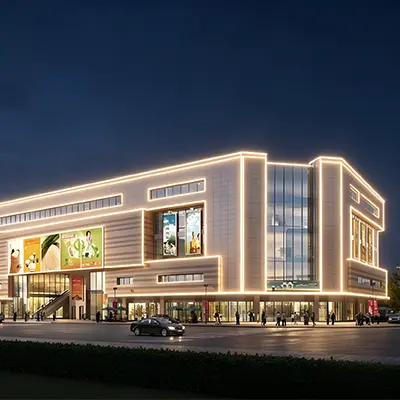
Commercial Buildings
Office towers, retail complexes, and mixed-use developments use facade linear lighting to establish a distinctive nighttime presence. Wall washing with neutral 4000K white creates a professional, modern appearance. RGBW fixtures add the flexibility to feature seasonal or event-specific color scenes on demand.
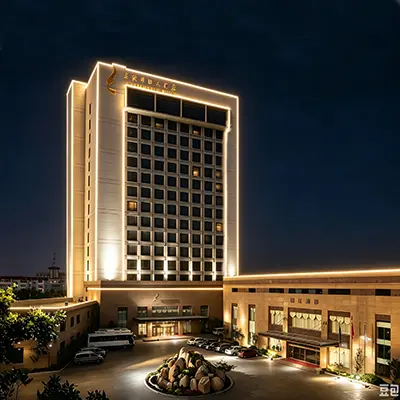
Hospitality & Retail
Hotels, restaurants, and flagship retail stores rely on warm 3000K facade lighting to project an inviting atmosphere. PMMA diffuser covers eliminate the industrial appearance of visible LED points, which matters when guests and customers view the facade from short distances at sidewalk level.
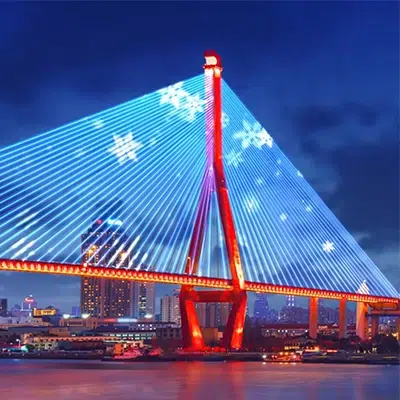
Bridges & Infrastructure
Bridge piers, overpasses, and transit stations can use linear fixtures to accentuate the rhythm of repeated columns and spans. RGB and RGBW models with DMX512 control allow city authorities to program decorative lighting effects and civic color themes for celebrations, holidays, and awareness campaigns. Aluminum-housed LED linear fixtures are well suited to exposed infrastructure environments where vibration and temperature extremes are routine.
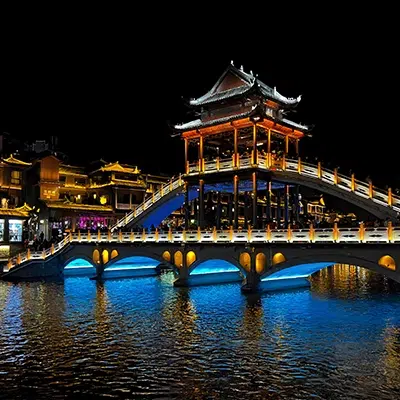
Landscape & Garden Architecture
Retaining walls, garden pavilions, and outdoor sculpture installations can use facade linear lights and shorter segments to illuminate landscape features. IP66-rated fixtures handle ground-level exposure to irrigation, splashing, and soil contact without compromising the seal. Warm white illumination complements natural stone and wood materials common in landscape architecture.
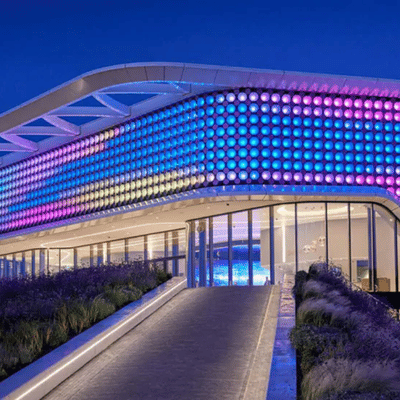
Cultural & Institutional
Museums, universities, and government buildings use facade lighting to communicate permanence and civic importance. Grazing techniques on stone and masonry facades reveal the craftsmanship of the building material, while carefully aimed accent fixtures draw attention to entrance porticos, inscriptions, and decorative friezes.
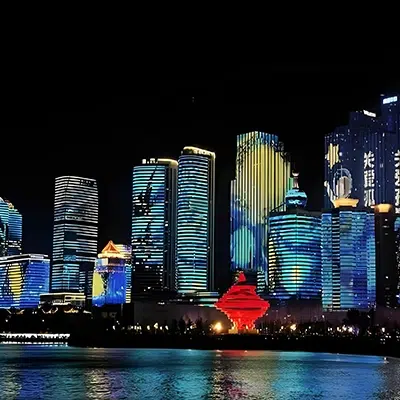
Media Facades
When pixel density reaches 8-32 pixels/m, facade linear lights function as a low-resolution exterior display. Content including animations, text, abstract patterns, and synchronized light shows runs through media servers that output DMX512 or TTL/SPI signals. Media facades turn building exteriors into communication surfaces for branding, art installations, and civic events.
Have a Facade Lighting Project in Mind?
Send us your building dimensions and facade material details. Our engineering team will recommend the right fixture, beam angle, and control setup for your application.
Get Project RecommendationTechnical Specifications & LED Performance Data
All Guangqi facade linear lights share a common design foundation: extruded aluminum bodies with anodized or powder-coated finishes, silicone gasket sealing for IP65/IP66 ingress protection, and stainless steel mounting hardware. Differentiating specifications are organized by series below.
| Parameter | Embedded Series | Glass Series | PC Series | PMMA Series |
|---|---|---|---|---|
| Models | 2842A, 2845A, 3030A | GQ-2831 | GQ-L1636, GQ-L3047, GQ-L3048 | GQ-L1730, GQ-L1840, GQ-L2845H/X/XB, GQ-L3053, GQ-L3846 |
| Cover Material | Perforated Aluminum | Tempered Glass | Polycarbonate | PMMA Diffuser |
| Housing | Extruded Aluminum Profile (6063-T5) | |||
| Input Voltage | DC24V / DC36V / DC48V | |||
| LED Colors | Single Color (3000K / 4000K / 6000K), RGB, RGBW | |||
| LED Density | 48 – 120 LEDs/m | |||
| Pixel Density | 8 – 32 pixels/m | |||
| Control Protocol | DMX512, TTL (SPI), RDM | |||
| IP Rating | IP65 / IP66 | |||
| Operating Temp | -20°C to +50°C | |||
| Lifespan (L70) | > 50,000 hours | |||
| Certifications | CE, RoHS, IEC 60598-1 compliance | |||
Input Voltage & Drop Compensation
We offer DC48V alongside DC24V because voltage drop over 10+ meter runs at DC24V can reduce brightness by 15-20% at the far end. Higher voltage means lower current for the same wattage, which reduces resistive losses in the cable and allows longer fixture daisy-chain lengths before a new power injection point is needed. For projects with runs exceeding 8 meters, we routinely recommend DC36V or DC48V to maintain uniform brightness across the full installation length.
LED Density & Pixels
LED density across the product line ranges from 48 to 120 LEDs per meter. Higher density delivers greater brightness output but also increases power consumption per meter. In the market, 48–60 LEDs/m is common for standard products. For media facade applications, our DMX512 series offers higher pixel resolution: more LEDs per meter mean more pixels, and more pixels result in a clearer media screen.
DMX512, TTL & RDM: Choosing the Right Control System
Control protocol selection determines what your facade lighting can do and how you manage it long-term. Each protocol serves a different scale and complexity of installation.
DMX512
DMX512 is still the de facto protocol for professional architectural lighting: up to 512 channels per universe at refresh rate that allows smooth dimming/color changing. An individual RGBW pixel uses 4 channels (red, green, blue, white), so 1 DMX universe can control 128 RGBW pixels. For larger facades, multiple universes are linked through Art-Net or sACN distribution over Ethernet.
DMX512’s ecosystem advantage is significant. Virtually every professional lighting controller, media server, and building automation system supports DMX output. This means you can integrate facade lighting into broader building management platforms or hand control to event production teams using standard equipment.
TTL (SPI)
TTL signal protocol, sometimes marketed under specific IC chip names, is a simpler, lower-cost approach to pixel-level control. Each LED pixel receives color data sequentially through a clock-and-data signal chain. TTL works well for installations under 50 meters where signal integrity is manageable. Beyond that distance, signal degradation can cause flickering or color errors in the downstream fixtures, requiring signal amplifiers at regular intervals.
RDM (Remote Device Management)
RDM extends DMX512 with bidirectional communication. Controllers can query each fixture for its current DMX address, operating temperature, lamp hours, and fault status. For large-scale facade installations where fixtures are mounted at heights that make physical access expensive, RDM pays for itself through reduced maintenance truck-roll costs. Technicians can diagnose a malfunctioning fixture from ground level before dispatching a crew with a lift.
Which Protocol to Specify
For most commercial facade projects, DMX512 provides the best balance of flexibility, industry support, and long-term serviceability. Projects requiring pixel-mapped media content can still use DMX512 distributed via Art-Net or sACN. TTL is appropriate for smaller decorative installations where budget constraints outweigh the long-term maintenance advantages of DMX. RDM is suitable for demanding, large-scale lighting projects that require monitoring of each individual luminaire, such as long-term deployed LED lighting systems in city landmarks, hotel atriums, cultural tourism night tours, etc. It supports remote address configuration, monitoring of power supply / temperature rise, diagnosis of communication anomalies, and reduces manual inspection costs.
Project Case Studies: Facade Lighting in Action
These project scenarios represent typical facade linear lighting applications that our engineering team encounters regularly. They illustrate how specification decisions play out in practice.
Commercial Office Tower — Wall Washing Application
4000K
Neutral White
GQ-L3047
(PC)
DMX512
Protocol
A multi-story commercial building required uniform illumination across a smooth rendered facade. Wall washing with 45-degree optics mounted at 800 mm from the surface created an even brightness gradient from ground floor to roofline. PC covers were selected for the long continuous runs (individual spans exceeding 25 m) to manage bracket loading on the curtain wall system. DC48V supply maintained consistent brightness across the full run length.
Heritage Hotel — Stone Facade Grazing
3000K
Warm White
GQ-L2845H
(PMMA)
DMX512
Protocol
A restored heritage hotel with hand-cut limestone walls needed facade lighting that would reveal the surface texture without harsh shadows or visible LED hotspots. PMMA diffuser covers at 200 mm mounting distance with 15-degree grazing optics produced a smooth light wash that accentuated the joint patterns and natural color variation of the stone. The 3000K color temperature complemented the warm tones inherent in the limestone material.
Urban Bridge — Dynamic RGB Media Lighting
RGBW
Color-Changing
GQ-L3048
(PC)
DMX512 + Art-Net
Protocol
A city infrastructure project required dynamic color-changing lighting along bridge piers and deck edges. RGBW pixel fixtures at 24 pixels/m provided sufficient resolution for animated wave patterns and civic color themes. Art-Net distribution over fiber-optic backbone delivered DMX universes across the full bridge span, with RDM-capable fixtures enabling remote diagnostics for the transportation authority’s maintenance team.
Ready to Discuss Your Facade Lighting Design?
Share your project elevation drawings, and we will prepare a fixture layout, photometric simulation, and cost estimate within two days.
Start Your ProjectFacade Linear Light Pricing: Cost Factors & Budget Planning
Transparent pricing discussion helps project stakeholders plan realistic budgets. Facade linear light pricing depends on several specification variables, and understanding these factors prevents surprises during procurement.
Typical Entry Range
$7 – $10
Single-Color / PC Cover / Per Linear Meter
Professional Range
$11 – $80
RGB & RGBW / DMX512 / Per Linear Meter
Procurement Note
Ballpark factory-direct sales figures. Levels fluctuate based on order volume and custom requirements.
LED Type
Single-color white LEDs cost less than RGB, which costs less than RGBW. That added white channel in RGBW fixtures requires a fourth LED chip per pixel and more complex driver circuitry.
Cover Material
PC-cover models typically carry a 5%-30% premium over equivalent Tempered glass facade linear light bar models due to material cost and additional processing required. PMMA diffuser models are more higher than those two.
Pixel Density
Higher pixel counts per meter mean more LED driver ICs, more solder joints, and more complex PCB layouts, all of which increase manufacturing cost.
IP Rating
IP66 models require more extensive sealing (potting, compression gaskets, or ultrasonic welding) compared to IP65, adding to production cost.
Total Installed Cost
Fixture cost represents roughly one-third of the total installed system cost. Controllers, power supplies, cabling, mounting hardware, signal distribution equipment, and installation labor typically add 2-3x the fixture cost. Budget planning should account for the complete system.
Volume orders reduce unit cost considerably. For projects more than 500 meters of facade linear light ordered, please contact our project sales staff for complete project-wide price quotes based upon your total specifications.
Certifications, IP Ratings & Quality Standards
Quality certifications provide objective verification that a product meets established safety and performance requirements. For outdoor architectural lighting, the relevant standards address electrical safety, environmental protection, and material compliance.
CE Marking
CE certification confirms that the product complies with EU directives covering electrical safety (Low Voltage Directive 2014/35/EU) and electromagnetic compatibility (EMC Directive 2014/30/EU). All Guangqi facade linear lights carry CE marking as standard.
RoHS Compliance
RoHS (Restriction of Hazardous Substances, directive 2011/65/EU), restricts hazardous materials in electrical components to comply with European standards. Conformity means the fixtures are free of lead, mercury, cadmium, hexavalent chromium, PBBs, and PBDEs, in excess of permitted concentrations. RoHS is a prerequisite for EU distribution and increasingly adopted by North American and Asia-Pacific purchasing bodies.
IEC 60598-1 Compliance
IEC 60598-1 defines the general requirements and tests for luminaires, including mechanical strength, electrical insulation, thermal endurance, and resistance to dust and moisture. This standard forms the technical foundation for luminaire safety certification worldwide and is referenced in the CE marking process.
IP65 & IP66 Ingress Protection
The IP (Ingress Protection) rating system, defined in IEC 60529, quantifies a fixture’s resistance to solid particles and water. IP65 means complete dust protection (first digit 6) and resistance to low-pressure water jets from any angle (second digit 5). IP66 increases water protection to resistance against powerful jets. For standard outdoor facade applications, IP65 is sufficient. Coastal installations, ground-level mounting, and fixtures subject to pressure washing during building maintenance should specify IP66.
Quality Control Process
Since 2010, Guangqi Lighting has maintained a manufacturing quality system with incoming material inspection, in-process testing at multiple production stages, and 100% aging test (burn-in) before shipment. Every fixture undergoes a waterproof test and full-spectrum electrical safety check prior to packing. This investment in process control is why we stand behind a 3-year product warranty on all facade linear light models.
After-Sales Support & Technical Service
A facade lighting installation is a long-term commitment. Fixtures are mounted on building exteriors where access requires planning and sometimes heavy equipment. After-sales support matters more in outdoor architectural lighting than in virtually any other LED product category.
Warranty Coverage
All Guangqi facade linear lights carry a 3-year warranty covering manufacturing defects in materials and workmanship. This warranty applies to the LED array, driver components, housing integrity, and waterproof sealing. If a fixture fails within the warranty period due to a manufacturing defect, we provide a replacement unit at no charge.
Technical Response Time
Our technical support team responds to inquiries within 24 hours on business days. For active project installations, we provide priority support with direct engineer access for troubleshooting DMX addressing, power supply configuration, and fixture commissioning issues. Remote diagnostics via RDM-capable fixtures allow us to assist with fault isolation without requiring on-site presence.
Spare Parts & Model Continuity
We stock spare parts for all current fixtures and have spares for discontinued models for minimum 3 years after end-of-production in order that the fixture most likely to be damaged in a particular large-scale installation can be replaced with a matching fixture rather than requiring an entire section retrofit.
Project Documentation
Every order ships with IES photometric data files, installation manuals, wiring diagrams, and DMX addressing guides. For projects requiring custom documentation for building management systems or municipal lighting inventories, we provide asset data sheets tailored to the client’s format requirements.
Facade Linear Light Engineering Tools
Start Your Facade Lighting Project
From specification to delivery, our engineering team supports every phase. Tell us about your building, and we will design the lighting solution.
Talk to an EngineerFrequently Asked Questions About Facade Linear Lights
LED facade linear lights excel in energy saving (generally 100-140 lm/W), longevity exceeding 50,000 hrs, optical control, color change ability via RGB/RGBW LEDs, and small form factor. Compared to old-style metal halide bulbs, LEDs cut energy use 60-80%, with better color rendering and far quicker start-up. Maintenance costs drop substantially because LED arrays do not require lamp replacements on scheduled cycles the way discharge sources do. On large commercial buildings, the reduced truck-roll frequency alone can offset the fixture premium within the first two years of operation, making LED the default specification for new facade projects.
Installation proceeds in five steps: (1) Site reconnaissance – check facade size, plan cable pathways. (2) Bracket installation – install brackets with anchors/washers at 1-1.5 m sections. (3) Wiring – run DC power, signal leads, conduit, keep signal leads separate from power. (4) Fixture placement – hang fixtures flush and gap evenly on brackets. (5) Programming – establish DMX addressing, test channels, build scenes. Always follow local electrical codes and use IP-rated waterproof connectors for all outdoor junctions.
DMX512 is best when exacting control is desired, with 512 channels per universe and wide-scope controller support – recommended in most commercial projects. TTL (SPI) is simpler and less expensive, better for shorter pathways below 50 m. RDM allows remote interface with distant fixtures for diagnostics and remote control – worth the higher cost if facade projects are above four stories and access to distant installations is difficult. For high-rise facade on possibly snow- or rain-tested structures, remote read-out capabilities of RDM justifies the small extra cost. Most specifiers default to DMX512 because it covers the widest range of project requirements with the best long-term flexibility.
IP65 is the minimum for outdoor facade lighting, providing protection against rain and cleaning spray. IP66 is recommended for coastal locations, ground-level installations, and facades subject to pressure washing during building maintenance. Guangqi facade linear lights are rated IP65 or IP66 as standard. For submerged applications such as fountains or water features, IP67 or IP68 fixtures are required instead.
Four options: PC for impact resistance at 88% transmission, tempered glass for 92% clarity, PMMA diffuser to eliminate visible hotspots, and perforated aluminum for flush-mount concealment.
Yes. With pixel-level control at 8-32 pixels/m, facade linear lights transform building exteriors into dynamic media surfaces. Each pixel displays independent colors via DMX512 or TTL protocols, enabling animations, text, and synchronized light shows. Higher pixel density (24-32 pixels/m) provides finer resolution. RGBW models and dedicated media servers with video mapping capability are typically specified for media facade applications.
3000K warm white for heritage and hospitality, 4000K neutral white for commercial, 6000K cool white for glass and steel. RGBW fixtures switch between all three plus full-color.
Our high quality LED facade linear lights are rated to maintain practical lumen levels for more than 50,000 hours – approximately 11-12 years, assuming an average of 12 hours usage every night. Lifespan is determined largely by thermal management, drive current, and encapsulant sealing etc. Guangqi fixtures have aluminum extrusion housings designed for heat sinking by passive convection and are rated to L70 > 50,000 hours – where the lights produce 70% of their initial lumen levels.