Get in Touch with GUANGQI


Lux to Foot-Candles Converter: Formula, Chart, and Examples

Updated August 2026
Lux to foot candles is an illuminance unit conversion: multiply the lux value by 0.09290304. To convert in the other direction, multiply foot-candles by approximately 10.763910416709722. For example, 500 lx × 0.09290304 = 46.45152 fc. This conversion calculator handles either direction and shows four decimal places, while the formulas, worked examples, and lookup chart remain usable without it. Lux and foot-candles are both units of illuminance; the calculation changes the unit, not the underlying reading or its measurement quality.
1 lx0.09290304 fc
1 fc≈ 10.7639104167 lx
500 lx46.45152 fc
Lux to foot-candle converter
Convert between lux and foot-candle. The unit changes; the measured quantity does not.
Result
fc
500 lx = 46.4515 fc
Lux to Foot-Candles Formula
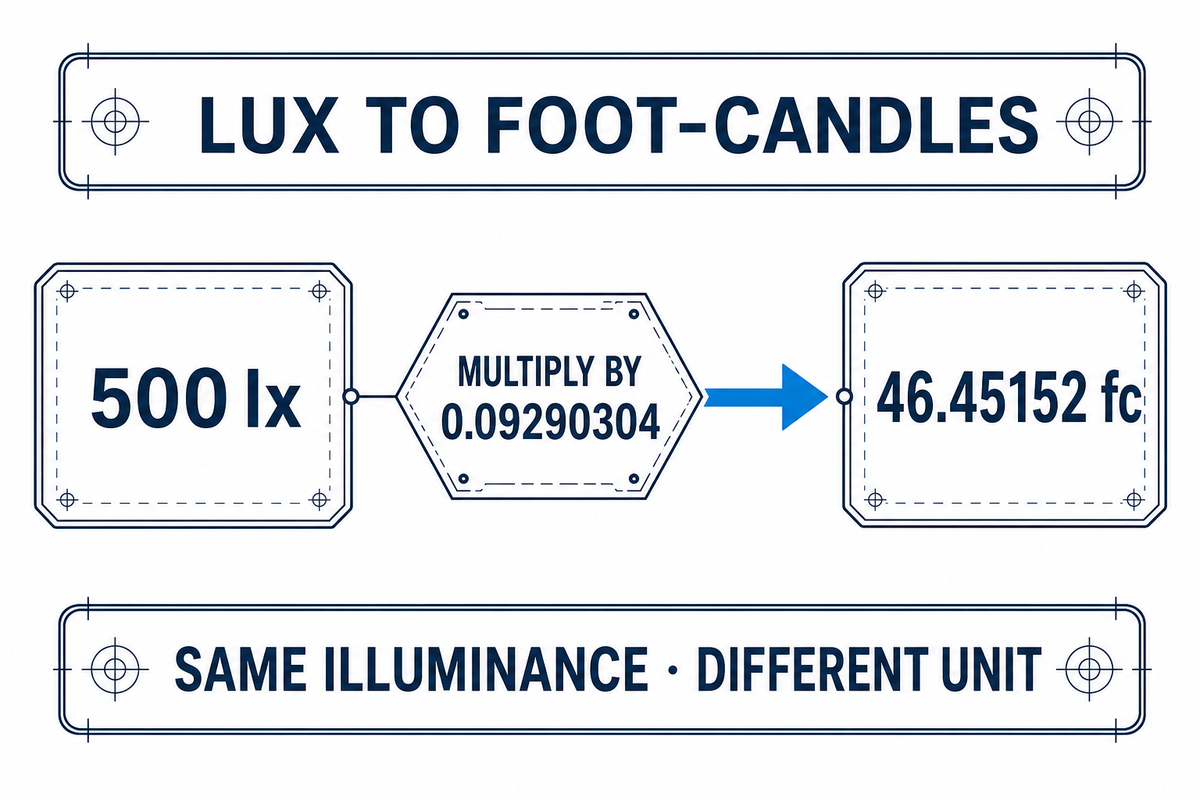
The forward formula is:
Foot-candles = lux × 0.09290304E(fc) = E(lx) × 0.09290304
You may also see the instruction written as foot-candles ≈ lux ÷ 10.7639104167. Both operations are equivalent at the displayed precision. Multiplying by 0.09290304 is convenient when the factor is stored directly; dividing by about 10.764 is convenient for a quick estimate.
Do not simply divide by 10 when the disclosed conversion factor is required. That shortcut changes 500 lx from 46.45152 fc to 50 fc, creating the 7.64% error quantified later in this guide.
For 500 lx, the complete calculation is 500 × 0.09290304 = 46.45152 fc. The display rounded to four decimal places shows 46.4515 fc. Keep the unrounded value for any later calculation, then round only the final reported result to a precision justified by the source reading.
A wrong result appears because the reverse operation turns 500 lx into 5,381.96 fc. The NIST conversion row below identifies the correct relationship.
“footcandle … 1.076 391 E+01 lux”
NIST presents the relationship using scientific notation and a rounded displayed factor. The area derivation below describes the longer value used by this calculator. These extra digits describe the relation between the units; they don’t guarantee the light meter measured to that many digits of precision.
A 7.64% shortcut check below provides a second way to catch the same mistake.
Why the Conversion Factor Comes From Area
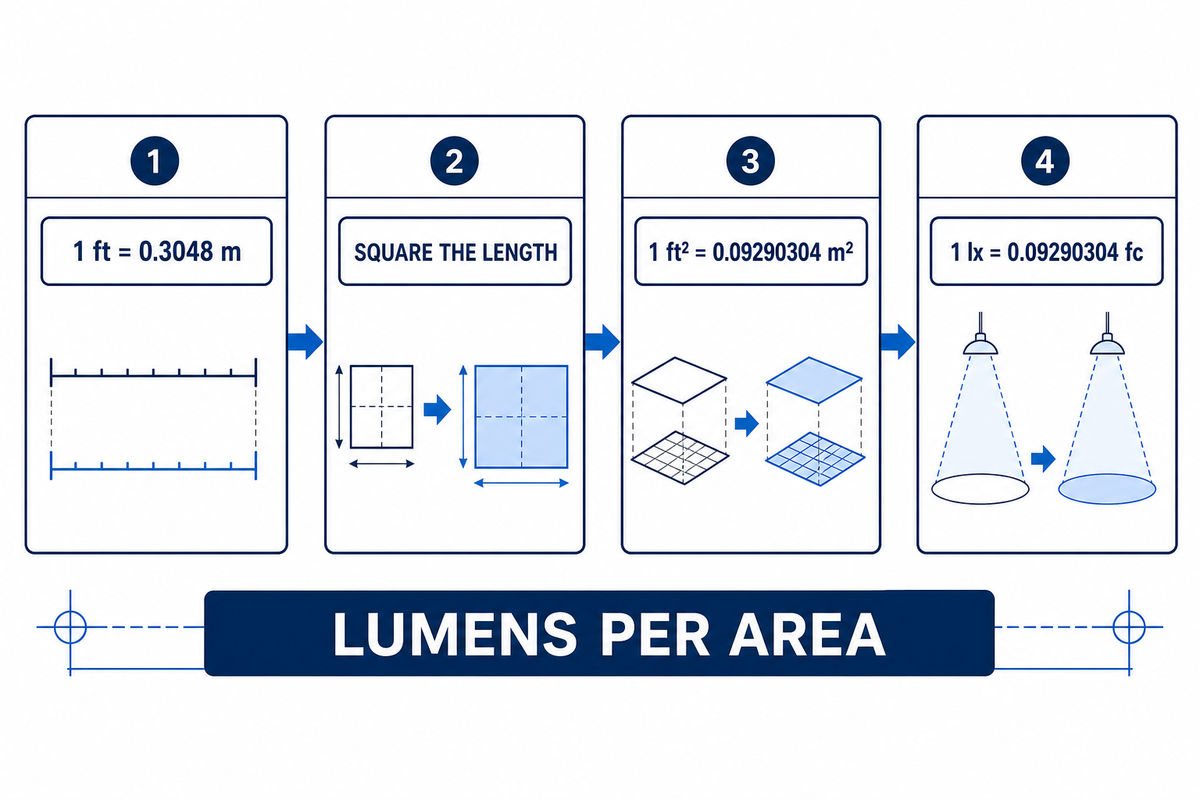
Lux and foot-candles both describe the same physical quantity—illuminance—but they use different area units. One lux is one lumen per square metre, also written as one lumen per square meter in the United States. One foot-candle is one lumen per square foot. The conversion therefore comes from the relation between a square metre and a square foot, not a lighting-industry rule of thumb.
- Start with the international foot. NIST states that 1 ft equals exactly 0.3048 m.
- Square the length. One square foot is
0.3048 × 0.3048 = 0.09290304 m². - Compare equal luminous flux over each area. One lumen spread over 0.09290304 m² produces approximately 10.763910416709722 lumens per square metre.
- State the illuminance relationship. Therefore, 1 fc = (1 ÷ 0.09290304) lx ≈ 10.763910416709722 lx, and 1 lx = 0.09290304 fc.
This area relationship is the reason one square metre contains about 10.7639 square feet, so a foot-candle has about 10.7639 times the numeric value of a lux. The exact ratio is 1,562,500 ÷ 145,161. Sources that print 10.76, 10.764, or 10.76391 are showing the same relationship at different display precision.
The definitions are documented in the International Bureau of Weights and Measures overview of SI units, the NIST photometric calibration publication Special Publication 250-95, and the NIST explanation of the international foot conversion.
Mixing a linear foot ratio with a square-foot ratio creates a mismatch that can survive a casual review. On an engineering drawing, the exact 0.3048 m definition must be squared before the illuminance units are compared.
Worked Lux-to-Foot-Candle Examples
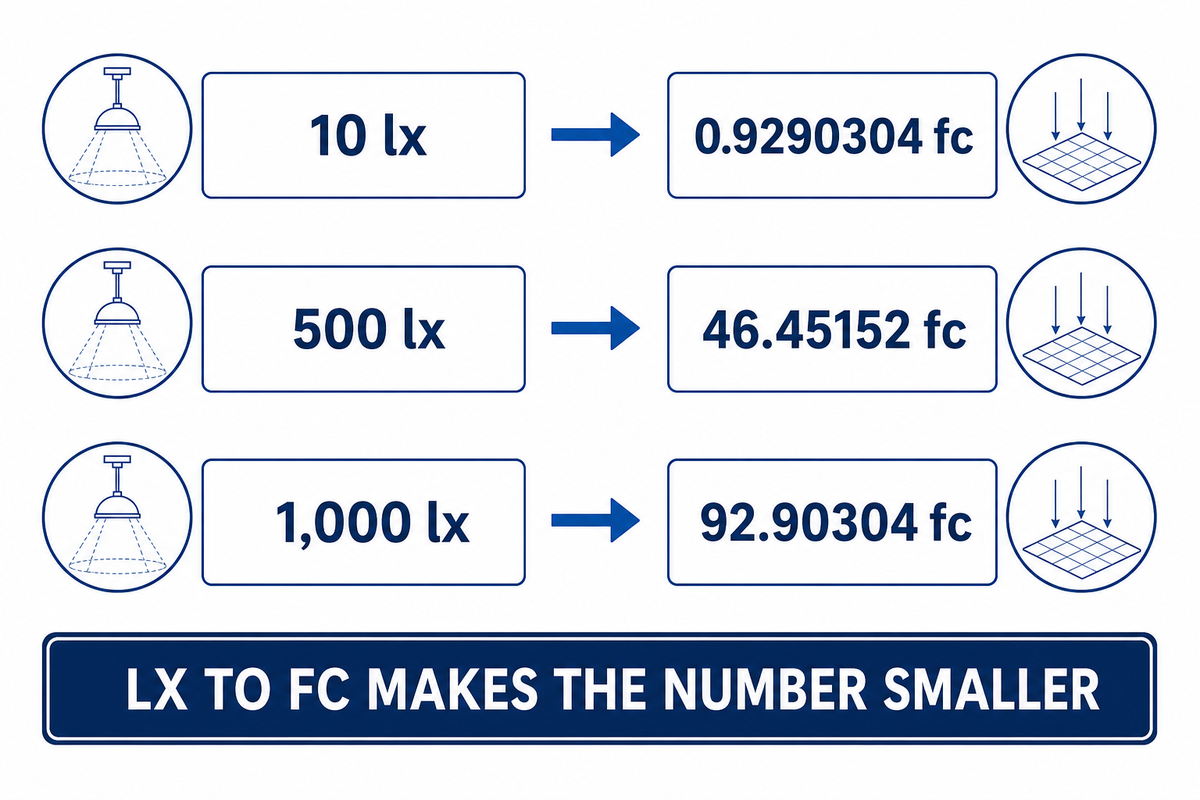
In each case, the same forward factor appears. Labeling the source unit makes it harder to use the reverse factor by mistake.
For a drawing or field-report handoff, the NIST-backed factor keeps all four examples on one evidence chain. The reverse check then exposes a copied decimal or wrong direction before it reaches another document.
- 10 lx (10 lux):
10 × 0.09290304 = 0.9290304 fc. Rounded to four decimal places: 0.9290 fc. - 100 lx:
100 × 0.09290304 = 9.290304 fc. Rounded to four decimal places: 9.2903 fc. - 500 lx:
500 × 0.09290304 = 46.45152 fc. Rounded to four decimal places: 46.4515 fc. - 1,000 lx:
1,000 × 0.09290304 = 92.90304 fc. Rounded to four decimal places: 92.9030 fc.
As a quick magnitude check, the foot-candle value should be about 0.1 times the lux value. This isn’t the calculation itself. A 10× shortcut would produce 50 fc, which looks plausible but is about 7.6% high.
Reverse-check the answer when it will be copied into a drawing, report, or procurement document. For example, 46.45152 fc × 10.763910416709722 returns approximately 500 lx, apart from ordinary computer floating-point display behavior.
Lux to Foot-Candles Conversion Chart
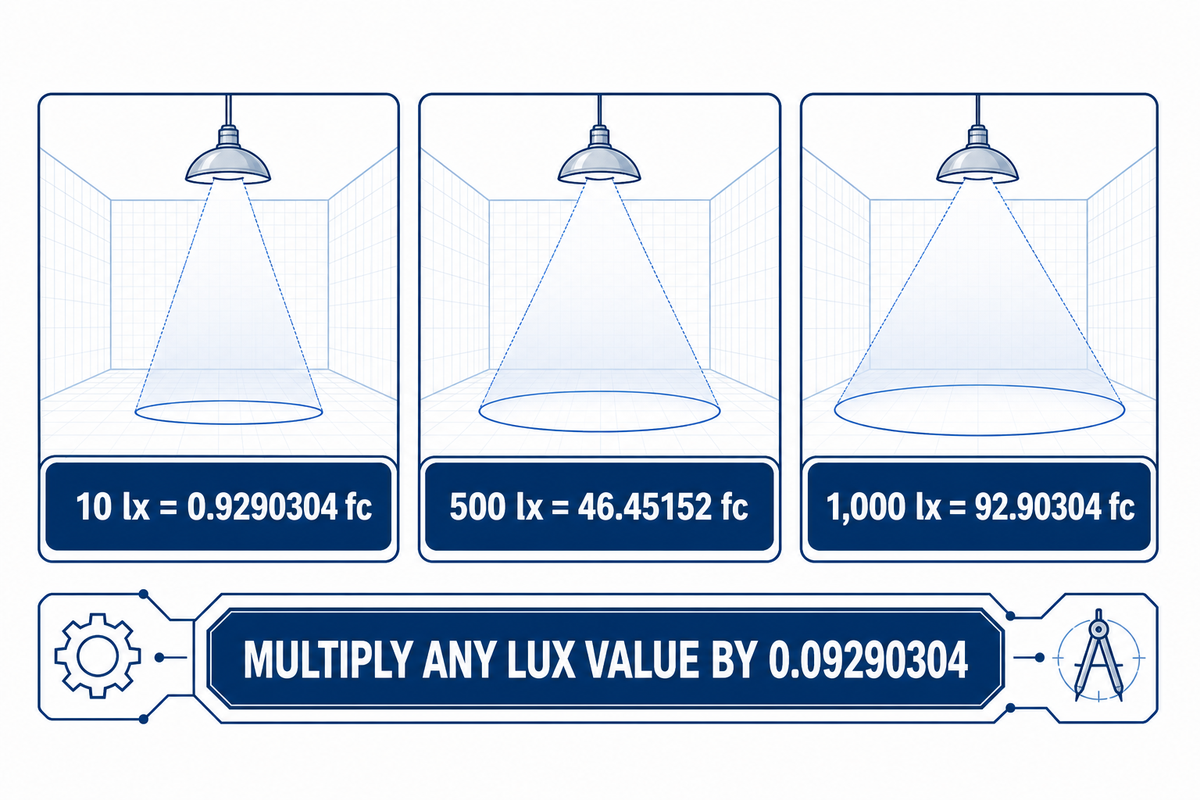
Using the same forward calculation as the worked examples, every value below is formula-derived from lux × 0.09290304. The table converts units; it doesn’t recommend a light level or represent a new field measurement.
The lookup risk is selecting a nearby row and treating its rounded value as the source reading. NIST supplies the unit relationship; the recorded 500 lx or 1,000 lx value must still come from the actual drawing, specification, or field record.
| Lux (lx) | Foot-candles (fc) | Calculation |
|---|---|---|
| 1 | 0.09290304 | 1 × 0.09290304 |
| 5 | 0.4645152 | 5 × 0.09290304 |
| 10 | 0.9290304 | 10 × 0.09290304 |
| 50 | 4.645152 | 50 × 0.09290304 |
| 100 | 9.290304 | 100 × 0.09290304 |
| 200 | 18.580608 | 200 × 0.09290304 |
| 300 | 27.870912 | 300 × 0.09290304 |
| 500 | 46.45152 | 500 × 0.09290304 |
| 750 | 69.67728 | 750 × 0.09290304 |
| 1,000 | 92.90304 | 1,000 × 0.09290304 |
| 2,000 | 185.80608 | 2,000 × 0.09290304 |
| 5,000 | 464.5152 | 5,000 × 0.09290304 |
Use the formulas or calculator in this document, not the rounded display values, whenever the source value is between two rows. Make sure to keep the original reading for a second reviewer to verify the conversion and its direction.
Foot-Candles to Lux Reverse Conversion
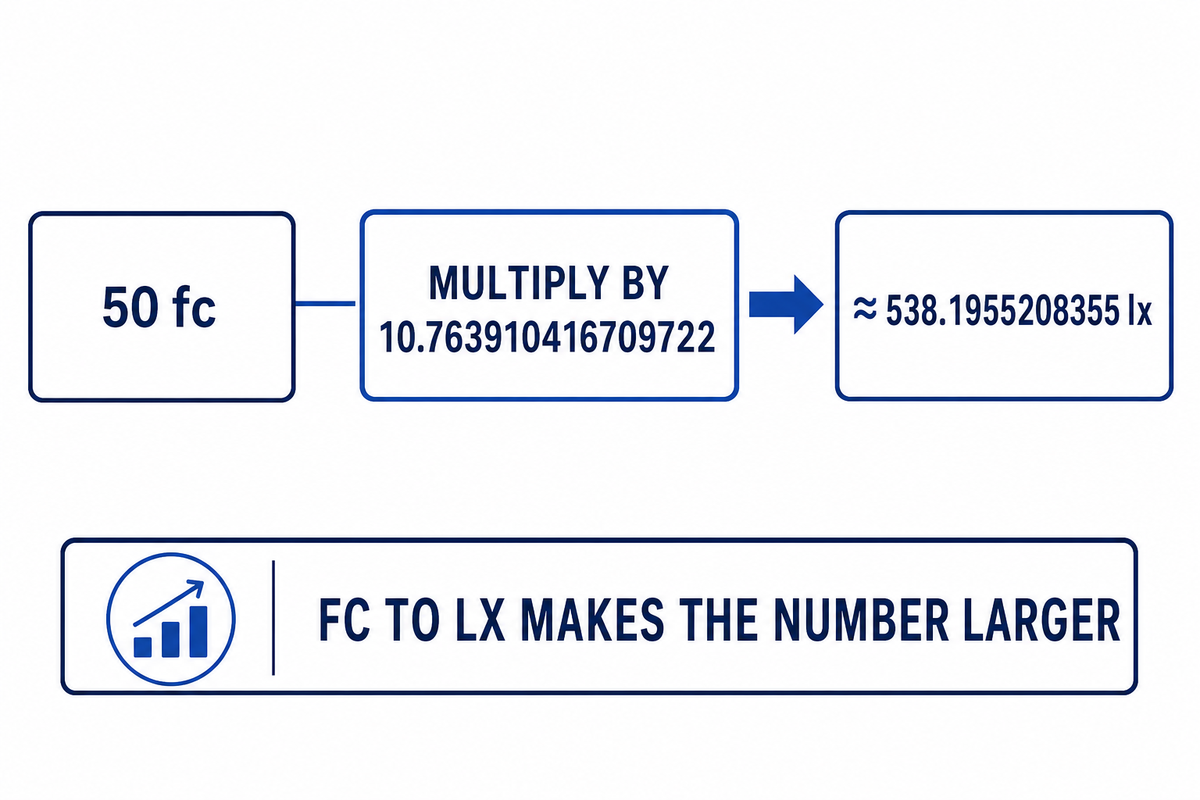
From that conversion chart, the reverse operation is direct: multiply foot-candles by the area factor.
The wrong-direction risk is easy to spot because a correct fc-to-lx result grows by about 10.7639. The NIST area relationship provides the evidence check, while the original foot-candle entry remains the source record.
Lux ≈ foot-candles × 10.763910416709722E(lx) ≈ E(fc) × 10.763910416709722
- 1 fc × 10.763910416709722 ≈ 10.7639104167 lx.
- 5 fc × 10.763910416709722 ≈ 53.8195520835 lx.
- 50 fc × 10.763910416709722 ≈ 538.1955208355 lx.
- 200 fc × 10.763910416709722 ≈ 2,152.782083342 lx.
The direction check now runs the other way: the lux number should be about 10.76 times the foot-candle number. Applying 0.09290304 to a foot-candle input would invert the intended direction. Keep fc → lx beside the equation until the unit label has been transferred to the result.
Area-Based Direction Check
Moving from lux to foot-candles makes the number smaller: multiply by 0.09290304. Moving from foot-candles to lux makes it larger: multiply by the rounded reciprocal 10.763910416709722.
Lux and Foot-Candles Measure Illuminance, Not Lumens
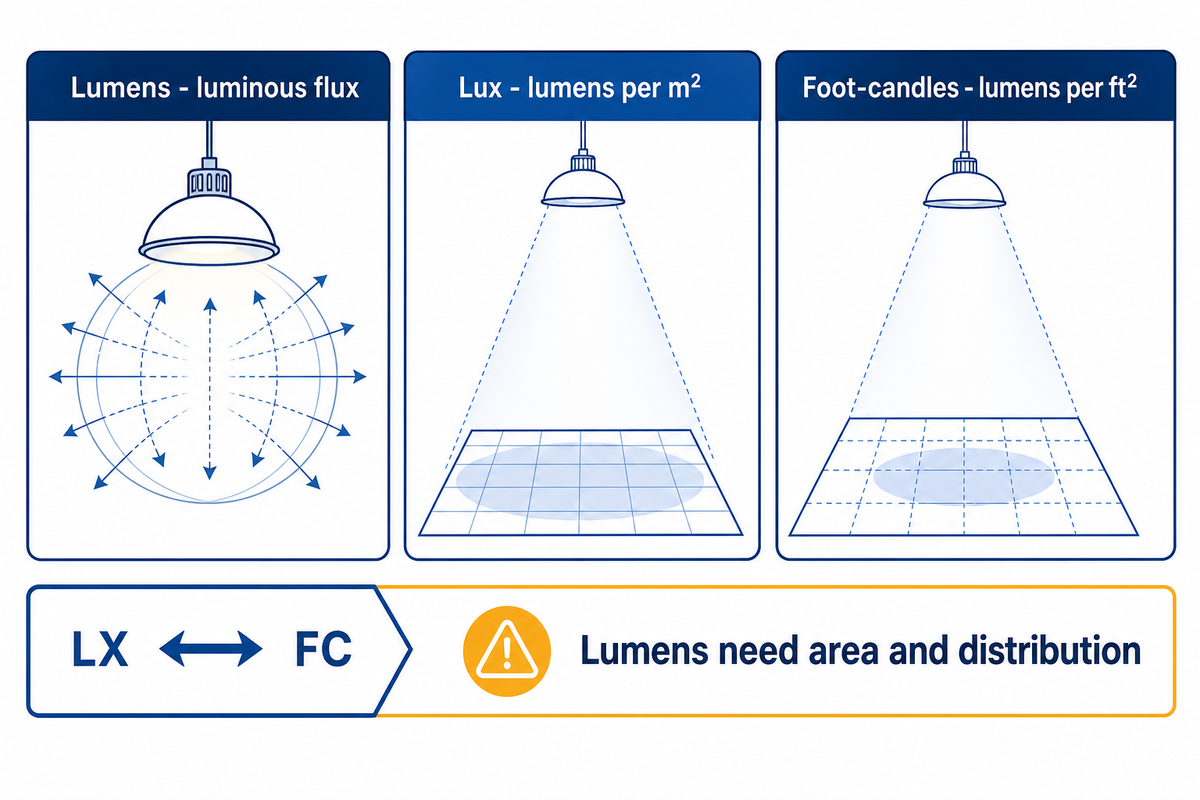
Lux and foot-candles can be converted directly because both describe illuminance: luminous flux received per unit area. Lumens describe luminous flux itself. The NIST photometry reference keeps those quantities distinct; a lumen value alone does not state the area over which the light arrives or how the beam is distributed, so it cannot be converted to lux or foot-candles with one universal factor.
Searches may spell the pair as footcandles and lux or ask for lux to footcandles; those forms refer to the same unit relationship. The statement “one lux equals one lumen” is incomplete. One lux equals one lumen per square metre, while one footcandle equals one lumen per square foot. The difference between lumens and footcandles is therefore a difference between luminous flux and illuminance, not an alternative spelling.
| Quantity | Unit | What is needed? |
|---|---|---|
| Illuminance | lux (lm/m²) | Convert directly to fc |
| Illuminance | foot-candle (lm/ft²) | Convert directly to lx |
| Luminous flux | lumen (lm) | Area and light distribution are also required |
Use our lumens versus lux guide for a more detailed explanation of this quantity boundary. The direct converter only starts after an illuminance value already exists in lx or fc.
The distinction becomes clearer along a simple photometric chain. Each light source has a total light output expressed in lumens. Optical distribution directs some of that visible light toward a surface. The amount of light falling on a surface per unit area is illuminance, expressed in lux or footcandles. Luminance and luminous intensity answer still different questions, so neither candela nor candela per square metre belongs in this two-unit conversion.
The number of lumens describes total light output, whereas the amount of visible light arriving at a specific plane depends on distribution and distance. A light meter is used to measure the amount of light falling on that plane. It can measure how much light actually reaches the sensor, but the reading should not be relabeled as generic “light intensity” when illuminance is the quantity being reported.
As a numerical illustration, knowing that a fixture emits 20,000 lm does not reveal the illuminance at a work plane. Distance, beam angle, aiming, losses, surface position, and overlap with other fixtures influence how much light actually arrives. If a valid lighting calculation or measurement later reports 300 lx at that plane, then the unit step is straightforward: 300 lx equals 27.870912 fc. The converter does not reconstruct the missing optical conditions.
Using Lux and Foot-Candle Readings in the Field
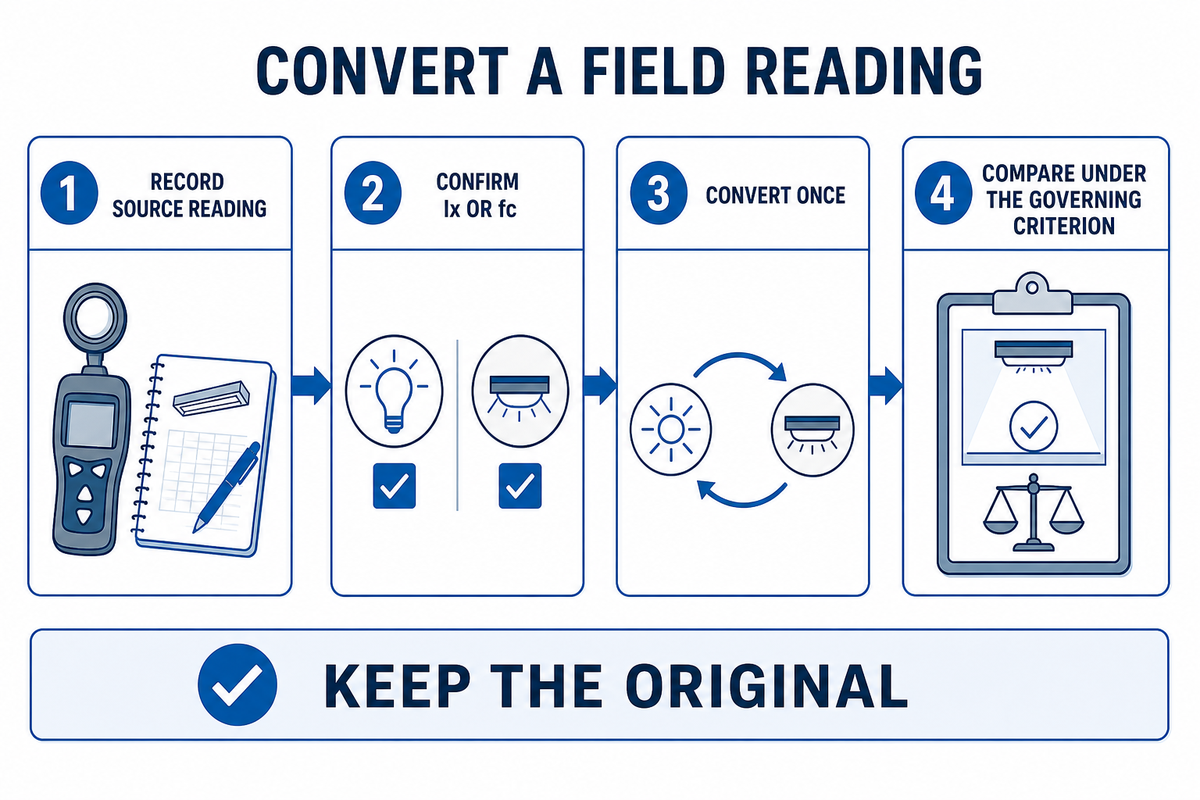
A unit conversion can align a light-meter display with a drawing or report, but it doesn’t validate how the reading was collected. CIE and ISO publish a standard for characterizing illuminance- and luminance-meter performance. Its scope shows that meter behavior has separate technical considerations; exact unit arithmetic is not a substitute for calibration, geometry, spectral response, or an appropriate measurement procedure.
- Record the source reading. Keep the number, unit, measurement point, date, and relevant operating condition together.
- Confirm the display unit. Distinguish lx from fc before entering the number. Do not infer the unit from the size of the reading.
- Convert once. Apply the correct direction and retain the original beside the converted result.
- Compare under the governing criterion. Consult the project specification, measurement method, or context-specific requirement separately.
This sequence helps teams exchange readings across unit conventions. It doesn’t declare that a space meets a target. Context-specific requirements do exist—for example, the U.S. Occupational Safety and Health Administration publishes minimum illumination provisions for specified construction areas—but such tables aren’t universal design targets and are outside this converter’s unit-only scope.
LED lighting projects for commercial spaces or sports projects can document lighting levels in one unit and receive field readings in the other. Their lighting requirements and lighting standards still depend on the intended use, measurement method, and governing specification. International lighting projects may therefore report both scales—for example, 125 lx beside 11.61288 fc, or 625 lx beside 58.0644 fc—but the unit conversion alone does not select a target or approve a design.
Consider a handover where a meter records 487 lx and the receiving drawing uses fc. The conversion is 487 × 0.09290304 = 45.24378048 fc. The record might therefore state “487 lx measured; 45.24 fc converted.” It should also identify the measurement location and condition. Reporting only 45.2438 fc would hide the source precision and could make the converted value appear to be a separate reading.
The measurement position can be more significant than the unit used. Shifting a meter by a few centimetres or feet, flipping it over, adding an extra light source, or recording results in another condition may alter the value, but converting the same recorded value to another unit repeatedly won’t. The same unit formula applies near a bare bulb, an incandescent bulb, or a shielded uplight, yet their distributions can produce very different readings. Glare, uniformity, surface reflectance, and visual comfort are matters of lighting design and evaluation, not synonyms for illuminance.
If the next task is layout and fixture planning, continue to our lighting design services. Application-specific context is also available in the warehouse lighting design guide and sports lighting design guide.
Rounding and Common Conversion Mistakes
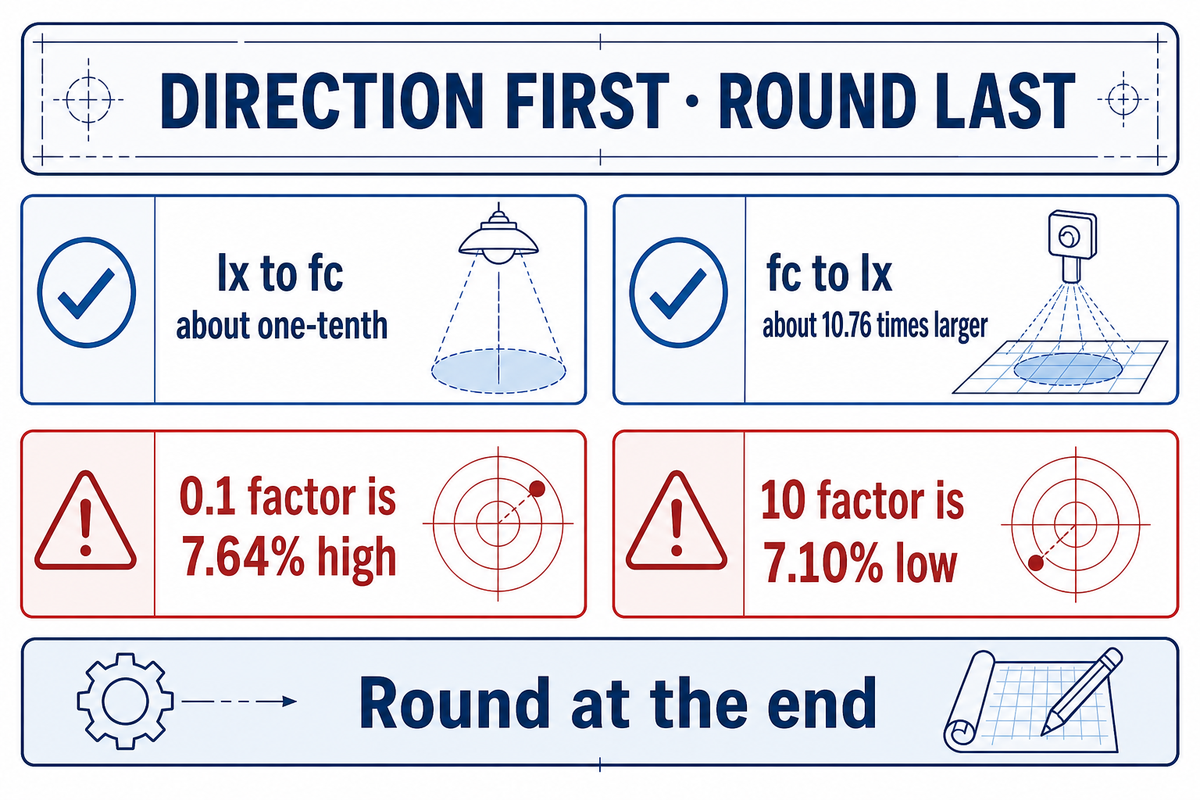
After the field-reading workflow, NIST guidance helps separate conversion-factor treatment from the significant digits justified by a measured value. The calculator can carry the exact unit relation while the reported result is rounded to match the source data and the document’s purpose. Long decimal output should not be presented as evidence of equivalent measurement accuracy.
| Error category | Diagnostic | Correction |
|---|---|---|
| Forward factor reversed | 500 lx becomes 5,381.96 fc | Multiply lx by 0.09290304 |
| Reverse factor reused | 50 fc becomes 4.645 fc-like output | Multiply fc by the rounded reciprocal 10.7639104167 |
| Rounded 10× shortcut | 500 lx is reported as 50 fc | Use the disclosed factor; correct result is 46.45152 fc |
| Square-foot relation ignored | A length ratio of 3.28084 is used | Use the squared area relationship |
| Lumens treated as illuminance | No receiving area is known | Obtain area and distribution information |
| Original reading discarded | Direction and precision cannot be traced | Store source and converted values together |
| Premature rounding | Several steps compound a rounded intermediate | Round only the final reported value |
| Display digits treated as meter accuracy | Four decimals are claimed as measured certainty | Use the meter and method uncertainty instead |
| Conversion treated as an acceptance verdict | No governing criterion was checked | Evaluate the project requirement separately |
The quickest triage is the area-based direction check: lx to fc should make the number roughly one-tenth as large; fc to lx should make it about 10.76 times larger. Then verify quantity, source precision, and document context. For product and application context beyond unit conversion, see GQLAMP’s industrial lighting systems.
Lux belongs to the International System of Units, while the foot-candle is a non-SI unit. When a drawing or field record uses foot-candles, one footcandle and approximately 10.7639104167 lx describe the same illuminance, provided both values refer to the same point and condition.
Choose display precision after asking what the input represents. An exact definition such as 1 ft = 0.3048 m supports an exact conversion factor. Values such as 500 lx do not automatically support a result written to eight decimal places. For a quick comparison, 46.5 fc may be sufficient; for a calculation chain, retain 46.45152 internally and apply the project’s stated rounding rule at the end.
Approximation errors can also be quantified. Replacing 0.09290304 with 0.1 makes a forward result about 7.64% high; replacing 10.7639104167 with 10 makes a reverse result about 7.10% low. Rounding 46.45152 fc to 46.5 fc changes the displayed value by about 0.10%, while rounding it to 46 fc changes it by about 0.97%. Those percentages describe arithmetic differences, not acceptable measurement tolerances.
The same boundary applies if a source record states uncertainty or tolerance such as 1%, 2%, 3%, 5%, or 10%. Conversion preserves the relative relationship; it does not turn a 5% source uncertainty into 0.01% certainty. A reporting or acceptance procedure must decide how those limits are carried and rounded.
Unit symbols also prevent copying errors. Write a space between the number and symbol—500 lx or 46.45 fc—and avoid using “luxes.” In a table or drawing, put the unit in the column heading and label whether a value was measured, specified, calculated, or converted. That small documentation habit is more useful than adding unsupported decimal digits.
Frequently Asked Questions
How do you convert lux to foot-candles?
Multiply the lux value by 0.09290304. For example, 250 lx × 0.09290304 = 23.22576 fc. You can also divide lux by approximately 10.763910416709722; the two forms are equivalent at the displayed precision. Keep the source value and unit beside the result, use the disclosed factor during the calculation, and round only the final displayed number to an appropriate precision. As a direction check, the foot-candle number should be a little under one-tenth of the lux number. If it grows instead, the reverse factor was probably applied.
How many lux is one foot-candle?
One foot-candle equals (1 ÷ 0.09290304) lux, approximately 10.763910416709722 lux. The relationship comes from area: one foot-candle is one lumen per square foot, while one lux is one lumen per square metre. Because the international foot is exactly 0.3048 metre, one square foot is exactly 0.09290304 square metre, producing the reciprocal factor used here. A short display may show approximately 10.764 lux, which is the same relationship rounded.
Are lux and foot-candles the same?
They measure the same physical quantity, illuminance, but use different area units. Lux is lumens per square metre; foot-candles are lumens per square foot. A unit conversion can restate a reading without changing the light condition. It also can’t improve the original measurement’s accuracy or decide whether the reading satisfies a project criterion. Think of footcandles and lux as two scales for the same reading, much as two length units can describe one distance. Lumens, candela, and luminance are different quantities or measurement relationships and don’t belong in this direct two-unit equation.
How many foot-candles is 1,000 lux?
1,000 lx equals 92.90304 fc. Multiply 1,000 by 0.09290304. A four-decimal calculator display shows 92.9030 fc. If the source reading is less precise, report fewer digits as appropriate rather than treating all calculator digits as measured certainty.
Can lumens be converted directly to foot-candles?
No universal direct conversion exists because lumens describe luminous flux while foot-candles describe illuminance over an area. You need the receiving area and enough information about light distribution. Once illuminance is known in lux or foot-candles, the two illuminance units can be converted directly.
Does a converted light-meter reading prove compliance?
No. Conversion only changes the unit label and numeric scale. A defensible assessment also depends on the governing requirement, measurement locations, geometry, meter performance, calibration, operating conditions, and the applicable procedure. Preserve the original reading and evaluate those factors separately.
References & Sources
The unit definitions, area derivation, precision boundary, and field-use limitations in this guide were cross-checked against metrology and public-regulation sources. All conversion-chart values and worked examples were calculated from the disclosed factors; they aren’t measured lighting targets.
- NIST Guide to the SI, Appendix B.9: conversion factors for illuminance
- NIST Special Publication 250-95: photometric calibrations
- NIST: revised unit conversion factors and the international foot
- International Bureau of Weights and Measures: measurement units
- NIST Guide to the SI, Appendix B: using and rounding conversion factors
- CIE, ISO/CIE 19476: characterization of illuminance- and luminance-meter performance
- OSHA 29 CFR 1926.56: illumination provisions for specified construction areas