Get in Touch with GUANGQI



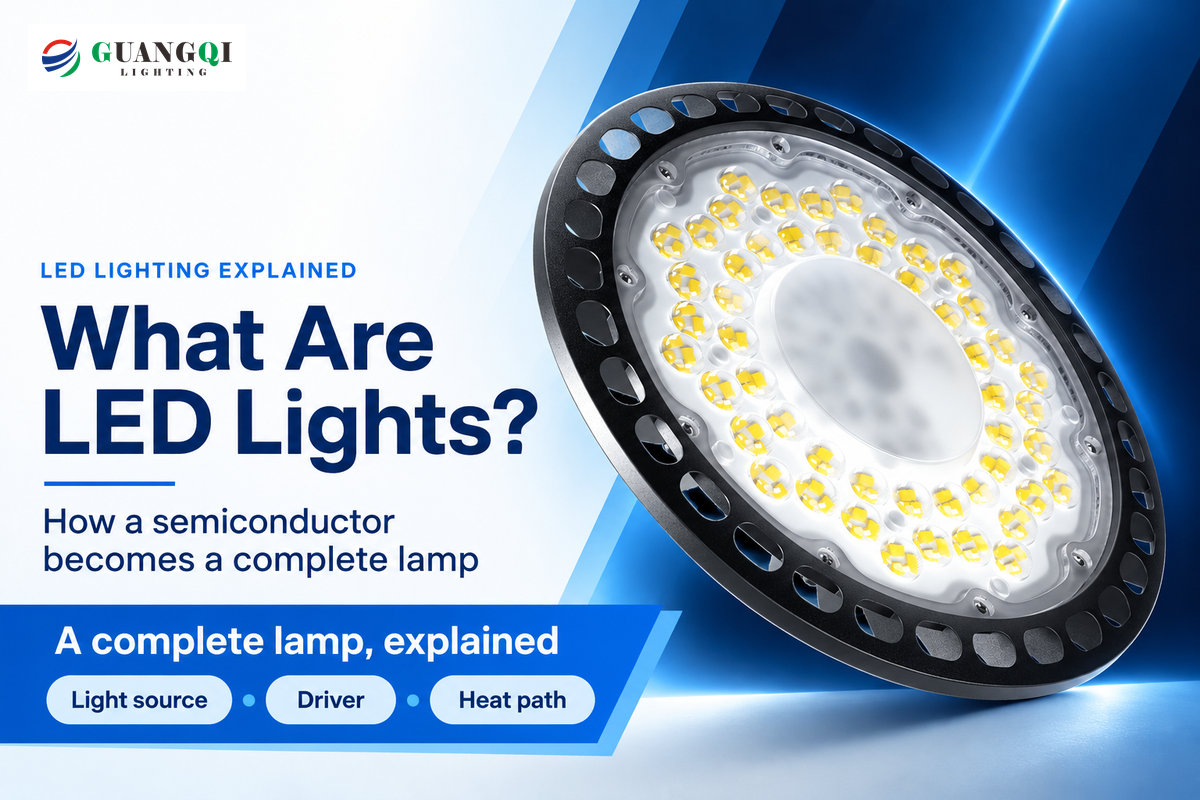
LED lights use light-emitting diodes: small semiconductor devices that convert electrical energy into light. When asking what are LED lights, start with the difference between the tiny emitter and the complete lamp. The emitter makes light, while the driver, optics and thermal design make that light usable in a room, fixture, or outdoor installation.
It’s the same with a familiar screw-in lamp, a flat ceiling panel and a small indicator on a charger: the shapes tell you little about the internals and following that line of inquiry helps explain how LED lights work and their efficiency, their different colors and why an LED lamp can still get hot.
What LED means: diode, bulb and fixture
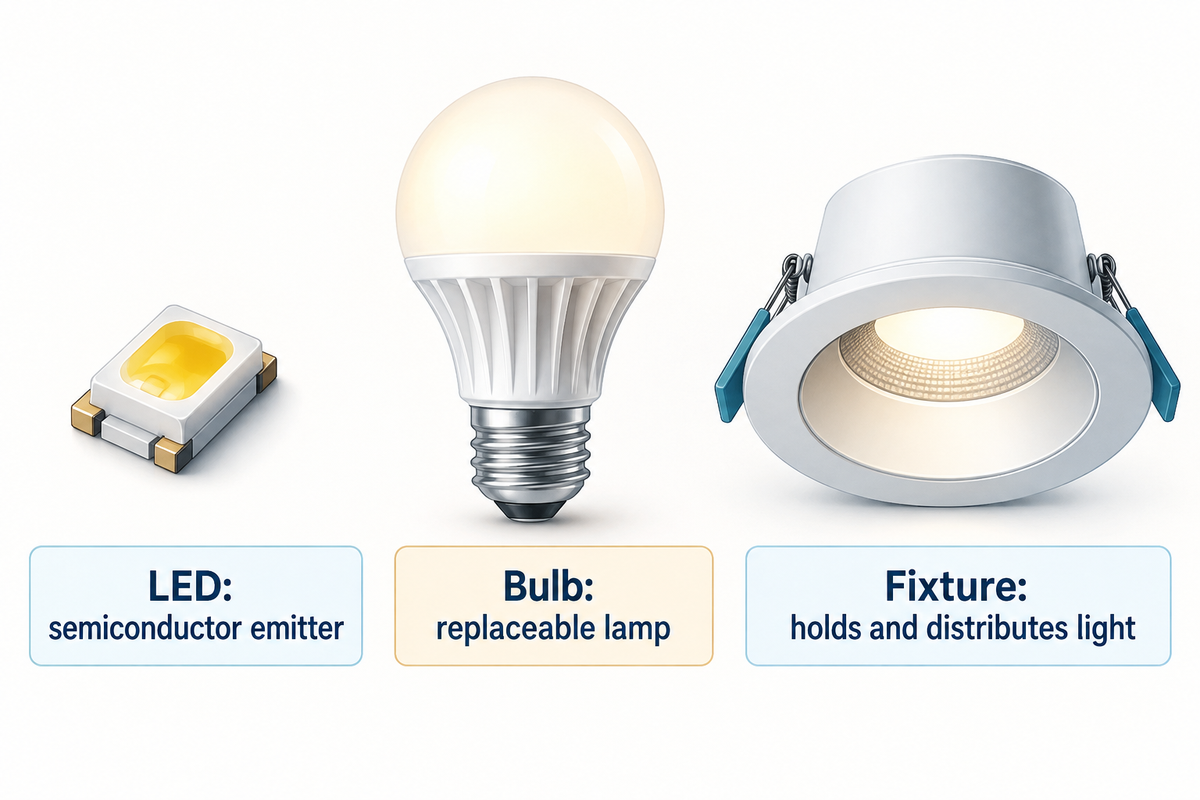
An LED is the light-producing semiconductor, and an LED bulb is a complete replaceable lamp built around one or more emitters. A fixture, also called a luminaire, holds and distributes the light. Some fixtures accept separate bulbs; others integrate the LED module, driver and housing in one product.
The U.S. Department of Energy’s LED Basics distinguishes the light source from the complete lighting system. That distinction is important whenever a specification mentions output, efficiency or life span: a component figure describes something different from the lamp you install.
Consider the emitter as the light maker, not the entire finished appliance. A conventional two-lead indicator LED may look like a small, plastic bead. More recent lighting packages can be surface-mounted on a board, with several emitters in a package. The current passed must be appropriate to the light source. Calling them “tiny light bulbs” is convenient, but there are no miniature glowing filaments inside.
A replaceable light bulb fits in an appropriate socket; an integrated fixture may contain a serviceable module or a permanently assembled light source. The familiar shapes and bases of the common light bulb describe physical formats different from the technology that creates the light. A familiar outline does not settle the maintenance question.
How a semiconductor produces light
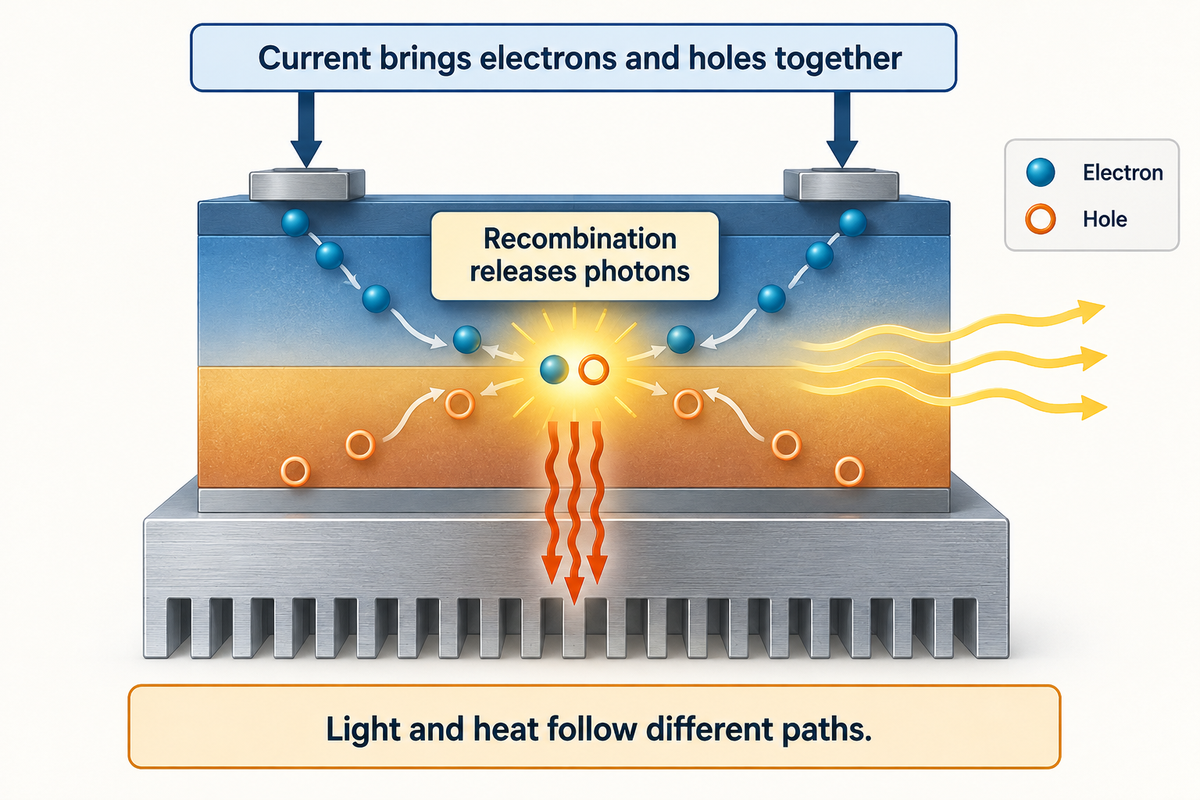
LEDs work through semiconductor emission: electrical current brings electrons and holes together in an active region, where the carriers recombine. Their recombination releases energy in the form of light. Suitable semiconductor materials help the process be efficient enough for useful illumination; the electronic structure of the materials determines the emitted color.
Florida State University’s explanation of light-emitting diodes depicts this phenomenon, called electroluminescence. A hole in the chip isn’t a physical gap; rather, it’s an available electron state. In a simplified p-n junction picture, the p-type and n-type regions provide different charge carriers. Forward bias brings the charge carriers into the light-producing region.
Movement of electrons alone doesn’t make all semiconductors efficient lamps. Ordinary silicon junctions release much of their recombination energy without useful visible emission. Compound semiconductors show better behavior. Gallium nitride compounds are used for making blue emitters. Other emission wavelengths are achieved through the use of gallium arsenide and other phosphide compounds. Typically, composition and architecture are more important than the simple use of the word ‘semiconductor.’
How do LED bulbs work?
A typical LED bulb works by controlling electrical current and tuning the resulting light through its optical parts. The active part of a bulb is a semiconductor emitter where recombination releases light energy in the form of photons, but the complete bulb also integrates electrical conversion and heat management, so performance is dependent on the driver, emitters and optics.
Some input energy is usefully converted to emitted light, and the remaining energy is lost to heat in the semiconductor and electronics. The light and heat of the system therefore don’t follow the same physical path. The LED Energy Path Map below depicts the main energy flow routes for various LED systems. This doesn’t imply that every lamp is similarly designed or constructed.
| Part or stage | What travels through it | Function in the lamp |
|---|---|---|
| Rated electrical input | Electrical energy | Supplies the complete product at its specified input |
| Driver | Controlled electrical current | Feeds the emitters and introduces some conversion loss |
| LED board or module | Current and conducted heat | Connects and supports the light-source packages |
| Semiconductor die | Charge carriers | Produces photons and heat |
| LED package | Light and heat leaving the die | Provides electrical, optical and thermal connections |
| Phosphor, where used | Light of different wavelengths | Converts part of the emitter output to help produce white light |
| Lens, reflector or diffuser | Emitted light | Changes the distribution reaching the illuminated area |
| Thermal interface and heat sink | Conducted heat | Moves heat toward surfaces that release it to the surroundings |
| Housing and surrounding air | Remaining heat transfer and outgoing light | Complete the thermal and optical environment |
This map weaves the Department of Energy’s system overview with ENERGY STAR’s explanation of LED heat management. Certain design elements can help hide these components even though they remain essential to the overall function.
How LEDs produce white light
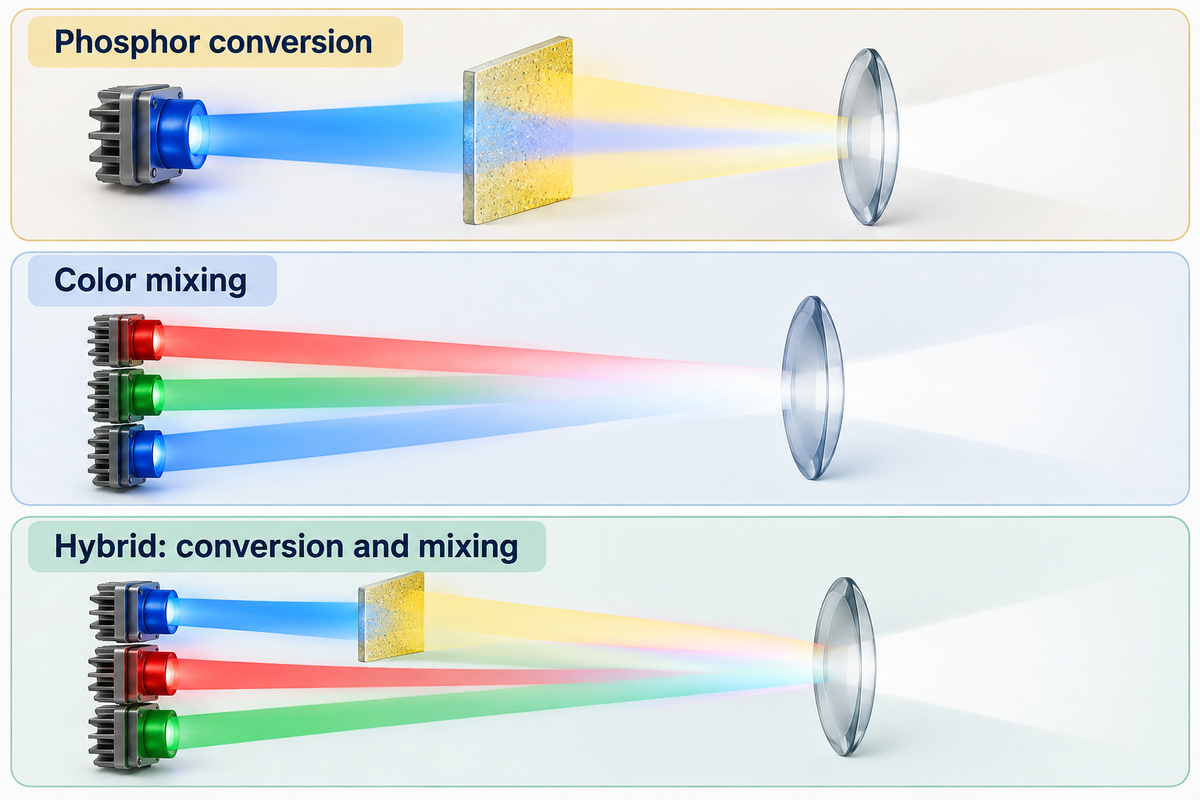
White LED light typically combines different wavelengths instead of being derived from a single “white” semiconductor color. In a phosphor-converted design, a short-wavelength emitter excites a material which emits at a longer wavelength. Another approach employs a mix of differently colored LEDs. Hybrid systems employ a combination of the two.
The Department of Energy covers phosphor-converted, color-mixed and hybrid white-light systems in its LED technology overview. In a common arrangement where blue and phosphor are combined, some blue light and the converted light are mixed to provide white light to the eye. An RGB system can control and adjust red, green and blue light to generate white light.
Here we’ll take a different approach to the lighting replacement example. Consider two lamps with the same labeled lumen output, where one appears warm while the other appears cool. The room doesn’t need to get brighter when the cooler lamp is fitted. The difference may come from the spectral mixture and color temperature while the total light output remains the same. Readers comparing boxes should thus consider brightness and appearance separately. If a red fabric looks different under the two lamps, color rendering raises another question that the Kelvin number alone cannot answer. In such a case, equal lumens help compare output. However, to discuss appearance, one must look at the color and consider how the material looks under the intended light.
Lumens and Kelvin describe two different things: light output and color temperature, respectively. In the explanation on Lighting Facts by the FTC, they separate brightness, energy use and light appearance. Our guide on warm white light appearance explores the color distinction further.
Inside an LED lamp: driver, optics and heat path
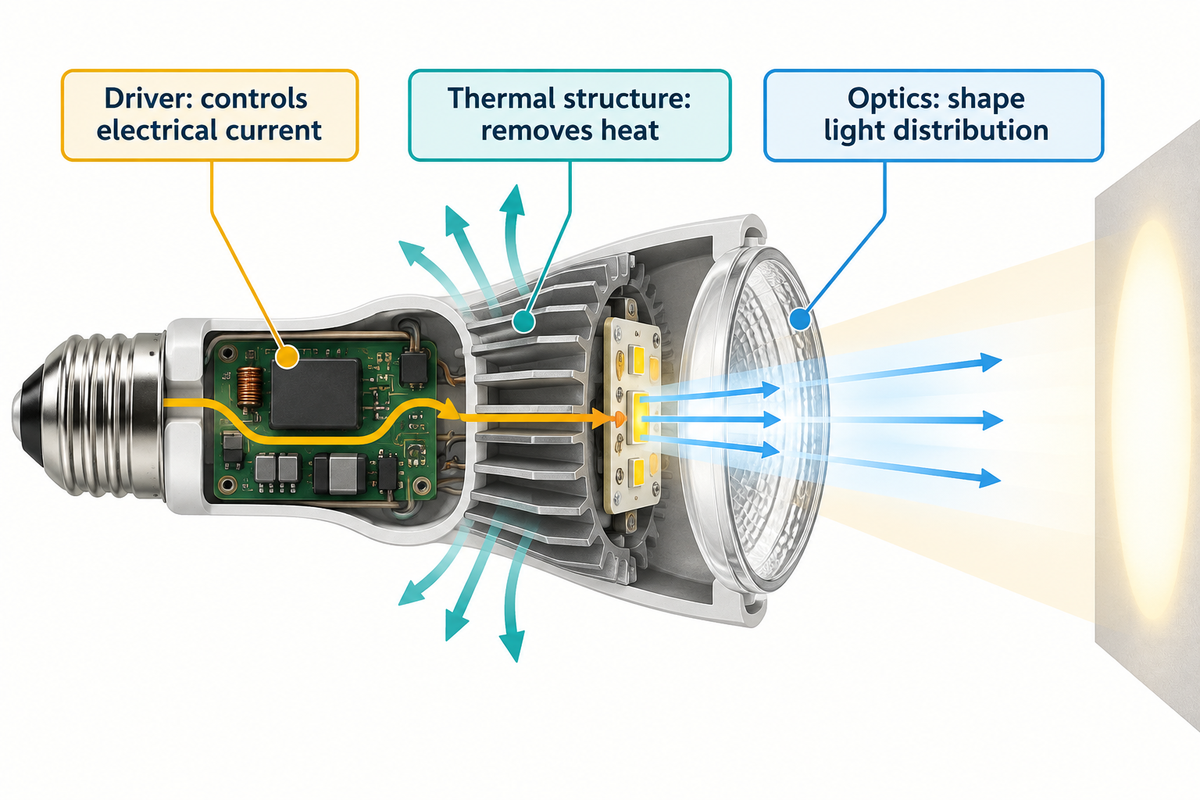
The driver and optics do their jobs and the thermal structure does its job in removing heat from the emitters. These things turn a small semiconductor light source into a decent lamp. A good lumen output doesn’t describe how a product manages its operating temperature, responds to controls, etc.
A bare LED emits light in a specific direction. Reflectors, lenses and diffusers can change the output for a desk, ceiling or roadway light. Diffusers even out hotspots on a surface and directional optics can focus the light to a smaller area. Because of these different choices, equal lumen outputs may appear different when illuminating a work surface.
Does LED take AC or DC?
An LED junction emits light when forward current flows. An LED lamp can accept AC mains through its electronic circuitry. Other products require an externally specified DC supply. The product’s rated input describes the complete assembly; it doesn’t imply that a bare LED can be connected to the same supply.
Suppose a maintenance team is called to replace a lamp that flickers only near the bottom of a dimmer’s travel. The lamp’s familiar appearance may lead the team to replace the light source, when in fact, the issue may be with the dimmer. The team may note the model number of both the lamp and dimmer as well as the dimmer setting at which the issue occurs. Compatible current control may permit a more even light output. A mismatch may result in flicker. This example describes a diagnostic procedure. It isn’t the case that every flickering lamp has this issue. It could be a control problem. A qualified technician can determine this before replacement.
The Department of Energy’s flicker research explains the rapid response time of LEDs to drive current and how driver loading, dimming level and dimmer input affect light output over time. The driver and control are related but discrete elements; see our LED control methods for that next level.
LED, incandescent and fluorescent light compared
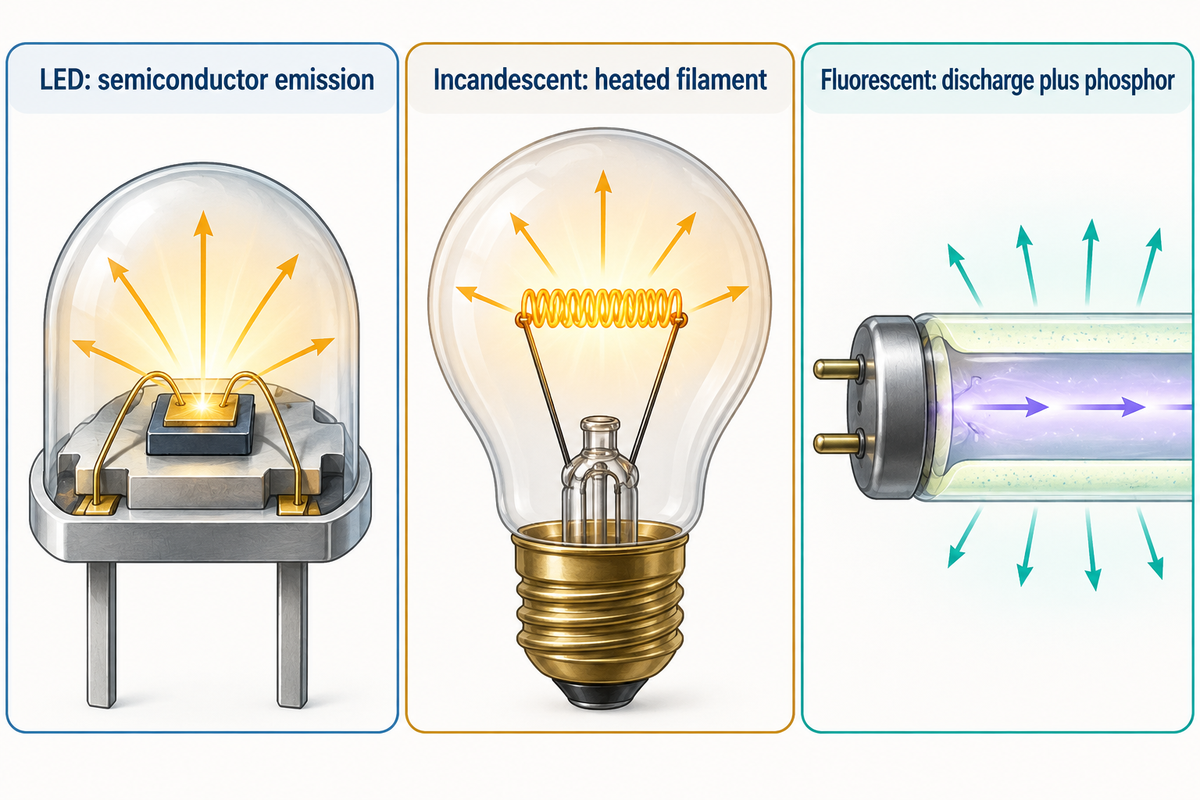
For an assumed equal light output comparison, a 9 W LED lamp uses less electrical power than a 60 W incandescent lamp. The light producing mechanism is different for each. An LED uses semiconductor emission. An incandescent bulb heats a filament and a fluorescent lamp uses a gas discharge with a phosphor coating to produce visible light.
The ENERGY STAR comparison of lighting technologies explains the difference. Fluorescent lamps produce ultraviolet radiation which the coating converts to visible light. Incandescent lights must heat a filament to glow. Unlike incandescent bulbs, LEDs create visible light using a mechanism other than a hot filament. Electronics and light sources still produce heat.
| Comparison | LED lamp | Incandescent lamp | Fluorescent or CFL lamp |
|---|---|---|---|
| Light-making process | Semiconductor recombination | Heated filament | Gas discharge plus phosphor conversion |
| Main light-producing element | LED die or package | Metal filament | Coated discharge tube |
| Electrical support | Driver circuitry | Supply matched to lamp rating | Ballast circuitry |
| White-light route | Conversion, color mixing or hybrid | Thermal emission | Phosphor emission |
| Initial light distribution | Directional at the source | Broad around the filament | Broad around the tube |
| Heat consideration | Heat path from emitters and electronics | Hot filament and surrounding envelope | Discharge, tube and ballast heat |
| Brightness comparison | Use rated lumens | Use rated lumens | Use rated lumens |
| Energy comparison | Actual watts multiplied by operating time | Actual watts multiplied by operating time | Actual watts multiplied by operating time |
| Complete-product check | Optics, thermal design and controls | Socket, fixture and operating rating | Ballast, fixture and operating rating |
Hypothetical energy example: assume the two lamps provide the same useful light and run for 1,000 hours. Energy consumption in kilowatt-hours equals watts multiplied by hours, divided by 1,000. The LED therefore uses 9 × 1,000 ÷ 1,000 = 9 kWh. The incandescent uses 60 kWh, a difference of 51 kWh over that operating period. A household budget owner can repeat this calculation using actual lamp wattages and operating hours, then multiply each result by their own electricity rate. Purchase price, replacement labor and maintenance need separate estimates before this energy comparison becomes a full ownership-cost calculation.
A watt-equivalent description relates output to a familiar older lamp; it isn’t the LED’s actual consumption. The same is true when a package states that a lamp is a 40-watt replacement. Luminous efficacy, which relates the electrical input to the visible light output, is measured in lumens per watt. It, too, needs to be compared at the same boundary. A bare LED package and a complete luminaire are different systems.
Heat, lifespan and the limits of LED lighting
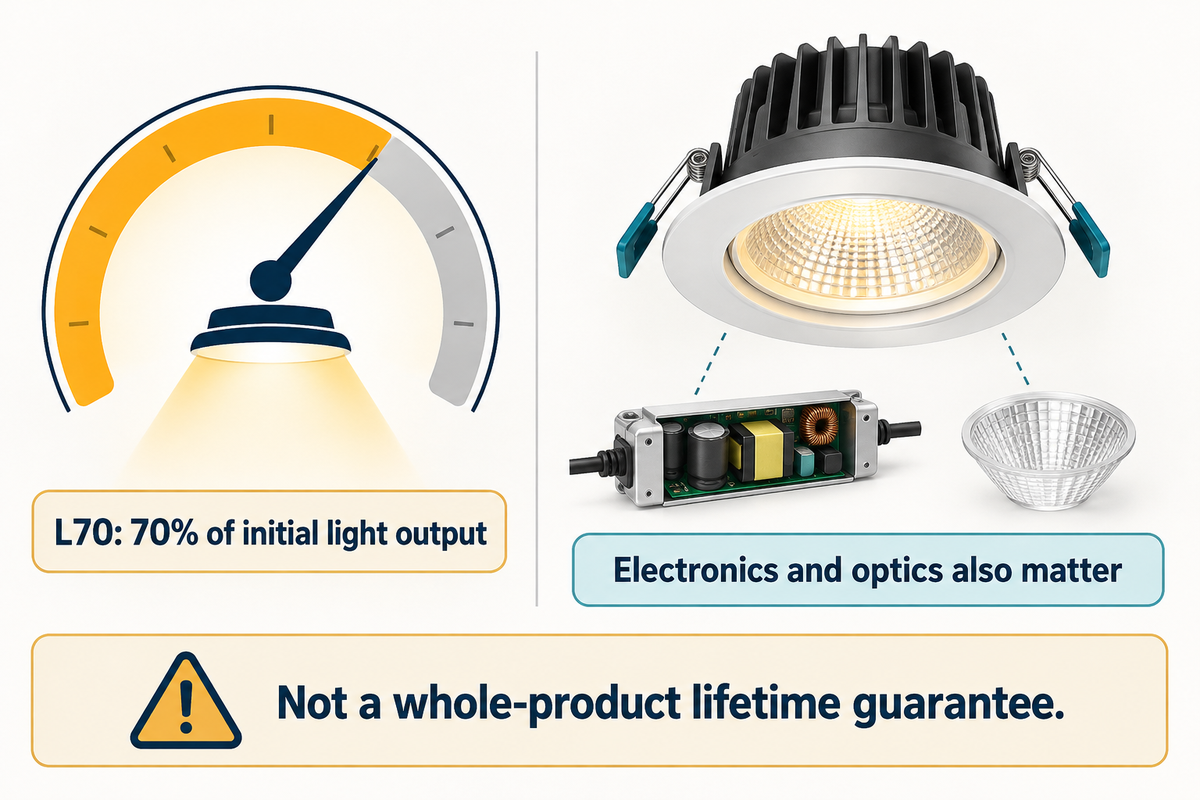
LED lighting can consume less power for the required light and still become hot to the touch. Heat has to leave the semiconductor and the electronics through the product’s thermal structure. Useful life includes more than a glowing chip; the electronics and optical parts can also impact whether the complete lamp still performs its job.
ENERGY STAR’s thermal explanation suggests that heat sinks dissipate heat to the surroundings. A beam may look cool, but that doesn’t mean the base is cool. Enclosing a lamp changes its thermal surroundings, so the product’s enclosure and operating ratings matter even when it appears to fit easily into the socket.
L70 describes the point at which light output has declined to 70% of its initial value. This is a lumen-maintenance target. However, that doesn’t necessarily mean all of the components will function until that time. The Illuminating Engineering Society’s 2018 Position Statement states:
“The IES does not support the use of LED lumen maintenance life as the sole metric for determining solid-state luminaire lifetimes.”
The LM-80-21 and TM-21-21 provide information pertaining to solid-state light sources and projection methods using source-maintenance data, respectively. Those documents help explain how longevity figures are developed. The DOE mentions color changes and component failures as reasons for a lighting product becoming unsuitable.
What is the downside of LED lights?
Good thermal design is required to manage LED heat, while controls and optics address flicker and unwanted glare. LEDs must also have suitable controls and optics. Poor combinations of those components can lead to unacceptable performance and reduce useful life. A lamp still needs compatible control equipment, and a sealed product may provide limited repair and maintenance options.
Comparing claims that LEDs last many times longer than incandescent lamps requires stated products and conditions. Neither “little heat” nor “less heat” defines an operating temperature. A maintenance plan should use the complete product’s documentation and replaceable-part arrangements, rather than assigning a whole fixture the expected life of its semiconductor alone.
How to recognize an LED light
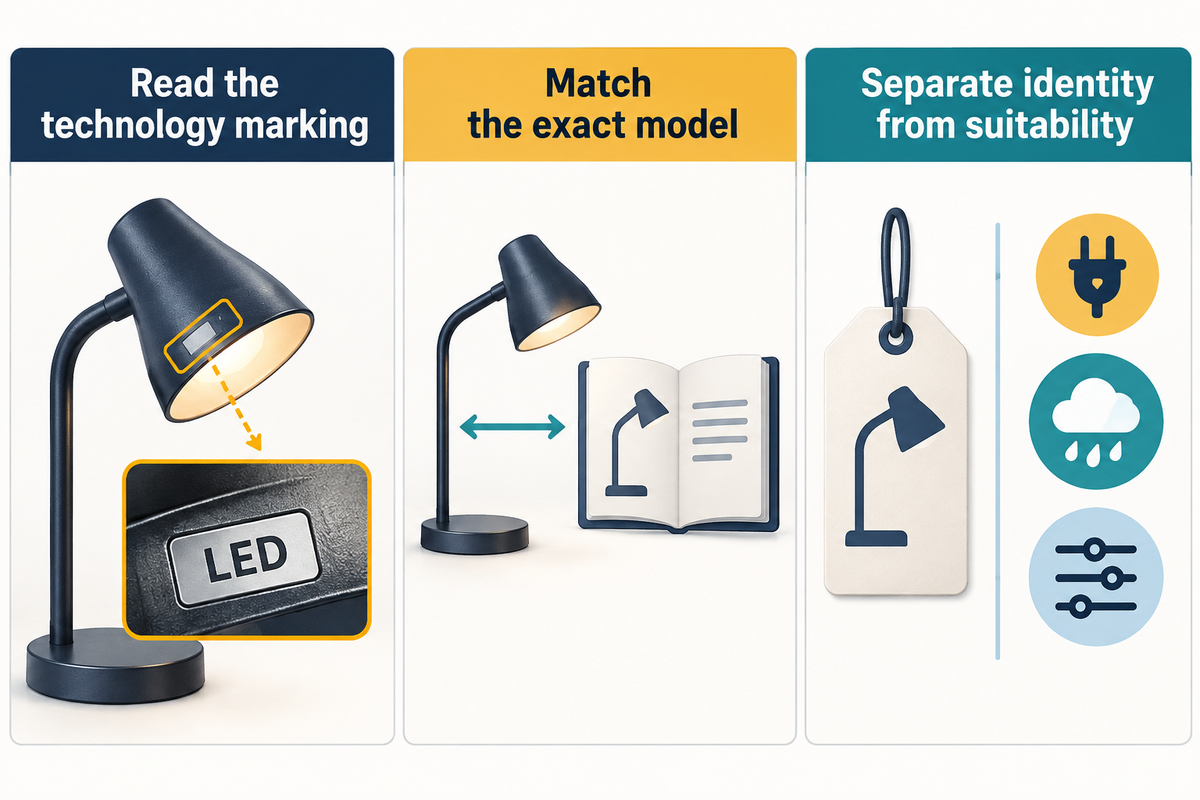
Identify an LED light with the help of specific technology markings and model information. Shape and other clues like a Lighting Facts label can provide secondary support. The label explains performance fields shared by a family of lamp technologies, and doesn’t establish that light-emitting diodes are used in the enclosed product.
The Federal Trade Commission’s labeling guidance pertains to incandescent bulbs, CFLs, and LEDs. There’s a physical counterexample to identification by shape. The Food and Drug Administration’s CFL explanation describes a type of covered CFL that’s similar to traditional incandescent lamps.
Label-First LED Check
- Read the technology marking. Look for LED or light-emitting diode on the lamp, packaging or fixture label.
- Match the model. Use the exact manufacturer and model in the product documentation if the marking is unclear.
- Separate identity from suitability. Record input, light output, base, enclosure rating and control compatibility as different properties.
For an unlabeled light, model documentation provides a better approach than opening it. Visible yellow material or a frosted cover don’t provide a complete means of product identification. Once the technology is established, industrial LED bulb replacement requires consideration of the existing fixture and electrical infrastructure.
What is changing in LED lighting
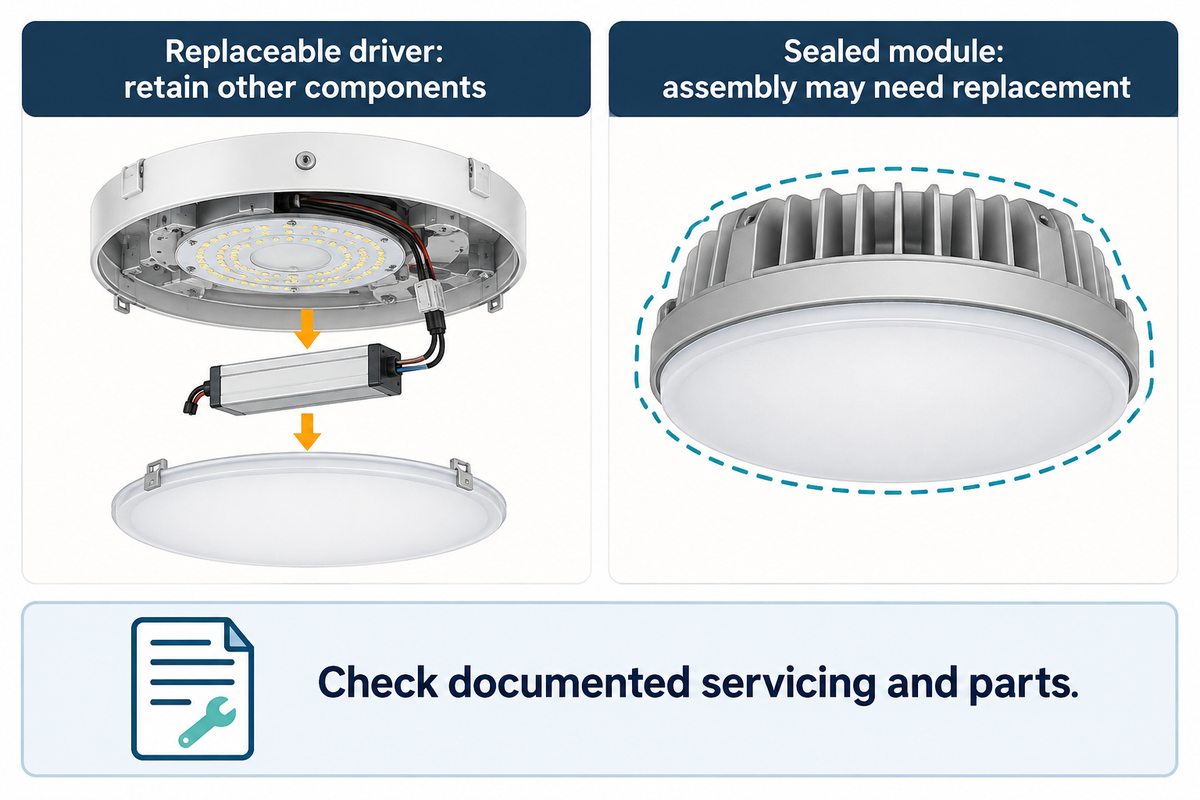
In the field of LEDs, complete lighting systems combine efficient emitters with optics and controls, with repairable and upgradable design as additional considerations. The International Energy Agency (IEA) connects further progress with circular design and smarter operation in its March 2026 commentary. The IEA report moves beyond a product containing an LED.
The commentary The next wave of LED lighting: Smarter, circular and more efficient covers modularity and repairability along with efficiency. An LED lamp with a replaceable, modular driver presents a different maintenance path than one with an inseparable assembly. The presence of documented servicing, along with the parts and accessibility, impacts that path.
When a facilities team is considering an update to lighting, one practical question may be this: if one electronic component fails, what must be replaced? The answer can impact spare-parts planning. Drivers that can be replaced can allow other components to be saved. Sealed modules may require the entire assembly to be replaced. These are construction choices to make before a purchase, and not to assume based on a long emitter-life figure.
Controls are another system-level consideration. Dimming and scheduling can alter when full light is delivered. Their usefulness comes from controlling light as needed based on the space. An inconvenient, otherwise efficient light may be the result of a poor location of a sensor or an unsuitable control sequence. We discuss extended control functions of street lighting, and how controls may change light operation in our connected street lighting article.
When thinking about lighting solutions for a project planned in 2026, take into account the entire luminaire’s light distribution, controls, and service arrangements, and input power. Record which elements the manufacturer supports for replacement and how that support is provided. The LED mechanism remains a semiconductor process, but product-level choices determine how the light is controlled and serviced after installation.
Frequently asked questions
Can LED lights be dimmed?
Some LED lights can be dimmed when the product and control are compatible. The lamp or fixture must be designed for dimming and paired with the supported type of control. An ordinary dimmer does not make every LED product dimmable. The model documentation and any stated compatibility list identify the intended combinations before two products are treated as interchangeable.
Why are LED lights flickering?
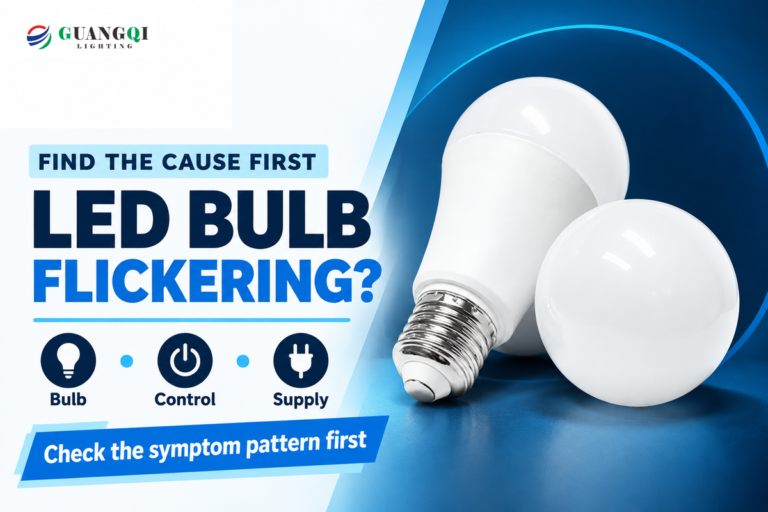
Flickering can come from driver behavior, a mismatched dimmer, the power supply or another electrical fault. The symptom alone does not identify the responsible part. Operating conditions and the exact lamp and control models give an inspection a starting point. Our guide to LED bulb flickering causes explains the different possibilities without assuming that the semiconductor has failed.
Can LED lights be repaired?
Some LED luminaires have replaceable drivers or modules; many small sealed lamps are replaced as complete products. Repairability follows the construction and availability of suitable parts. A replacement component must match the manufacturer’s specifications. A long-rated LED chip does not mean that opening a damaged household lamp is a practical repair.
A serviceable luminaire and a disposable lamp therefore present different maintenance decisions. Before arranging work, identify the exact model, the manufacturer’s servicing instructions and whether replacement parts remain available. A component that physically fits may have a different electrical rating, thermal requirement or control interface. The question is whether the manufacturer supports that repair for the complete product, rather than simply whether another LED board can be found. Electrical work belongs with a qualified person following the documented procedure.
Do LED lights need electricity?
Yes. LEDs need electrical energy to emit light. A battery-powered or solar-powered LED still uses electricity supplied by that system. A mains-powered lamp includes electronics suited to its rated input. The LED chip itself is a light source, not an energy source.
What are LED lights used for?
Uses of LED technology include home lighting for general lighting purposes, outdoor illumination, vehicle brake lights, displays and small indicators in electronic devices. Panel lights and street fixtures use the same semiconductor principle with different optics and ratings. Application requirements determine the complete product design.
The useful distinction: the semiconductor produces light; the complete lamp controls electricity, light distribution and heat. Compare brightness in lumens, input in watts and service life at the complete-product level.
Guangqi Lighting’s guides cover the remaining questions, once the basic mechanism is clear. These include the appearance of light, control behavior, and the differences between a lamp and its fixture. For an existing industrial installation, study our industrial lighting solutions, in conjunction with the provided replacement guide, and keep the fixture’s electrical arrangement, operating environment, and maintenance requirements together.
References & Sources
- LED Basics U.S. Department of Energy.
- Light-emitting diode explanation Florida State University, Molecular Expressions.
- Learn About LED Lighting ENERGY STAR.
- Lighting Facts label questions and answers Federal Trade Commission.
- Flicker Research U.S. Department of Energy.
- PS-10-18 position statement on luminaire lifetime Illuminating Engineering Society, 2018.
- LM-80-21: Measuring Maintenance of Light Output Characteristics of Solid-State Light Sources Illuminating Engineering Society.
- TM-21-21: Projecting Long-Term Luminous, Photon, and Radiant Flux Maintenance of LED Light Sources Illuminating Engineering Society.
- Compact Fluorescent Lamps (CFLs): Fact Sheet/FAQ U.S. Food and Drug Administration.
- The next wave of LED lighting: Smarter, circular and more efficient International Energy Agency, March 2026.