Get in Touch with GUANGQI



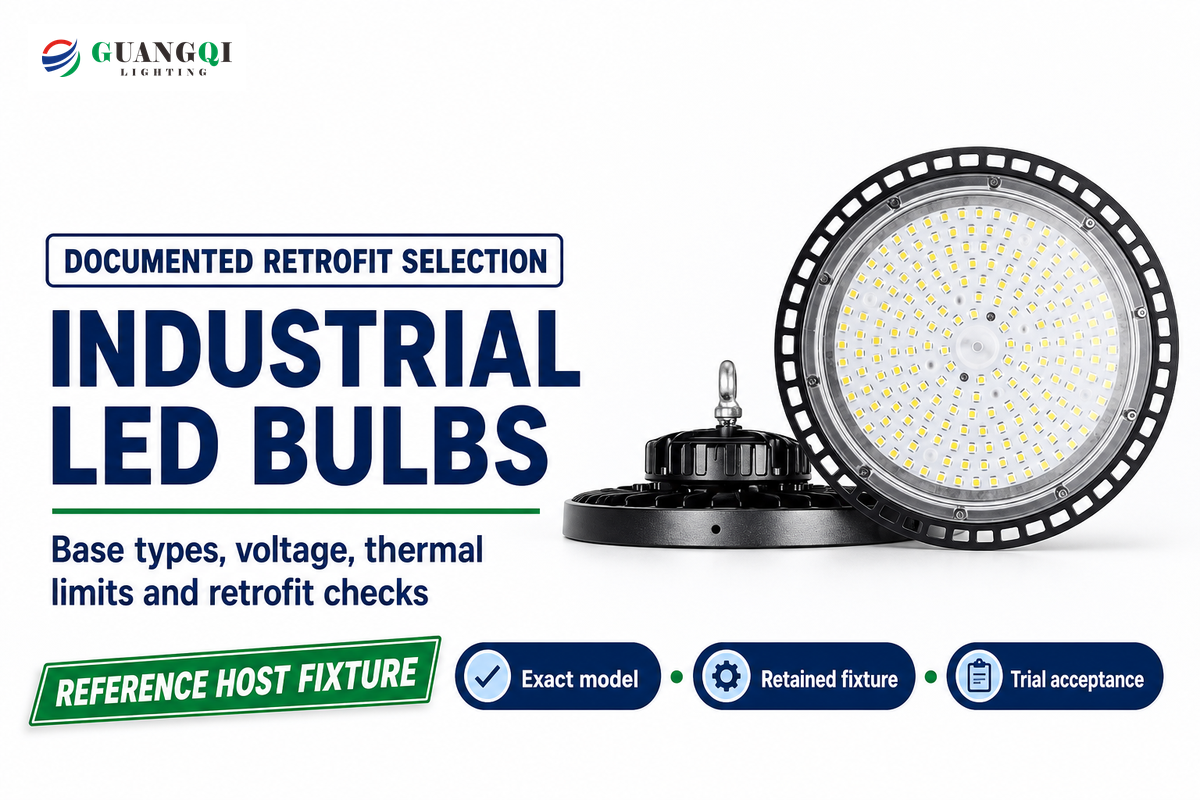
Industrial LED bulbs are replacements for lamps used in industrial or commercial fixtures. Modern lighting still requires a product match. An exact screw base is only part of the conversion; the actual lamps must also match the supply and conversion method with the housing retained. Start with those constraints before comparing brightness, advertised life or the purchase price.
Updated October 2026
Industrial LED bulbs require a documented match to the socket, supply voltage, wiring mode and fixture conditions. Enclosed-fixture approval still has limits. Release a batch order only after the exact model and its installed lighting performance have been checked.
Quick checks before ordering
- Enclosed-fixture approval can exclude vapor-tight housings.
- A threaded base identifies a connection; it doesn’t approve a conversion.
- Input voltage belongs to the exact lamp model and wiring mode.
- A trial installation must check task illumination and controls, as well as physical fit.
This guide is for maintenance personnel and buyers for assembling a specification. Qualified electrical personnel must identify the circuit and evaluate any conversion. Emergency lighting, moving machinery and classified locations need their own application review; the ordinary lamp checklist does not approve those systems.
Conducting a lighting audit starts with the work area and the existing equipment. Industrial facilities need proper lighting for the actual job. A commercial LED label cannot settle a host-fixture mismatch, and commercial lighting projects need the same separation between lamps and complete fixtures.
What qualifies as industrial LED light bulbs?
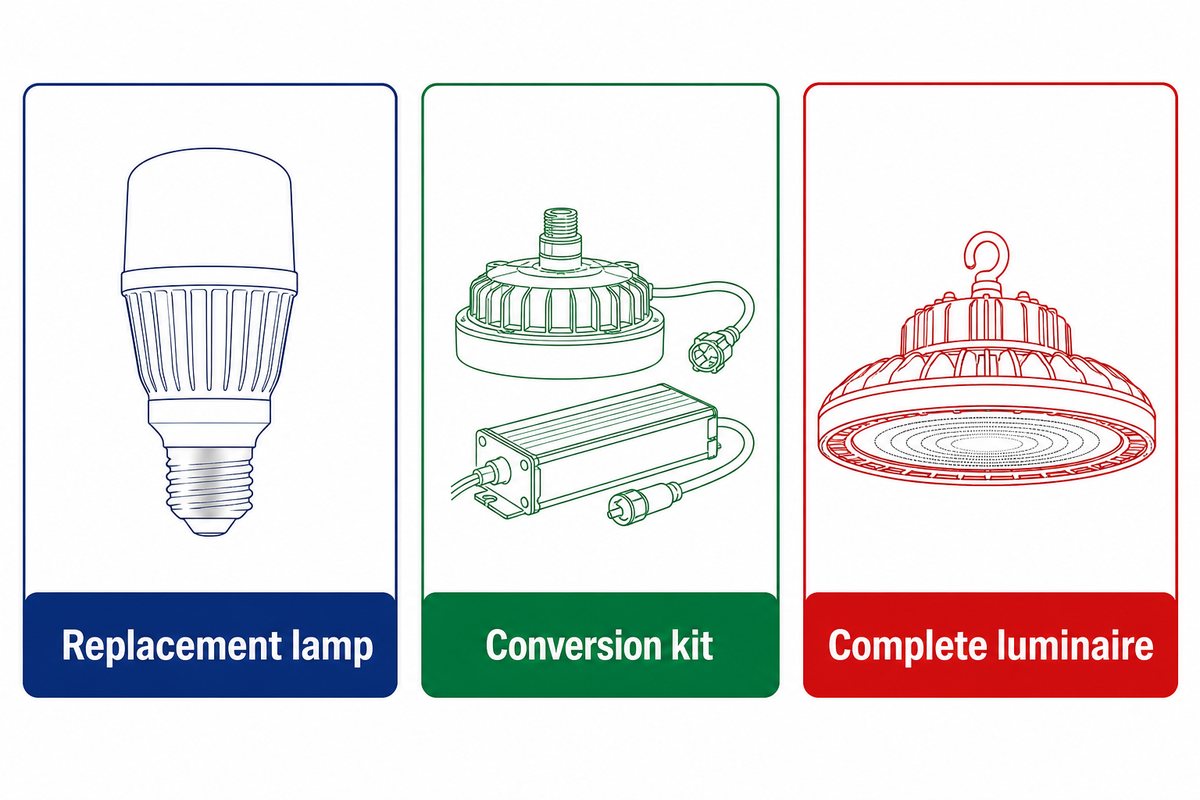
Industrial LED light bulbs are replaceable LED lamps selected for an industrial fixture and its operating conditions. There are different requirements for screw-base HID replacements, linear lamps and conversion kits. An integrated LED high bay is a complete luminaire, so replacing it involves a different product and document set from changing a lamp.
A corn lamp places LEDs around a body that resembles rows of kernels. That shape describes the light-emitting geometry, not an electrical approval. Traditional bulbs, including an incandescent bulb or a metal-halide lamp, can share a broad socket family with an LED replacement while requiring different control gear.
Unlike traditional incandescent or fluorescent products, the proposed lamp may include a driver housing that alters the physical envelope. A high-quality LED claim still needs model evidence.
UL’s conversion guidance distinguishes a lamp’s certification from authorization to modify its host light fixture. To begin, define what remains after the work. A seller’s expression, “LED light” or “lighting solution” won’t define this. High-performance LED wording describes a sales claim until the required performance is documented.
| Category or designation | Identify | Acceptance boundary |
|---|---|---|
| E26 medium screw-base lamp | Exact lamp and holder designation | Verify voltage and host instructions separately |
| E27 medium screw-base lamp | Documented regional/product designation | Category grouping does not prove interchangeability |
| E39 mogul replacement | Lamp base and holder model | Check installation and support requirements |
| E40 mogul replacement | Exact designation on both documents | Do not infer compatibility from its resemblance to E39 |
| EX39 extended-mogul lamp | Specified extended-base arrangement | Require the documented holder/host match |
| Linear T8 LED lamp | Tube length, holder and operating mode | Separate tube documentation from screw-base selection |
| Luminaire retrofit kit | Components, applicable hosts and labels | Follow the kit’s conversion scope |
| Integrated LED high bay | Complete fixture and mounting/control system | Compare installed distribution and service access |
| Emergency or classified-location installation | System function and location requirements | Ordinary lamp acceptance is insufficient |
Product categories from the DesignLights Consortium group E26/E27 and E39/E40 replacement lamps. These are qualification categories, and don’t ensure that members in these categories would be able to fit into E26/E27/E39/E40 sockets. A 277 V lamp still needs its own electrical and installation assessment, regardless of where a catalog groups it.
Industrial LED bulb base types and physical fit
When selecting a lamp, ensure that its exact base matches the documented lampholder and the application for which it’s being used. Then check the body envelope, operating orientation and support. Industrial LED bulbs can have substantial driver housings and extended bodies. A lamp that screws into place may still obstruct a reflector, door or a required safety tether.
When a request is made for a replacement, photograph the existing label and record the holder designation. The public ANSI/NEMA C81.61-2025 catalog identifies the lamp-base specification standard. Its public summary does not provide the dimensional clauses needed to establish E39/E40/EX39 interchangeability. An adapter also needs documented acceptance for the proposed application.
LED lights provide different body and base arrangements, so select fixtures designed for the documented lamp or kit. A lamp may provide bright light but fail to meet the host’s documented fit requirements.
8-Gate Base-to-Enclosure Record
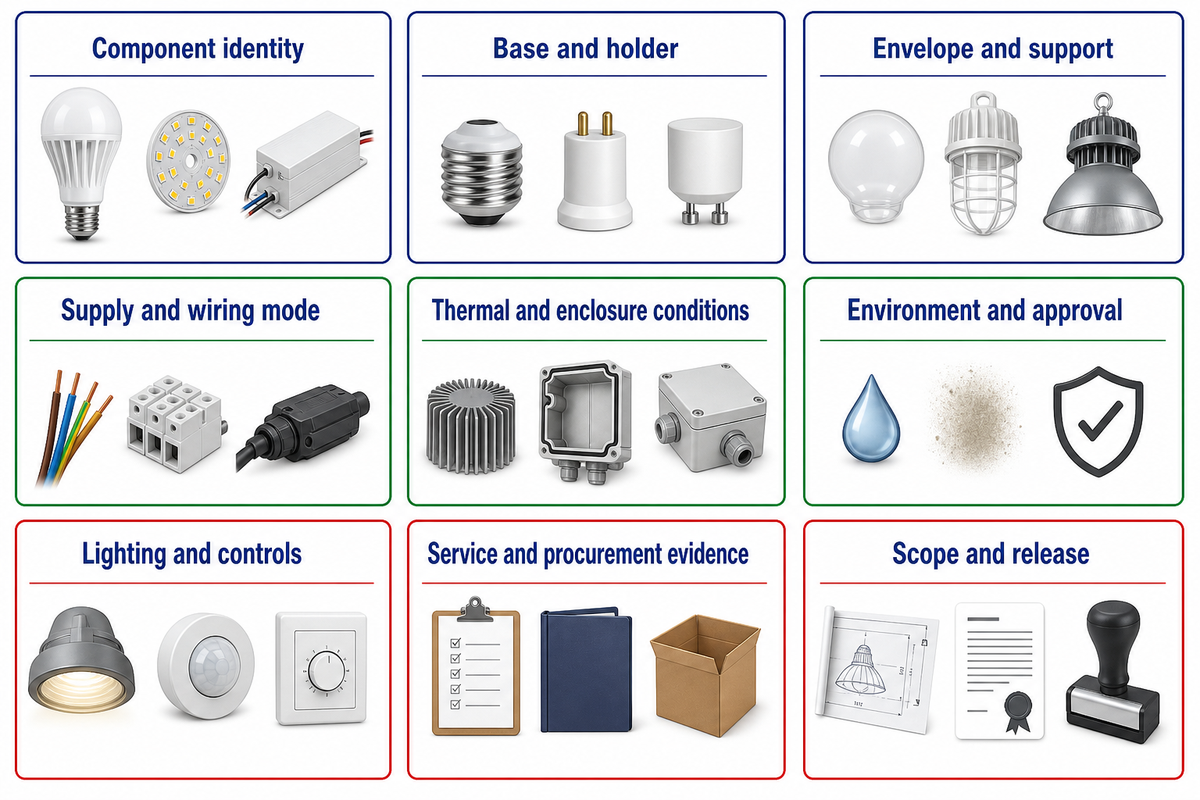
A selection record that pairs eight site checks with exact-model evidence, an unresolved item owner and a stop condition.
Use the record before ordering, then attach the final installation documents. The release line confirms scope; it doesn’t turn this editorial checklist into a certified retrofit procedure.
| Check | Record and required evidence | Stop or review condition | Owner |
|---|---|---|---|
| 1. Component identity | Existing host and proposed complete lamp/kit model | Bulb, kit and complete fixture descriptions conflict | Purchaser |
| 2. Base and holder | Exact designations and approved mechanical match | Match is assumed from threads or an adapter | Electrical reviewer |
| 3. Envelope and support | Body clearance, orientation, tether/support instructions | Door interference or support requirement unresolved | Maintenance lead |
| 4. Supply and wiring mode | Verified circuit input and model installation instructions | Ballast output is substituted for supply identification | Qualified electrician |
| 5. Thermal and enclosure conditions | Model temperature range and permitted host conditions | Enclosure or hottest operating condition falls outside scope | Electrical reviewer |
| 6. Environment and approval | Damp/wet/classified application evidence | IP rating is offered as classified-location approval | Site safety reviewer |
| 7. Lighting and controls | Task criteria, distribution and exact control combination | Glare, insufficient light or control behavior fails the trial | Maintenance lead |
| 8. Service and procurement evidence | Warranty conditions, availability and current program records | Only a generic badge or undated family claim supplied | Purchaser |
| Scope and release | Record separate emergency/machinery review where applicable | Open safety-critical item or unidentified application | Responsible site reviewer |
In the case of the example for the SATCO S23152, the product page shows that it’s offered with an EX39 base and a universal operating position. These fields don’t cancel its other restrictions. Current’s ED28 instructions add compartment and tether conditions. Even a 277 V application requires the record to be completed before a purchaser accepts an apparently similar replacement.
Matching voltage without confusing supply and ballast output
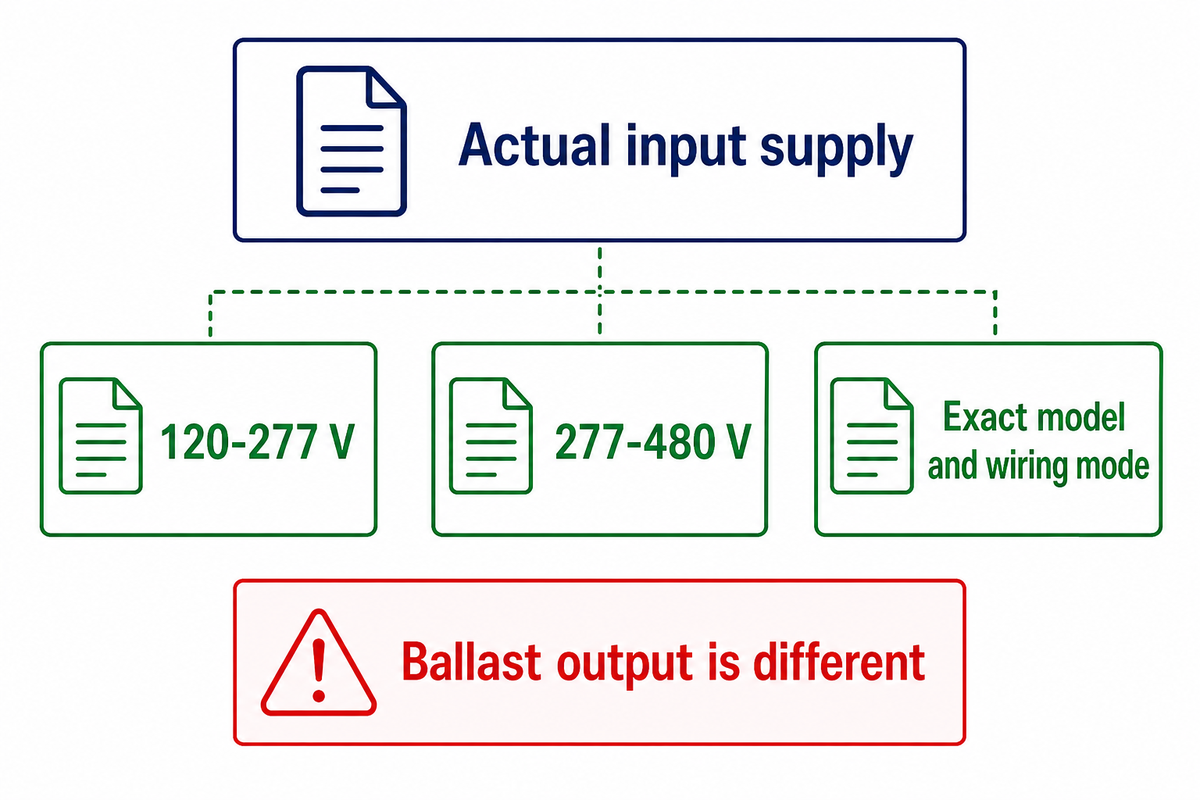
Select a lamp using the actual input supply and its specified wiring mode. The retained HID ballast’s output is a different part of the circuit. A lamp described as 120-277 V isn’t rated for a 480 V input and a higher voltage product still requires applicable installation conditions to be checked.
Current’s LEDL152 application guide lists 120–277 V and 277–480 V product ranges. A base designation can’t tell you which version is inside a carton. Request the complete model number and instructions, rather than a family photo or a partial catalog code.
A useful hypothetical purchasing check is a maintenance team considering S23152 for a retained high bay. The quotation repeats its page title, “100–277V,” but the site’s proposed operating point is below 120 V. The same product page’s Electrical Volts field and description say 120–277 V. The purchaser cannot resolve that conflict by selecting the wider range. Document the disagreement, ask SATCO for governing model directions and hold acceptance of that operating point. The qualified electrician still has to identify the real circuit and approved conversion method. This is a document review example and not an installation that GQLAMP performed or a finding that the lamp fails.
For the 277–480 V lamps covered by Current LEDL116, the US warning separately limits use to branch circuits permitted by NEC Section 210.6 for E39/EX39 holders. Have the responsible electrical reviewer evaluate that situation. A 480 V marking alone doesn’t approve every US installation.
Ballast-compatible, bypass and hybrid retrofit paths
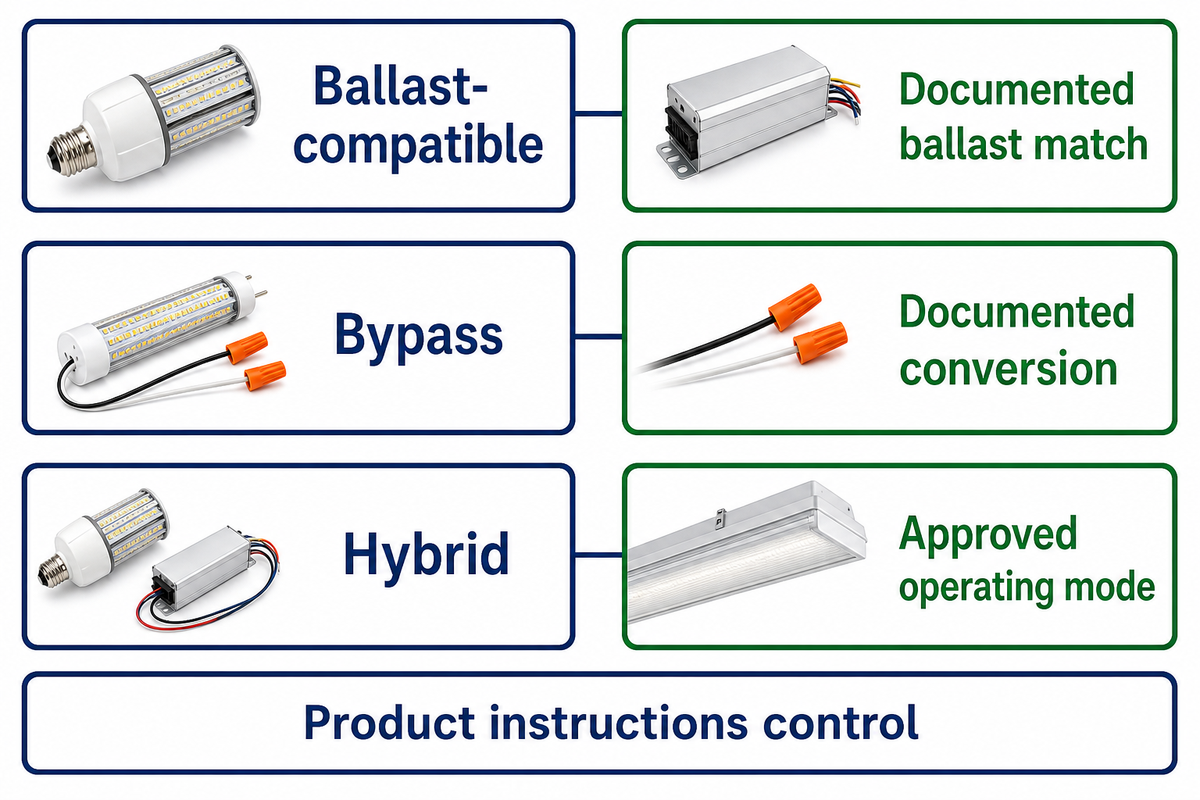
A ballast-compatible lamp requires the documented ballast match. A bypass product requires its documented conversion. A hybrid lamp requires the approved mode to be confirmed. These descriptions serve as starting points, but in all cases the product instructions control. Don’t assume a screw base industrial replacement acts like a fluorescent tube carrying a similar label.
Do industrial LED bulbs need a ballast?
Industrial LED bulbs need a ballast only when their manufacturer specifies operation with an approved ballast. A ballast-bypass model requires a documented conversion for its host fixture. Hybrid products may accommodate more than one arrangement, subject to the product instructions. Confirm the arrangement before ordering. Removing, retaining, or bypassing equipment is the work of qualified electrical personnel.
UL’s Type A/B definition concerns fluorescent replacement lamps. Current also calls the HID lamp in LEDL116 Type B, but that installation guide has its own bypass and kit requirements. The instructions don’t allow operation with a ballast or igniter. Similar terms don’t merge the two product families.
“Listed or labeled equipment shall be installed and used in accordance with any instructions included in the listing or labeling.”
Conversion coverage may be limited to named hosts or defined mechanical/electrical conditions. Request the relevant kit documentation and labels, as well as the supplied parts. Offering a low-cost bulb becomes a different scope of work if the housing requires conversion or field evaluation. Be sure to include that work in your proposal.
Fluorescent lights require a tube and ballast assessment. Instructions for the screw-base model can’t substantiate that assessment.
Thermal limits in open and enclosed fixtures
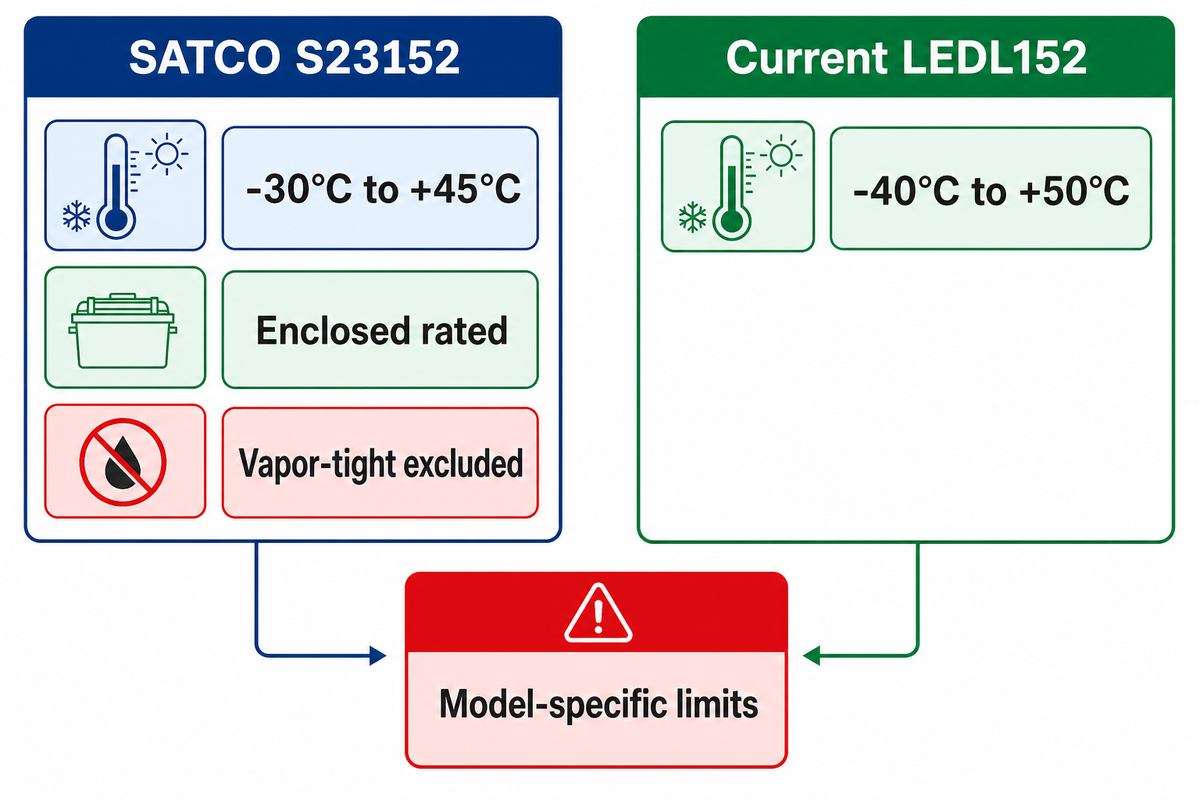
Approval for the enclosure and the thermal limits must be evaluated together. LEDs and their electronics still produce heat, and a retained housing can change how that heat escapes. The acceptable conditions are described in the lamp’s instructions, including requirements for any compartment, orientation, and ventilation. “Enclosed rated” does not mean unrestricted use in every closed fixture.
SATCO’s S23152 page lists an operating range of −30°C to +45°C, says the model is rated for enclosed fixtures, and excludes vapor-tight fixtures. Current’s LEDL152 guide lists −40°C to +50°C for its own HID-replacement family. Keep those source-specific limits separate. Neither is a universal LED bulb thermal rating.
| Document and field | Published value | Selection limit |
|---|---|---|
| SATCO S23152: base | EX39 | Verify the documented host/holder match |
| S23152: selectable input power | 36 W / 27 W / 18 W | Confirm the selected setting and lighting result |
| S23152: listed light output | 5,040 lm / 3,780 lm / 2,520 lm | Lamp output does not establish task illumination |
| S23152: Electrical Volts | 120–277 V | Title says 100–277 V; resolve the conflict with the manufacturer |
| S23152: operating temperature | −30°C to +45°C | Apply only under the model’s documented conditions |
| S23152: enclosure | Enclosed fixture: yes | Installation Notes exclude vapor-tight fixtures |
| S23152: operating position | Universal | Does not remove enclosure or temperature restrictions |
| Current LEDL152: voltage ranges | 120–277 V or 277–480 V | Choose the exact version; do not transfer across models |
| LEDL152: family operating range | −40°C to +50°C | Current family guidance, not SATCO’s limit |
| Current LEDL116: compartment | Greater than 552 in³ | Strict installation condition; measure and check the guide |
| LEDL152: relevant ED28 table entries | 552 in³ minimum | Does not override LEDL116’s greater-than wording |
When should you not use LED bulbs?
Don’t accept proposed LED bulbs if the voltage, wiring, enclosure conditions or application approval can’t be confirmed. Reject a model that falls outside its documented limits, and refer damaged fixtures or uncertain classified locations for qualified evaluation. A complete replacement luminaire must be checked for application before being accepted.
Let’s say we have an enclosed high bay, whose measured lamp compartment is exactly 552 in³. A buyer would see this volume in Current’s application table and assume the ED28 conversion is satisfied. LEDL116 however, requires a compartment that’s greater than 552 in³. Therefore, 552 in³ wouldn’t satisfy this requirement. Approximate dimensions shown in the reference guide can’t be used to replace a measured assessment of the actual compartment. Place the model on hold and request the manufacturer or responsible reviewer to clarify the application. Ordering the model first may cause the installer to identify this conflict at a later date. This example is to illustrate a document mismatch. It isn’t intended to say that all enclosures of this size will overheat.
Ambient temperature and a marked case temperature point are different measurements from an LED junction temperature. Check which one the instructions require and how it’s measured. Comparing a measured housing surface to S23152’s published +45°C operating limit wouldn’t, by itself, prove that the lamp meets the temperature requirements.
Ambient light describes background illumination; it is unrelated to a thermal ambient rating.
Confirm the governing revision of the installation guide with the manufacturer for the supplied model; an older example isn’t approval.
SATCO lists 50,000 hours for S23152. The lamp product-page life field doesn’t waive the +45°C operating limit or establish service life of a lamp in an unverified enclosure. Keep all conditions of service with any life comparisons.
Industrial lighting ratings for damp, dusty and hazardous locations
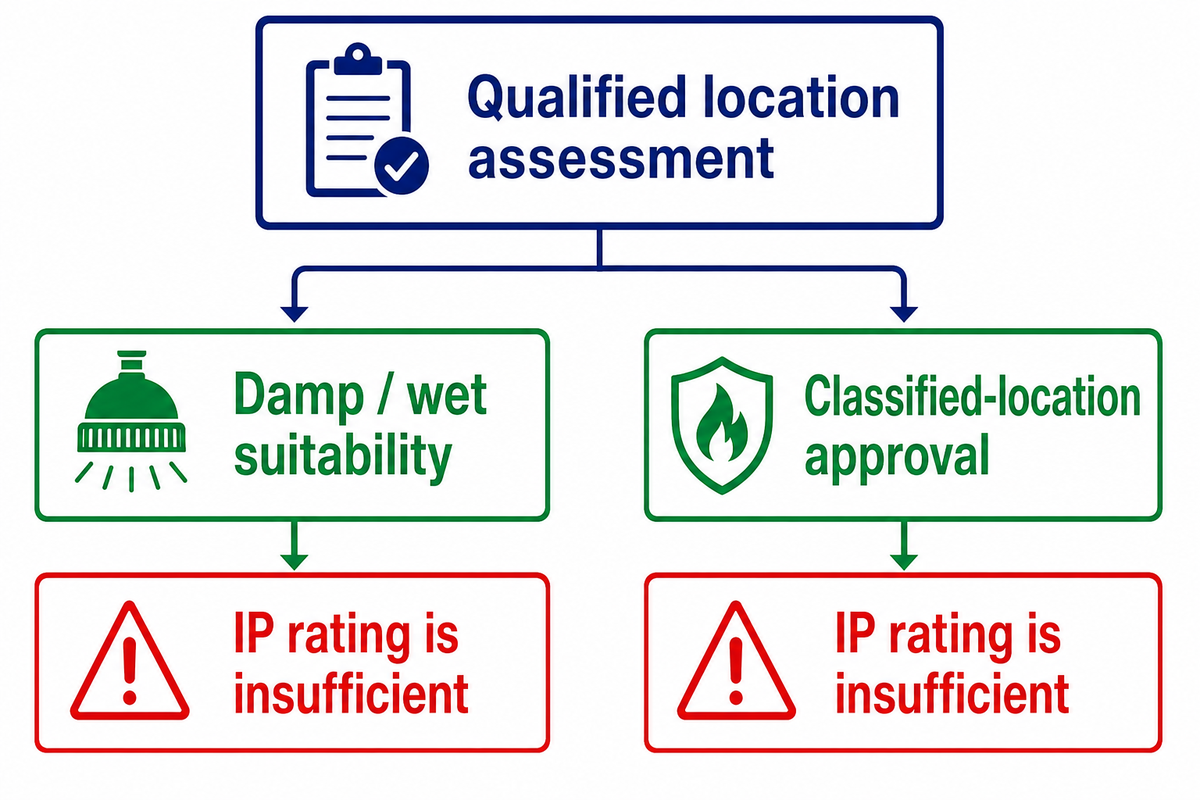
Select the environmental approval for the actual operating location. Damp, wet and classified hazardous applications are separate questions, and an ingress-protection rating doesn’t answer all of them. A replacement must retain the documented suitability of the host arrangement. Where the classification of the site is uncertain, stop routine lamp selection and get a qualified location assessment.
OSHA 1910.303 addresses suitability for environmental conditions, including dampness and excessive temperature. OSHA 1910.307 covers classified locations. Equipment must satisfy the applicable provisions, with marking and installation exceptions retained. Dust present in a room isn’t sufficient to classify that room, and IP65 doesn’t mean the device is approved for use with combustible dust or flammable vapors.
A washdown area raises a different purchasing objection from a dry warehouse aisle. A lamp approved for an enclosed fixture may still exclude a vapor-tight housing, as SATCO states for S23152. Don’t override the exclusion with the housing’s environmental label. Refer the proposed combination for review or select a fixture which is fully complete and approved.
Industrial environments can impose different exposure conditions along the same production line. Each must be reviewed individually. Suitable lighting adds visibility without changing the location’s approval requirements.
Moisture and temperature extremes are part of the actual field conditions for outdoor use. The range of −30°C to +45°C in S23152 is for one model; the installation and location need to meet fixture requirements, as well. For classified applications, consult the site’s responsible reviewer and the relevant hazardous-location lighting guide.
Matching illumination, color temperature and controls
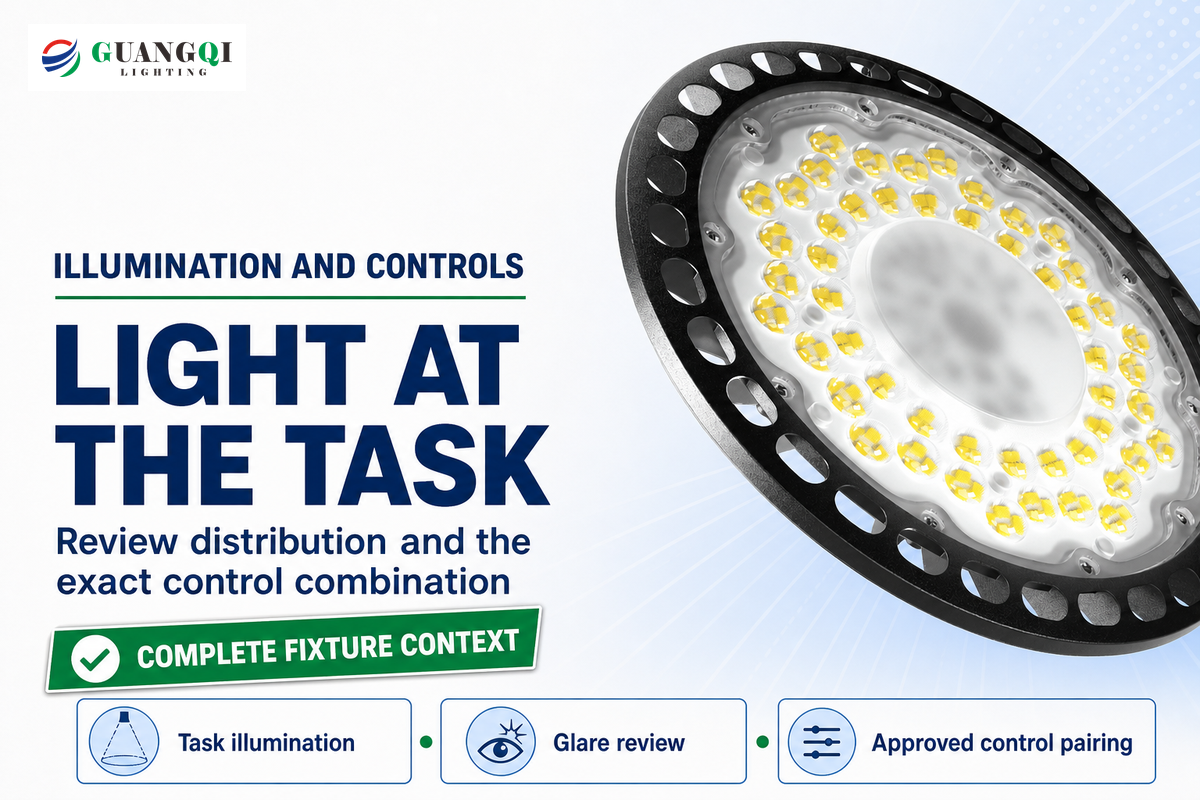
Compare usable light at the task, not just lamp lumens or equivalent wattage. Retained reflector/lens designs will affect light distribution. Controls affect operation. Define the lighting needs of the aisle, inspection station or work area before the trial, then check the exact lamp/control combination in its intended states. More light output doesn’t necessarily mean better light quality.
The DOE luminaire purchasing guidance recommends adequate task lighting and comparison of like products. Color temperature describes appearance of light, while color-rendering information aids in the evaluation of tasks where color matters. These don’t substitute for glare or distribution review. White LED options should be chosen for the work rather than the highest available CCT.
General lighting and an inspection task may require different distributions. Quality light in industrial settings means visibility at the required task with an acceptable level of glare.
“Perfect lighting” is a vague specification; define the task and its acceptance criteria before evaluating a proposed lamp.
Why do industrial LED bulbs flicker?
LED bulbs can flicker because of their driver behavior, an unsuitable control combination, or an electrical issue. Symptoms of a fault may be similar, but the cause depends on the specific installation. Approved operating modes of industrial LED bulbs should be confirmed before use; request qualified investigation of unexpected behavior.
Lutron’s compatibility guidance illustrates why a “dimmable” label needs an exact tested pairing. A “dimmable” label, for example, does not approve an industrial HID lamp. Current LEDL116 specifically excludes phase-cut dimmers, so do not select a control by analogy with fluorescent bulbs or residential lamps.
Advanced lighting control devices need their own interface and compatibility documents. A smart LED label doesn’t define that interface and its operating limits.
DOE’s flicker research distinguishes stroboscopic effects from direct flicker. LED technology does not eliminate the need to evaluate driver and control behavior. A lamp that looks steady to one observer is insufficient evidence for machinery applications. Request appropriate measurements and qualified assessment under control states of interest, including separate review of temporal light modulation around moving machinery; don’t rely on hand-wave checks or safety assessments using cell phone videos.
SATCO provides 5,040lm, 3,780lm, and 2,520lm configurations for S23152’s selectable settings. Those values allow a buyer to identify the offered setting; however, the retained light fixture determines where the light goes. An illumination shortfall at a shelf face can’t be remedied by citing the lamp’s maximum lumen.
Bulb retrofit or complete LED high bay replacement?
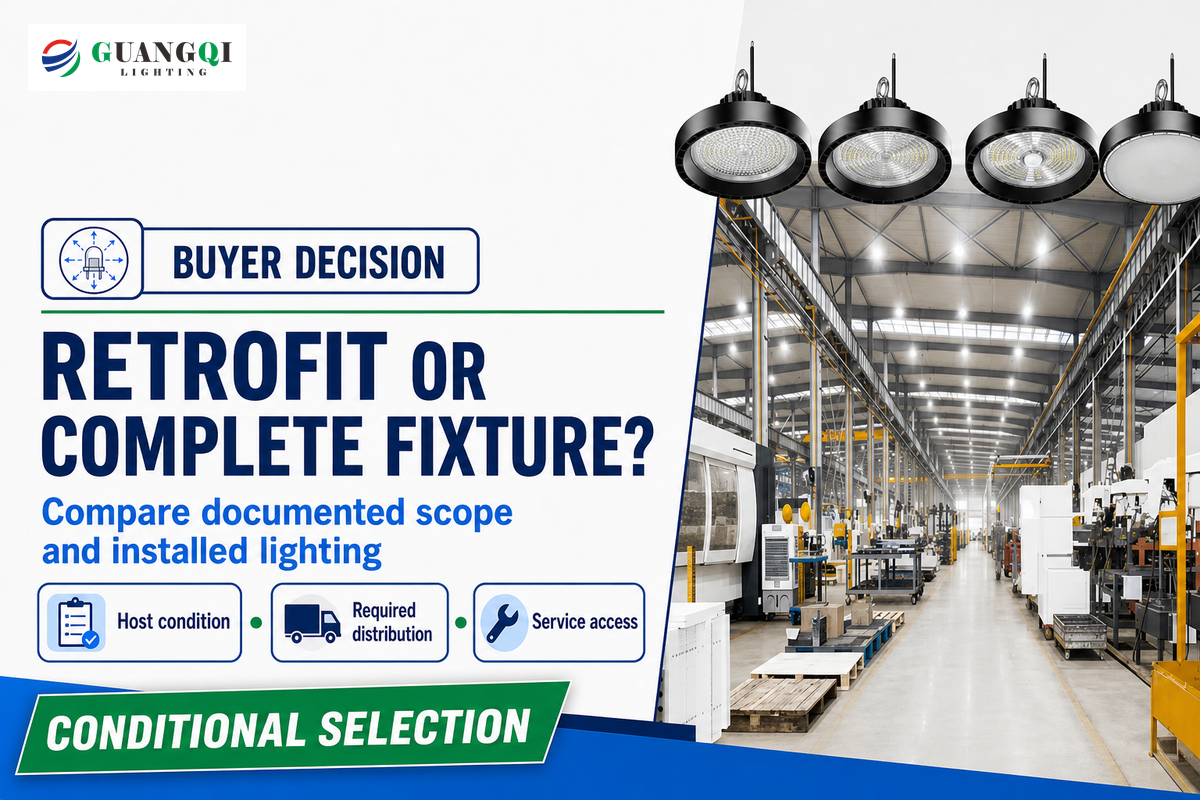
Retain a fixture only if its condition and documented conversion path meet the application, and the installed lighting passes the agreed trial. Choose a complete LED high bay if the retained arrangement can’t satisfy those conditions or the lighting design needs different distribution or controls. Compare the installed scope and service requirements before choosing on lamp price.
A bulb retrofit can preserve a sound housing and can also preserve worn or hard to reach parts, and/or poorly suited parts to the lamp. DOE suggests comparing like products. A retailer’s PL price list can’t establish industrial high bay costs. Neither path earns automatic energy savings or lifespan promise.
Facilities that haven’t yet converted to LED should compare those installed scopes before ordering. LED warehouse lighting must satisfy aisle and shelf-face tasks, not merely replace a lamp’s wattage.
| Site finding | Path to evaluate | Evidence still required |
|---|---|---|
| Sound housing; approved lamp/kit match | Retained-fixture retrofit | Electrical, thermal and pilot lighting acceptance |
| Damaged socket or enclosure; poor cooling | Qualified repair or complete replacement | Condition assessment and proposed fixture scope |
| New distribution or control needs | Complete luminaire comparison | Photometry, control documents and service access |
| Emergency or classified function | Application-specific system selection | Required functional approval and continuity plan |
The bottleneck for maintenance could be access, not price. In a hypothetical warehouse aisle, the team has a sound housing but needs a lift to reach it. A small trial shows acceptable floor light yet poor shelf-face illumination behind the retained reflector. Increasing the order to a brighter bulb would likely not improve the distribution and may actually add glare. Ask for a retained-system assessment and a complete-fixture photometric comparison before releasing the batch. When quoting, include lift access, conversion labor, and the lighting plan for the work area. No payback period follows from this scenario since actual operating hours, installed power and costs haven’t been provided.
GQLAMP’s commercial offering includes complete high bay and warehouse luminaires. Compare against the UFO high bay product family for this, while keeping bulb approval to the bulb manufacturer. A 36 W replacement lamp and a complete fixture with different distribution are not equivalent purchasing scopes.
Different fixtures are designed with different optics and service arrangements. The team should request the specific flexibility in lighting that they need, instead of accepting a broad feature set.
Warehouse lighting supplier documents and pilot acceptance
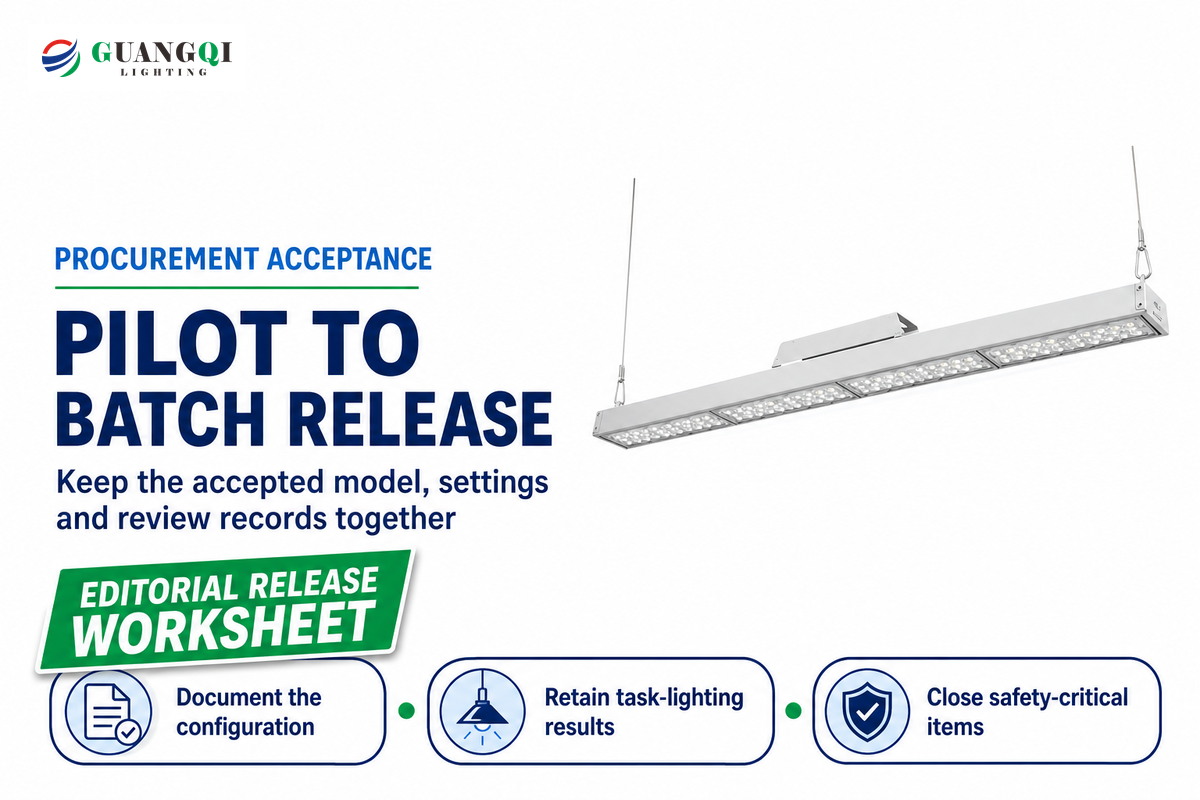
Ask the lighting supplier for the actual model documents, relevant host scope, and operating conditions before committing to a quantity. Agree on a trial acceptance with the electrical reviewer and maintenance lead. The purchaser should then release the batch against the accepted model and configuration, with unresolved items assigned to someone who can close them.
Pilot-to-Batch Release Sheet
A purchasing worksheet that connects accepted trial configuration with observed task-lighting conditions and outstanding approvals for the batch order.
Set objective criteria for trial. A lamp that switches on can easily be misinterpreted as a satisfactory outcome. The 2018 Mike Holt retrofit discussion describes later output, color and flicker. It doesn’t establish the reason for the issues. Use that experience to plan observations, not to predict a failure percentage.
Upgrade planning teams should document the deficiencies the upgrade needs to correct. The supplier’s durability claim should also be accompanied by its warranty and operating conditions.
| Field | Record | Release action |
|---|---|---|
| Trial identity | Lamp, host, control and selected settings | Match the batch specification |
| Electrical/thermal scope | Approved instructions and site review | Close any mismatch before release |
| Task light levels | Agreed measurement locations and criteria | Retain results for the chosen setting |
| Glare and color | Work-area observations and task needs | Resolve unacceptable light quality |
| Control states | Start, switching and authorized dimming states | Investigate unexpected behavior |
| Moving machinery | Application-specific modulation assessment if relevant | Separate review; visual impression is insufficient |
| Emergency functions | Required system suitability and work continuity | Exclude ordinary-lamp-only acceptance |
| Service | Access, parts and warranty conditions | Include maintenance scope in the purchase |
| Sign-off | Electrical reviewer, maintenance lead, purchaser | Hold open safety-critical items |
For exit-route or emergency lighting duties, obtain the separate system review, and maintain required protection during the work. Emergency safeguards must be operational, and exit routes must be adequately lit (OSHA 1910.37). LEDL116 excludes emergency/exit applications. An ordinary high bay can’t override that exclusion.
The accepted S23152 setting could be 18 W, 27 W or 36 W. Write the chosen setting into the batch record, rather than ordering against a photograph of the family. The same record should identify the voltage document used to settle the page conflict and the applicable enclosure conditions.
Industry outlook: current LED lighting solutions and retrofit documents
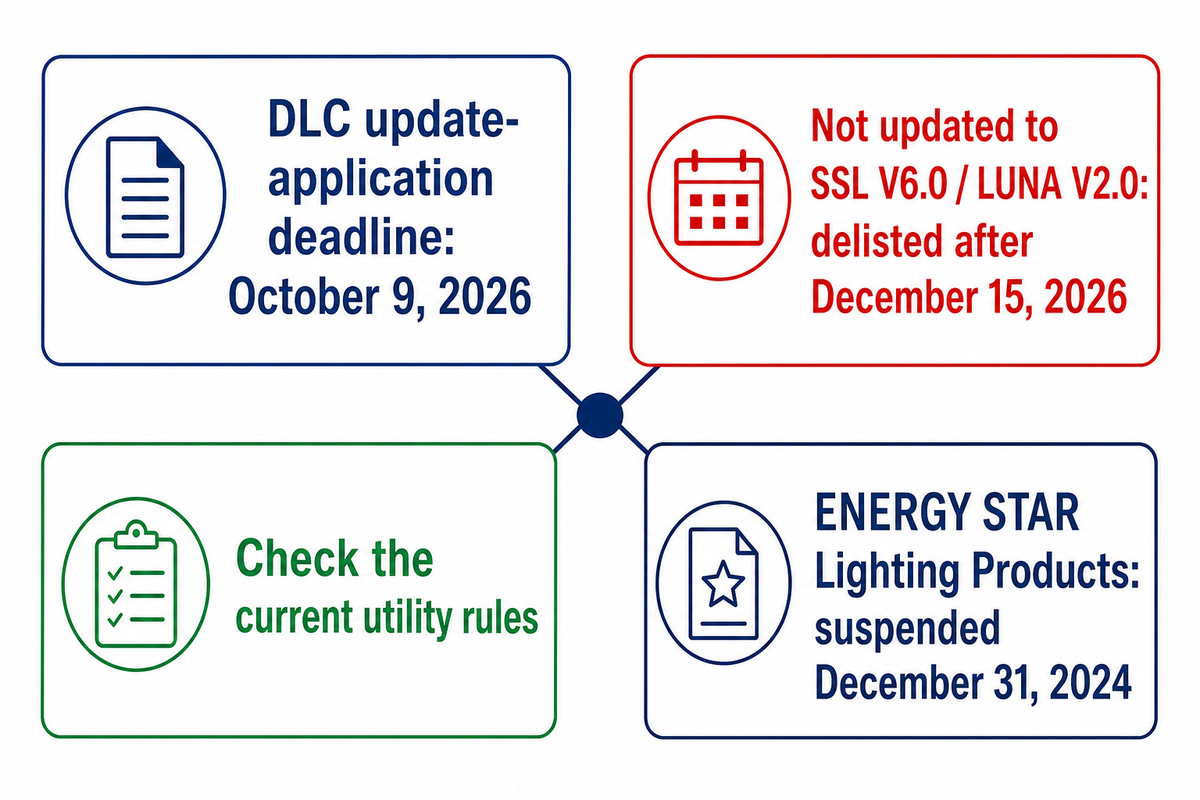
Current model records matter because qualification programs can change while old certificates and product files remain available. A buyer planning work in late-2026 should confirm the exact status of the records and the requirements of the utility at the project date. Separate acceptance questions include qualification programs, electrical conversion and installed lighting.
The DLC’s October 1, 2026 transition FAQ sets October 9 as the update-application deadline for SSL V5.1/LUNA V1.0 products. Products not updated to SSL V6.0/LUNA V2.0 will be delisted after December 15, 2026. As of this article’s October update, that December event is still upcoming. It is worth noting that temporary delisting and later relisting is possible based on the results of applications currently under review.
DLC states delisted records are still viewable and specific incentive cutoffs and grace periods are part of the specific program. Ask the utility which status and project date govern an application. A searchable record or a seller’s old screenshot doesn’t guarantee current incentive eligibility.
The EPA’s product-development archive indicates that Lighting Products are suspended on December 31, 2024, while keeping historical lamps and luminaires lists. This statement focuses on those suspended lighting programs and not on all the ENERGY STAR categories.
For commercial and industrial buying, record the source, version, model and check date. UL’s 2023 UL 1598C edition notice also illustrates why conversion instructions and labels need attention; it doesn’t prove a new 2026 revision. Efficient lighting still depends on an appropriate application and an incentive record doesn’t justify an unsuitable host conversion.
LED solutions should be compared against the agreed scope. An energy-efficient LED offer requires the same checks as any other proposed replacement. Energy-efficient lighting solutions should document the selected model and configuration.
Frequently asked questions
What is the best LED light for industrial use?
Choose the product that meets the task and documented installation conditions.
The right LED product depends on the replaceable component, environmental approval and required distribution. LED high bay lights suit a different purchasing scope from screw-base replacements. Start with task criteria and the host’s condition, then compare complete model documents. A highest-lumen or lowest-price claim can’t select the best lamp for every industrial facility. An industrial or commercial space needs its own task criteria.
Which LED bulb brand lasts the longest?
Brand names alone do not establish installed service life.
Compare the exact model’s life statement, warranty and operating conditions. DOE’s LED Basics explains that lumen depreciation and electronic failure are different issues. LED bulbs can last well under suitable conditions, but package data can’t guarantee the complete lamp. A claim that one brand lasts many times longer than traditional bulbs needs comparable, application-specific evidence.
What is the downside of LED bulbs?
Retrofit limitations can include heat, control compatibility and retained optics.
A replacement can fit mechanically yet lack the required enclosure or conversion approval. Driver behavior and the dimming combination can affect operation. Retained reflectors may deliver poor task lighting even when the lamp has ample output. Evaluate those constraints before committing to quantity; an unsuitable retrofit can erase the expected maintenance benefit of changing lighting technology.
Can industrial LED bulbs be used outdoors?
Only when the model and host arrangement permit the location.
Check moisture exposure and the documented temperature conditions. An enclosed-fixture rating alone doesn’t authorize every wet or vapor-tight installation. S23152’s vapor-tight exclusion demonstrates why the complete instructions matter. Outdoor industrial lighting needs application evidence, rather than approval inferred from a seller’s broad indoor/outdoor heading.
What is the strongest LED light bulb?
Maximum brightness is a poor substitute for the required light distribution.
Compare useful task illumination, glare and permitted input power. Bulbs come in various forms, and their highest lumen setting can be unsuitable for a retained housing. S23152 publishes selectable outputs rather than one universal setting. For a large space, assess the complete fixture arrangement before using a maximum-output label as the purchase criterion.
An integrated high bay may offer a different distribution, but it also changes mounting, controls and service requirements.
Are LED light bulbs cheaper to use?
Energy efficiency can reduce consumption, but the installed comparison determines savings.
Compare energy consumption using actual installed input power and operating hours for equivalent task lighting. Include conversion work, access and maintenance in the purchasing decision. Compared to traditional lighting options, an energy-efficient lamp can use less electricity; this guide doesn’t assign a universal savings percentage or payback without site inputs.
Which is the best company for LED bulbs?
Select a supplier that can document the exact product and application.
Ask for installation scope, model-specific limits and a clear response to conflicting fields. A supplier of complete LED fixtures may be the right partner for a fixture replacement while a lamp manufacturer provides the bulb documentation. GQLAMP’s public pages describe full industrial luminaires; the inspected pages didn’t establish a named industrial replacement-bulb model.
The useful comparison is whether the proposed product and support close your site’s selection questions, rather than a universal company ranking. Send the supplier the host label and the unresolved fields in the selection record. Ask who will provide governing instructions and how the accepted trial configuration will appear on the order. A clear response lets the purchaser compare the same scope across offers. Keep lamp documentation with the lamp manufacturer and complete-fixture documentation with the fixture supplier.
Review the fixture path before placing the batch order
Bring the host labels, supply information and required lighting performance to the discussion. If complete-fixture replacement is the better path, explore GQLAMP’s industrial LED lighting range and request the applicable model documents.
This guide used publicly available manufacturer and authority documents checked in October 2026. The named SATCO and Current examples are from those manufacturers. The buyer worksheets are editorial selection aids; no proprietary GQLAMP bulb test, certified conversion or measured retrofit outcome is claimed. See GQLAMP’s company background for its full luminaire manufacturing context.
References & Sources
- LED Retrofit Kits, UL Certified Luminaire Retrofit Kit FAQs UL Solutions.
- Qualify a Product DesignLights Consortium.
- ANSI/NEMA C81.61-2025: Electric Lamp Bases American National Standards Institute catalog.
- 29 CFR 1910.303: General requirements Occupational Safety and Health Administration.
- 29 CFR 1910.307: Hazardous (classified) locations Occupational Safety and Health Administration.
- Purchasing Energy-Efficient Commercial and Industrial LED Luminaires US Department of Energy.
- Flicker Research US Department of Energy.
- 29 CFR 1910.37: Exit-route safeguards and operational features Occupational Safety and Health Administration.
- FAQ: October 9 Update Application Deadline and Upcoming December 15 Delisting DesignLights Consortium, October 1, 2026.
- Product Development Archives US Environmental Protection Agency ENERGY STAR.
- New Edition and Scope Expansion of LED Retrofit Standard UL Solutions, September 8, 2023.
- LED Basics US Department of Energy.
Model examples are linked beside their claims to SATCO S23152 and Current LEDL152/LEDL116. Their limits don’t transfer across brands or product families.