Get in Touch with GUANGQI


LED Flood Lights · Stadium & Sports Series
Stadium & Sports Lighting — LED Flood Lights for Fields, Arenas & Courts
From 50W community courts to 1,500W professional stadiums – Guangqi Lighting is making IP66-rated, glare-free LED stadium flood lights for whatever level you’re playing at.
50W–1,500W
Power Range
≥130 lm/W
Luminous Efficacy
IP66
Ingress Protection
14 Years
Manufacturing Experience
CE / RoHS
Certified
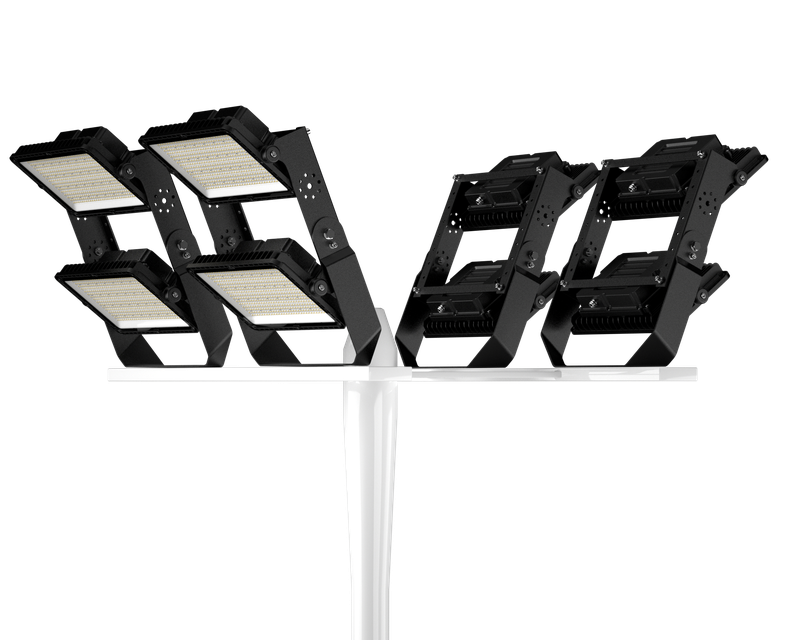
What Is Stadium & Sports Lighting?
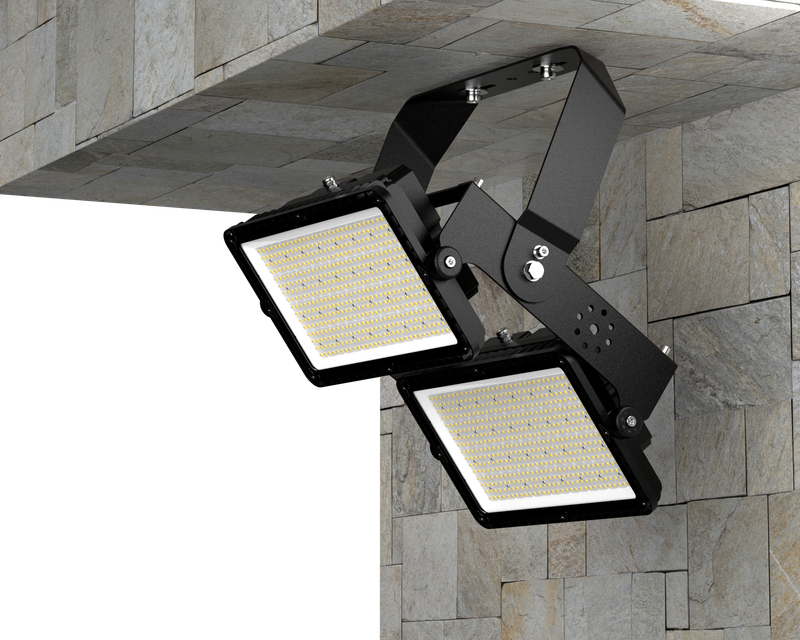
Stadium and sports lighting uses high-powered LED flood lights to light playing surfaces, crowds and stadium infrastructure for competitive and recreational sports. Whether it’s a brand new facility for tennisi balls 500 players or a 60,000 person professional football stadium, the outdoor sports lighting system is not a cosmetic feature – it is a critical component on which player safety, broadcast picture quality and the financial success of night games depend.
Today’s LED sports lighting has become the norm across all sporting venue categories – replacing traditional metal halide for three key engineering reasons: LED luminaires produce 130 lm/W luminous efficacy compared with 80-100 lm/W for metal halide, they immediately reach full intensity without the 3-15 minute warm-up period required by metal halide, and they offer a rated life of 50,000-100,000 hours – 3-5 times longer. For the owner/operator, the economics are clear: savings on energy bills, no expense for lamp replacement and vastly reduced maintenance downtime.
Since being established in 2010, Guangqi Lighting has been providing LED flood lights for sports facilities. Our stadium and sports lighting solution includes four product lines – GQ-SPMD02, GQ-SPMD07, GQ-SPMD08, and GQ-FL09 – of sporting flood lights with beam characteristics and lumen outputs calibrated to IES RP-6 and EN 12193 national requirements for every application type.
LED Stadium Light Product Series — 50W to 1,500W Modular Design
We offer four series of sports and stadium-specific LED flood lights across four series: from 50W small-court LED fixtures up to 1,600W high-power flood lighting systems for elite arenas. Every series combines IP66-sealed, 50,000-hour-rated water and dust proof die-cast aluminium housing with SMD3030 flip-chip LED technology and appropriate LED beam optics to ensure a long lived, consistent lumen package.
By having each series modular, power levels are available in logical steps – 50W on the SPMD02, 100W on the SPMD07 or 200W on the SPMD08 – and engineers can specify the precise LED stadium light configuration that will meet the facility’s demands without surpassing requirements or carrying excess capacity. If you need assistance, try our Wattage Selection Guide to work out the required power level in six simple steps.
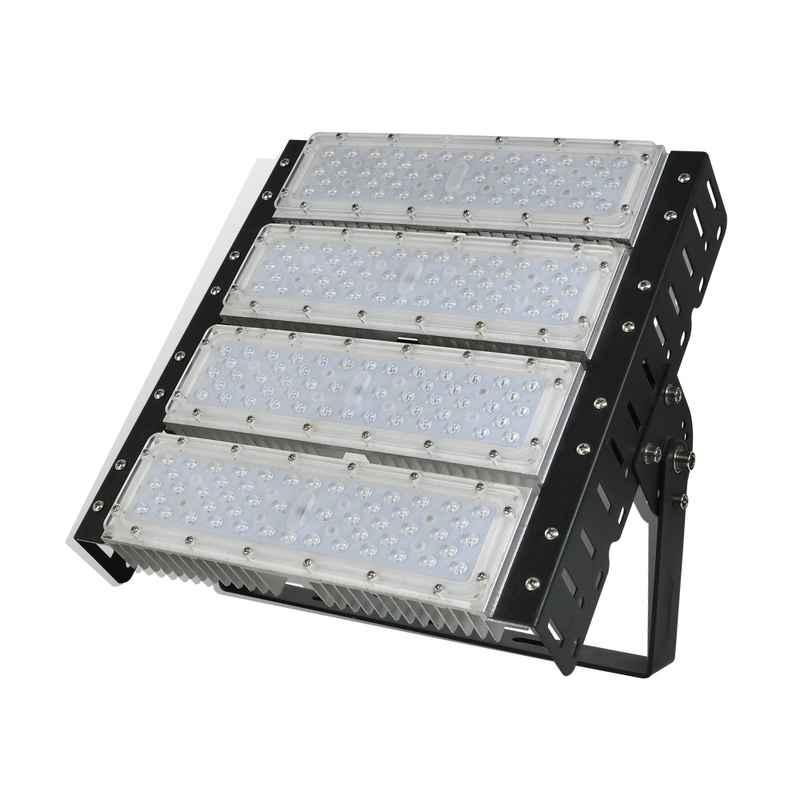
Community / Recreational
GQ-SPMD02
50W – 300W Modular Stadium Flood Light
Power Range50W 100W 150W 200W 250W 300W
Module Base50W / module
Beam Angle30° / 60° / 90°
Efficacy≥130 lm/W
IP RatingIP66
CRI≥Ra80
CCT5000K / 5700K / 6500K
Warranty2 years
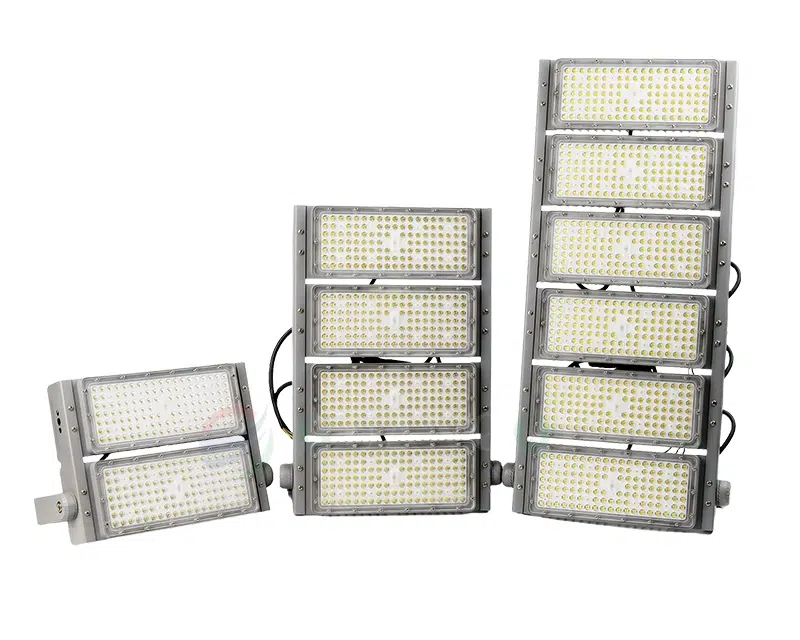
Multi-Sport Complex
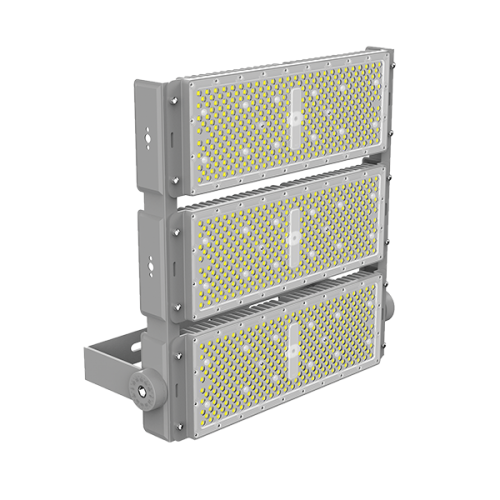
GQ-SPMD07
100W – 600W Modular Stadium Flood Light
Power Range100W 200W 300W 400W 500W 600W 800W 1000W
Module Base100W / module
Beam Angle60°
Efficacy≥130 lm/W
IP RatingIP66
CRI≥Ra80
CCT5000K / 5700K / 6500K
Warranty2 years
Professional Stadium
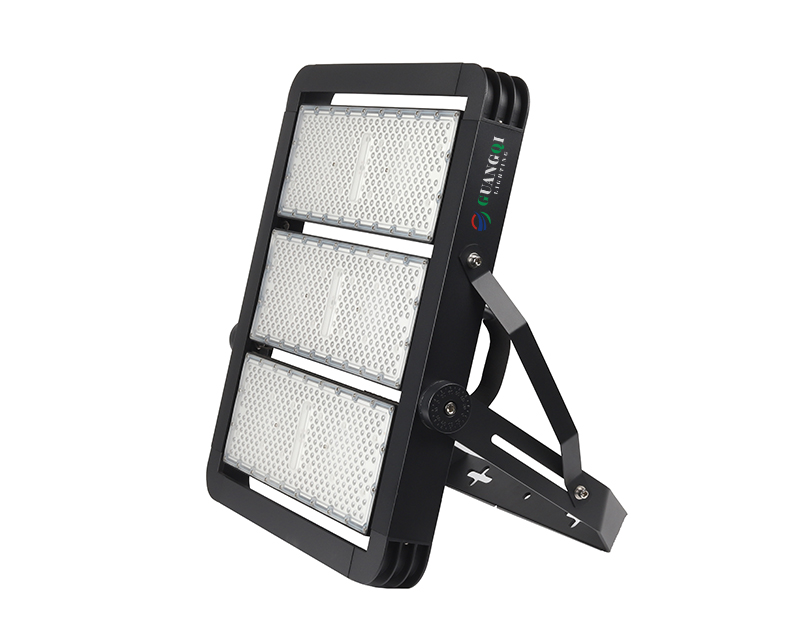
GQ-SPMD08
200W – 1,600W Modular Stadium Flood Light
Power Range200W 400W 600W 800W 1000W 1600W
Module Base200W / module
Beam Angle60° / 90°
Efficacy≥130 lm/W
IP RatingIP66
CRI≥Ra80
CCT5000K / 5700K / 6500K
Warranty2 years
Championship / Broadcast
GQ-FL09
200W – 1000W High-Mast Stadium Flood Light
Power Range200W 400W 600W 800W 1000W
StructureMonolithic high-power
Beam Angle 30° / 60° / 90°
Efficacy≥130 lm/W
IP RatingIP66
Surge Protect.4–6kV
Mounting15–40m high-mast poles
Warranty3 years
Engineering note on 1000W LED stadium lights:
The 1000W SPMD08 configuration (5 × 200W modules) delivers approximately 130,000 lumens at ≥130 lm/W efficacy — equivalent to replacing a 2,500W–3,000W metal halide fixture while drawing less than 40% of the energy. This makes the 1000W LED stadium light the preferred retrofit specification for Class III football and soccer stadiums. The modular architecture means a single module failure results in 80% light output retained — not a full fixture blackout.
Ready to specify your LED stadium lighting system? Download full product datasheets, IES photometric files, and lumen maintenance projection curves for all four series – or contact an applications engineer for the fastest way to get started.
Request Product Specifications
Sports Venue Applications — Football, Tennis, Pickleball, Baseball & More
LED sports lighting needs vary widely by sport discipline. Blue-chip broadcast-grade stadium lights for professional tennis require tight illuminance uniformity and effective glare control to ensure player focus will not be masked by excessively bright signals; modest LED floodlights aimed from 30-m high-mast poles over multiple field zones must provide precisely targeted high-intensity wash from scopes designed for narrow beam optics to avoid light trespass over residential neighbors; and in the fastest-growing outdoor sports category, pickleball - where the majority of facilities are similar to tennis or badminton halls - modest lighting poles 5-8m tall must produce balanced 40 fc to 50 fc on a level court surface without excessive brightness or dark areas.
Guangqi's series of four luminaire families qualifies for every outdoor sports stadium lighting category. Recommended product-to-sport-class mappings for IES RP-6 illuminance ranges are shown below 600 fc, across recommended mounting heights:
| Sport / Venue | IES Class | Required Illuminance | Recommended Series | Typical Pole Height |
|---|---|---|---|---|
| Football / Soccer Field | Class I (Broadcast) | ≥500 fc / 5,400 lux | GQ-FL08 1000W–1600W | 25–40m |
| Football / Soccer Field | Class III (Recreational) | ≥50 fc / 540 lux | GQ-SPMD09 400W–800W | 12–20m |
| Baseball Field | Class II (Amateur) | ≥100 fc / 1,080 lux | GQ-SPMD08 600W–1000W | 15–25m |
| Tennis Court (Tournament) | Class I | ≥200 fc / 2,160 lux | GQ-SPMD07 400W–600W | 10–15m |
| Tennis Court (Club / Recreational) | Class II | ≥75 fc / 810 lux | GQ-SPMD07 200W–400W | 8–12m |
| Pickleball Court | Recreational | 30–50 fc / 320–540 lux | GQ-SPMD02 100W–200W | 5–8m |
| Basketball Court (Outdoor) | Recreational | ≥30 fc / 320 lux | GQ-SPMD02 150W–300W | 6–10m |
| Athletics Track | Class II | ≥100 fc / 1,080 lux | GQ-SPMD08 400W–600W | 12–18m |
| Multi-Sport Arena | Class II | ≥150 fc / 1,615 lux | GQ-SPMD07 or SPMD08 | 10–20m |
Pickleball and tennis court lighting — high-value specifications
Pickleball court lighting has become one of the most active LED sports lighting specification categories in the past three years, driven by explosive growth in North America and Europe. Unlike football stadiums where fixture count is large and lighting poles exceed 20m, a standard pickleball court facility requires just two to four poles at 5-8m, with 100W-200W LED fixtures aimed inward to achieve 30-50 fc playing surface illuminance while keeping glare below the EN 12193 GR-50 limit at player eye level. Our GQ-SPMD02 with 60 beam optic is our standard recommendation for this application.
For tennis court lights, visibility is non-negotiable. The ball travels at speeds exceeding 200 km/h in competitive play, and the playing surface must meet a minimum uniformity ratio of 0.5 (minimum divided by average illuminance) to eliminate dark patches that compromise player reaction time. Our SPMD07 200W-400W fixtures mounted on court-perimeter poles at 8-12m height deliver a measured uniformity ratio above 0.6 - exceeding EN 12193 Class II requirements. High-value specifications like these require full photometric simulation before installation; we provide this at no charge.
Professional Stadiums
GQ-FL08 1000W–1600W
High-mast · Broadcast-grade
Football & Soccer Fields
SPMD09 400W–1000W
12–40m poles · IES Class I–III
Tennis Courts
SPMD07 200W–600W
8–15m poles · Uniformity ≥0.6
Pickleball Courts
SPMD02 100W–200W
5–8m poles · GR ≤50
Baseball Fields
SPMD08 600W–1000W
Infield / outfield zoning
Basketball Courts
SPMD02 150W–300W
Indoor / outdoor configurations
LED vs Metal Halide Stadium Lights — Performance & Cost Comparison
For most of the 20th century, metal halide (MH) stadium lighting was the only technology capable of delivering the high lumen outputs professional sports facilities demand. A 2,000W-3,000W metal halide fixture array was considered standard equipment - powerful, accepted, and treated as an unavoidable energy cost. That calculus changed when LED efficacy crossed the 130 lm/W threshold and the economics of LED stadium flood lights shifted decisively. Modern LED lights also solve the warm-up and re-strike delays that disrupted operations under metal halide installations.
Today, a 1,000W LED stadium light delivers equivalent or greater illuminance compared to a 2,500W-3,000W MH system - with measurably better color rendering, zero warm-up delay, and maintenance costs reduced by over 80%. For facility managers evaluating a metal halide replacement, the energy savings typically produce a simple payback of 2-4 years, with no lamp replacement costs for the subsequent 40+ year fixture lifespan.
| Performance Parameter | LED Stadium Lights (Guangqi) | Traditional Metal Halide |
|---|---|---|
| Luminous Efficacy | ≥130 lm/W | 80–100 lm/W |
| Wattage for ~130,000 lm | 1,000W LED | 2,500–3,000W MH |
| Working Lifespan | 50,000–100,000 hours (L70) | 12,000–20,000 hours |
| Warm-Up / Re-Strike Time | Instant (0 seconds) | 3–5 min warm-up; 10–15 min re-strike |
| Color Rendering Index | CRI ≥Ra80 (Ra90 available) | CRI 65–80 (degrades with age) |
| Flicker for Broadcast | Flicker-free (<5% flicker index) | 120Hz flicker at 50/60Hz power |
| Dimming Capability | 0–100% DALI / 0-10V control | Not practical |
| Annual Lamp Replacement Cost | $0 (solid-state, no consumables) | $80–$150 per fixture per year |
| Energy Savings vs 2500W MH Baseline | ~60% energy reduction | Baseline |
The retrofit financial model — a real-world calculation
For a standard mid-size football stadium with 40 metal halide lights at 2,000 W, 6 hours a night, 200 nights a year, at $0.12/kwh electricity. Annual cost $115,200 The LED retrofit equivalent, 40 GQ-SPMD08 fixtures at 800 W , with equal or higher ambient illuminance at 130 lm/W, would cost $46,080/year -- $69,120/year over a year simple payback of $180,000 $220,000, years with a fixture+ installation budget given.
Decreased maintenance costs alone saves, on average, another $12,000-$25,000 per year in lamps, lift use and downtime for mid-size venues – driving the real payback to 1.8-2.5 years in many cases. For facilities managers, the LED stadium light system argument is not speculation; it is mathematics.
Why flicker matters for sports broadcasting:
Metal halide lamps operating at standard 50/60Hz power frequencies produce a 120Hz luminous flicker that is imperceptible to the human eye but highly visible to high-speed cameras at shutter speeds above 1/500s. This produces banding artifacts in broadcast footage — a non-negotiable disqualifier for any venue seeking broadcast rights. LED stadium lights operating at less than 5% flicker index eliminate this issue entirely. This alone makes LED the mandatory specification for any arena that anticipates live television coverage or professional sports photography.
Stadium Lighting Cost Guide — Pricing by Wattage & Application
Something I get asked a lot, by facility managers and lighting contractors alike, is "how much will this LED stadium lighting cost?" The simple answer: the total project cost of all LED stadium lighting is highly variable, depending on fixture watts, fixture numbers, pole installation, controls level, cost of local labour, and many other factors. But the cost per fixture is remarkably bounded - and as a B2B LED manufacturer, which sells direct to the lighting contractor, distributor and facility operator worldwide, our fixture pricing show factory-direct economics, not inflated prices that relate to a retail sale to an end-user.
| Application Type | Typical Fixture Count | Wattage Range | Indicative Fixture Budget (Factory-Direct) | Est. Annual Energy Saving vs MH |
|---|---|---|---|---|
| Pickleball Court (2 courts) | 4–6 fixtures | 100W–200W | $800–$2,400 | $200–$600/yr |
| Tennis Court (1 court, recreational) | 4–8 fixtures | 200W–400W | $1,600–$6,400 | $400–$1,500/yr |
| Football / Soccer Field (Recreational) | 6–12 fixtures | 400W–800W | $4,800–$19,200 | $3,000–$8,000/yr |
| Football / Soccer Field (Semi-Pro) | 12–24 fixtures | 800W–1200W | $19,200–$57,600 | $8,000–$25,000/yr |
| Baseball Field (Amateur / Class II) | 12–20 fixtures | 600W–1000W | $14,400–$40,000 | $6,000–$18,000/yr |
| Professional Stadium (Class I) | 30–80 fixtures | 1000W–1500W | $60,000–$240,000 | $30,000–$90,000/yr |
* Fixture Costs are indicative manufacturer direct prices for all models listed assumed to be for GQ-SPMD / GQ-FL09 series only. Pole installation, electrical infrastructure and project management costs are not included and vary by location. Energy savings are calculated on the basis of $.12/kWh, 6 hr/day, 200 days/year, replacing the equivalent metal halide wattage at the power ratios determined in the comparison section above.
Where total project cost comes from:
In our experience across stadium lighting projects in Asia, Europe, and the Middle East, pole installation and electrical infrastructure represent 40–60% of total project cost. Fixture cost is the most controllable variable in the budget — and the one where factory-direct sourcing delivers the most measurable value. Projects that obtain a free photometric plan from us before finalising specifications consistently avoid over-specifying fixture quantity, reducing both capital expenditure and installation cost without compromising illuminance performance.
Get an accurate project budget — not a generic range estimate
You provide your venue dimensions, pole height, and IES illuminance class target. Our engineers will then send back a photometric simulation, fixture count confirmation and indicative pricing within 48 hours - at no cost to you.
Get Project QuoteTechnical Specifications — Lumens, Beam Angles & IP Ratings
Design of the stadium lighting system starts with three engineering Inputs, the required illuminance at the playing surface (lux or fc per the relevant IES RP-6 or EN 12193 class), the mounting height of the lighting poles, and the total horizontally illuminated area. From these three engineering inputs, a lighting designer determines the needed lumen output for each fixture, beam angle type, and minimum number of fixtures to install. Photometry software (AGi32, DIALux, or equivalent) confirms the results.
Lumen Output by Wattage — GQ-SPMD / GQ-FL09 Series
All series of GP of floodlight from Guangqi stadium have at least 130 lm/W of luminous efficacy over complete power range (VIA IES LM-79-19 test method). Guaranteed minimum lumen output of typical wattage combinations is as follows:
| Wattage | Min. Lumen Output | Series Options | Typical Venue Match |
|---|---|---|---|
| 50W | 6,500 lm | SPMD02 | Pickleball accent / small court supplement |
| 100W | 13,000 lm | SPMD02 / SPMD07 | Single pickleball or recreational basketball court |
| 200W | 26,000 lm | SPMD02 / SPMD07 / SPMD08 | Two pickleball courts / recreational tennis |
| 400W | 52,000 lm | SPMD07 / SPMD08 / FL09 | Full tennis court (Class II) / small football field |
| 600W | 78,000 lm | SPMD07 / SPMD08 / FL09 | Amateur baseball / Class III football field |
| 1000W | 130,000 lm | SPMD08 / FL09 | Professional football / Class II arena |
| 1200W | 156,000 lm | SPMD08 | Large stadium / Class I arena supplementary zones |
| 1600W | 208000 lm | SPMD08 | Championship / broadcast-grade stadium (Class I) |
Beam Angle Selection — Which Optic for Which Venue?
Choosing the appropriate beam angle ranks as one of the most important choices in stadium lighting design. The optimal optic is a function of mounting height, throw distance to the playing surface, and the desired illuminance distribution pattern. Below is a mapping of what options are suitable given an actual venue configuration:
3°/5°
narrow beam (GQ-SP Series)
High-mast poles at 30-40m to provide maximum spread across 60-80m of field. In addition to minimizing spill light outside of the field boundary, greatly reduces spectator glare rating.
10°
spot beam (GQ-SP Series)
20-30m high-mast or corner-pole on large fields. Provides high center-field illuminance for broadcast camera zones in field lighting projects.
30°
narrow-medium (GQ-SPMD and FL Series)
Community sports poles at 8-12m. Small to medium courts, with tight central cluster and predictable edge fall off.
45°
mediumbevill (GQ-FL09)
Allround-optic for 15-25m pæle. Vanlig til semi-prof baseballstadium og full perimeter sportsanlegg.
60°
medium-wide(all four series)
Standard lens (Optic) most often used for medium height applications Broad homogeneous distribution of illuminance– the preferred beam angle in this range
Wide
beam 90 (all four series)
Low-pole setup at 5-10m with wide spread required for acceptable uniformity. Suitable for pickleball, recreational basketball, and perimeter security.
Most professional stadium lighting designs employ intentional blending of beam angles of the fixture array - tighter, narrower optics on the corner and end-zone poles for the longest throws, wider optics on the sideline poles where the fixtures are much closer to the field. This blending of beam angles can be used to deliver target illuminance uniformity ratios above 0.6, yet with minimal fixture count and energy usage.
Full Electrical and Optical Specification
| Parameter | Specification | Standard / Test Method |
|---|---|---|
| LED Chip | SMD3030 flip-chip, low junction temperature design | — |
| Junction Temperature | <80°C at rated power | JEDEC JESD51 |
| Color Rendering Index | CRI ≥Ra80 standard; Ra90 available on request | IES LM-79-19 |
| Color Temperature | 5000K / 5700K / 6500K | — |
| IP Rating | IP66 (dust-tight + high-pressure water jet resistant) | IEC 60529 |
| Surge Protection | 4–6kV differential and common mode | IEC 61000-4-5 |
| Housing | Die-cast aluminium body, tempered glass lens, stainless steel hardware | — |
| Power Factor | >0.95 | — |
| THD | <15% | — |
| Dimming | 0–100% via DALI or 0-10V (optional) | IEC 62386 |
| Operating Temperature | -40°C to +55°C | — |
| Lifespan (L70) | ≥50,000 hours | IES LM-80 |
| Flicker Index | <5% (flicker-free for high-speed photography) | IES TM-24 |
Certifications & Sports Lighting Standards
LED stadium lights purchased by international customers for use in professional sporting venues, government-funded athletic or sports facilities, or export markets should be supplemented with documentary certification verifying compliance with established industry standards. For most applications, the two LED stadium light products in Guangqi's GQ-SPMD and GQ-FL09 series compliance with CE and RoHS, respectively, should be complemented by testing of the 46 IEC and EN standards that apply to high-power outdoor LED lighting fixtures used in sporting venues:
CE
EU Market Access
LVD + EMC Directive
RoHS
EU Hazardous
Substances Compliant
IP66
IEC 60529
Dust-tight + Water-jet
IES
LM-79-19
Photometric Testing
Key International Sports Lighting Standards
In order to specify LED stadium lights for a compliant sporting environment you need to understand what framework of lighting requirements you are working to. There are two main standards:
IES RP-6-15
The Illuminating Engineering Society's Recommended Practice for Sports and Recreational Area Lighting (North America). Establishes the classes of illuminance I through IV, the ratio requirements for uniformity, and the glare control specification for each major sporting activity from Class I telecast football to Class IV recreational tennis.
EN 12193:2018
European standard for light and lighting in sports facilities. Same scope as IES RP-6, with harmonised illuminance tables and a numerical scale of GLA by sport class, called Glare Rating (GR).
For energy efficient lighting classification of government supported buildings— a criterion for grant in many European markets—LED stadium lights are assessed for comparison with ASHRAE 90.1 (North America) and EU ErP Directive, both requiring maximum installed lighting power density (LPD) limits for sports venues. Due to LEDs higher efficiencies, the driver electronics'seriese at Guangqi usually can offer 40–60% headroom below LPD limits, therefore offering an avenue for grant application with green building meeting certain energy performance documentation.
Stadium Lighting Projects & Case Studies
Guangqi Lighting has supplied LED floodlighting systems for sports facilities throughout Asia, Europe and the Middle East during 14 years of activity (here). The examples depicted below demonstrate performance results, retrofit applications and the operating enhancements derived from a 500 kW+ switch-over from metal halide stadium lighting systems to LED. Note, all data is derived from project records and retrofit-post-rollout illuminance measurements.
Southeast Asia · Football Stadium
Regional Football Stadium — Night Games LED Upgrade
24 GQ-SPMD08 1000W fixtures installed on 25m poles. Replaced 24 2,500W metal halide stadium flood lights. Post-installation measured illuminance: 580 lux average on field (Projected IES Class II). KiloWatt savings: 62%. Simple payback period: 2.8years. Improved playing field illumination was observed by users in all positions, with on-field visual acuity increased by play and fan feedback supported by test footage broadcast-verified removal of 120Hz flicker contributions to game images of formerly HID lit field.
Middle East · Tennis Complex
6-Court Tennis Complex — Tournament Standard Lighting
48 GQ-SPMD07 300W fixtures across 6 tennis courts. EN 12193 Class II (200 lux average, ratio 0.5) design. Measured GR glare rating: 42 (qualifies as below the 50 Class II threshold); Night tournament capacity was extended by 3hours/night relative to previous 400W HID infrastructure. Improving the venue's annual energy efficiency savings by an estimated $18,000 relative to the previous capacity. Local electricity tariff rate.
Europe · Municipal Sports Park
Municipal Multi-Sport Park — Energy-Efficient LED Retrofit
The facility encompassed2 football pitches, 4 tennis courts and6 pickle ball courts. Mixed specification across all 3 series: 2 series with SPMD08 for football,2 series with SPMD07 for tennis, 2 series with SPMD02 for pickle ball. Total LED installed wattage: 38.4 kW. Total replaced HID wattage: 96k W. Samplei savings per annum of approximately $18,000 at local tariff. The upgraded venue qualified for municipal energy efficiency subsidy rebate payments based upon a documented LPD adhering to standards.
Asia · Amateur Baseball Stadium
Amateur Baseball Stadium — Infield and Outfield Zoning
20 GQ-FL09 600W (infield zone, 10beam, 20m poles)+16 GQ-FL09 800W (outfield zone, 25beam, 25m poles). or achieved 650 LUX infield and 320 LUX in the outfield, simulatedthe ized IES RP-6 Class II design for asymmetric baseball illumination. Lamp replacement costs fell from $12,400 to $0 in the first year of LED operation as maintenance cost.
After-Sales Service & Warranty
The operating model for LED stadium lighting fixtures represents a capital investment that may be amortized across many years of operation, but for years to come, we produce and support every product series offering a complete warranty program and customer service system that considers the exigencies of sports venue management- when a lamp failure on a budgeted game night is a perception-damaging issue for many levels of an operators' business.
2 yr
Standard Warranty
All GQ-SPMD Series
3 yr
Standard Warranty
All Series
5 yr
Premium Warranty
Project-Level Agreement
48 hr
Technical Response
All Warranty Claims
What the warranty covers
Every line of Guangqi stadium LED products guarantees against defects in materials and quality, LED driver failing, lumen depreciation over 30% of initial rating (L70 failure prior to the expiration of warranty), and housing integrity under IP66 rated conditions. Our warranty records direct comparison against theIes.org LM-79-29 photometric test result to confirm lumen efficacy. For project size commitments that incorporate a 5-year warranty coverage arrangement, we also specifically gurarantee LED module lumen depreciation and will supply replacement modules.
Retrofit and installation support
For facilities upgrading from metal halide to LED—our most popular application for our stadium flood light products—Guangqi offers a retrofit consultation of: existing fixture audit best practices, pole structural load documentation for the LED fixture dimensions and weight, photometric comparison (existing MH versus proposed LED configuration), and IES file delivery for independent AGi32 or DIALux validation. This is included as part of our free photometric design program for qualified projects.
Post-installation, our engineers deliver commissioning assistance through email and video call, including aiming angle confirmation, electrical connection assurance and dimming control setup. Installation operation instructions, specifications for mounting bracket compatibility and wiring diagram are dispatched for each product series.
LED Stadium Lights — ROI Calculator
Compare 10-year total cost: Guangqi LED vs metal halide. Includes energy, maintenance & replacement costs.
—
Total Savings
—
Payback Period
—
Annual Energy Saved
Total Cost Comparison over 10 Years
Calculation Assumptions
Professional Lighting Design Tools
Frequently Asked Questions
Questions below are collected from engineering inquiries, purchase requests and technical consultation of facility managers, electrical & lighting contractors and 9 sports venues operators in various countries all over the world from Guangqi's customers profile.
Required lumen output per fixture depends on the number of fixtures deployed, mounting height, beam angle selected, and the target illuminance level defined by the IES RP-6 or EN 12193 class applicable to the sport and venue tier. As a reference: a professional football field illuminated to IES Class I (500 fc / 5,400 lux) with 30 fixtures at 30m poles requires approximately 130,000–195,000 lumens per fixture (1,000W–1,500W LED). A recreational sports field at Class IV (10 fc / 108 lux) with 8 fixtures at 12m poles may require only 26,000–52,000 lumens per fixture (200W–400W). Precise lumen requirements are determined by photometric simulation using the IES file for the chosen fixture — we provide this simulation free of charge for qualified projects.
LED stadium lights span from 50W for small community courts to 1,500W for professional championship arenas. Common specifications: 100W–200W for pickleball and recreational basketball; 200W–600W for tennis courts and small football fields; 600W–1,200W for semi-professional football, soccer, and baseball; and 1,000W–1,500W for professional Class I–II stadiums. The 1000W LED stadium light is currently the most widely specified wattage for mid-size professional venues, replacing 2,500W–3,000W metal halide systems in retrofit projects while delivering equal or greater illuminance at 60% of the energy draw.
Guangqi's stadium flood light series offers six beam angle options: 10°, 25°, 30°, 40°, 60°, and 90°. Narrow beams (10°–25°) are used on high-mast poles at 25–40m to aim light precisely at specific field zones with minimal overspill. Medium beams (40°–60°) suit mid-height poles at 10–25m and provide broad, even illuminance distribution. Wide beams (90°) are appropriate for low poles at 5–10m where a wide spread is needed to achieve acceptable uniformity on small courts. Most professional stadium lighting designs use a deliberate mix of beam angles — narrower optics at corner poles where throw distance is greatest, wider optics on side poles where fixtures are closer to the playing surface.
Total stadium lighting installation cost covers fixture procurement, pole and foundation civil works, electrical wiring and switchgear, and project management. Guangqi's LED stadium light fixtures range from approximately $200–$400 per unit for 100W–200W community fixtures to $1,500–$3,000 per unit for 1,000W–1,500W professional stadium fixtures at factory-direct pricing. For a typical 6-pole recreational football field retrofit using 12 × 800W fixtures, indicative fixture cost is $9,600–$19,200 — with total project cost including civil and electrical work usually 2–3 times fixture cost depending on site conditions. A free photometric plan from Guangqi confirms the minimum fixture count required for your illuminance specification, preventing the over-specification that inflates both fixture and installation budgets.
LED stadium lights reduce glare when correctly specified — but they do not eliminate it automatically. Glare control is a function of beam angle selection, fixture aiming angle, and mounting height above the playing surface, not just light source technology. EN 12193 quantifies sports lighting glare using the Glare Rating (GR) scale, where Class I venues require GR ≤ 50. Guangqi's anti-glare optic designs, combined with correct photometric aiming calculations, achieve GR ≤ 42–48 in verified project installations. A poorly specified LED fixture using an excessively wide beam at insufficient mounting height can produce worse glare than the metal halide system it replaces. This is the primary reason we insist on providing photometric simulation before confirming any fixture specification.
For international procurement: CE marking (mandatory for EU market access — covers LVD and EMC directives), RoHS compliance (EU restriction on hazardous substances in electrical equipment), IP66 certification per IEC 60529 (essential for outdoor sports venues subject to rain, dust, and pressure washing), and IES LM-79-19 photometric test reports (required by lighting engineers for design verification). For North American projects, ETL or UL listing is standard. For government-funded EU venues, ErP Directive energy labelling compliance may be required for grant eligibility. Guangqi's full series carry CE and RoHS certification; IP66 test reports and IES LM-79 photometric data files are available upon request for every product model.
Smaller community sports venues benefit from LED conversion at least as much as large professional stadiums do — and in some respects more so. Community facilities typically operate with constrained maintenance budgets, meaning the elimination of recurring lamp replacement costs and the 50–65% reduction in energy consumption have proportionally larger positive impacts on facility sustainability. A community sports facility replacing 8 × 400W metal halide fixtures — in effect using LED area lighting technology scaled for sport — with 8 × 200W LED fixtures reduces monthly energy cost by approximately 50% and removes the need for lift equipment to replace lamps every 2–3 years. The GQ-SPMD02 series (50W–300W) was specifically designed for community court and small sports facility applications where modest pole heights and tight budgets are the norm.
Guangqi LED stadium lights are rated for ≥50,000 hours at L70 — the point at which lumen output reaches 70% of initial rated output. Each LED light provides consistent output across its rated lifespan. At a typical utilisation of 6 hours per day, 200 operational days per year, this translates to approximately 41 years of operational life before reaching L70 degradation. In practice, most facility operators plan LED fixture refresh at 10–15 years to maintain peak illuminance levels. Guangqi's standard warranty is 2 years for the GQ-SPMD series and 3 years for the GQ-FL09 series, with project-level 5-year warranty agreements available for qualifying orders. All warranty claims receive a 48-hour technical response.
Yes — retrofit is the most common deployment scenario for Guangqi's stadium flood light range. LED fixtures mount on existing poles using adapter brackets compatible with pole diameters from 60mm to 120mm across our product series. Three engineering considerations apply to retrofit work: (1) confirming that the existing pole structural rating supports the LED fixture's weight and wind-load at the chosen mounting angle; (2) verifying that the existing electrical circuits, cable ratings, and switchgear support the revised current draw for LED drivers; and (3) recalculating aiming angles to account for the LED beam optic's light distribution characteristics, which differ from the MH reflector it replaces. Our retrofit consultation service covers all three assessments at no charge for qualified projects.