Get in Touch with GUANGQI


Solar Street Lights: Commercial Solar LED Lighting Solutions
Zero electricity bills. Zero grid dependency. Guangqi Lighting offers commercial-grade solar powered street lights across 9 product families — from compact all-in-one models for residential pathways to split systems deployed on major highways, industrial yards, logistics centers and other public area.
9
Product Series
160LM/W
Lumen Output
IP65/66
Protection
CE & RoHS
Certified
10+ Years
Mfg.
What Is a Solar Street Light and How Does It Work?
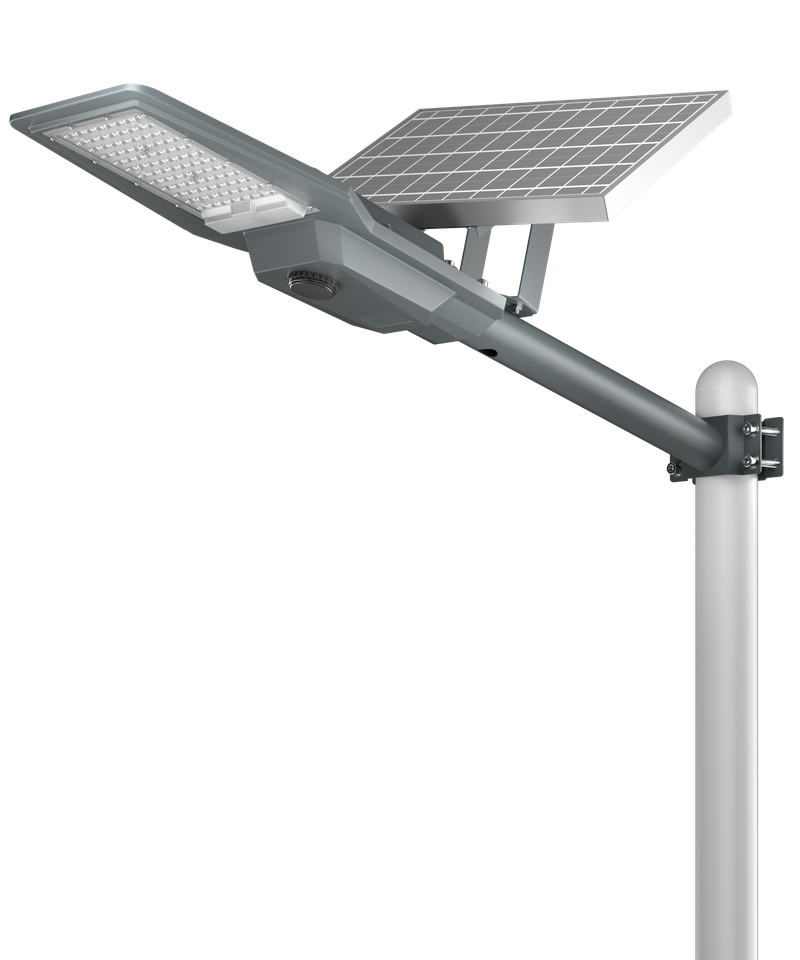
A solar street light is an independent outdoor lamp which is powered by its own built-in photovoltaic electricity generation device. Different from traditional street lights which use electricity supplied from a power grid, a solar powered street light runs completely “off-grid”, charging itself during daytime and lighting roads and public spaces in darkness using completely independent energy.
Core Components of a Solar Light System
All solar LED street lights comprise four main components that form a totally closed loop energy system:
Solar Panel
A solar panel, either monocrystalline or polycrystalline — solar panels convert sunlight into DC electricity: monocrystalline solar cells tend to have a higher conversion rate (around 19-22%) and thus occupy less space, a benefit that makes them the more popular choice for solar street lights.
LED Lamp Head
An LED lamp head, where super bright LED lightchips produce 130 to 160 lumens/watt: rendering the light far more energy efficient than traditional HPS or metal halide bulbs at equal wattage.
Battery Pack
A battery pack, which stores the solar energy generated during daytime consumption: Lithium Iron Phosphate (LiFePO4) batteries have now become the norm; they last noticeably longer than lead-acid batteries (around 2000 charge cycles), have an extremely low risk of thermal runaway and wider operating temperature ranges.
Charge Controller
A charge controller, usually a maximum power point tracking (MPPT) type, which governs energy flowing from the solar panel to the battery, then from the battery to the LED lamphead: MPPT technology can produce up to 30% more energy, especially when the sun is at a strange angle early in the morning or late in the evening.
How the Lighting Cycle Works
All lights run dusk to dawn without needing human intervention: a photocell or light sensor merely turns on the light; (many installations also combine motion sensors with a three-step timer: the LED chip fully lights up on motion detection, dims to 50% in the silent hours, then fully re-lights with any new detection, meaning the lithium battery has a much longer idle life).
The upshot is a long lifespan on installation: LED lightchips are rated at 50000+hours, solar panels 25 years, Lithium Phosphate batteries retain 80% of their charge after 2000 cycles.
Types of Solar Street Lights: All-in-One, Split & Integrated Systems
Meanwhile, there are three different architectures of LED solar street light to choose from. Needless to say, the choice of system depends on the wattage, free space and installation complexities involved:
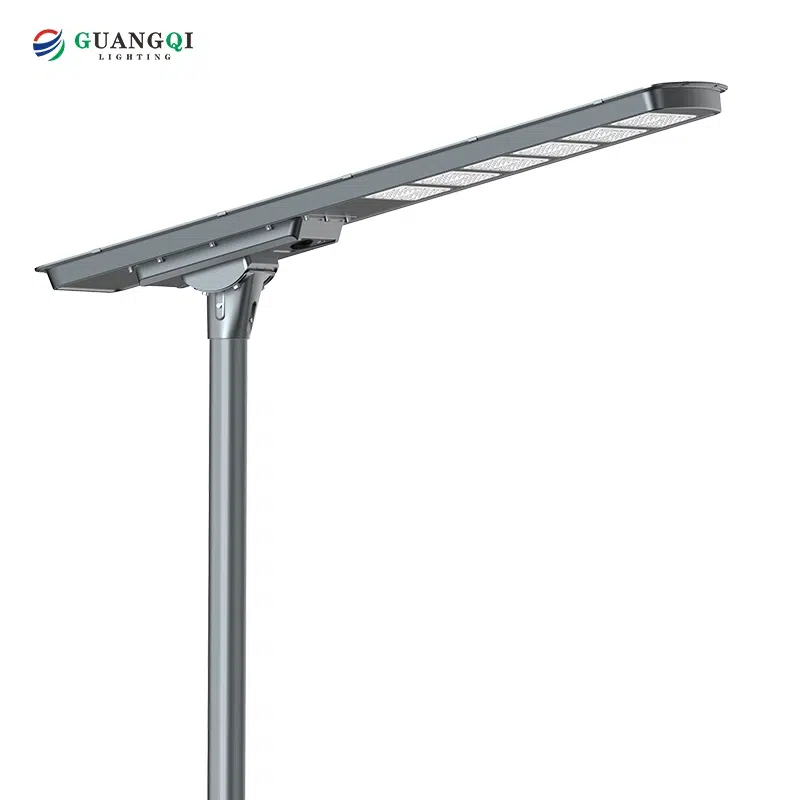
ALL-IN-ONE
All-in-One Solar Street Light
The all-in-one (AIO) design integrates all components within a single lightweight system, easy to install. Bolt directly onto a pole.
Power range: 20W – 100W
Best for: Residential streets, park paths, campus walkways
LiFePO4 battery options: 40-100AH(12.8V)
Trade-off: Panel size dictated by the enclosure dimensions. Not suitable for roadways requiring more than 100W.
Guangqi model: GQ-STSL010 (patented all-in-one design, 60W/80W/100W)
All-in-one solar lighting is especially practical in regions with shorter daylight hours because the solar powered LED module and MPPT controller work together to maximize charge intake even in low light conditions during early morning and late afternoon.
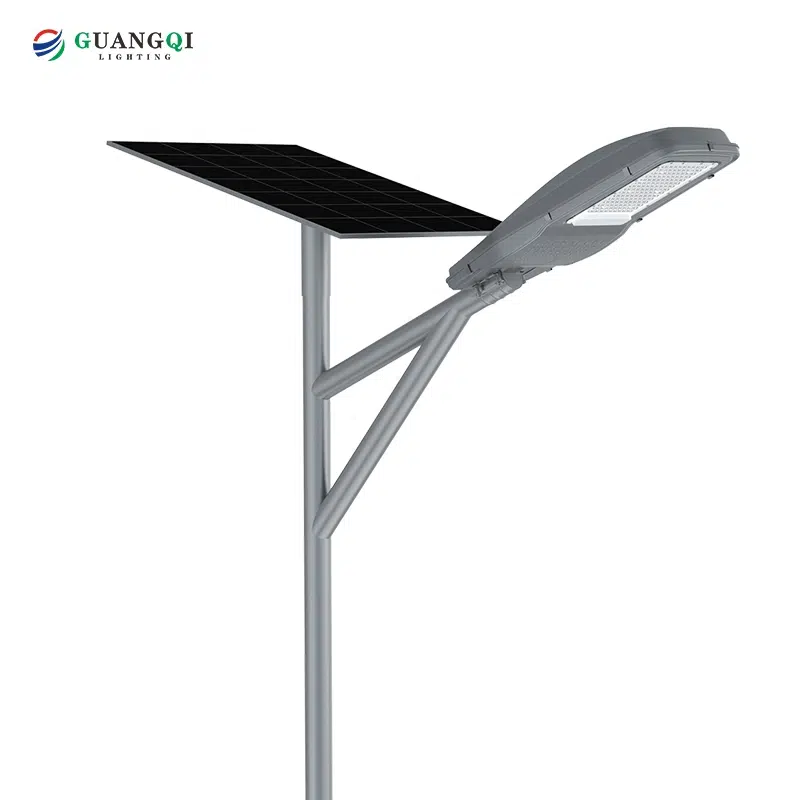
SPLIT
Split Solar Street Light
Separate solar panel frame-mounted, LED lamp head and battery pack:
Power range: 20W – 80W
Best for: Main roads, highways, industrial parking lots
LiFePO4 battery options: 60Ah-120Ah(3.2V)
Pro: Larger panel capacity = greater stored energy, panel angle can be seasonally adjusted for maximizing solar gain
Guangqi models: GQ-STSL012(30W-50W-80W)
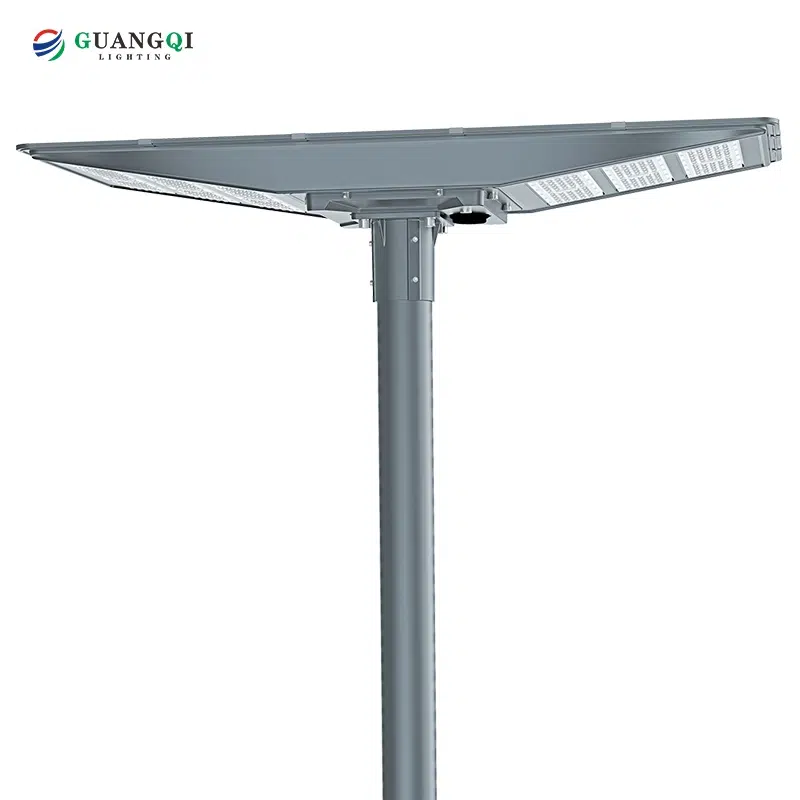
INTEGRATED
Integrated Solar Street Light
A compromise solution – the LED lamp and battery are integrated into a single compact unit while the solar panel is mounted on a short arm immediately above the luminaire. Less bulky than a fully split solution yet more capable than a dedicated all-in-one product.
Power range: 40W – 70W
Best for: Secondary roads, community streets, commercial areas
LiFePO4 battery options: 40-70Ah(3.2V)
Trade off: The panel is still in the same general location as the lamp so it can be partially shadowed by poles, light poles, or other physical obstructions in tight quarters
Guangqi models: GQ-STSL06, GQ-STSL07, GQ-STSL09, GQ-STSL10
Here’s a quick simplified decision process we use with project buyers: if you need less than 100W and want rapid installation with minimal labor, select integrated. If the road classification requires 100W or higher—or if location’s terrain causes regular shadows that require an elevated panel—choose split. Integrated fits the bill for municipal projects that desire medium power without the weight of a dedicated panel mount.
Solar Street Light Applications: Roads, Parking Lots & Beyond
Lighting applications for solar street fixtures go far broader than most buyers think. Every location where power is costly, risky, or even non-existent benefits from outdoor solar lights—and increasingly any site where local government desires to reduce the cost of energy even if the grid is readily available.
Urban & Suburban Roadways
City secondary and primary roads. Split systems with 100W-300W panels on 8-12 meter poles deliver the lumen levels specified in CIE 115 for roadway illumination standards, without the costly trenching required to extend power in many developing regional economies.
Parking Lots & Commercial Areas
Parking lot lights powered by solar energy lowers running costs for commercial parking facilities, shopping centers, warehouse districts, and distribution centers. These area light fixtures (plasma or metal halide sources) with wide beam widths (70-140 degrees) minimize energy consumption during less-active hours through motion sensor switching. In most cases, the initial investment will be recovered within 3 years of starting operation.
Highways & Expressways
High-powered split systems (100W-200W) mounted on 10-14 meter poles accommodate highway ramps, toll booths, and interchange zones. These are the most demanding installations—as their luminaires require to put out 20,000+ lumens at 4000K-5000K to promote drivers’ high speed vision needs.
Rural Electrification & Off-Grid Roads
In many remote, desert, forest, agricultural, and arctic locations inaccessibly distant from the existing grid infrastructure, solar street lighting may be the only economically viable solution. Based on the space and luminosity demands, 40-80W all-in-one units will cost a fraction compared to laying conventional power lines.
Industrial Compounds & Factories
Parking lot perimeter lighting and loading bay illuminator’s areas in industrial estates. Solar flood lights and pole-mounted fixtures provide dusk to dawn security coverage for cameras and uniform area lighting, while lack of external wiring prohibits access from vandals.
Parks, Campuses & Residential Communities
The outdoor illumination of landscaped environments at academic campuses, municipal parks, and enclosed subdivisions. Lower-wattage (20-60W) all-in-one solar fixtures on 3-6 meter poles unobtrusively serve as a security light for walkways and meet pedestrian illumination standards.
Solar Street Light Specifications: Wattage, Lumens & Battery Capacity
Guangqi Lighting’s 9-series offers from 20W to 150W of PV powered LED street lighting. Below are the major electrical specifications for each product type. All listed performance data is derived from ready-to-deploy solar lighting systems—variation in battery-pack design and solar configuration can be realized through special customization options.
| Model Series | Type | Power (W) | Lumen Output (lm) | Solar Panel | Battery | IP Rating |
|---|---|---|---|---|---|---|
| GQ-STSL01 | All-in-One | 20 / 40 / 60 | 2,600 – 7,800 | Mono 30–80W | LiFePO4 15–40Ah | IP65 |
| GQ-STSL06 | Integrated | 20 / 40 / 60 / 80 | 2,600 – 10,400 | Mono 40–100W | LiFePO4 20–60Ah | IP65 |
| GQ-STSL07 | Integrated | 40 / 60 / 80 / 100 / 120 | 5,200 – 15,600 | Mono 60–160W | LiFePO4 30–90Ah | IP65 |
| GQ-STSL08 | All-in-One (Patented) | 60 / 90 / 120 | 7,800 – 15,600 | Mono 80–160W | LiFePO4 40–90Ah | IP66 |
| GQ-STSL09 | Integrated | 40 / 80 / 120 | 5,200 – 15,600 | Mono 60–160W | LiFePO4 30–90Ah | IP65 |
| GQ-STSL10 | Integrated | 60 / 80 / 100 / 120 / 150 / 200 | 7,800 – 26,000 | Mono 80–280W | LiFePO4 50–150Ah | IP66 |
| GQ-STSL11 | Integrated | 40 / 60 / 80 | 5,200 – 10,400 | Mono 50–100W | LiFePO4 25–60Ah | IP65 |
| GQ-TKJ-A | Split | 100 / 150 / 200 / 300 / 400 | 13,000 – 52,000 | Mono 150–500W | LiFePO4 80–300Ah | IP66 |
| GQ-TKJ-B | Split | 200 / 300 / 400 | 26,000 – 52,000 | Mono 280–500W | LiFePO4 150–300Ah | IP66 |
Lumen output calculated at 160 lm/Watts typical LED efficacy. Actual lamps lumen output can have a 5% variation depending on Junction Temperature, Driver type and driver output current. Battery capacity sized for 3-5 days of autonomy while installed in local solar conditions. Please consult our engineering team for site specific calculations.
Every model in the table above uses high-efficiency solar cells that maintain usable charging rates even when ambient light is diffused by cloud cover or haze — a critical factor for installations in tropical or coastal climates where direct sun exposure fluctuates seasonally.
Key Technical Parameters
Other specifications buyers should read up on beyond the wattage and lumens are:
Color temperature:
Residential 3000K (warm white), roadway 4000K-5000K (neutral to cool white), higher CCT helps visual acuity but makes glare worse if the lamps are mounted at low heights.
Beam angle:
Roadway fixtures and parking lot area fixturesgenerally use asymmetric 70*140 optical distributions and donât have any uplight to reduce light pollution.
Motion sensors:
PIR (passive infrared) or microwave sensors with adjustable sensitivity and range (8-12 meters). In order to double the effective runtime of the lamps, set the sensor to dim to 30% when background motion is quiet and schedule accordingly.
Remote control:
Simple remote included with systems for dimming and scheduling adjustment. Professional 4G or LoRa enabled IoT dashboards that monitor entire fleet of fixtures let the engineer have remote access to functions anywhere on earth with an internet connection.
Compatibility with light poles:
Standard pole mount adapters accommodate diameters from 60mm to 76mm. Light pole height 10m? load ratings are critical; lamp arm assemblies must be tested to IEC 60598 for 150 km/h sustained wind load.
Solar Street Light Project Case Studies
Actual data from installation sites will give you a more complete picture of a fixture than a spec sheet. Here are three projects that demonstrate the kinds of streetscale problems different solar streetlights installations can solve.
Provincial Highway, Southeast Asia — 2024
280-Unit Highway Lighting Retrofit
A provincial administration was responsible for a 14 km section of two-lane highway leading from a large coastal city to a regional airport. The utility’s grid connections would have taken 9 km of cable at around $85 per meter – a budget constraint. The team opted for our GQ-TKJ-A 200W split solar street lights in 10-meter galvanized steel poles spaced 35 meters apart.
Twenty three days of work with a 12-man crew were needed for installation. The 280 pole bases were the most time-consuming step, as each required 48 hours to set. To expedite commissioning, we divided the project into two halves – the first 7 km of road was energized about two weeks before the remaining sections.
“We had budgeted for generator-powered temporary lights during construction. The solar fixtures made that unnecessary — each unit was up and running within minutes of pole mounting.” — Project Site Supervisor
280
Fixtures
14 km
Road Length
$0
Annual Electric Bill
~$765K
Cabling Cost Saved
Industrial Logistics Park, Middle East — 2023
Solar Parking Lot Lights for a 45,000 m² Compound
A regional distribution center in the Gulf wanted to replace existing HPS (high-pressure sodium) parking lot luminaires for the loading zones and visitor parking lot with energy-efficient lighting to cut down on electrical expenses (approximately $18,000 per year) and reduce maintenance. The existing luminaires were hard to access and bulb replacements occurred every 10-14 months due to heat damage on the HPS lamps.
Our recommendation was 64 GQ-STSL10 integrated solar street lights with PIR (passive infrared) motion sensors that dim the fixtures to 40% to 5 AM. The parking lot and loading zone lights operate at full power throughout the four hour shift, while the perimeter and visitor parking lot lights operate at half power between midnight and five o’clock.
“The electricity savings were the original goal. The surprise was maintenance — we have not replaced a single fixture or battery in 18 months. With HPS, we were changing bulbs every quarter.” — Facility Operations Manager
64
Fixtures
$18K/yr
Energy Saved
0
Replacements in 18 mo.
Village Road Network, East Africa — 2024
Off-Grid Village Electrification: 120 All-in-One Units
Extending the electric grid to fifteen rural villages in sub-Saharan Africa can cost $3,394 $10,000 to $6,786 $25,000 per km of transmission line, reports the World Bank on rural electrification. Even though the total population of three farming villages of about 6,500 people is comparable to the aforementioned grid extensions, transmission was not a feasible alternative.
An off-grid NGO-funded project installed 120 GQ-STSL08 solar street lights (60W) all-in-one on 6-m poles along 8 km of village roads and around 2 village focal points. Installing solar units could be handled by a 2-person crew in under 30 minutes. Ease of installation and simplicity of design was so important; local technicians were trained only ½ a day and have since carried out all routine checks without factory technicians visiting the sites for the first 10 months.
Beyond providing light, the project resulted in a significant rise in village night-time economic activity according to village elders and safety benefits that village health officials cited from emergency night-time transportation. These secondary effects are commonplace with off-grid solar street lighting projects – the light is the tangible deliverable, but the social return on investment extends far beyond.
120
Units Deployed
8 km
Roads Lit
6,500
People Served
30 min
Install per Unit
Why Choose Commercial-Grade Solar LED Street Lighting?
There is a world of difference between the $30 solar garden lamp purchased from the retail shelf and the engineered commercial solar street light intended for 10+ year roadway service. Most of the difference is in what you don’t see in the parts inside that keep the fixture running on year five.
What Sets Commercial Solar Apart
LiFeP04 in my pocket or garage?
Lithium-ion cells are cheap, loaded with plastic, and will degrade over the first 6 months and 250 cycles. LiFeP04 cells are chemically stable from -20C to 60C, weigh 20% more, and retain 80%+ of original capacity after 2000 cycles. A 15% premium in cell cost gives you a 60% reduction in warranty-period replacement cost.
MPPT or PWM charging?
MPPT charge controllers extract an extra 25%-30% useable energy from each panel than a PWM controller. That 50W boost from a 200W panel is enough for another rainy night of autonomy every month.
Tempered glass or plastic lens?
Commercial LED fixtures are sealed with tempered glass that won’t yellow, scratch, or degrade from UV exposure. Plastic lens covers do even better saving a little at the factory but degrade up to 15% after 3 years outside.
Die-cast aluminum housing?
Die-cast aluminum is corrosion resistant, holds up in harsh weather conditions, dissipates heat so much better than sheet aluminum or plastic, and directly extends LED chip life. Tungston or other raw materials are cast in with the Aluminum and hit the machining process fully integrated. Our lamps have integrated heat-sink fins integrated into the housing designed for maximum thermal performance in still air.
Guangqi Lighting: Your Solar Street Light Manufacturer
Zhongshan Guangqi Lighting Co., Ltd has been producing outdoor lighting products — solar and LED — since 2010. We have the ability to control the entire manufacturing cycle (mold, optical design, thermal simulation, SMT, and testing) in addition to a fully-equipped QC lab with testing and integrating sphere measurements for every batch.
As an OEM and ODM solar street light manufacturer shipping to Asia, Europe, North America, and the Middle East, we manufacture for Asian and Western brands. Minimum order quantities are 50 units for standard configurations or 200 for customized fixtures. Our engineering staff can provide free photometric analysis if we have the conditions of a project – just tell us the length and width of the road, and we will determine optimal pole height, fixture width, and wattage.
High efficiency in an LED solar street light is not just about the chip — it is the combined result of panel yield, MPPT charging gains, and optical lens design that together determine how much of the stored energy actually reaches the road surface.
Solar Street Light Pricing: Cost Factors & ROI Analysis
Most common question from project purchasers,”What is the price of a solar street light?” The reality is that the price of solar street lights varies by half a dozen interrelated factors – and the cheapest solar street lamp is rarely the most economical purchase over 10 years.
All-in-One (20W–120W)
$120 – $450
Per unit, FOB. Residential paths, parks, rural roads.
Integrated (40W–200W)
$250 – $800
Per unit, FOB. Secondary roads, community streets.
Split System (100W–400W)
$500 – $1,200
Per unit, FOB. Highways, industrial, major roads.
What Drives the Price
Six factors explain the most variation in price between solar street lighting units of the same wattage:
Battery Chemistry & Capacity:
LiFePO4 adds approximately 15%-20% to the cost of the battery pack over lithium-ion – but the investment pays a return in fewer battery replacements. Typically a 100Ah LiFePO4 pack in a 200W system adds $60-$90 over a standard lithium alternative.
Solar Panel Grade:
Tier-1 mono-crystalline cells with higher efficiency cost marginally more than polycrystalline or lower-grade cells, but generate sharply greater energy per-square-meter – critical on installations where mounting space on the pole or fixture is constrained.
LED Chip Brand:
CREE, Bridgelux, or Philips Lumileds chips maintain their lumen output over the longest period of operation. Cheaper chips expire the lumen depreciation curve more quickly, so the effective brightness at 10 years is diminished.
Controller Type:
MPPT or PWM. Cheaper units default to PWM to cut costs by $8 -$15 each. Above 80W Watt systems; the additional cost of MPPT is justified.
Housing Material:
Die-cast aluminum vs. sheet metal vs. ABS plastic. Die-cast aluminum housings provide a very rugged product; the cost is justified on fixtures that are expected to endure 8+ years outside.
Certifications:
CE, RoHS, IP65/IP66 rating, IEC conformity etc… each certification adds significant testing and paperwork costs that can be avoided by cheap-fix equipment manufacturers.
Total Cost of Ownership: Solar vs. Grid
A side-by-side comparison of a 10-year running cost on a standard street light versus solar can show why municipal authorities find solar more cost-effective even in areas already supplied with grid electricity:
| Cost Category | 100W Solar Street Light | 100W Grid Street Light |
|---|---|---|
| Fixture Cost | $550 | $180 |
| Pole & Foundation | $200 | $200 |
| Cabling & Trenching | $0 | $1,200 (avg. 30m run) |
| Electricity (10 yr) | $0 | $1,800 |
| Battery Replacement (yr 6) | $120 | N/A |
| Bulb Replacement (HPS) | N/A | $250 (5 changes) |
| 10-Year Total | $870 | $3,630 |
Estimates based on industry averages; actual costs vary by region, electricity tariff, and installation conditions. Energy costs assume $0.15/kWh average commercial rate and 10 hours nightly operation.
Any up-front investment differential drops away quickly when you account for reducing energy costs to zero and virtually no scheduled maintenance. For large scale deployments, up front price per unit on a solar street light is reduced through economies of scale. Reach out to us to obtain a project specific landed quotation including installation guidance.
Certifications, Warranty & After-Sales Support
Paper trail is as important as the product performance for commercial and government procurement. All Guangqi solar street lights come with the documentation and certification needed for import clearing and tender procedures in the key export markets.
Standard Certifications
CE
CE Marking
EU Safety Directive
RoHS
RoHS Compliant
Hazardous Substance Free
IP65
IP65 / IP66
Dust & Water Ingress
IEC
IEC 62722 / 61215
LED & Panel Standards
Warranty Terms
Guangqi offers variable warranty coverage by component, as failure mechanisms differ across the lighting system:
LED Module: 3-years full warranty
The LED chips are rated at 50,000+ hours(L70). Though unlikely to fail in warranty period, the most common warranty claim for this product is driver IC failure (included below).
LiFePO4 Battery: 2 year full warranty
The battery is the most critical component being affected by local climate. If the average temperature in your area exceeds 40C, we suggest the option with extended thermal management. This includes a passive heat sink and ventilation channel in the battery compartment.
Powered solar-panel: 5-year warranty
5-year warranty on power output (guaranteed 90% of rated capacity at year 5). Monocrystalline panels de-grade at a rate of about 0.4%-0.5% per annum four times slower than polycrystalline.
Controller & Housing: 3 year warranty
3 year warranty on the MPPT charge controller, die-cast aluminum enclosure, mounting hardware and lens assembly.
After-Sales Support Process
Guangqi’s after-sales process has been designed for export customers who cannot send technician to our factory for each problem:
Step1 – Off site diagnosis
Our technical team assesses the images, fault code (if present) and site conditions by email or video call. We are usually able to offer a diagnosis within 24 hours.
Step2 – Spare part delivery
In case part is replaced, we send the spare part to the project site. For the batteries pack and LED driver module are the usual spare we send-we have safety stocks for all the active models.
Step3 – Instructions for your local technician
We provide detailed replacement instructions with drawings so your local electrician can carry out the swap. For complicated problems we can do a live video call during the repair.
In case of larger fleet deployment, we provide a yearly maintenance kits—ready-to-ship selection of the most frequent spare parts (drives, battery modules, sensor units)—distributed in advance of dry season or monsoon, when failure rate tends to increase.
Solar Street Light Engineering Tools
Ready to Light Your Next Project?
Send us the length and width of the road, the height of the pole, and the desired wattage and our team will generate an optimized photometric layout plan within 48 hours free of charge.
Frequently Asked Questions About Solar Street Lights
LED modules last 50,000 – 80,000 hours, roughly 12 – 18 years at 10 hours per night. LiFePO4 batteries hold over 80% capacity after 2,000 cycles (about 5 – 7 years). Solar cells degrade less than 0.5% annually.
Higher initial cost. For a given light output at the same wattage, a solar street light with an integrally mounted batteries and solar cell will cost more than grid-connected fixtures. Longer rainy seasons or overcast conditions will reduce output if the battery capacity or panel wattage are not sized for the local cloud cover. Cells mounted on a pole top may be shaded in tall cities by the first few hours’ sun each morning or evening. Also, batteries typically need replacement every 5 to 7 years, raising lifetime operation costs. In areas with very short winter daylight or persistent fog, system sizing must be especially conservative, which pushes up the panel and battery cost further.
For most commercial and municipal projects, the answer is yes. While the purchase price per unit costs about 2 to 3x more than high-efficiency HID fixtures, it costs nothing to operate and there is no trenching and laying of power cable required. Typical payback on a 100W solar street light is 3 to 4 years using delivered energy and maintenance savings, leaving 10+ years of service with no further operational expenses.
It depends on wattage, battery size, and system type. Small integrated LED units from 25W to 60W typically range from $150 to $350. Large integrated and all-in-one fixtures from 80W to 150W are in the $400 to $800 range. Commercial wattages range from 150W to 400W and can cost from $700 to $2,000 or higher per streetlight. Charges for pole, foundation and labor are additional, request a quote for project-specific landed price.
The cost for professional setup on a prepared installation site is normally between $100 and $300 per unit, including pole, base and fixture install. Savings are achieved by omitting the much more expensive trenching and wires necessary under grid-powered lighting. Installing a pole with integral foundation reduces site work installation costs by 40% to 60% compared to trenching for a conventional electric light (if permit is included).
LiFePO4 (lithium ferrophosphate) is the preferred premium for commercial use. It is rated for -20C to 60 C use safely, provides 2,000+ charge/discharge cycles at 80% depth of discharge, and exhibits significantly superior thermal stability vs. common lithium-ion – there is no fire/explosion hazard even if it is thoroughly abused. Cost difference is about 15% more than standard lithium-ion, but the extended life and durability makes it best value for 5+ years of outdoor use.
Yes. A correctly designed system will have larger batteries and may have more wattage capacity in the panel to overcome lower insolation. A 3- to- 5 day autonomy is the average for most systems, meaning the battery capacity is enough to sustain lights for 3 days of rainy/cloudy weather while maintaining target illuminance. In colder places with winterized lumen/irradiance factor, the design takes worse-case seasonal conditions into account.
All-in-one units pack the solar cell, LED, and battery into one housing — best for 20W-120W. Split systems mount the panel separately on a pole arm, handle up to 400W, and offer more design flexibility at a higher price.
It depends on how the road is classified and what height of the pole is being used. Generally, residential streets and foot/ cycle paths (6-8 m poles) require 3,000-6,000 lumens. Secondary urban roads (8-10 m) require 8,000-15,000 lumens. Major roads (10-12 m) require 15,000-30,000+ lumens. Also check with the relevant illumination standards (CJJ 45-2015 in China, CIE 115 internationally, or the local authority road lighting design code).
Many of our commercial units have come equipped with IoT-ready controllers that use 4G, LoRa, or Zigbee to communicate. A cloud-based management platform will allow operators to keep track of battery conditions, solar production, lumen output, as well as issues and failures no matter where they are. Controlled remotely, most of these features will also include set-time dimming, switch on/off, and remote group control. Fault alerts can be pushed to maintenance teams by SMS or email so failed units are flagged the same day. Naturally, Guangqi offers optional smart controllers with full remote monitoring for large orders.
Trending now