Get in Touch with GUANGQI



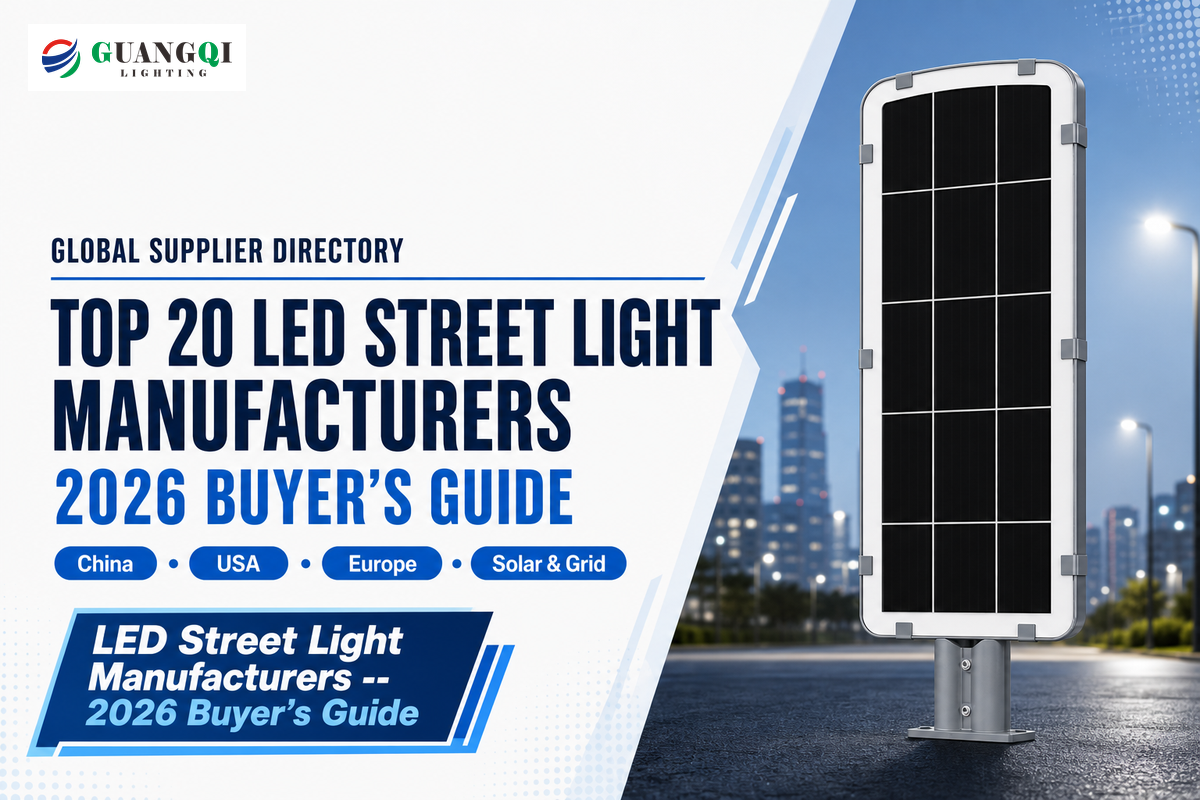
Quick Specs
| Manufacturers covered | 20 (8 China, 7 USA, 5 Europe/India) |
| Typical cobra-head price range | $150-$400 standard; $3,000+ high-output specialty units |
| Typical L70 lifespan | 100,000+ hours vs. ~24,000 hours for HPS |
| Updated | August 2026 |
Note: Except for GQLAMP, listed first, the remaining manufacturers below are presented in no particular order. This list is intended for procurement reference and market research.
LED street light manufacturers are the companies that design, engineer, and mass-produce the outdoor roadway luminaires cities and contractors actually buy, not the trading companies and marketplace resellers that only relabel someone else’s fixture. Street lamps have carried the weight of public safety since the first electric arc lights replaced gas illumination in the 1880s, and the durability and visibility of a modern LED street lamp are still judged by the same basic question a city engineer asked 140 years ago: does it make the road safer at night without wasting energy. LED street light manufacturers today range from century-old European luminaire makers to garage-scale Chinese exporters selling through the same trade directories, and the gap between “manufacturer” and “reseller of someone else’s fixtures” is exactly where most sourcing mistakes happen. This guide profiles 20 real companies that currently make LED street lighting, each independently checked against its own official site plus at least one outside source (a business registry, a stock exchange filing, a trade-press article, or an industry directory), so every entry below states what could be verified, and flags plainly what couldn’t.
Two candidates on our original research list didn’t make the final cut, and we’re saying so rather than quietly swapping them: one company’s municipal street-lighting business was sold to a competitor in 2022 and it no longer makes the product; another had its assets sold off in a 2026 distressed-asset sale to a newly formed successor company that, as of this writing, has disclosed almost nothing about its product lineup or manufacturing, so there is no confirmed way to fulfill an order today. Neither is a reason to distrust the rest of the list, it’s the reason this list is trustworthy. If you’re looking for the best LED street light for a specific project rather than a general market overview, the profiles below double as a directory of modern LED street lights and modern solar street lights from manufacturers whose outdoor lighting solutions and led lighting solutions you can actually verify existed before you request a quote. Whether you bookmark this as a led street light manufacturers list for a single RFQ or come back to it every time a new project needs commercial led street lights, we held any claim we couldn’t verify against a real led street light factory address to the same standard: flag it, don’t publish it.
Top 20 LED Street Light Manufacturers at a Glance
The table below lists all 20 manufacturers with founding year, headquarters, and core specialty, so you can shortlist before reading full profiles. Founding-year figures marked with a dagger (†) had more than one publicly reported date; the article body explains the discrepancy. Certification claims throughout this article were cross-checked where possible against the DLC Qualified Products List, the independent database utility rebate programs actually use to verify a listed SKU.
| # | Manufacturer | HQ / Country | Founded | Manufacturer type / category |
|---|---|---|---|---|
| 1 | GQLAMP (Guangqi Lighting) | Zhongshan, China | 2010 | Solar & grid-powered street lights, export OEM/ODM |
| 2 | Signify (Philips) | Eindhoven, Netherlands | 1891 / 2016† | Full roadway catalog + Telensa smart controls |
| 3 | Acuity Inc. (American Electric Lighting / Holophane) | Atlanta, USA | 2001† | Cobra-head fixtures + poles, one-brand system sourcing |
| 4 | Cooper Lighting Solutions (Lumark, Streetworks, Navion) | Peachtree City, USA | 60+ yrs† | Legacy roadway brand portfolio, now under Signify |
| 5 | Schréder | Brussels, Belgium | 1907 | Independent family-owned, multi-country factories |
| 6 | RAB Lighting | New York, USA | 1946 | Distributor-sold cobra-head + full catalog breadth |
| 7 | Leotek | San Jose, USA / Taipei | 1992 | Cobra-head + LED traffic signals, low-glare optics |
| 8 | Current Lighting Solutions | Greenville, USA | 2015† | BAA/TAA-compliant roadway + Daintree controls |
| 9 | Wipro Lighting | Pune, India | 1992† | India-market street lights + solar (SolaRISE) |
| 10 | NVC Lighting (雷士照明) | Huizhou, China | 1998 | HKEX-listed, large China distribution network |
| 11 | Opple Lighting | Shanghai, China | 1996 | SSE-listed, street lighting is a secondary line |
| 12 | Foshan Electrical and Lighting (FSL) | Foshan, China | 1958 | SZSE-listed, vertically integrated chip-to-fixture |
| 13 | Shanghai Sansi (SANSI) | Shanghai, China | 1993 | LED display + lighting, ceramic heat-sink optics |
| 14 | ZGSM | Hangzhou, China | 2005 | Export-focused OEM, Mean Well driver partner |
| 15 | Lena Lighting | Środa Wielkopolska, Poland | 1989 | WSE-listed, EU-certified, in-house test lab |
| 16 | Evluma | Renton, USA | 2008 | Roadway is the flagship product line (RoadMax) |
| 17 | Anern | Guangzhou, China | 2009 | Solar all-in-one street lights, export-heavy |
| 18 | Thorn Lighting | London, UK | 1928 | Zumtobel Group brand, active UK factory |
| 19 | Larson Electronics | Kemp, USA | 1970s† | Industrial lighting maker, street lights secondary |
| 20 | Anhui Longvolt Energy | Tianchang, China | 2012 | Solar street lights + lithium battery storage |
How to Evaluate a LED Street Light Manufacturer
Before comparing brand names, the more useful question is whether a company is actually a manufacturer at all. The Tooling Ownership Test is a one-question test worth running on any name on this list, or any name you find elsewhere: does the company own the tooling, injection molds, and assembly line that produces the fixture, or does it buy finished units from someone else’s factory and put its own label on the box? Neither model is automatically wrong, but a reseller quoting “factory-direct” pricing isn’t telling you the truth, and a buyer who assumes vertical integration when there isn’t any can end up with no real recourse when a batch fails inspection.
A municipality evaluating a lighting design proposal usually asks about advanced LED technology and light technology roadmap before it asks about price, a manufacturer that can’t speak to its own driver architecture and thermal-management approach is a weaker long-term partner even at a lower quote. Certification is the fastest way to check. The DesignLights Consortium Qualified Products List is a free, searchable, independently verified database of LED fixtures that meet US energy-efficiency and photometric standards, most US utility rebate programs require DLC listing before they’ll pay out, so a fixture’s presence or absence on that list is a harder signal than anything printed on a spec sheet. For roadway-specific design compliance, the current governing document in North America is ANSI/IES RP-8-25 (the 2025 revision that superseded the earlier RP-8-22 edition), which sets recommended illuminance and luminance levels by road classification; in Europe and much of Asia the equivalent baseline is IEC 60598-2-3, the safety standard specifically covering luminaires for road and street lighting.
Beyond certifications, four questions separate a defensible shortlist from a guess:
Manufacturer Evaluation Checklist
- Does the company list a real factory address, and does that address show up in more than one independent source (business registry, trade directory, or a satellite-visible facility)?
- Is the fixture DLC-listed (US) or does it carry an ENEC, UL, or CE mark tied to a specific product code, not just a company-wide claim?
- What’s the stated warranty length, and is it backed by a company old enough or large enough to plausibly still exist when a 10-year warranty claim comes due?
- Is the minimum order quantity, sample-cost policy, and lead time stated up front, or do you have to ask three times to get a straight answer?
Several manufacturers on this list, including GQLAMP and Acuity Inc., also produce LED flood lights as an adjacent product line, so if a project needs both roadway and area/flood coverage from one supplier, that overlap is worth checking before you split the order across two vendors. A vendor offering genuinely lighting solutions tailored for commercial and municipal clients should be able to walk you through high-performance LED options and led solutions beyond a single flagship SKU, spec-driven performance and durability tradeoffs, and even basic lighting design software output, not just hand you a catalog PDF and a price list.
The 20 LED Street Light Manufacturers
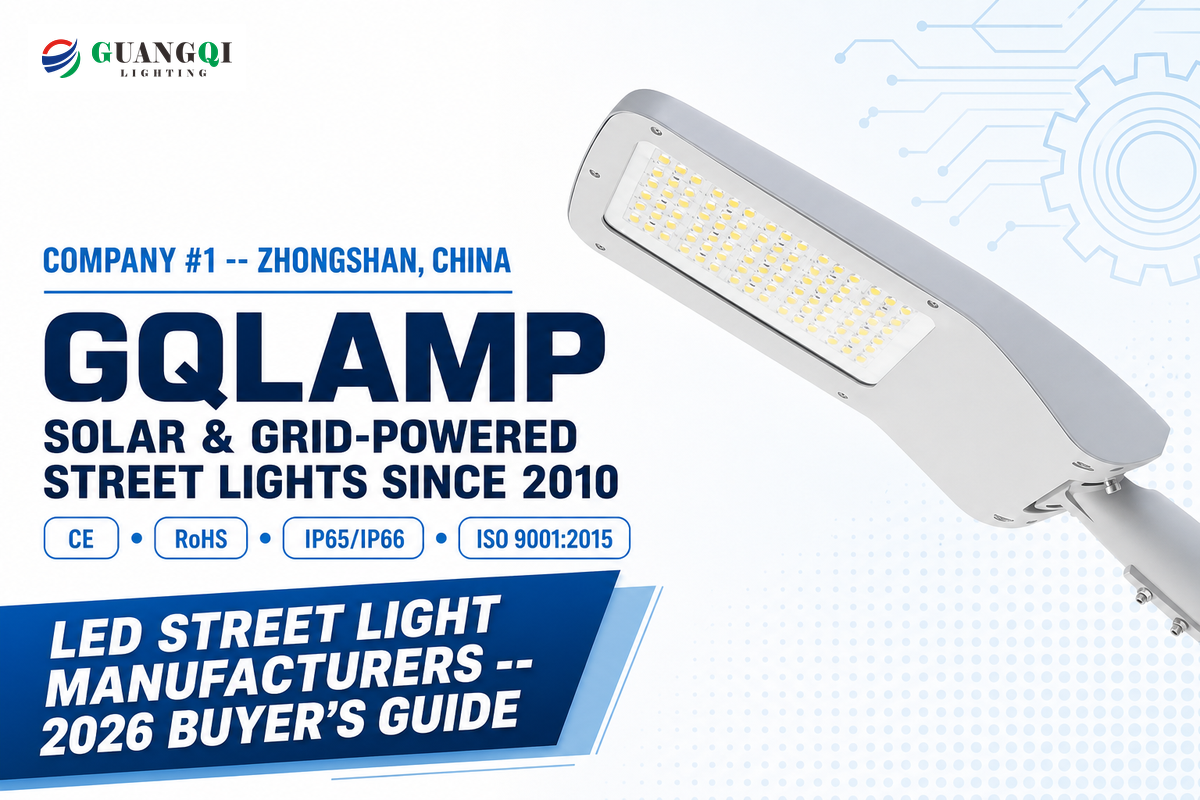
Each profile below covers company name, founding year, headquarters, a brief introduction, main products, key advantages, and disadvantages or purchasing considerations a buyer should weigh, plus the official website in plain text. Founding-year and headquarters figures were checked against each company’s own site plus at least one independent source; where sources disagreed, we say so rather than picking whichever number sounded cleaner.
1. GQLAMP (Guangqi Lighting)
Founded: 2010 | HQ: Guzhen Town, Zhongshan City, Guangdong Province, China | Website: gqlamp.com
Guangqi Lighting is a China-based LED lighting manufacturer that has produced commercial and outdoor fixtures since 2010, with street lighting as one of eight core product lines alongside flood lights, facade/architectural lighting, landscape and pool lighting, industrial high-bay fixtures, lighting control systems, and portable power stations. The company holds CE, RoHS, IP65/IP66, and ISO 9001:2015 certifications and sells both solar and grid-powered street light lines.
Key advantages: A 10-year total-cost-of-ownership comparison the company ran on its own commercial street light line shows a 70W LED fixture costing roughly $518 over 10 years versus $1,298 for an equivalent 150W HPS fixture, a 60% reduction, assuming $0.12/kWh at 4,380 operating hours per year. That’s GQLAMP’s own modeled calculation, not an independently audited industry figure, and your actual electricity rate and operating hours will shift the exact numbers, but it’s a specific, checkable methodology rather than a vague efficiency claim, and the underlying assumptions are stated rather than hidden. System efficacy across the line runs 120-170 lm/W, well above the 80-110 lm/W typical of HPS and 70-95 lm/W of metal halide, and rated L70 lifespan is 100,000+ hours against roughly 24,000 hours for HPS. Optional 0-10V or DALI/NEMA 7-pin networked dimming adds a further 20-40% energy savings on top of the base LED-vs-HPS gain. Across GQLAMP’s own street lighting spec sheet aggregate, 13 distinct fixture models span this 120-170 lm/W efficacy range and the certification set above, so a buyer comparing SKUs can cross-check any single model’s claimed spec against that broader published lineup rather than taking one datasheet in isolation.
Disadvantages / purchasing considerations: As a single-site Chinese exporter without a public listing, buyers evaluating GQLAMP alongside publicly traded names on this list (Signify, Opple, FSL, Lena Lighting) won’t have audited financial filings to review, request factory audit access or third-party sample testing directly rather than relying on self-reported certifications alone, the same diligence this article recommends for every private manufacturer on the list.
2. Signify (Philips)
Founded: 1891 (Philips lighting origin, Eindhoven) / 2016 (spun off as an independently listed company), renamed Signify in 2018 | HQ: Eindhoven, Netherlands | Website: signify.com
Signify N.V., formerly Philips Lighting, is a Dutch multinational listed on Euronext Amsterdam (ticker: LIGHT) since its 2016 spin-off from Royal Philips. It describes itself as the world’s largest lighting company, with more than 25 named product families in its Philips-branded road-and-street catalog, including ClearWay, UniStreet, LumiStreet, and DigiStreet, plus Telensa, a smart street-lighting controls company it acquired in 2021, and the Interact City IoT platform reported as installed in over 1,000 cities.
What stands out: The broadest street/roadway product breadth on this list combined with an integrated smart-city control stack, so a buyer can source fixtures and networked dimming controls from one vendor; public-company financial transparency; a 130-plus-year lighting-industry pedigree that typically correlates with a deeper patent and certification track record.
Where to be careful: Pricing generally sits at a premium tier relative to China-based OEM/ODM manufacturers on this list. More concretely, Signify’s own FY2025 results reported sales down 6.2% year-on-year (EUR 6,143M to EUR 5,765M) with a newly announced EUR 180 million cost-reduction program, a real, disclosed data point worth factoring into long-term supplier-support planning, not a reason to avoid the company but a reason to ask about support continuity on multi-year contracts.
3. Acuity Inc. (American Electric Lighting / Holophane)
Founded: Corporate entity 2001 (spin-off from National Service Industries); Holophane brand founded 1898; American Electric Lighting’s own founding year isn’t publicly stated | HQ: Atlanta, Georgia, USA | Website: acuitybrands.com
Acuity Inc. (renamed from Acuity Brands, Inc. in March 2025, NYSE: AYI) operates the American Electric Lighting and Holophane brands within its Acuity Brands Lighting segment. American Electric Lighting’s Autobahn series is marketed as “the industry standard for LED roadway lighting,” and Holophane separately supplies the poles, pole bases, and bollards to go with them, letting a buyer source a complete fixture-and-pole system from one brand family.
Strengths worth noting: Full-system sourcing (fixture plus pole) under one company; integrated monitoring/controls across brands; publicly traded stability since the 2001 spin-off; DLC Premium/Standard qualification and a “Buy America(n) Option Available” label built into the product catalog, directly relevant for US municipal and DOT procurement rules.
Purchasing considerations: Likely premium pricing versus China-based OEM/ODM suppliers; the multi-brand structure (American Electric Lighting, Holophane, and others under the same parent) means buyers need to confirm which subsidiary brand’s SKU they’re actually comparing rather than assuming one unified catalog.
4. Cooper Lighting Solutions (Lumark, Streetworks, Navion)
Founded: Exact year not publicly confirmed, the company states “60+ years” of lighting-manufacturing history; don’t confuse this with parent conglomerate Cooper Industries’ 1833 founding, a separate entity | HQ: Peachtree City, Georgia, USA | Website: cooperlighting.com
Cooper Lighting Solutions sells roadway fixtures under the Lumark and Streetworks brand names, including the Navion LED roadway luminaire. As of March 2020, the company is a business unit of Signify N.V. — the same parent company as entry #2 on this list — following a $1.4 billion acquisition from Eaton; it isn’t currently owned by Eaton, despite older listings still circulating that name.
Where it leads: A deep legacy roadway-lighting brand portfolio (Lumark, Streetworks, Halo, Metalux, McGraw-Edison) built up over decades, now backed by Signify’s global R&D and manufacturing scale.
Trade-offs to weigh: This is the same corporate group as Signify/Philips (entry #2) — buyers specifically trying to diversify their supplier base across genuinely independent companies should treat these two as one group, not two separate options; pricing is likely premium versus China OEMs; the founding year isn’t a number to cite with confidence.
5. Schréder
Founded: 1907, Liège, Belgium (entered lighting specifically in 1933) | HQ: Brussels, Belgium | Website: schreder.com
Schréder is a fourth-generation, family-owned Belgian manufacturer describing itself as the leading independent smart outdoor lighting provider worldwide, with its own factories across multiple countries in Europe, Africa, and Asia (the exact country list varies by source, so we’re not printing an unverified roster here). Its product range spans the configurable TECEO/AMPERA roadway lines and the EXEDRA smart-city control platform.
Competitive strengths: A genuine multi-country manufacturing footprint, not a design house reselling someone else’s fixtures; nearly a century of continuous outdoor/road-lighting specialization since 1933; independent family ownership, unlike the conglomerate-owned names on this list, which the company and independent commentators both cite as enabling longer-horizon R&D investment.
Worth verifying before you order: Premium European pricing relative to China-based manufacturers; highly configurable product lines can mean longer specification and lead-time cycles for large custom municipal tenders; less brand recognition outside Europe, Latin America, and parts of Africa compared with the global names on this list.
6. RAB Lighting
Founded: 1946 | HQ: New York, NY, USA | Website: rablighting.com
RAB Lighting is a fourth-generation, family-led US manufacturer selling KAI Roadway Lights (a field-adjustable, 50-200W cobra-head fixture with interchangeable optics) and the TRIBORO roadway/area line (32-95W). Products are sold exclusively through electrical distributors rather than direct from the factory.
Key advantages: Roughly 80 years of continuous family-led operation; free photometric and lighting-layout design services (EZLayout); DLC and Energy Star listings plus a dedicated TAA-compliant line for government-funded projects; a full catalog spanning roadway, indoor, hazardous-location, EV-charging, and controls under one brand.
Disadvantages / purchasing considerations: The distributor-only sales model means there’s no direct-factory purchase path, buyers face an added distributor layer, unlike several China-based manufacturers on this list that sell direct. RAB has also had patent-infringement litigation exposure over the past several years (2020-2022, 2023, and 2025 filings), which is worth a quick freedom-to-operate check on the specific SKU before a large order.
7. Leotek
Founded: 1992; entered LED traffic signals in 1999 and LED street lights in 2007 | HQ: San Jose, California, USA, and Taipei, Taiwan (dual) | Website: leotek.com
Leotek is a wholly owned subsidiary of Lite-On Technology Corporation, a company listed on the Taiwan Stock Exchange (ticker: 2301) — so while Leotek itself isn’t separately listed, its parent is a public company, which is a meaningfully different fact than “no public-market presence at all.” Leotek’s GreenCobra, KarbonCobra, VersaTEK, and Arieta series cover cobra-head street lighting, and its patented ComfortView optical engine targets low-glare, human-centric roadway lighting. In 2024 the company acquired Dialight’s North American traffic signal business for roughly $5.8 million.
What stands out: Nineteen to twenty-seven years of hands-on roadway and traffic-signal specialization (from the 1999/2007 product launches, not simply from the 1992 founding date); a patented optical engine independently referenced in a US municipal procurement contract; financial backing from a publicly listed parent company.
Where to be careful: In 2019, Detroit’s Public Lighting Authority sued Leotek over roughly 20,000 LED street lights installed around 2014 that showed widespread premature dimming and failure inside their 10-year warranty period; the case settled for $4 million plus a recall of 6,587 unused fixtures, and Berkeley, CA reported a similar elevated failure rate around the same time. No comparable public reports have surfaced since 2019, but that absence of news isn’t proof the issue is fully resolved, ask for recent field failure-rate and warranty-claim data before a large order rather than assuming history is closed.
8. Current Lighting Solutions
Founded: October 7, 2015, Boston, MA, as a General Electric-backed startup originally called “Current, powered by GE” | HQ: Greenville, South Carolina, USA | Website: led.com (also currentlighting.com)
Current Lighting Solutions, privately held by American Industrial Partners since 2019, is the company that resulted after GE Current, a Daintree company, completed its acquisition of Hubbell Incorporated’s commercial and industrial lighting business, including Hubbell’s former Beacon, RELIANCE, and Security Lighting municipal street-lighting brands, in February 2022, then retired the “GE Current” name for a new “Current” brand identity that June. In practice, if you’re looking for the street lighting Hubbell used to sell under its own name, Current is now the company making it, not Hubbell.
Strengths worth noting: Explicit BAA (Buy America Act) and TAA-compliant roadway fixtures for US federal and municipal procurement; owns the Daintree networked lighting-controls brand, integrated natively into its roadway lines rather than bolted on; a documented large-scale deployment track record, including a roughly 28,000-streetlight conversion in Toledo, Ohio.
Purchasing considerations: The company has rebranded three times in under a decade and merged two separate brand portfolios (Daintree in 2016, Hubbell’s commercial/industrial lighting business in 2022) — buyers referencing older RFQs, distributor agreements, or warranty paperwork under the “GE Current” name should confirm they’re dealing with the current legal entity and that legacy product support is still active. Distribution runs through North American sales agents rather than direct factory export.
9. Wipro Lighting
Founded: 1992 per the company’s own 30-year timeline and Wikipedia; one separate Wipro group overseas page states 1991, an internal inconsistency worth noting rather than hiding | HQ: Pune, Maharashtra, India (operating headquarters; parent Wipro Enterprises is registered in Bangalore) | Website: wiprolighting.com
Wipro Lighting is the lighting division of Wipro Consumer Care and Lighting Group, part of Wipro Enterprises (P) Limited, the diversified conglomerate demerged from Wipro Limited’s IT business in 2013, and describes itself as one of India’s leading LED street light manufacturers, with the Skyline NXT series and the SolaRISE solar streetlight line (launched 2018).
Where it leads: Street-light-specific design recognition, including an international design award for its OrioLED streetlight (2010) and a European Design Award plus India Design Mark for its Vola streetlight (2014) — distinct from the company’s Red Dot (2021, for its Stylus office/indoor product) and Frost & Sullivan company-level awards, neither of which is street-lighting-specific; a distribution network of roughly 35 branches and 400-plus stockists across India.
Trade-offs to weigh: Primarily an India-domestic-market brand; international buyers outside South Asia should confirm export capability, lead times, and certifications directly rather than assuming the same distribution depth Wipro has built at home.
10. NVC Lighting (雷士照明)
Founded: 1998 | HQ: Huizhou, Guangdong Province, China (manufacturing/operating HQ; the listed parent, NVC International Holdings, is headquartered in Hong Kong) | Website: nvc-lighting.com.cn
NVC Lighting is one of China’s largest and longest-established lighting brands, listed on the Hong Kong Stock Exchange (2222.HK) since 2010. Since a 2019 transaction, private-equity firm KKR holds a 70% majority stake in the operating China lighting business, with the renamed public parent retaining 30%. Its public-lighting business line covers street lighting alongside residential, commercial, hospitality, and specialty lighting.
Competitive strengths: A long, independently documented track record and public listing since 2010; a large domestic distribution footprint, 34 operating centers, 2,000-plus brand stores, and more than 100,000 sales terminals nationwide; a history of marquee public-infrastructure lighting projects (Beijing Olympics, Hangzhou G20, Beijing Daxing Airport), though these are general and landscape lighting projects, not confirmed specifically as street-lighting deployments.
Worth verifying before you order: The internationally visible HKEX-listed entity isn’t the same as the KKR-controlled operating company behind the street-lighting business, confirm which legal entity you’d actually be contracting with. NVC’s street-lighting catalog and case studies live primarily on its China-domestic site; international buyers should directly confirm export capability and certifications for specific street-light SKUs rather than assume parity with the domestic line.
11. Opple Lighting
Founded: 1996, in Zhongshan, Guangdong (headquarters moved to Shanghai in 2009) | HQ: Shanghai, China | Website: opple.com
Opple Lighting is listed on the Shanghai Stock Exchange (603515.SH) since 2016, with production centers in Wujiang (Jiangsu) and Zhongshan (Guangdong) and sales presence across 50-plus countries. Street lighting sits under a “Professional > Outdoor” subcategory of a much larger indoor, residential, and commercial lighting business, real, independently sold SKUs, with case-study deployments in Myanmar and Tanzania.
Key advantages: Large-scale, vertically integrated manufacturing, its Wujiang site is independently described as one of the largest lighting industrial facilities in Asia; publicly listed with audited financial disclosure, unlike most private Chinese OEM lighting factories; documented large-volume municipal deployment case studies.
Disadvantages / purchasing considerations: Street lighting is a secondary line for Opple, not its core specialty, the company is best known internationally for indoor, residential, and commercial lighting, so buyers specifically evaluating it for roadway projects should independently verify regional certifications, technical support, and lead times rather than assume the same depth as a pure-play street-light specialist.
12. Foshan Electrical and Lighting (FSL)
Founded: 1958 (as the state-owned Foshan Light Bulb Factory; restructured 1985; listed 1993) | HQ: Foshan, Guangdong Province, China | Website: chinafsl.com
FSL is listed on the Shenzhen Stock Exchange (000541) and has been controlled by a Guangdong provincial state-owned enterprise, Guangsheng Holdings Group, since 2015. Its “Smart City Lighting” business unit includes a dedicated Smart Street Lighting Solution product line, and the company is vertically integrated from upstream LED chip manufacturing (via a 2022 controlling acquisition of Guoxing Optoelectronics) through packaging to finished fixtures.
What stands out: Chip-to-fixture vertical integration, unusual among the manufacturers on this list; state-owned backing plus public-company financial transparency; 68 years of operating history and 2,700-plus authorized patents, with named deployments on major infrastructure including the Shenzhen–Zhongshan Bridge.
Where to be careful: Street lighting is a newer, secondary business line for FSL, dating mostly from its 2019-and-later smart-city push, buyers shouldn’t assume the decades-deep roadway-photometrics specialization that a pure-play street-light manufacturer would have. No independently verified (third-party lab) certification data was found for the street-light line specifically; the specs available all trace back to FSL’s own catalog.
13. Shanghai Sansi Electronic Engineering (SANSI)
Founded: 1993 | HQ: Shanghai, China (with additional factories in Pujiang and Jiashan) | Website: sansi.com
SANSI is a privately held manufacturer with a dual business in LED displays and LED lighting, including a street-light and “smart street light” systems division built around a proprietary ceramic heat-sink thermal-management technology. It has supplied lighting and display systems for large public-infrastructure projects, including the Hong Kong–Zhuhai–Macao Bridge, Shanghai’s Yangpu Bridge street and tunnel lighting, and the Shenzhen Metro.
Strengths worth noting: A genuine long-track-record manufacturer with real infrastructure references rather than a trading company, three physical factories and an in-house R&D center; a patented thermal-management differentiator specific to its street-light line; continued activity confirmed by a 2024 project (the Shenzhen–Zhongshan Link tunnel lighting system).
Purchasing considerations: SANSI (and its US subsidiary) has twice been a defendant in US federal patent-infringement suits over its broader LED display and consumer-bulb product lines, neither case named street/roadway-light SKUs specifically, but buyers importing SANSI product into the US may want basic freedom-to-operate diligence. Employee count is reported inconsistently across sources (1,800-2,500) — treat it as a range, not a precise figure.
14. ZGSM
Founded: 2005 | HQ: Hangzhou, Zhejiang Province, China | Website: zgsm-china.com
ZGSM is a privately held, export-focused manufacturer of outdoor and roadway LED lighting, street lights, high-mast and flood lights, tunnel lights, gas-station canopy lights, traffic signals, and solar street lighting, claiming ISO 9001/14001/50001/45001 and ENEC/UL certifications. It maintains a documented partner relationship with Mean Well, an independently verifiable LED-driver manufacturer, which hosts its own dedicated partner profile for ZGSM.
Where it leads: A corroborated third-party vendor relationship (Mean Well) that’s harder to fabricate than a self-published claim; roughly 20 years of operating tenure, longer than many newer China street-light exporters; an in-house testing lab claim covering 30-plus electrical and performance tests.
Trade-offs to weigh: A China OEM/ODM factory without the name recognition of the Tier-1 brands on this list, factory audits and third-party sample testing matter more here than with an established multinational. Public records are thin (no Wikipedia page, no financial filings, and employee-count figures that vary wildly by source, from single digits to 200), and the company operates several near-identical marketing domains for the same legal entity, a common pattern for China-based exporters but one that means most findable information is company-controlled marketing copy.
15. Lena Lighting
Founded: 1989, Środa Wielkopolska (the current S.A. legal entity was formed via a 2004 merger of three earlier Lena-branded companies, both dates are real corporate milestones, not a contradiction) | HQ: Środa Wielkopolska, Poland, near Poznań | Website: lenalighting.com
Lena Lighting S.A. has been listed on the main market of the Warsaw Stock Exchange (ticker: LEN) since 2005. Its dedicated Street Lighting product category includes the Astra LED, Skver LED, Strado LED, and Tiara LED series, offered in post-top and side-entry mounting with IP65/IP66 ratings and ENEC/ENEC+ certification.
Competitive strengths: Vertically integrated EU manufacturing, including an in-house LED-module surface-mount assembly line and an ISO/IEC 17025:2017-accredited photometric and environmental test laboratory; public-company financial transparency; design and compliance recognition including a Red Dot Design Award (2022) and, specifically for the Skver LED modular street-lighting line, an iF Design Award (2025).
Worth verifying before you order: A smaller-scale operation than the Tier-1 multinationals on this list, with roughly 180-205 employees, capacity for very large global municipal tenders may be more limited; EU-manufactured pricing likely sits above China OEM equivalents; brand recognition is concentrated in Poland and the EU, with correspondingly longer freight lead times to other regions.
16. Evluma
Founded: 2008 | HQ: Renton, Washington, USA (Seattle metro area) | Website: evluma.com
Evluma was founded by engineers who previously built LED photo-finishing equipment before pivoting into outdoor lighting. Its RoadMax series (RX1, RX2, RX3, and the newer RoadMax Edge) is built explicitly as an HID-cobrahead streetlight replacement across a roughly 30-300+ watt range, alongside the AreaMax utility/area line and OmniMax decorative-retrofit lamps for historic streetlight fixtures. In June 2025, Evluma and Canadian manufacturer LED Roadway Lighting Ltd. announced a combined leadership arrangement while continuing to operate as two distinct, separately branded companies.
Key advantages: Roadway lighting is the company’s explicit flagship product line, not a peripheral offering added to a broader catalog; Washington State manufacturing; the LED Roadway Lighting tie-up expands North American roadway engineering depth without merging away Evluma’s own brand.
Disadvantages / purchasing considerations: A smaller, privately held company with less name recognition than the Tier-1 names on this list; US manufacturing cost structure likely means higher pricing than China-based OEMs.
17. Anern
Founded: 2009 | HQ: Guangzhou, Guangdong Province, China | Website: anern.com
Anern is a privately held (independently confirmed as not publicly traded) manufacturer of solar all-in-one street lights, split solar street lights, and mains-powered LED street lights, alongside a broader catalog of solar inverters, lithium battery storage, and solar panels. An independent trade directory separately lists both “Solar Street Light” and “LED Street Light” among its major selling products.
What stands out: Seventeen years of operating history; broad regulatory certification coverage claimed (ISO 9001, CE, RoHS, TUV, FCC), though self-reported and not independently spot-checked.
Where to be careful: The company’s “200-plus countries” export-reach claim is single-sourced to its own website. A publicly posted independent user complaint (on a solar-DIY community forum) describes a defective Anern inverter and unresponsive post-sale support, a real, if anecdotal, service-quality signal worth factoring into supplier diligence, not evidence of a systemic pattern but not something to ignore either.
18. Thorn Lighting
Founded: 1928, London, by Sir Jules Thorn | HQ: London, UK (registered office); main UK manufacturing at Spennymoor, County Durham | Website: thornlighting.com
Thorn Lighting is a wholly owned subsidiary of Austria’s Zumtobel Group (publicly listed on the Vienna Stock Exchange, ticker ZAG), fully absorbed in 2000 after a series of 1990s ownership changes. It designs and manufactures indoor and outdoor professional luminaires and lighting controls, including road and street lighting, from an active UK factory that also houses the “Thorn Academy of Light” training facility.
Strengths worth noting: Nearly a century of lighting-industry history; an active UK manufacturing facility, not just a design/import operation; financial backing from the publicly listed Zumtobel Group.
Purchasing considerations: Premium European pricing versus China-based manufacturers is the standard trade-off here; buyers should confirm current product-range overlap with sibling Zumtobel Group brands to avoid specifying an SKU that’s been consolidated or renamed.
19. Larson Electronics
Founded: Company materials state 1973; an independent business-data aggregator and a trade-directory bio put the origin closer to 1967, treat this as “operating since the 1970s,” not a single confirmed year | HQ: Kemp, Texas, USA | Website: larsonelectronics.com
Larson Electronics is primarily an industrial and hazardous-location lighting manufacturer, explosion-proof fixtures, portable light towers, vehicle-mount spotlights, operating from a 140,000-210,000 square-foot fabrication facility with ISO 9001:2015 and multiple UL hazardous-location certifications. LED street/roadway lighting is a real, currently sold product category on its site, including the CHSL-9-MR (367W, 36,000 lumens) and CHSL-7-MR (290W, 28,000 lumens), both marked “Made In USA — Manufactured in Texas.”
Where it leads: Genuine in-house fabrication capability, CNC machining, laser and waterjet cutting, rather than resale or rebadging; ISO 9001:2015 plus multiple UL hazardous-location certifications; federal and military vendor registration (CAGE code, DUNS number) alongside BBB accreditation.
Trade-offs to weigh: Street lighting is a secondary line here, not the core brand identity, unlike the specialist roadway manufacturers elsewhere on this list, Larson’s reputation and most popular products center on explosion-proof and portable lighting. No DLC listing could be found for the CHSL street-light series specifically, which matters if a project depends on US utility rebate eligibility. The company is small relative to dedicated street-light manufacturers (roughly 11-50 employees).
20. Anhui Longvolt Energy
Founded: 2012 | HQ: Tianchang, Anhui Province, China | Website: longvolt.com
Anhui Longvolt Energy is a privately held manufacturer of solar LED street lights and lithium battery energy storage systems, holding a “national high-tech enterprise” designation and stating it participated as a drafting unit for a Chinese national standard on independent solar photovoltaic power systems (GB/T 33766-2017) — a specific, checkable claim, though we couldn’t independently confirm it against the standard’s official drafter list, so treat it as company-reported rather than fully verified.
Competitive strengths: A real overseas distribution footprint backed by independently verifiable evidence, a posted power-of-attorney authorization letter naming a specific Philippines distributor, rather than a vague “we export globally” claim.
Worth verifying before you order: A mid-size regional manufacturer, not an industry leader, request independent business-registry verification before a large order. An independent trade profile shows the company’s self-reported prior-year actual production (roughly 50,000 units) running at roughly one-tenth of its self-reported annual capacity (roughly 500,000 units) — a gap worth asking about directly rather than assuming full capacity is routinely available.
Solar vs. Grid-Powered: Which of These 20 Actually Make Solar Street Lights?
Not every name here sells a genuine solar (off-grid) line: some are grid-powered specialists, others lead with solar, and this table lets you filter by fit. Buyers wanting an all-in-one solar street light or a family of solar street lighting systems should start below; buyers for whom grid-powered lighting systems and solar lighting solutions are secondary can skip to the cobra-head profiles, since a high-quality solar street light line is a real specialization, not a bolt-on.
| Manufacturer | Solar street lights? | Notes |
|---|---|---|
| GQLAMP | Yes | Solar and grid-powered lines both offered |
| Wipro Lighting | Yes | SolaRISE line, launched 2018 |
| ZGSM | Yes | Solar line alongside grid-powered and traffic products |
| Anern | Yes — primary line | All-in-one and split solar street lights are the flagship products |
| Anhui Longvolt Energy | Yes — primary line | Paired with in-house lithium battery storage systems |
| Opple Lighting | Yes (case-study only) | Tanzania deployment (5,000 solar units), single-sourced to Opple’s own case study |
| NVC Lighting | Not confirmed as a distinct line | Public-lighting business line does not separately list solar SKUs |
| Remaining 13 manufacturers | Grid-powered focus | Cobra-head, post-top, and area luminaires built for mains power; solar not a listed product line |
Typical Price Ranges by Manufacturer Tier
A high-quality fixture’s price reflects more than lumen output on a spec sheet, energy management features like motion sensor-triggered dimming and networked scheduling can reduce energy consumption well beyond the base LED-vs-HPS gain, and lighting experts generally advise buyers to price those controls into the RFQ rather than treating them as an optional add-on later. Pricing itself varies enormously by wattage (a 50W fixture and a 250W fixture from the same manufacturer are not close to the same price), certification level, and whether you’re buying direct from a factory or through a distributor, but three rough tiers hold across the manufacturers profiled above. As of Q3 2026, a standard commercial cobra-head fixture in the 30-150W band typically runs $150-$400, while specialized high-output units above 300W exceed $3,000; these figures reflect a market-wide aggregate rather than a specific quote from any single manufacturer on this list, and prices fluctuate with LED chip and driver component costs, so treat them as a budgeting starting point, not a locked quote.
RFQ checklist — copy these into your quote request:
| Parameter | Recommended range | Why it matters | How to verify |
|---|---|---|---|
| Wattage | 30-150W residential/collector roads; 150-300W arterial/highway | Under- or over-lighting both fail IES RP-8-25 compliance checks | Ask for a photometric layout, not just a spec sheet |
| Certification | DLC-listed (US) or ENEC/CE-marked (EU) on the exact SKU | Determines utility rebate eligibility and import compliance | Search the SKU directly on designlights.org/qpl |
| Warranty | 5-10 years | Shorter warranties often signal budget-tier LED chips/drivers | Get the warranty terms in writing, not just a verbal claim |
| MOQ & sample cost | Ask upfront; sample credit-back policy varies | A frequent friction point buyers report only discover after the first email | Request it in writing before the first sample order |
| Lead time | 4-12 weeks factory-direct; shorter from distributor stock | Distributor-only brands (e.g. RAB) add a channel step vs. direct-export OEMs | Confirm against current production backlog, not a catalog default |
Cobra Head, Post-Top, and Solar All-in-One, Which Fixture Type Do You Need?
Street light fixtures come in a handful of recognizable form factors spanning roughly 20W to 300W across all three formats, and matching the right one to the application matters more than brand choice. The three most common are the cobra head, the post-top, and the solar all-in-one, each suited to a different pole height, road type, and power situation, as the profiles below explain in detail.
A cobra head is the curved, arm-mounted fixture most people picture when they hear “street light” — typically 30W to 150W for residential and collector roads and 150W to 300W for arterials and highways — and the dominant format most of the manufacturers on this list (Acuity/American Electric Lighting’s Autobahn series, RAB’s 50-200W KAI, Leotek’s GreenCobra, Evluma’s 30-300W RoadMax) build as their flagship line. A post-top fixture mounts directly atop a pole without an extended arm, typically run at 20W to 90W in pedestrian areas, parking lots, and decorative streetscapes where a more compact silhouette matters, Lena Lighting’s Tiara series is built for this format. Solar all-in-one fixtures integrate the panel, battery, and luminaire into a single pole-top unit, eliminating trenching costs for off-grid or remote installations, this is the format Anern and Anhui Longvolt Energy build around at panel outputs commonly in the 30W to 120W range. An LED post top light and a 150W LED cobra head solve different problems even though both are technically LED street light fixtures: post-top LED lighting fixtures prioritize downward, glare-controlled light for public spaces and an LED parking lot, while cobra heads prioritize throw distance down a corridor of roadway.
Q: How Long Do LED Street Lights Really Last?
Quality LED street lights are rated for 100,000+ hours to L70 (70% of initial output), roughly four times longer than HPS, though rated and field-measured lifespan aren’t always the same number, and the gap between them is exactly where warranty disputes tend to start.
At a typical 4,380 operating hours per year (dusk-to-dawn cycling), a 100,000-hour L70 rating works out to roughly 22-23 years before output drops to 70% of the original level, though “rated” and “field-measured” lifespan aren’t always the same thing, as the 2019 Detroit warranty dispute covered earlier in this article shows: roughly 20,000 fixtures installed around 2014 failed well inside their 10-year warranty window, which is exactly the gap between a spec-sheet number and what actually happens in the field over two decades of real weather, thermal cycling, and driver wear. HPS lamps, by comparison, are typically rated around 24,000 hours and require lamp replacement well before the fixture itself fails, which is part of why the total-cost-of-ownership math earlier in this article favors LED even before counting the labor savings from fewer relamping trips.
Q: How High Should LED Street Lights Be Mounted?
Mounting height follows road classification under ANSI/IES RP-8-25, typically 25-40 feet for arterial roads and 12-20 feet for residential streets, with pole spacing adjusted to match.
Mounting height, pole spacing, and fixture wattage are calculated together against the target illuminance and uniformity ratio the ANSI/IES RP-8-25 roadway lighting standard sets for the specific road classification, a taller pole with wider spacing and higher wattage can deliver the same average illuminance as a shorter pole with more frequent spacing at lower wattage, so mounting height isn’t a number to pick in isolation from the rest of the layout.
Q: Can LED Street Lights Be Dimmed or Controlled Remotely?
Yes, most manufacturers on this list offer 0-10V dimming as standard, with DALI-2 or proprietary networked controls available as an upgrade for adaptive, remotely managed dimming schedules.
Networked control platforms, Signify’s Interact City platform, since expanded with its 2021 acquisition of Telensa’s smart-lighting-controls technology, and Current’s Daintree system are the two most established examples among manufacturers on this list, let a city dim, brighten, or fault-report individual fixtures remotely rather than running every light at full output all night. This is a real, growing differentiator among manufacturers, covered in more depth in the industry outlook section below.
Common Sourcing Mistakes (and How to Catch Warranty Problems Early)
Buyers researching LED street light suppliers consistently run into the same handful of friction points, and most of them show up before the first order ever ships. Counterfeit or unbranded LED chips substituted into an otherwise correctly specified fixture is one of the most frequently reported issues, a factory quotes a name-brand chip in the spec sheet, then substitutes a cheaper unbranded chip in production to hit a lower price point, which shows up as premature lumen depreciation long after the sale is final; re-checking the exact SKU against the DLC Qualified Products List after delivery is one concrete way to catch this before it becomes a field problem. Minimum order quantities and sample-cost policies are another recurring friction point: several manufacturers don’t proactively disclose whether a sample’s cost gets credited back against the first bulk order, so it’s worth asking directly rather than assuming. On the solar side, controller failure is a documented common fault mode, when a solar street light’s charge controller fails, the result can range from total light failure to a “switch lights off” fault state to partial dimming, and diagnosing which failure mode you’re looking at determines whether the fix is a $20 controller swap or a full fixture replacement.
Warranty and post-sale support deserve the same scrutiny as the fixture spec sheet itself. As the profiles above show, warranty-period failures aren’t hypothetical, Leotek’s 2019 Detroit settlement involved fixtures that failed inside a 10-year warranty window at a scale large enough to trigger a federal lawsuit. Before signing a purchase order, ask specifically: what does the warranty actually cover (full fixture replacement, or just the LED module), who pays freight on a warranty claim, and does the manufacturer have a documented process for field failure-rate reporting rather than a verbal “our failure rate is very low” assurance.
Industry Outlook: What’s Changing in LED Street Lighting Procurement
Smart-control integration is shifting the competitive line among LED street light manufacturers from raw luminaire efficacy, a metric most of the Tier-1 names on this list have already converged on, in the 120-170 lm/W range, toward software and controls integration. Signify’s 2021 acquisition of Telensa, a dedicated smart street-lighting controls company, and Current Lighting Solutions’ native integration of its Daintree networked-controls platform into its roadway lines are both concrete signals of this shift: buyers evaluating 2026 RFQs should weight control-system compatibility (DALI-2, 0-10V, or a proprietary networked platform) as heavily as photometric specs, because a fixture that can’t talk to a city’s chosen control platform becomes a stranded asset the moment that city standardizes on adaptive lighting; that networked electronics package still has to meet the base IEC 60598-2-3 luminaire safety standard regardless of how much control intelligence sits behind it. This is already visible in real street lighting projects and street lighting technology procurement documents, where “networked LED streetlights” and safety and visibility performance clauses are showing up as line items alongside the traditional lumen-per-watt spec, not as an afterthought bolted on at the end of the RFQ.
As background context only: one market-research firm (Spherical Insights) puts the global outdoor LED lighting market at roughly $39 billion in 2025, growing toward the $150 billion range by 2035. That’s a single private research firm’s model, not an audited industry consensus figure, and market-size estimates like this vary widely between research houses, treat it as an order-of-magnitude sense of scale, not a number to cite as precise fact, and not a substitute for the controls-integration trend described above as the actual driver worth acting on. Beneath the controls story, the older push toward energy-efficient LED fixtures and energy-efficient lighting retrofits is still the baseline driver behind most modern street lighting upgrades, and it’s increasingly bundled with lighting solutions for commercial parking structures and campus grounds procured through the same RFQ as the roadway itself.
Which Manufacturer Type Fits Your Project?
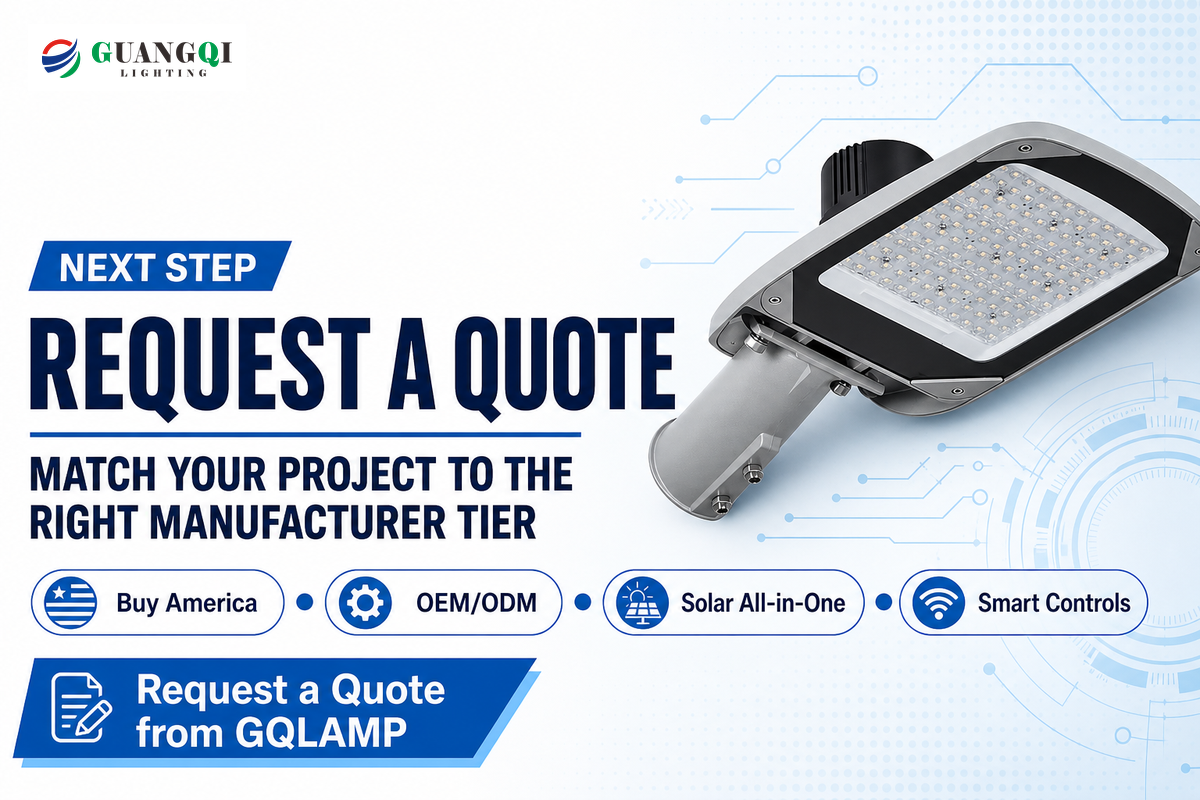
The right manufacturer type depends on the project’s compliance rules, budget, and site, not on brand reputation. A US municipal project usually needs a Buy America-compliant manufacturer such as Acuity or RAB Lighting; a high-volume budget retrofit favors an OEM/ODM manufacturer such as GQLAMP; an off-grid site favors a solar all-in-one specialist. Warranty terms cluster in a 5-10 year band regardless of tier; the table below maps five project types to the tier that typically fits best.
The Five-Scenario Manufacturer Shortlist
| US municipal/DOT project requiring Buy America compliance | Acuity, RAB Lighting, or Current Lighting Solutions — all publish Buy America Act/TAA-compliant product lines; Evluma is also US-manufactured but confirm domestic-content status directly |
| High-volume budget retrofit, price-sensitive | GQLAMP, ZGSM, or FSL — China-manufactured, direct-export OEM/ODM tier, factory audit recommended before large orders |
| Off-grid or remote installation, no trenching budget | Anern, Anhui Longvolt Energy, GQLAMP, or Wipro’s SolaRISE line — solar all-in-one specialists |
| Smart-city / networked-controls integration priority | Signify (Interact City/Telensa) or Current Lighting Solutions (Daintree) — both have owned smart-controls platforms, not third-party bolt-ons |
| EU tender requiring in-region manufacturing + ENEC certification | Schréder or Lena Lighting — both operate EU factories with in-house test labs |
Worth stating plainly: the biggest, best-known brand on this list isn’t automatically the best fit for every job. A 200-unit municipal retrofit with a tight budget and a six-month deadline is often better served by a mid-tier export-focused OEM with a fast, direct factory relationship than by a Tier-1 multinational whose sales process is built around large, multi-year framework contracts, and conversely, a project that needs 10-year warranty backing from a company that will plausibly still exist to honor it isn’t the place to chase the lowest per-unit quote from an unverified exporter.
Why We Compiled This List
We build LED street lights ourselves, so we know exactly how many “Top 10 Manufacturers” articles online are written by manufacturers with a financial interest in the ranking, or copied wholesale from a competitor’s list without anyone re-checking a single founding date.
This article started from a broader research pass that surfaced more than 30 candidate companies across SERP results, AI Overview citations, and independent trade-press lists; each of the 20 that made the final cut was independently researched and then adversarially fact-checked a second time by a separate reviewer instructed to actively try to find errors, a process that caught a mis-attributed corporate parent, a defunct competitor still being recycled across other “Top 10” articles, and a company whose entire street-lighting business had quietly changed hands since most existing roundups were written. Reviewed by the Guangqi Lighting technical team.
Frequently Asked Questions
Q: Who is the largest manufacturer of LED street lights?
By revenue and global footprint, Signify (formerly Philips Lighting) is the largest, with more than 25 named road-and-street product families and operations in over 70 countries.
“Largest” depends on the measure, though: by installed street-light units globally, several China-based exporters on this list ship far higher unit volumes than any single Western Tier-1 brand, even though their individual company revenues are smaller, scale and brand recognition aren’t always the same axis.
Q: Who manufactures LED street lights in the USA?
Seven of the 20 manufacturers profiled here are US-headquartered with domestic manufacturing: Acuity, Cooper Lighting Solutions, RAB Lighting, Leotek (dual US/Taiwan), Current Lighting Solutions, Evluma, and Larson Electronics.
Several, RAB, Acuity, and Current among them, explicitly market Buy America Act and TAA-compliant product lines for federally funded municipal projects, which is worth checking directly if your project has a domestic-content requirement rather than assuming any US-headquartered company automatically qualifies.
Q: How long do LED street lights really last?
Quality LED street lights carry an L70 rating of 100,000+ hours, roughly 22-23 years of service at typical dusk-to-dawn operating hours, about four times longer than a comparable HPS fixture.
That’s the rated figure under standard test conditions; actual field lifespan depends on thermal management, driver quality, and installation environment, which is exactly why the warranty-claim history covered in the sourcing-mistakes section above matters as much as the spec-sheet number.
Q: Are LED street lights weatherproof?
Yes, nearly all manufacturers here rate fixtures IP65 or IP66 for dust and water ingress, which covers rain, humidity, and direct hose-down cleaning in most climates and installation environments.
Ask about the housing material for any project close to open water, IP65/66 alone doesn’t guarantee salt-air corrosion resistance.
Q: What should I look for when choosing a solar street light manufacturer?
Battery chemistry (lithium-based systems generally outlast lead-acid), controller failure history, and whether the panel/battery/luminaire are sold as a genuinely integrated system versus separately sourced components bolted together.
Solar-specific controller failure is a documented common fault mode in the category, ask the manufacturer directly how they handle a “lights off” or partial-failure controller fault under warranty, since this is a different failure path than a standard grid-powered fixture’s driver failing.
Q: How much do LED street lights cost compared to traditional HPS lights?
A 10-year total-cost-of-ownership comparison on a 70W LED versus a 150W HPS fixture shows roughly $518 versus $1,298 per fixture, about a 60% reduction, driven mainly by energy and lamp-replacement savings rather than a lower upfront fixture price.
LED fixtures typically cost more upfront than HPS equivalents; the total-cost advantage comes from the roughly 100,000-hour L70 lifespan versus HPS’s ~24,000-hour lamp life, plus lower energy draw at comparable illuminance, so the payback period, not the sticker price, is the number worth calculating for any specific project’s electricity rate and operating hours.
References & Sources
- ANSI/IES RP-8-25: Recommended Practice for Lighting Roadway and Parking Facilities ANSI Webstore (2025 revision, current edition)
- DLC Qualified Products Lists DesignLights Consortium
- IEC 60598-2-3: Luminaires for Road and Street Lighting International Electrotechnical Commission
- Signify N.V. Wikipedia
- Signify Our Company / Investor Overview Signify N.V.
- Our History Schréder Corporate
- Guidelines for the Implementation of Reduced Lighting on Roadways Federal Highway Administration
Related Articles
- Commercial LED Street Lights Buying Guide road-classification wattage ladder and 10-year TCO comparison
- LED vs. HPS Street Lights efficacy, safety CRI, and lifespan compared
- Solar Street Lights Guide all-in-one and split solar system fundamentals
![Industrial LED Bulbs: Bases, Voltage & Heat [Checklist]](https://gqlamp.com/wp-content/uploads/2026/10/industrial-led-bulbs-blog-featured-150x150.png)