Get in Touch with GUANGQI



Updated October 2026
How many pool lights do I need?
First determine the zone of the pool that each light must reach. The pool shape, finish and viewing direction, in addition to the output of the fixtures being considered must be taken into account. A count based on just pool area could leave a shallow shelf dark and/or reflect glare into the seating area.
Quick Specs
- Decision: count by zones, then compare exact models.
- Worked pool: hypothetical 16 ft × 32 ft rectangle; 512 sq ft.
- Candidate layouts: two large fixtures or four nicheless fixtures; equivalence unproven.
- Required inputs: geometry, finish, primary viewpoint and installation scope.
- Final approval: model instructions, local requirements and a documented night check.
Quick answer: There’s no universal pool-light count. Divide the pool into visible zones, check exact fixture coverage and compare positions from the main viewing area. An estimate is a good starting point, but have it checked before the final count.
Installing a light begins with defining its purpose. Pool spotlights selected for a decorative effect may not address the entire pool. Your choice of lights should support enjoying your pool under the intended conditions, with a separate assessment of swimming at night.
How many lights does your pool layout need?
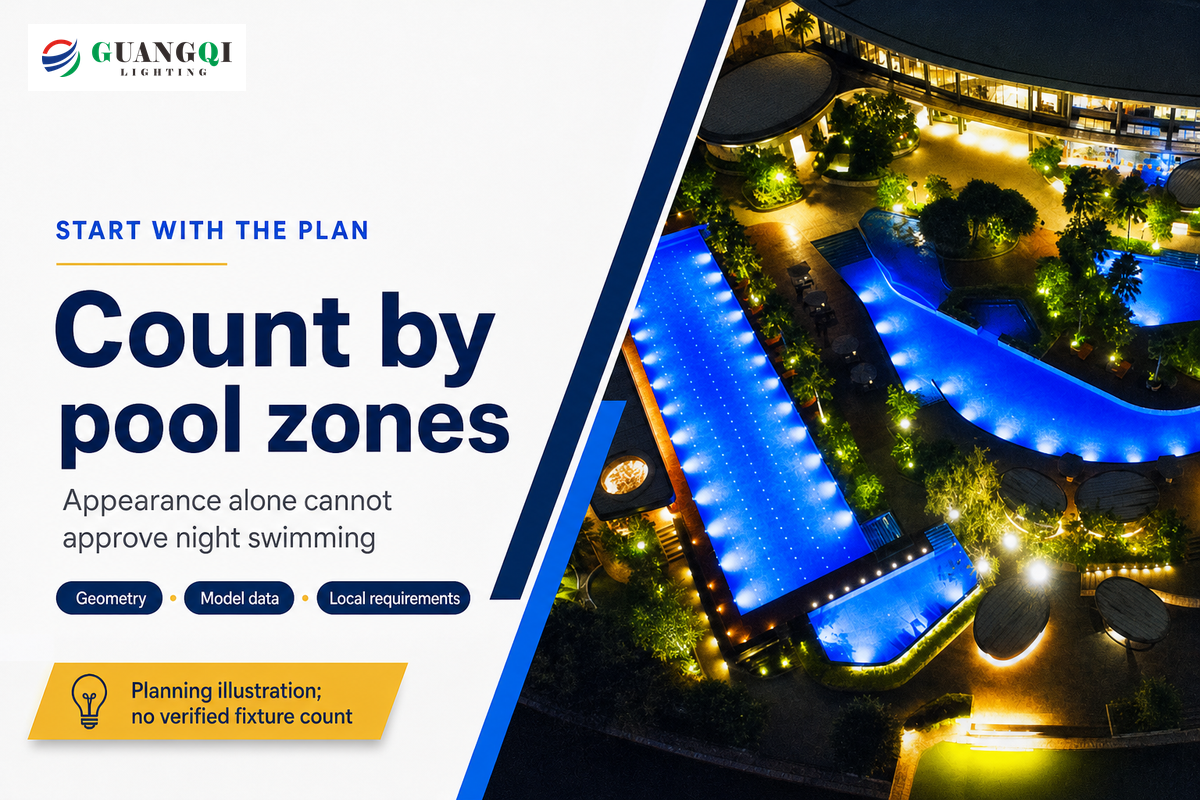
Your pool needs a lighting layout that covers its separate zones and doesn’t glare into the main viewing area. One light may be a candidate for a relatively compact pool with no obstructions, while an L-shaped pool, a separate spa or a broad shelf needs a separate assessment. The exact number would depend on the chosen model and installation constraints.
- Map geometry before choosing the number of fixtures.
- Compare white-light output separately from decorative color effects.
- Treat dark finishes and obstructed zones as layout questions.
- Compare installed scope, rather than fixture price alone.
- Keep electrical approval separate from visual acceptance.
A starting estimate for the number of pool-lights is provided in the pool-lights sizing calculator. This estimate should be discussed during the layout process and it doesn’t establish coverage around steps and benches. The broader pool-water lighting guide describes the various types of lighting and their relationship to the project.
The size of the pool is one of the factors to consider, but adequate lighting depends on several layout decisions. Describe your lighting needs and select the lighting setup before addressing “how many lights do I need?”
Sometimes the first question is whether underwater lights are needed at all. Georgia’s public-pool rules don’t require underwater lighting, but require adequate illumination of the enclosure and pool. That provision doesn’t authorize an unlit night swim. Residential requirements and operating conditions must be checked locally.
“Illumination shall render all portions of the pool, including the pool bottom and main drain suction outlets, readily visible.”
A common mistake is assuming a light has a job and buying it before it’s identified in the plan. For the hypothetical 16 ft × 32 ft pool used below, the area is 16 × 32 = 512 sq ft. That calculation describes size; it does not determine beam reach, fixture count or permission to swim at night.
Map the pool zones before counting fixtures
Prior to counting pool lights, separate the main swimming area, steps, shallow shelves and spa. Fixtures placed to illuminate the main swimming area may leave an adjacent zone in shadow. To avoid glare and evaluate coverage, mark the viewing direction on the same drawing.
Pool Zone Evidence Schedule
The Pool Zone Evidence Schedule breaks down a pool into areas with lighting, identifies a possible design solution and gives the evidence needed prior to purchase.
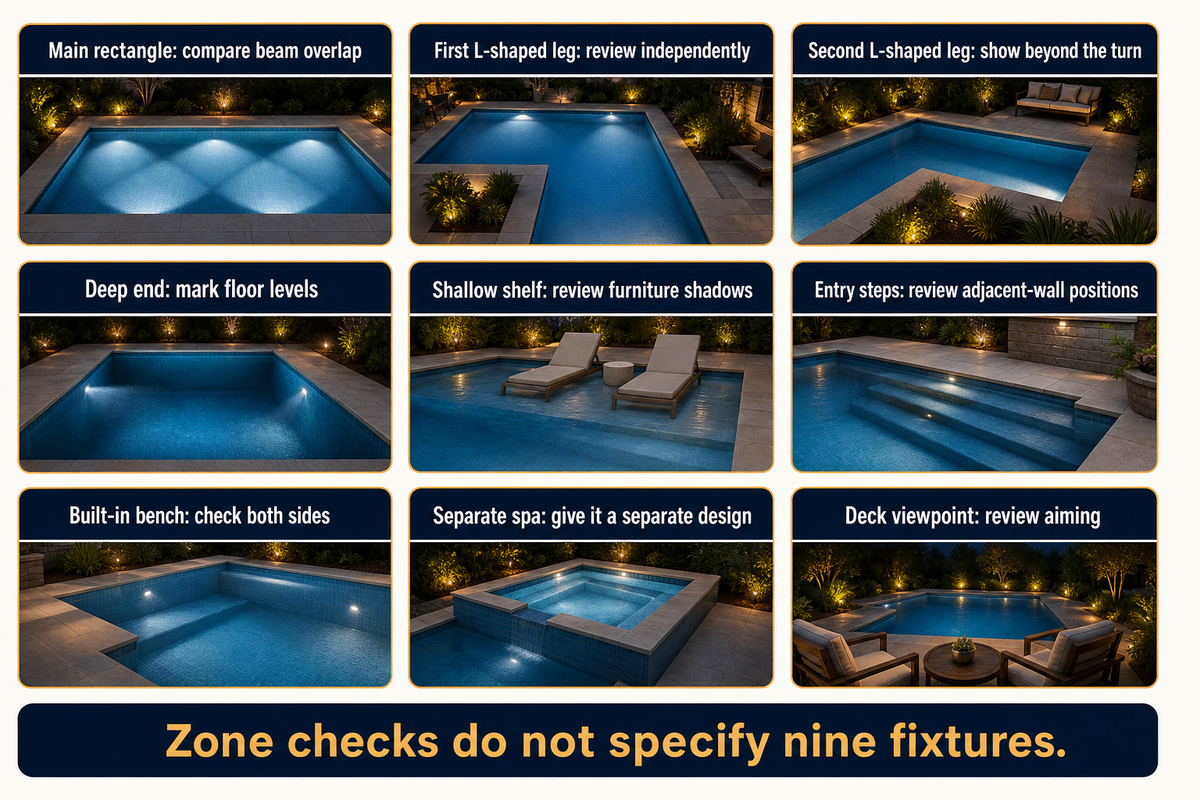
Copy this filled-in example into an annotated plan. Instead of specifying nine fixtures, it presents an example of a pool with some features. The owner identifies viewpoints, the designer reviews coverage and the installer verifies buildability. Mark the depth of the pool in each section; the number of spotlights can’t explain coverage without those sections.
| Zone | Problem to check | Response on the plan | Evidence to request |
|---|---|---|---|
| Main rectangle | Dark gap between beams | Compare overlapping coverage | Exact-model beam information |
| First L-shaped leg | Corner interrupts the sightline | Review this leg independently | Plan with aiming directions |
| Second L-shaped leg | Hidden floor beyond the corner | Show coverage beyond the turn | Section and layout drawing |
| Deep end | Different depth and beam path | Mark floor levels | Depth-specific design review |
| Shallow shelf | Seats or loungers block light | Review shelf-compatible fixtures | Listing and placement limits |
| Entry steps | Treads cast shadows | Compare adjacent-wall positions | Step section with beam direction |
| Built-in bench | Bench interrupts coverage | Check both sides of the obstruction | Annotated bench section |
| Separate spa | Pool fixture doesn’t establish spa coverage | Give the spa its own design | Spa model and control schedule |
| Deck viewpoint | Viewer faces the light source | Review aiming from the seating area | Viewpoint sketch and night observations |
Hypothetical scenario: an L-shaped pool. An owner compares a 12 ft × 24 ft main leg with an 8 ft × 12 ft side leg. Dimensions are illustrative, and their overlap must be dealt with on the actual drawing before calculating the total area. A light facing down the main leg can’t be assumed to cover the floor around the corner. The designer marks each leg and the steps as separate review zones, and checks whether one proposed position can cover more than one zone. The owner is seeking to have fewer fixtures. A useful compromise is to request two placement diagrams showing uncovered areas rather than accept a count based on the combined area alone.
In a 2024 Trouble Free Pool layout discussion, an owner raised shadows from wet-deck furniture and glare toward the house. That’s an owner-reported planning problem, not an installation standard. It explains why furniture belongs on the drawing. A hypothetical 8 ft shelf needs a coverage review even when the main pool appears bright.
Dark finishes change the lighting decision
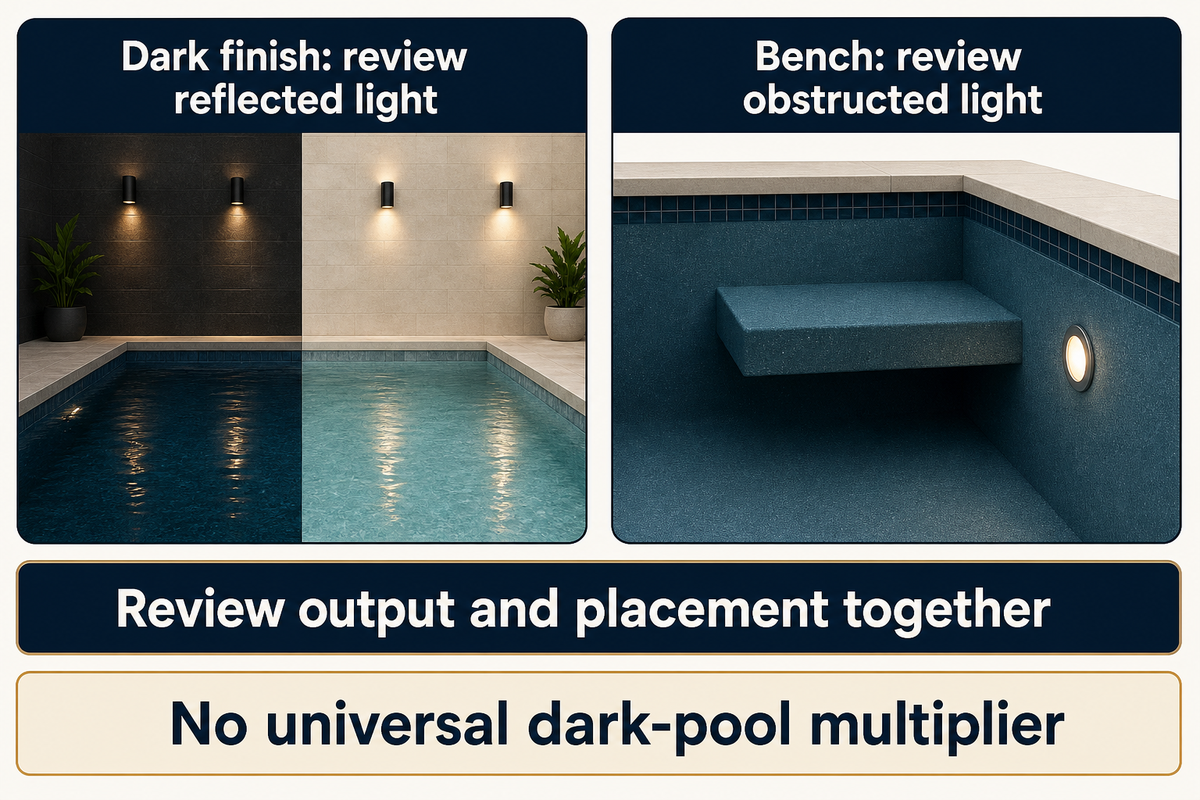
A dark pool finish can change the lighting effect because the surface reflects less light toward the viewer. This should be considered when reviewing output and placement together. No universal multiplier is verified for extra fixtures in a dark pool, and doubling wattage alone isn’t sufficient to solve the layout.
How does pool finish affect lighting?
Hayward’s 2020 lighting design guide says lighter finishes reflect more light and darker finishes need more lighting for a similar effect. Darker finishes absorb more light. The manufacturer guidance supports the direction of the effect, rather than a fixed percentage for every pool surface.
The purchasing mistake is pairing two photographs taken with different exposures, pool water and ambient lighting. A dark finish can look dramatic in a promo shot, but that doesn’t mean steps are easily visible. Compare pool lighting options with the intended finish, and differentiate white light from color options.
Hypothetical scenario: a dark-finish retrofit. A 15 ft × 30 ft pool has one existing light and an 8 ft bench along one wall. The owner plans a darker interior and wants a brighter replacement in the same niche. The installer first records the existing light, fitting, power source and bench position. The designer compares the proposed replacement with a layout using an additional position, without assuming either option will produce the same result. If the bench shadows the far side, a higher-output light in the original position may leave the underlying problem unresolved. The owner can then decide whether to retain the finish choice, revise placement or accept a different visual effect before the resurfacing work begins.
For that illustrative 15 ft × 30 ft retrofit, a dark surface and an 8 ft bench create different questions: reflected light and obstructed light. Keep them separate in the quote. A manufacturer should explain how the proposed lighting options address both, rather than attach an unsupported “dark-pool factor” to an area estimate.
Pool light placement should follow the viewing direction
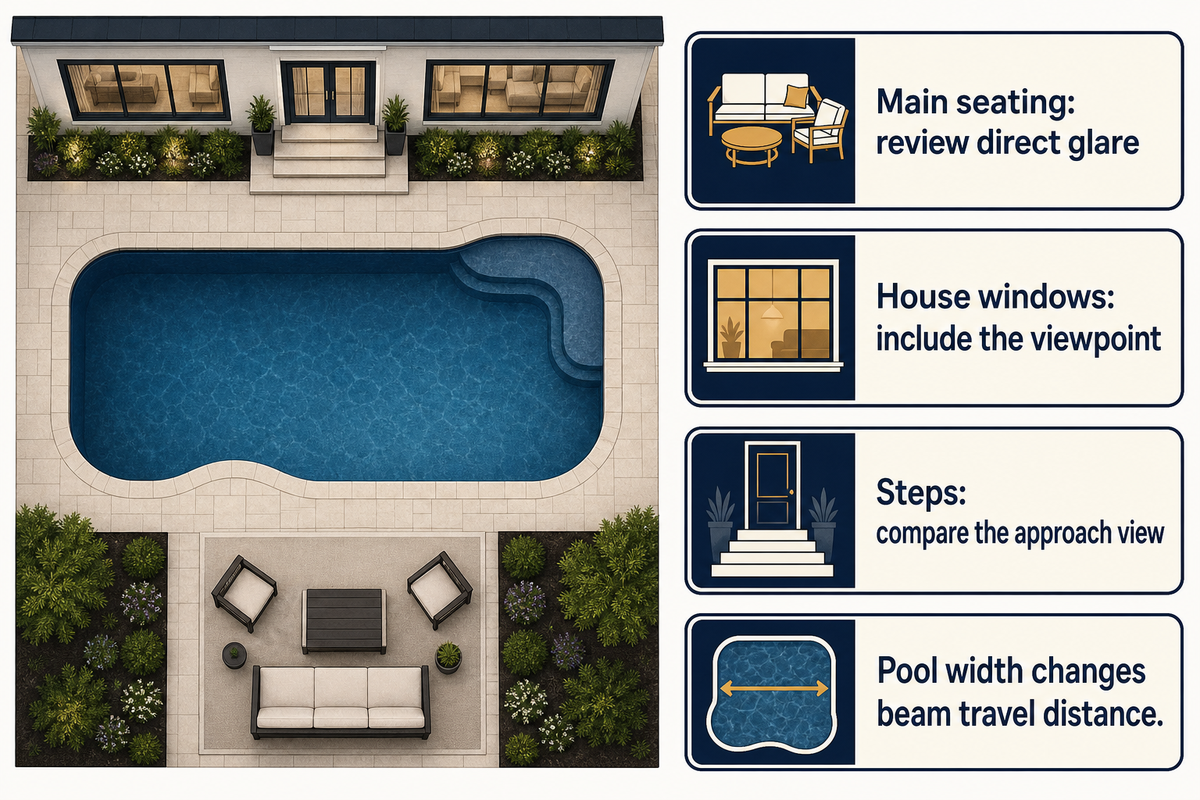
Position pool lights with the main viewing area in mind, then assess coverage from that arrangement. A beam aimed at a terrace can still create glare, even with illuminated flooring. House windows, seating, and the primary walking path belong on the lighting plan along with dimensions, depths, and underwater features.
Where should you position your pool light?
Hayward recommends aiming lights away from the house or viewing area. Australian contractor LEDREX’s design discussion also suggests glare can be caused by excessive brightness and poor placement. That contractor experience is helpful planning context; it isn’t a measured threshold or a U.S. electrical code.
Sketch arrows for the face of the light across the pool wall and the floor, keeping the main seating area on the same drawing. If a quote shows lights along one side of the pool, ask why that side was chosen. “Even light distribution” should be explained for the selected model, not just shown with a series of dots. Choosing the right pool fixture means considering its light intensity and aiming together.
Compare the view from the main deck to the view from the steps. Our lighting design service can receive the annotated plan. The request should specify the desired lighting effect of the pool, rather than request the brightest fixture. What the viewer sees is also impacted by outdoor lighting.
A pool that’s 16 ft-wide changes the distance a beam must cover compared with a narrow spa. Considering the right lighting means verifying that path and the viewing direction together. If switching one position removes glare from the seating area, ask for a revised coverage drawing before approving additional fixtures to compensate for coverage gaps in other locations.
Compare two large lights with four nicheless lights
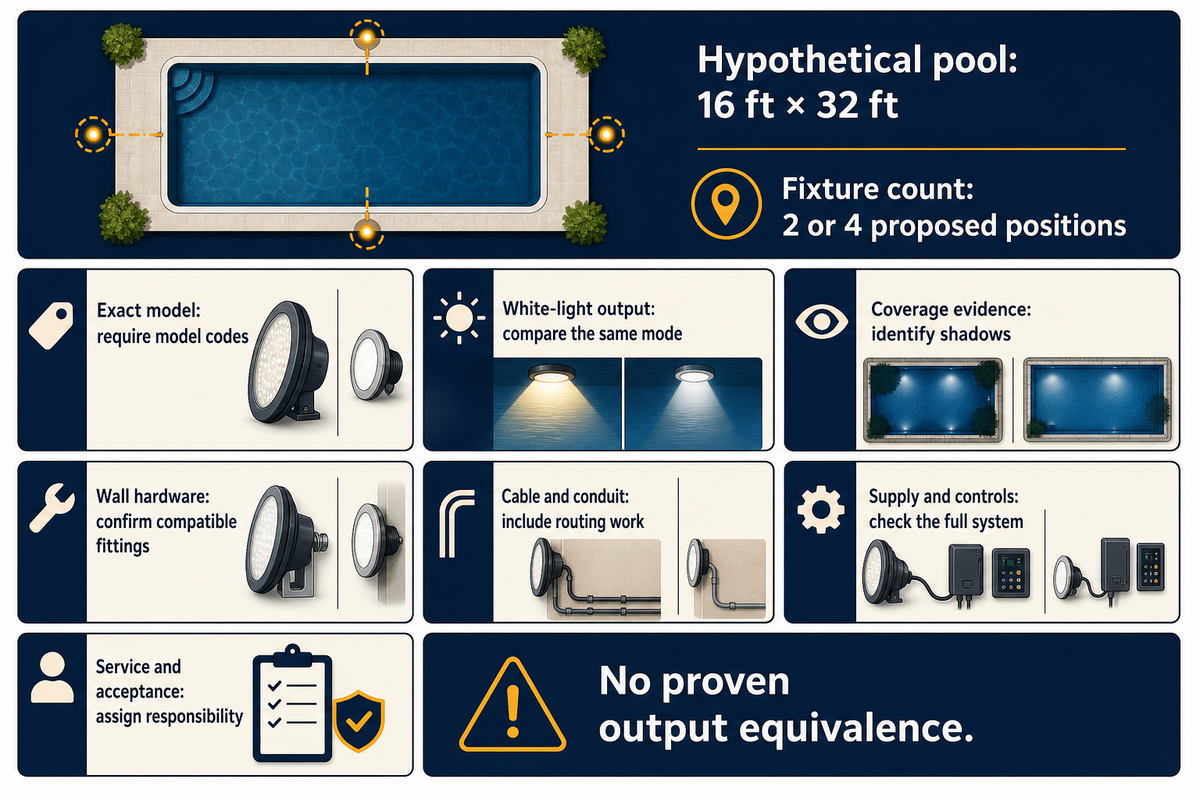
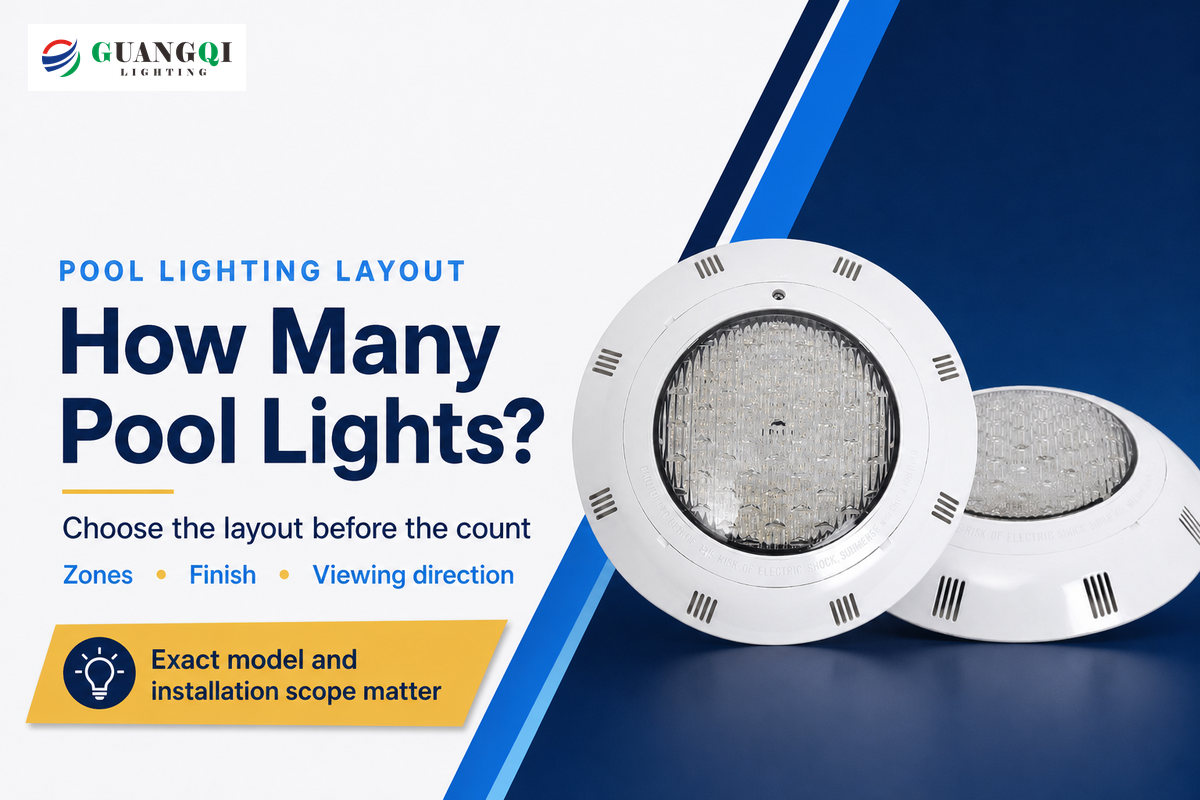
Consider two large lights and four nicheless lights as alternative layouts, not equal-output packages. More positions may help address separate zones, while fewer positions may simplify part of the installation scope. Actual output, beam shape, finish and control compatibility determine whether the layouts serve the whole pool as intended.
LED lights offer different output and beam options across many brands. Find out what the proposed lights provide in the intended operating mode. Lumens per fixture may help compare documentation, but the number of lights to achieve the desired coverage can’t be established without a layout.
Hayward’s 2020 guide lists 2,600 lumens for its Universal ColorLogic pool light, and 640 lumens for ColorLogic 320 in white mode. It gives typical spacing guidance of 14 ft for the former and 5–7 ft for the latter. Dated, model-specific examples show why fixture counts aren’t interchangeable. They don’t recommend the candidates listed below.
Two large fixtures
- Two proposed lighting positions
- Review beam overlap and corner shadows
- Price the selected niche and service access
Four nicheless fixtures
- Four proposed lighting positions
- Review smaller-fixture output and aiming
- Price the selected fittings and service access
Pool Lighting Quote Comparison
The Pool Lighting Quote Comparison maintains geometry while revealing differences in fixtures, installation work, controls, and evidence for each candidate.
This table shows the decisions a hypothetical 16 ft × 32 ft new-pool buyer faces. Prices are left blank because publicly available evidence can’t prove the cost of the installed work for this project. This is a scope comparison the buyer can give to the bid participants.
| Quoted item | Two large fixtures | Four nicheless fixtures | Buyer decision |
|---|---|---|---|
| Pool input | 16 ft × 32 ft rectangle | Same geometry and finish | Reject mismatched assumptions |
| Fixture count | 2 proposed positions | 4 proposed positions | Keep count separate from output |
| Exact model | Model still to be selected | Model still to be selected | Require model codes before ordering |
| White-light output | Request selected-model data | Request selected-model data | Compare the same operating mode |
| Coverage evidence | Show beam overlap | Show coverage between positions | Identify remaining shadows |
| Wall hardware | Price compatible niches | Price compatible fittings | Confirm installed scope |
| Cable and conduit | Measure routes for 2 positions | Measure routes for 4 positions | Include routing work |
| Supply and controls | Confirm load and compatibility | Confirm load and compatibility | Check the complete system |
| Service and acceptance | Show access and night-check scope | Show access and night-check scope | Assign responsibility before purchase |
Hypothetical scenario: the rectangular new pool. A buyer gets two sketches for the same 16 ft x 32 ft pool. One shows two lights; the other shows four. The lower fixture count appears cheaper until quotes show different controls and missing conduit work. The buyer asks the suppliers to use the same finish, viewpoint and white-light operation, and mark beam directions on the plan. The two-light candidate requires an explanation of coverage between the positions. The four-light candidate requires evidence that smaller fixtures achieve the desired effect. Neither sketch wins on count alone. With the scope of the work defined, the buyer can compare prices and expectations without assuming two LED lights equal four of the other model.
A 512 sq ft rectangle is an input only. Example outputs from the manufacturer of 2,600lm and 640lm are specific to their products as shown in a 2020 guide. Reach out to suppliers for the data of selected models using our fixture comparison resource and don’t transfer the outputs to an unspecified large or nicheless light.
Separate replacement from adding new pool lights
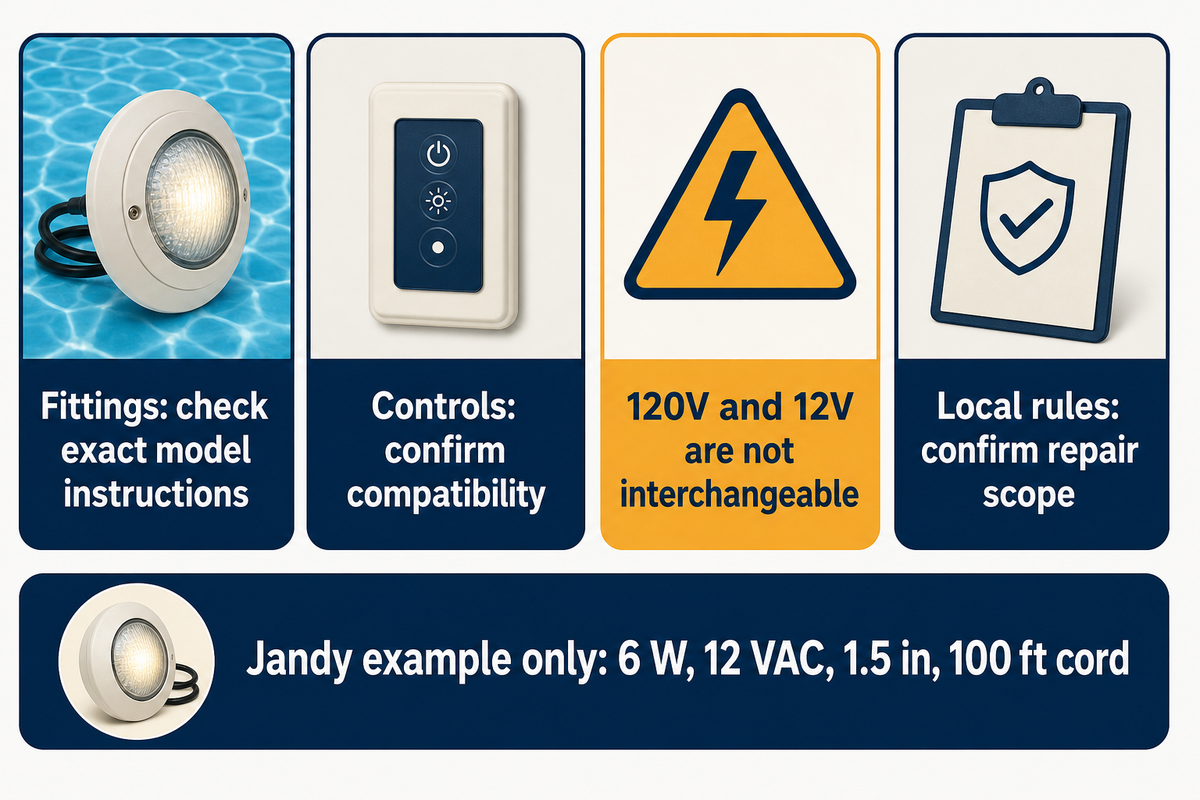
Replacing a fixture and adding new lighting positions are different projects. Replacing a fixture may be able to use some of the existing infrastructure only after checking compatibility and local requirements. Adding positions introduces fitting, cable-routing and control decisions. A quote should show what work is included before the owner compares the amount of light or purchase price.
An existing halogen light or incandescent fixture may be replaced with LEDs. Energy efficiency and lower wattage can be useful, but they don’t prove mechanical fit. Lower-wattage lights using less power still need a compatibility review. Incandescent light fixtures with a standard Edison base shouldn’t be presumed compatible with any replacement lamp. Check the listing and manufacturer’s instructions for the fixture.
For example, Jandy’s HydroCool page lists a 6 W, 12 VAC model using a 1.5 in return fitting with a 100 ft cord. “Nicheless” does not establish that a different model fits that same type of installation. Compare pool and spa fixture formats before selecting a replacement.
Local rules may also limit the replacement scope. Miami-Dade’s pool-light permit guidance identifies low-voltage requirements for existing residential pool-light repairs or alterations. Applicability, permitted work, and inspection should be confirmed locally. A compatible niche doesn’t mean the existing supply is also compatible.
Supply decisions should be made by the qualified installer. A 120V light and a 12V light are not interchangeable because their housings look similar. A proposal to change voltage to 12V must identify the listed equipment and applicable requirements; buying a transformer to convert the supply isn’t an installation plan.
The 6 W, 12 VAC, 1.5 in-fitting and 100 ft-cord example shows how many compatibility questions sit behind one light fixture. A quote with a new position requires the routing, controls, and inspection scope in writing. Our LED versus incandescent cost comparison can support the operating-cost discussion after compatibility is settled.
Ask manufacturers for a layout and matching files
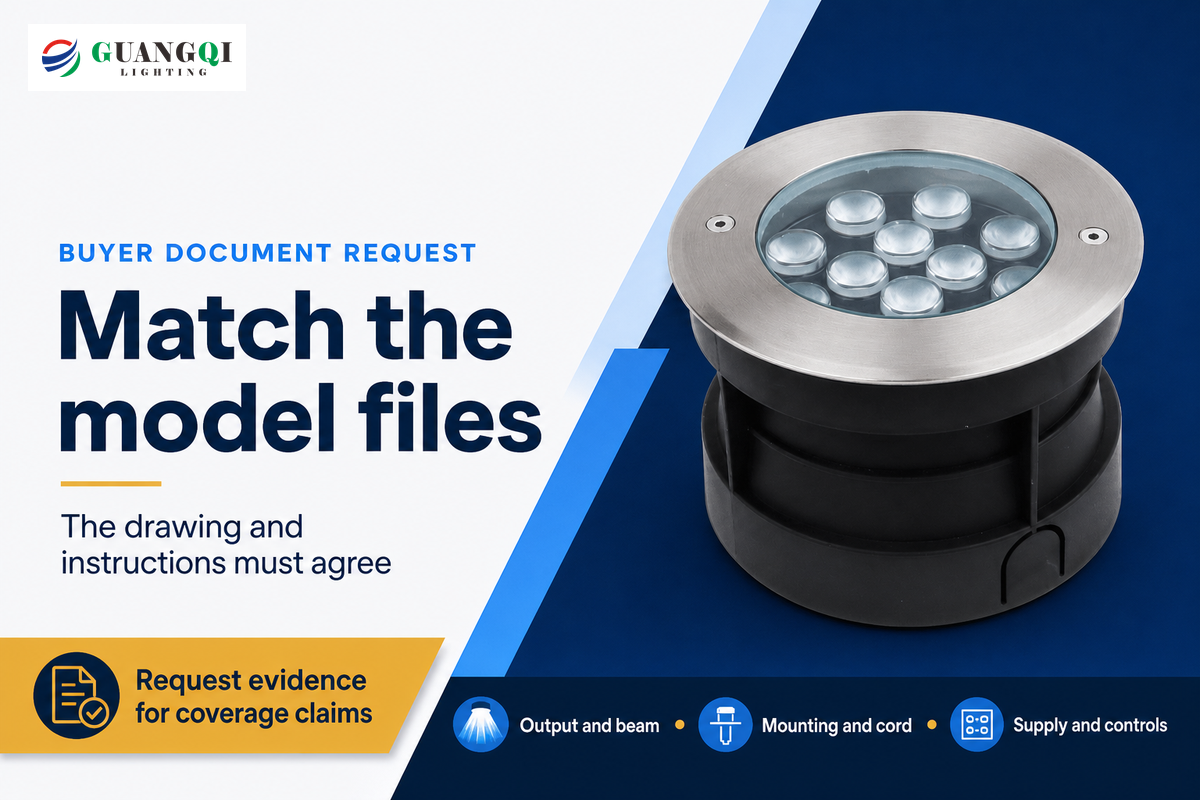
Ask pool-light manufacturers to supply a drawing tied to the exact model and the operating mode, and to include a copy of the instructions with the drawing. A figure in lumens or wattage label doesn’t specify coverage around the shape of the pool. The supplier’s drawing, product data, and control schedule should be tied to the same configuration to assist the installer in defining the scope of work.
Send plans and sectional elevations, pool size, finish sample and preferred color effects. Show the size and shape of every zone. Request the suppliers to find this information in their documents: output for the intended mode and characteristics of the beam, approved arrangement for mounting, cord options, electrical requirements, and compatible controls. Where measured photometric files aren’t available, request what justifies the coverage claim.
A common mistake is receiving a layout for one model and instructions for a similar name. LIGMAN’s underwater-luminaire instructions, for example, require submersion for heat dissipation. That warning belongs to those luminaires. It can’t replace the instructions or operating limitations of another manufacturer’s product.
For the hypothetical 16 ft x 32 ft pool, send one shared plan to every bidder. A procurement contact can compare scope, the installer can confirm access, and the owner can assess the proposed lighting effect. Use our project enquiry form to send the drawing and request a model-specific response.
Distributed LED layouts still need a night check
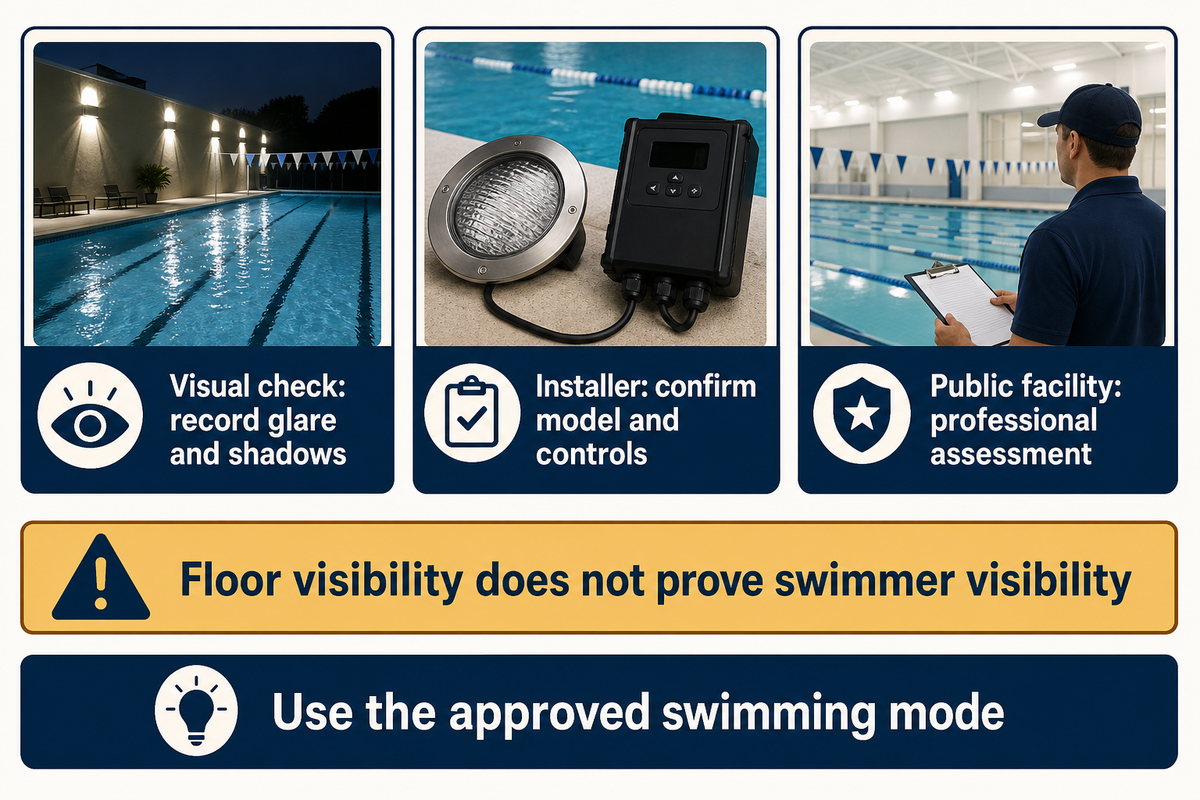
Distributed LED layouts need a night check because the manufacturer’s layout and control files don’t determine acceptable visibility on their own. Review the pool under its intended operating conditions, including deck lighting and reflections. Glare and shadow are assessable through a visual check; public-pool assessment and electrical acceptance follow the applicable professional and local-authority approval processes.
More flexible controls are available. The IntelliVibe system of Pentair offers up to 4 lighting zones. PoolPro’s May 2025 launch report mentions a new line and states that it isn’t backward compatible with MicroBrite, IntelliBrite and GloBrite lights. Don’t assume a new controller is compatible with an existing fixture family.
Pool owners should check intended white-light operation, permitted color settings and deck lighting separately. Reviewing a pool at night means looking beyond the color program. Georgia’s public-pool rule bans dimmable or colored underwater lighting in its scope. Decorative settings presumed suitable for residential pools can’t be presumed suitable for public facilities. The current page of the CDC’s Model Aquatic Health Code reveals the fifth edition, published in 2024; it’s model-based guidance and not evidence of adoption by local jurisdictions.
The presence of floor markings is not a complete test of swimmer visibility. A 2022 study of a submerged manikin used 108 tests and four lifeguards across two public pools, and concluded that the combined effects of perception and working conditions should be considered. The findings don’t provide a count of residential fixtures. Owners shouldn’t stage tests with submerged people.
Do
- Record glare and shadow observations from agreed viewpoints
- Have the installer confirm model and control compatibility
- Assign professional assessment for public-pool operating conditions
Don’t
- Accept a promotional photo as coverage evidence
- Assume floor visibility alone proves swimmer visibility
- Use an unapproved decorative mode for night swimming
A system with four control zones still requires an assessment of its intended mode of operation to be documented. For a hypothetical 16 ft x 32 ft pool, document the steps, bench and deck views on the same plan that’s used for purchase. A night check closes the visual discussion. It doesn’t replace the electrical approval, or the safety assessment by a public facility.
Frequently Asked Questions
How many MicroBrite lights do I need?
Choose the exact MicroBrite model and have its layout reviewed for your pool’s shape, finish and viewing direction.
What should the layout review include?
A product-family name doesn’t establish a count. Send a dimensioned plan with depths, steps, shelves and the main seating viewpoint. Ask the supplier to identify the proposed fixture positions, operating mode and compatible controls, then explain any coverage limitations. Keep MicroBrite documentation separate from IntelliVibe or another Pentair family. No verified universal area-to-count rule was established for this article. If a shelf or separate spa is included, ask how each is covered. A proposal for one light in the pool should identify its limits just as clearly as a proposal with more positions.
Why is pool lighting so expensive?
The installed price includes more than the light: fittings, cable routes, supply, controls, access and commissioning can change the scope.
How can I compare quotations fairly?
Use the same pool drawing and visual expectations for each quotation. Separate fixture purchase from wall hardware, installation work, electrical equipment and night-check responsibilities. A cheaper light may require a complete change of controls or additional access work. Ask bidders to identify inclusions and exclusions rather than compare fixture prices alone. This guide doesn’t estimate a local installed price without a project quote.
Are LED pool lights safe?
LED technology alone doesn’t prove that a pool-light installation is safe; product suitability, installation and local requirements must all be checked.
Who should confirm suitability?
Use equipment approved for the intended pool application and a qualified installer who follows its instructions and applicable local rules. The installer must review supply, protection, fittings and control compatibility. A lower-voltage label or energy-efficient design can’t replace those checks. Keep a decorative night observation separate from electrical acceptance, and have public-pool operating conditions assessed through the appropriate professional process.
Is 5000 lumens bright for outdoor lights?
A 5,000 lm rating describes emitted light, not coverage or glare in a pool.
What else affects the result?
Beam shape, mounting, depth, finish and ambient lighting affect the result. Don’t transfer a general outdoor-light rating to an underwater lighting layout.
Can one spa light cover a separate pool?
A spa light doesn’t establish coverage in a separate swimming pool.
How should the two areas be planned?
Review the spa and pool as separate zones with their own geometry and fixture documentation, even when they share a controller.
Are color-changing LED lights easy to operate?
Operation depends on the fixture and compatible controls.
What should I ask about controls?
Confirm how to adjust the colour using the supported switching or automation method. Distinguish decorative programs from the operating mode approved for swimming. More color choices don’t establish better coverage.
What are the different types of pool lights available?
Pool lights come in niche-mounted, nicheless and application-specific formats.
How should I choose a format?
LED, halogen and incandescent options appear in new or existing installations. The mounting arrangement and electrical listing matter alongside the light source.
Choose the layout before approving the count
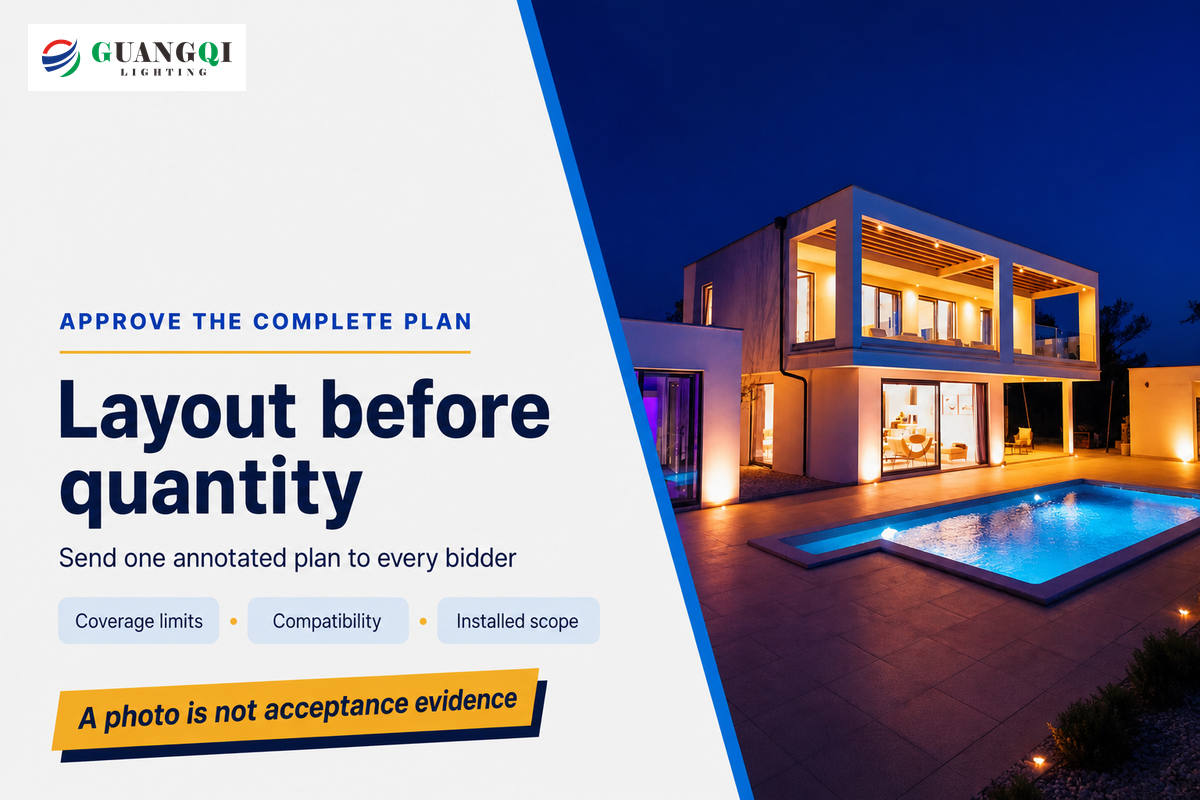
Approve the lighting layout before purchasing a fixed number of pool lights. Provide suppliers the same geometry, finish and viewing direction, and compare the complete installation scope. Also request them to explain the limits of the coverage. Keep visual expectations, electrical requirements and public-pool operating rules as separate parts of the approval.
Key takeaway
For the hypothetical 16 ft × 32 ft pool, two large lights and four nicheless lights are candidates to investigate. Select the count after reviewing coverage, glare, model compatibility and installation scope.
Start with a zone-marked plan, then review the pool and water lighting options and request a model-specific layout and quote. The best answer is a count supported by that plan and its limits, so the owner knows what’s purchased and the installer knows what must be delivered.
Related Reading
References & Sources
- Georgia Department of Public Health: Public Swimming Pools, Rule 511-3-5-.12 public-pool lighting requirements; checked October 2026.
- Miami-Dade County: Swimming Pool Light Safety Permit local residential repair and alteration context; checked October 2026.
- CDC: Model Aquatic Health Code, current-edition page fifth edition issued in 2024; checked October 2026.
- International Journal of Aquatic Research and Education: Ability of Lifeguards to Detect Submerged Manikins in Public Swimming Pool Environments 2022 research, not a fixture-count formula.
- PoolPro: New Pentair Lights, IntelliVibe May 2025 product-launch reporting, including manufacturer statements.
Manufacturer documents are linked where their specific products are discussed. Illustrative dimensions and candidate counts are planning examples, not measured installations or universal recommendations.