Get in Touch with GUANGQI



By DD · Updated October 2026
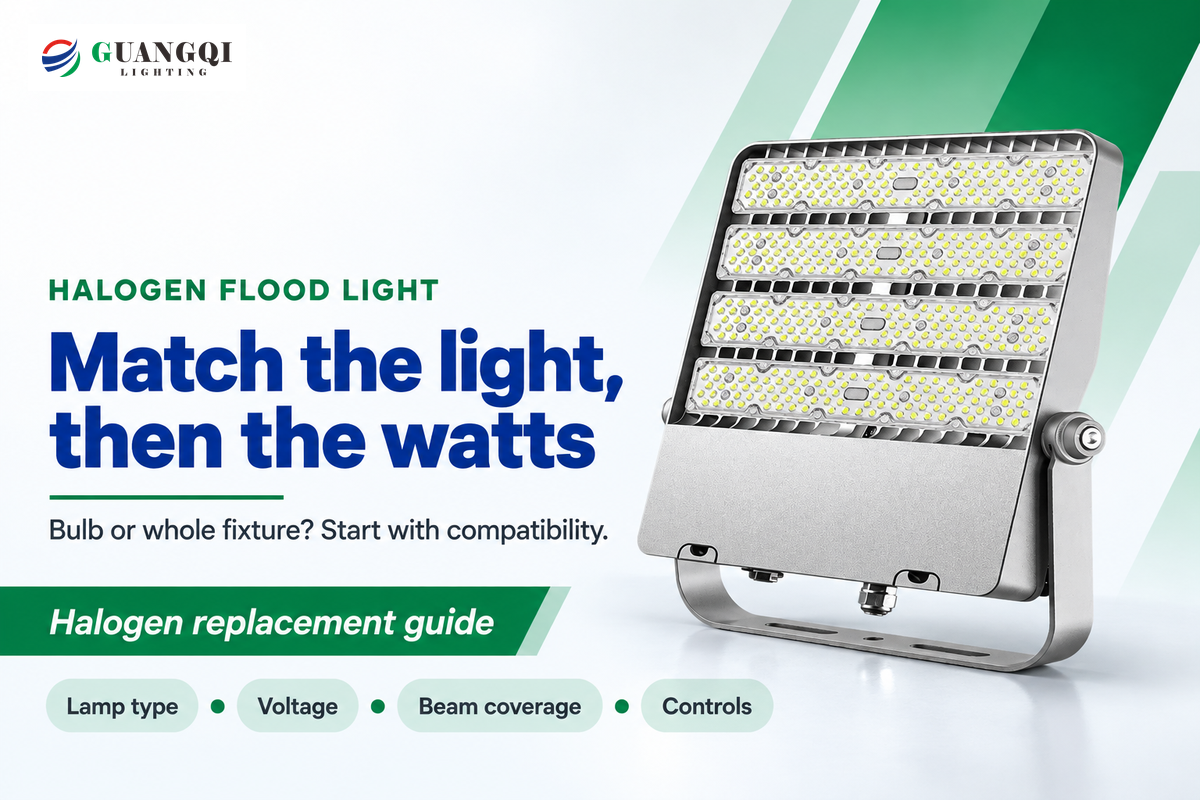
When replacing a halogen flood light, match the type of lamp first, then voltage, light output and beam coverage. A lower wattage LED can reduce energy consumption, but a bad choice can leave the edges dark, flicker on the old dimmer or not fit behind the glass. Start with the existing bulb’s marking, and compare how the replacement lights the working area.
Choose a halogen flood light replacement by lamp type, voltage, lumen output, beam coverage and controls. LED watts alone don’t establish an equivalent replacement. Confirm the bulb fits and is approved for the enclosure, or compare a complete LED fixture.
Quick Specs: What to Compare
| Power | Watts (W): electricity input, not brightness |
|---|---|
| Light output | Lumens (lm): check whether the figure describes the bulb or complete luminaire |
| Light on the task | Illuminance and distribution at the actual mounting position |
| Color quality | Color temperature, color rendering and flicker |
| Compatibility | Supply voltage, base, dimensions, enclosure and controls |
- Read the complete lamp marking before ordering light bulbs.
- Compare beam coverage and glare as well as output in lumens.
- Check enclosure and dimmer suitability separately.
- Use actual operating hours when calculating electricity savings.
Identify the Halogen Bulb and Fixture
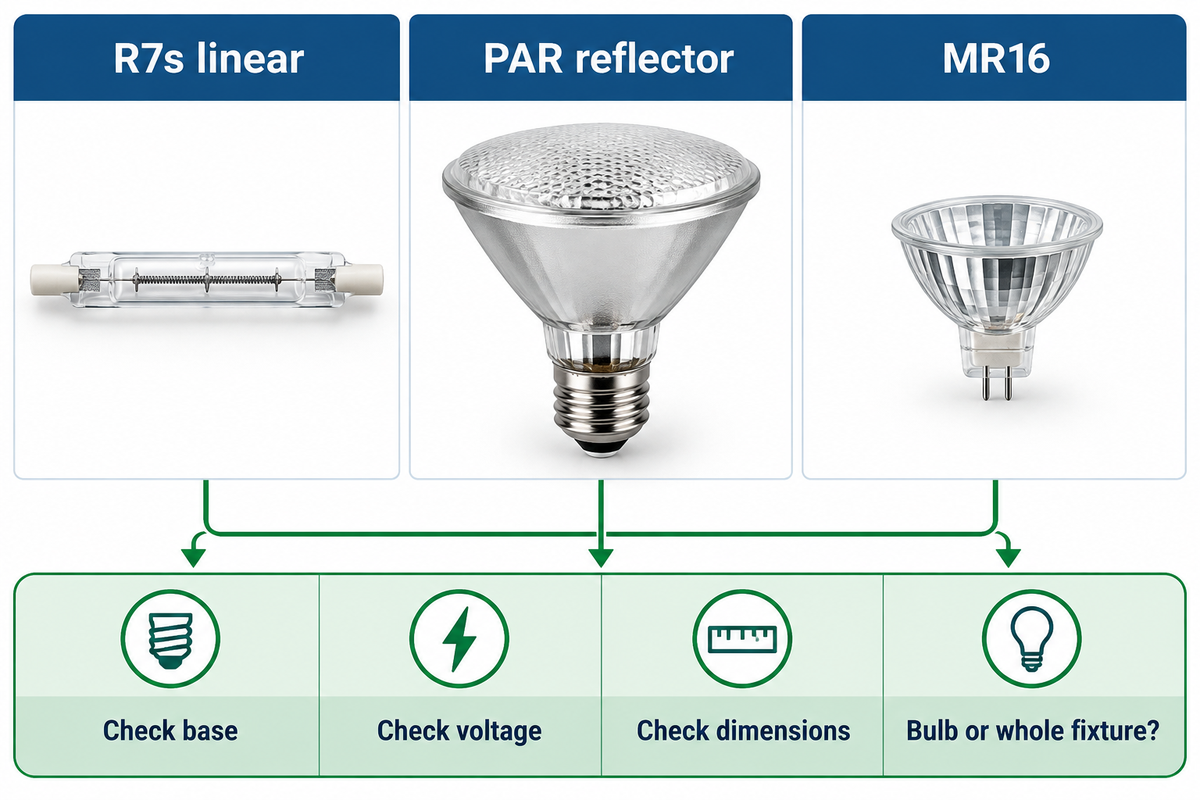
Start with the lamp marking: An R7s linear halogen bulb, a PAR38 reflector lamp and an MR16 lamp are different replacement jobs. Record the base, supply voltage and dimensions, and check if the purchase is a new bulb for the existing housing or a complete light fixture.
A linear quartz halogen lamp usually sits between two end contacts inside a reflector. A PAR lamp has its own reflector and front lens. PAR20, PAR30 and PAR38 describe different reflector formats; the marking alone doesn’t tell you if a particular LED is suitable for the given socket, enclosure or beam requirement.
Voltage deserves its own check. The Philips Plusline S model used below is rated at 230 V. A similar-looking replacement sold for 120 V is a different electrical product. Never select between the two based on wattage or physical appearance alone.
Photograph the old halogen light bulb marking, the fixture label, and the control label with the equipment safely isolated. For a hardwired unit, have a qualified electrician assess the damaged wire, seals, sockets and/or mounting hardware. An LED bulb can’t repair a deteriorated housing.
When searching for a selection of halogen bulbs or LED replacements, keep the application visible. A portable worklight, a ceiling recess, a wall pack, and landscape lighting don’t need the same distribution. A guide to LED flood light bulb formats can help to narrow the lamp family, before evaluating individual models.
How Many Lumens Does a Halogen Flood Light Produce?
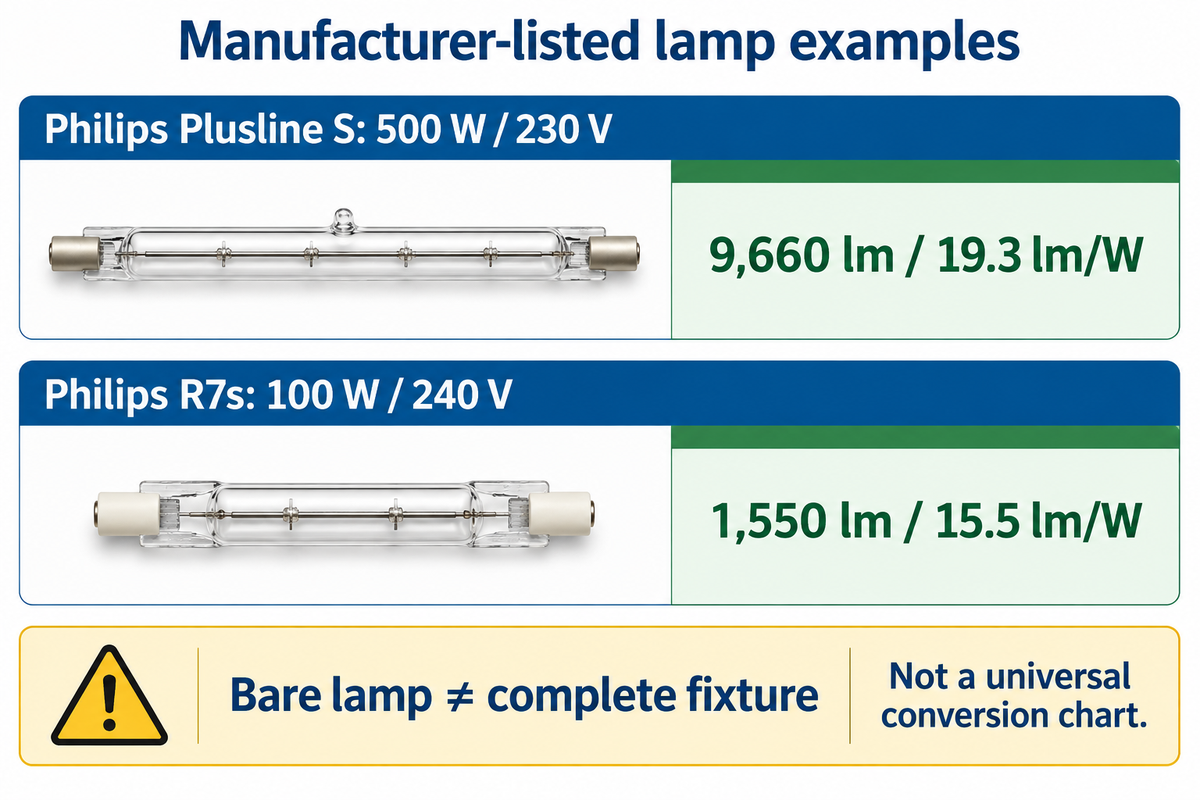
Signify states 9,660 lm for one 500 W Philips Plusline S lamp and 1,550 lm for a separate 100 W R7s model. These can be used as reference values for the named products. Read the old lamp’s own specification before treating any lumen value as the target for replacement.
| Exact product | Power | Voltage | Rated lamp output | Listed efficacy |
|---|---|---|---|---|
| Philips Plusline S, 924735544298 | 500 W | 230 V | 9,660 lm | 19.3 lm/W |
| Philips R7s, 923920045792 | 100 W | 240 V | 1,550 lm | 15.5 lm/W |
These two models of differing power have differing rated efficiencies. They don’t provide a measured range for every 500 W lamp. The second specification is available on Signify’s 100 W R7s product page.
How many lumens is a 500W halogen floodlight?
For the cited Plusline S bulb, the manufacturer states 9,660 lumens. A floodlight built around the same bulb has a reflector, cover and aiming arrangement. Its useful light distribution therefore needs a separate comparison with the proposed LED luminaire.
Keep three measurements separate: lamp lumens, complete-fixture output, and illumination on the working surface. The U.S. Department of Energy’s LED Basics discusses source efficacy and luminaire efficacy. This info is very useful when an LED supplier gives complete-fixture lumens, and the old halogen data sheet gives bare lamp lumens.
There are limits in consumer replacement charts as well. In Australia’s Energy Rating lamp comparison, standard incandescent lamps are distinguished from pressed-glass reflectors. A PAR38 halogen replacement row shouldn’t be a sizing rule for a linear worklight. For measurement distinction, see lumens versus lux.
What LED Wattage Replaces a Halogen Flood Light?
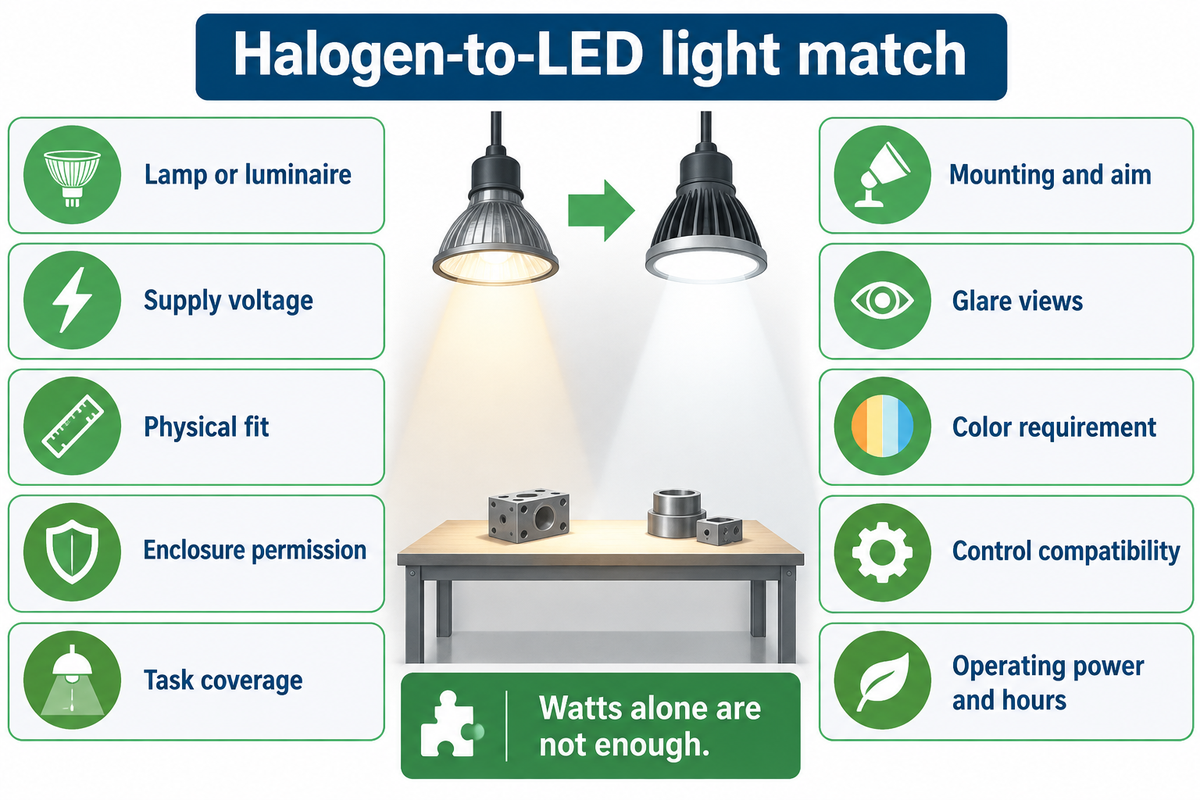
No single LED wattage replaces every halogen flood light of a given wattage. Make a shortlist with the old product’s rated light output. Then compare the new fixture’s distribution at the intended height and angle. Retain the lower-power option only when the required work area remains adequately lit.
A useful first comparison is to ask suppliers for the complete luminaire’s lumens and watts, its beam option, and a lighting diagram for the same mounting position. A narrow spotlight can make the center look brighter while leaving the edges of an outdoor space darker. A wider flood may illuminate surrounding areas you did not intend to light.
Power shortlist example: Suppose the lighting design calls for 10,000 lm of complete-fixture output, and a candidate fixture delivers 125 lm/W. Dividing 10,000 lm by 125 lm/W gives 80 W. Both inputs are illustrative project assumptions, not measurements of the halogen lamp above. Use the result to screen candidates, and confirm their beam and task illumination in the layout.
Business Wales identifies misleading equivalence claims and a change in spill light as some of the common LED replacement problems. Trial a candidate in the actual location before purchasing a large quantity.
Halogen-to-LED Light Match Worksheet
This worksheet differentiates between electrical fit, useful illumination, and operating experience, prior to replacement being approved.
| Check | What to record | Decision it changes |
|---|---|---|
| Lamp or luminaire | Bare-bulb output or whole-fixture output | Whether the lumen figures describe comparable equipment |
| Supply | Voltage on both product labels | Electrical suitability |
| Physical fit | Base, contact spacing and overall dimensions | Whether a bulb retrofit is practical |
| Enclosure | Explicit permission for the intended enclosed use | Retain the housing or choose another product |
| Task coverage | Layout or trial at the working surface | Beam choice and fixture quantity |
| Mounting | Height, aim and surrounding obstructions | Whether a one-for-one swap works |
| Glare | Views from entrances, walkways and work positions | Shielding, aiming or output reduction |
| Color | Color temperature and rendering requirement | Whether materials remain easy to distinguish |
| Controls | Dimmer, photocell or sensor model and compatibility | Driver and control selection |
| Operating power | System watts and expected hours | Electricity budget |
Maintenance staff can complete the equipment fields, the facility manager can approve coverage and glare, and procurement can evaluate alternatives using the same criteria. A quotation providing wattage only leaves all three groups answering different questions.
Halogen vs LED: Heat, Color and Beam Quality
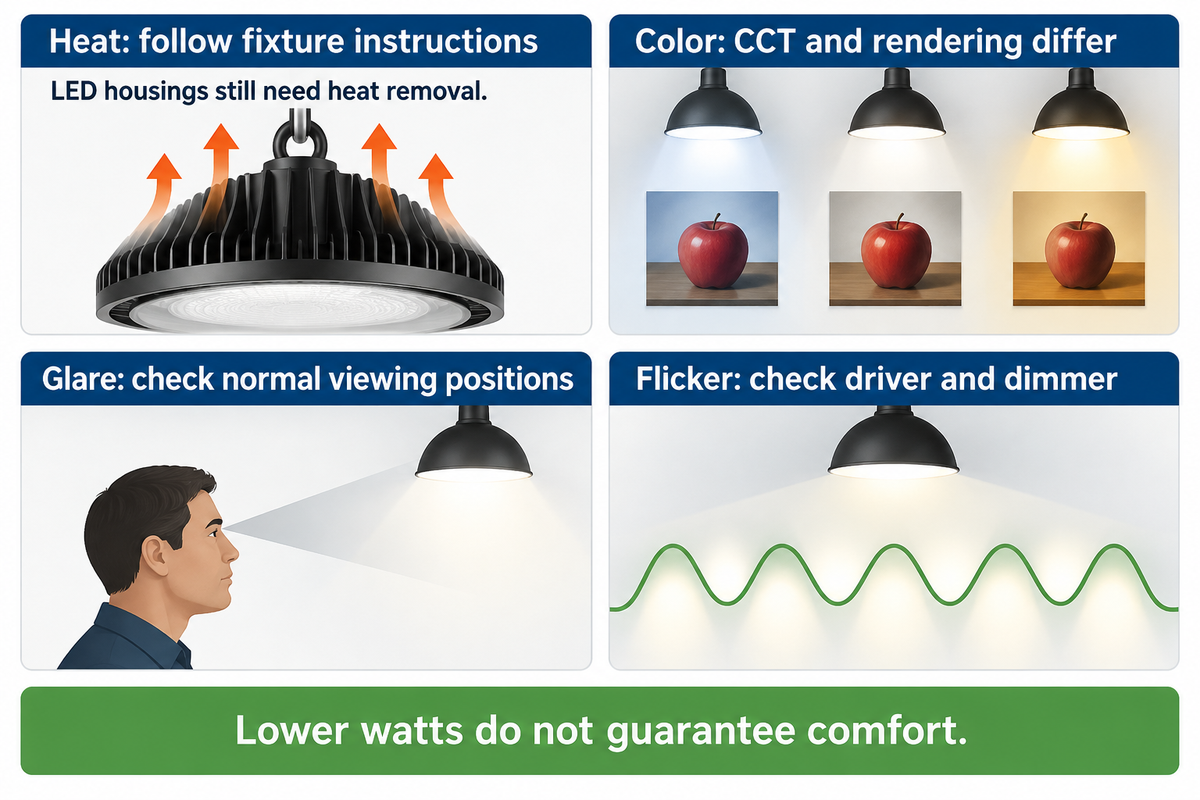
Halogen and LED lighting differ in how they produce light, handle heat and respond to controls. Examine beam, color appearance, color rendering and flicker separately. Lowering electrical consumption is good, but an acceptable replacement must also maintain visibility and visual comfort in the intended position.
Do halogen flood lights get hot?
Yes. Treat an operating halogen light and its surrounding housing as hot equipment. Isolate power and allow cooling as directed by the manufacturer, before servicing. Keep the specified protective glass, guard, and clearances in place; replacing the bulb doesn’t cancel the fixture’s instructions.
Heating occurs with LEDs. Less infrared in the beam doesn’t mean the housing can be touched. Heat must be removed from the LEDs and the power supply through the fixture’s thermal design. The DOE’s technical buyer guidance notes that enclosed fixtures can raise the operating temperature and impact some LED products.
“Fully enclosed fixtures trap heat and increase temperatures in which lamps operate.”
Which light is better, halogen or LED?
LED is the stronger candidate when operating hours make electricity use important and a suitable product meets the lighting requirements. Retaining a sound halogen fixture can still be a reasonable short-term choice for occasional use, especially when the existing beam and controls work well and replacement installation costs are substantial.
For color, the cited 500 W Philips model states 2,900 K and CRI 100. That information describes this lamp. It isn’t a guarantee regarding all fixtures. Color temperature describes the appearance of light as warm or cool, and color rendering describes how objects appear. Choosing a cooler white doesn’t automatically improve either visibility or color rendering.
Glare deserves a separate viewing check. DOE’s outdoor glare guidance states that if the same amount of light is concentrated into a smaller emitting area, it can feel more glaring. Check from the doorway and normal approach direction, not just from directly beneath the floodlight.
Temporal quality also matters. DOE’s explanation of flicker relates LED output stability to the driver and its reaction to a dimmer. Watch for flicker throughout the intended dimming range and while in normal use. “Dimmable” on the box doesn’t mean it will work with every dimmer.
Three examples illustrate the point. An occasionally used portable light may save little money each year. A nightly loading dock makes running cost and access for maintenance more important. Color-critical displays make color rendering and viewing comfort more important than having the lowest wattage. Each example warranted a different acceptance check.
Replace the Bulb or the Whole Light Fixture?
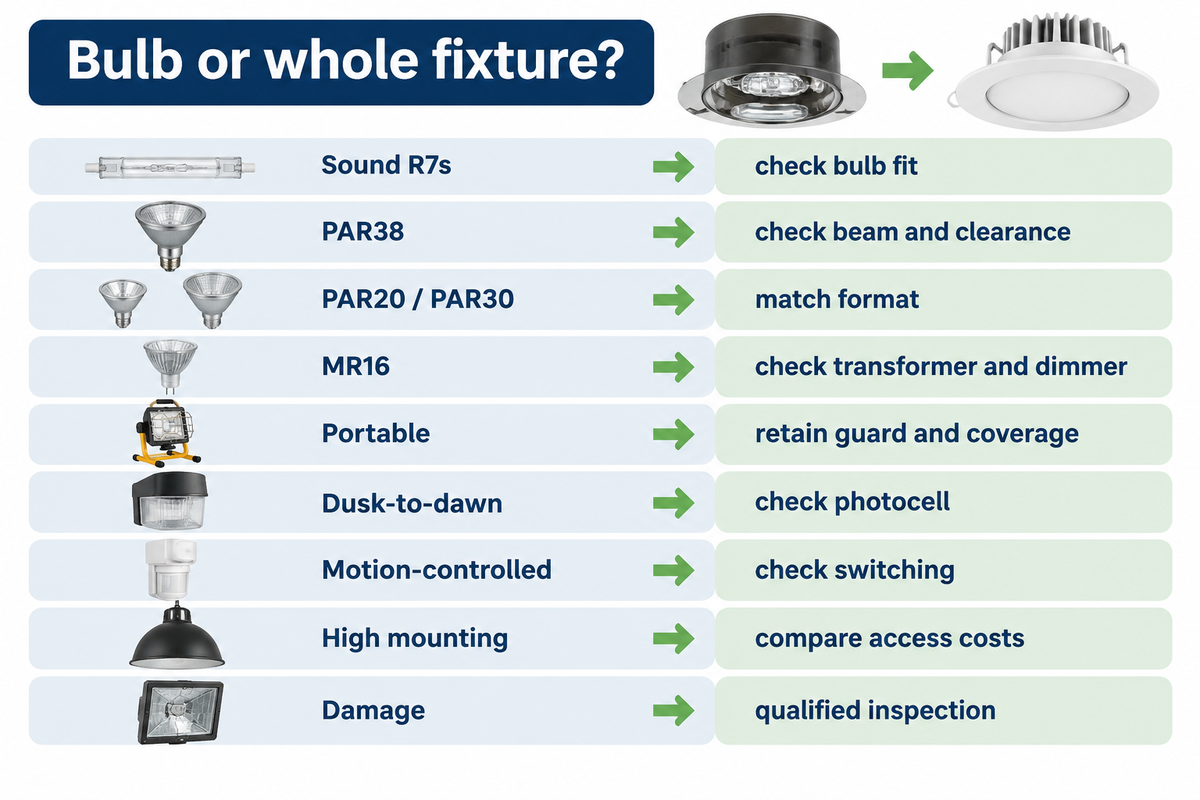
Keep a sound fixture when a replacement bulb meets the same electrical, physical, enclosure, and lighting requirements. Replace the unit when no acceptable bulb is found, the housing requires repair, or a different optical system or control arrangement is required.
A real R7s example shows why product-level checks matter. Feit’s BP100J118/LED/HDRP is listed at 15 W, 1,600 lm and 120 V. Its page says enclosed-fixture-rated and dimmable, with dimensions of 4.7 inches long by 1.2 inches wide. That provides a specific candidate for a compatible installation, rather than a rule that every R7s LED must operate in open air.
The same product lists a damp-location rating. This doesn’t permit every exposed outdoor installation, nor should it be confused with a waterproof fixture rating. Assess the complete assembly’s application limits. For a larger LED body, assess the available space around the bulb, as well as contact distance.
Are halogen flood lights dimmable?
The two Philips halogen models mentioned in this report are listed as dimmable. A replacement LED still needs a compatible dimming system. Existing motion-sensor flood lights and a motion-activated flood light with timer also need their control specifications checked. A lamp that works with a simple switch may act differently with electronic controls.
| Existing type or condition | Start with | Check before ordering |
|---|---|---|
| Sound R7s linear housing | A specified compatible bulb | Contact spacing, width and enclosure rating |
| PAR38 halogen reflector | A matching-base LED reflector | Beam distribution and fixture clearance |
| PAR30 or PAR20 fitting | The same lamp format | Overall dimensions and intended directional pattern |
| Low-voltage MR16 system | A lamp and control-system compatibility check | Transformer and dimmer requirements |
| Portable worklight | Bulb retrofit or complete portable unit | Guard, handling and work-area coverage |
| Dusk-to-dawn security light | A compatible lamp or integrated replacement | Photocell operation and unwanted spill |
| Motion-controlled flood | A control-compatible replacement | Switching behavior and detection coverage |
| High or difficult-to-reach mounting | Compare whole-fixture maintenance arrangements | Access cost and replaceable components |
| Damaged socket, seals or wiring | Qualified inspection | Repair or replacement of the affected equipment |
For a multi-light installation, test one candidate before changing the rest. Confirm start-up, dimming, sensor switching and the view from the working area. A durable housing and a suitable driver matter as much as a long advertised LED life.
Calculate Energy Savings Before Buying
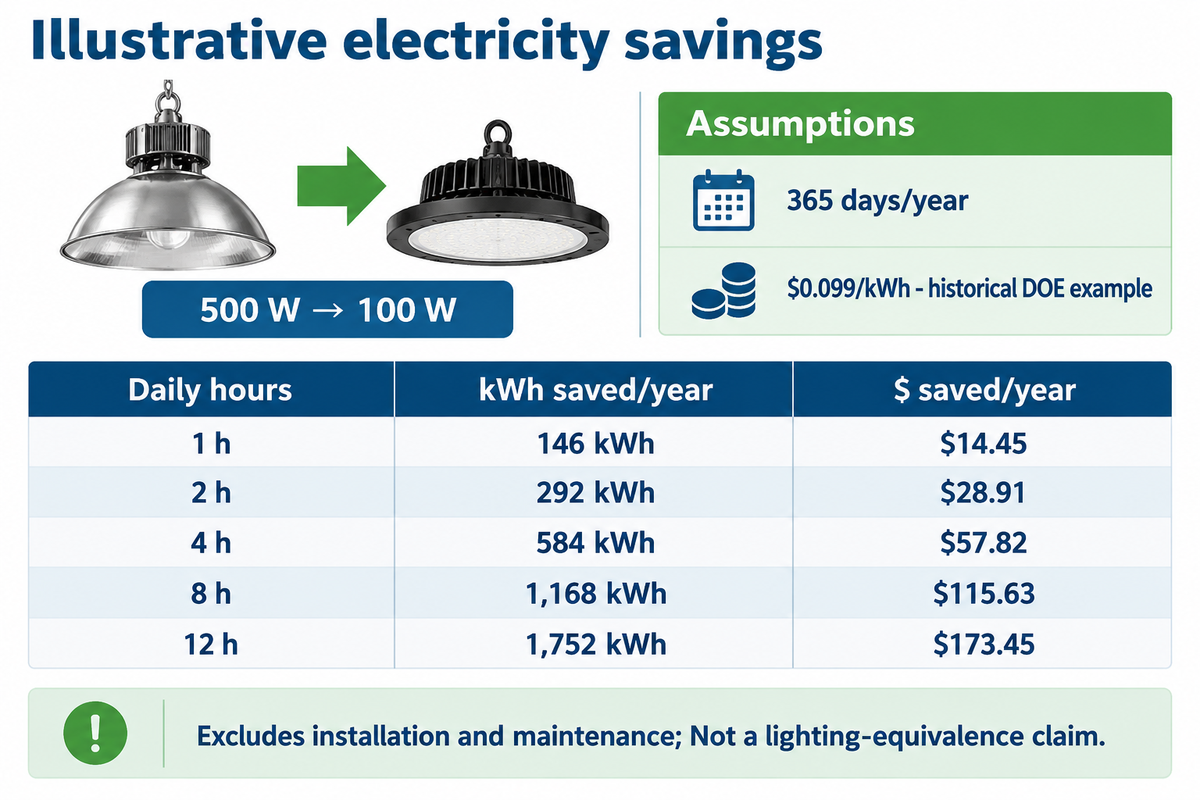
For an assumed change from 500 W to 100 W, operating four hours daily for 365 days at $0.099/kWh, the electricity saving is $57.82 per year per light. The rate is the historical illustrative federal-facility assumption in DOE’s June 2023 buyer guide, not a current local tariff. This calculation describes power use only; choose a lighting solution that passes the coverage and compatibility checks before using it in a purchase decision.
The DOE example rate supplies a transparent input; replace it with your own electricity bill. The Business Wales method begins with system load, annual operating hours and electricity price to determine the cost. The electricity price in dollars per kilowatt-hour can be multiplied by annual consumption to calculate the annual electricity cost.
Annual saving: (old system W − new system W) ÷ 1,000 x annual hours x price per kWh.
For the stated example: (500 − 100) ÷ 1,000 × (4 × 365) = 584 kWh/year. At $0.099/kWh, 584 × $0.099 = $57.816/year, rounded to $57.82. A sensor that cuts operating hours changes the result; use the expected switched-on time rather than the length of the night.
Operating-Hours Savings Table
The following table shows the effect of change in use time on the same power reduction, prior to installation and maintenance costs.
| Hours per day | Annual energy saved | Annual electricity saving |
|---|---|---|
| 1 h | 146 kWh | $14.45 |
| 2 h | 292 kWh | $28.91 |
| 4 h | 584 kWh | $57.82 |
| 8 h | 1,168 kWh | $115.63 |
| 12 h | 1,752 kWh | $173.45 |
The financial comparison relies on the power differential and the installed cost. The five-year analysis that follows holds the four-hour assumption. Request firm quotes for the unpriced items; a short payback based on electricity alone may not hold when the cost of access for installation is high.
Illustrative total cost of ownership: retain or replace
| Cost item | Retain 500 W system | Install suitable 100 W system |
|---|---|---|
| Purchase price | Replacement bulbs as needed | Use the selected product quote |
| Installation & commissioning | Service work required | Include fitting, access and aiming |
| Energy (5-yr) | $361.35 | $72.27 |
| Maintenance & spares (5-yr) | Bulbs, controls and service visits | Driver, controls and service arrangements |
| Downtime risk (5-yr) | Price the effect of a failed light | Price the effect of a failed light |
For a chosen two-year electricity-only payback target, the maximum incremental installed budget is $57.816/year × 2 = $115.632, rounded to $115.63 per light. Compare the actual installed quote with this ceiling. This example excludes maintenance differences, financing, tariff changes and control standby consumption.
DOE notes that LED electronics can fail before the emitters, so an advertised light-source life is not a maintenance-free promise. Maintenance costs should differentiate between the lamp and the full system. Ask which parts can be replaced and what happens when a driver or sensor fails.
Choose a Replacement for Your Site
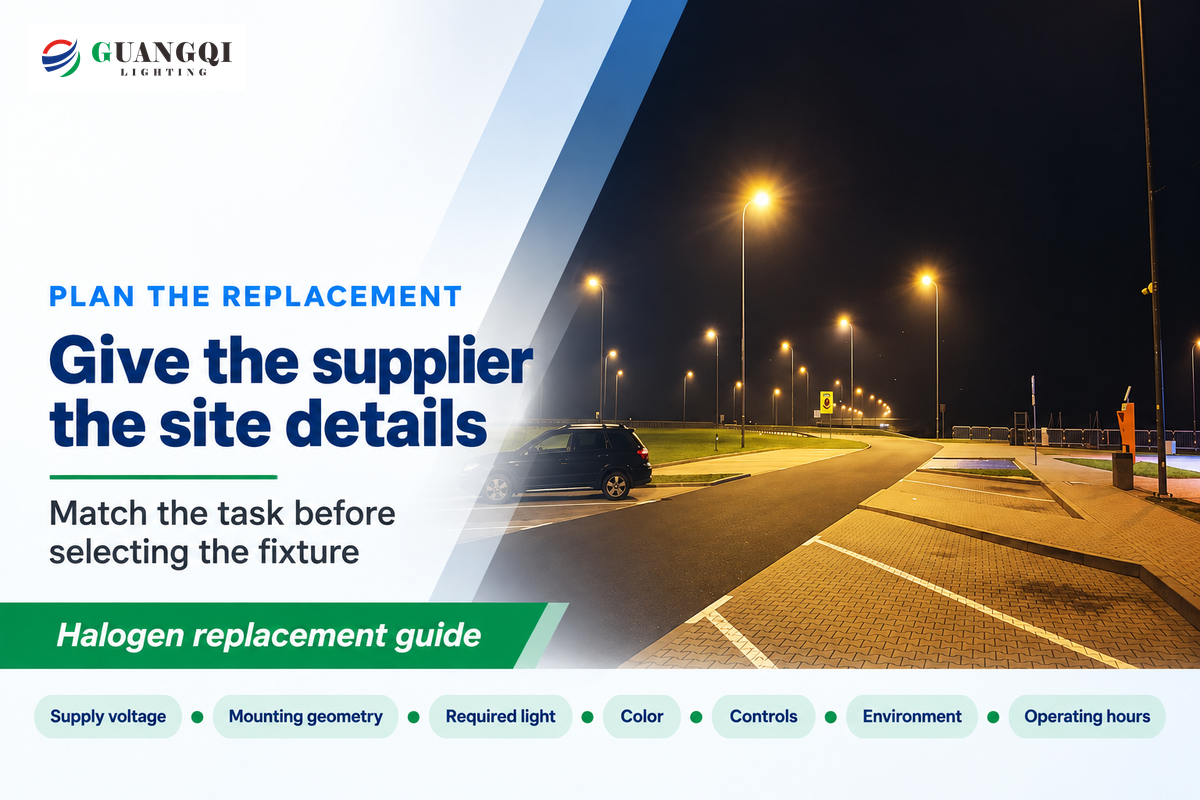
Choose a replacement around the task, mounting and operating constraints, then ask suppliers to explain how their product meets the requirement. A commercial yard needs a layout; a display needs color and glare checks; a sound small fitting may need only an approved replacement lamp.
For a complete-fixture comparison, GQLAMP’s published model table lists its GQ-FL50 at 50 W and 6,500 lm, and the GQ-FL100 at 100 W and 14,500 lm. The latter is offered in 60°, 90° and 120° beam options in the model table. These are the manufacturer’s model figures. When selecting beam and layout for the site, don’t take model names as halogen equivalence labels.
Copy the following fields into a quote request, and include fixture photographs, area dimensions, mounting heights and existing control details. Procurement can then compare quotations without asking each supplier to guess what “same brightness” means.
RFQ checklist — copy these into your quote request:
| Parameter | Recommended range | Why it matters | How to verify |
|---|---|---|---|
| Supply voltage | Match the measured/nameplate V | A 120 V lamp and a 230 V lamp are different products | Check installation and product labels |
| Mounting geometry | State height and setbacks in m or ft | Distribution changes with position | Dimensioned site sketch |
| Lighting requirement | State the task and required lux or foot-candles | Defines useful illumination | Agreed layout and site check |
| Color requirement | Specify CCT in K and needed rendering | Protects appearance and task visibility | Data sheet plus sample evaluation |
| Controls | Identify dimmer, sensor or photocell model | Prevents incompatible operation | Compatibility statement and trial |
| Environment | State rain exposure and ambient °C or °F | Determines enclosure and thermal suitability | Application ratings and installation instructions |
| Operating schedule | State hours/day and days/year | Makes savings comparable | Schedule or measured operating record |
A landscape spot light used for accent lighting, path lights marking a route, and broader outdoor lighting serve different functions. In general, when an equivalent energy-efficient replacement uses fewer watts, don’t add excess output. Consult the LED flood light wattage guide for wider application sizing, and the lighting control panel guide for integrated switching.
Send your existing lamp marking to GQLAMP along with dimensions of the site and operating schedule to discuss an LED flood light retrofit.
Request a floodlight replacement recommendation
Frequently Asked Questions
How long do halogen flood lights last?
Use the exact bulb’s rated life; the two Philips models cited here each list 2,000 hours.
That rating belongs to the lamp, not every component of the floodlight. The housing, socket, switch and sensor have separate service requirements. When comparing replacements, ask about the complete product warranty and which components can be serviced. A long LED emitter-life figure shouldn’t be substituted for a guaranteed maintenance interval for the entire installation.
How do I change a halogen flood light bulb?
Isolate the power, allow the unit to cool as its instructions require, and follow the fixture’s lamp-replacement procedure.
Use the specified lamp type and rating, and handle the replacement as its packaging directs. Inspect the protective glass, seals and retaining parts before returning the unit to service. A cracked cover, damaged socket or suspect wiring needs attention rather than another bulb. Use qualified help for hardwired equipment, uncertain isolation or difficult access; don’t improvise a lamp-holder conversion.
Why were halogen lights banned?
“Halogen ban” is an imprecise description of rules that apply to defined lamp categories in particular jurisdictions.
For example, the U.S. general-service-lamp rule published in 2024 defines covered lamps and exclusions; it isn’t a worldwide prohibition on every halogen product. Check the exact category and current local requirements when sourcing a replacement. Don’t assume that a rule about selling covered lamps requires removal of all already-installed floodlights.
Is it flood light or floodlight?
Both spellings refer to the same general type of broad-area lighting.
Product searches may use either form. Pay more attention to the lamp base, voltage, beam and application rating than to whether the seller writes the name as one word or two.
Should I leave floodlights on all night?
Run floodlights for the hours needed by the site’s activity and security plan, and use suitable controls where lighting can be reduced.
A photocell can follow daylight changes; a sensor can detect activity. Confirm the controls work with the selected light and preserve the required illumination. Unnecessary hours add electricity cost and unwanted spill, even with LED lighting.
Do halogen flood lights use a lot of electricity?
A 500 W light uses 0.5 kWh for each hour it operates at that input power.
Multiply by your operating hours and tariff to find the cost. Compare that result with a suitable replacement’s complete-system consumption, including any controls, before deciding whether changing the light is worthwhile.
Our Perspective on Halogen Replacement
GQLAMP supplies LED lighting, so this guide focuses on the decisions involved in replacing a halogen flood light. The model examples come from published manufacturer specifications, while the electricity calculations use stated assumptions. We separate lamp fit from beam performance because a lower power rating alone doesn’t answer either question. Learn more about GQLAMP’s lighting business.
References & Sources
- LED Basics U.S. Department of Energy.
- Purchasing Energy-Efficient Light Bulbs DOE; technical buyer tips on enclosure, fit and dimming.
- Glare in LED Outdoor Lighting DOE.
- Flicker Basics DOE.
- Comparing lumens to watts Australian Government Energy Rating.
- LED Lighting Business Wales; replacement checks and electricity calculations.
- General Service Lamps: 2024 Final Rule U.S. Department of Energy, Federal Register.