Get in Touch with GUANGQI


LED Pixel Lights for Building Facades & Architectural Installations
Individually addressable LED fixtures designed for animated facade illumination, media walls, and landmark lighting. IP67 waterproof, DMX512 & SPI controllable, rated 50,000 hours of outdoor use.
- IP67 Waterproof
- CE & RoHS Certified
- 50,000 hr Lifespan
- V-0 Fire Rating
- 8 Models Available
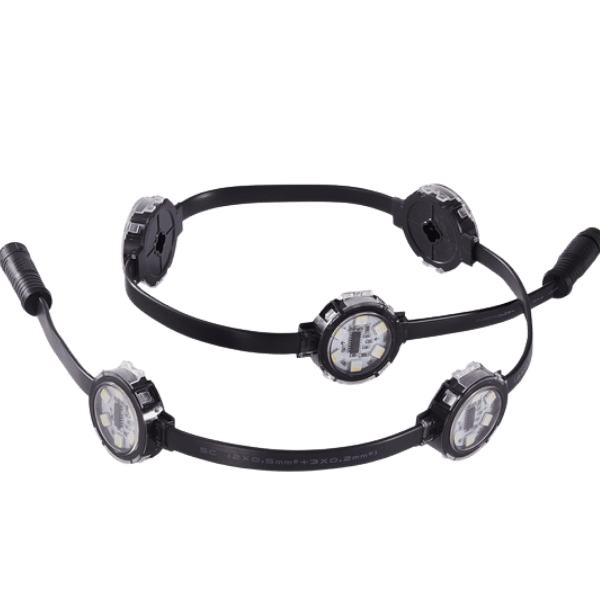
What Are LED Pixel Lights?
An LED pixel light differs from more generic LED lighting fixtures because it is a completely self-contained digital addressable LED point source of illumination—and it is also completely waterproof. Its body encloses an integrated circuit (IC) chip that is independently commanded through a central controller to set each pixel’s brightness and color independently—which means a grid of thousands of individual pixels across a large building facade can light up in a myriad of colors all at once.
What this makes possible—programable lighting down to the individual point—is similar to what you could do with a traditional LED flood or wash fixture if you lined up twenty of them across a scene: but instead of a couple of broad areas lit with one color each, a grid of pixel lights creates a rich, detailed “video” image composed of thousands of distinct points. What is “pixel” is basically a data point on a computer screen; in the same way you can make a image of many colored pixels with a computer, one of these pixel LED fixtures can create a scene made out of thousands of different illuminated pixel points.
A traditional LED flood or wash fixture can only be controlled as a single zone; with a pixel LED fixture you can control each individual pixel point in a grid separately. This allows building facades and other flat surfaces to be animated with animated images, individual color chasing, scrolling text, and even low-resolution videos—and means you can “resolve” a display in the same way you can a computer monitor or projection screen: the denser the pixels are spaced, the higher the resolution of the images you can produce from a given standing distance.
An LED pixel light works here as a physical equivalent of the “pixel” concept from a computer screen: each pixel light we produce in our Guangqi PX series is a cell in a grid on the side of your building. Put enough together in a pattern, connect them in a network and add in a programmer, and the wall becomes a pixel-based visual display. For a performance you can see from the street. The closer the pixel lights are spaced, the higher the “resolution” of the image.
One of the most important factors in pixel LED implementation is pixel density—how many pixels per unit of surface area. For a typical 20-storey isometric facade, you’d want something close to 40 pixels per square meter in order for the animation to look good from a viewing distance of thirty meters or more. Drop below 25 pixels per square meter and things start looking a little blockier, while anything above about 70 pixels per square meter doesn’t really add to the visual effect you see from the street yet any further increase in density costs a lot more and isn’t worth it.
Types of LED Pixel Lights: Round, Square & Rectangular
We design pixel LED fixtures in three main geometries, each one appropriate for different surface types and mounting methods. Your best choice depends on your building material, the space available for mounting, and the desired visual effect. Here is our product line in the Guangqi PX series:
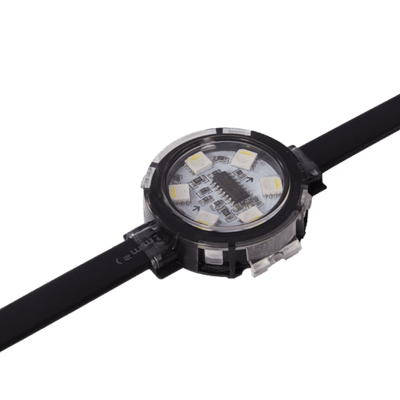
Round Series
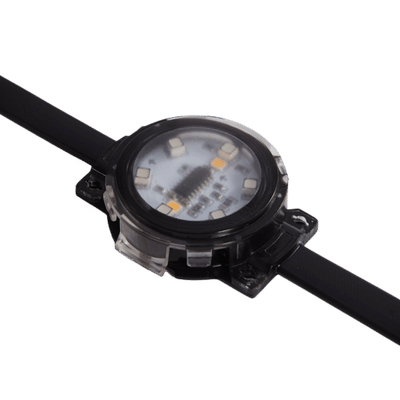
PX-F35
Diameter
34.2 mm
Height
12.3 mm
Power
0.72W / 0.96W / 1.44W
Voltage
DC12V / DC24V
Control
TTL / DMX512
Smallest diameter fixture capable of high density pixel LED requirements. At 34.2 mm diameter, the PX-F35 is the smallest round fixture in the series, suitable for close pixel spacing on concave and convex surfaces.
Round Series
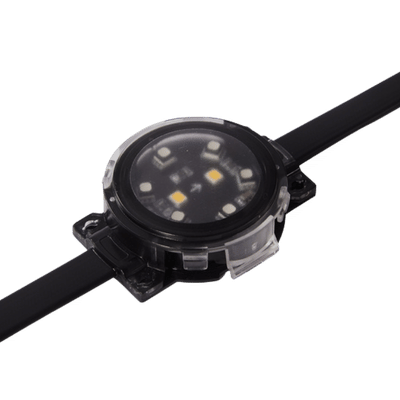
PX-F40
Diameter
39.6 mm
Height
12.8 mm
Power
1.44W / 1.96W
Voltage
DC12V / DC24V
Control
TTL / DMX512
Larger diameter fixture for use on bright displays at longer viewing distances. An output of up to 1.96W means this fixture gives more punch than the PX-F35.
Round Series
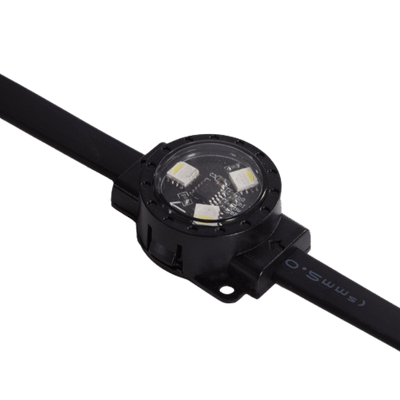
PX-F45
Diameter
45.0 mm
Height
16.2 mm
Power
1.44W / 1.96W
Voltage
DC12V / DC24V
Control
TTL / DMX512
Largest data-enabled compatible round module. At 45 mm diameter, it is conducive to wider beam dispersion, making it a good match for lower-density installations on large building facades where individual points are viewable from 50+ meters.
Round Series
PX-F32
Diameter
32.2 mm
Height
16.6 mm
Power
1.44W / 1.96W
Voltage
DC12V / DC24V
Control
SPI / DMX512
SPI-enabled small round pixel. Our PX-F32 combines a tiny 32.2 mm housing with SPI data protocol for easier wiring of single-string installations of 512 pixels or fewer, lowering per-string cabling costs.

Round Series
PX-F42 / PX-S50
PX-F42 Dia.
41.4 mm
PX-S50 Dia.
50.0 mm
Power Range
1.44W – 1.96W
Voltage
DC12V / DC24V
Control
SPI / DMX512
Larger SPI round pixels for medium-density grids. At 50 mm, PX-S50 is the largest round pixel in the line, creating a distinctive visual point that’s highly visible from a long distance, great for towers and observation structures.

Rectangular & Square
PX-K2560 / PX-K3338
PX-K2560
25 × 60 × 15 mm
PX-K3338
33 × 38 × 14 mm
Power
0.72W – 3.88W
Voltage
DC24V
Control
SPI / TTL / DMX512
Non-round form factors for linear grid distributions. The rectangular PX-K2560 (2.88W-3.88W) is the highest-output pixel in the series, well matched to installations requiring high brightness LED output at fewer mounting points. Meanwhile, PX-K3338 is designed for tight grid arrangements on flat surface facades.
All eight model variants are based on a uniform platform: durable PC housing material, IP67 waterproofing tested to IEC 60529 standards, V-0 fireproof rating by UL 94 standards, and compatibility with LED chips from Cree, Epistar, Osram, or San’an. Options include single-colored: red, green, blue, yellow, white, warm white; and full-color: RGB and RGBW—here, the add-on white LED channel produces higher-quality pastel and warm hues.
Facade & Architectural Applications for LED Pixel Lighting
Pixel lighting is designed for outdoor application. The individually addressable LED pixel lighting and rated IP67 enclosure allow this group of fixtures to serve as the backbone of architectural illumination of commercial and municipal buildings. Here are the key use cases in which pixel lights make a difference.
Building Facades & Media Walls
Tall building facades such as office skyscrapers, retail malls, and hotels often feature pixelized display grids to have animated lighting effects. Each building surface becomes a projection surface viewable from neighboring streets. Typical pixel spacing varies from 50 mm to 200 mm based on viewing distance and display duration complexity. RGB LED pixel and RGBW LED grids allow for collective branding as well as animated event briefs.
Ferris Wheels & Observation Structures
Theme parks and roller coasters call for fixtures that are resilient to frequent vibration, g-force, and 24-hour environmental exposure. Pixel lights are installed along acceleratory rides such as roller coaster tracks and bumper cars to shape spinning and spiraling motion from kilometers away. SPI control makes wiring simpler over the long rotational structural members. Always test run the installation for 72 hours before crane placement takes place on high towers-payments reveal unintended driver failures that can be a pain to resolve.
Bridges & Infrastructure
Bridges, tunnels, and pylons often use pixelized shapes to accentuate the lines and weights of the infrastructure. Pixel fixtures function during the hours of darkness to turn cityscapes into landmarks. With a -30C to 60 C range, pixels are suitable for cold winter environment bridge campaigns. Cable-supported bridges sometimes only need the round PX-F35 or PX-F40 modules along each cable strand.
Landmark & Monument Lighting
Public monuments, clock towers, and monuments can use pixel FX to project animated color schemes without permanent structural changes. Both divided structure and embedded flush appearance keep the pixel lights inconspicuous throughout the daytime. DMX512 protocols permit broader integration with city lighting inventories, providing the ability to synchronize displays of multiple icons during festivals.
Amusement Parks & Theme Parks
In addition to ferris wheels and other theme park rides, pixel lights form the structures themselves, or overlay them as frontlit and backlit signage. Entrance and security gates, directional wayfinding columns, or textured exterior facades are lit with predetermined color LED sequences programmed to match seasons or special events using the full RGBW set of color channels for quick scene changes without multiple transceiver boxes or added wiring.
Commercial Plazas & Retail Exteriors
Shopping centers and retail plazas use pixel lighting to oversize exterior facades into eye catching displays that attract passersby to high margin shops. Custom-designed effects, brand color accents, and scheduled animation sequences extend the visibility of retail property branding past dusk. With a ceiling of pixel grid fixtures, this flexibility allows holiday campaigns, grand openings, and day-to-day branding to be controlled from the same system with no need for fixture swaps.
Have a facade or structure that needs pixel lighting? Send us your project dimensions for a free layout plan.
Discuss Your ProjectHow Pixel Lights Work: DMX512, SPI & Addressable Control
Each individual LED pixel light contains a small (about 1x2mm) integrated circuit (IC). Its controller sends a data stream, and each IC reads its specific slice of that stream to determine the color and brightness levels of the LED chip attached to it. Two protocols dominate the pixel lighting industry: DMX512 and SPI. Knowing the difference will directly impact your project’s wiring complexity and price tag, as well as the ability to expand.
DMX512 (ESTA E1.11)
DMX512-A, regulated by the industry wide ESTA E1.11 norm, has been the solid industry standard since the 1980s. Transmitting data over a differential RS-485 signal, it carries 512 channels per “universe”. Each pixel typically carries RGB or RGBW, with 3 or 4 color channels respectively. A single DMX universe can control from 128 to 170 individual pixels.
To control thousands of pixels on a large installation, use multiple DMX universes simultaneously through the sACN or Art-Net Ethernet protocols, limiting the installation only by the bandwidth of your network. This is the best choice when you are integrating a pixel facade with existing professional lighting equipment and/or anticipate the need for a lighting desk for live control; or when your pixel installation exceeds the addressing capacity of SPI.
Great for:
Large facades (over 500 pixels), professional lighting setups, live/control room operation, multi control zones.
SPI (Serial Peripheral Interface)
SPI is a simple serial protocol with a ‘streaming data’ system, passing the data lines through each IC in a daisy chain while a clock signal determines the speed of each bit. Every IC then interprets its own 3 or 4 color channels of data and passes it along to the next.
Lower cost with a more modest addressing depth, SPI installations need fewer wires and simpler controllers. Maximum addressing depth before signal degradation (without repeaters) can be roughly approximated at 500-1000 pixels per data line, depending on the specific IC chip.
Best for:
Simple, mid scale (under 1000 pixels) installations with tight budgets and standalone display needs, directly controlling installation; eg feature walls, artist projections, and consumer retail settings.
Addressable vs. Non-Addressable: Why It Matters
This “addressable RGB” feature means each pixel has a separate address in the data stream, allowing the pixel controller to simultaneously color 1 pixel with red, 1 with blue, and 1 with yellow. Non-addressable variants (such as common luminaire or flood lights) read one data signal and will project the same color to every light in the row or cluster of lights.
However, the addressing function is what really distinguishes a media facade from a static colorwash facade. Activities as simple as pulsing gradients or color chasing waves start demanding pixel-by-pixel addressing. Once one has wired and configured a signal to a pixel light, the IC chips in the Guangqi pixel lights (typically WS2811 pixels, UCS1903, or SM16703 for SPI, DMX512 decoder for DMX) does the addressing work automatically.
More straightforward, lower cost wiring (SPI). But if you have a large project and go beyond 512 pixels, then DMX512 provides the addressing heigth you need. For very large projects we generally propose a mixed approach: SPI for the short, repeating, decorative areas, DMX512 for the main body of animation work where simulation light synchronization is required.
Online vs. Offline Control
Guangqi series pixel lights can be operated in either online or offline mode. For online mode, the pixel network runs in real time under the control of a controller/memory card attached to a PC running lighting software. For offline mode, the animation sequences are preprogrammed to a memory card of the controller, then the system operates automatically. Usually in commercial ceiling system, the red facade pixel run in offline mode, till it does the update.
Technical Specifications & Performance Ratings
Below table summarizes all 8 LED pixel light models on the critical specification categories relative to planning, namely power drain, physical size and control protocol. Only distinctions were found in these areas. All models can be summed up by the performance foundation listed below the table.
| Model | Form | Dimensions | Power | Voltage | Control | Beam Angle |
|---|---|---|---|---|---|---|
| PX-F35 | Round | Ø34.2 × 12.3 mm | 0.72W / 0.96W / 1.44W | DC12V / DC24V | TTL / DMX512 | 120° |
| PX-F40 | Round | Ø39.6 × 12.8 mm | 1.44W / 1.96W | DC12V / DC24V | TTL / DMX512 | 120° |
| PX-F45 | Round | Ø45.0 × 16.2 mm | 1.44W / 1.96W | DC12V / DC24V | TTL / DMX512 | 120° |
| PX-F32 | Round | Ø32.2 × 16.6 mm | 1.44W / 1.96W | DC12V / DC24V | SPI / DMX512 | 120° |
| PX-F42 | Round | Ø41.4 × 14.7 mm | 1.44W / 1.96W | DC12V / DC24V | SPI / DMX512 | 120° |
| PX-S50 | Round | Ø50.0 × 15.0 mm | 1.5W / 1.96W | DC12V / DC24V | SPI / DMX512 | 120° |
| PX-K2560 | Rectangular | 25 × 60 × 15 mm | 2.88W / 3.88W | DC24V | SPI / DMX512 | 120° |
| PX-K3338 | Square | 33 × 38 × 14 mm | 0.72W / 0.96W / 1.44W | DC24V | TTL / DMX512 | 120° |
Common Specifications Across All Models
LED Chip Options
Cree, Epistar, Osram, San’an
Color Options
R, G, B, Y, W, WW (single color) | RGB, RGBW (full color)
IP Rating
IP67 (IEC 60529) — dust-tight, temporary immersion rated
Fire Rating
V-0 (UL 94) — self-extinguishing within 10 seconds
Housing Material
PC (polycarbonate)
Electrical Safety
Class III (SELV / extra-low voltage)
Operating Temperature
-30°C to +60°C
Beam Angle
120°
Lifespan
50,000 hours
Outdoor Durability
10-year longevity, year-round weather resistance
Certifications
CE, RoHS
A note about the choice of voltage: 24V is more advantageous for a longer run of cable as the voltage drop over a long distance is lesser. If the cable run between your pixel and power supply is greater than 5 meters 24V is going to keep the brightness uniform while a 12V supply is not. For very short runs and smaller installations where the total distance travelled remains under 5 meters 12V is acceptable (5V systems exist for consumer pixel products, but all Guangqi facade models run on 12V or 24V for the longer cable runs required in commercial projects). Use of the PX-K2560 or PX-K3338 is restricted to DC24V only due to their higher power consumption.
Require a certain combination? We customize LED chip, color temperature and wiring length according to your project requirements.
Get Custom ConfigurationLED Pixel Light vs Strip Light vs Dot Light
The elements of project specs for three product types often get mixed up: pixel lights, LED strip lights, and LED dot lights (or LED point light sources). Both functionalities are similar but different. Clarifying these can avoid over specifications of costly fixtures and avoid under specifying fixtures that actually require individually addressable control.
| Feature | LED Pixel Light | LED Strip Light | LED Dot / Point Light |
|---|---|---|---|
| Form Factor | Discrete module (round, square, rectangular) | Flexible or rigid linear strip | Often 80-160 mm diameter |
| Individually Addressable | Yes — each module has its own IC | Varies — basic strips are not; pixel strips are | Sometimes — depends on IC integration |
| Typical Power | 0.72W – 3.88W per pixel | 4.8W – 24W per meter | 5-15W per point |
| Best Use Case | Dynamic facade animations, media walls | Linear accent lighting, cove lighting, contour outlining | Starfield effects, signage backlighting, dense grids |
| Mounting Surface | Flat or curved facades, structural frames | Channels, grooves, flat surfaces | Perforated panels, mesh, curtain walls |
| Pixel Pitch Control | Fully adjustable at mounting time | Fixed by LED spacing on strip (typically 30/60/144 per meter) | Adjustable, but limited by wiring |
| IP Rating (Outdoor) | IP67 typical | IP65 – IP68 depending on encapsulation | IP65 – IP67 typical |
| COB Variant Available | No | Yes — COB strip for continuous light line | No |
When to Use Each Product
Use pixel lights in applications which need a lot of animation, color chases or video on a facade or structure. Its module form factor gives mounting options no strip-light can provide on irregular surface. Every unit is pixel-addressable by default.
Use strip lights or pixel led strips for linear accent purposes: cove lighting on the ceiling line, contour on window or door frame, neon flex outlines, or an ongoing line of light on the edge of a building element. If you do not have a requirement of individually addressable control on a linear surface, strip is more economical. COB strips can create a uniform line of light with no LED pixels showing.
Use the dot lights for ultra high density starfield effects, points of interest for signage and dynamic mood lighting elements where the smallest point possible is absolutely critical. Dot lights at 12mm are smaller than any of the pixel light modules offering. Due to their size they’re ideal for mesh and curtain wall applications where the light fixtures need to be virtually invisible in daylight conditions.
In most large curtain wall projects we will deliver a mix of all three types: pixel lights on the main animation zones of the facade, strip lights running along the main structural fascia and window lines, and dot lights fitting into decorative mesh panels within the glass curtain wall. A mix of pixel, strip, and dot typically provides a more cost effective solution than pixel lights alone while still creating a multi-layered visual experience.
Installation Planning for Outdoor Pixel Lighting
A carefully considered planning process will determine the ultimate reliability of the pixel lighting system over its lifespan. Contractor site conditions, climate and weather conditions, cable routing layout, operating voltage power distribution, and maintenance needs must all be addressed well in advance of installing the first fixture. Here are several practical guidelines based on hundreds of facade projects we’ve installed since 2010.
Site Survey & Pixel Layout Design
Calculate the surface area in m2. Establish the number of m2 of pixel density needed to be visible from the desired viewing distance at each location. To animate the facade at 30-50m viewing distance 16-64px/m2 is typical working range for most content. Make a tracer outline of proposed pixel locations on facade drawing. Resolution needs to accommodate window locations, drainage runoff paths and sensitive structural material interfaces. Your pixel layout is the blueprint for all the downstream system design: wiring topology, fixture sizes, power all depend on how the pixels are mapped.
Power Distribution Planning
Aggregate all pixel used, multiply by each pixel’s power consumption value. Add 20% for system headroom to find out the power supplies needed. For 36px per m2 at 71m2 operation with the PX-F40 pixel at 1.96W each 36 × 71 × 1.96 = 5009W. One of more power supplies with a minimum capacity of 20% more would be needed to provide pixel saturation at this density. Consider placing power supplies every 15-25 meters along the length of wire for best performance. For outside locations power supplies should be rated for Class III operation. Use a minimum of IP67 rated power supplies especially outdoors.
Signal Wiring & Controller Placement
Wire the data out and back between controller and start of pixel groupings. Use SPI or DMX512 protocols. Each SPI chain acts as a single data stream, connect each pixel to the next to create a chain, avoid longer runs over 500-1000 pixels. DMX512 runs shall be wired in a twisted pair pair wire, terminated with 120 ohm resistor at either end of the run. Protect each pixel power-to-data conversion with fuse and cable regulator box enclosures if left outside. For DMX512 universes create Cardnox nodes placed as needed to distribute the network locally.
Weatherproofing & Connector Sealing
Remember, a flood-proof IP67 or IP68 fixture makes no difference if the cable connections aren’t sealed. Use IP67 or better rated dipors and connectors when wiring any connections together. Solder joints should be protected with heat-shrink tubing and covered with marine-grade self-fusing tape. Run downward, and laterally to avoid gathering rain water in junction boxes. A higher rated IP67 ensures no intrusion from rainwater after many years of exposure to high velocities and extended immersion.
Mounting & Mechanical Fastening
Pixel lights attach using adhesive pads, screw through brackets, or clip in mounting plates depending on the facade material. Standard hardware for concrete and masonry anchor-mounted stainless steel screw mounts with silicone back-sealing. For ACP and glass curtain wall, custom clips are designed to maintain the panel warranty by eliminating the need for drilling. When designing the assembly, include the expansion of the mounting hardware in long runs of pixel modules – individual pixels are too small for expansion to be an issue, but the mounting rails and brackets need slotted holes.
Testing, Commissioning & Burn-In
After installation verify each pixel on the controller program and confirm it is responding correctly. Run a maximum-brightness white test to look for dead pixels with color variation. Then run a 72-hour burn-in at full power to screen any early breakdown of the components batteries for LEDs and driver ICs tend to last about 48-72 hours of continuous operation. Replacing one failed pixel on-site is straightforward, replacing one on the 18th floor as a permanent installation is avoided at all costs.
Common Installation Error
Running DC12V to pixels located 8-10 meters from the power supply. By the time the voltage drop adds up along the cable run, the pixels at the end of the run are significantly dimmer than those at the beginning. If your layout with long-distance runs cannot avoid this situation, upgrade to DC24V or add a power injection point a third of the way down the run. Installing this at the time of the project is a lot cheaper than retrofitting it years later.
Pricing Factors & Project Budget Guide
The rest of the technical factors effecting pixel light pricing may be less obvious but are equally important: pixel light price by component. A true apples-to-apples comparison of two Chinese pixel lights sold by a lower-tier manufacturer helps you understand how to construct a successful budget.
LED Chip Brand & Grade
The binning consistency and protective lumen data on Cree and Osram chips costs more than Epistar and San’an. When deploying the pixels in a visual environment where chromaticity along all 16.7 million colors needs to be very consistent (media facades, branding applications) the premium on top-tier chips is well worth it. When the pixel light is being used decoratively and can be viewed at moderate distances mid-tier chips provide color richness on par with those built on the higher-cost 20-company binning lines.
Pixel Size & Power Rating
Chips in larger modules tend to be more expensive, since manufacturing a 2.88W-3.88W chip requires more equipment time than the smaller form factors. The PX-K2560 at the top-end of the asset is rectangular in shape to begin with, requiring additional material and different manufacturing infrastructure, as well. And a model like the PX-F35 (0.72W-1.44W) is less costly per pixel than a 3W module, but each module may require multiples to get the same brightness.
Control Protocol
The cost of DMX512-compatible LED pixel light is ever so slightly higher than SPI-only pixels because the DMX decoder IC is more complex than an SPI shift register. The difference per pixel is marginal, but it adds up for large quantities of pixels. Add to this the extra cost of the controller as well as the wiring: DXX512 needs better shielded wire and controllers – generally more costly – than SPI systems.
Order Quantity & Custom Configuration
All of our pixels are volume priced. Custom configuration can be priced at a discount (this excludes your “specials”) with a minimum order quantity, (wire length, connector type, color temperature). Lead time for standard models of our products is normally 2-3 weeks, custom configuration could add additional 1-2 weeks depending on customization modification.
Budget Allocation Guideline
Total project cost for a complete facade pixel lighting system is approximately: Pixle fixtures 40-55%; power supplies & controllers 15-25%, cabling & connectors 10-15%; installation labor 15-25 %. Depending on building height(taller building increasing labor share), pixel density (denser grid increasing fixture share), control complexity (live-event DMX system increasing controller share).
A line-item quotation is available for any project. Provide us with the exterior dimension, pixel density, desired control system, and we will engineer a customized line item quotation for you- usually within 2-3 business days.
How can I get a detailed project quotation? Our engineers can do the calculation from pixel quantity to power supply capacity.
Request Detailed PricingReal-World Project Showcases
All three infrastructures displayed here cover different application types and scales. Each structure offered technical challenge and requiring based on the specific application choice of a different model of the Guangqi PX series.
Observation Wheel Dynamic Lighting Installation
A 65 meter observation wheel in a high-profile coastal tourism plaza. The operator required animated effects viewable from the adjacent waterfront promenade (~200-400 meters away). The key technical challenge was vibration, as the wheel slowly rotations, and every fixture, then, endpoints are affected by the constant stresses across the fixture structure due to wind load as well as centrifugal forces.
Our decision was to implement the PX-F42 (diameter 41.4mm, SPI control). An optimal balance of output, size, and rationalized wiring makes this our preferred model in the “just enough” range of each attribute. Because the wheel spokes divided naturally into independent chains of about 80 pixels apiece, we chose SPI for the control system rather than DMX512, which would have required a more complex line of circuit cards run across the rotating slip rings while delivering no functional benefit at the pixel count of the spoke segments.
All fixtures were run through a 72-hour burn-in on the ground before installation on the wheel. Two units failed during burn-in and we repaired them before installation with the crane, confirming the justification of this standard and best practice for any high-elevation installation: field failures with this system have totaled less than 0.3% to date.
Hotel Facade Media Wall
1,400 m²
Facade Coverage Area
44 px/m²
Average Pixel Density
12 kW
Total System Power
A 22 story hotel required a media facade facing the street. The array was constructed between glass curtain wall sections and solid aluminum composite panel (ACP). PX-F40 pixels representing the ACP portion, providing 10 mm pixel density (direct surface mounting), while PX-K2560 rectangular modules covered the mullions (narrow, elongated profile – 18mm height) of the fenestration grid.
DMX512 control over Art-Net technology permitted the hotel AV team to trigger varied animation scenes for themed corporate events, outdoor markets and festivities, and city holidays from a central media server. Two models of pixel (PX-F40 and PX-K2560) also resulted in an approximately 15% reduction in overall fixture count by covering the window opening zone with fewer higher-output fixtures rather than many smaller lower-output models.
Commercial Plaza Decorative Lighting Retrofit
The Problem: An existing commercial plaza had aging halogen decoration lighting across three building fronts and two pedestrian arcades. Energy costs were high, illumination choices were limited to gel filters that faded every year, and access for maintenance in a bucket truck was required for every lamp replacement.
The Solution: We replaced the entire halogen system with a pixel light grid using PX-F35 (round, for the curved arcade columns) and PX-K3338 (square, for the flat storefront panels). The retrofit brought a nearly 80% reduction in the lighting energy load compared to the halogen system, plus full RGB color-changing illumination that was not available previously. The property management company programs seasonal holiday themed scenes—warm white and gold for winter, greens and blues for summer—in a tablet interface connected to the off-line controller. No bucket truck required to go from summer greens to winter golds!
Key Lesson: Retrofitting almost always uncovers wiring infrastructure shortcomings that new-build projects can avoid. In this project, the existing conduit paths were too narrow for the combined power and data cables. To keep the schedule on course, we ran the data cables in separate surface conduit, while using the existing conduit for power, therefore avoiding restoring finished drywall.
LED Pixel Lighting Engineering Tools
Start Your Pixel Lighting Project
From initial facade survey to final commissioning, our engineering team will assist you at each step. Tell us your building outline and we will send you a complete pixel lighting plan solution.
Request a QuoteFAQ: LED Pixel Lights
IP67 IS the recommended minimum for facade-mounted pixel lights. IEC 60529 defines IP67 as a fixture completely dust impermeable (6) and suitable for temporary immersion in water at depths of 1 meter (7). This matters because facade fixtures face direct rain impact, not just splash. IP65 fixtures handle dust and low-pressure water jets, but after 3-4 years of exposure to wind-blown rain, fixtures without IP67 ingress protection commonly develop leaks at the junction of the power cable and the fixture.
Pixel density is a project-to-project decision based on viewing distance and content type/quality needed. As a general reference, 36-64 pixels per sq.m. can hold up well for a typical commercial building facade from 20-50 meters away rendering simple animation effects with clear area coverage. Video-quality media facades behind more immersive experiences at up-close viewing angles may call for 100+ pixels per sq.m. Video-mapped RGBW simple color wash effects could be achieved at 16-25 pixels per sq.m. Send us your project dimensions and typical viewing distance so our engineering team can determine the best pixel layout recommendation.
Guangqi LED pixel lights are rated for 50,000 hours, roughly 11-13 years at 10-12 hours of daily operation. PC housing and IP67 sealing are tested for 10-year outdoor durability. Coastal salt spray environments may need more frequent service than inland sites.
Guangqi pixel lights operate on class 3 power supplies, rated for 50,000 hours, and an operational voltage of DC12V or DC24V. Power input consumption depends on the LED pixel configuration model: from 0.72W-3.88W. For estimating power demand on your project, add up the system total power consumption then add 20% margin to specify the power supply size. Use outdoor Class 3 approved power supplies with rated waterproofing level of IP67 or higher. We recommend operating at DC 24V for dispersed installations or where long cable runs are anticipated to reduce voltage drop.
Yes- and amusement parks and outdoor rides are one of the most difficult application environments for pixel lights. Vibration, centrifugal, weather exposure, temperature extremes all go along with constantly moving Guinness displays, ferris wheels, and countless ride operations. The V-0 UL-94 fire rated (Classified for 50,000 hour operation) PC housing rated IP67 waterproofing made specificlaly for these applications are a core part of Guangqi pixel lights used for theme parks, blow-up rides, and other enviromental/extreme use settings. Our pixel lights pass the demanding test for movement wheels where the set of them must maintain the effect through years of continuous rotations.
Guangqi Lighting offers its pixel lights with a 2-year warranty (or 5 years for qualifying projects, based on the specifics of the project). All pixel light models are covered under a manufacturing defect claim, premature LED die failure, or waterproofing assembly failure fault. Our 24-hour phone support commitment translates to a technician will call you or your reps back within 1 business day. For projects above 5,000 pixels, we also include on-site commissioning support and a batch of spare units (typically 2-3% of order quantity) shipped at no additional charge so field replacements can happen without lead time delays.
Just start by providing 3 pieces of info: the facade size you want to deploy the pixel lights on (height and width in meters) the viewing distance to the building from the street or public area and choose the static color scenes, animated image patterns, or complete video contents you want to use. Forward this info to our engineering team via the quote request form and we will do the calculations for pixel density, recommend specific lighting models, prepare wiring diagram plan, and send you a project quotation within 2-3 working days for typical size facades.
Trending now