Get in Touch with GUANGQI




Buying commercial solar flood lights is a specification problem, not a shopping problem. A facility manager lighting a parking lot, a contractor bidding a perimeter, or a municipal buyer wiring nothing at all needs proof the fixture will still hit its numbers on a cloudy night in January, and most product pages never give it. This guide is the procurement layer above the consumer buying advice: how to read the spec sheet, size the battery, hit the light level your application requires, and qualify for rebates.
Commercial solar flood lights are self-powered LED area luminaires that pair a photovoltaic panel, an MPPT charge controller, and a LiFePO4 battery to deliver roughly 5,000–20,000+ lumens for parking lots, perimeters, and facades without trenching or a grid connection. Unlike residential units, a commercial-grade fixture carries LM-79 and LM-80 photometric test data and is sized for two to three nights of autonomy so it doesn’t go dark after a run of overcast days.
Key Takeaways (Before You Request a Quote)
- A quoted panel wattage is solar input, not light output, a “100W” solar flood light usually runs a 20–30W LED array. Compare lumens, never watts.
- LiFePO4 isn’t cold-immune: it loses roughly 15–25% of usable capacity near −10°C, which is exactly when your nights are longest.
- “Solar always wins” is false. Below three peak sun hours in winter, even a correctly sized off-grid system fails, critical 24/7 sites need a hybrid grid backup.
- A high-output commercial flood light can’t be “DarkSky Approved” at 5000K; that program caps color temperature at 3000K.
- The economic case is driven by avoided trenching (~$30 per linear foot), not the fixture price.
Quick Specs: Commercial vs Residential Solar Flood Light
| Attribute | Commercial-Grade | Residential/Consumer |
|---|---|---|
| Battery | LiFePO4 pack, 25.6V or 51.2V, 3,000–6,000 cycles | Li-ion (NMC), 500–1,200 cycles |
| Controller | MPPT (+15–30% winter harvest) | PWM on/off |
| Photometric proof | LM-79 + LM-80/TM-21 reports | Marketing lumens only |
| Sealing | IP66 (pressure-jet rated) | IP44–IP65 |
| Lumen range | 5,000–20,000+ lm | 500–3,000 lm |
| Warranty | 5 years, battery replaceable | 1–2 years |
Guangqi Lighting builds solar and wired fixtures across this range; see the commercial solar flood lights collection for models with published photometrics.
What Separates a “Commercial-Grade” Solar Flood Light From a Consumer Unit
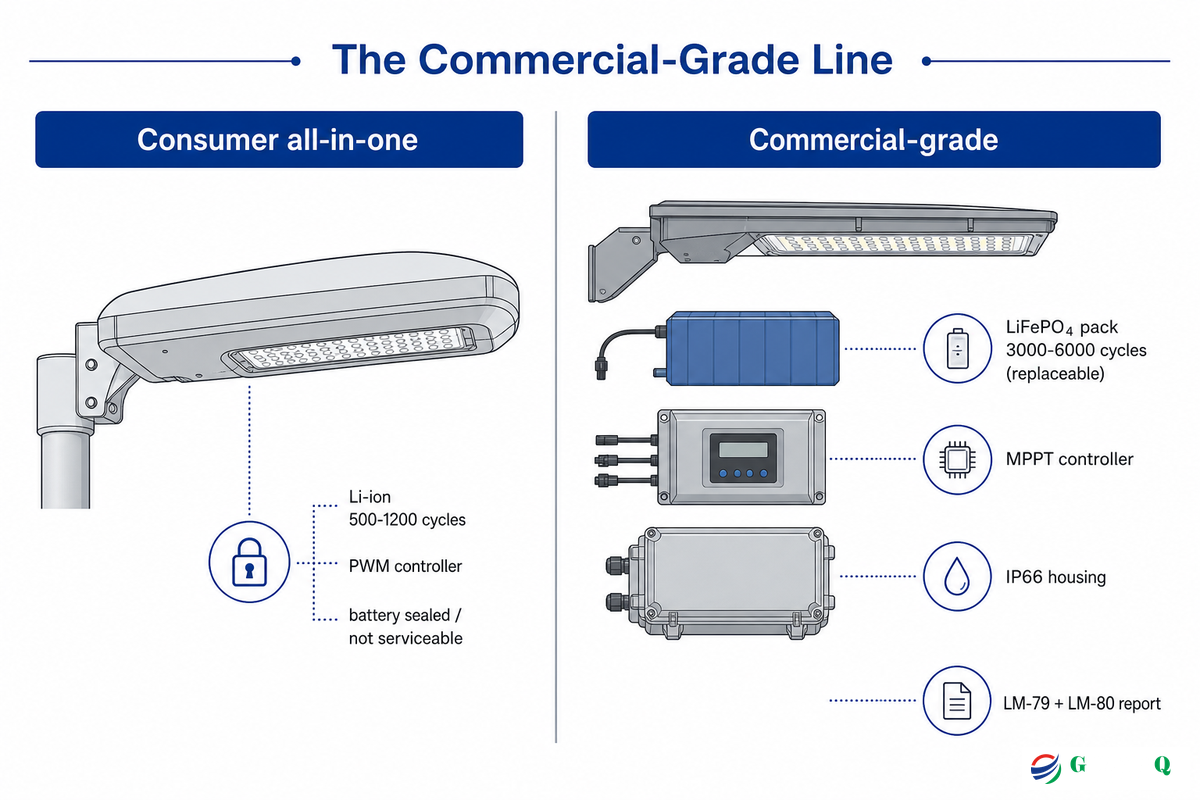
A fixture earns the “commercial” label when it clears six measurable thresholds, battery chemistry, charge controller, photometric proof, ingress protection, thermal engineering, and warranty. The word “commercial-grade” appears on almost every product page, but vendors rarely attach numbers to it. The Commercial-Grade Line above is the pass/fail gate: if a fixture misses two or more rows, it’s a rebadged consumer light fixture no matter what the listing says.
The clearest divide is architecture. Consumer “all-in-one” lights fold the solar panel, battery, and LED light into one sealed body for tidy shipping; when the battery dies at year three, the whole unit is scrap. Field practitioners on solar forums consistently steer commercial buyers toward systems with a separate, serviceable MPPT charge controller and a replaceable LiFePO4 pack, the difference between a ten-year asset and a disposable. The integrated architecture itself is old: the foundational patent for a solar light combining an LED, rechargeable battery, panel, and dusk-to-dawn control dates to US Patent 6,573,659. What separates a 2026 commercial fixture isn’t the concept, it’s the proof.
If you’re new to how the panel-to-LED energy path works, our solar flood lights technical guide covers the fundamentals; this page assumes you’re past that and ready to specify.
A common failure shows why the line matters. A property manager orders a batch of “commercial grade solar flood lights” for a 40-unit apartment perimeter, picks the cheapest 8,000-lumen listing marketed as the best commercial solar flood lights, and finds half the run dark within 2 years. The reason is structural, not bad luck: those units used sealed Li-ion cells that shed capacity in the cold and a body that makes the battery impossible to replace. Guangqi engineers every commercial fixture around a serviceable LiFePO4 pack and in-house thermal testing precisely because that hidden failure point is where the cheap imports lose money.
✔ Key Point
Ask for the battery chemistry in writing. “Lithium” can mean Li-ion (NMC) or LiFePO4, and the lifecycle-cost difference is roughly 5x. If a data sheet only says “lithium,” assume the cheaper chemistry until proven otherwise.
Reading the Spec Sheet: 7 Numbers That Decide a Commercial Solar Flood Light

Seven numbers predict field performance: delivered lumens, luminous efficacy, color temperature, color rendering, beam distribution, BUG rating, and ingress protection. Read them in that order, and treat any missing number as a red flag rather than a rounding error.
Start with the single most abused figure. A “100W solar flood light” describes the panel’s rated solar power input, the LED array behind it typically draws 20–30W. At a realistic efficacy of 150 lumens per watt, a 25W array delivers about 3,750 lumens, not the “10,000+” a marketing headline implies. The math is unforgiving: genuine 20,000-lumen output needs roughly 100–130W of constant LED power, which a panel smaller than 15 inches physically can’t recharge. If a listing claims five figures of lumens on a tiny panel and a sub-20Ah battery, the number is theoretical, not measured.
Higher wattage doesn’t mean brighter, either. A 30W fixture at 160 lm/W produces about 4,800 lumens; a 50W fixture at 100 lm/W produces about 5,000, two-thirds more battery drain for under 5% more light. On a solar fixture, where every watt spent at night must be earned back during the day, efficacy is a survival metric, not a footnote.
The reason this matters is structural: on a solar fixture the battery is a fixed daily budget, so a padded lumen figure quietly drains it and the light fails early. Guangqi measures delivered output on an in-house goniophotometer to the LM-79 method rather than trusting a supplier’s headline, because the gap between claimed and measured lumens is exactly where field failures start.
| Spec | What it proves | Commercial range | Red flag |
|---|---|---|---|
| Delivered lumens | Actual light at the fixture | 5,000–20,000 lm (LM-79) | Panel watts shown as output |
| Efficacy | Light per watt of battery | 140–200 lm/W | Not stated |
| CCT | Color of light | 4000K–5000K security; 3000K dark-sky | No Kelvin listed |
| CRI | Color accuracy | 70+ (80+ for retail/camera) | Below 70 or absent |
| Distribution | Beam shape on the ground | Type II/III/V per application | “Wide beam,” no type |
| BUG rating | Uplight/glare control (TM-15) | Low U-value for ordinances | No BUG or “unshielded” |
| IP rating | Water/dust sealing | IP66 minimum | Below IP65 outdoors |
Ranges compiled from IES lumen-maintenance guidance and commercial product photometrics; verify each against the vendor’s LM-79 report.
📐 Engineering Note: LM-79 vs LM-80 vs TM-21
These aren’t interchangeable. LM-79 tests the finished luminaire, total lumens, efficacy, CCT, CRI, and distribution. LM-80 tests only the bare LED package over a minimum of 6,000 hours. TM-21 then projects that LM-80 data into a rated life such as L70 (the hours until output falls to 70% of initial). So the lifetime figure on a data sheet comes from TM-21, not LM-80, and the IES itself notes that L70 stops differentiating products above ~36,000 hours. Ask for all three; a fixture with only “50,000-hour” marketing and no reports has proven nothing.
Check the IP rating on the panel and the lamp separately. Some units publish IP66 for the housing while the panel connector is only splash-rated; our IP rating guide for lighting breaks down what each digit certifies.
Battery Autonomy & Panel Sizing: Guaranteeing the Site Never Goes Dark

Size the system from days of autonomy against your worst solar month, not from the panel wattage on the box. “Autonomy” is how many nights the battery can run the light with little or no charging, commercial off-grid designs typically target two to three nights. Everything else follows from that number.
Here’s the Autonomy-Days sizing formula, worked end to end so you can drop in your own figures:
📐 Worked Example: Autonomy-Days Sizing
Battery: Wh = LED watts × night hours × autonomy days ÷ depth of discharge.
A 60W fixture running 12 hours, 3 nights of autonomy, at 0.9 DoD for LiFePO4:
60 × 12 × 3 ÷ 0.9 = 2,400 Wh → at 25.6V that’s a ~94Ah LiFePO4 pack.
Panel: W ≥ daily load Wh ÷ worst-month peak sun hours ÷ system efficiency.
Daily load 60 × 12 = 720 Wh; a December site with 3.5 peak sun hours at 0.8 efficiency:
720 ÷ 3.5 ÷ 0.8 = ~257W of panel. Pull your worst-month peak sun hours from the NREL PVWatts calculator before you trust any vendor’s “works anywhere” claim.
Two spec choices decide whether that math holds in winter. An MPPT charge controller harvests roughly 15–30% more solar energy than a PWM controller in the low, changing light of overcast days, and monocrystalline panels beat polycrystalline by a similar margin in the same conditions. Chemistry matters just as much. LiFePO4 stays operable to around −20°C where a ternary NMC cell can lose 30–40% near −10°C and cut off entirely, but LiFePO4 is not immune to cold. It sheds roughly 15–25% of usable capacity near freezing, and controlled testing in the Journal of Power Sources measured a LiFePO4 cell delivering just 31.5% of its room-temperature capacity at −20°C. That’s the figure most buyers miss: size the pack for the worst month and the worst temperature, because both bottom out on the same January night.
Be honest about the ceiling. Even a well-specified system with motion sensing and adaptive dimming tops out around three to four days of autonomy. Plan the fixture, then run your numbers through the solar flood light sizing calculator before committing to pure off-grid on an uptime-critical site.
This is the reason commercial solar flood lights with battery specifications should always state three numbers a consumer listing omits: the LiFePO4 capacity in amp-hours, the depth of discharge, and the days of autonomy. Without them, one quote can’t be compared against another.
Application Sizing: Parking Lots, Perimeters, Signage & Sports

Match delivered lumens to the light level your application requires, then divide across enough fixtures to stay uniform, one over-bright pole creates glare and dark gaps, which is a safety failure, not a saving. The standard for parking is ANSI/IES RP-20, which sets a minimum maintained horizontal illuminance of 0.2 foot-candles and calls for an average-to-minimum uniformity of 3:1 or better. Ask a vendor whether a quoted ratio is average-to-minimum or maximum-to-average, they are not the same claim.
| Application type | Target level | Fixture output | Mount height |
|---|---|---|---|
| Walkway / pathway | 1–5 fc | 3,000–7,500 lm (30–50W) | 8–20 ft |
| General parking | 1–5 fc, 3:1 uniformity | 6,000–12,000 lm (60–100W) | 15–25 ft |
| Entrances / exits | 5–20 fc | 10,000–15,000 lm | 15–25 ft |
| Perimeter security | 5–20 fc vertical | 8,000–15,000 lm | 12–20 ft |
| Loading / service yard | 5–20 fc | 15,000–20,000 lm | 20–30 ft |
| Roadway / large lot | Per RP-8 class | 14,000–24,000+ lm (120–200W) | 25–40 ft |
| Signage / flag | Accent, uniform wash | 2,000–5,000 lm | Ground / bracket |
| Facade / wall wash | Accent, graze | 3,000–8,000 lm | Ground / soffit |
| Fuel / canopy | 20–30 fc | 10,000–15,000 lm | Canopy deck |
| Sports court / arena | Per class of play | 15,000–20,000+ lm | 20–40 ft, aimed |
Levels from ANSI/IES RP-20 and commercial photometric practice; mounting height drives lumen requirement, a 30-ft pole needs far more output than a 15-ft one for the same ground illuminance.
Are commercial solar flood lights bright enough for a parking lot?
Yes, when they’re sized as a system rather than bought as single units. A 300 m² (about 3,200 ft²) lot at the IES minimum works out to roughly 20,000–30,000 delivered lumens spread across four to six fixtures of 6,000–12,000 lumens each, not one giant pole.
The reason to split the load is uniformity: RP-20’s 3:1 ratio means the darkest spot between poles can’t fall below a third of the average, and a single high-lumen head leaves shadowed gaps that defeat both security cameras and the even illumination drivers rely on. Commercial solar units in the 6,000–12,000-lumen class, pole-mounted at 15–25 feet, and sold as solar led parking lot lights or high-powered solar flood lights, are the working range for most lots. For road-scale sites, our solar street lights carry the higher output and distribution types.
⚠️ Common Mistake
Ordering the highest-lumen fixture instead of the right distribution. For a stadium or sports court, beam control and glare rating matter more than raw output; see our stadium and sports lighting range for aimed optics rather than flood wash.
Pure Solar, Hybrid, or Grid-Tie? Choosing by Uptime Requirement
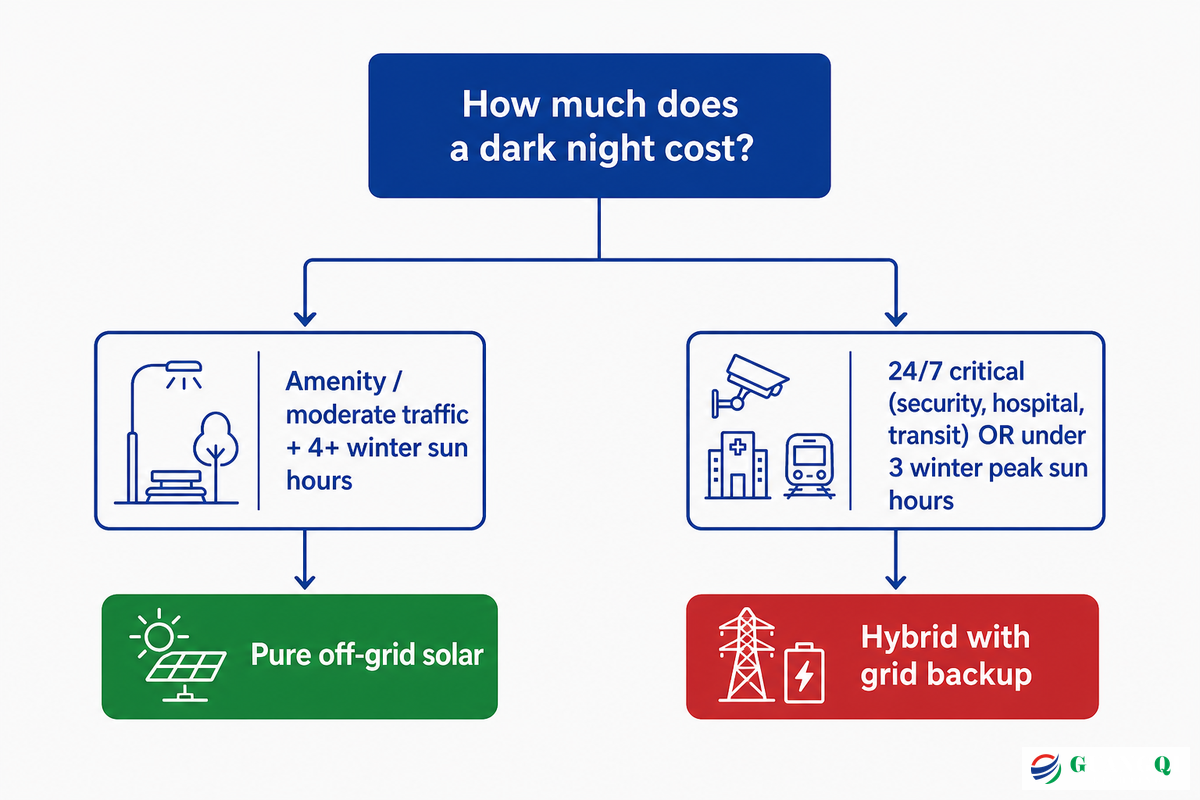
Match the power architecture to how much a dark night costs you. Pure off-grid solar fits amenity and moderate-traffic lighting with decent sun; a site that must stay lit through any weather needs a hybrid design that switches to grid backup when the battery drops below a set threshold. Treating every site as pure-solar is the marketing default, and it’s wrong for uptime-critical zones.
The hard cutoff is solar resource. A pure-solar system struggles below three peak sun hours per day in winter even when it’s sized correctly, a reality in the Pacific Northwest, the northern Baltic, and much of inland China. Practitioners on solar forums are blunt that storage cost and footprint make pure-solar parking-lot lighting unreliable at large scale, and residents in chronically cloudy regions report consumer solar simply failing over long overcast stretches. That isn’t a reason to avoid solar; it’s a reason to zone it.
✔ Pure solar fits
- Employee lots, secondary drives, overflow parking
- Landscape, pathways, signage, perimeter amenity
- Remote or off-grid sites with 4+ winter sun hours
- Where trenching cost is the deciding factor
⚠ Specify hybrid / grid backup
- 24/7 security checkpoints and gate houses
- Hospital drop-offs, transit hubs, emergency access
- High-security perimeters and loading docks
- Cloudy climates below 3 winter peak sun hours
How does solar lighting compare in cost to trenching for wired fixtures?
On a retrofit, solar usually wins because it deletes the most expensive line item: the trench. Running conduit and wire for grid-tied outdoor lighting costs on the order of $30 per linear foot, so a single pole set 200 feet from the nearest panel can carry $6,000 in trenching before the fixture is even mounted.
A commercial solar unit costs more upfront, roughly three to four times a wired head, but avoiding trenching and the electrical permit typically saves $2,000–$4,000 per fixture on a retrofit, which is why installed-cost math, not fixture price, decides these projects. New construction with conduit already in the ground narrows the gap; run the numbers on the solar vs wired ROI calculator for your run length.
Project TCO, MOQ & OEM/ODM: What Drives Commercial Pricing
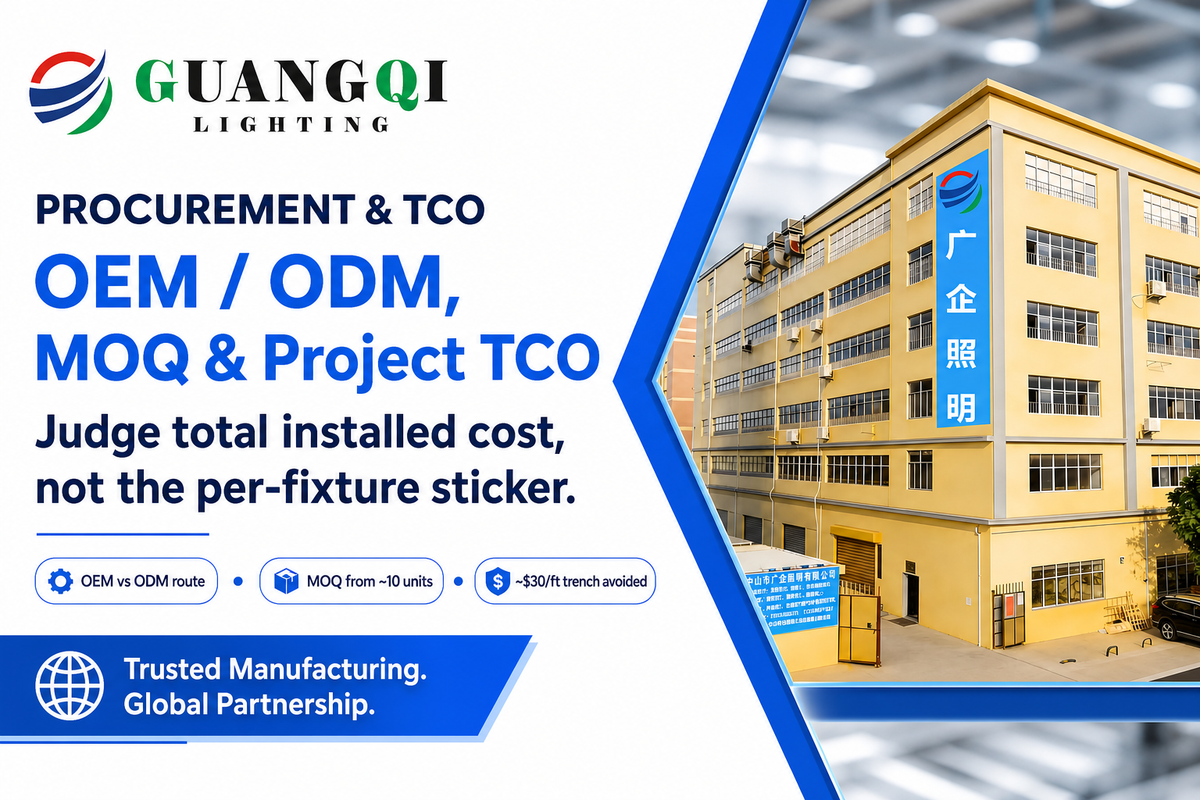
Commercial pricing is set by five variables, fixture wattage, LED chip grade, housing construction, optical design, and certification scope, then multiplied or discounted by order volume. Judge the project on total installed cost over the life of the asset, not the per-fixture sticker — a payback that keeps improving as Harvard Business School research tracks solar panel and battery prices falling 22% and 25% from 2020 to 2025.
Real numbers help calibrate a budget. Standard commercial solar area lights land roughly $440–$600 per unit at 50–70W; high-performance and hybrid models run $1,000–$1,500; and full parking-lot systems reach $3,000–$5,000 per pole depending on battery size and mounting. Payback on a trench-avoiding retrofit is commonly cited at three to six years, after which the fixture runs at zero energy cost. In our own manufacturing, unit cost is driven most by the die-cast housing tooling, the optical design, and the certification set a target market demands, which is why a fixture built for one market’s rebate program isn’t automatically the cheapest for another.
One scenario makes the trade-off concrete. A logistics operator lighting a 4-acre distribution yard found the trenching quote alone ran past $18,000 for cable to the far bays, more than the entire solar premium for the project. That hidden civil cost is what flips the decision: the reason solar wins on retrofits is rarely the fixture, it is the avoided digging. Industrial solar lights outdoor at this scale get specified by installed cost per covered acre, not by unit price.
📐 Engineering Note: OEM vs ODM and Minimum Order
Two procurement routes carry different economics. OEM uses an existing fixture and tooling with your branding, CCT, and market-specific electrical configuration, lower minimums, faster lead time. ODM develops new mold tooling, optics, and driver from your specification, higher minimums and a build-to-order lead time of roughly 12 weeks, with minimum orders often starting around 10 units. Standard catalog models with existing tooling ship far faster than a new ODM program, so confirm which route a quote assumes before comparing prices.
“The number buyers most often skip is depth of discharge. A pack advertised at 100Ah that you can only safely pull to 80% is an 80Ah pack for sizing purposes, get that wrong and the light dies a year early, on the coldest nights, when replacement access is hardest.”
Certifications, Rebates & Dark-Sky Compliance

The right certifications lower net project cost through rebates and keep you clear of ordinances that can force a re-install. Build the compliance list before you shortlist fixtures, because a cheaper light that fails a dark-sky code is the most expensive option once you pay to replace it.
For utility rebates, the currency is a DesignLights Consortium listing backed by LM-79/LM-80 photometrics; DLC’s outdoor dark-sky framework, LUNA, reached V2.0 effective January 5, 2026, and layers light-pollution criteria onto standard qualification using the IES TM-15 BUG method (Backlight, Uplight, Glare).
Dark-sky compliance holds a trap worth understanding. A high-output commercial flood light generally can’t be “DarkSky Approved” the way a porch light can, that residential category caps total output at 1,000 lumens. The DarkSky Commercial category has no output ceiling, but it requires a nominal CCT no higher than 3000K, uplight held to 0.5% of output (max 50 lumens), and a dimming option, so a 5000K security flood can’t qualify unless you respecify it to warmer 3000K. Jurisdictions are tightening: a 2025 University of Hawai‘i advisory recommends U0 (zero-uplight) fixtures per the same TM-15 standard in wildlife-sensitive areas. Over-lighting is a compliance failure too, not only under-lighting.
- ✔ LM-79 + LM-80/TM-21 reports, the gate for every rebate and dark-sky claim below
- ✔ DLC / DLC Premium listing for utility rebate eligibility
- ✔ IES TM-15 BUG rating (target a low U-value) for local ordinances
- ✔ CE / RoHS and IP66 (or IP68 for submersion-adjacent sites)
- ✔ Buy American / BABA documentation for public and federally funded work
2026 Commercial Solar Lighting Outlook: What’s Changing for Buyers
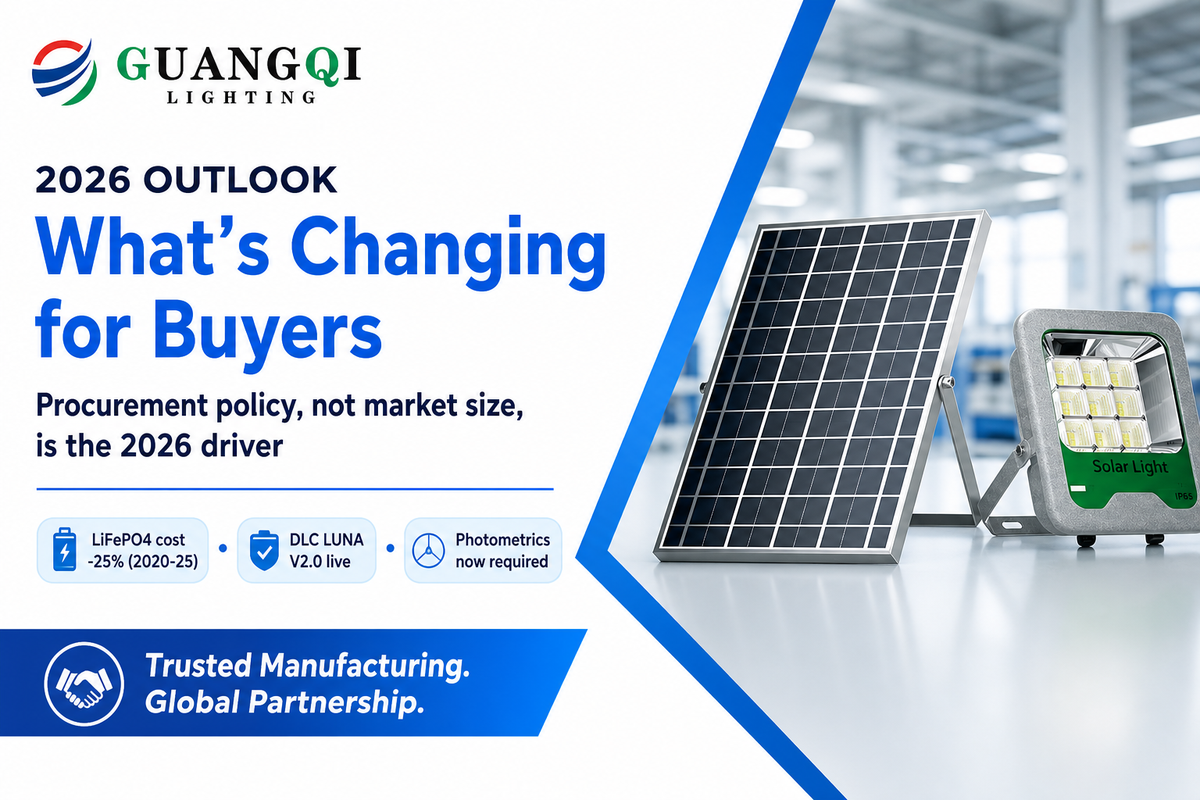
The decision driver for 2026 is procurement policy, not market size. Two forces are moving at once: rebate programs are increasingly demanding photometric proof, and battery economics have shifted enough that spec-grade LiFePO4 fixtures now compete on delivered cost, not just on avoided trenching. Both reward buyers who can read a spec sheet.
On cost, Harvard Business School research puts the decline in solar panel and battery prices at 22% and 25% respectively from 2020 to 2025, and BloombergNEF recorded a 27% year-on-year drop in benchmark storage cost in 2025. That said, don’t assume a straight line down: some cell prices are ticking back up in 2026 on material and labor costs, so lock pricing on large orders rather than waiting for a bottom.
On policy, DLC LUNA V2.0 taking effect in January 2026 and the spread of BUG-based dark-sky ordinances mean the fixtures that qualify for rebates and pass local code are increasingly the same short list, the ones with full photometric files. If you’re planning a 2026 project, put “LM-79 report and DLC listing” at the top of your RFQ, not the bottom.
Guangqi builds its commercial solar street lights and flood fixtures to that documentation standard because, for a 2026 buyer, a rebate-eligible and code-compliant spec is now a procurement requirement rather than a bonus.
The Commercial Solar Flood Light Buyer’s Scorecard
Run any fixture through this ten-row scorecard before you commit. A commercial-grade unit should pass every row; two or more misses puts it back in the consumer bin regardless of the listing. Every check traces to a published standard — the ANSI/IES RP-20 light levels, LM-79/LM-80 photometrics, and DLC rebate criteria covered above.
| No. | Check | Pass criteria |
|---|---|---|
| 1 | Delivered lumens | LM-79 report, not panel watts |
| 2 | Efficacy | 140–200 lm/W stated |
| 3 | Battery chemistry | LiFePO4 named, with Ah/Wh capacity |
| 4 | Autonomy | 2–3 nights, worst-month sized |
| 5 | Controller | MPPT, not PWM |
| 6 | Ingress | IP66 on housing and panel |
| 7 | Distribution + BUG | Type II/III/V + TM-15 rating |
| 8 | Rebate/compliance | DLC listing; 3000K if dark-sky |
| 9 | Warranty | 5 years, battery serviceable |
| 10 | Cold rating | Operating temp to −20°C |
Frequently Asked Questions
Q: How many lumens do commercial solar flood lights need for a parking lot?
View Answer
Target the IES minimum of about 0.2 foot-candles maintained with a 3:1 average-to-minimum uniformity. For a typical 300 m² lot that means roughly 20,000–30,000 delivered lumens total, split across four to six fixtures of 6,000–12,000 lumens each rather than one high-output pole. Splitting the load is what holds uniformity and removes the dark gaps that defeat cameras.
Q: How long do commercial solar flood lights last?
View Answer
The LED engine is rarely the limit — it is rated to L70 at 50,000 hours or more, a figure derived from LM-80 data projected through TM-21. The battery is the wear item and sets the real service life. A commercial LiFePO4 pack rated for 3,000–6,000 cycles gives roughly 8–15 years before replacement, versus 2–3 years for the consumer Li-ion cells in budget fixtures. In practice the deciding question is not the LED at all but whether you can reach the battery: a pole-top or rooftop-perimeter fixture whose pack lasts 8–15 years avoids the recurring lift-and-service call that a 2–3 year consumer cell forces onto hard-to-access mounting points. Budget for one battery swap over the fixture’s life, and confirm in writing that the pack is field-serviceable rather than sealed into the housing.
Q: Do commercial solar flood lights work in winter and cloudy weather?
View Answer
Yes, if they are sized for the worst month and use the right chemistry. Winter compounds four penalties: shorter days, possible snow on the panel, reduced battery capacity in the cold, and longer runtime hours. LiFePO4 with an MPPT controller is the specification for cold, low-light sites, but if a location sees fewer than three peak sun hours per day in winter, a hybrid grid backup is the reliable choice over pure off-grid.
Q: Are commercial solar flood lights worth it versus wired for a business?
View Answer
On a retrofit, usually yes. Solar costs more per fixture but deletes trenching at roughly $30 per linear foot and removes the electrical permit, often saving $2,000–$4,000 per fixture and paying back in three to six years.
Q: What certifications should commercial solar flood lights have?
View Answer
At minimum, LM-79 and LM-80/TM-21 photometric reports, CE/RoHS, and IP66. For utility rebates add a DLC listing; for dark-sky ordinances add an IES TM-15 BUG rating and, where required, a 3000K CCT option. Public projects may also require Buy American documentation.
Q: Can commercial solar flood lights run on motion sensors and timers?
View Answer
Yes. Commercial units pair a photocell for dusk-to-dawn switching with a programmable controller that holds a dim baseline and boosts to full output on PIR motion. This adaptive mode is what stretches a single charge across a long night — though even in intelligent mode, plan for a practical ceiling of three to four cloudy days of autonomy.
Spec your commercial solar lighting project with us
Send us your coverage area, target light level, and site climate. We’ll return a fixture spec with LM-79 photometrics, battery-autonomy sizing, and a compliance checklist.
About This Guide
Guangqi Lighting has manufactured LED and solar outdoor fixtures in Guzhen, Zhongshan since 2010, with in-house die-cast tooling, goniophotometer IES photometry, and a QC program that runs 48-hour burn-in, salt-spray, and 6,000-hour lumen-depreciation testing before a model ships. The specification thresholds and sizing methods here reflect that testing plus published standards (ANSI/IES RP-20, LM-79/LM-80/TM-21, IES TM-15) and independently verified market data. Reviewed by the Zhongshan Guangqi Lighting technical team. (Updated July 2026)
References & Sources
- An Intuitive Metric for Lumen Maintenance — Illuminating Engineering Society (IES)
- ANSI/IES RP-20-14 Lighting for Parking Facilities — American National Standards Institute / IES
- PVWatts Calculator and PVWatts Version 5 Technical Reference (NREL/TP-6A20-62641) — U.S. National Renewable Energy Laboratory / DOE OSTI
- Low-temperature performance of LiFePO4 cathode material — Journal of Power Sources (Elsevier)
- DarkSky Approved Luminaires Guidelines v3.1 — DarkSky International
- LUNA (Light Usage for Night Applications) — DesignLights Consortium
- Falling Battery Storage Costs Are Quietly Reshaping Electricity Markets — Harvard Business School Working Knowledge
- Battery Storage Costs Hit Record Lows — BloombergNEF
- Dark Skies Protection Advisory Report (Draft, Dec 2025) — University of Hawai‘i
Related Articles
- Solar Flood Lights: Specs, Types, and Installation Explained — the technical fundamentals behind this buying guide
- Solar Flood Light vs Wired: Complete Comparison — the 5-year cost breakdown
- LED Flood Light Wattage Guide — sizing watts by lumens and area
- IP Rating Guide for Lighting — what IP65, IP66, and IP68 actually certify
- Commercial Solar Flood Lights Collection — models with published photometrics
![Industrial LED Bulbs: Bases, Voltage & Heat [Checklist]](https://gqlamp.com/wp-content/uploads/2026/10/industrial-led-bulbs-blog-featured-150x150.png)