Get in Touch with GUANGQI



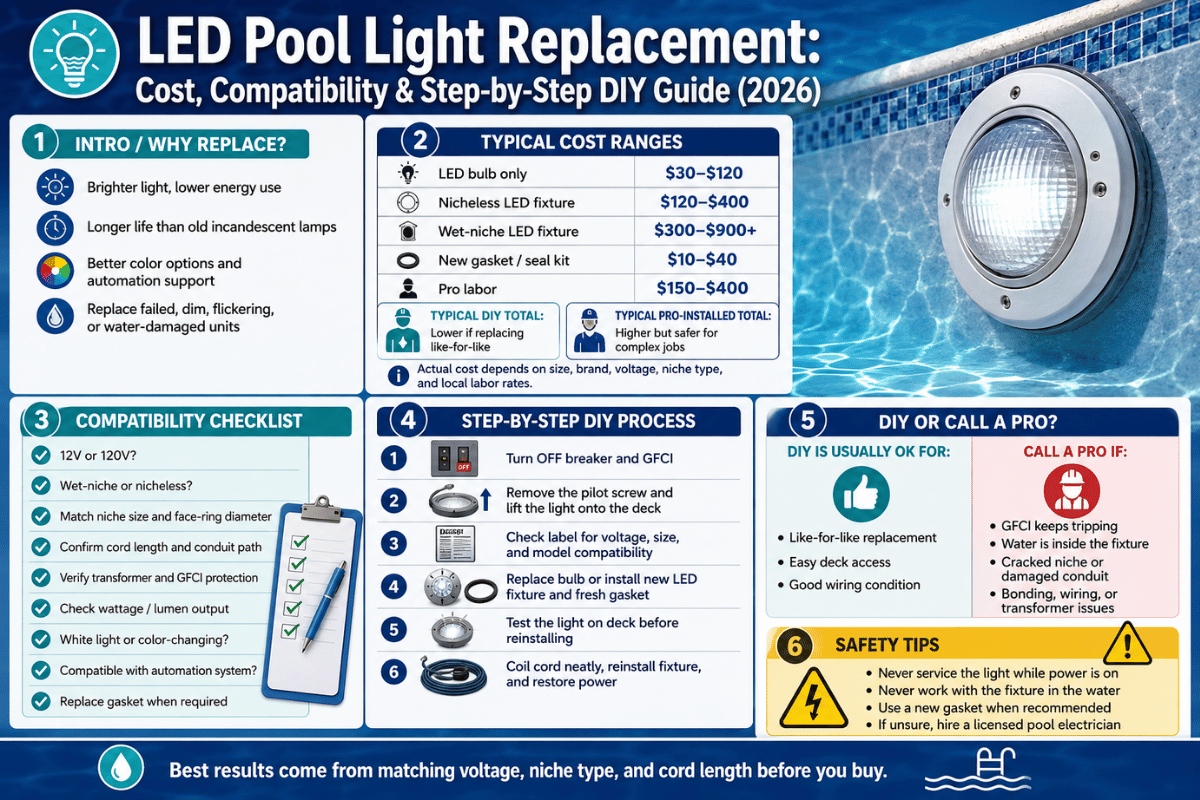
If you are researching LED pool light replacement, the decision tree is more nuanced than swapping a household bulb. Three replacement tiers define a cost spectrum from $30 to over $1,700 per light, and the right choice depends on your existing fixture, niche depth, and how many lights are in the project.
This guide offers: 2026 Cost data; A decoder for brands of Pentair and Hayward niches; A handy chart for the NEC 680 retrofit rules that changed this past cycle of code; A step-by-step no-drain procedures you can do yourself or hand to your favorite contractor with confidence.
Quick Specs — LED Pool Light Replacement at a Glance
| Voltage Options | 12V (low voltage) or 120V (line voltage), per NEC 680 Article 23 |
| Replacement LED Wattage | 9W – 75W (replaces 100W – 500W incandescent / halogen) |
| Lifespan (LED) | 25,000 – 50,000 hours, typically 10 – 20 years at 4 hr/day |
| Waterproof Rating | IP68 (continuous submersion) per IEC 60529 |
| Bulb-Only Replacement | $30 – $600 per bulb |
| Full Fixture Replacement | $500 – $1,700 per light (parts + labor) |
| Standards Reference | NEC 680.23 / UL 676 / IES LM-80 |
Should You Replace Your Pool Light With LED?
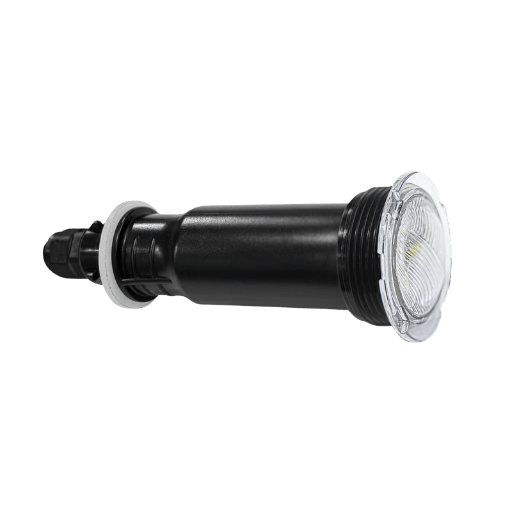
Yes — for nearly every existing incandescent or halogen pool light, the LED upgrade pays back in 3 to 6 years and then keeps saving money for another 10 to 15. According to the U.S. Department of Energy, residential LEDs use at least 75% less energy and last up to 25 times longer than incandescent equivalents. For underwater pool fixtures the savings are even sharper because incandescent pool bulbs run hot, fail fast, and consume far more wattage per visible lumen than indoor versions.
The strongest indicator: a 35W LED flood provides roughly the same luminous output as a 300-500W incandescent. That is an 88% to 93% reduction in electrical consumption. Assuming your pool is lit 4 hours per day at it is costing about $117 per year to run a 500W incandescent bulb versus about $8 annually for its 35W LED equivalent. That $109 a year in savings is what pays for itself.
The tougher question is which LED replacement path makes sense for your individual fixture. That branches into three replacement tiers — covered next.
💡 Pro Tip
Skip the LED upgrade only if your existing fixture is a recent integrated-LED unit (Hayward ColorLogic 2.0+, Pentair IntelliBrite, Jandy WaterColors). For those models, “replacement” means a new fixture — not a bulb swap. See the 3-Tier Decision below.
Bulb-Only vs Fixture vs Niche: The 3-Tier Replacement Decision
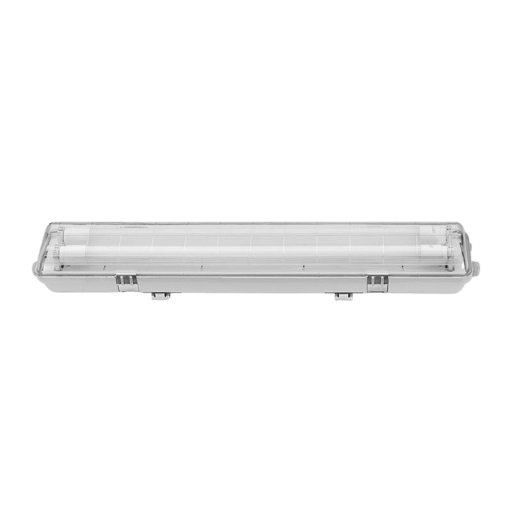
Most pool light failures don’t actually require a full fixture or niche replacement, but most quotes assume you do. Asking the right question saves $400 to $1,400 per light. The three tiers, in order of cost:
The 3-Tier Pool Light Replacement Decision
- Tier 1 – Just bulb replacement ($30 to $600): Your existing fixture is still in good shape and its seal is intact; only the light source has failed or dimmed out. Applies to Pentair AmerLite, Hayward AstroLite / StarLite / DuraLite, Sta-Rite / Swimquip, and Jacuzzi Full Moon – all which will accept LED replacement bulbs in the existing fixture.
- Tier 2 – Complete fixture replacement ($500 to $1,700): The integrated-LED unit has failed (there is no replaceable bulb), or the fixture has cracked, lost its gasket seal, or corroded. This is the necessary replacement for Hayward ColorLogic, Pentair IntelliBrite / GloBrite / MicroBrite, and Jandy WaterColors when the LED board itself dies.
- Tier 3 – Niche replacement (~$2,000 to $4,000): The underwater niche mounted in the wall of your pool has cracked or corroded through, or is missing altogether (if your pool has no light). This requires draining the pool below the niche and chipping into the shell.
Two discoveries in my research changed how I think about Tier 2. First, integrated-LED fixtures from the top three brands show a well documented failure pattern a little over the warranty period; the owners on community led forums say ColorLogic 2.0 fixtures tend to fail after about a year of service. Second, the PureLine Pure Colors LED cannot even be caught by the integrated-LED trap; it uses the common Pentair AmerLite housing plus a conventional LED bulb for seemingly the exact same fixture and thus reverts to Tier 1 economics each time the bulb expires.
When should you replace the entire fixture instead of just the bulb?
Three scenarios necessitate Tier 2: you own a modern fixture with integral LED and a non-removable bulb, the gasket on your niche housing failed and spray has entered the LED driver (condensation is visible, then the whole fixture fails), or your lens broke. Anything less than those extremes – flicker, color drift, partial failure, screw-base fixture – is nearly always a Tier 1 bulb swap.
2026 Cost Breakdown — DIY vs Pro Replacement
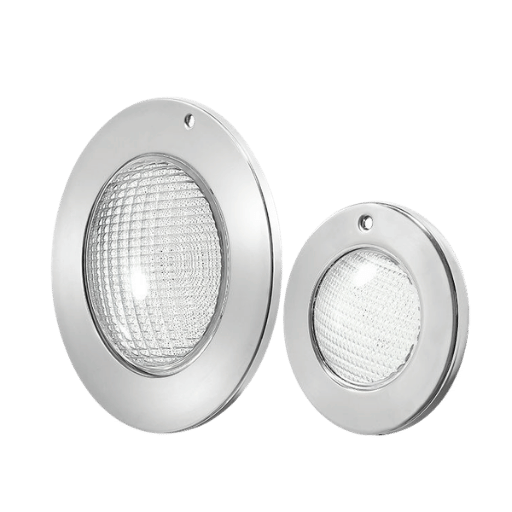
Average residential pool light replacement runs $500 to $1,700 per light fully installed, with a national average near $1,100 (HomeGuide 2024 survey, validated against Forbes 2025 home improvement pricing). The spread is wide because the three tiers above carry very different labor profiles. The matrix below maps each tier to DIY versus contractor cost:
| Replacement Tier | DIY Cost (parts only) | Pro Cost (parts + labor) | Time |
|---|---|---|---|
| Tier 1 — LED bulb only | $50 – $300 | $150 – $400 | 30 – 45 min |
| Tier 1 — Color-changing LED bulb | $300 – $600 | $450 – $750 | 30 – 45 min |
| Tier 2 — Full LED fixture (small) | $400 – $800 | $600 – $900 | 2 – 3 hr |
| Tier 2 — Full LED fixture (large/RGBW) | $800 – $1,200 | $1,000 – $1,500 | 2 – 3 hr |
| Tier 3 — Niche replacement | N/A (not DIY) | $2,000 – $4,000 | 1 – 2 days |
Pro labor on bulb-only and fixture work runs $50 to $100 per hour for established pool service contractors. Independent licensed electricians charge $50 to $130 per hour and are needed whenever the job touches the junction box, conduit run, GFCI breaker, or 12V transformer rather than just the lens-side fixture work — which adds roughly $80 to $200 to the total invoice when the existing wiring needs any code-compliance updates.
Can you replace a pool light without draining the pool?
For 1 and most 2 fixtures, yes. Pool light fixtures actually ship with a 50 to 100 feet cord coiled inside the deck-side junction box so the fixture itself can be pulled to the deck while the pool stays up if service is required. When servicing, shut off 240, pull the single bracket screw on the trim ring, and lift the entire fixture up the cord to the deck. Replace bulb or whole fixture, tighten the gasket, shove it back into the niche, re-screw. Only Tier 3 niche repair – installing a housing in the wall – requires draining below the light.
LED vs Halogen vs Incandescent: 10-Year ROI Math
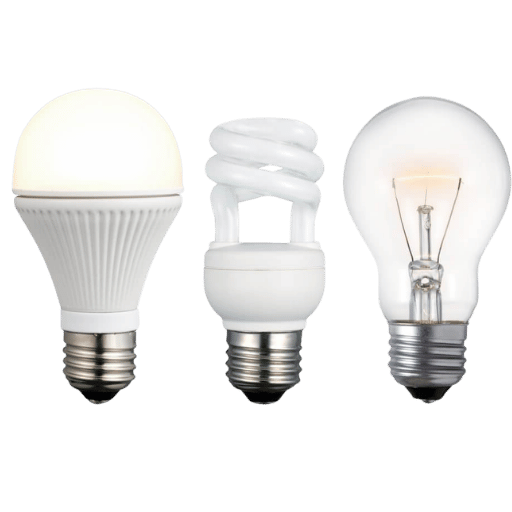
The 10-Year Pool Light TCO Model sets the three light types side by side over ten years of service, revealing the variables that really count: bulb expense, replacement frequency, and energy consumption. Assumptions: 4hr/night 365 nights $0.16 / kWh (2026 the United States residential average).
| Cost Component (10-Year) | Incandescent (500W) | Halogen (300W) | LED (35W) |
|---|---|---|---|
| Annual energy | $117 | $70 | $8 |
| 10-yr energy | $1,170 | $700 | $80 |
| Bulb cost (each) | $50 | $80 | $300 |
| Lifespan | ~1,500 hr (1 yr) | ~4,000 hr (3 yr) | ~30,000 hr (20 yr) |
| Replacements in 10 yr | 10× | 3× | 0× |
| Bulb cost total | $500 | $240 | $300 |
| 10-Year TCO | $1,670 | $940 | $380 |
The key figure isn’t the LED’s reduced power cost; it’s the ten reduction in replacement time and cost. Every bulb replacement takes about 30-45 minutes of pool service or DIY time; the incandescent owner gets to do ten of those over ten years, the LED owner none. After calculating for the LED’s higher initial cost per bulb, total ownership costs come to about 23% of the incandescent equivalent.
Halogen is caught in the middle. More efficient than incandescent but already papering its 3-year replacement cycle, with a middling lifetime cost. Economics only make sense to toss out your halogen if you had an integrated halogen to start with, and you can get a Tier 2 LED replacement for significantly less than the cost of keeping the old one going a bit longer.
Compatibility Decoder — Which LED Fits Your Existing Niche?
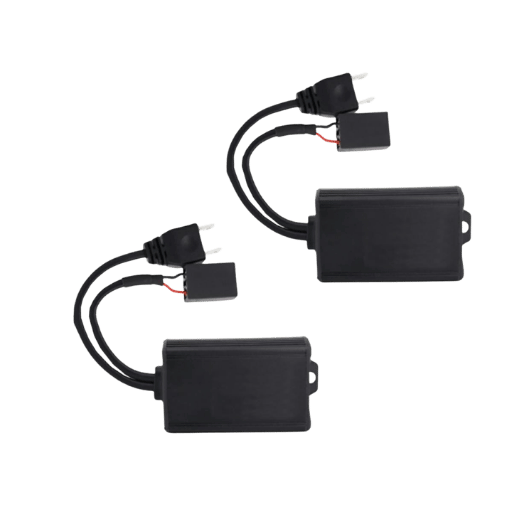
The biggest installer myth in pool lighting: nothing more than ‘You are stuck with whatever brand you have’. Actually, same 10-hole bolt pattern is used for trim ring for both standard-deep niches of Pentair and Hayward. AmerLite trim plate from Pentair will fit in Hayward AstroLite niche and vice versa.
The hard constraints are: niche depth (standard vs shallow), cord length (50 ft vs 100 ft) and if the fixture you want is integrated-LED or it takes a replacement bulb.
| Existing Fixture | LED Replacement Path | Bulb-Only Option? | Niche Compatibility |
|---|---|---|---|
| Pentair AmerLite | 35W LED bulb (12V or 120V) | ✔ Yes | Standard 10-hole |
| Hayward AstroLite / StarLite / DuraLite | 35W LED bulb (12V or 120V) | ✔ Yes | Standard 10-hole |
| Sta-Rite / Swimquip | 12W LED bulb (white or color) | ✔ Yes | Standard 10-hole |
| Jacuzzi Full Moon | LED Rainbow bulb (12V or 120V) | ✔ Yes | Retrofits most niches |
| Hayward ColorLogic 2.0+ | Full fixture only | ✘ No (integrated LED) | Shallow niche → flat-back LED only |
| Pentair IntelliBrite / GloBrite / MicroBrite | Full fixture only | ✘ No (integrated LED) | Standard 10-hole |
| Jandy WaterColors | Full fixture only | ✘ No (integrated LED) | Standard 10-hole |
| Blue Square Spectrum 360 | Replacement LED bulb (12V or 120V) | ✔ Yes | Universal screw-in (most existing fixtures) |
| PureLine Pure Colors | LED bulb in AmerLite housing | ✔ Yes (third path) | Standard 10-hole |
Re: installing a new ColorLogic fixture Here is one common installer mistake: believing an under-10″ deep ColorLogic niche can accommodate a typical-depth upgrade fixture— it cannot, only flat-backed LEDs will fit. Measure your niche depth before placing an order; bevelled-back lighting will need to be under 10″, shallow ColorLogic near 4″.
The lighting choices you have will be based on the shape of the niche. If you have the shallow LED ColorLogic then only another flat back LED fixtures will fit. If it is the standard deep style then you can use nearly all LED lighting fixtures or can flip back to incandescent style.
Code & Conditions — NEC 680 and Salt Water Pool Notes
Two retrofit constraints get skipped in most pool lighting guides, and both can void insurance or shorten fixture life by years. The first is electrical code: NEC Article 680.23 governs underwater luminaires and was updated in the 2023 cycle to expand GFCI requirements, with the 2026 NEC pushing GFCI coverage to all 250V receptacles in the pool equipment area. Even on a Tier 1 bulb swap, the existing GFCI breaker should be tested and the fixture’s bonding lug verified — bonding to the pool’s #8 AWG copper grid is required by code and is the single mechanism that prevents stray current shock if a gasket later fails.
The second constraint is salt water pool chemistry. Standard 304 stainless steel housings — used on most budget pool fixtures — fail in salt-chlorinated water within 1 to 3 years. The cause is metallurgical, not warranty fraud: 304 SS lacks molybdenum, the alloy element that gives 316 grade stainless its chloride pitting resistance. For pools running salt-chlorine generators, only 316 SS housings should be specified — 304 will pit, then perforate, then leak water into the niche cavity.
Compounds of pool chemistry make things even worse. As a member of one technical forum posted, ‘Stainless steel stains less, it isn’t stain proof. Rust and corrosion can be caused by low pH over a long period.” Keeping pH stable in 7.2-7.6 range would save what kind of housing you have- but only 316 SS would have a margin of safety when chemistry is not properly maintained.
📐 Engineering Note
For NEC 680 compliance on a retrofit: (1) keep the top of the fixture lens ≥18 inches below the normal water surface; (2) verify the deck-side junction box sits ≥4 inches above water level and ≥8 inches above grade; (3) maintain bonding continuity from niche shell through #8 AWG solid copper to the pool equipment pad — no underwater splices; (4) on 12V systems, confirm the transformer is listed for pool/spa use and located ≥5 ft from the pool edge per NEC 680.23(A)(2).
How long will an LED pool light last?
High quality LED pool fixtures are rated 25,000 to 50,000 hours under the IES LM-80 testing standard (lumen output remaining at 70% of original). At four hours nightly and between 17 and 34 years before the LED itself drops below useful brightness. The lifespan of the housing especially in salt pools is shorter and it is the failure point. Expect ten to fifteen years out of a 316 SS housing, half that from 304 SS in a salt pool.
Step-by-Step — No-Drain LED Replacement Protocol
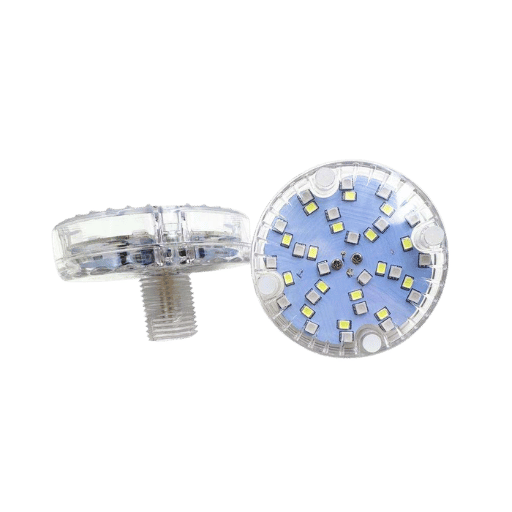
For Tier 1 bulb-only and almost all Tier 2 fixture replacements, this is all done at the deck level with the pool full. Time required: Thirty to forty-five minutes for bulb-only, ninety to two hundred and twenty minutes for fixture. Tools required: Phillips and flat-head screwdrivers, replacement gasket, soft towel, multimeter (for fixture replacement), watertight junction box (fixture replacement).
- Cut power and verify. Switch off the breaker for the pool light circuit. Test with a non-contact voltage tester at the deck-side junction box. Confirm the GFCI is healthy by pressing TEST then RESET — if it fails to trip, fix the GFCI before touching the fixture.
- Remove the trim screw. The single Phillips screw at the top of the trim ring secures the fixture in the niche. Back it out completely – do not let it drop into the pool.
- Pull the fixture to the deck. Hustle the fixture out of the niche by the cord. Coiled inside the junction box are fifty to one hundred feet of slack cord – a work-around so the fixture does not have to be disconnected to reach the deck. Lay on a soft towel to protect the lens.
- Open the fixture. Remove the lens retaining screws (usually four to six) and lift the lens and previous gasket. Check inside the housing for water – any standing water indicates the gasket has failed and a low Tier fixture replacement (Tier 2) is the best option, not a bulb-only swap.
- Replace the bulb (Tier 1) or fixture (Tier 2). For bulb-only change, screw in the matches LED replacement (double check voltage 12V or 120V is same as existing). For fixture replacement, transfer the cord to the new housing according to the manufacturer’s wiring diagram.
- Always install the new gasket. The previous gasket is single use. Even on a bulb-only change, installation of a new gasket is what separates a five year fixture from a one year leak. Seat it squarely with no twists.
- Now snip, seat, re-energize. Re-attach the lens screws snug, but not over torque – Gasket needs an even set, not a crush. Re-fit the fixture into the niche, feed slack cord into the GFCI box, tighten trim screw.Restores power, check light, then GFCI.
⚠️ Important
Edge case: a handful of legacy installs (5%?) have the fixture cord routed through an anchored conduit elbow that refuses to free the fixture to deck level. Pool service technicians report that draining the pool below the niche and pouring dish soap into the conduit is the usual procedure. If the fixture fails to extend to deck after 5-7′ of cord travel, halt and call a pool electrician – not forcing it may break the conduit at the niche.
Commercial Pool LED Replacement — Hotels, HOAs and Municipal
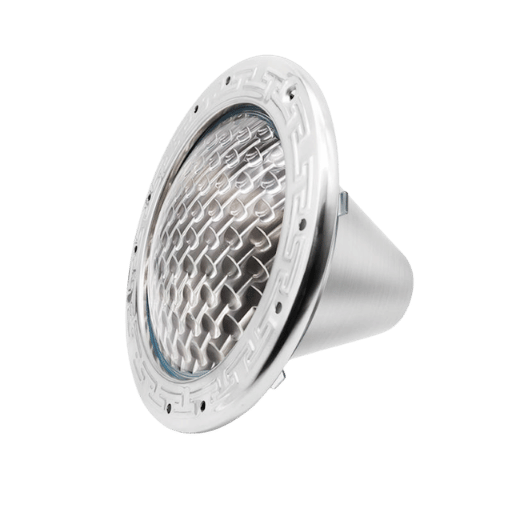
Commercial pool LED replacement runs different math from residential. Operating hours are higher (often 12+ hours per night for resort settings, 24/7 for hotel atriums), labor is contracted at scale, and certification documentation matters at the procurement level — CE, RoHS, IP68, ISO 9001 quality system records all need to ship with every order or the fixtures get rejected at customs.
For projects above 20 fixtures — including pool and spa light installations on the same property — the replacement decision tilts toward complete fixture upgrades rather than bulb-only retrofits. The labor savings of doing one site visit instead of two (bulb now, fixture later) usually outweigh the marginal bulb-replacement cost, and the warranty starts fresh on the entire assembly. Across the 40+ countries where Guangqi Lighting has supplied commercial pool lighting since 2010, the recurring procurement requirement is third-party-tested IP68 housings in 316 stainless steel — not 304 — even when the project specifications don’t explicitly call out grade. Resort, hotel, and municipal pools nearly always run salt chlorination or aggressive cleaning chemistry that 304 SS won’t survive past the warranty period.
Smart-controlled commercial systems (DMX512, DALI, 0-10V dimming) are now standard for new commercial installs — they replace the standalone-fixture model with zone-level lighting control that integrates with building automation. For a replacement project on an older standalone system, ask whether the existing line-voltage wiring can support a smart-controlled retrofit, or whether the budget needs to include conduit and controller-side work.
For commercial replacement projects, a custom quote based on niche count, certification requirements, and target market is usually the most accurate path. Request a project quote with your fixture count and existing niche specifications.
2026 Industry Outlook — What’s Changing in Pool LED Tech
Five signals for trend from market analysts and code bodies are valuable for following, if your replacement decision needs sticking out for the coming 5 to 10 years:
- Market tailwind continues. Industry analysts project the U.S. LED pool light market growing at 13.5% CAGR from 2026 to 2033 , and the U.S. LED underwater pool lights segment specifically at 10.5% CAGR. Bulb and fixture availability gets better, not worse — even for legacy niches.
- 316 stainless becoming standard. Salt-chlorinated pools have crossed roughly 50% share of new residential builds in southern U.S. markets, pulling 316 SS housing from “premium upcharge” to “expected default.” Plan the next replacement as 316 even if the existing fixture is 304.
- RGBWW commoditization. Tunable white and full-spectrum colors RGBWW were a premium feature in 2024, and now constitute a mid-tier price point. In the course of two years, the price divide between fixed cool-white and full-spectrum tunable changed from about 3 to 1.5.
- Smart-controlled replacing standalone in commercial. DMX512 and DALI control protocols are displacing standalone fixture installs in resort, hotel, and municipal pools. Standalone is still the right call for residential — but commercial replacement specs increasingly require smart-control compatibility.
- NEC 2026 GFCI expansion. The 2026 National Electrical Code extends GFCI requirements to 250V receptacles in pool equipment areas. If your retrofit involves any panel work, plan for GFCI on circuits previously exempt under 2020 / 2023 NEC.
If you are planning your replacement before May 2026 (peak season), the main point to remember: only spec a 316 SS-mounted fixture, favor a Tier 1 bulb-only path if your current housing can accommodate this, and make sure your installer is consulting 2026 NEC for any electrical work.
Frequently Asked Questions
Q: Are LED pool lights worth it?
View Answer
For nearly every existing incandescent or halogen pool light, yes — though the math sharpens with use intensity. LED replacements draw 75% to 90% less energy and last 20 to 30 times longer than the bulbs they replace, per the U.S. Department of Energy. A typical residential setup running 4 hours per night recovers the LED upgrade cost in 3 to 6 years, after which the LED keeps saving money for another decade. The payback shortens further for pools running longer hours: a hotel pool at 12 hours per night sees payback in roughly 12 to 18 months because the energy delta scales linearly with operating hours while the upfront cost stays fixed.
Q: How much does LED pool light replacement cost?
View Answer
National averages run $500 to $1,700 per light fully installed, with a $1,100 average per HomeGuide’s 2024 contractor survey. Bulb-only LED replacements (when your existing fixture supports a bulb swap) run $50 to $600 for the bulb plus 30 to 45 minutes of labor. Full-fixture replacements with color-changing LED hit the high end of the range, particularly for integrated-LED units like Pentair IntelliBrite or Hayward ColorLogic.
Q: Can I replace my pool light with LED?
View Answer
Almost certainly yes – with path depending on your existing fixture line. Pentair AmerLite, Hayward AstroLite / StarLite / DuraLite, Sta-Rite / Swimquip, Jacuzzi Full Moon, and Blue Square Spectrum 360 fixtures accommodate LED replacement bulbs in the pre-existing housing – as Tier 1 in the 3-Tier Decision above. If your current fixture is an integrated-LED model (Hayward ColorLogic 2.0+, Pentair IntelliBrite / GloBrite / MicroBrite, Jandy WaterColors), the LED diode is co-bonded to the fixture board, and so full fixture replacement is necessary when the LED fails – Tier 2. The PureLine Pure Colors LED is the exception: an LED bulb that fits the standard Pentair AmerLite fixture, and reverts to Tier 1 economics when the bulb burns out.
Q: How many lumens should a pool light be?
View Answer
Plan for 1,800 to 2,400 underwater lumens per residential pool light. Manufacturer ratings on the box are typically air-rated; underwater illumination drops 30% to 40% due to refraction and absorption, so a fixture rated at 3,000 lumens delivers approximately 1,800 to 2,100 in actual pool conditions.
Q: What color pool light doesn’t attract bugs?
View Answer
Warm white LED 2700K to 3000K and amber spectrum LED produce significantly fewer “flying insect” bites than cold white (5000K+). RGB color-twisting fixtures programmed to red or amber also significantly reduce bug bites. Why? Much poolside bugs are triggered or course on blue and ultra-violet short wavelength action spectra, and warm white LEDs eliminate those wavelengths.
Q: What is the lifespan of LED pool lights?
View Answer
Individual LED chips are rated 25,000 to 50,000 hours per IES LM-80 testing–around 17 to 33 years of use at 4 hours nightly-though the common fixture overall lifespan will be shorter than that and is highly dependent upon housing material: in a salt water swimming pool, 316 stainless steel LED fixture housings last 10 to 15 years; 304 stainless steel housings perish in 1 to 3 years.
Q: Should I replace my pool light bulb only or the whole fixture?
View Answer
Use the 3-Tier Decision: bulb only if the housing seals are intact and the fixture accepts a replaceable bulb (Pentair AmerLite, Hayward AstroLite, Sta-Rite / Swimquip, Jacuzzi Full Moon families); full fixture if the housing has cracked, gasket has failed, or the unit is integrated-LED with no replaceable bulb (Hayward ColorLogic, Pentair IntelliBrite, Jandy WaterColors). Bulb-only is 5× to 14× cheaper when feasible.
Q: Are LED replacements compatible with my existing transformer?
View Answer
Yes in the vast majority of cases, but confirm the transformers minimum wattage load. Old 300 watt magnetic transformers don’t reliably fire 35 watt LED lamps–your incoming wattage drops so far the unit “clamps out”. If you already own 12v magnetic transformer and it is 8 years or older, plan to replace it to one which is LED rated in conjunction with the LED fixture upgrading. Modern electronic transformers operate flawlessly under a LED load.
Need a Commercial-Grade LED Pool Light Replacement?
Guangqi Lighting is an OEM LED pool fixture manufacturer supplying resort, hotel, HOA, and municipality jobs in IP68 IP 68 stainless steel form. Custom OEM/ODM specifications, CE/RoHS/ISO 9001 packaging & documentation prepped with every unit.
Replacement Reality Check from Guangqi Engineering
This guide draws on 15 years of Guangqi Lighting field data manufacturing IP68 commercial pool fixtures across 40+ export markets — particularly on the recurring 304-versus-316 stainless steel housing failures we see in saltwater conversions. Cost data is sourced from independent third-party guides updated through Q1 2026; NEC code references reflect both current 2023 cycle and announced 2026 changes. Where claims rely on industry estimates rather than primary measurement (such as the 10-year TCO math), inputs are explicitly stated so you can re-run the calculation against your own electricity rate and use hours.
References & Sources
- LED Lighting — U.S. Department of Energy
- Lighting Choices to Save You Money — U.S. Department of Energy
- Swimming Pools and the ENERGY STAR Score (2024) — U.S. Environmental Protection Agency / ENERGY STAR
- 304 vs 316 Stainless Steel: Corrosion Resistance, Properties, Applications — Rolled Alloys
- Pool Light Replacement Cost (2026) — HomeGuide
- National Electrical Code (NEC) Article 680 — Swimming Pools, Fountains, and Similar Installations — National Fire Protection Association (NFPA), 2023 / 2026 cycles
- IEC 60529 — Degrees of Protection Provided by Enclosures (IP Code) — International Electrotechnical Commission
- IES LM-80 — Measuring Lumen Maintenance of LED Light Sources — Illuminating Engineering Society
Related Articles
- The Complete Swimming Pool Light Guide — types, voltage, color, installation
- Professional LED Pool Light Range — IP68 stainless steel fixtures for commercial projects
- Facade & Architectural Lighting — RGBW DMX-controlled commercial fixtures
- Landscape & Garden Lighting — bollards, path lights, accent fixtures for resort applications
- Pool Lighting Control Systems — DMX512, DALI, 0-10V dimming for commercial installations
- Lighting Design Services — DIALux simulation and IES photometric planning
![Industrial LED Bulbs: Bases, Voltage & Heat [Checklist]](https://gqlamp.com/wp-content/uploads/2026/10/industrial-led-bulbs-blog-featured-150x150.png)