Get in Touch with GUANGQI



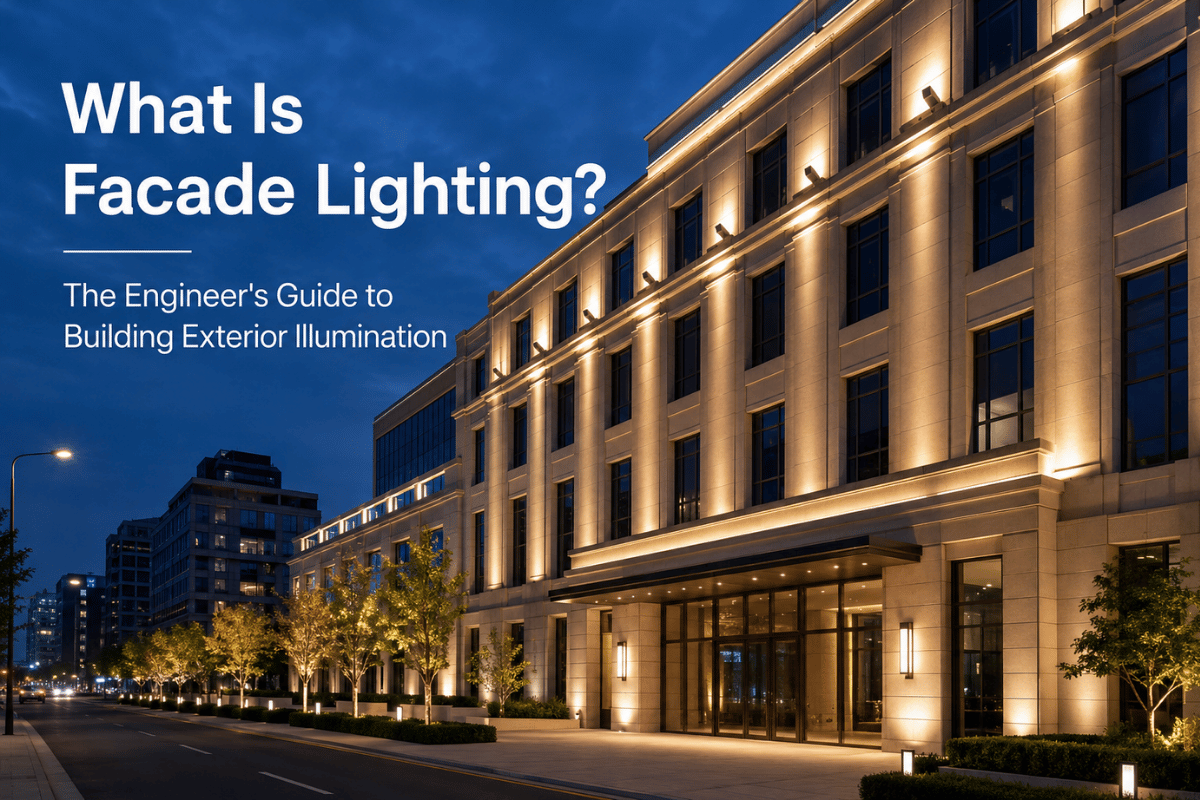
Facades are the engineered installation of a building’s exterior surfaces- the tactical placement, aiming, and adjustment of luminaires so various architectural elements are evident at night. Facade lighting is NOT landscape lighting that references the ground plane or security lighting that accounts for human perception. Facade lighting, the discipline, is about form, materiality, night-time identity. This guide illuminates its purpose, the six core techniques specifiers use in 2026, the governing standards, and the discipline’s future as EU EPBD 2024 and LEED v5 evolve the compliance framework.
Quick Specs: Commercial Facade Lighting
| Typical Illuminance (LZ3 urban) | 0.2–1.5 footcandles (≈ 2–16 lux) on medium-reflectance facade material |
| IP Rating Standard | IP65 minimum, IP66 for exposed elevations (per IEC 60529) |
| Common Fixture Types | Floodlights, linear LED, wall washers, wall grazers, accent spots, RGB pixel/media facade |
| CCT Range (ANSI C78.377-2024) | 1800K, 2000K, 2700K, 3000K, 3500K, 4000K, 5000K, 5700K, 6500K |
| Control Protocols | DMX512, DALI / DALI-2, 0–10V, Bluetooth Mesh, Art-Net |
| LPD Allowance (Title 24 LZ3) | 0.17 W/ft2 general; ASHRAE 90.1-2022 Addendum b: 0.10 W/ft2 for facade specifically |
| Rated Lifespan (L70) | 50,000 hours minimum per IES LM-80 |
What Is Facade Lighting? Definition, Purpose, and Function
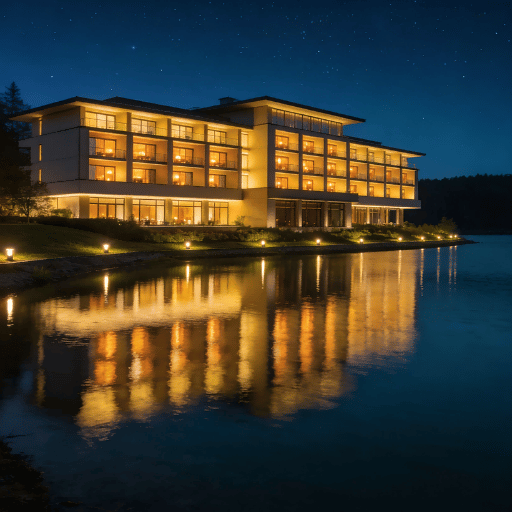
What it Is. Facade lighting is the use of applied light to identify and reveal the external architectural shells of a building- its portico, its curtain wall, its punched openings, and its massing, surface modulation, and finishing materiality. It is not lighting for the grounds that surround it or for the spaces and paths within it. Instead, it is the shape you see at night.
Three traits separate facade lighting from adjacent disciplines:
- What we are lighting. It is the cladding, the articulation, the form, the surface, the quality of the skin; it is the extension of the daylight conditions into a richer night-time narrative.
- The lighting is pointed at the building’s exterior walls, not the ground.
- Specifiers begin with the building’s daytime composition; the facade lighting scheme is its night-time corollary
It is viewed at a range of distances (50 m to a driver, 10 m to a pedestrian, a meter to a thumb), and must be legible at all of these scales.
How Facade Lighting Works — The Optical and Engineering Basics
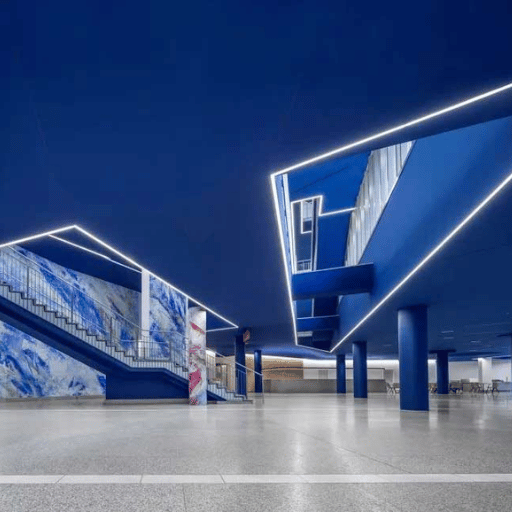
What it is not: facade lighting is not security floodlighting (which emphasises detection over compositional clarity), not signage lighting (which is governed as outdoor advertising), and not landscape lighting (which accounts for planting as well as pathways). While many project incorporate multiple disciplines, specifications, fixtures, and GLA standards depend on one another.
A facade scheme relies on three engineering layers: light source, optical guidance, and target illuminance. Fail to balance any one of these three and the scheme simply does not look right, even with the highest quality fixtures.
Light source. LED arrays now dominate the market, with intensive binning to a tight Macadam ellipse (4-step or 7-step per ANSI C78.377-2024) ensuring luminaire-to-luminaire consistency. Binzhuang [specifies] a very tight 3-step MacAdam tolerance – smaller than the standard ANSI calibration – which smaller degree of shifting in colour result from batch to batch shipments delivered over months.
Target illuminance. The US industry standard reference is ANSI/IES RP-43-25 (2025), which redefines Lighting Zones LZ-1 through LZ-4 and supersedes the 2022 edition Alcon & others mentioned. This is the standard that discusses outdoor pedestrian lighting, so it treats facial lux values as derived from work practical reflectance factors usually combined with RP-43 zone illuminance, relying on the IES Handbook of the fellow division for the multiplies.
📐 Engineering Note
For a standard urban site that falls in the LZ3 range of a quarter-mile or so 100-250m indoor soft-to-medium reflectances brick and limestone the lived-in facade provides a mid-range 0.2-1.5 footcandles of illuminance vertically. Divide those values by 2 for dark low-reflectance black marble, or multiply by 2 for mirror-polish mirror. Building entries in the same zone are provided with a maximum of 4 footcandles on the ground and 2 footcandles vertically-a hierarchy that ensures the entry draws the eye rather than blends in. These values obey the scheme of lighting zone LZ0-LZ4 embraced by DarkSky International, and carried forward by the RP-43 collection (RP-43-25 follows the 2022 RP-43-22, and is scoped to pedestrian outdoor lighting), to precede the specific facade footcandle ranges found in older RP-43-22 annex tables and in the IES Architectural Exterior Lighting chapter. Each one must be cross-checked against project-led reflectance and zone calculations prior to introduction.
Six Core Types of Facade Lighting — Techniques That Define Building Night Identity
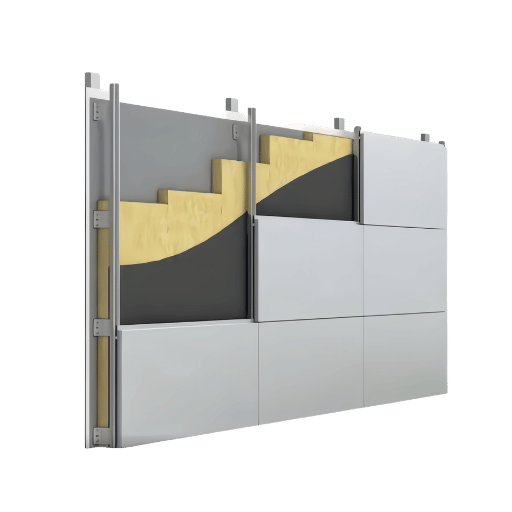
Commercial lighting techniques by and large reveal six standards. Each has a typical mounting height, a standard beam angle, and a usage application. Combining multiple techniques on one elevation is prevalent, the layering of three or four is par for the course, but each must be predesignated and not casually selected as “wall washer.”
| Technique | Beam / Distance | Surface Effect | Best Building Type | Typical Fixture |
|---|---|---|---|---|
| Floodlighting | 15°–120° asymmetric; 5–50 m throw | Broad luminance on large elevations | Stadia, monuments, large public buildings | 50–1000 W LED flood light, narrow / medium / wide optic |
| Wall Washing | 60°–90° wide; 1–3 m offset from wall | Even, soft luminance from top to bottom | Office, retail, modern curtain walls | Surface-mount or in-ground linear wall washer with asymmetric optic |
| Wall Grazing | 5°–15° narrow; 0.1–0.5 m offset from wall | Strong shadow play exposing material texture | Brick, stone, heritage, textured concrete | In-ground or recessed linear grazer with tight beam |
| Linear Lighting | Continuous run, 8°–60° beam options | Outline / contour articulation; horizontal or vertical | Modern architecture, hotel parapets, bridges | RGBW LED linear bar, recessed or surface mount |
| Accent / Spot Lighting | 5°–25° narrow; variable mounting | Focal point on a column, sculpture, signage | Civic, hospitality, retail entry features | In-ground uplight, projector, framing optic |
| RGB / Media Facade | Pixel-array; 20–50 mm pitch typical | Dynamic content, animation, branded display | Mixed-use, retail, entertainment districts | LED pixel point, mesh screen, individually addressable |
What Is the Difference Between Wall Washing and Wall Grazing?
The two techniques appear similar on a fixture data sheet but produce contrasting consequences on a project elevation. Wall washing involves mounting the fixture far from the surface (1-3 m) with a wide asymmetric beam angle that uniformly distributes light on a flat plane – the architectural objective is to forego surface details to emphasize material colour and draw out form. Wall grazing involves mounting the fixture extremely close to the surface (0.1-0.5 m) with a narrow tight beam angle that skim across the surface details – the architectural objective is to accentuate relief and pattern in the mortar joints and to produce form when highlighting specific features.
The single most common installation failure is choosing wall washing fixtures and then mounting them too close to the wall — a mistake the optical physics will not forgive. As specifiers at California Lighting Sales note, “fixture placement that drifts too close to the wall” is what turns a wash into uneven hot spots. The reverse failure also happens: wall grazers mounted too far from the surface lose their texture-revealing effect and degrade into ordinary wash lighting at half the brightness.
📐 Engineering Note
Field commissioning good tip:when not clearif a building wall-wash or wall-graze, look at the day time facade. If the surface needs to be flat colour and crisp lines (curtain wall, painted stucco, flat sheet-metal), specify washing. If the surface needs to be textured and have depth (brick, rough cut stone, board form concrete, terracotta). specify grazing.
Mixing both on adjacent panels creates visual chaos unless consciously contrasted.
LED vs Traditional Light Sources for Facade Lighting — The Performance Reality
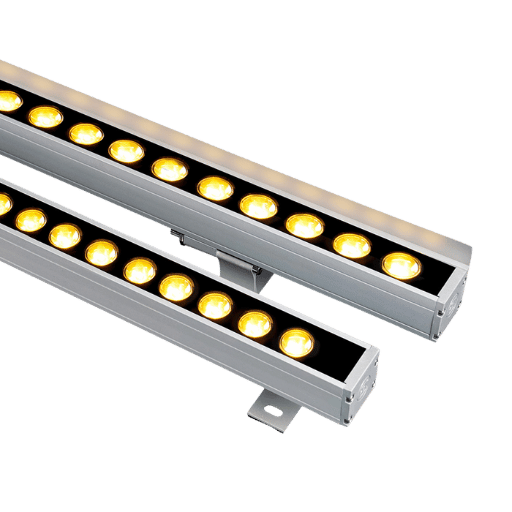
Why has LED taken over the metal halide and high-pressure sodium for facade projects?
It’s not branding-it’s all about quantifiable performance on efficacy, lifespan, colour quality and cost of ownership. The seven figures below synthesize general LED performance benchmarks published by the U.S. Department of Energy along with the International Energy Agency with efficacy and lifespan ranges established through review of the entire lighting industry, citing the lifespan testing protocol IES LM-80.
Individual product data sheet performance can range anywhere within the figures cited.
| Metric | LED | HPS | Metal Halide | Fluorescent |
|---|---|---|---|---|
| Efficacy (lm/W) | 100–200 | 80–140 | 75–100 | 50–100 |
| Rated lifespan (L70) | 50,000+ hours | 15,000–24,000 hours | 12,000–30,000 hours | 7,000–15,000 hours |
| Warm-up time | Instant | 5–10 min | 5–15 min | Instant |
| CRI | 70–98 | 22–70 | 65–93 | 50–90 |
| Energy vs LED baseline | Baseline | +40–60% | +30–50% | +20–40% |
Two consequences for facade specifiers. 1. The long life gap exacerbates on high and/or difficult access elevations. Re-lamping a 60 m metal halide flood rated for 12 hours per day in the above example is roughly a three-year interval.
A 50,000 hour LED bulb has been gone for 11 years on the same pattern. The labor saved – boom lift hire, traffic management, downtime – has to be many times the bulb savings over the first re-lamp cycle.
Secondly, the difference in colour rendering quality is more significant on facades than on roadways. A 70 CRI HPS will make red brick look muddy brown and blue glass look grey. A 90 CRI LED makes them both look as the architect intended.
Achieving CRI 90 on facade lighting is common in heritage and top-end commercial projects for precisely this reason the vast majority of HPS and metal halide even at powerful wattages cannot achieve this level of colour rendering.
All of our Guangqi facade fixtures are put through integratingsphere photometry before they leave our production line. That data is what allows us to promise consistent colour temperature on a re-order 6 months down the line the binning data is archived back in the project folder, not just in marketing material.
Facade Lighting Design Principles — From Hierarchy to Light Pollution Control
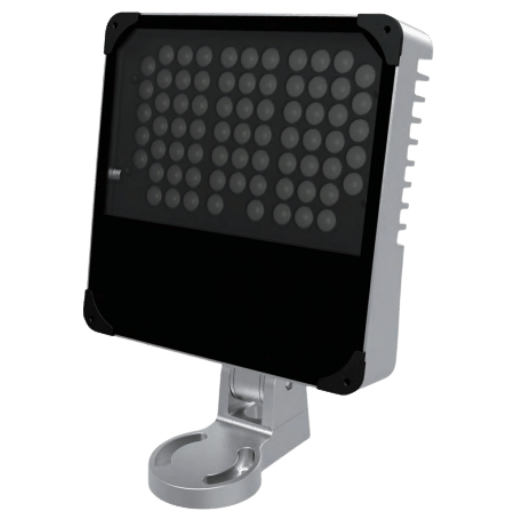
Facade lighting sits in an awkward regulatory position. Pedestrian lighting has IES RP-43-25. Roadway lighting has IES RP-8. Sports lighting has its own series. Facade lighting has no widely-adopted current single standard in U.S. or EU regulatory practice — practitioners draw on IES Handbook chapters, ASHRAE 90.1 BUG limits, Title 24 lighting power densities, and the DarkSky lighting zone framework. The closest dedicated international document, CIE 094-1993 “Guide for Floodlighting”, covers decorative exterior illumination of monuments and commercial buildings but is now flagged as obsolete and under revision through CIE TC 4-59. For working specifiers in 2026, the practical compliance map is the five principles below.
- Hierarchy. Always indicate much less illuminance at the focal elements (entry, signature, columns, parapet, etc.) than on background surfaces, about 3-5 times less. Flat lit facade looks like “on”; hierarchical one is architecture.
- Appropriateness. Match the technique to the surface (see H2-3). Wall washing for flat planes, grazing for textured masonry. Blending the two on neighboring surfaces is a self-consciously ordered compositional gesture, not a default technique.
- Controlling glare.Specify cut-off optics, diffusers, baffles, and mounting positions that screen direct LED views from the pedestrian vision zone.ASHRAE/IES 90.1-2022 Addendum b codifies this with BUG (Backlight, Uplight, Glare) ratings; California Title 24 dust8 in LZ3 mandates BUG conformity for all outdoor luminaires over 6,200 initial lumens, with specific B/U/G ceiling values that vary by architecture master plan zone dust8.
- Lighting power density.ASHRAE 90.1-2022 Addendum bawith its own specific allowance for facade lighting – 0.10 W/ft based on illuminated facade area, not traded against other exterior surface allowances.California Title 24 dust8 Light Zone 3 establishes the general non-tradable surface allowance at 0.17 W/ft; dust8 LZ2 drops to 0.10 W/ft. A facade scheme that neglects LPD planning is never approved on the initial submission.
- Obtrusive-light containment. “Light pollution” abbreviates at least five separate problems: sky glow, glare, trespass, vertical boundary illuminance, and ecological impacts. Each is measured and addressed separately – sky glow by uplight ratio maximums, trespass by shielding and aiming limits, ecology by spectral and time-of-night restrictions.
⚠️ Common mistake.
Designers commonly treat “warmer CCT” as a one-step ecological intervention.Dimmable CCT tunability isn’t researched to produce a known ecological benefit – the same conversion can keep the sky-glow metric between 0.2 and 1.6 times the result of a standard high-pressure-sodium fixture depending on uplight percentage, lumen output, and shielding profile.CCT ignores spectrum on one axis, but several other obtrusive-light contributors are equally dangerous. Specify them all, not just spectrum.
Choosing Facade Lighting by Building Type — A 9-Row Decision Matrix
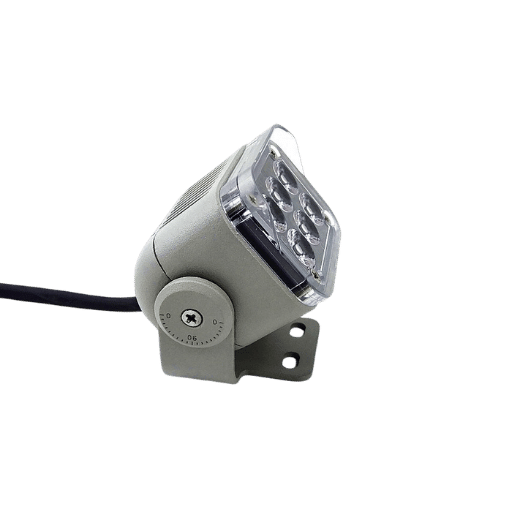
The facade lighting language must match the use category.Hotel facades represent brand and prestige; an office building represents a clean light signal and energy efficiency conformance; a heritage building represents preservation. These identical techniques result in distinct specifications when the design brief changes. The matrix below determines the hierarchy of approved technique, CCT, illuminance, and primary control protocol for the five main commercial building types.
| Building Type | Primary Technique | Typical CCT | Illuminance Target | Control Protocol |
|---|---|---|---|---|
| Luxury hotel | Linear + accent + RGBW (low saturation) | 2700–3000 K warm white | 0.5–1.0 fc on background; 1.5–3 fc on entry | DMX512 or DALI-2 with scene presets |
| Class-A office | Wall washing + linear contour | 3500–4000 K neutral | 0.2–0.8 fc; LPD-driven | DALI-2 + photocell + astronomical clock |
| Retail / mixed-use | Media facade + RGBW + accent | RGBW dynamic; 3000K static | Variable; pixel-density-driven | Art-Net / DMX512 high-refresh |
| Heritage building | Wall grazing + low-lumen flood | 2200–2700 K warm; CRI ≥ 90 | 0.1–0.5 fc; strict cut-off | 0–10V or DALI; minimal automation |
| Commercial residential | Wall washing + entry accent | 2700–3000 K warm | 0.2–0.6 fc; trespass-controlled | Photocell + time clock; resident scheduling |
| Stadium / sports facility | High-output flood + linear contour | 4000–5700 K cool | 2–8 fc on facade; signage focus | DMX512 with event-mode programming |
| Cultural / museum | Linear glow + projection accent | 2700–3000 K warm; CRI ≥ 90 | 0.3–1.0 fc; conservation-bounded | DALI + IoT astronomical clock |
| Civic / government | Wall washing + accent on signage | 3000–4000 K neutral | 0.5–1.5 fc; symbolic emphasis | DALI-2 + scheduled photocell |
| Bridge / infrastructure | Linear contour + accent on towers | 3000–4000 K; RGB option for events | 0.5–2.0 fc; navigational cues primary | DMX512 or 0–10V; civic event scenes |
A caveat for heritage buildings.Few heritage facade schemes can be summed up as “pick the right technique” – it’s a regulated design process including conservation officer consultation, daytime fixture visibility with approved mounting locations to avoid historic fabric disturbance, and right-sizing illuminance for the elevation. Many landmark projects choose to isolate a single elevation and keep all others completely dark, magnifying the strategic illuminative “pop.” Heritage should be considered its own, autonomous workflow with a dedicated approval chain, not one code row in a building-type matrix.
From Guangqi’s deployment experience: a Middle East mixed-use commercial complex installed 2,400+ RGBW DMX-controlled LED fixtures across multiple primary facade elevations, with seasonal scene programming for the Eid holiday cycle and a separate daytime “off” mode mandated by the local heritage adjacency rules. The control complexity — not the fixture count — was the project’s primary specification challenge.
Key Specifications and Fixtures for Outdoor Facade Lighting
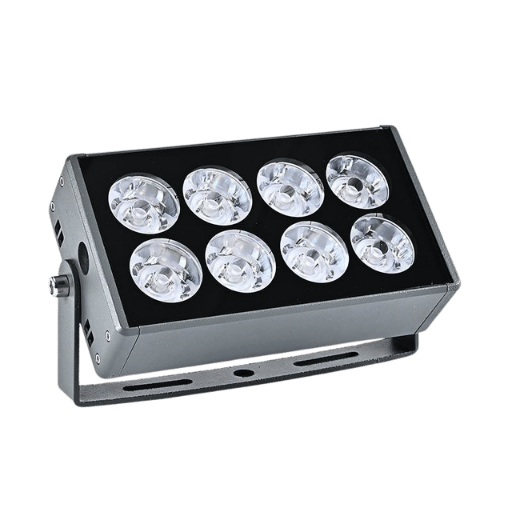
Procurement teams require a firm spec checklist that has stood up to both compliance analysis and field commissioning. The checklist below is the working baseline used on commercial facade projects in 2026- each line item has a standard or industry-abiding equivalent.
Facade Lighting Fixture Specification Checklist
- A minimum of IP65 allowed on sheltered facades, IP66 on fully-exposed elevations in driven-rain or pressure-washer scenarios. IEC 60529 defines the test.
- Impact rating IK08 is the minimum for accessible mounting heights (5J vandalism resistance impact); specify IK10 on ground-mounted uplights at street-level.
- Operating temperature should support -30 C to +50 C ambient for global deployment; verify both ends with accelerated thermal cycling data, not only nameplate claims.
- CRI of 80 is the baseline; require 90 on time-honored projects with material colour fidelity as a driver.
- Colour temperature consistency to ANSI C78.377-2024 4-step or 7-step MacAdam ellipse; specify 3-step tolerance on elevations where fixtures will visibl ycompare to adajcent luminaires.
- A constant-current LED driver rated at 0.95 power factor with 10kV line-to-ground surge protection is the minimum and must match the control protocol for dimming.
- Optical control requires a document BUG rating and cut-off optics for any luminaire emitting 6,200 lumens (per ASHRAE 90.1-2022 and Title 24).
- Control protocol chose from DMX512, DALI / DALI-2, 0-10V for an integrated building control system; default to DALI-2 for commercial, and Bluetooth Mesh as the retrofit market-leader.
- Rated lamp life should be a minimum of 50,000 hours at L70 according to IES LM-80.
- Labels should include CE certification, EU RoHS Directive 2011/65/EU, UL listing for U.S. installations, and ISO 9001:2015 manufacturing quality assured.
Guangqi’s checking protocol tests each shipment of fixture 6,000 hours accelerated aging, salt spray, 85 C operation thermal cycling and vibration per IEC 60068-2-6, lumen loss. The lumen test results stay available in the project folder so that a revised order six months later can be assured a the facades ship in the same MacAdam ellipse- the practical between a facade that still matches at year five and one that has drifted into visible patchwork.
Where Facade Lighting Is Heading — 2026 Trends and the Smart-Sustainable Convergence
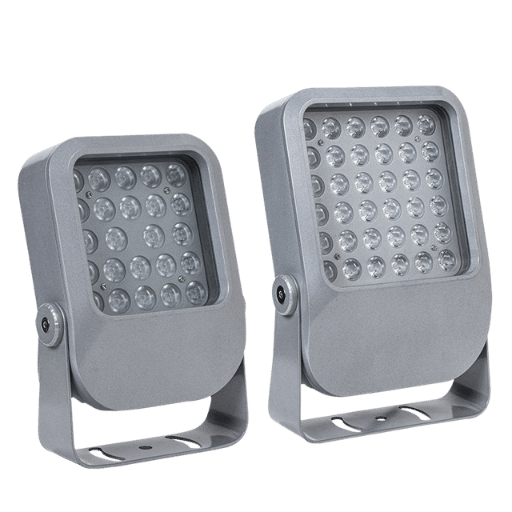
The most significant change in facade lighting for 2026 is not the latest 2-mm media-facade pixel pitch or AI-content engine. It is the regulations. Two policy frameworks ( EU EPBD 2024, and U.S. LEED v5) redefines what “compliant” facade lighting, and the hardware will follow the rule-set, not own them.
EU EPBD 2024 (Directive EU/2024/1275). The recast directive came into force on 28 th May 2024 and member states must transpose into national law by 29 th May 2026. While (as described below) the new directive doesn’t specify facade-associated limitations, the minimum energy performance standards for non-residential structures provides a clear incentive for LED retrofits a through-the-glass LED retrofit (including facade lighting on commercial surfaces).
Signify has calculated that replacing all remaining conventional EU commercial lighting installations with efficient connected LED could result in savings of 73.9 GWh per annum this is, in turn, an easily-understood global business emission reduction target which feeds directly into the upcoming building-level retrofit briefs for 2026, the upcoming deadline.
U.S. LEED v5 (BD+C, Published November 2025). The updated USGBCspecific certification program accelerates limits on a building-wide lighting power density budget, and raises the credit weight for smart controls, daylight harvesting, and occupant-level switching.
It makes no prescriptive facade lighting code, but reduces its ultimate efect via building-wide LPD budget overrun and Light Pollution Reduction credits, which influence which fixture, optic, and BUG code rating combinations it becomes feasible to specify on the facade plan. To qualify as LEED v5 Platinum, a building must account for ongoing measured operating efficiencies, not merely the estimated intent at the design stage.
ANSI C78.377-2024 outdoor CCT additions. The 2024 revision of ANSI C78.377 established 1800 K and 2000 K nominal CCT bins specifically for outdoor and special indoor applications, lowering the minimum CCT allowed below the previous 2200 K limit. This allows warmer outdoor photometry to be more simply specified while maintaining true CCT consistency.
However, take note of the following important caveat: the U.S. Department of Energy research on LED street lighting and sky glow found that CCT alone is not a reliable predictor of ecological impact. This same conversion gave sky-glow readings from 0.2 up to 1.6 the HPS baseline, depending on uplight, lumen output, and shielding.
True 1800 K light is helpful, but only if accompanied by cut-off optics, lumen/lux control, and time-of-night controls.
Wireless- and luminaire-level control. Adoption of Bluetooth Mesh for outdoor lighting is growing by about 27% per year (per this industry reporting) and replace wired DALI from retrofit installations where running new control wiring is too expensive. DALI-2 continues to be the default protocol for new commercial.
DALI-2 and Bluetooth Mesh converge on the same operational pattern: scene presets for typical evenings, a late-night reduced mode, and event programming for holidays or building-specific cycles.
💡 Pro Tip for 2026 Specifiers
If you are choosing facade fixtures on a commission after May 2026 in the EU, or applying for LEED v5 certification in the US, choose DALI-2-ready drivers, B<2 / U<1 / G<3 BUG ratings, and CCT options from 2000 K to 4000 K. All three options enable the fixtures to meet both EPBD requirements and LEED v5 LPD calculation without any redesign at the CD phase.
Frequently Asked Questions
Q: What is the meaning of facade lighting?
View Answer
Facade lighting means the engineered illumination of a building’s exterior vertical surfaces — walls, columns, parapets, and architectural features — for the purpose of revealing the architecture after dark. It is a sub-discipline of architectural lighting design with its own techniques, fixtures, and compliance requirements that are distinct from landscape, security, and signage lighting.
Q: What are the main types of facade lighting?
View Answer
Six fundamental tools include floodlighting (broad level of illumination from medium throws), wall washing (uniform illumination from 1-3 m offset), wall grazing (close to surface detailed relief of texture from under 0.5 m offset), linear lighting (visual articulation of outline & shape), accent/spot lighting (definition of focal points & accents), and RGB/media facade (programmable pixel-array of dynamic context or image). Nearly all signature works employ three or four tools simultaneously on a single elevation.
Q: What is an example of facade lighting?
View Answer
REACH Kennedy Center (Washington DC) by Steven Holl Architects brightens the building external recesses using the directional flood lighting of the building’s convex curves to evenly illuminate its outer void spaces against the dusky sky. More commercially, a developing Middle East mixed-use retail/residential complex employed 2,400+ RGBW DMX lighting instruments with automated scene programming – blending continual wall washing of the principal facades with programmed media-facade pixels for brand-content transmission.
Q: How is facade lighting different from architectural lighting?
View Answer
Architectural lighting is the broader discipline covering all lighting design that responds to architecture — interior, exterior, public, residential. Facade lighting is the subset focused specifically on exterior vertical surfaces of buildings. Every facade lighting project is architectural lighting, but most architectural lighting projects (interior offices, retail spaces, museums) are not facade work.
Q: What IP rating does a facade lighting fixture need?
View Answer
IP65 covers sheltered installations protected by overhangs or canopies. IP66 is the working baseline for fully exposed elevations subject to wind-driven rain and pressure washing. IP67 covers temporary submersion (rare in facade work). IP68 covers continuous submersion and applies to in-ground uplights and pool-adjacent fixtures. All ratings are defined under IEC 60529.
Q: How long do LED facade lights last?
View Answer
A commercial LED facade fixture is typically rated for 50,000 hours at L70 (per IES LM-80 / TM-21: lumen output has dropped to 70% of initial value at that point); premium fixtures running on conservative drive currents reach 70,000 to 100,000 hours under the same metric. At a 12-hour nightly operating schedule, 50,000 hours is roughly 11 years before measurable degradation; the same fixtures running 8 hours per night push the rated service life past 17 years. Drivers and surge protection often dictate end-of-life before the LED package itself, which is why high-quality facade fixtures specify constant-current drivers with surge protection rated to ≥10 kV line-to-ground and a documented driver-replacement pathway that does not require fixture body removal — both factors significantly affect total lifetime cost on tall elevations where fixture access labour is the dominant maintenance expense over a 15-year horizon.
Q: How much does commercial facade lighting cost?
View Answer
Cost scales with elevation area, fixture density, control complexity, and project location. Commercial LED installation in 2025 industry data ranges from $3.20 to $4.00 per square foot for new-build projects, with retrofit work running lower on already-wired structures. Individual commercial-grade facade fixtures typically run $100–$400 supplied; installation labour is the same again or more on tall or hard-access elevations. Request a project-specific quote tied to actual elevation drawings rather than relying on cost-per-square-foot rules of thumb — they hide most of the variance.
Q: Can RGB facade lighting be controlled remotely?
View Answer
Yes—RGB and RGBW facade fixtures are actually controlable through DMX512 or Art-Net routes for pixel-resolution addressing, with a central framework that can handle scene-preSETS, timeline programming, and remote scheduling over the building data loop. Bluetooth Mesh protocol has recently appeared as an effectively-fluid choice in retrofit scenarios where any new control cable installation could be considered physically unfeasible. Cloud link-up models enable remote-laboratory checkup on fixture conditions and energy consumption across an entire building complex.
Specifying a Facade Lighting Project?
Guangqi engineers DIALux simulations and supplies CE / RoHS / IP66-rated facade fixtures with documented MacAdam binning. Request a project-specific photometric model and quotation.
About This Guide
This facade lighting guide draws on Guangqi Lighting’s 15-year LED manufacturing experience in Guzhen, Zhongshan — including over 2,400 RGBW DMX fixtures deployed on a single Middle East commercial complex and IES LM-80 lifespan testing performed in our integrating-sphere photometry lab. Compliance citations cross-reference IEC 60529, ANSI C78.377-2024, ASHRAE 90.1-2022 Addendum b, EU EPBD Directive 2024/1275, and the November 2025 release of LEED v5 BD+C. Standards versions and regulatory dates are accurate as of May 2026.
References & Sources
- U.S. Department of Energy — LED Lighting — efficacy and lifespan baseline data
- International Energy Agency — Energy Efficiency: Lighting — global commercial lighting policy and consumption data
- DarkSky International — Lighting Zones LZ0 to LZ4 — outdoor lighting zone framework
- European Commission — Energy Performance of Buildings Directive (EU/2024/1275) — EPBD 2024 recast and 2026 transposition deadline
- U.S. Green Building Council — LEED v5 — November 2025 BD+C rating system release
- International Electrotechnical Commission — IP Ratings (IEC 60529) — ingress protection standard
- Illuminating Engineering Society — ANSI/IES RP-43-25 Recommended Practice: Lighting Design for Outdoor Pedestrian Applications
- ASHRAE/IES Standard 90.1-2022 Addendum b — facade lighting power allowance 0.10 W/ft2
- American National Standards Institute — ANSI C78.377-2024 Solid-State Lighting Products — chromaticity tolerances and 2024 CCT additions
- European Parliament — RoHS Directive 2011/65/EU — restriction of hazardous substances in electrical equipment
- IES LM-80 — measuring lumen maintenance of LED light sources
- U.S. DOE — Report on LED Street Lighting’s Impact on Sky Glow — CCT-and-sky-glow research summary
Related Articles
- Facade and Architectural Lighting — Category Deep Dive — broader product-category coverage
- Facade Linear Light Guide — specification and selection for linear fixtures
- LED Wall Washer Light — fixture-level technical guide
- LED Pixel Lights for Media Facades — RGB pixel-level architectural displays
- Commercial Lighting Control Systems — DMX512, DALI-2, and protocol selection
- About Guangqi Lighting — manufacturing facility, R&D, and certifications