Get in Touch with GUANGQI



![LED Wall Washer Light: Specification & Design Guide [2026]](https://gqlamp.com/wp-content/uploads/2026/04/a.png)
Going into a facade project equipped with an LED wall washer light specification feels simple—until you find yourself on fi×ture number 120 with hot spots showing in the finished work, a gradient imbalance that the control system can’t keep up with and an installation that needs to be re-lamped before long. This guide aims to help architects and lighting specifiers understand the choices involved in any wall washing project, so that it either ends with a perfectly uniform surface, or at least doesn’t get there a fi×ture too late. It centers around three concepts often missing from product screens: a napkin-math photometry layout tool, a control system selection quiz based on calculation of the number of fi×tures, and an IP rating Q&A that e×plains what the specified rating actually tested for.
Quick Specs — LED Wall Washer Light at a Glance
| Power range | 10 W – 108 W+ per fi×ture |
| Luminous output | 100 – 130 lm/W (chip dependent) |
| CCT options | 2700K / 3000K / 4000K / 5700K, RGB, RGBW |
| Beam angles | 10° – 60° (fixed or field-replaceable optics) |
| IP rating | IP65 (shielded) / IP66 (exposed) / IP67 (in-ground) |
| Control protocols | 0–10V, DALI, DMX512, Art-Net / sACN |
| Rated lifespan | 50,000 h (L70 typical) |
What LED Wall Washer Lights Actually Do — Effect, Physics, and Architectural Logic
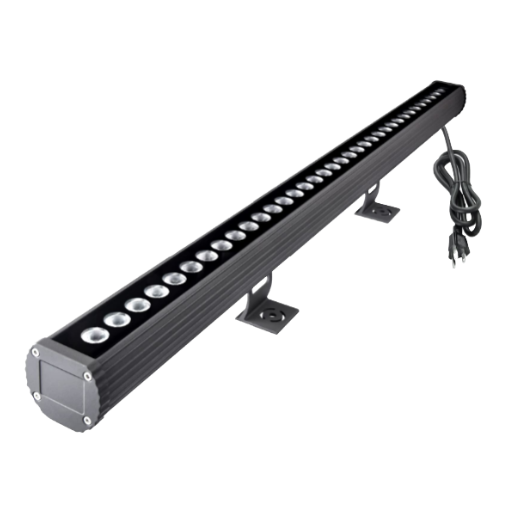
An LED wall washer is a long-bar or compact fixture designed to project a broad, even wash of light on to a vertical surface. The key characteristic here is a smooth, unbroken gradient from top to bottom across the wall—there’s not a single bright patch, not an exposed beam edge, not a scalloping pattern between fixtures. That uniform spread doesn’t come from raw wattage.
It comes from the optic: a high-quality PMMA lens or a tempered glass diffuser designed to generate a control led, asymmetric beam pattern, rather than the symmetrical spread of a standard flood light.
The most widely held false idea is that a wall washer is some type of flood light directed at a wall. It is not. A flood light expels lumens in all directions, producing a symmetrically shaped cone of light.
A wall washer uses special asymmetric optics to uniformly cover a set vertical surface without wasting intensity on the wall’s edges or the empty space above or below. That distinction will make the very first time you use a 30 flood instead of a 45 linear wall washer—you’ll be embarrassed by the flood high lighting every flaw the wall washer was designed to conceal.
Wall washers also come in three mounting configurations – surface-mounted linear strips, recess-line flush, and landscape uplights – meaning different installation needs on the architecture. At the product level specification stage, the Guangqi GQ-WS LED wall washer luminaire series shows wattage, IP and CCT options for seven different models; this tutorial examines the decision issues that are located upstream of product requirements. For similar categories, see our facade architectural lighting systems preview, facade linear lighting fixtures, and LED in-ground landscape uplights.
Wall Washing vs. Wall Grazing: The Photometric Decision That Changes Everything
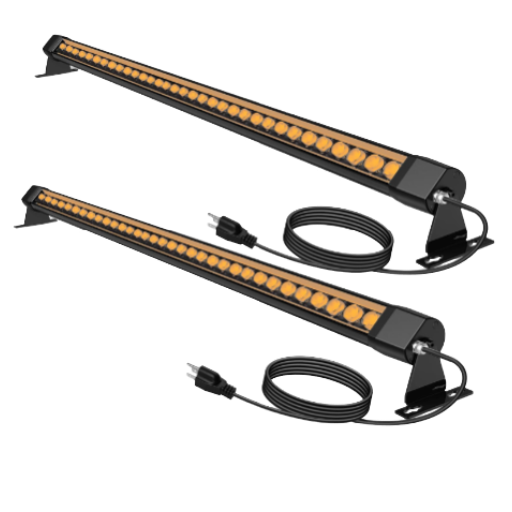
Both share the same fixture group initial. The distinction comes from the mounting distance and beam angle- two in principle variables that are exceedingly simple to create in theory but costly to correct after the cladding is sealed. Wall washing obscures surface texture, wall grazing unveils it.
Applying the wrong method upon the wrong surface produces the exact opposite of the desired architectural result.
✔ Wall Washing — Smooth, Even Wash
- Fixture offset 60–90 cm from the wall
- Wide beam: 45°–60°
- Desired effect: Cancels out shadows, effectively hides surface imperfections, generates the illusion of more space in rooms
- Best for: painted drywall, smooth render, glass curtain walls
⚠️ Wall Grazing — Texture-Revealing Rake
- Fixture offset 15–30 cm from the wall
- Narrow beam: 10°–25°
- Desired effect: long raking shadows provides texture and depth
- Suitable for: natural stone, exposed brick, timber rainscreen, textured concrete
The top in-progress problem is grazing on glaze on smooth polished concrete or glass. In an attempt to show texture—of which none exists—the thin-beam rake accentuates all of the form-work line, handprint, and joint that’s supposed to be concealed. The same light, hung at 60cm and shifted to a 45 beam, would give the crisp glow the project intended.
Use this scenario table as first-pass for façade materials. For sculpture, statues, or large uplights where grazing is purposeful, I think outdoor architectural spotlights do a better job than a converted wall washer.
| Surface Material | Recommended Technique | Beam Angle | Offset From Wall |
|---|---|---|---|
| Smooth plaster / painted drywall | Wall Washing | 45°–60° | 60–90 cm |
| Natural stone / exposed brick | Wall Grazing | 10°–25° | 15–30 cm |
| Glass curtain wall | Wall Washing | 45°–60° | 60–90 cm |
| Timber rainscreen / raw wood | Wall Grazing | 10°–20° | 15–25 cm |
| Perforated metal screen | Test both on a mock-up | 30°–45° | 30–60 cm |
| Terracotta / textured render | Wall Grazing | 15°–30° | 20–35 cm |
How to Calculate Fixture Spacing and Offset Distance — The Engineering Method
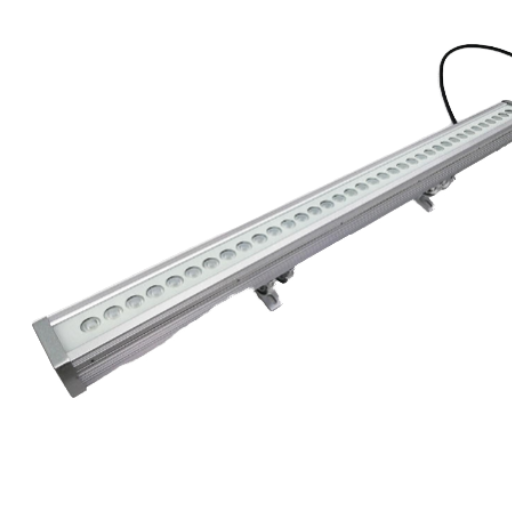
Most product datasheets cite the rule of thumb “fixture offset should roughly equal fixture spacing” which is fine for walls under 5m. Beyond this height it becomes so inaccurate as to be useless, projecting hot spots at the level of the Grade followed by severe fall-off at the parapet. The geometry is simple; the 45 beam projected 1m off set to an 8m wall over shoots at the parapet despite the square, and the number of fixtures required to keep the wall lit up uniformly vertically is more than linear program ‘simple’ (or ‘correct’) would imply.
The US Department of Defense UFC 3-530-01 Interior and Exterior Lighting Systems explicitly states that “a wall washing luminaire must produce “adequate and uniform vertical illuminance”, the operative word being “uniform”, not “centre point illuminance”.
How Far Should LED Wall Washers Be Mounted From the Wall?
Mount fixtures out-off centre at a distance that is approximately a half your wall height (though the maximum is 1m). However, if 3 m height, then 1.5 m maximum is fine-though in actual fact we tend to go with 1 m here so beocias fixtures are still readable to the eye. The fixtures are spaced at a distance 1.0-1.2 x off-centre distance in order to produce overlapping beam patterns, which provide an even wash.
For walls that are more than 6 m high, move to twin row mounting (mid level and at grade) and not increasing offcentre distance, as talking fixtures further away from your wall gets rid of a lot of your output skyward spill.
📐 Engineering Note — The 3-Rule Wall Washer Spacing Method
We have a three-rule approach to first-pass spacing for facade projects. It’s not a replacement for photometric simulation on the final design, but it gets proposal-stage layouts within ~15% of modeled results on smooth and moderately-textured surfaces.
- 1. Rule 1- Offset. (Buffer Distance from wall height 2 capped at 1.0 metre for walls under 5 m in height.)
- Rule 2 – Spacing. Centre to centre of fixtures (=offset 1.0 1.2 to have a uniformity ratio of 0.7 or more.
- Rule 3 – beam angle. For throw distances greater than 2 m, use a beam angle less than 20 to limit spill beyond the parapet and select wider beams for shorter throws.
The variable architects always under-estimate is not offset – its bracket height. On a linear wall washer mounted at ground and aimed upward, bracket height above grade determines at what point along the vertical to aim the beam and where it lands. Too low, you must steepen the aiming angle, driving the hot-spot high and leaving the bottom of the wall dark. Field documentation for Asia Pacific Lighting considers bracket height a primary variable; most residential guides ignore it altogether. The following worked example assumes fixed bracket height of 200 mm above grade, typical for most linear surface-mount brackets.
| Wall Height | Offset | Fixture Spacing | Beam Angle | Fixtures per 10 m Run |
|---|---|---|---|---|
| 2.5 m (interior lobby) | 0.7 m | 0.8 m | 45° | 12–13 |
| 4 m (standard storey) | 1.0 m | 1.1 m | 45° | 9 |
| 6 m (hotel lobby / double-height) | 1.0 m (max) | 1.2 m | 30° | 8 + dual row |
| 10 m (high-rise parapet) | 1.0 m (max) | 1.0 m | 15°–20° | 10 + dual row mandatory |
For signed-and-sealed specifications – especially where the owner or jurisdiction demands a photometric plan – use an IES file simulation in DIALux or AGi32 instead of relying on the 3-Rule output. Our professional photometric design services team can generate an IES based simulation for any model GQ-WS.
Color Temperature and LED Technology: Choosing Between Single-Color, RGB, and RGBW
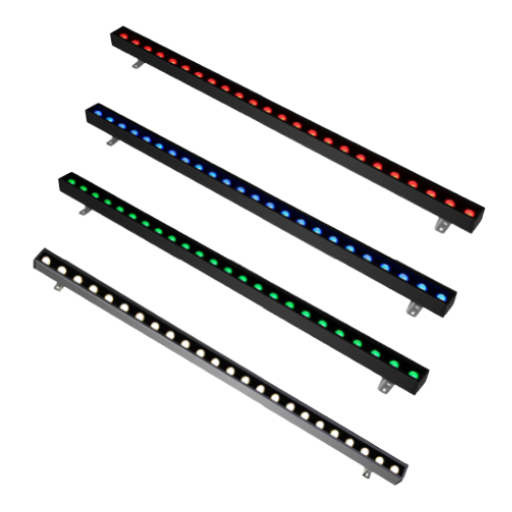
Color temperature, also spelled colour temperature in British and EU specs, is the second most frequent wall washer project failure. Architects specify a “warm white” face, get 4000 K neutral white, only to find stone joints built for a 2700 K glow. As always, the fix is getting ahead of the problem: match fixture CCT to adjacent surfaces and surroundings during spec-ing.
| CCT | Visual Character | Best-Fit Surfaces & Applications |
|---|---|---|
| 2700 K | Warm amber | Sandstone, terracotta, timber; boutique hospitality |
| 3000 K | Warm white | Most facade applications; hotels, residential, retail |
| 4000 K | Neutral white | Concrete, glass, aluminium; modern commercial |
| 5700 K | Cool white | Signage, industrial facades, high-contrast retail |
Our engineering team considers four variables when selecting every shade of fixture-CCT. surface material reflectance, surrounding streetlight CCT, adjacent building CCT, and the brand’s visual identity standards. Summing the factors shows mismatches that come across as errors: a 2700 K warm wall wash surrounded by 5000 K cool-white street lighting appears to be a mistake, even if the individual fixture specs are correct.
Single-color, RGB, and RGBW are three fundamentally different fixtures. Make your decision based on what the building requires, not the option that sounds most flexible on the spec sheet. An LED wall washer rgb fixture is only a good investment if the owner has a plan to run color scenes and show mode in the schedule – not a roadblock feature.
LED Technology Decision Tree
- No color controls planned, white wall wash Single-color (tunable white optional). More efficacious, higher CRI, fewer controls required.
- Color programming is seasonal or occasion-based, white is secondary RGB. The widest possible color palette consumes the least white light quality, using RGB mixing to produce a 70-80 CRI pure white.
- Wants both daily white operation and occasional color changes RGBW. Keeps a dedicated 85+ CRI white channel operational on demand while maintaining a broad RGBspectrum in reserve. The preferred choice for stadium venues and public face landmarks.
Control Systems Compared: DMX512, DALI, Art-Net, and Wireless Options
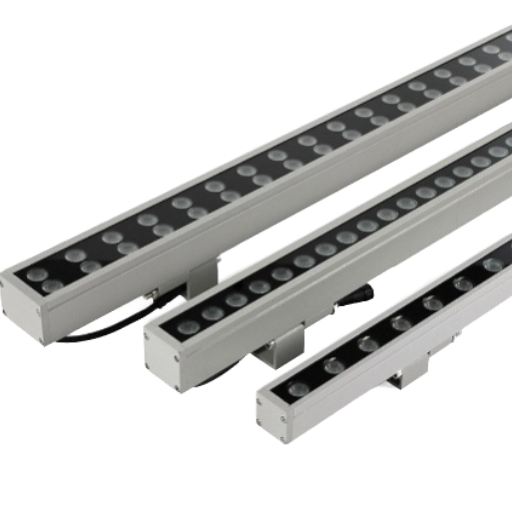
Control system decision is where small projects get nickeled-and-dimed on their data protocol and large ones run into issues (albeit discreetly). Which protocols you use depends entirely on your fixture count, integration demand, and commissioning budget. Don’t gaff this, and you will have to run a separate DMX universe over a wall to humor a LED wall washer rgb controller.
How Many DMX Channels Does an LED Wall Washer Light Use?
A DMX universe equates to 512 channels 3 channels of an RGB fixture, 4 of an RGBW fixture (note the number of dimmer or strobe channels can bring a single fixture to 5 or 6). With an RGBW fixture you can have a maximum of 128 fixtures in a single DMX512 universe. For projects of 192 fixtures and more you would either fragment into several universes (each with a controller or splitter) or you would need to take an IP-based protocol such as Art-Net or sACN carrying many universes over a single communications link.
| Protocol | Max Fixtures | Typical Use | Wiring Cost | BMS / Smart Integration |
|---|---|---|---|---|
| DMX512 | 128 RGBW / universe | <100-fixture color projects | Low | Manual console |
| DALI / 0–10V | 64 addresses per line | Interior + dimming applications | Medium | BMS-ready native |
| Art-Net / sACN | Thousands (IP-based) | Large-scale facades, bridges, stadiums | Higher (fiber or Cat6) | Full BMS + IoT |
| Wireless (RF / Zigbee) | 50–200 typical | Retrofits, landscape, residential | Low | App-based control |
On a recent 192-fixture RGBW wall washing installation on a river bridge in the Middle East, a single DMX512 universe was maxed out at precisely the 128-fixture limit. The other 64 fixtures needed a second Art-Net node over fiber to keep all 192 fixtures tightly centralized in a single scene—and this really should have been discussed and designed into the project at the proposal stage, not after commissioning. When an outdoor project approaches about 100 fixtures or more, default to Art-Net and use DMX only as a secondary backup rather than a primary solution.
Power and driver choice is just as critical; refer to our LED driver and power supply selection guide for the wiring-loss and redundancy considerations that large-scale LED projects depend on.
IP Ratings, Standards, and Compliance: What the Codes Actually Mean
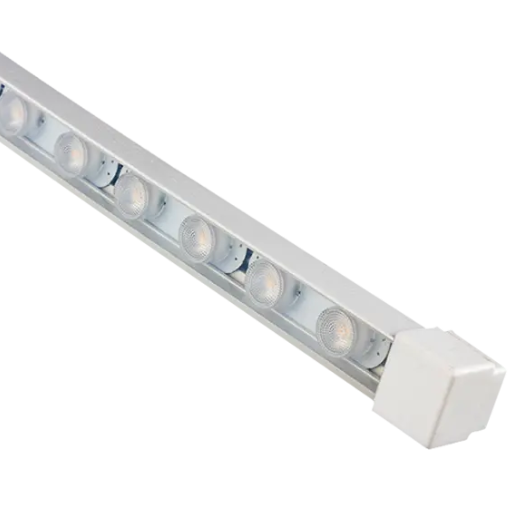
The field of IP ratings is the most frequently cited specification language and the one most misunderstood. The IEC 60529 test bench is specific; the difference between 65 and 66 is greater than a simple single digit separation. IP65 is a light water-spray test; IP66 is a high-pressure jet test; IP67 is full submersion.
A fixture that passes for IP65 in a lab may fail in a real outdoor installation in the field where the fixture is “subjected to wind-driven rain at the pressure and from the angle it would be encountered in normal use”.
| IP Rating | IEC 60529 Test Condition | Typical Application |
|---|---|---|
| IP65 | Dust-tight + low-pressure water spray (6.3 mm nozzle) | Shielded surface mount under soffit or parapet |
| IP66 | Dust-tight + 12.5 mm nozzle at 100 L/min from 3 m, all directions | Exposed pole-mounted, bridge, exterior wall wash lighting |
| IP67 | Dust-tight + 1 m submersion for 30 minutes | In-ground landscape uplighters, flood-prone areas |
| IP68 | Dust-tight + continuous submersion (manufacturer-defined depth) | Underwater pool and fountain fixtures |
Elevating outdoor wall washer light installation at locations in coastal, flood, or freeze / thaw setting more frequently yields in IP66 waterproof enclosures with corrosion grade material (316 stainless or marine-anodized aluminium) than it does in raising the enclosure to IP67. The waterproof ingress test evaluates sealed integrity in a freeze frame; long-term field performance hinges on gasket material, cable-gland orientation, and thermal-cycling fatigue – factors other than IP numbers. Verify your project’s adherence criteria to determine the standards required in your region.
Beyond IP, the standards stack for an architectural wall washer ranges from IEC 60598-1, luminaire safety (electrical insulation, thermal endurance), IEC 62031 for LED module safety, including photobiological hazard, and in the US, UL 1598, luminaire safety, plus DLC Premium / Standard qualification for utility rebate. EU export requires CE under the LVD (2014/35/EU) and EMC (2014/30/EU) directives, tested in an accredited lab prior to declaration of conformity. The UFC 3-530-01 lighting standard for federal buildings is often the basis for institutional and government specifications, dictating individual lights relative to a common point of reference for the entire building to hit specific vertical illuminance levels, not fixture wattage.
Energy Savings and 5-Year ROI: Calculating the Business Case
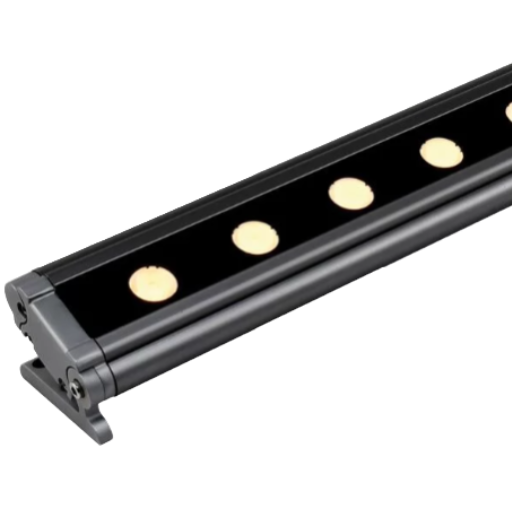
That’s the real energy case for LED wall washers versus metal-halide or halogen—but the ROI math that marketing decks generate rarely lives long enough to flush out when it hits a facilities manager’s spread sheet. The setting below is the one our engineering team uses on retrofit proposals; your inputs are unique to each project, so take the figures as methodology not canon.
ROI Formula — Annual Savings per Fixture
kWh saved per fixture per year = (P_old P_new) operating hours 1000
Annual savings = kWh saved × local electricity rate
Worked example. Going from a 150 W metal-halide facade floodlight to a 36 W LED wall wash fixture operating 12 hours a night 365 days a year at USD 0.12 kilowatt-hour: (150 36) 4,380 1000 0.12 USD 59.92 per fixture per year. For a 100-fixture system that is about USD 6,000 in energy savings annually; LED L70 at 50,000 hours rather than 10,000 hours for metal-halide adds USD 8,000 to 15,000 annually in deferred re-lamp and access costs.
The global market for architectural lighting fixtures is an unequivocal growth story. valued at USD 11.37 billion in 2025, projected to approach USD 17.86 billion by 2034. This means that the rebate and incentive programs available for LED retrofit are still expanding in most markets. Get DLC Premium qualification factored into fixture choice early, because utility rebate eligibility can reduce initial bill-ud by 15-30% on large projects. Custom wattages and CCT configurations lead times are typically 4-8 weeks, so plan rebate documentation completion in the same buying cycle.
“Early collaboration between the lighting designer, architect, and contractor is essential, not optional. The cost of correcting a specification decision after hardware is on site – wrong CCT, wrong IP rating, wrong control protocol – is always an order of magnitude greater than the cost of making it right in design development.”
— Senior lighting designer, California Lighting Sales
Use our facade lighting TCO calculator to zero in on a 5-year total cost of ownership model, and the energy savings calculator for rebate-qualified cases.
Frequently Asked Questions About LED Wall Washer Lights
Q: What is the purpose of a wall washer light?
View Answer
A wall washer fixture creates a uniform plane of illuminance on a wall, feature or interior wall. The aim of a wall washer is a continuous gradient of feathery-shadow-free light, which illuminates flaws and detours attention away from the lit object itself. For building facades this visual effect signifies high quality architecture and offers a longer hours of value for the public space therein.
Q: How far should LED wall washers be from the wall?
View Answer
For walls lower than five metres, offset wall height 2 with one metre ceiling. For taller facades, switch to either dual-row mounting instead of further offsets, and bring beam angle down to less than 20 for throws exceeding 2 meters.
Q: Can LED wall washer lights be used indoors?
View Answer
Yes – led wall washer lights indoor applications are found in hotel lobbies, art galleries, department and retail stores, and museums where consistent vertical illumination guides the design intent. Indoor-rated units have lower IP ratings (IP20 or IP40 for example), use 0-10 V or DALI dimming rather than outdoor DMX, and often in trimless recessed housings for a clean fit.
Q: What does DMX control add to LED wall washer lights?
View Answer
DMX control offers the ability to program countdown color scenes on a schedule to deliver dynamic architectural lighting brand moments at events or simple dim-to-warm curves through the evening, if each RGBW fixture has a dedicated address. In the absence of DMX or a system with the same protocol, fixtures are only able to be switched or globally dimmed.
Q: How long do LED wall washer lights last, and what maintenance is needed?
View Answer
Reliable LED wall washers are rated to operate for 50,000 hours at L70 – meaning after 50,000 hours the LED package is in good condition to deliver 70% of its initial lumen output, which is about 11 years at 12 hours per day. The driver is typically the first part to go: budget for 8 to 10 years of driver replacement. Annual inspection for gasket integrity, cable-gland orientation, and flush lens appearance will address most failure modes before they are visually evident on the structure.
Q: What is the difference between IP65 and IP66 for outdoor wall washers?
View Answer
IP66 is capable of withstanding high-pressure water jets (nozzle 12.5 mm, flow 100 L/min, 3 m head) coming from any direction. IP65 passes the same high-pressure test with a lighter low-pressure jet. If a fixture is exposed to wind-driven rain or is mounted on an exposed facade, use the IP66 fixture.
Related Articles
- LED Driver & Power Supply Selection Guide – calculations for wiring-loss and redundancy with large fixture quantities
- Sports Lighting Design Guide – pole heights, photometric testing, and IES standards
- Landscape Spotlights — grazing, highlighting, and tree-uplighting specifications
- Outdoor Wall Lights — bollard-and-sconce-scale lighting for facades
Start Your LED Wall Washer Light Project
Share your facade, bridge or landscape installation story. Our team of engineers will provide advice for the GQ-WS model, lens options, and control protocol requirements to align with your project scope and jurisdiction.
About This Guide
This guide line includes 15 years of field experience behind manufacturing and commissioning of LED wall washer light solutions in airports, commercial and hospitality mixed-used buildings, and public transportation projects. Just the above-mentioned spacing and control-protocol suggestions are calculated from the GQ-WS series field experience data, including the utilized RGBW 192-fixture bridge system in the control section. Final project specifications including used lighting design standards should be verified against your ideal geometrical, thermal, electrical, and jurisdictional conditions through IES photometric simulations – portal this guideline is only a design-stage methodology please do not consider it as signed-and-sealed design documents.
References & Sources
- UFC 3-530-01 Interior and Exterior Lighting Systems — U.S. Department of Defense, Whole Building Design Guide
- IES Lighting Library Standards Collection — Illuminating Engineering Society (includes ANSI/IES RP-2 retail lighting standard)
- Roadway Lighting Uniformity Ratio Definitions — Federal Highway Administration, U.S. Department of Transportation
- Architectural Lighting Market Size, Share & Global Report to 2034 — Fortune Business Insights, 2026
- IEC 60529 (Ingress Protection testing), IEC 60598-1 (Luminaire Safety), IEC 62031 (LED Module Safety) — International Electrotechnical Commission