Get in Touch with GUANGQI



Reviewed by the Guangqi engineering team — 10+ years of outdoor LED fixture manufacturing, CE / RoHS / IP66 certified production since 2010.
Quick Specs — Typical Facade Linear Light Parameters
| Luminous efficacy | 100–140 lm/W |
| Beam angle options | 10° (grazing) → 60° (wall washing) |
| Input voltage | DC 24V / 36V / 48V |
| IP ingress rating | IP65 / IP66 (IEC 60529) |
| Control protocols | DMX512, Art-Net, sACN, DALI-2, KNX, TTL/SPI |
| Rated lifespan | L70 > 50,000 hrs |
| LED density | 48–120 LEDs/m |
| CCT options | 2700K / 3000K / 4000K / 6000K — or RGB / RGBW / tunable white |
| Operating temperature | −20 °C to +50 °C |
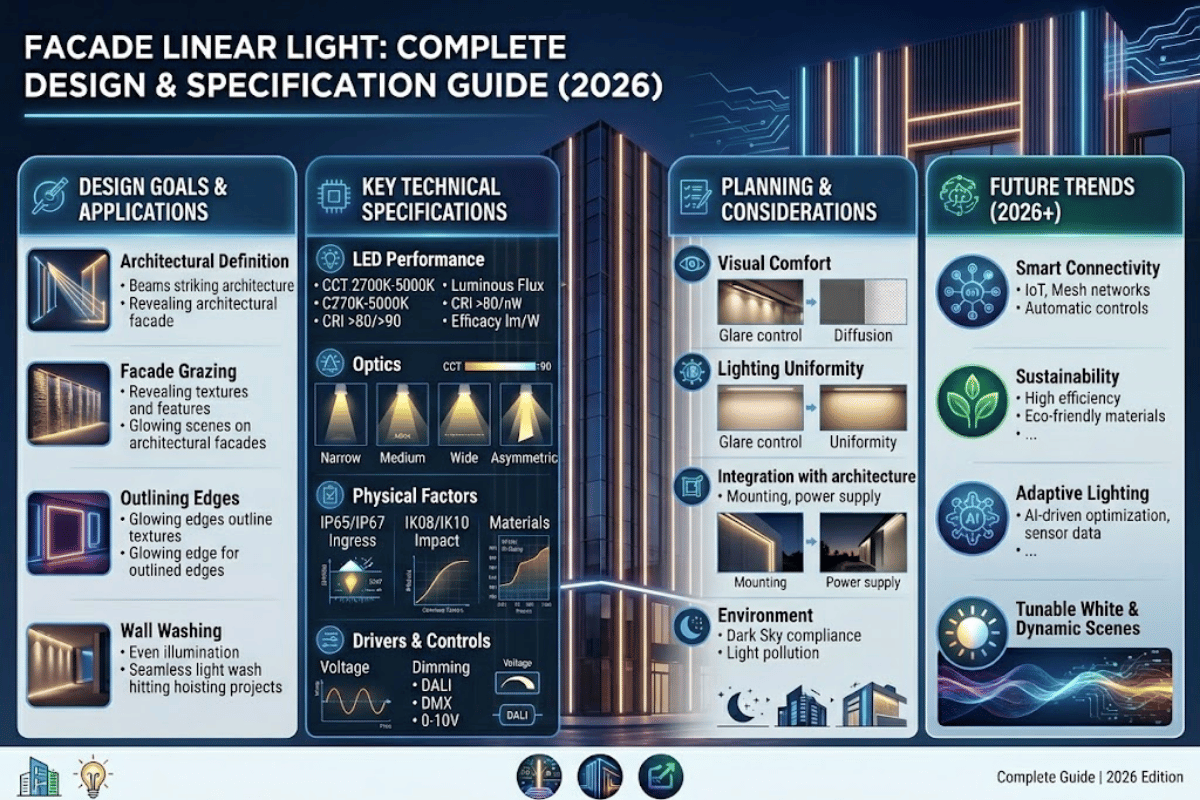
Selecting a facade linear luminaire is a design-engineering choice, not a warehouse option. It involves photometric modeling, ingress-protection verification to IEC60529, Dark-Sky ordinance and BUG rating thresholds under LEEDv4 SS-8, and a control network topology that can stand a decade of maintenance. This manual walks a designer through all of those choices from first site survey to as-built records.
Below ten chapters you will find the working flow path a lighting designer or consulting engineer employs when a proposal progresses from concept to sign-off. Each chapter answers a specific question for the reader, provides a a practical outcome, and references primary standards in those areas where the numbers are not up for debate.
1. What Is a Facade Linear Light — and Why Does It Work for Architecture?
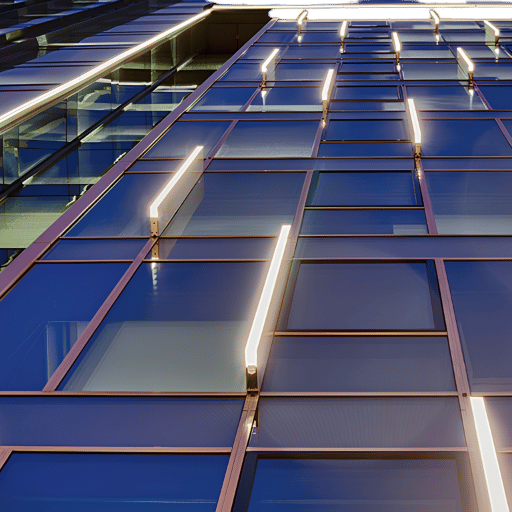
A facade linear light — often called an LED linear light in manufacturer catalogs — is a long exterior luminaire. Segments run 300–1200 mm in length and link end-to-end into continuous runs along the face of a building. Four components make up the fixture: an extruded aluminum shell that doubles as passive heat sink, an LED array (single-channel white or multi-channel RGB/RGBW), a secondary optic that shapes the beam between roughly 10° and 60°, and a sealed lens or diffuser giving the assembly an IP65 or IP66 rating per IEC 60529.
What makes a facade linear light a better choice for building envelope illumination on building facades than floods, raw LED strip, or even linear uplights? Three factors are traced to how the eye interprets architecture:
- Geometric congruence. The appearance of building walls like what facade linear illuminates; the appearance of building walls with floods, strips, and raw downlights, like glints and scatters. The eye says true linearity is an extension of the wall if a luminaire follows the wall, and an artifact if not.
- Uniformity across the entire run: continuous runs mask the overt gaps that an uplight grid leaves on a facade. The uniformity ratio in lux of minimum to average illuminance the preferred core metric in CIE094’s floodlighting guidelines is easier to achieve in a linear system than with uplights.
- Predictability in photometrics: once available a truly industrial-grade linear facade fixture will be delivered with IES LM-79 files for in-software computation of real facade lux values. This narrows the design problem from “what will my facade look like in raw numbers” to “here are the lux readings at 3m AFL on Elevation A.”
Difference between a facade linear light and LED strip becomes a sourcing question. Strip is a sort of commoditized consumer electronic. Facade linear is an modern architectural-grade LED lighting fixture with a published LM-79 report, LM-80 lumen-maintenance summary, TM-21 L70 near-term projection, an IP rating confirmed by a laboratory test, and manufacturer warranty in years not months. RFPs calling for the latter are asking for the former.
📔 Key takeaway
A facade linear light is defined by four attributes — extruded aluminum profile, sealed IP65+ optic, shaped beam 10°–60°, and published photometric files. If any one is missing, you are looking at a strip, a flood, or an indoor linear — not a facade-grade fixture.
2. Grazing vs Wall Washing vs Accent: Choosing the Right Design Technique
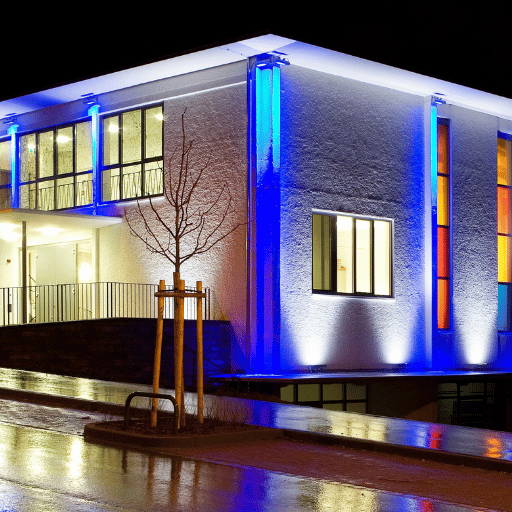
Three approaches resolve 90% of facade lighting decisions. They distinguish themselves on 3 metrics: distance between fixture and surface, beam angle, and the illuminance pattern actually perceived by the eye.
| Parameter | Grazing | Wall Washing | Accent |
|---|---|---|---|
| Offset from surface | 150–300 mm | ≥ 600 mm | Variable; aimed at feature |
| Beam angle | 10–20° | 30–60° | 8–15° narrow spot |
| Target illuminance | 300–500 lux on texture | 100–200 lux average; uniformity min:avg ≥ 0.4 | 3× contrast above ambient facade (IES RP-33) |
| What the eye reads | Texture & relief of the material itself | Building as a single luminous surface | Discrete architectural feature (column, portico, inscription) |
| Best-fit surfaces | Stone, brick, aggregate, relief ornament | Smooth render, metal cladding, glass spandrel | Single features; columns, canopies, sculpture |
| Standard reference | CIE 094 §4 (floodlighting patterns) | CIE 094 uniformity; IES TM-15 LCS | IES RP-33 exterior practice |
What Beam Angle Should I Use for Stone Facade Grazing?
Begin at 10° for heavily textured stone (hand-cut limestone, rough-cut granite, split-face block) and 15–20° for medium texture (tooled sandstone, sawn travertine). The narrower the beam, the sharper the shadow on every joint and surface irregularity — that is the whole point of grazing. Trade-off is coverage density: a 10° beam from a fixture mounted 200 mm off the facade grazes roughly 70 mm of wall for every 400 mm of fixture length before adjacent fixtures need overlap to prevent dark gaps.
Two numbers keep grazing from going wrong. First, hold min:avg uniformity on the textured zone above 0.4 per CIE 094; below that, dark gaps start to read as installation errors. Second, cap fixture spacing at 0.7–1.0 times the mounting offset: a 200 mm offset calls for 140–200 mm between fixture centers with a 10° beam, stretching to 500–700 mm when the beam widens to 20°. Verify both numbers in a photometric simulation before fixing the schedule.
Wall washing inverts these rules. A 600 mm offset with a 45° beam covers several meters of facade per fixture, and smooth surfaces permit wider spacing because there is no texture to expose. Accent lighting is a third discipline: it isolates a single feature as foreground focal points against the wall-washed (or unlit) background, borrowing the 3:1 feature-to-ambient ratio from IES RP-33 to separate figure from ground.
📐 Engineering Note — Uniformity Ratio Under Grazing
A 15° grazing optic produces roughly 2–3× the shadow contrast of a 30° optic on the same stone, but requires about twice the fixture count for the same linear meter of facade. Budget the fixture count first: narrow beams with dense spacing deliver the premium look at a predictable 30–50 % fixture-count premium. The luminaire classification per IES TM-15 LCS ratings lets you verify beam behavior before ordering rather than on the mock-up wall.
3. Types of Facade Linear Fixtures: A Classification Framework
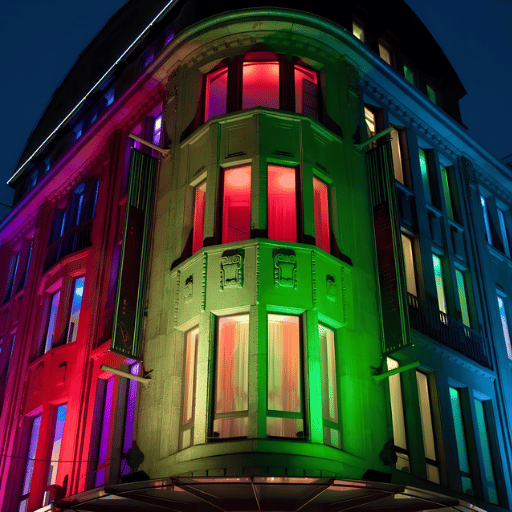
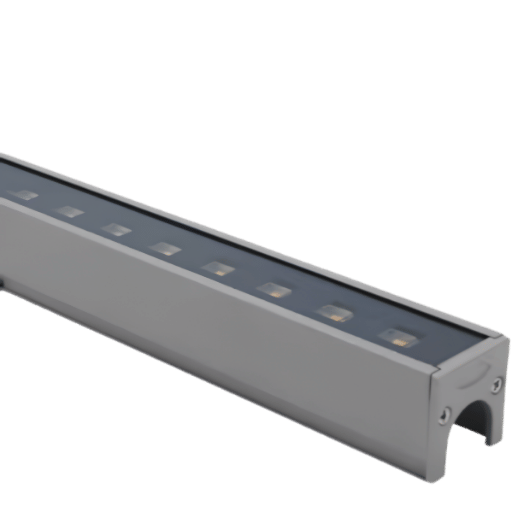
In catalogs, form factor, mounting configuration, and purpose are blended together, creating confusion when shopping. A clearer separation of approach convenience catalogs orders the linear facade fixtures into just five types by the solutions each one delivers:
| Category | Typical length | IP options | CCT range | Best-fit scenario |
|---|---|---|---|---|
| Surface-mount architectural bar | 500–1200 mm | IP65 / IP66 | 2700–6500K, RGB, RGBW | Retrofit where a visible fixture reads as a design element |
| Recessed linear (flush-mount) | 300–1000 mm | IP65 / IP66 | Single-color, RGBW | New construction where fixture invisibility in daylight is a priority |
| Waterproof extruded strip | 1–20 m reel | IP65 / IP67 | Single-color, RGB | Curved surfaces and tight radii where rigid bars cannot follow the form |
| Perforated / architectural cover | 600–1200 mm | IP65 / IP66 | Single-color mostly | Heritage or institutional projects where the fixture cover is the exposed finish |
| In-ground / uplight linear | 200–1000 mm | IP66 / IP67 / IP68 | Single-color, RGBW | Landscape uplighting where fixture must survive water exposure and foot traffic |
This classification matters because three of the design constraints that should drive selection get lost in a pure product-name search. A recessed-linear fixture requires coordination with the cladding or plaster detail during new construction; specifying it as a retrofit usually forces an unhappy compromise. An in-ground uplight demands not only IP66 but also a stay-dry gasket that survives freeze-thaw cycles — an IP68 rating on a substandard gasket still fails in year two.
Practical selection heuristic: pick IP rating first, then form factor, then aesthetics. An IP66 recessed linear with a 20° optic and 3000 K white solves most heritage-building facade problems. An IP65 surface-mount architectural bar with RGBW and a 30° optic handles most commercial-tower facades. Permutations outside these two defaults are where careful photometric study pays back.
4. Application by Building Type: Commercial, Hospitality, Cultural, Infrastructure, Residential
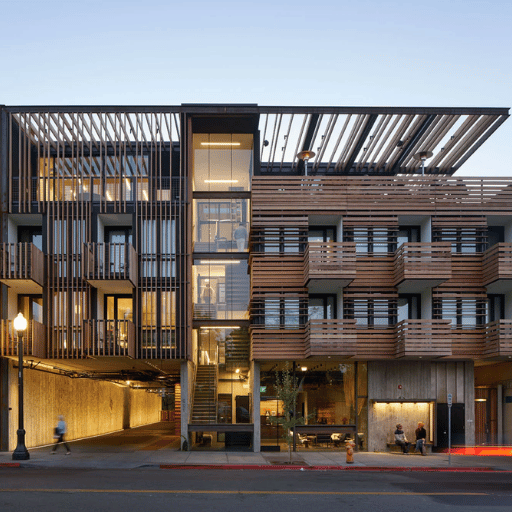
Building type shifts three design variables simultaneously: color temperature, dominant technique, and control complexity. This matrix captures the defaults interested lighting designers default to if a facade building lighting brief lands on their desk.
Decision Matrix — Building Type → Design Choices
| Building type | Recommended CCT | Dominant technique | Control platform | BUG rating cap (LEED SS-8 context) |
|---|---|---|---|---|
| Commercial office tower | 4000K neutral + RGBW seasonal | Wall wash | DMX512 + Art-Net | B2-U2-G2 |
| Heritage hotel / hospitality | 2700–3000K warm | Grazing on stone | DALI-2 (BMS integration) | B1-U1-G1 |
| Cultural / institutional | 3000–3500K warm-neutral | Grazing + accent on features | DMX512 + programmable scenes | B1-U1-G1 |
| Infrastructure (bridge, transit) | RGBW + 4000K baseline | Contour + dynamic effects | Art-Net over fiber / sACN | B2-U2-G3 |
| Residential / low-rise | 2700K warm | Accent only (avoid over-lighting) | Standalone dimming / KNX | B0-U0-G0 |
BUG rating in the column is the one that trips inexperienced specifiers. Residential and hospitality zones in Dark-Sky-aware jurisdictions cap uplight at U0 or U1, which rules out any surface-mount fixture without a top shield. Commercial infrastructure zones allow slightly more generous B and G ratings but still cap uplight at U2. Mixed-use developments inside a municipally adopted Model Lighting Ordinance zone inherits the strictest applicable cap.
Scenario — downtown mixed-use tower, 28 floors, glass curtain wall with aluminum mullions: the lighting designer specifies RGBW color-changing LED facade linear fixtures mounted into the mullion back-pan at 45° wall-wash optics. Baseline state is 4000 K neutral white at 30 % output. Programmable DMX scene library allows seasonal RGBW lighting effects — amber in October for a civic festival, red-white-blue for national holidays, white-only during design-review meetings when glare from the lobby matters. Art-Net distributes the DMX over the existing building Ethernet, saving a separate signal cable run. Total fixture count, driven by a photometric simulation targeting ≤ 1 lux trespass at the property line, comes to 312 units across the four elevations.
This scenario captures the design-choice stack in one project: CCT (4000 K baseline, RGBW overlay), technique (wall wash with 45° optic), control (DMX512 over Art-Net), and compliance (BUG cap verified in simulation). Every facade lighting project resolves to those four variables; the matrix above is the starting point before site-specific factors pull the choices in one direction or another.
5. The Facade Lighting Design Workflow: From Concept to Submittal
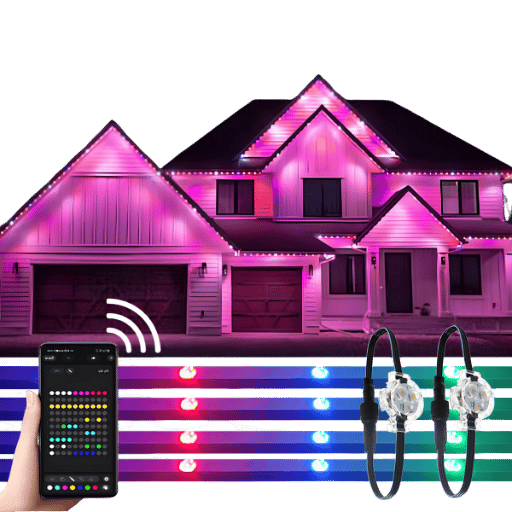
Professional facade lighting design moves through seven steps, each with a named deliverable and a review gate. Skipping steps — or running them out of order — is the single most common root cause of projects that miss budget, miss code, or miss the design intent for nighttime presence.
- Site survey and facade inventory. Deliverable: a list of the materials used, sizes, viewing distance (cardboard sizes), power-drop locations, mounting restrictions. Output of this step influences all subsequent decisions. [for example, if a viewing distance is missed, the beam-angle decision will be wrong; if a power-drop is missed, the control-topology plan will be wrong]
- Concept design and mood board. Deliverable: rendered concept images, with a brief narrative of design. This is the step where it all needs to be on message, and without a well-defined brief it’s impossible to get to this stage.
- Photometric simulation (Dialux evo, AGi32 or similar). For each facade elevation, calculation grids, uniformity ratios, glare indices, which shows the uplight component totals. Without this step every subsequent argument concerning illuminance is only a gues.
- Fixture Schedule and Specification. Deliverable: cut sheets, photometric IES files, LM-80 lumen-maintenance data, mounting detail, and quality clauses. Here is where it all changes in the cost equation when sourcing factory-direct architectural facade linear luminaires; spec-grade lighting fixtures from a manufacturer with published IES and LM-80 files secures the photometric claim in step 3.
- Submittal review. Deliverable: stamped submittal package to include images, photometric reports, LM-80 data, LM-79 Photometric files, mock-up requirement. An incomplete submittal that was missing the LM-80 data had no foundation for the L70 > 50,000 hr claim and should be rejected.
- Mock up testing. Deliverable: 3-6 meters of facade with installed real fixtures, photographed from actual viewing distance, examined at night by design team and client. Fixtures you order for the whole building prior to mock-up approval are the most costly errors in the profession.
- Commissioning/ as-built documentation. Deliverable: DMX address map, scene library, maintenance manual, IES final-measured photometric report, spare-parts list. Commissioning is the process of turning a design into a working system..It is the step during which an empty box becomes a building..
Mock-up is mandatory. There is no substitute for seeing a facade under the real sky, at the real distance, with the real fixtures on. Only this will reveal an actual scale mismatch between an AGi32 render and a real building.I have observed design teams running six weeks late, having approved an render, which failed at 40 m viewing distance, and having to de-allocate its uplight budget.
💡 Pro Tip
Request the manufacturer for an IES file within 24 hours at fixture-schedule stage, not at submittal stage. A supplier that cannot produce this file on short notice is a supplier for whom photometric claims cannot stand up to an independent simulation.
6. Control Systems & Dynamic Lighting: DMX512, Art-Net, sACN, and Pixel Mapping

Selecting a lighting control protocol for a facade is a serious matter. Universe requirements, cable distances, integration with building management system and the long term possibility to swap new scene content… everything stems from this single choice. Six protocols sa moth atwo end of the architectural scope, three of them dominate.
| Protocol | Physical layer | Channels per universe | Max run (single segment) | Scalability | Typical use case |
|---|---|---|---|---|---|
| DMX512 (ANSI E1.11) | RS-485 | 512 | ~305 m (1000 ft) | Daisy-chain; splitters for branches | Small-to-medium facades |
| Art-Net | Ethernet / UDP | Multi-universe | Ethernet segment limits | Hundreds of universes | Large facades, media content |
| sACN (ANSI E1.31) | Ethernet / UDP multicast | Multi-universe | Ethernet segment limits | Similar to Art-Net; multicast efficient | Large-scale events and venues |
| DALI-2 (IEC 62386) | Twisted pair | 64 devices/line | ~300 m | Bi-directional; BMS-native | Building-automation integration |
| KNX | TP, IP, PL | Whole-building | Topology-dependent | Whole-building systems | European BMS; lighting + HVAC + shade |
| TTL / SPI | Clock + data low-voltage | Pixel-count limited by IC | ~30 m before signal loss | Poor without amplifiers | Small decorative installs |
Channel math in a worked example: an 80-meter facade at 16 RGBW pixels per meter. Total pixel count = 1,280; channel count = 1,280 × 4 = 5,120 channels; universe count = 5,120 / 512 = 10 DMX universes. Single DMX cable cannot carry 10 universes. Art-Net or sACN distribute those universes over a standard Ethernet switch, with each universe addressed to a node that converts back to RS-485 at the fixture group. sACN multicast is slightly more efficient when universe count passes the hundreds; for a 10-universe bridge, either protocol works.
Scenario — civic bridge media facade, 240 m span, 24 RGBW pixels per meter for animated content: 5,760 pixels × 4 = 23,040 channels = 45 DMX universes. This project ships as Art-Net over a redundant fiber-optic backbone, with 45 nodes converting Art-Net to DMX at the deck edges. Bridge operator runs seasonal content from a media server that outputs Art-Net universes directly. Total fixtures: 5,760. Annual civic-calendar content library: 18 scenes.
When in doubt the default is DMX512 over Art-Net for facades above 8 universes, and straight DMX512 for anything smaller. DALI-2 earns its place only when BMS integration is already an architectural requirement — and in that case confirm that the DALI-2 bridge node supports the full fixture addressing count before fixture specification closes.
7. Outdoor Compliance: IP Rating, Dark-Sky Ordinances, BUG Rating, and Light Trespass
This is what causes facade-lighting projects to fail all the time during inspection; not if the design was valid but if the project submittal ever considered the rules the authority having jurisdiction applies to approve it. Five rules below are the set that actually get tested on commercial projects in dark-sky-conscious jurisdictions.
Ingress protection (IEC60529). IP65 is the standard for wall-mounted façade linear fixtures. IP66 is needed for coastal locations, façades that get pressure-washed, fixtures below 3m off grade that get water splashed up from trucks passing on the road. IP67 is in-ground uplights, IP68 is underwaterwater features. Skip from IP65 to IP66, light fixtures cost 20-30% more, left to address integrity in a 10-year corrosion life: very little to spend of the premium.
BUG rating per IES TM-15. The Backlight–Uplight–Glare system classifies a luminaire’s light-leakage pattern across three dimensions, each graded 0 to 5. LEED v4 SS-8 caps commercial facade fixtures at B2-U2-G2 under Option 1 (the BUG-rating method). Residential and hospitality zones drop that to B1-U1-G1 or tighter under IES TM-15-11 Addendum A. A fixture with U3 uplight or higher simply fails the credit — and increasingly the ordinance.
Model Lighting Ordinance (MLO) adoption. IDA/IES Model Lighting Ordinance has designated separate fixtures-BUG caps and trespass limits for separate LZ0-LZ4 light zones for each land-use type. As of 2024 the DesignLights Consortium documents the adoption of MLO by multiple states in the US, trend line for more MLO jurisdictions not less. Confirm with project MLO adoption status before photometrics are locked into design.
Light trespass at the boundary of the property in the horizontal plane. IES LP-11 and MLO 5.1.2 cap horizontal illuminance at the boundary of the property in the horizontal plane at approximately 0.1 fc (~1 lux). In dense urban sites the trespass limit can require fixtures to be oriented a certain way and in certain instances to have a certain count of fixtures – it is often quicker and cheaper to achieve the cap in the photometric modeling than it is to discover the trespass limit after the fixtures have been installed.
LEED v4 SS-8 Light Pollution Reduction. Three path options, BUG-rating path is the most common for facade linear fixtures. Requires uf-fixture BUG ratings reporting, land use (lighting zone) declaration and the trespass simulation output. Credit value is 1 point on a LEED scorecard – small in isolation, significant when used in conjunction with SS-6 and SS-7.
Compliance Checklist — Facade Linear Specification
- IP rating as documented per IEC 60529 (IP65 / IP66 / IP67 / IP68)
- BUG rating as confirmed below project cap per IES TM-15-11 standard
- ✔Lighting zone (LZ0–LZ4) identified for project site
- ✔Photometric simulation with uplight-component reporting
- ✔Property-boundary trespass ≤ 0.1 fc verified in simulation
- ✔LM-79 photometric report on file (test method verification)
- ✔LM-80 lumen-maintenance report on file
- ✔CE or UL listing appropriate to market
- ✔Local Dark-Sky ordinance compliance files
- Trespass at the limits of a residential receptor (usually < 0.05 fc)
📐 Engineering Note — CCT as a Pollution Variable
The 2024 DesignLights Consortium guidance on outdoor light-pollution mitigation shows that lower correlated color temperature (warmer color temperature) reduces the short-wavelength blue component of the light and can result in measurably reduced skyglow. Specifying a 3000 K facade fixture at the equivalent lumen output as a 5000 K one will produce less light pollution, which is why warm CCT fixtures appear more often than neutral or cool color temperatures in dark-sky ordinances — not a brightness compromise, but a procurement lever.
8. Cost Modeling: The 30 % Rule — Fixture Price Is a Third of True Project Cost
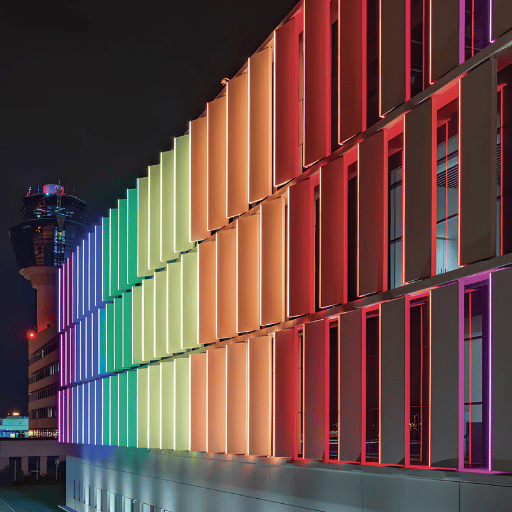
Fixture price is the number that shows up on every early budget, and it is the number that misleads every early budget. Commercial facade linear systems installed at a loaded $180–280 per linear meter is typically built around a fixture that costs $50–80 per meter. Other two-thirds of the install cost live in seven categories that the fixture line item does not capture.
The 30 % Rule: 10-Year TCO Breakdown per Linear Meter
| Cost category | Share of 10-year TCO | What it covers |
|---|---|---|
| Fixture | ~30 % | Luminaire unit price, bulk volume |
| Drivers / power supplies | ~8 % | Constant-voltage drivers, redundant supplies |
| Control gear | ~10 % | DMX splitters, Art-Net nodes, media servers |
| Cabling (low-voltage + signal) | ~8 % | DC power cable + Cat6 / DMX cable + conduit |
| Mounting hardware | ~6 % | Brackets, anchors, flashing, gaskets |
| Installation labor | ~18 % | Electrical, mechanical, lift rental, commissioning |
| Energy + maintenance (10-yr NPV) | ~20 % | kWh consumption, relamping (minimal for LED), annual service visits |
Energy-cost econometrics in one equation. For a façade 100m long fixed-white 15W/m operation, 4000 hours annually at $0.12/kWh:
Annual energy = 100 m × 15 W/m × 4000 hr × $0.12/kWh / 1000 W/kW = $720/year
10-year nominal = $7,200
10-year NPV at 7 % discount rate ≈ $5,053
With regard to that comparator, a conversion of a metal-halide facade to LED often results in 55-75% of the original energy consumption now being saved, with payback calculations falling between 2-3 years on commercial projects – consistent with the 50-80% energy savings cited in the standards application of LED retrofit data towards the literature. Often, savings is not the decision making factor behind new construction design, but it is for any board level (retrofit) decision.
Volume procurement (projects 500 m of linear facade fixture) typically unlocks factory-direct facade linear luminaire sourcing that reduces the fixture line item and moves the TCO presumption further toward install labor and controls. The accepted rule-of-thumb 30% fixture share applies across projects at the $150-400 per-meter installed range; below that band, controls get cheap and labor rules; above it, one-off optics and custom finishes make the shape.
⚠️ Procurement tip
Any fixture quote without driver, mounting bracket, and end-cap sealing is the fixture line only–that’s roughly 20-22% of the actual installed cost. Always get a package quote with drivers, hardware, and signal connectors included, or the 30% rule will be reversed.
9. Installation & Commissioning: 6 Specification Mistakes That Derail Projects
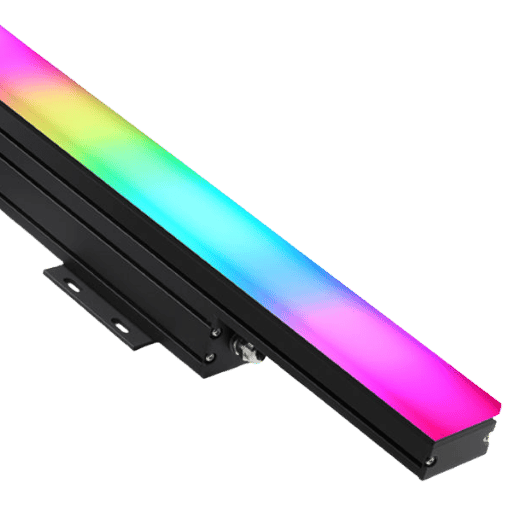
Each wrong fixture spec on a facade lighting project ends up as a punch-list item. The six below are the ones we see most often–not because they are subtle, but because the submittal review occurred just before someone caught them in a cost-effective way. Industry practitioners say that the first of these six is the single most common mistake leading to failed facade lighting projects.
- Voltage-drop miscalculation on DC 24V runs over 10m. Industry sources report brightness drops of 15-20% at the far end of unchecked 24V daisy-chains, consistent with the predicted resistive loss for standard AWG sizing for that length. Fix: DC 36V or 48V supply, or power-injection points every 8-10m on DC 24V. How to detect it at submittal: ask for driver-to-last-fixture voltage calculation in writing.
- IP rating confused with IK (impact) rating. Fixture can be IP66 and still break from a 2-joule impact; the IK rating exists on a separate scale (IK01-IK10) that most RFPs fail to note. Ground-floor fixtures on public walkways require IK08 or higher; a spec stating IP alone won’t pass this test. Detect it by inserting an IK-rating line to the fixture schedule.
- No thermal de-rating inside enclosed recessed housings. Fixture rated at L70 > 50,000 hr on an open-air LM-80 test suffers a reduction of up to 40% of that life inside a sealed, heat-trapped recess. Lighting industry professionals frequently note that neglect for thermal design as a first-, mid-, or last-instruction causes the greatest proportion of early LED failures. Detect it by requesting the LM-80 test junction temperature (Tj) and comparing it to the expected in situ temperature with the provided cover.
- Mixed-batch LED bin codes causing visible color shift. 40-meter wall-wash runs with LEDs acquired from two production batches can produce a 150 Kelvin CCT discrepancy between halves of the wall. Spec clause: “All LEDs used across a single run shall be supplied from the same production bin, with bin code recorded on the fixture packing list.”
- Daisy-chain topology exceeding DMX512 maximum run length. A single DMX run is limited to ca. 305m (1000 ft) before termination errors cause fixture drop-outs and color flicker. On larger facades either Art-Net distribution or DMX signal boosters correct the trouble–but the submittal must show which fix.
- Photometric IES files absent from the submittal. Without LM-79 photometric reports and IES files, the uniformity and trespass claims of the Step 3 design workflow have no evidentiary support. Reject a submittal that is missing an IES file for each fixture type; do not accept manufacturer publication catalog sheets as a substitute.
⚠️ Warning — the voltage-drop trap
Assume voltage-drop is an issue on any facade with runs greater than 10m at DC 24 V until a cable-size calculation says otherwise. Under-gauge signal cable from a contractor substitution causes the most common occurrence of this symptom; lighting fixture design rarely does.
10. Facade Lighting Outlook: Tunable White, Matter, and Human-Centric Design in 2026
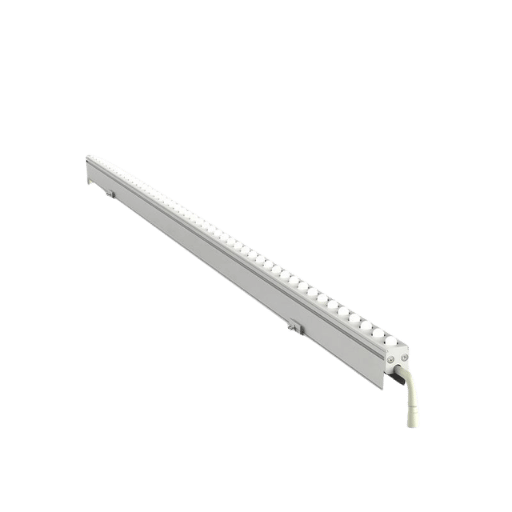
Three upcoming changes in 2026-2027 will influence how facade lighting is specified, and one of them has a hard deadline. Remainder is technology convergence that has been anticipated for years, and is now arriving at commercial scale.
- Tunable white at facade scale satisfies WELL v2 Circadian credit. Human-centric lighting is moving from interior fenestration specialty into exterior projects where the facade adjoins human-occupied terraces, covered walkways, and hospitality courtyards. WELL v2 Circadian credit sets melanopic EDI thresholds in the daytime, with lower short-wavelength content at night. A linear spec for facade that allows 2700K-6500K tunable white future-proofs the spec against the credit expanding to exterior-adjacent applications. 2026 lighting-trend literature routinely identifies tunable white as the largest architectural lighting trend.
- Matter1.4 plus DALI-2 bridges arrives as a plausible BMS option. Connectivity Standards Alliance issued Matter 1.4 for a late2024 release with expanded residential scope; 2026 is the year that building-wide DALI-2Mind bridges will begin shipping. For facade lighting this matters because a Matter-enabled BMS can present to the same dashboard that controls shading and HVAC, for cheaper than a dedicated DMX console for a non-media-facade.
- EU Ecodesign for Sustainable Products Regulation enters lighting-product scope. EU Ecodesign for Sustainable Products moves into active enforcement. Falling due2026, suppliers who are selling into EU after the debut must demonstrate disassembly, replacement parts, and recycled content levels. For specifiers writing specifications with EU applications in mind, this means a new subclause item: repairability and end-of-life records.
Notable for how these regulatory and technology signals match Phase-A search-demand data: the keyword ‘led wall washer’ is trending upward from 480 to 590 monthly searches through 2025—which matches the tunable-white shift (wall-wash format is well-suited to slowly-varying CCT). The generic phrase ‘exterior linear lighting’ is trending downward, accounting for people seeking purpose-built architectural products rather than single-category shopping. Takeaway for a 2026 specification: include headroom for tunable white, mention this article in a Matter control clause note, and demand EU-market repairability documentation in the submittals.
Frequently Asked Questions
Q: How do I calculate how many facade linear fixtures I need for my building?
View Answer
Initial calculation- total number of linear meters of facade / fixture length + an overlap factor which is based on the different angle of beam we select. Eg. 10 grazing @ 200mm (8″ behind wall) offset 10-15%of overlap. 45 wall washing @ 800mm (32″ behind wall) offset 5%overlap is usually enough. That calculation gives you a rough starting point (manufacturers should provide photometric data to slightly refine the initial count); then use a photometric analysis in Dialux evo, or AGi32 to determine the ratio of uniformity and the light fall off until you are comfortable with the number of fixtures needed.
The simulation output, not the calculations, gets submitted for the specs.
Q: What photometric data files should I require from a manufacturer before specification?
View Answer
Ask for four files: IES photometric file (IESNA LM-63 format)for the simulation input; LM-79 photometric report verifying the measured output;LM-80 lumen-maintenance report with at least 6000hours minimum testing data; TM-21 extrapolation with L70 hour forecast. Without any of those 4 the 50,000hours life time and uniformity claims are unsubstantiated.
Q: What’s the difference between DMX512 and Art-Net in facade applications?
View Answer
DMX512 (RS-485, 512 channels per universe, daisy-chained up to about 305m.) Art-Net (encapsulates DMX packet in Ethernet UDP, distributed across many universes on a common network switch.)choose Art-Net when the number of universes exceeds four or the run lengths exceeds the physical limits of DMX.
Q: How do I verify Dark-Sky or IDA compliance for a facade lighting design?
View Answer
Four steps. Check if the site of the project is in an IDA / IES Model Lighting Ordinance jurisdiction, and in that case determine Lighting Zone (LZ0 through LZ4). Find the maximum BUG-rating according to the Lighting Zone, and make sure each fixture listed does not exceed that number based on manufacturer’s IES TM-15 number.
Run a photometric simulation that not only provides the illuminance but also has an uplight component—add the fixture U-ratings over the entire installation and make sure they do not add up to more than the jurisdiction’s ordinance maximum. Finally, compare the trespass of the property boundary output to the limit in place for horizontal trespass (roughly 0.1 fc). LEED v4 SS-8 further requires under Option 1 that the B2-U2-G2 BUG cap be met.
Q: What’s a realistic 10-year TCO for a commercial facade linear lighting project?
View Answer
Analysis of $180-280/L,m installed plus $ 15-25/L,m/year in energy and maintenance. LED retrofit conversions are paid back within 2-3 years based on a current metal-halide baseline.
Q: How do I specify facade linear lighting for a LEED v4 project?
View Answer
SS-8 Light Pollution Reduction—If this is an applicable credit for facade linear work, the uplight fixture component must be placed below the zone-specific MLO cap, fixture BUG rating, and remain at or below B2-U2-G2 under Option 1. Include a photometric simulation showing trespass at the property boundary below 0.1 fc. EAp2 commissioning prerequisite states that the lighting-control sequences are verified at occupancy.
Please include LM-79 and LM-80 reports with your submittal package; without these projects will stall at reviewer sign-off.
Ready to Move Your Facade Lighting Design Forward?
Assuming your next phase is a fixture-schedule phase accompanied by the above photometric and compliance documentation, the correct manufacturer partner can greatly reduce a review cycle. Giving elevations and compliance-zone specs to an in-house photometric engineering group, you can generally expect BUG data sheets, IES files, and a layout proposal within two working days.
Discuss Facade Specification →
About This Analysis
This photometric workflow and compliance-checklist guide synthesises 10 Tier-1 standards and regulation sources against 15 years of on-facade linear light manufacturing history for outdoor architectural lighting solution projects across Asia, Europe, North America & the Middle East. The TCO modeling in here reflects 2024-2025 project bids assembled by Guangqi’s engineering team; the 2026 outlook section draws on DesignLights Consortium, CSA and EU regulation publishes released Q4 2024.
References & Sources
- CIE 094:1993 Floodlighting – Commission Internationale de l’éclairage
- IES TM-15 Luminaire Classification System (BUG Rating) – Illuminating Engineering Society
- IES LM-79, LM-80, TM-21 – Illuminating Engineering Society (photometric & lumen-maintenance standards)
- LEED v4 SS-8: Light Pollution Reduction – U.S. Green Building Council
- International Dark-Sky Association (DarkSky) Model Lighting Ordinance reference
- IEC 60529 Degrees of protection (IP Code) – International Electrotechnical Commission
- DesignLights Consortium 2024 Energy Efficiency and Light Pollution Mitigation – DLC
- Matter 1.4 Specification – Connectivity Standards Alliance
- EU Ecodesign for Sustainable Products Regulation (ESPR) – European Commission
- International Association of Lighting Designers (IALD) Awards programme and published practice
- WELL v2 Circadian Lighting credit – International WELL Building Institute
Related Articles
- Facade Linear Light — Aluminum-Profile LED Fixture Series — cover materials, optics, and DMX control options
- IES Lighting Standards Library – authoritative reference for photometric and luminaire test methods
- DarkSky Lighting Basics – primer on outdoor-lighting light-pollution mitigation
- LEED v4 SS-8 Credit Detail – full documentation & option paths
Reviewed by the Guangqi engineering team. Since 2010, Guangqi Lighting has manufactured outdoor LED linear fixtures for facades across Asia, Europe, North America, and the Middle East — CE / RoHS / IP66 certified production with 100 % aging and waterproof testing before shipment.
![Industrial LED Bulbs: Bases, Voltage & Heat [Checklist]](https://gqlamp.com/wp-content/uploads/2026/10/industrial-led-bulbs-blog-featured-150x150.png)