Get in Touch with GUANGQI



Quick specs
Quantity: correlated color temperature (CCT), measured in kelvin (K). Options discussed: 2200K, 2700K, 3000K and 4000K. Decision inputs: owner specification, exact fixture configuration, photometry, spectrum and site feedback. Scope: roadway and community lighting; no universal Kelvin recommendation.
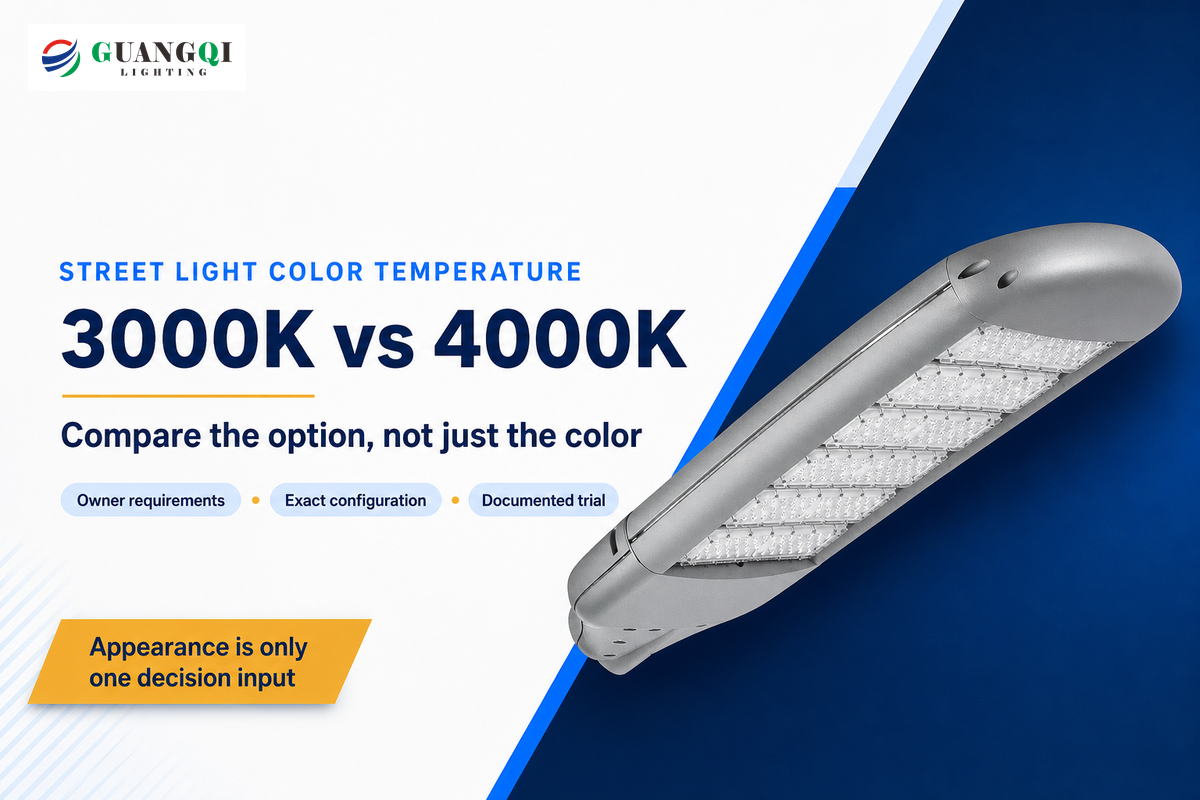
Street light color temperature describes how warm or cool a white light source appears. It doesn’t clarify how much useful light gets to the road. For a consumer comparing 3000K and 4000K LED lighting quotes, that distinction is important. A nice sample and a compliant lighting design address different questions.
Street light color temperature is a color-appearance specification. Start with the road owner’s requirements, then compare exact CCT options at documented output and geometry. A lower Kelvin value doesn’t by itself prove better visibility or wildlife suitability.
Key takeaways
- Two sources can have the same CCT and different spectra.
- 3000K looks warmer than 4000K; neither number establishes roadway performance.
- Match the quoted option to its supporting files before comparing price or watts.
- Keep stakeholder preferences separate from engineering acceptance.
What street light color temperature measures
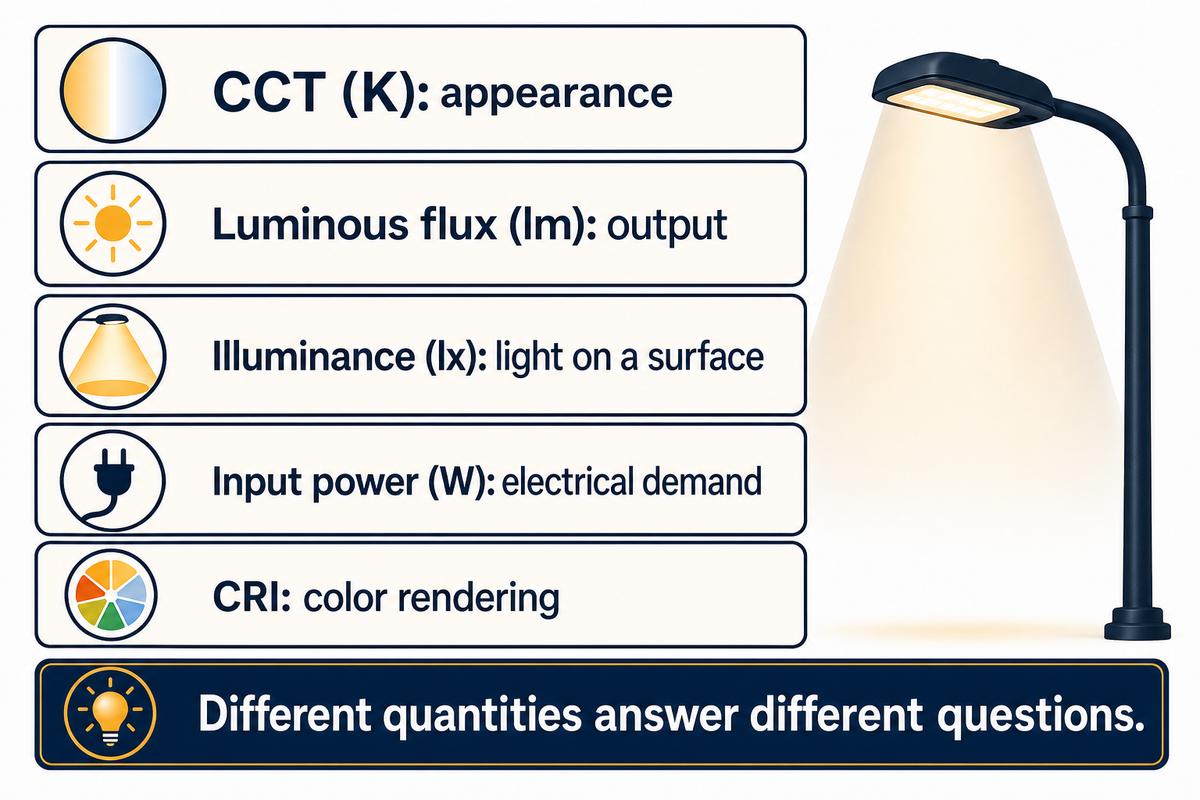
Correlated color temperature describes the appearance of nominally white light on the kelvin color temperature scale. Lower values indicate warmer tones; higher values indicate cooler light. The output, electrical power and color rendering are separate characteristics, so understanding color temperature starts with differentiating these quantities when comparing a lamp or fixture.
The U.S. Department of Energy’s color and spectrum research illustrates spectral power distributions for the same chromaticity. One color label describes light emitted; it isn’t a complete description of that light source. Likewise, CCT isn’t the physical temperature of a lamp.
| Quantity | What it describes | What it cannot settle alone |
|---|---|---|
| CCT (K) | Warm or cool white appearance | Roadway brightness or visibility |
| Luminous flux (lm) | Light output | Where the fixture directs it |
| Illuminance (lx) | Light arriving on a surface | Every aspect of seeing conditions |
| Input power (W) | Electrical demand | Useful delivered light |
| Color rendering index (CRI) | A color-rendering metric | Full spectrum or application suitability |
The common error is to read “cool white” as “more powerful.” Use the separate lumens vs. lux guide to distinguish source output from light on a surface. Use the lumens vs. watts guide to compare power.
Compare 2200 K, 2700 K, 3000 K and 4000 K
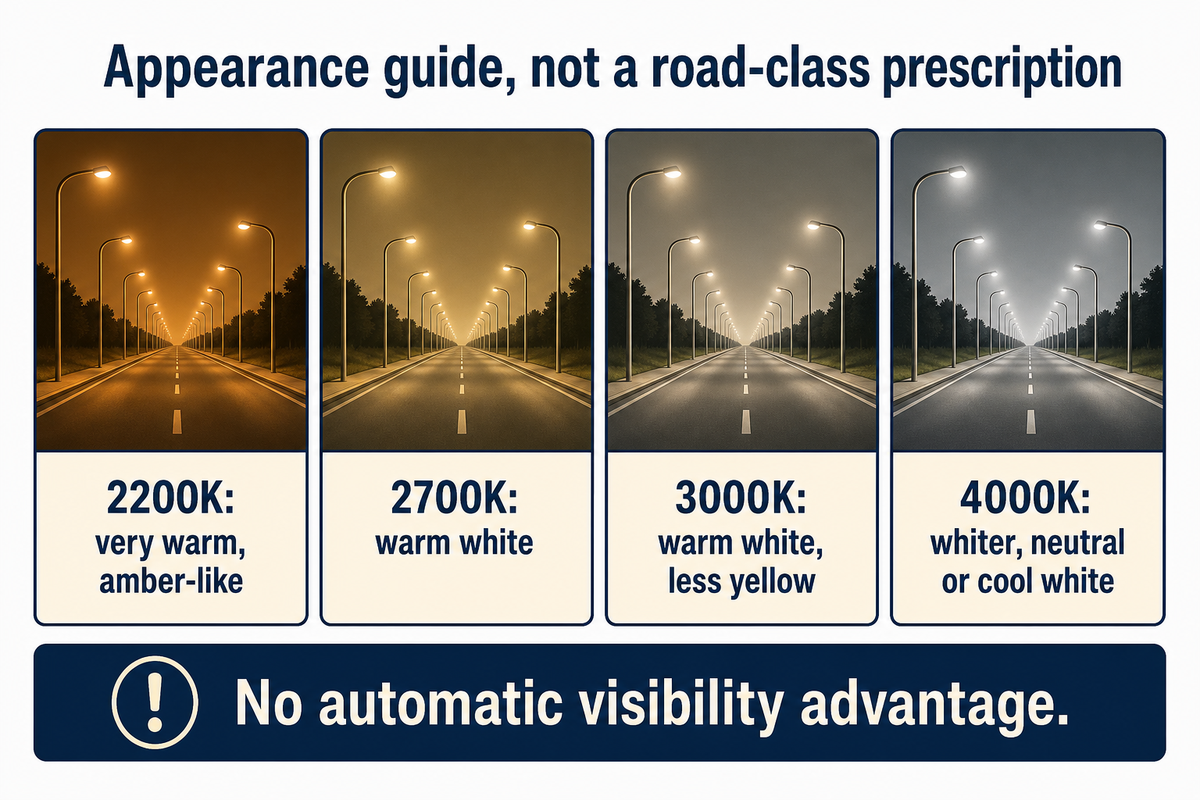
When selecting street lights, 2200K through 3000K appear warmer in tone than 4000K LED lighting. A suitable shortlist depends on the road owner’s approved alternatives and the situation. The table is a means of selecting samples for discussion, with appearance descriptions separated from lighting levels, ecological conditions, and formal design criteria.
| Nominal CCT | Relative appearance | Reason to include a sample | Limitation |
|---|---|---|---|
| 2200K | Very warm, amber-like appearance | Owner requests a very warm candidate | Does not prove narrow-band amber output or habitat suitability |
| 2700K | Warm white with a warm glow | Warm appearance is part of the community brief | Does not determine delivered lumens |
| 3000K | Warm white, less yellow than 2700K | An approved warm-white option is needed | Not a universal municipal requirement |
| 4000K | Whiter; often called neutral white or cool white | Owner specification permits this candidate | No automatic visibility advantage over warmer samples |
Terms such as neutral light and cool white light vary across the lighting industry. A neutral color description is still an appearance label. Give the real Kelvin value in the schedule and the actual lighting temperature is clear. High color temperatures may be considered bluish next to warm light; the description is silent on whether sufficient light reaches a crossing.
Is 3000K or 4000K better for outdoor lighting?
Neither 3000K nor 4000K is the best color temperature for outdoor lighting in all locations. A 3000K source has a warmer appearance, while a 4000K source appears whiter. Warmer color temperatures may satisfy a stated appearance preference. Selecting the right color temperature requires an approved design and site-specific choice; compare samples without quietly modifying their output, optics or state.
There are illuminating examples of the evaluation of appearance preferences. Illustrative selection scenario: A community road owner wants warmer light beside homes, while the maintenance team wants replacement parts consistent with their existing 4000K inventory. Procurement requests both 3000K and 4000K configurations. The engineering team checks each option for conformity with the approved design. The residents review the samples under documented conditions. If the warmer option is preferred, the owner must make a clear decision regarding ordering and the replacement stock. Finance can price that inventory consequence without assigning an invented efficiency penalty to warm white light. The warm vs cool discussion then has a practical outcome. The owner approves the defined configuration and maintenance arrangement, rather than purchasing whichever example looks most appealing.
Brightness and glare need their own checks
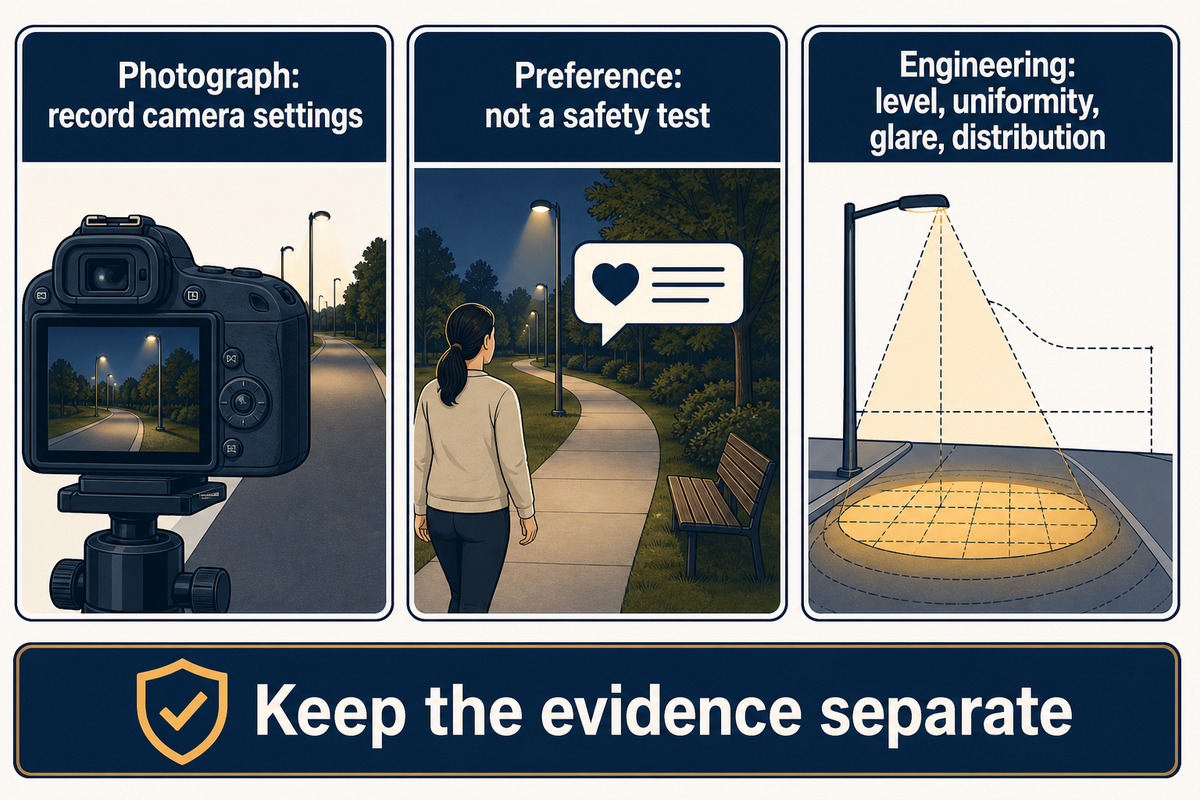
Color labeling of street lights can’t take the place of lighting checks for level, uniformity, glare, and distribution. These checks pertain to the installed system and the observer’s task, including security lighting or task lighting specified in the site brief. Compare proposed lighting solutions using the project geometry and applicable criteria, then consider color preference within the options that meet the design brief.
The Federal Highway Administration’s archived 2015 driver-performance research found spectral effects depended on experimental conditions. There were effects of adaptation luminance, headlamps, speed and the location of the target. That is a reason to resist simple warm-versus-cool safety rankings, not a current design formula. Use the separate street lighting design standards guide for elaboration on design-related questions.
Common failure modes
Buying by a daylight photograph. A photograph of the color of the light can be altered by white balance on the camera. Just as a picture can help identify a product or an installation, a picture can’t help define the perception of the completed roadway at night by an observer. Record settings if photographs accompany a trial; photographs should be considered auxiliary to on-site records.
Changing color to fix the wrong problem. When examining lighting, factors of direction and mounting of the light and operating hours should also be assessed. The joint DarkSky and Illuminating Engineering Society principles address useful, targeted, low-level, controlled and warm-colored lighting. When a complaint is regarding light reaching a bedroom or living rooms, consider other factors before assuming that a lower color temperature would resolve the complaint.
Calling a preference vote a safety test. A record of the perception that light creates a more pleasant ambiance doesn’t measure target detection, glare, or compliance. The experiments conducted by the FHWA used defined visual tasks, and a buying walk-through doesn’t define or reproduce them. To claim that one CCT will ensure safety, evidence should be provided beyond subjective feedback.
Near wildlife, require more than a Kelvin label
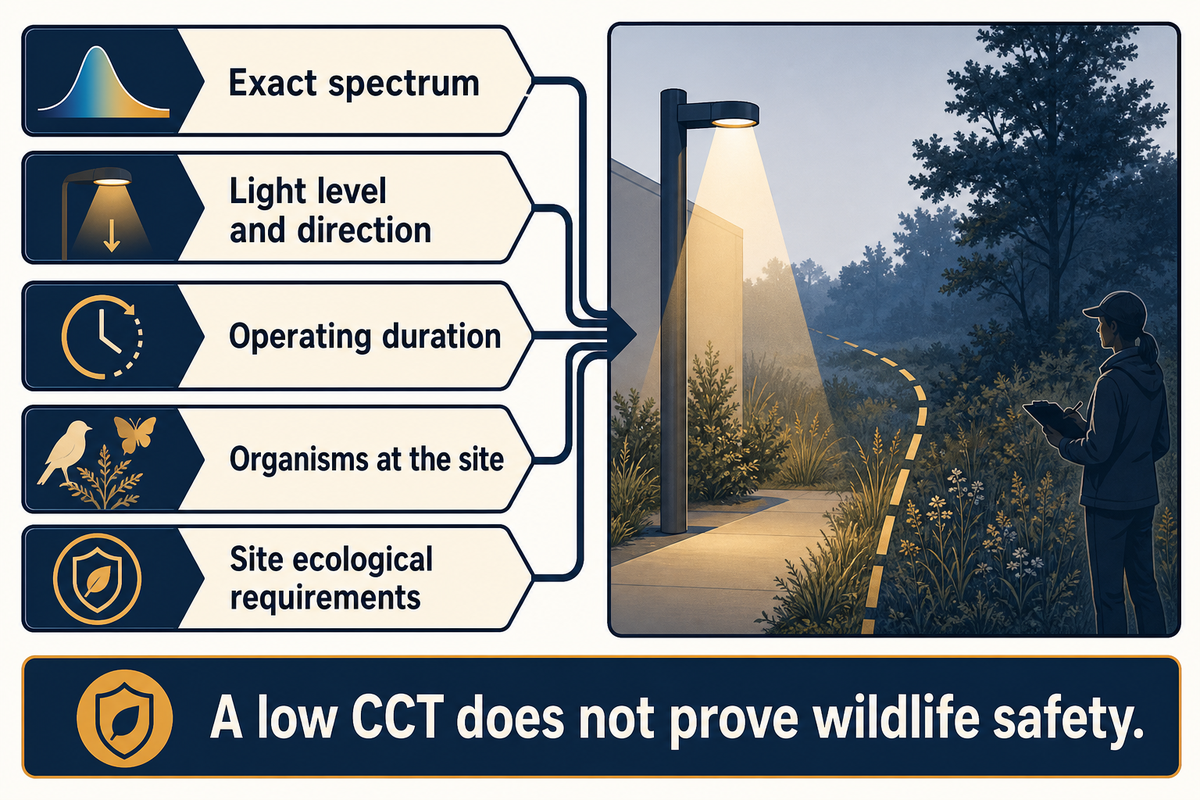
Near a sensitive habitat, request spectral power distribution and the ecological requirements of the site, in addition to a CCT. Spectrum is just one of many inputs: the level of light, the direction, the duration, and the organisms present also play a role. Low color temperatures may be included in a project brief, but they don’t determine that an installation is safe for wildlife.
DOE’s sky-glow research considers spectrum together with output and uplight. When comparing sites, it shouldn’t be read as predicting absolute values for a new site. During a related DOE webinar, Bruce Kinzey talks about spectral data as follows:
“people have to look at the actual spectral content.”
A field study at three Swiss forest sites, published online in 2025, found that there were different color-temperature responses among different insect groups. Trap captures don’t show population-level harm and a general safe Kelvin value can’t be extrapolated. The implication for purchasing is practical: send the exact proposed spectrum and operating schedule to whoever owns the site’s ecological assessment.
Do street lights have blue light?
Many white LED street lights emit some short-wavelength light, including blue wavelengths, but the amount depends on the spectrum of the specific source. A warm-white label doesn’t mean zero blue light. If there’s a spectral limitation in your project, CCT and a product photo won’t prove compliance.
Procurement takeaway: Specify the ecological requirement first. Do not substitute “amber-like appearance” for a spectral limit or treat a spectrum chart as ecological certification.
Normalize bids before comparing watts
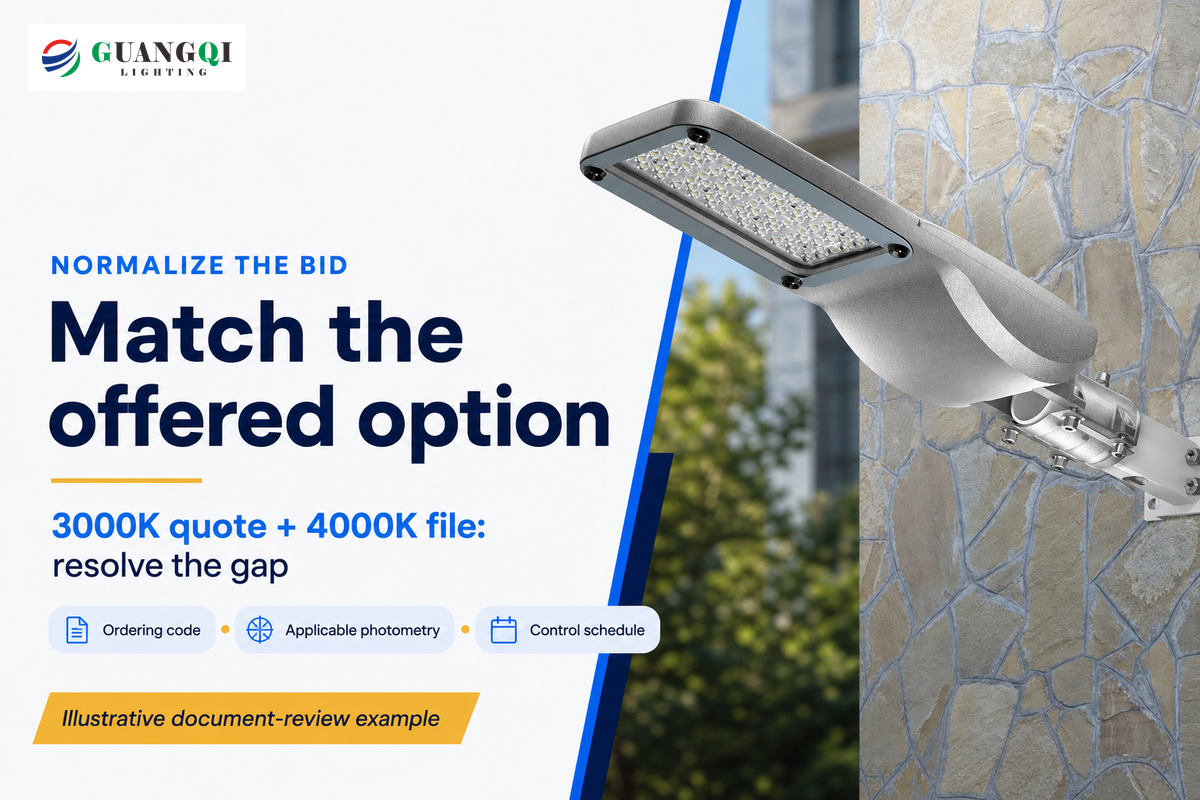
Comparable CCT bids specify the exact luminaire configuration and provide supporting documents. Use the same project brief for each supplier. The six-field table below is an editorial procurement worksheet: it exposes missing or changed information before engineering compares performance and finance compares the resulting offers.
6-Field CCT Option Deviation Table
| Field | Example entry | Decision or required evidence | Owner |
|---|---|---|---|
| 1. Exact configuration | Quote says 3000K; attached file says 4000K | Record the deviation; do not treat it as resolved | Procurement |
| 2. Color and spectrum | CCT stated; spectrum and CRI not supplied | Request required color data for the offered option | Engineering |
| 3. Output and input | Catalog values have no option reference | Ask which lumen and watt figures apply | Engineering and finance |
| 4. Optic and photometry | Photometric file belongs to another option | Request matching data or documented applicability | Engineering |
| 5. Operating profile | Dimming schedule omitted | Compare offers under the owner’s stated schedule | Owner and finance |
| 6. Sample traceability | Sample label lacks ordering code | Link the trial sample to the purchase configuration | Quality and procurement |
Illustrative bid-review scenario: A contractor posts a bid for a 3000K fixture, but the downloadable photometric file is labeled 4000K. The procurement officer identifies the discrepancy and doesn’t assume that the offer fails or that the variants are identical. Engineering asks the manufacturer for a matching file or a documented explanation of applicability. Finance is withholding comparison of input watts until the offered configuration is clarified. If the manufacturer can’t resolve the document gap, then the bid is considered incomplete. The bottleneck is traceability, not an assumed warm-light efficiency loss. This approach gives each team a concrete action without inventing a percentage difference between LED chips or a savings figure.
For commercial street-light fixtures, keep configuration data for grid-powered systems separate from data for solar-powered systems. The LED versus HPS street-light comparison covers the broader retrofit consideration.
Run a documented night trial
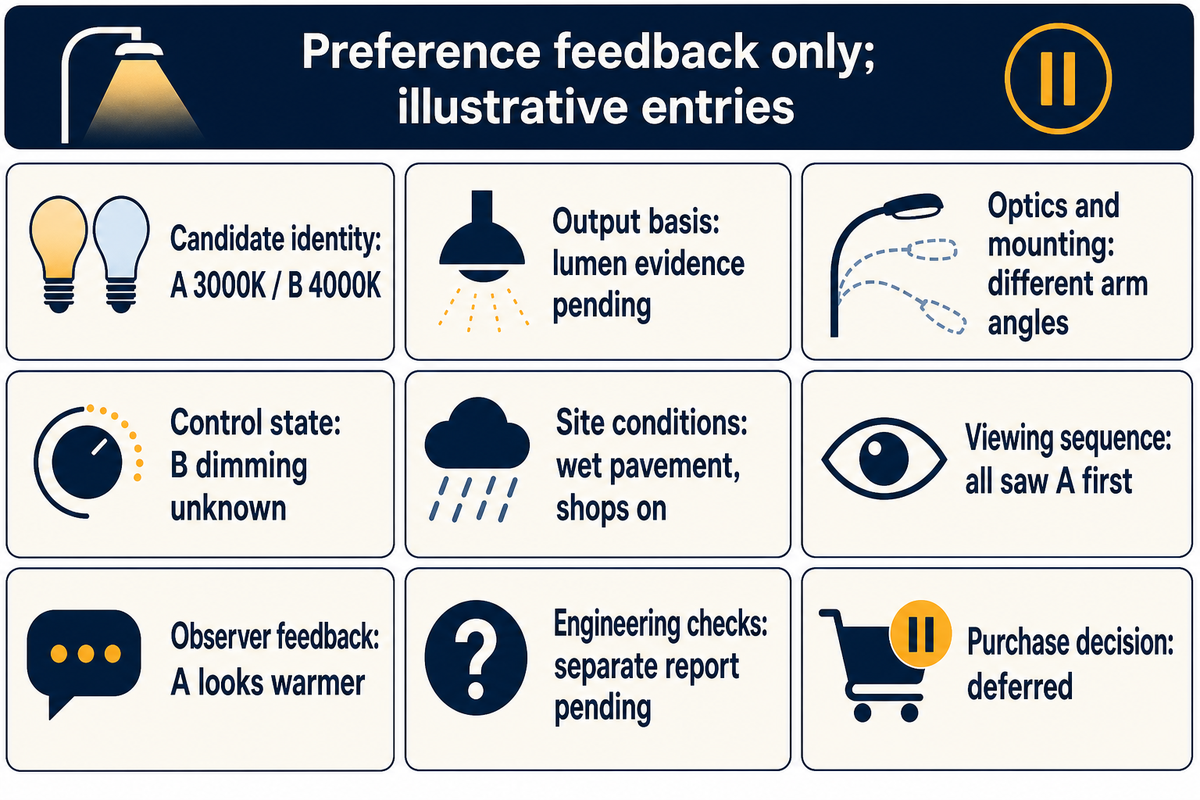
A night trial can be documented to show that a given stakeholder prefers one of the permitted options. Record output, geometry and operating conditions so that an obvious setup difference is not mistaken for a CCT preference. Keep this record separate from the designer’s acceptance criteria; it isn’t a validated safety or ecological test.
The 2023 community survey from Boulder showed that 84% of respondents preferred warm light in residential areas. Evidence from public consultation is helpful in defining the brief, while engineering assessment is kept separate.
Same-Output Color Trial Record
| Record field | Illustrative entry | Next action | Limitations / Not suitable for |
|---|---|---|---|
| Candidate identity | A: 3000K; B: 4000K | Attach full ordering codes | CCT labels alone cannot identify samples |
| Output basis | Lumen evidence pending | Confirm the intended comparison output | Equal watts do not establish equal output |
| Optics and mounting | Different arm angles observed | Correct or disclose the difference | Cannot isolate color while geometry changes |
| Control state | B’s dimming state unknown | Record both actual settings | Unmatched operation confounds impressions |
| Site conditions | Wet pavement; adjacent shop lighting on | Record weather and surrounding light | Do not generalize to every condition |
| Viewing sequence | All observers saw A first | Counterbalance order in the review plan | Order can bias preference |
| Observer feedback | “A looks warmer” | Record color preference separately | Does not measure detection or recognition |
| Engineering checks | Separate report not yet reviewed | Designer reviews applicable criteria | This record cannot certify compliance |
| Purchase decision | Deferred pending complete records | Owner names the selected configuration | A preferred sample is not automatic approval |
Illustrative Consultation Scenario: Residents in the shopping area compare two samples on a pedestrian path near the shops. Many prefer the warmer looking sample as the cooler light contrasts with the shop fronts and state that the warmer looking sample creates an inviting atmosphere in these outdoor spaces. The organizer captures the preference, and the surrounding layered lighting, and notes that one of the samples is dimmed. The comparison is repeated under documented settings before the owner draws a color-preference conclusion. Engineering receives the comments about dark patches separately and checks distribution against the design brief. The meeting doesn’t become an improvised driving simulation. A record that says “preference pending a comparable setup” is more useful to the purchasing team than a neat vote attached to mismatched conditions.
Keep the identity of the observer, the order in which the observations were made and any changes to the setting in the project record. Describe how light affects the situation without transforming an impression into a measured outcome. Photographs and adjectives like “brighter” shouldn’t take the place of measurements. Choosing the best appearance and choosing the right light distribution are related purchasing tasks, but their evidence is different.
Check the road owner’s current specification
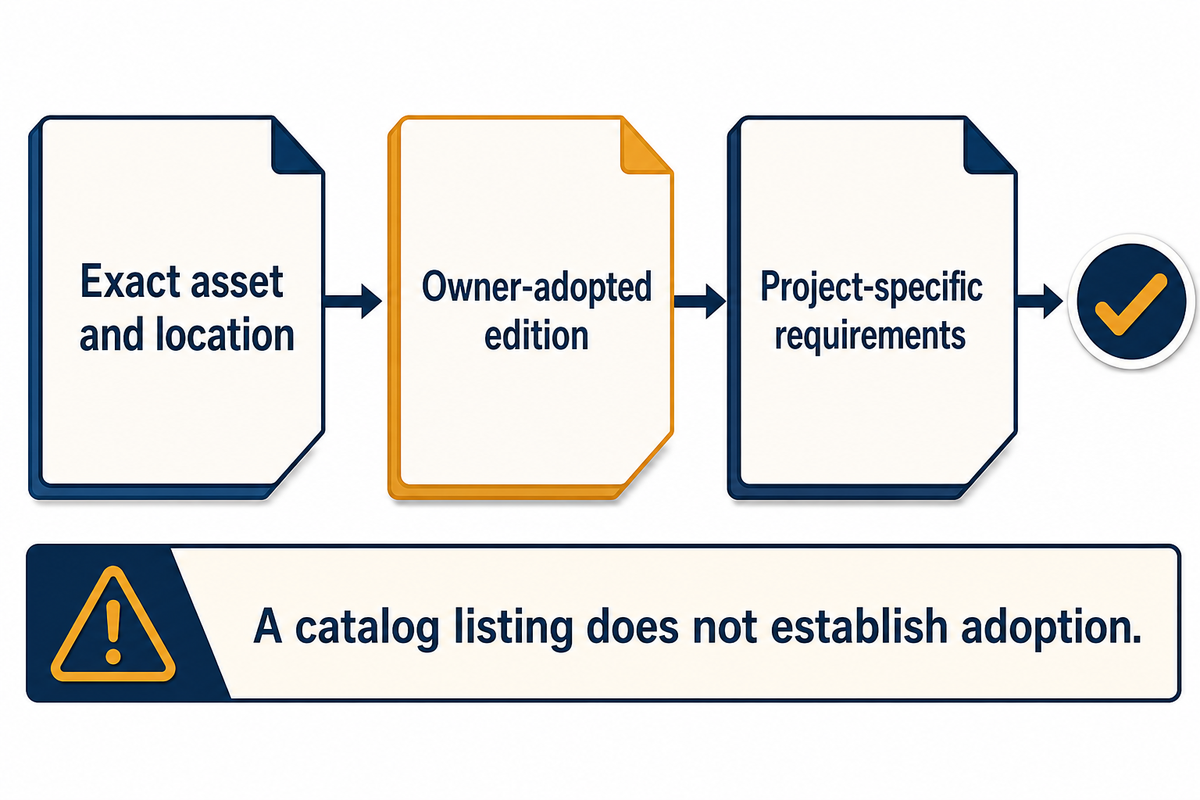
The owner’s applicable specification limits the CCT options and acceptance criteria. Confirm the exact asset, location and edition of the adopted document before placing the order. An up-to-date industry catalog and a municipal example can assist in defining the requirements for the project; however, they don’t automatically define requirements for a different project.
As an example, the pedestrian route guidance in Seattle’s downtown area lists 3000K with a ±300K tolerance for its prescriptive path and 3000K for its performance path. The page is marked last updated July 2017. The values pertain to the described pedestrian applications in the downtown area of Seattle; they don’t indicate that the city of Seattle has a Kelvin rule for all roadways.
As checked in October 2026, the Illuminating Engineering Society catalog lists ANSI/IES RP-8-25+E2. The listing identifies the published recommended practice, not the edition adopted in your contract. Ask the owner to name the governing documents and any project-specific requirements. Do not refer to numerical criteria from a different road class or from an old tender.
For a combined lighting project for roadways and parking areas, check requirements for each area, separately. The parking lot lighting standards guide helps organize that adjacent scope without turning this color-temperature article into a complete design specification.
Request the exact street-light configuration
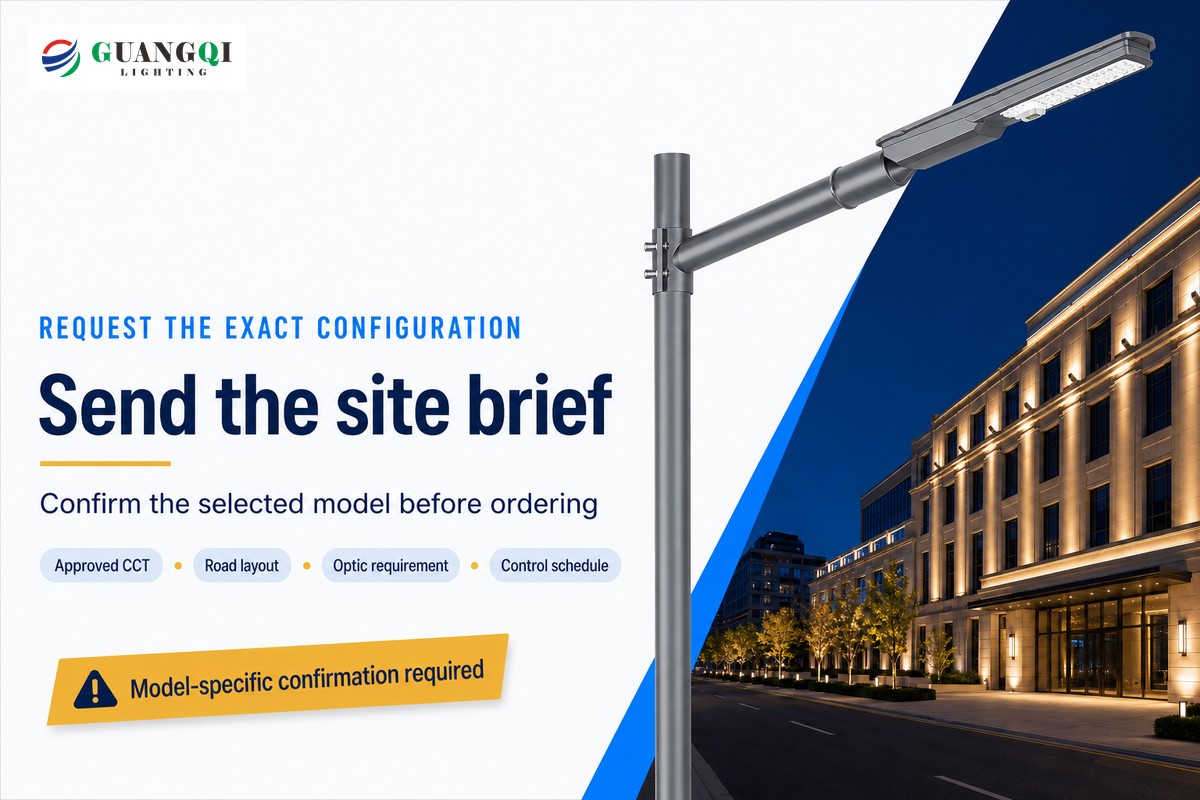
Send the owner-approved CCT, road layout, optic requirement and control schedule with your inquiry. Guangqi’s LED street-light range has options in 2700K-6000K for roadway and community lighting. Confirm the availability of the selected model and close any gaps with the deviation table prior to placing the order.
To choose the right lighting from the available range of lighting options, start with the site brief. For organizing the layout of the site and its documentation, refer to Guangqi’s lighting design services.
Frequently Asked Questions
Which is whiter, 4000K or 6000K?
6000K generally appears cooler or more bluish than 4000K, which is often described as neutral white.
Color names are less precise than the stated CCT and actual sample. A higher value on the color temperature scale doesn’t tell you which option delivers more lumens, uses fewer watts or better suits a road. When reviewing different color temperatures, keep the approved project requirements and the exact fixture data beside the appearance comparison. Don’t select a cooler lamp simply because its photograph looks brighter.
Is 3000K too yellow for street lighting?
3000K has a warm-white appearance; whether it looks too yellow is a preference question within the project’s permitted choices.
A person accustomed to cooler temperatures may notice the change more strongly than someone viewing a warm-lit street. Nearby shop windows, building lighting and the previous installation provide context for that judgment. That combination of lighting affects how people describe the color of light. Gather comments about the lighting choices from the relevant site users, record the comparison conditions and retain engineering acceptance as a separate decision. A preference for a whiter light isn’t, by itself, evidence that the warmer configuration fails its design criteria.
Can a street light’s color temperature be changed?
Only a fixture designed with suitable color-selection or color-tuning capability can change CCT through its intended controls.
Don’t assume from experience with incandescent bulbs or domestic LED bulbs that dimming a fixed-CCT street light changes its color in a controlled way. DOE’s guide to color-tunable products distinguishes dim-to-warm, white-tunable and other approaches. Confirm the actual product function, permitted settings and related output data with the manufacturer. An advertised choice of CCT at ordering is different from a user-adjustable fixture after installation; the wording on a category page doesn’t settle that distinction.
Is 4000K warm or cool?
4000K is commonly called neutral white or cool white; product naming varies.
Specify 4000K in the order rather than relying on the marketing name.
Why are street lights different colors?
Different source technologies, specified CCTs and replacement histories can produce different street-light colors.
Warm and cool light may appear on adjacent roads because the owners selected different systems or replaced them at different times. For an unexplained change in an existing fixture, compare its appearance with its documented specification and maintenance record. Color alone can’t diagnose the cause.
About this guide
Prepared from public technical, municipal and manufacturer sources reviewed in October 2026. The two record tables are editorial purchasing aids with illustrative entries. They contain no Guangqi field-test results and don’t replace project design, ecological review or acceptance measurements.
References & Sources
- Color and Spectrum U.S. Department of Energy.
- Evaluation of the Impact of Spectral Power Distribution on Driver Performance Federal Highway Administration, 2015, archived report.
- Five Principles for Responsible Outdoor Lighting DarkSky and Illuminating Engineering Society.
- Sky Glow Research U.S. Department of Energy.
- Sky Glow Comparison Tool webinar transcript U.S. Department of Energy.
- Mitigating light pollution impacts on arthropods based on LED properties van Koppenhagen and colleagues, Conservation Biology.
- Streetlight Color Temperatures City of Boulder, 2023 community feedback.
- Downtown Design: Pedestrian Lighting Seattle Streets Illustrated.
- ANSI/IES RP-8-25+E2 catalog entry Illuminating Engineering Society.
- Understanding LED Color-Tunable Products U.S. Department of Energy.