Get in Touch with GUANGQI



![LED vs HPS Street Lights: Cost & Performance [2026 Guide]](https://gqlamp.com/wp-content/uploads/2026/07/led-vs-hps-street-lights-featured.png)
LED vs HPS street lights is the head-to-head comparison between solid-state semiconductor fixtures and gas-discharge sodium-vapor lighting for roadway and municipal projects. Led vs HPS street lights comes down to a critical point many comparisons skip: does the light really help you *see* at night, not just appear *bright*? For half a century, high-pressure sodium fixtures have illuminated roadways, but their yellow-orange glow has such poor color rendering it actually changes your perception of objects, faces and hazards in the dark. The true difference between LED and HPS street lighting, and traditional street lights generally, is less about brightness and this type of lighting’s raw performance – and much more about how each tech presents the scene a driver needs to react to. This article reviews the cost and efficiency figures every comparison of led streetlights vs hps streetlights covers, runs through the other advantages of LED and the performance of LED technology for street lighting, and looks deeper at the safety case, retrofit timing, and the real cases where HPS may still come out ahead, if you’re working on a project involving LED streetlights or LED street lamps for a real site, Guangqi’s commercial street lighting catalog covers cobra head, post-top, and shoebox options.
Whether you searched led vs hps street lights pros and cons, sodium vs led street lights, or high pressure sodium lights vs led energy consumption, this table covers the core numbers behind all three questions.
Quick answer: led street lights average 120-170 lm/W vs 80-110 lm/W for HPS. They can last for over 100,000 hours, vs an estimated 24,000 hours for HPS. HPS offers color rendering between 20-30, whereas LED is between 70-90. In many cities, the replacement of a 150-W HPS cobra head comes with a 65-90 W LED equivalent. This is a savings of 50%-60% on energy use, and most HPS conversions have a payback period of 3-5 years (before utility incentives are included).
- HPS’s poor color rendering (CRI 20-30) influences the appearance of objects and colors in the dark.
- Typically, a 150W HPS system is swapped for 65W to 90W LEDs – a much smaller power usage.
- When HPS ballasts and lamps reach the end of their life, they don’t usually fail cleanly – rather, cycling and flickering appear.
- Portland’s real 45,000-fixture conversion saved $100,000/month within its first year
- Decorative fixture retrofits are the one niche where HPS remains an option, since paybacks of 9 years or longer are common there.
Quick Specs: LED vs HPS Street Lights
| System Efficacy | LED 120-170 lm/W | HPS 80-110 lm/W |
| Rated Lifespan (L70) | LED 100,000+ hrs | HPS ~24,000 hrs |
| Color Rendering (CRI) | LED 70-90+ | HPS 20-30 |
| Warm-Up / Restrike | LED instant | HPS 5-10 min cold, longer hot restrike |
| Dimming / Controls | LED 0-10V, DALI, networked | HPS not possible |
| Typical Payback | 3-5 years before utility rebate, faster after |
How LED and HPS Street Lights Differ at the Physics Level
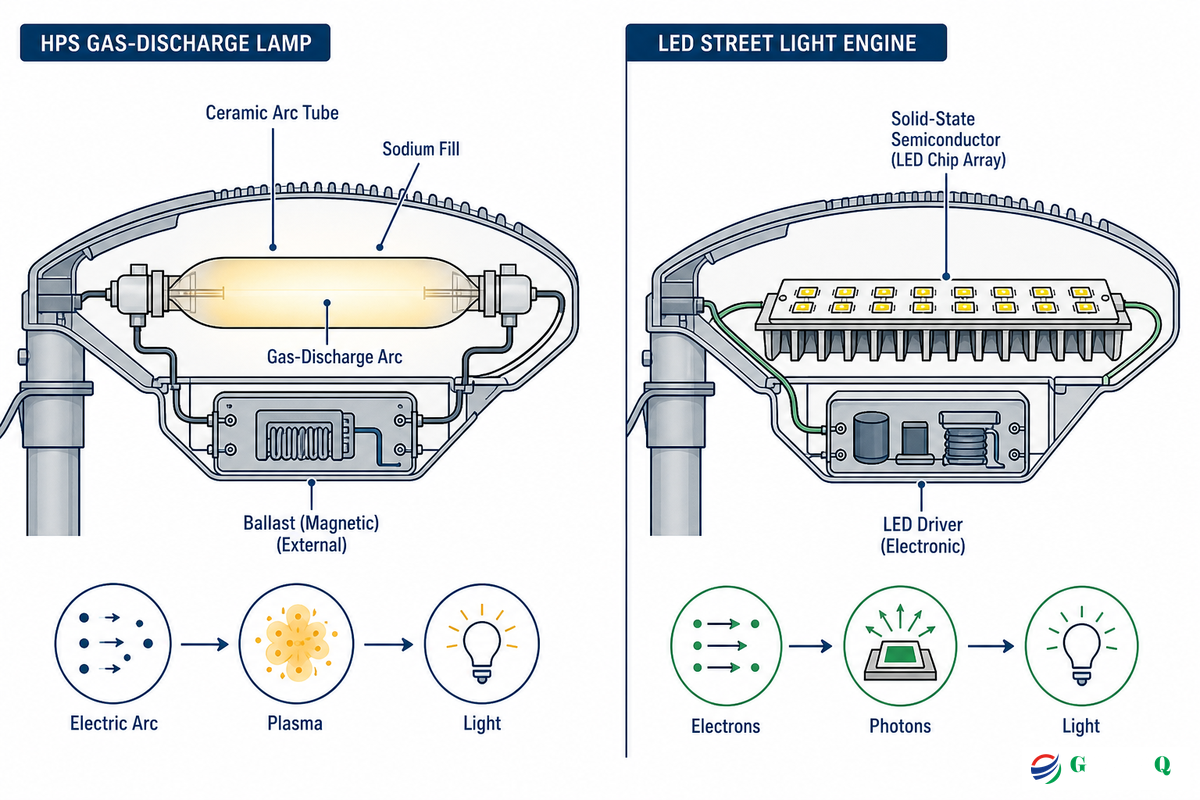
Fundamentally, an LED light source for street lighting is a solid-state semiconductor device. Forward voltage pushes electrons across a p-n junction, and their recombination releases energy directly as photons, no gas, no filament required. A high-pressure sodium lamp, by contrast, is a gas-discharge fixture: an electrical arc ionizes sodium vapor inside a ceramic arc tube, creating a plasma that emits light once it reaches operating temperature.
That mechanism difference is why HPS street lights need a sodium-vapor gas-discharge arc and a ballast, requiring 5-10 minutes of warm-up from cold plus a longer hot-restrike delay after a power interruption, while an LED fixture reaches full brightness in under a second.
That same physics also explains the efficiency gap and the overall efficiency advantage LED holds over sodium technology, because a solid-state device simply has fewer places to lose energy than a gas-discharge one — a structural reason the U.S. Department of Energy’s own SSL LED Adoption Report confirms and one Guangqi’s engineering team cites when specifying fixtures, not a marketing claim. LED light emission converts a large share of input power directly into visible light, which is why lighting efficiency improves so dramatically when a fixture moves from HPS to LED, the core reason LED lighting systems have become the default for new roadway and parking lot projects on energy efficiency grounds alone, and it’s why the efficiency of LED keeps improving compared to sodium and HPS with each new driver generation, moving fixtures away from HPS and toward LED technology across the industry. Gas-discharge HPS loses a meaningful share of input power as heat and as light in a narrow sodium spectral band the eye doesn’t use efficiently for full-color vision, the same underlying reason HPS renders color so poorly.
The CRI-20 Visibility Gap, Why HPS’s Color Rendering Is a Safety Problem
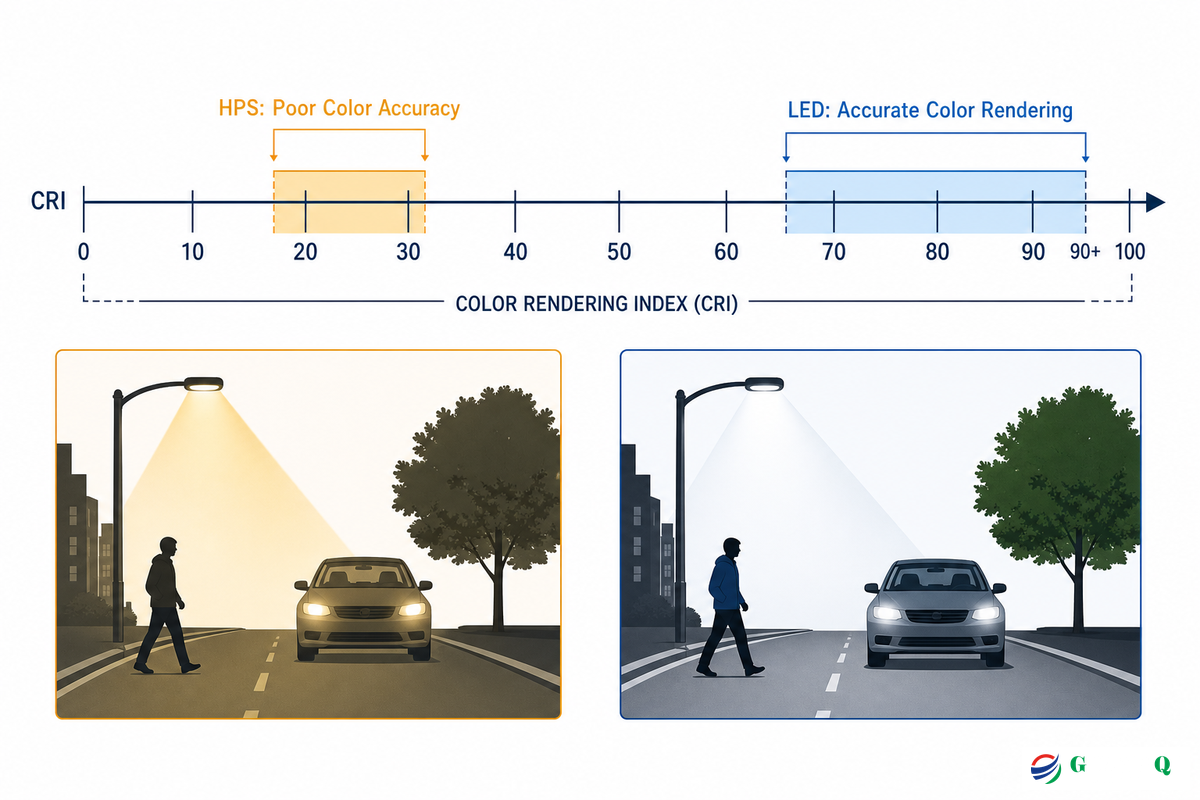
CRI-20 Visibility Gap is the best term for the most basic problem with HPS light: the Color Rendering Index (CRI) of typical HPS lighting is 20-30 on a scale of 0-100, compared with 70-90+ for LED. Most street lighting analyses treat this difference between the yellowish light and orangish tint of HPS and the bright white light of LED as a cosmetic concern. It’s not. The color of the light is genuinely better than sodium technology in ways that directly influence whether a motorist or pedestrian can quickly identify what they’re seeing: the object, the pedestrian’s coat against the sidewalk, the road ahead, etc. A low-CRI light source limits the ability to differentiate between various colors.
Statistics compiled by the Federal Highway Administration show that traffic fatalities occur nearly three times as frequently at night as they do during the day, despite less than a quarter of total miles being traveled at night. Properly illuminated roads can reduce crashes at intersections by up to 38%, per the FHWA’s Nighttime Visibility program, and up to 76% of pedestrian fatalities happen in the dark. None of these statistics is directly related to the LED vs. HPS issue; they’re simply statistics about the effect of having adequate lighting. But the quality of the light, the ability of drivers to see and identify hazards, pedestrians, and traffic signals correctly, depends significantly on CRI.
📐 Engineering Note
CRI alone doesn’t tell the whole story, of course. IES TM-30, a newer method, includes measures of fidelity (Rf) and gamut (Rg) and a score for R9-the rendering of saturated red-that CRI averages out. If it’s critical that a light clearly render red signals, brake lights, or high-visibility safety vests, ask about the TM-30 Rf/Rg/R9 scores instead of the basic Ra: Real value lies in the actual light quality and light color accuracy, not simply the lumen number.
What are the differences between HPS and LED lighting in terms of brightness and light pattern?
HPS lamps are omnidirectional – they throw light 360°, and a fixture’s reflector must direct much of it back toward the roadway, wasting some of it as backlight and uplight. LED fixtures emit from a flat array and pair with purpose-built optics (Type II, III, or V distributions) that deliver light onto the roadway from the get-go – which is why you’re seeing fixture specifications include uplight rating as a design parameter rather than an afterthought.
Practically speaking, a lower lumen LED fixture will be able to put more light on the pavement than a higher lumen HPS fixture rated at the box, since less is thrown away in the wrong direction. That directional control also reduces light pollution – less wasted uplight translates into less sky glow and less spill onto adjacent properties – a factor a growing number of dark-sky ordinances now explicitly regulate.
HPS Wattage Cross-Reference, Matching LED Replacements Without Overspec
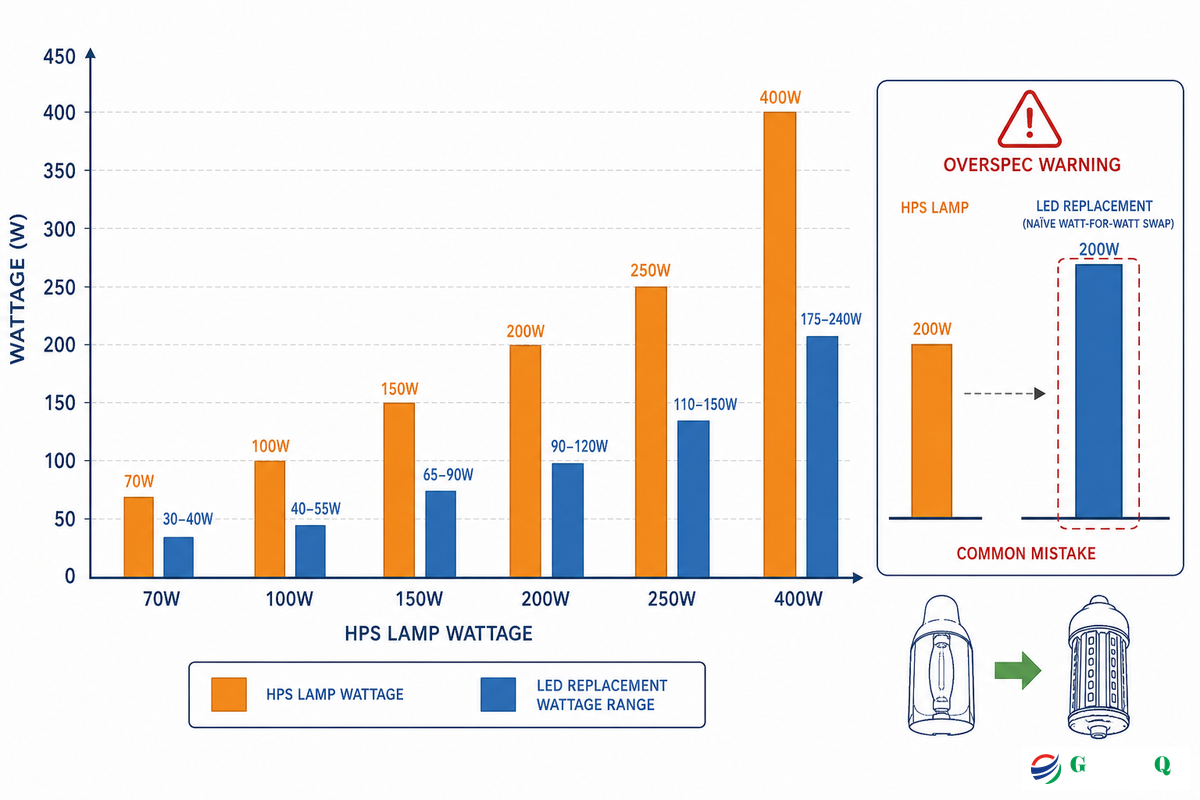
Assuming a watt-for-watt swap or judging the amount of light based on nothing but wattage numbers is the single most expensive mistake in an HPS-to-LED conversion, and it’s a trap Guangqi’s engineering team sees repeatedly on quote requests. A 150W HPS system (lamp plus the magnetic ballast) pulls almost 180W at the wall; this isn’t replaced by a 150W LED but rather by a roughly 65-90W LED, thanks to the LED optics being able to put a higher share of lumens on the roadway. This overspec problem happens because HPS is omnidirectional and loses light to reflector inefficiency, so a naive wattage-halving (ordering a 75-90W LED lamp for a 150W HPS fixture) generally leads to a fixture running 30-40% brighter than called for, wasting money on both the fixture itself and the electric bill for years afterward. Portland’s own transportation bureau confirms the real-world pattern behind this table: its LED replacements ran roughly half the wattage of the HPS fixtures they replaced.
| HPS Lamp Watt | System W (w/ Ballast) | LED Replacement | Application Type |
|---|---|---|---|
| 50W | ~62W | 20-28W LED | Pathway, pedestrian walkway |
| 70W | ~85W | 30-40W LED | Residential street, pathway |
| 100W | ~125W | 40-55W LED | Local road, low-mount pole |
| 150W | ~180W | 65-90W LED | Cobra head, arterial road |
| 175W | ~207W | 75-100W LED | Wide collector, secondary arterial |
| 200W | ~230W | 90-120W LED | Collector road, parking area |
| 250W | ~295W | 110-150W LED | Major arterial, wide intersection |
| 310W | ~365W | 140-185W LED | Major intersection, wide arterial |
| 400W | ~465W | 175-240W LED | Highway, high-mast |
| 1000W | ~1130W | 425-560W LED | Highway high-mast, stadium-adjacent arterial |
Worked example: A municipality currently using 150W HPS cobra heads (~180W at the wall when accounting for ballast losses) selects a 70W LED replacement. At about 140 lm/W, that 70W LED puts out nearly 9,800 initial lumens, or nearly the same usable output as a 150W HPS fixture with a 16,000 initial lumen rating (after you factor out the inevitable reflection and mid-life light loss). This compares to a reduction in power consumption from ~180W to 70W, or 61%, rather than the roughly 50% a naive watt-for-watt calculation would imply. That’s directional math: you need a photometric simulation at your specific pole height and spacing to verify uniformity before placing a large order, and you can narrow your selection using Guangqi’s LED product selector tool by wattage and application prior to performing that simulation.
Lifespan, Failure Curve, and the Real Maintenance Bill
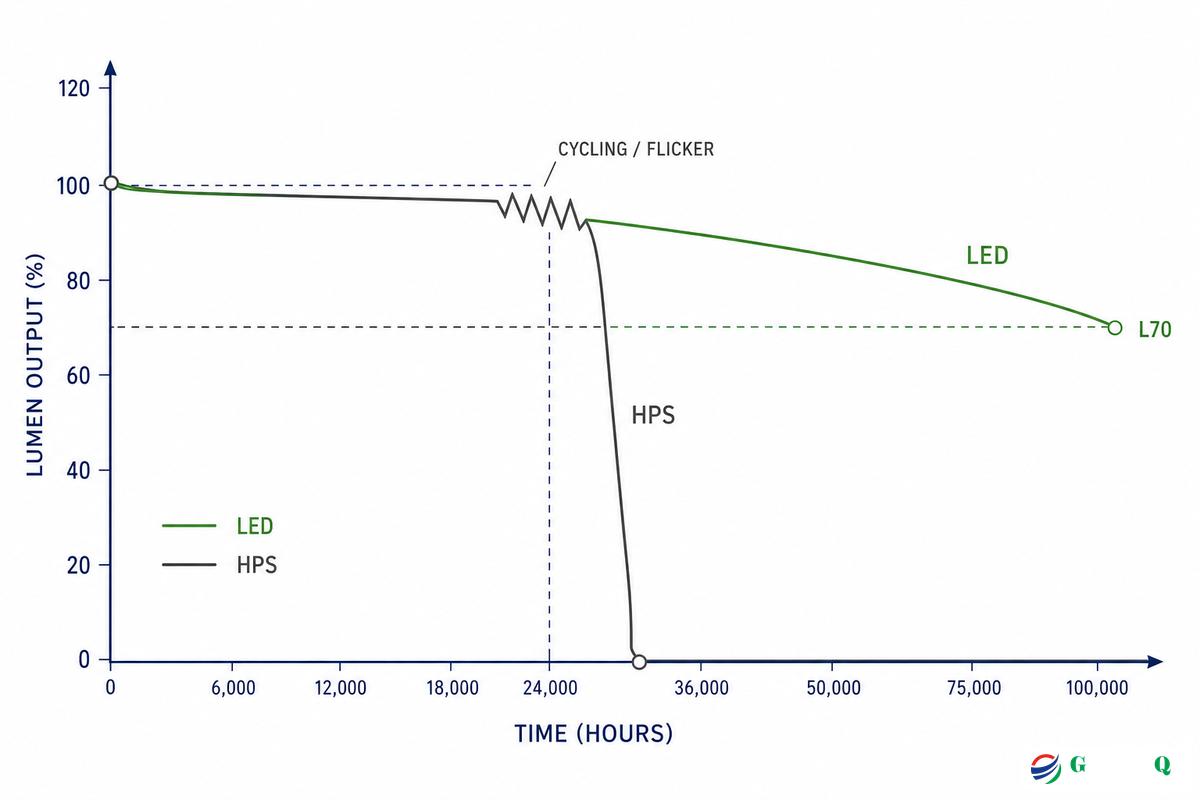
HPS lamps are rated around 24,000 hours, which at 12 hours of nightly operation works out to roughly five years, a figure Portland’s own transportation bureau cites directly from its own fixture inventory, and one that lines up with the maintenance cadence field electricians describe independently. A senior electrician on the Mike Holt forum, a trade community for licensed electricians, put it plainly: cycling, the light turning on, dimming, and shutting off repeatedly — “is normal at the end of life of the lamp,” and the practical fix is scheduled relamping: “change your HPS lamps every four years.” That’s not a fixture defect; it’s the arc tube aging and the sodium fill degrading, and it happens gradually enough that a lamp can be “still working” on a walk-by inspection while already delivering a fraction of its rated output.
LED fixtures fail differently. Instead of an abrupt lamp burnout, the life of LED street lights is rated by L70, the point at which output has declined to 70% of initial value, commonly 100,000 hours or more for DLC-listed products. There’s no ballast to replace on a separate schedule either; the driver typically shares the fixture’s rated life, which is part of why an efficient LED driver and the long life of LED hardware give it such a long lifespan advantage, offsetting its higher initial cost once the full picture is priced in rather than just the purchase invoice. Over a 10-year horizon, that difference means an HPS installation goes through two to three relamping cycles, each one a bucket-truck dispatch, a lamp cost, and often a ballast inspection, while a comparable LED installation goes through zero. For a facilities team managing hundreds of poles, that gap between “still working” and “worth the maintenance budget” is what actually drives the streetlight replacement decision, not the marketing pitch about lumens.
Energy Cost, Utility Rebates, and the Payback Timeline
Total cost of ownership is exactly where it begins to look cost effective, and Portland, Oregon has run one of the country’s largest municipal LED implementations to demonstrate the cost savings and save energy with real-world metrics. Having converted 45,000 street lights, the city announced within a year that savings had already exceeded $100,000 per month, with a plan to save approximately $1.5 million per annum once fully converted – a total program cost of $18.5 million funded in part through Energy Trust of Oregon rebates, along with a forecast to cut energy consumption and lower energy bills by 20 million kilowatt hours per year in electricity consumption.
All rebate eligibility is determined by the DesignLights Consortium Qualified Products List, a requirement for most utility rebate programs. Reaching DLC Premium-higher efficacy under the SSL Technical Requirements V5.1-usually enables access to a higher rebate tier that can help negate the small price premium of a higher-efficacy fixture. As a ball-park before ordering a proposal, Guangqi’s street light savings calculator shows annual energy and maintenance savings for a count of fixtures at a given utility rate.
| Scenario | 10 Fixtures | 40 Fixtures | 100 Fixtures |
|---|---|---|---|
| Old HPS draw (150W lamp, ~180W system) | 1.8 kW | 7.2 kW | 18.0 kW |
| New LED draw (70W, ~73W system) | 0.73 kW | 2.92 kW | 7.3 kW |
| Annual energy savings (4,000 hr/yr, $0.13/kWh) | ~$557 | ~$2,229 | ~$5,572 |
| Annual maintenance savings (relamp + labor avoided) | ~$180 | ~$720 | ~$1,800 |
| Total annual savings | ~$737 | ~$2,949 | ~$7,372 |
| Project cost (fixture + install) | $1,800 | $7,200 | $18,000 |
| Simple payback (before rebate / with 30% DLC rebate) | 2.4 yr / 1.7 yr | 2.4 yr / 1.7 yr | 2.4 yr / 1.7 yr |
Directional model assuming $0.13/kWh commercial rate and 4,000 annual operating hours; actual results depend on local utility rates, fixture pricing, and rebate eligibility. Guangqi provides project-specific TCO proposals on request.
The 4-Signal HPS Retirement Trigger, When to Stop Relamping and Retrofit
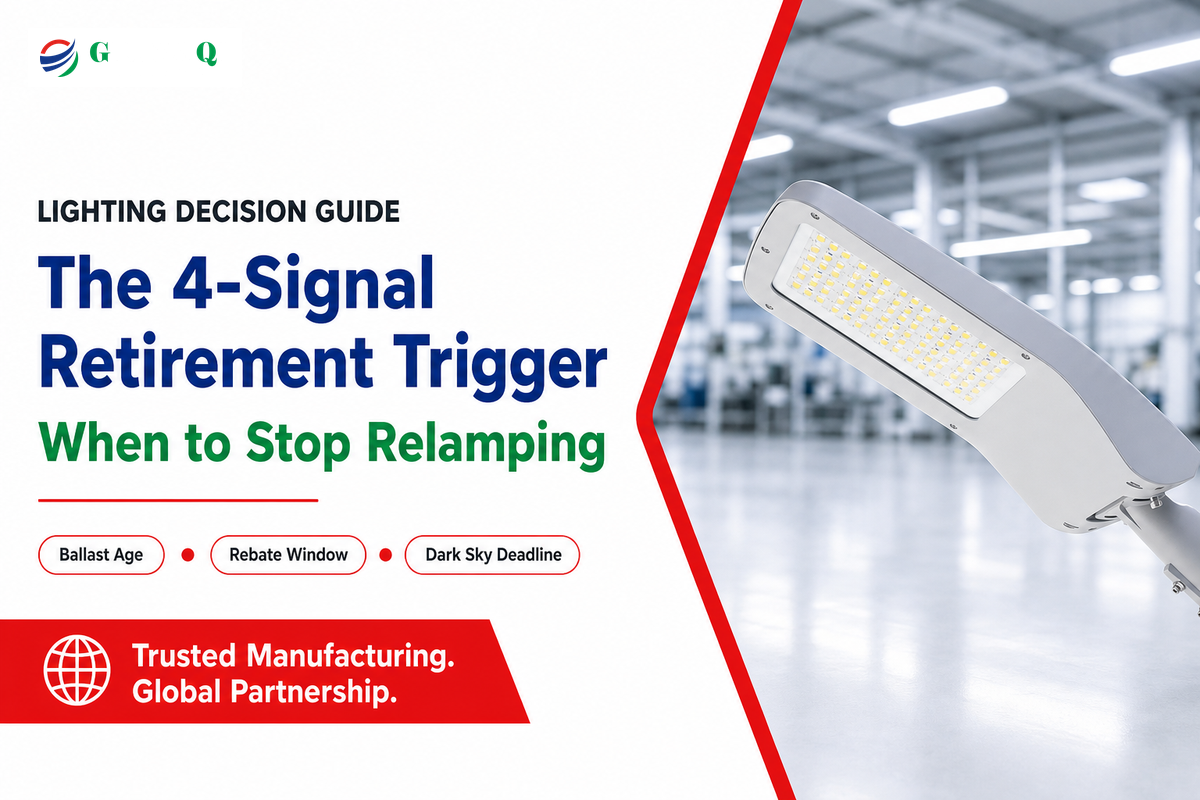
While most comparison articles simply state that LEDs are superior, the question that keeps facilities and public works managers up at night is Timing. Converting too early wastes remaining HPS service life and budget; waiting too long risks an expensive emergency replacement when a whole pole cluster fails within the same month. “Since my HPS fixtures still work, at what point does continued relamping actually cost me more than converting?” Enter the 4-Signal HPS Retirement Trigger, built around the same field data Guangqi’s engineering team uses when scoping municipal conversion projects: four conditions that, if present simultaneously, should trigger a re-assessment of your fixture inventory from a “maintain” posture to a “replace” strategy.
The 4-Signal HPS Retirement Trigger
- Ballast/lamp age past 4-5 years. Portland’s own fixture data and reports from third-party electricians confirm roughly five years of useful life for an HPS lamp before it enters the declining portion of its life cycle.
- Relamp frequency is rising, not flat. If the frequency of service calls for a given group of poles is rising year over year, the underlying ballasts, not just the lamps, are likely getting old as well (ballast life can range from 20,000 to 60,000 hours, often shorter than the lamp’s life).
- An active rebate window exists right now. DLC Premium rebate levels and utility incentives are often limited in duration. If you can complete the conversion while there’s a current rebate cycle available, payback time is substantially shortened.
- A compliance deadline applies. Dark Sky ordinances, energy codes, or statewide efficiency legislation establish a specific target date that isn’t just a financial preference; Pittsburgh’s 36,536-fixture LED Modernization Project, for example, is driven in part by a need to comply with the city’s Dark Skies ordinance.
When two or more of the signals above align, that’s the pragmatic cue to move from the “keep relamping” mindset to “budget the conversion.” When the ballast are relatively young, relamp rates are stable, no active rebate exists, and there’s no pending compliance deadline, the fixture inventory can realistically wait, in spite of the blanket “convert now” narrative peddled in much vendor literature.
Planning Your HPS-to-LED Retrofit, Sockets, Ballasts, and Controls
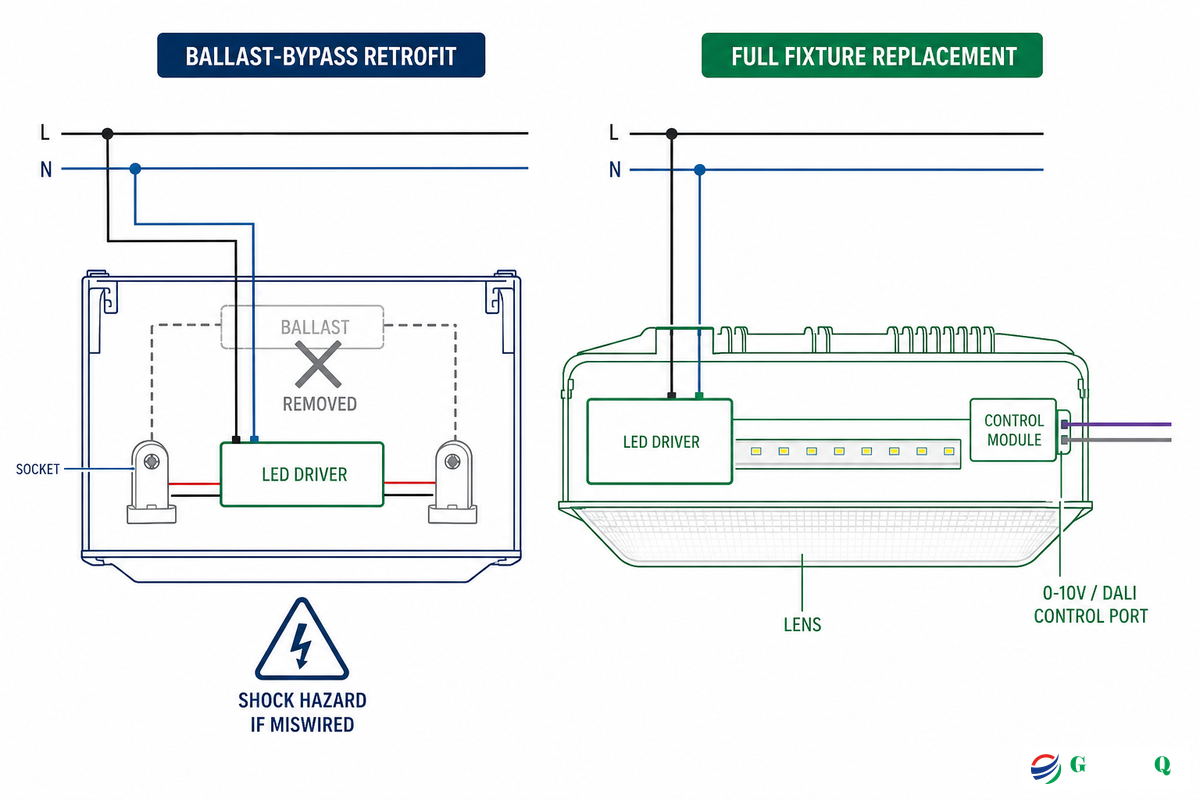
There are two ways to technically convert a fixture. Reusing the original housing and pole while removing the ballast and directly connecting the LED engine, or ballast-bypass, is the less expensive, faster approach when housing and gaskets are still in good condition. A full fixture replacement, which replaces the entire housing with a purpose-built LED luminaire that has an integrated lens, optics and thermal management system, is a better, longer-term solution if the original housing has a cracked lens, exhibits corrosion, or supports a heavier legacy fixture that the pole isn’t rated to support.
✔ Ballast-Bypass Retrofit Kit
- Reuses existing pole and housing
- Lower upfront cost per fixture
- Faster installation, less structural work
- Optics not optimized for the original housing shape
⚠ Full Fixture Replacement
- Purpose-built optics and thermal design
- Longest available warranty (often DLC Premium 10-year)
- Higher upfront cost per fixture
- Required when housing integrity has degraded
Incorrect wiring is the single most frequent field problem in a retrofit kit install, usually a connection of both ends of a fluorescent style tombstone to line voltage during a ballast-bypass project. If somebody later reinserts a lamp, expecting a non-live socket, a shocking result will ensue; a detail that’s important to point out explicitly to a contractor less versed in LED retrofit conventions.
Another decision level concerns controls; this is a dimension of the LED systems that simply has no counterpart in the HPS world. Pittsburgh’s LED Modernization Project has tied its fixture retrofits into a Network Lighting Management System which allows them remote dimming and maintenance data for every luminaire – capabilities they didn’t have before in an HPS system. Specify 0-10V dimming at the minimum; on projects of roughly 50 fixtures or more, DALI or a networked control system compatible with local energy code requirements may be justified, as the added cost of retrofitting a second time after initial installation is higher than building controls in the first time. The street light fixture selector from Guangqi can match any of its lights to the cobra, post top, or shoebox housings appropriate for the road class and mounting height.
Where HPS Still Gets Specified, Honest Edge Cases

As to whether there’s still any justification for choosing HPS, rarely, but with few exceptions that’s what content producers will lead you to believe.
New York State’s street lighting planning documentation has some excellent material that admits not all retrofits pencil out economically. Converting decorative and ornamental fixtures isn’t always cost-effective with payback in excess of nine years once you balance the fixture’s reduced wattage against the cost of decorative housing.
A city converting their standard cobra head units would likely see payback between 2-4 years, whereas that city replacing the decorative post top fixtures in a historic district wouldn’t.
Color temperature is the other genuine trade-off, not an artificial one – whether comparing a city’s HPS vs. LED, or even evaluating the range of color temperatures available in LED, because sodium lights never shipped in any form other than a single, fixed sodium streetlight color while LED offers a choice. Why do we have to trade overly yellow sodiums for overly blue LEDs, real residents wonder, and their concern deserves a real answer instead of a wave of the hand. When Portland upgraded its city street lights, it chose 4000K fixtures, then later had to officially address a 2016 American Medical Association policy recommending 3000K or less for road lighting over concerns of light’s blue-component effects. In a review, Portland itself found its low-wattage 4000K LED fixtures emitted roughly the same amount of absolute blue light as the higher-wattage HPS fixtures they replaced-a fact the Municipal Solid State Lighting Consortium helped explain: reduced overall light output from LED lights compensated for their higher blue-light ratio per lumen. Nuance counts: CCT isn’t the whole story, but perceived “harshness” from brighter lights in residential areas is a genuine design concern, not user error, which is why so many cities now stick to 3000K fixtures in those zones and keep 4000K on their arterial roads.
One other minor but real advantage for HPS: the lamps run so hot that they naturally melt snow and frost accumulating on the fixture and lens, a benefit not realized by LED’s cooler operation. It’s rarely enough to outweigh all of HPS’s disadvantages in its own right, but it’s a practical field note Guangqi’s engineering team includes in cold-climate project specs, since fixture housings certified to IP65/IP66 and tested under ISO 9001 quality processes still need this trade-off documented for the client- and the same cold-weather concern arises for solar-powered LED street lights that use batteries for autonomy instead of relying on a grid. Off-grid routes, rural streets, or new developments where trenching for a grid-connected conversion is prohibitive can consider solar street lighting using a solar LED street light as a lighting solution to the traditional HPS-to-LED choice.
Industry Outlook, The HPS Phase-Out Is Accelerating

A specific 2026 market-size number matters less than understanding why cities must act in the present. There are three separate pressures that have converged to shrink the time available to convert under the most advantageous conditions: 1) utility rebate tiers under the DLC’s SSL Technical Requirements V5.1, updated January 2025, incentivize higher-efficacy fixtures at better rates, and that threshold will rise; 2) Dark Sky ordinances, such as the one driving Pittsburgh’s 36,536-fixture LED Modernization Project, are evolving from voluntary suggestions into explicit requirements for compliance; and 3) as manufacturers continue to phase out the legacy product, the supply for HPS lamps and ballast is diminishing, making replacement-part lead times for HPS fixture replacement a growing concern.
That supply and policy pressure shows up in search behavior too: interest in “sodium vapor street lights” as a search term has increased approximately 83% year-over-year even as raw “HPS street lights” terminology searches have decreased – consistent with a market in which the conversation is shifting from “what’s this old technology” to “how do we plan the transition,” buoyed by high-profile municipal projects such as Pittsburgh’s and retroactive reporting on Portland’s decade-old program. City and facility managers planning for a 2026-2027 lighting budget should treat “wait and relamp” as the higher-risk strategy, not the safe default – the sodium street lighting era is drawing to a close, and the practical question for led streetlights and HPS streetlights is no longer “which technology,” but “when.”
“Cycling is normal at the end of life of the lamp, change your HPS lamps every four years.”
Frequently Asked Questions
Q: Why is HPS’s color rendering considered a safety issue, not just an aesthetic one?
View Answer
HPS’s Color Rendering Index of roughly 20-30 means it compresses the range of colors the eye can distinguish under its light, unlike LED’s CRI of 70-90+. That directly affects how quickly a driver or pedestrian recognizes an object, a person’s clothing, or a hazard at night — not just how the scene looks. FHWA data shows the nighttime traffic fatality rate runs about three times the daytime rate despite only a quarter of driving happening after dark, and while that statistic covers lighting adequacy broadly rather than CRI specifically, color rendering is one of the variables that determines whether bright light actually translates into a driver correctly identifying what’s in front of them.
Q: What LED wattage replaces a 150W HPS cobra head fixture?
View Answer
Drawing roughly 180W at the wall once ballast losses are included, a 150W HPS cobra head is commonly replaced by a 65-90W LED fixture — not a 150W LED. At 120-150 lm/W, a 70W LED delivers usable output comparable to the 150W HPS fixture’s mid-life performance, while cutting wall power draw by roughly 55-60%. The exact wattage depends on mounting height, pole spacing, and the road classification’s minimum illuminance requirement, so a photometric simulation is worth running before ordering fixtures at volume.
Q: How do I know my HPS fixtures are near end of life before they fail completely?
View Answer
Cycling — the lamp turning on, glowing dimly, then shutting off and restarting repeatedly — is the clearest field sign, and licensed electricians consider it a normal part of HPS end-of-life rather than a fixture fault. Watch also for a shift toward a reddish or pink cast as the lamp ages. Because HPS lamps are rated around 24,000 hours (roughly five years at typical nightly run times), a fixture inventory installed on a known date can be scheduled for relamping or conversion proactively rather than waiting for failure calls.
Q: Do utility rebates still apply if I only convert part of my fixture inventory?
View Answer
Yes — DLC and utility rebate programs are generally structured per qualifying fixture, not as an all-or-nothing program requirement, so a phased conversion still earns rebates on each converted fixture as long as it’s DLC-listed. Phasing by road classification or by the fixtures showing the retirement signals covered above is a common approach that spreads capital cost while still capturing rebate value on every unit converted.
Q: Can I reuse my existing HPS pole and mounting arm with a new LED fixture?
View Answer
In most cases, yes. Poles and mounting arms are rated for a broad span of fixture weights, and LED fixtures are usually lighter than the HPS luminaire they replace. Confirm the mounting bracket matches, and inspect older poles for corrosion first.
Q: Is there any situation where HPS is still the right choice in 2026?
View Answer
Rarely, and mostly around ornamental or decorative fixtures where the housing cost is high relative to the energy savings — payback there can run nine years or more, unlike the 2-4 year payback typical of standard cobra-head conversions. Heavy-snow climates also see one minor upside: HPS’s waste heat sheds ice on the fixture.
About This Analysis
This LED vs HPS comparison draws on FHWA nighttime safety data, Portland and Pittsburgh’s published municipal conversion records, DesignLights Consortium technical requirements, and licensed-electrician field reports on HPS end-of-life behavior. Guangqi’s engineering team, among the LED street light manufacturers running in-house IES LM-80 photometric testing rather than outsourcing it, contributed the wattage cross-reference methodology from its own photometric testing and goniophotometer optical validation work on commercial street light fixtures. Reviewed by the Zhongshan Guangqi Lighting Co., Ltd. technical team.
References & Sources
- Lighting, Proven Safety Countermeasures – Federal Highway Administration
- EDC-7: Nighttime Visibility for Safety – Federal Highway Administration
- LED Street Light Conversion Program – City of Portland, Bureau of Transportation
- LED Modernization Project – City of Pittsburgh
- DLC Qualified Products Lists – DesignLights Consortium
- Solid-State Lighting Technical Requirements V5.1 – DesignLights Consortium
- Adoption of Light-Emitting Diodes in Common Lighting Applications – U.S. Department of Energy
Related Articles
- LED vs Metal Halide, wattage equivalents, ROI, and lumens for industrial and area lighting
- Planning a metal halide-to-LED retrofit, stadium and high-mast lighting
- Solar lighting and solar street lamps for off-grid roads and new developments
- Networked lighting control systems for municipal street light projects