Get in Touch with GUANGQI



Commercial street lights are the LED, high-pressure sodium, or solar-powered fixtures that cities and municipalities specify for roads and streets, parking lots, and rights-of-way — but a commercial street light project goes beyond simply selecting a fixture. After a municipality or commercial property owner decides to upgrade, the project entails defining the owner of the lights, obtaining funding and rebates, creating a bid specification that yields comparable responses, and managing the installation and commissioning process. This guide takes you through all of these stages, from beginning to end.
If you need details about fixture wattage, lumen output, and optics, refer to our guide on Commercial Street Lights fixtures, which features detailed information on cobra head, shoebox, post top, and solar applications.
Quick Facts: A Commercial Street Light Project at a Glance
| Typical retrofit payback | 3–5 years (energy + maintenance savings) |
| Typical fixture rebate range | $20–$100+ per fixture, program-dependent |
| Capital improvement plan lead time | 6–12 months before target fiscal year |
| DLC Premium requirement | Gates most utility rebate tiers, not optional |
| Typical project phases | 5 (survey, design, procurement, install, commissioning) |
Commercial street lights are the fixtures municipal and commercial owners specify for public streets, roads, parking lots, and rights-of-way.
Switching an aging high-pressure sodium system to LEDs results in approximately 50-70% energy savings and extends fixture life by a factor of four. Many buyers focus solely on the fixture and underestimate the importance of budgeting, securing funds, and the bidding process that must occur prior to any actual installation work.
Key Takeaways
- Ownership of the lights determines the decision-maker and the entity responsible for funding. It’s important to determine whether streets are owned by a municipality, a utility company, or a private entity before beginning the planning phase of a project.
- A DLC Premium certification doesn’t guarantee equivalent field performance; even within the same performance category, there can be variations.
- Most municipal lighting retrofit projects are funded through the capital improvement plan rather than the operating budget, making a runway of 6-12 months quite common.
- It’s possible to combine various utility, DLC-listed, and state energy office rebates, although each program has different eligibility criteria and may have limitations based on the volume of fixtures purchased.
What “Commercial Street Lights” Covers, and Where to Find Fixture Specs
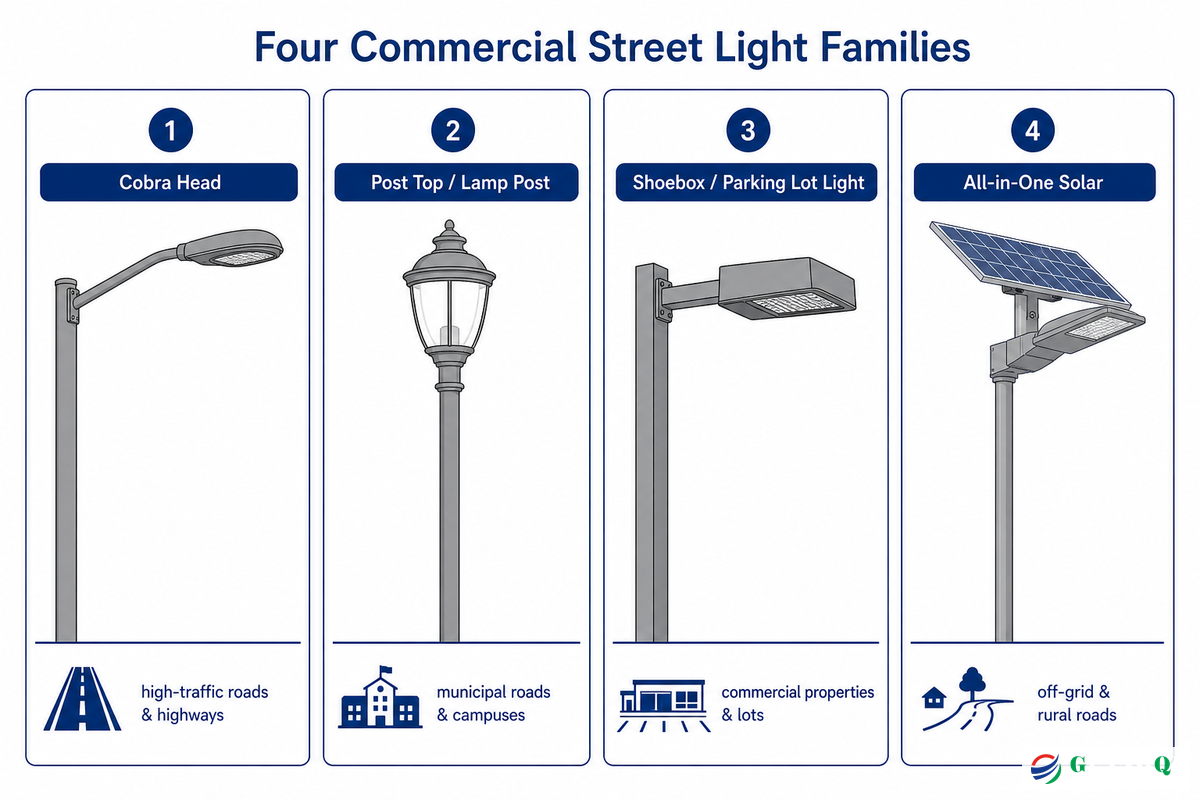
Commercial street lights cover four fixture families used on streets and roadways, in parking lots, and along highway corridors: LED post top and decorative fixtures, LED parking lot lights, cobra head fixtures, and solar street light systems. Buyers researching the best commercial street lights are usually asking two questions at once — which outdoor commercial street lights fixture fits the application, and how the project actually gets funded and approved. This guide covers the second question.
LED road lighting and commercial street lighting — whether led commercial street lights for a highway corridor, commercial decorative street lights for a downtown streetscape, or LED outdoor fixtures for a parking lot — break down by application: cobra head fixtures for high-traffic roads and highways; LED post top or lamp post lights for municipal roads, campuses, and streetscapes still commonly called street lamps (an LED lamp retrofit here is usually a pole-top swap, not a full pole replacement); LED parking lot lights — shoebox-style area lights, sometimes paired with LED flood fixtures at lot perimeters — for commercial properties; and solar street lighting for off-grid or rural roads, including small commercial street lights projects that don’t justify trenching new electrical service. Each family has specific guidelines for wattage range, optic distribution, and mounting height, because a fixture sized for a highway will overshoot the footcandle target — and the electric bill — on a residential street lights installation with much lower traffic speeds.
When comparing modern LED street lights to an older-generation high-pressure sodium lamp or metal halide roadway fixture, the factors that matter are efficiency, lifespan, and color rendering — LED technology delivers a commercial-grade fixture that requires less maintenance and holds up better across harsh weather conditions than legacy technology. Reliable lighting matters for safety and visibility on roads and streets as much as it matters for the utility bill, which is why most street and roadway lighting programs now default to LED as the baseline lighting design, not an upgrade option.
For off-grid corridors, an all-in-one solar street light integrates the solar panel, battery, and LED head into a single pole-top unit; this solar street light system removes the trenching cost that a wired commercial outdoor installation requires. Commercial solar and led solar street lighting typically trade peak lumen output for zero trenching cost against a grid-fed 150W fixture, so treat any “best solar street” light marketing claim as a starting point, not a spec — a commercial-grade solar unit and a commercial outdoor solar unit both still need a documented IP65 rating and a battery-autonomy figure sized to local weather conditions before they belong in an RFP. A solar powered street light is not automatically the lower-maintenance choice; see our solar street lights guide for panel-sizing and autonomy calculations.
For those who have identified their application and require specific wattage, lumen output, DLC listing, and CCT information to create a specification sheet, our commercial LED street light fixture line offers cobra head, modular, and photocell area lights with a fixture selector and savings calculator built-in.
While our Commercial Street Lights fixture guide addresses technical product specifications, it doesn’t cover the essential process that take place between the decision to upgrade and the actual commissioning of the lights, a real gap that this document aims to fill.
💡 Pro Tip
If your project involves replacing only a few fixtures on existing poles, you can proceed directly to the section on retrofitting. If, however, you are planning a large-scale, multi-year municipal program, begin by establishing the ownership of the lights and your budget, as these elements will influence all subsequent steps.
Who Owns and Maintains Commercial Street Lights
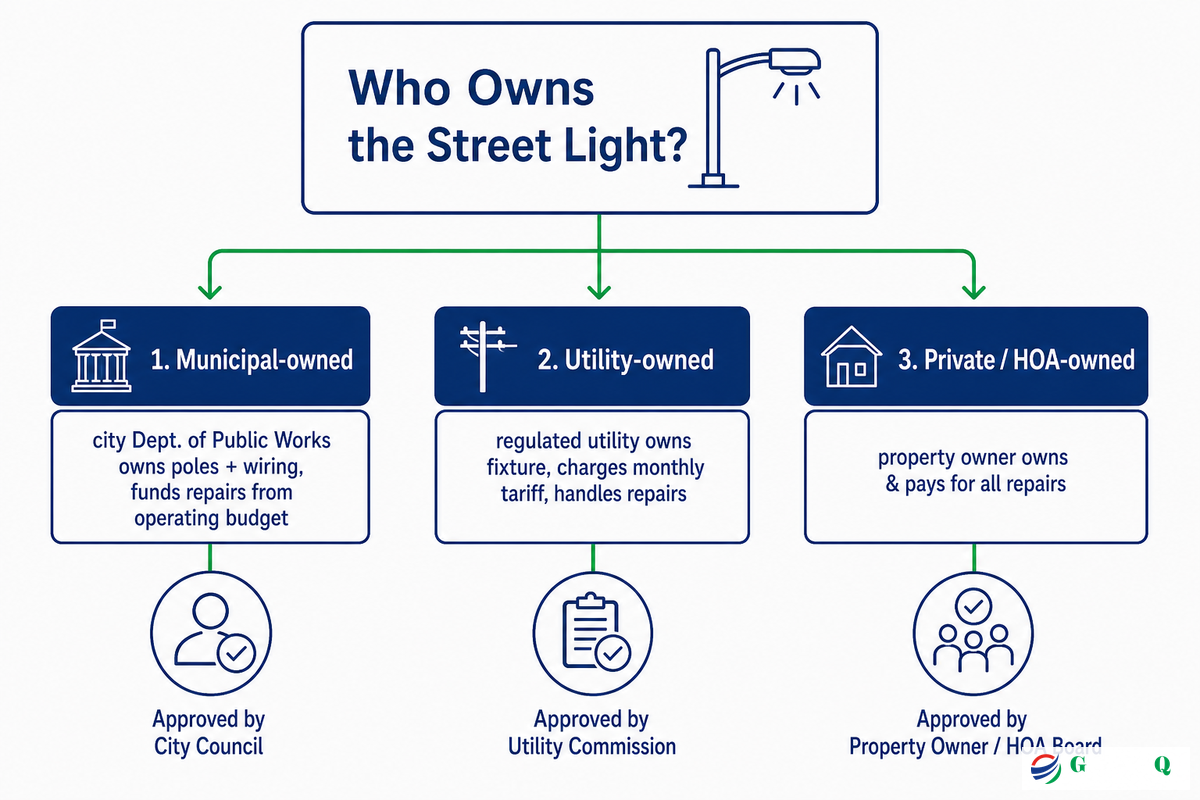
Street light ownership follows one of three models: municipal-owned, utility-owned, or private/HOA-owned. Who owns what determines who has authority over a project and who pays for it. Large municipalities generally operate under a municipal-owned model: the city’s department of public works (or transportation) owns the poles, fixtures and wiring, and the LED conversion runs through that department’s capital project approval process.
For instance, the Bureau of Transportation for the city of Portland, Oregon owns about 55,000 street lights outright, of which 45,000 are the cobra-head type and 10,000 are more decorative models. Small municipalities and unincorporated areas will often have a utility-owned system instead. A regulated utility owns the pole and the fixtures and then charges the municipality a monthly rate for each fixture, so a municipality often can’t simply change out a fixture unless it renegotiates the tariff-rate agreement with the utility, or pays for a buyout of the existing system. A property owner will manage private or HOA-owned lighting in commercial parking lots, gated communities, and campuses.
Who Pays When a Street Light Needs Repair?
Repair costs follow the ownership model. Under municipal ownership, the department’s operating budget and maintenance crews cover repairs. In a utility-owned system, the utility handles repairs and the city’s role is limited to reporting outages. Under private ownership, the property owner pays all repair costs directly.
Many cities keep a separate phone number for street light outage reports, apart from their general public works line, specifically because utility-owned repairs route through the utility rather than city crews. Commercial property managers with privately owned lighting usually roll street light maintenance into a general facilities contract rather than handling it as a one-off repair call.
⚠️ Important
Prior to soliciting quotes for a retrofit, confirm your street light ownership with a representative of your local public works department or utility account representative in writing. Surprisingly, a significant number of LED retrofit projects can get delayed by several months after the vendor has been selected because the entity making the request did not actually have the authority to order work on the pole.
Bottom line: figure out your ownership first to know who will ultimately be approving the PO and note that if your system is utility-owned you might need to consider a buyout first before any fixture changes.
Budgeting & Capital Planning for a Street Light Upgrade
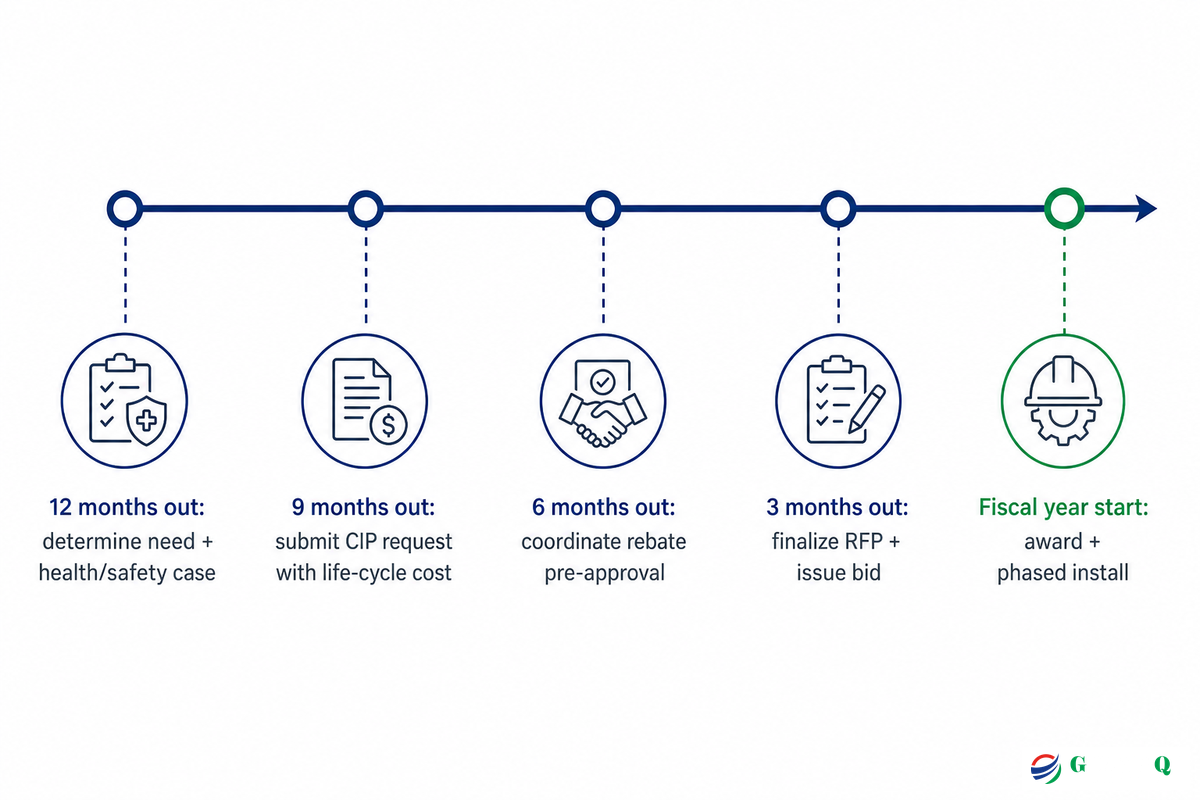
In most cases, municipalities will finance a street light retrofit project through their capital improvement plan (CIP) as opposed to the annual operating budget, because a street light system is a capital asset with a decade-plus service life, not a recurring operating expense, and CIP financing lets the cost be spread and matched against the savings it generates. The Government Finance Officers Association (GFOA) recommends that all local governments develop capital plans that cover a minimum of three years, but ideally five years or more, detailing their infrastructure needs, understanding the full life-cycle cost impacts, prioritizing infrastructure needs by health and safety before service level and asset preservation, and developing a financing strategy based on expected revenues. Typically, an individual street light line item in a CIP must be proposed in advance – six to 12 months prior to the fiscal year the project will be funded – rather than at some point during the fiscal year, because most CIP cycles close their intake window long before the fiscal year actually starts, and a request submitted mid-year usually just waits for the next cycle.
How Much Does a Commercial Street Light Upgrade Cost?
Fixture price is only one line item. Portland’s citywide LED conversion — covering 45,000 cobra head and 10,000 ornamental fixtures — ran on an $18.5 million capital ordinance the City Council unanimously adopted in December 2012, supplemented by Energy Trust of Oregon incentive dollars, and was estimated to return about $1.5 million per year in energy and maintenance savings.
That isn’t the scale of a single commercial parking lot, but the budget structure — capital funding request, incentive stacking, and savings-based payback case — stays the same regardless of project size. For a project-specific breakdown by wattage and fixture count, our street light savings calculator runs a 10-year LED-versus-HPS comparison for your fixture mix.
CIP Budget Timeline — Working Backward from Fiscal Year Start
- 12 months out: Determine need, develop a rough fixture-cost range, and identify health/safety justification (dark spots, complaint history, crash data).
- 9 months out: Submit CIP request, including life-cycle cost information – fixture, installation labor, and 10-year maintenance savings against the incumbent fixture technology.
- 6 months out: Coordinate incentive/rebate eligibility in parallel-most utility incentive programs require pre-approval prior to purchasing fixtures.
- 3 months out: Finalize RFP performance requirements, then issue bid.
- Fiscal year start: Award, procure, and begin phased installation.
Takeaway: budget for the total life cycle cost-not just the cost of the fixture-and submit your CIP request 6 to 12 months before you need the funding-not after the existing fixtures have failed.
DOE, Utility & DLC Rebate Programs: How to Fund the Upgrade
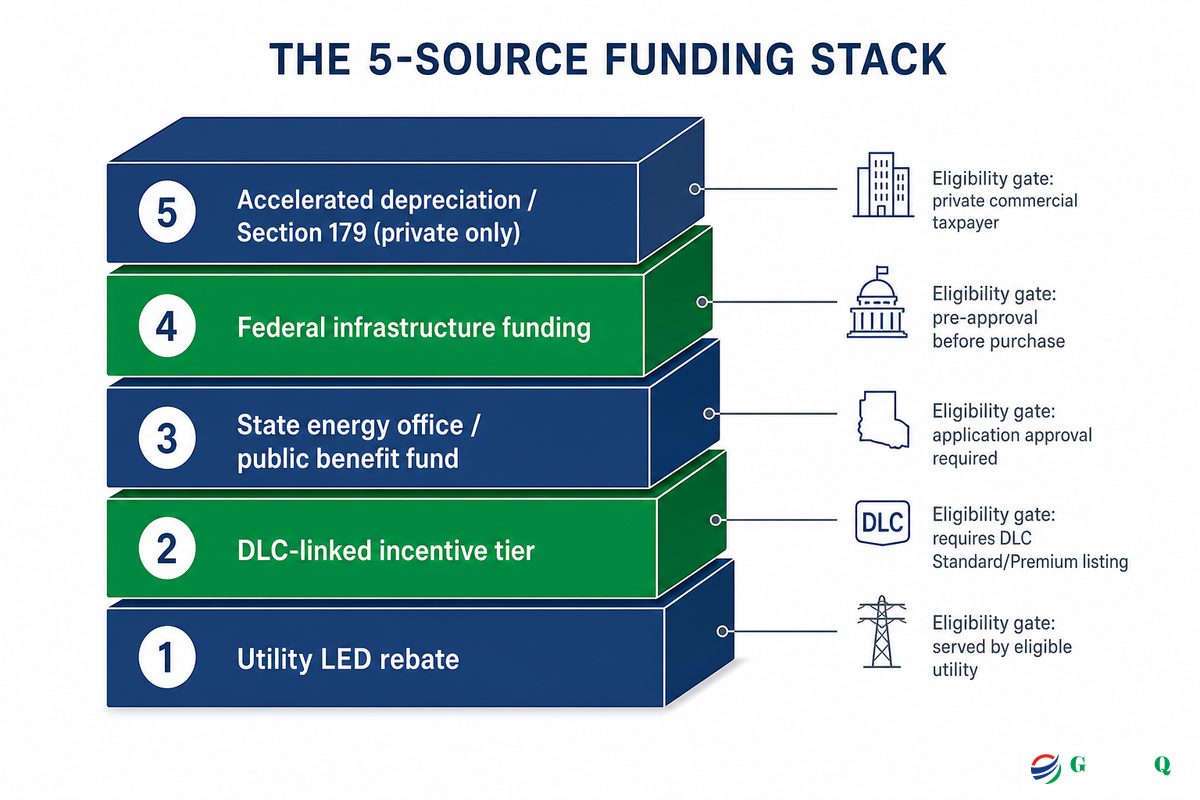
A commercial LED street light retrofit is rarely funded solely from capital budgets. You can often stack utility, DLC-listed incentive tiers, and federal/state energy programs on a single project, but not all incentive programs stack cleanly with one another; individual programs have varying eligibility requirements, and the wrong combination can delay a rebate payment for months.
The 5-Source Funding Stack
Five separate sources can often be stacked on a single commercial street light project: (1) utility LED lighting rebates, (2) DLC-listed incentive tiers, (3) state energy office or public benefit fund grants, (4) federal funding (e.g., through IIJA-linked programs), and (5) accelerated depreciation or Section 179 tax benefits for commercial private property owners.
| Funding Source | Applies To | Typical Gate |
|---|---|---|
| Utility LED rebate | Municipal & commercial | DLC Standard or Premium listing, pre-approval before purchase |
| DLC-linked incentive tier | Municipal & commercial | Product must be on the current DLC Qualified Products List |
| State energy office / public benefit fund | Municipal (mainly) | Formal application, often tied to a CIP-approved project |
| Federal infrastructure funding | Municipal | Larger-scale projects, competitive application cycles |
| Accelerated depreciation / Section 179 | Private commercial only | Tax treatment, not a rebate — consult your accountant |
“We prepare DLC Premium and LM-79/LM-80/TM-21 photometric data submittals as standard operating procedure for commercial and municipal projects, not as an additional cost of service; when a rebate application is denied for missing photometric data, it adds weeks to an already compressed project schedule.”
Rebate-Before-Bid Sequencing
Confirm utility and DLC-tier eligibility before finalizing RFP performance criteria, not after. The application for one Xcel Energy Colorado LED rebate program rejected smaller, one or two-fixture projects because the specified fixture wasn’t included on the utility’s listed product criteria, forfeiting savings that the city had budgeted into its project, since the rebate requirement to use a listed fixture wasn’t confirmed prior to finalizing RFP language.
Don’t treat a DLC Premium listing as the bottom line; verify all rebate program rules before locking down the RFP spec and choosing a fixture.
Writing a Street Light RFP: What Performance Criteria to Require

An RFP that includes only wattage and lumen output — no illuminance tier by road classification, no DLC tier, no warranty period — is the biggest culprit behind a street lighting bid turning out fixtures that “comply on paper but not on site.”
The current ANSI/IES RP-8-22 standard, Recommended Practice for Lighting Roadway and Parking Facilities, which supersedes previous editions (RP-8-14/18/21), establishes minimum and average maintained illuminance for each road classification; specifying that road class instead of a flat wattage requirement forces vendors to price for performance rather than cost. A commercial lighting RFP that chases a single “super bright” lumen number without pinning down the illuminance tier is not writing a spec — it is buying whatever a vendor already has in inventory; the goal of a road-class-based RFP is optimal lighting for the application, not the highest lumen count on the cut sheet.
| Road Classification | Min. Mounting Height | Typical Illuminance (avg. maintained) | Recommended DLC Tier | Suggested Warranty |
|---|---|---|---|---|
| Interstate / freeway | 35–40 ft | 0.6–1.0 fc | DLC Premium | 10 years |
| Major / arterial road | 25 ft (ANSI minimum) | 0.8–1.2 fc | DLC Premium | 7–10 years |
| Collector road | 22–25 ft | 0.6–0.9 fc | DLC Standard or Premium | 7 years |
| Local / residential street | 20 ft (ANSI minimum) | 0.4–0.6 fc | DLC Standard or Premium | 5–7 years |
| Highway (IES-recommended) | 30 ft | 0.6–1.5 fc | DLC Premium | 10 years |
| Parking lot / commercial | 20–30 ft (site-dependent) | 0.5–2.0 fc | DLC Standard | 5–7 years |
| Parking structure / garage | 10–14 ft | 5–10 fc | DLC Standard | 5 years |
| Pedestrian walkway | 12–16 ft | 1.0–2.5 fc | DLC Standard | 5 years |
| Off-grid / rural road (solar) | 18–25 ft | 0.3–0.6 fc | DLC Standard | 5 years |
Illuminance ranges are typical targets consistent with ANSI/IES RP-8-22 classification tiers; confirm exact values with a project-specific photometric layout, since pole spacing, optic type, and local ordinances shift the usable range.
📐 Engineering Note
Here’s an example: For a 2-lane collector road, 30 feet of spacing between poles, and a mounting height of 25 feet, the illuminance target is within the arterial/collector range.
RP-8 recommends an average maintained illuminance level of 0.8 to 1.2 footcandles for that classification, with a max-to-min ratio in the range of 4:1. Usually, a 70-100w DLC Premium cobra head, fitted with either a Type II or III optical distribution, should meet the low end of this band at the given spacing. By contrast, a parking-lot shoebox fixture in the 60W to 150W LED range usually covers the lower-illuminance band above, while an interstate-class cobra head often runs 300W or paired heads to hit the top of the arterial range. RFPs should explicitly call for a specific target footcandle range, max-to-min ratio, and CCT-typically 4000K for collector roads; 5000k is a brighter, more popular option for high-speed arterials-so bidders adjust the wattage and CCT based on the site, rather than shipping what they’ve in inventory.
Dark Sky and Compliance Criteria
If your project is in a residential vicinity or subject to local light pollution guidelines, include a Dark Sky compliance clause in your RFP. It mandates the use of full cutoff optics, with zero uplight and no light trespass onto adjacent residential properties, and a color temperature no higher than 3000K if near a residential area.
DesignLights Consortium’s new 2025-2026 technical requirements update, with its LUNA specification for dark-sky-friendly lighting products, offers a pre-defined specification you can incorporate into your RFP to avoid custom text for uplight controls.
RFP Performance Criteria Checklist
- Illuminance range and max-to-min uniformity ratio per road classification (RP-8-22)
- DLC Standard or Premium listing (must be specific to current QPL, not a general “DLC listed” designation)
- Warranty term (per road class table above)
- Full cutoff / dark sky compliance (where applicable per ordinance)
- Requirement for photometric testing documentation (LM-79/LM-80/TM-21) prior to contract award
- Ingress protection rating (IP65 minimum) matched to the lighting layout’s exposure — coastal, high-dust, or high-moisture sites often need IP66
The punchline: Spec the illuminance tier and warranty by road class, not just the wattage – that’s the only way you can meaningfully compare one bid to another.
Evaluating Fixture Manufacturers & Vendors
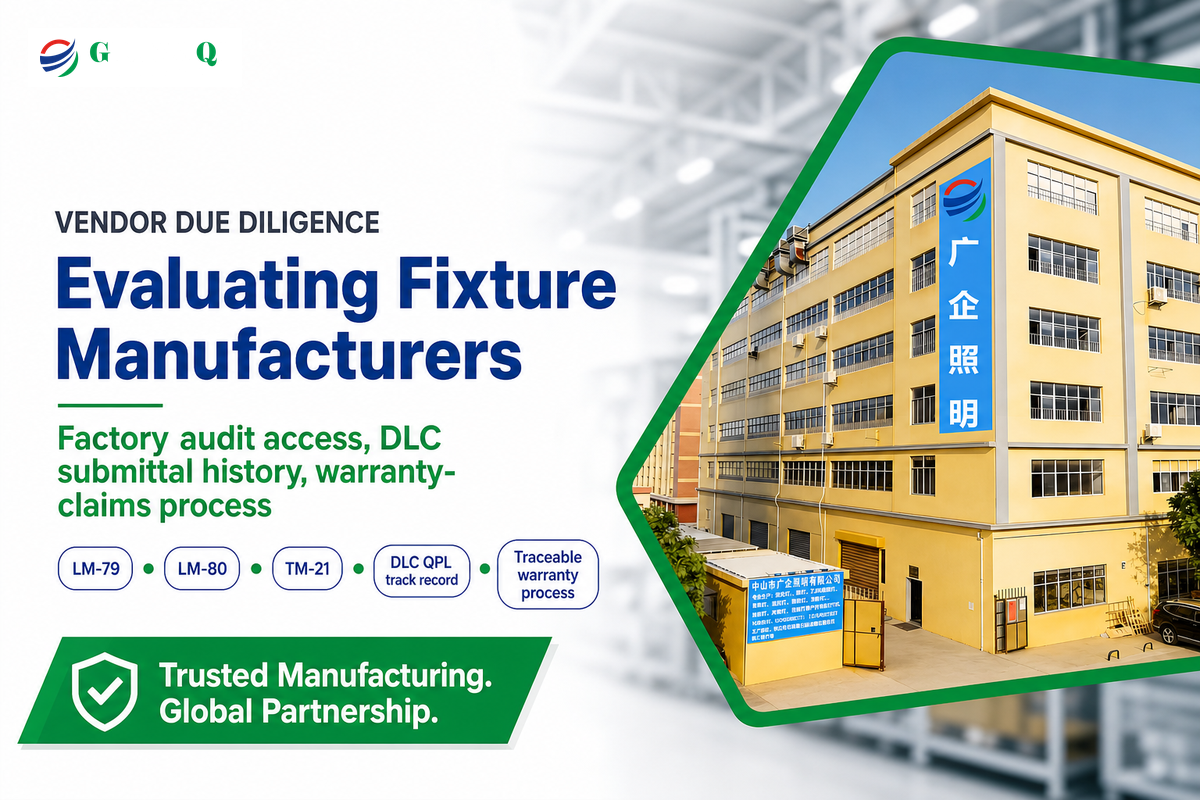
Meeting a spec sheet alone doesn’t guarantee product quality or vendor reliability. According to a 2012 study from the American Council for an Energy-Efficient Economy, the LED lighting industry was still immature, making it difficult to compare different products in the same application even if they nominally met similar criteria. This remains true: two fixtures of the same DLC Premium type, designed for the same lumen output, can have significant differences in actual light distribution, driver performance and failure rate.
A spec sheet only tells half the story. Three factors predict vendor reliability better than the spec sheet alone: factory audit access (can you verify testing claims, or does the manufacturer only provide third-party lab reports you can’t trace back), DLC/LM-79 submittal history (has this specific manufacturer successfully gotten products listed before, or is this their first submission), and warranty-claims turnaround (what’s the actual process and timeline when a driver fails in year three, not just the warranty term on paper). As a rule of thumb, ask what driver failure rate the manufacturer will guarantee in writing for year one — a vendor unwilling to commit to a number, or whose fixture carries an L70 rating below 50,000 hours instead of the 100,000-hour-plus figure typical of a DLC Premium product, is a reasonable red flag to raise before award.
Can LED Street Lights Be Dimmed or Controlled Remotely?
Yes. Most current-generation LED street lights support 0-10V dimming standard, with DALI or NEMA 7-pin receptacles for networked control, plus simpler dusk-to-dawn photocell scheduling and motion-sensor-triggered dimming for lower-traffic sites like parking lots. A motion sensor LED profile can drop a fixture to 30-50% output between vehicle or pedestrian triggers, on top of the base LED conversion savings.
Networked lighting control adds scheduled dimming, adaptive lighting response, and remote fault monitoring, and can cut energy consumption by an additional 20-40% beyond the base LED conversion – but it’s a vendor-capability question, not a fixture-spec question. Confirm during vendor evaluation, not after award, whether the manufacturer’s driver and LED modules are compatible with the network protocol your utility or municipality already uses, since retrofitting control compatibility — or swapping LED modules for a different protocol — after installation is far more expensive than specifying it upfront.
✔ Signs of a Reliable Vendor
- Traceable LM-79/LM-80 test reports from an accredited lab
- Prior successful DLC submissions in your fixture category
- Named warranty claims process with stated turnaround
- Willing to provide project references from similar-scale installs
⚠ Risk Signals
- DLC listing claimed but not verifiable on the current QPL
- No factory or third-party lab documentation offered
- Warranty terms vague on claims process, not just duration
- First-time DLC submission with no track record in your fixture type
Key takeaway: verify the manufacturer’s DLC submittal track record and warranty-claims process, not just the spec sheet – same-tier products still perform differently in the field.
The Street Light Retrofit Process: From Survey to Commissioning
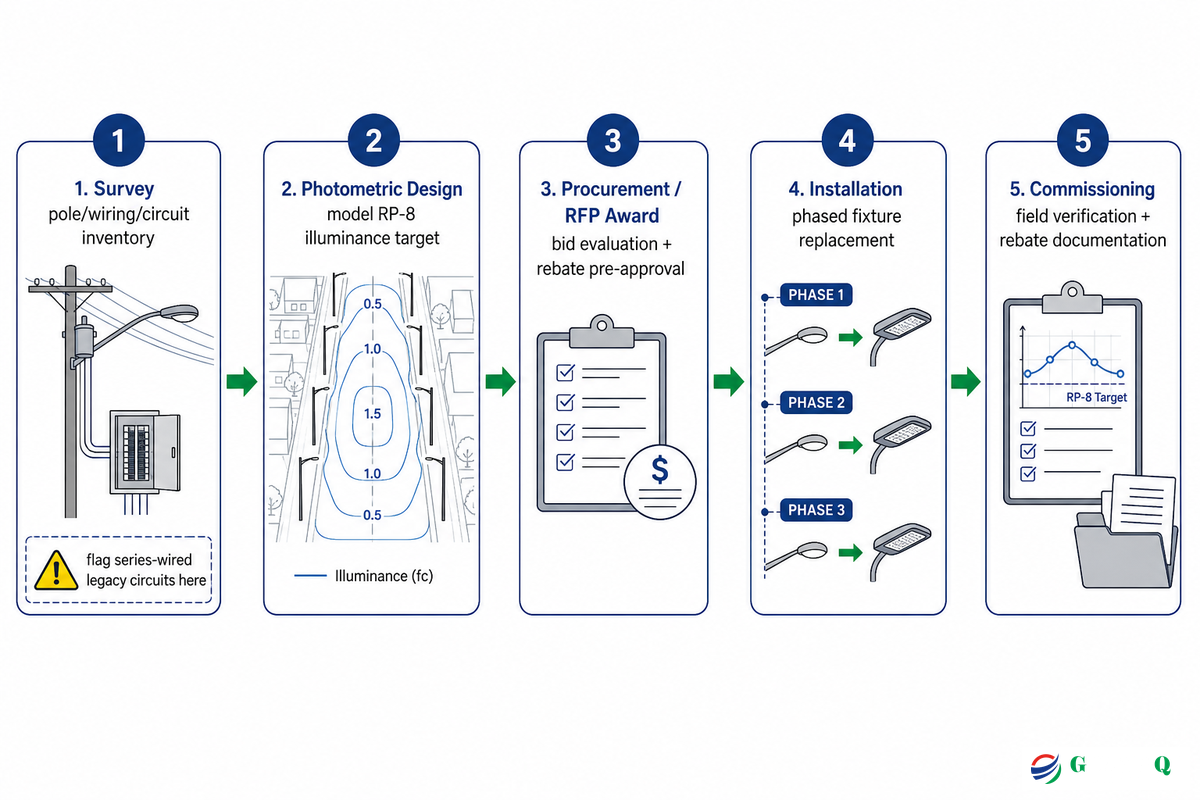
A municipal street light retrofit runs through five phases in most cases, and skipping the second one — photometric design — is a common source of post-installation complaints about glare or dark spots, because a layout that looks fine on a fixture count spreadsheet can still leave a corridor with uneven light once poles, tree canopy, and building setbacks are actually accounted for. A real municipal street light conversion RFP is a useful reference for how a survey-to-commissioning scope is typically written into a bid document.
- Survey: field inventory of existing poles, wiring topology, fixture count, and condition. This is also when circuit topology gets flagged – older systems wired in series rather than parallel need special handling (see below).
- Photometric design: model the proposed fixture layout against the RP-8 illuminance targets for each road class, adjusting wattage, optic type, or pole spacing before ordering anything.
- Procurement / RFP award: bid evaluation against the performance criteria set earlier, plus rebate pre-approval confirmation.
- Installation: phased fixture replacement, scheduled in most cases to minimize simultaneous outages across a corridor.
- Commissioning: field verification that installed illuminance matches the photometric design, plus rebate documentation submission.
⚠️ Common Mistake: Series-Wired Legacy Circuits
Some older municipal street light circuits were originally wired in series rather than parallel – a design common with legacy high-voltage lighting systems. Swapping the fixture head alone won’t work on a series circuit; the electrical topology generally needs to be converted to parallel low-voltage wiring before standard LED drivers will operate correctly. This gets caught in a proper survey phase, but it’s a real source of change orders when the retrofit is scoped from a fixture count alone without a circuit-level electrical review.
Key takeaway: budget time for the survey and photometric design phases before ordering fixtures – series-wired circuits and skipped photometric modeling are the two most common sources of mid-project change orders.
Common Mistakes in Commercial Street Light Procurement
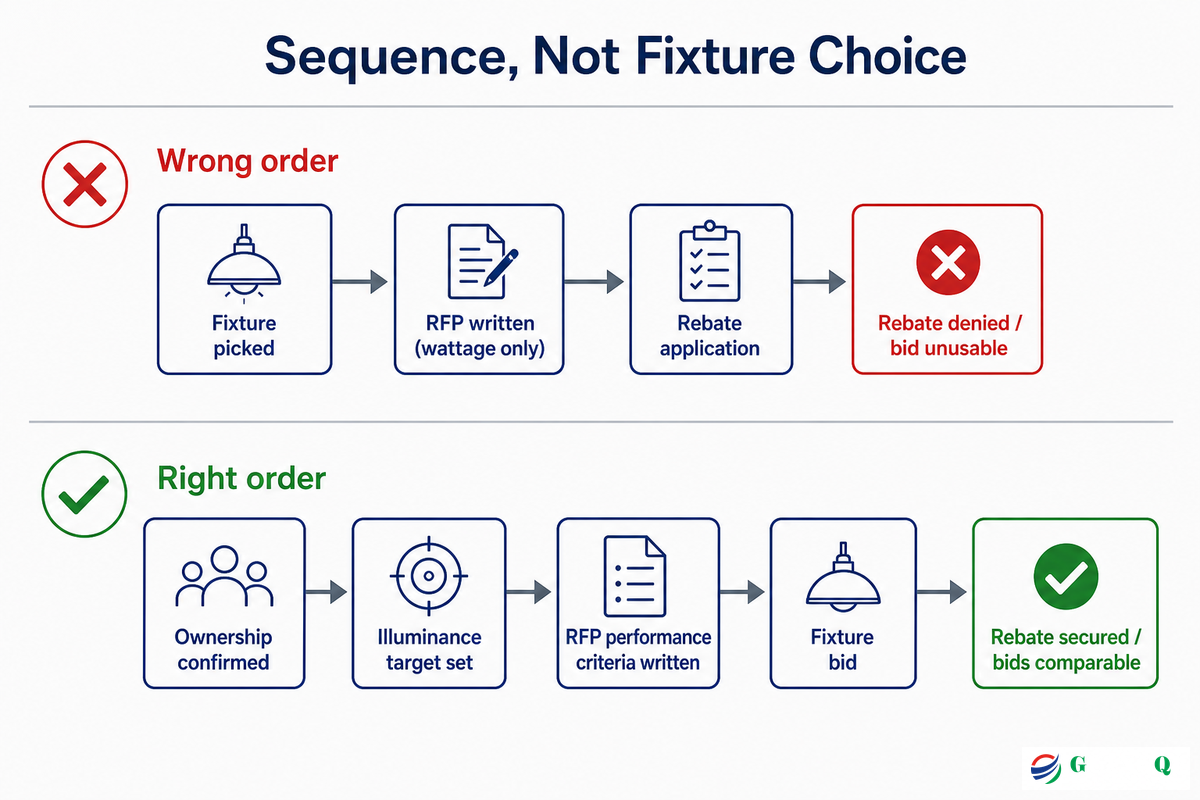
The pattern behind most of these mistakes is the same: a rebate gets denied, or a bid comes back unusable, not because the fixture itself was wrong, but because a step happened out of order — a wattage-only RFP got written before the illuminance target was pinned down, or a fixture got selected before its rebate eligibility was confirmed. Because these problems trace back to sequence rather than fixture choice, the fixes below are about the order the work gets done, not which brand wins the bid.
- DLC listing gets treated as a performance guarantee when it’s really a minimum bar – same-tier products still vary in real-world output and reliability, so ask for project references, not just the QPL listing number.
- Rebate applications go in one or two fixtures at a time. Utility programs are usually batch-based; program administrators have historically had more trouble with small, one-off requests; grouping multiple fixtures in a single rebate application tends to speed processing.
- RFP specifications have only referenced wattage. A bid spec that requests “100w LED, DLC listed” invites a broad spread of possible outcomes — real municipal RFPs that specify only lumen output without a failure threshold (as flagged in East Providence, RI’s street light conversion RFP) can leave the “more than 15% output failure” threshold undefined; requiring a target illuminance and uniformity ratio is the way to get comparable bid proposals.
- Survey work gets scoped by the count of fixtures alone, not by individual circuits, which may indicate series-wired legacy systems that require full re-wiring rather than just replacing fixtures.
- Funding request happens after the fixture has been selected-it should be prior to RFP spec development, rather than after an unqualified fixture has been chosen.
Key takeaway: In this type of project, many purchasing errors are due to the order of operations (funding, specification development, and survey) rather than to selecting the wrong fixture brand.
Industry Outlook: What’s Changing in Municipal Street Lighting Funding & Policy
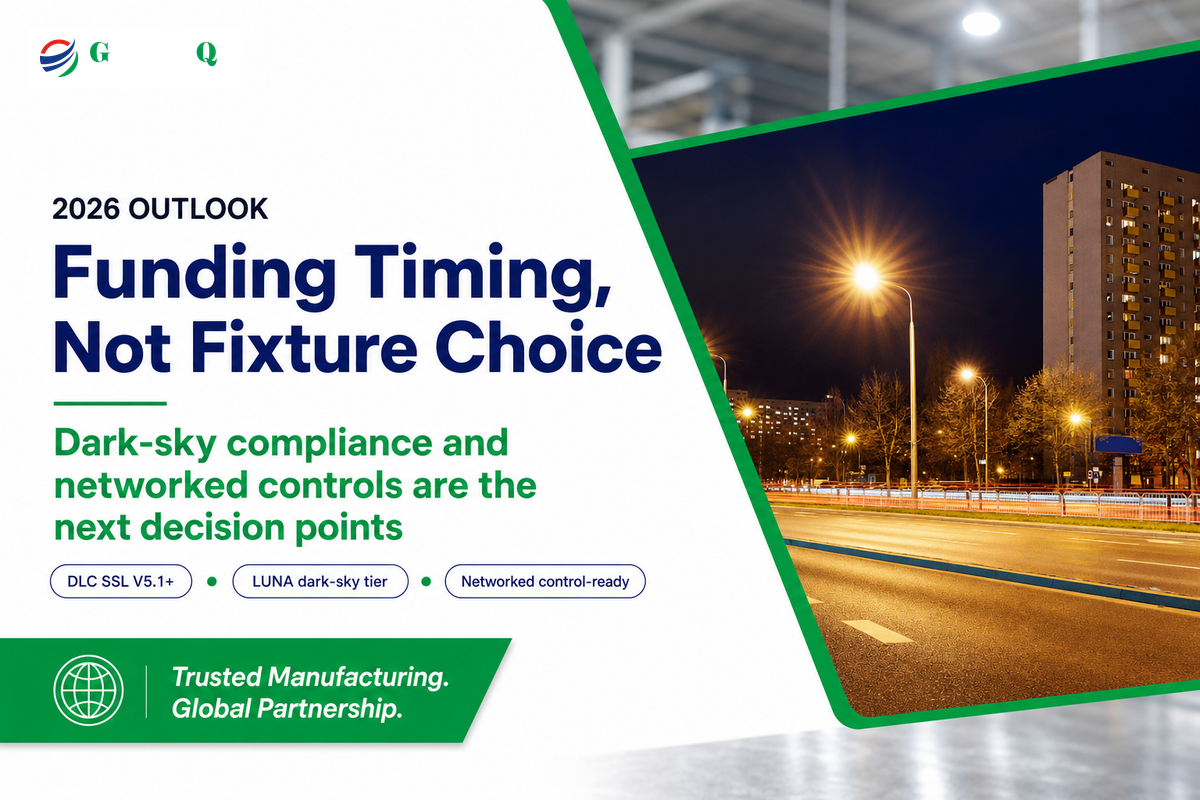
Municipal street lighting buying has been evolving. Adoption of LED isn’t as big a question as it was in the 2010s, because the DesignLights Consortium has substantially revised its technical requirements multiple times since the DOE published the original Model Specification for LED Roadway Luminaires back in 2011. Today’s SSL V5.1, effective mid-2020 with future updates extending to 2025-2026, is based on a field where LED is a mature technology. What’s still actively changing is how these projects are funded and managed. DLC’s 2025-2026 update includes the LUNA dark-sky specification tier, and many entities are beginning to make purchasing decisions about networked/5G-integrated lighting control in parallel with selecting a fixture, treating street lighting solutions as a system decision rather than a single line-item purchase.
For those looking to plan a 2026 project, the effect of this maturation is a drop in search interest for exact-match “commercial street lights” terms-not an indicator that projects are declining, but that buyers and their contractors are already familiar with the category. DesignLights Consortium and ANSI/IES have each made substantial updates in the past two years to their technical guidelines, and utility rebates are still revising their eligibility rules. If you are planning a retrofit within the next fiscal year, allow time to ensure your RFP’s technical requirements reflect the latest criteria, such as RP-8-22 and DLC SSL V5.1+, rather than an earlier specification, because specifying an outdated standard is one of the more frequent causes of bid proposals with mismatched results.
Two decisions are worth making deliberately rather than by default. If your project is anywhere near a residential boundary or falls under a local light-pollution ordinance, budget for DLC’s LUNA dark-sky tier now — retrofitting full-cutoff optics after installation costs far more than specifying it in the original RFP. And if your utility or municipality is already running any networked infrastructure (traffic signals, smart meters, municipal Wi-Fi), it’s worth asking your fixture vendor about network-protocol compatibility during the same conversation as fixture selection, not as a follow-up purchase once the poles are already up.
As an ISO 9001-certified manufacturer, Guangqi provides DLC Premium submittal support across export markets and sees this shift in practice: the operational risk for buyers today isn’t specifying the wrong wattage — it’s the compliance gap that opens when a fixture purchased a few years ago no longer matches the DLC SSL V5.1+ criteria a fresh rebate application now checks against.
Key takeaway: The choice of a specific fixture is no longer the question; it’s funding timing, dark-sky compliance, and when to specify networked controls.
FAQ, Commercial Street Light Procurement
Do commercial street lights qualify for utility rebates?
View Answer
Most utility LED rebate programs offer coverage on commercial and municipal street lighting if the fixture is on the current DesignLights Consortium (DLC) Qualified Products List. Requirements, amount of rebate, and the process for submitting a rebate vary by utility, with some requiring pre-approval before purchase and program administrators historically being more consistent with processing batch applications on multiple fixtures versus a single light. Make sure to verify your specific utility’s LED lighting rebate requirements prior to creating your RFP; the DLC tier for rebate eligibility should influence your specifications, not follow it.
What should a municipal street light RFP require?
View Answer
At a minimum, your RFP should clearly define each road classification by illumination range and uniformity ratio per ANSI/IES RP-8-22, the DLC tier required for your specific LED fixture’s listing on the Qualified Products List (QPL), a warranty duration appropriate to road class, any necessary dark sky or full cutoff requirements dictated by local ordinances, and a photometric submittal requirement (LM-79/LM-80/TM-21) prior to awarding a contract. Wattage and number of fixtures alone are insufficient; these parameters alone are likely to result in bids spanning inconsistent performance levels that cannot easily be compared on any metric other than price.
Who owns and maintains commercial street lights?
View Answer
There are three general categories of ownership of street lights: municipally owned, wherein the municipality’s public works or transportation department owns and operates the infrastructure, funding maintenance from its own budget; investor-owned, where an investor-owned utility owns the infrastructure and charges the municipality a monthly fee through a tariff or buyout agreement before LED fixtures may be installed; and privately owned, most commonly associated with commercial parking lots or gated communities, wherein the property owner is responsible for the infrastructure. Determine your ownership model prior to defining project scope, as it determines the approval authority for the work.
How long does a municipal LED street light retrofit project take?
View Answer
The typical timeframe from CIP approval to project completion is 9-18 months for a medium-size municipal project. This involves the CIP budgeting process discussed previously, followed by the issuing and award of an RFP (generally 60-90 days) and finally, installation and commissioning in phases. The installation schedule, which is often completed in phases by street corridor, is also a factor that may prolong the apparent duration of a project without changing the length of time needed for procuring the materials and services. For a citywide program covering thousands of fixtures (like the roughly 55,000 fixtures in Portland’s retrofit program), the process was carried out in phases over several years. Small commercial parking lot retrofit projects not going through a CIP may take only a few months from RFP to installation.
Can existing street light poles be reused in an LED retrofit?
View Answer
In most cases, yes, as LED cobra heads, post top fixtures and shoebox lighting is designed to fit on most existing poles, a major benefit of the cost savings realized with a retrofit versus replacing pole and fixture. Legacy fixtures wired in series rather than in parallel are an exception, and these require the electrical circuitry to be modified to accommodate a standard LED driver, hence the necessity for an electrical circuit survey rather than just a pole count prior to ordering any fixtures.
What’s the difference between a spec sheet and an RFP for street lighting?
View Answer
One spec sheet describes one product. One RFP identifies what the buyer wants (regardless of one particular product): road class illuminance & uniformity targets, DLC tier, warranty and compliance. Writing an RFP around a specific manufacturer’s numbers reduces options and may have legal/fairness issues on public projects.
Does DLC Premium listing affect rebate eligibility?
View Answer
Yes in most cases. DLC Premium is a more stringently applied designation, higher performing across efficacy, light quality and controllability thresholds than DLC Standard, and many of the higher-value utility rebates are restricted to products with this Premium designation rather than standard. Before drafting RFP specifications, check to ensure your target utility rebates specifically call for one of the more demanding DLC Premium tiers rather than standard; otherwise, you might spec out a DLC Standard fixture that isn’t eligible for the amount of money you expected to put toward the rebates.
Why We Wrote This Guide
Procurement, budgeting, and RFP-writing for commercial street lighting is the step beyond fixture specification that we don’t write up on our product pages — which is why we wrote this guide. Its funding-stack and vendor-evaluation framework draws on our own experience preparing DLC Premium and LM-79, LM-80 and TM-21 photometric submittals for municipal and commercial customers, checked against standards referenced by ANSI/IES, DLC, GFOA and municipal capital planning guidelines throughout. Reviewed by the Zhongshan Guangqi Lighting Co., Ltd. technical team.
References & Sources
- ANSI/IES RP-8-22: Recommended Practice for Lighting Roadway and Parking Facilities — Illuminating Engineering Society
- ANSI/IES RP-8-22: Design of Roadway Facility Lighting — American National Standards Institute
- DLC Premium Requirements, SSL V5.1 — DesignLights Consortium
- Final Version of DesignLights Consortium’s New Technical Requirements for LED Lighting Released — DesignLights Consortium
- Capital Planning Best Practices — Government Finance Officers Association
- LED Street Light Conversion Program — City of Portland, Oregon, Bureau of Transportation
- Capital Improvements Program (CIP) — Montgomery County, Maryland
- LED Installations through Government Procurement Programs — American Council for an Energy-Efficient Economy
- DOE Consortium Publishes Guidelines for Converting to LED Roadway Lighting — Electrical Contractor Magazine
Related Articles
- The Commercial Buyer’s Guide to Specifying Solar Flood Lights — a parallel procurement-focused guide for solar flood lighting projects
- Metal Halide to LED Retrofit Guide — indoor and area-light retrofit process and considerations
- IP Rating Guide for Outdoor Lighting — ingress protection ratings referenced in RFP compliance criteria
- Street Light Fixture Selector Tool — match fixture type and wattage to your road classification
- Solar Street Lights Guide — off-grid and rural road lighting options