Get in Touch with GUANGQI


Lumens vs Watts: How to Choose Brightness, Not Just Power


Updated August 2026
Lumens vs watts is a comparison between visible-light output and electrical power input. When replacing a common household lamp, find the required lumens first, then compare the watts used by products that deliver that output. With commercial light fixtures, wattage is only the first factor: beam distribution, glare, color quality, control compatibility, mounting, and the intended illumination at the work plane must also be suitable.
The short answer
Use lumens to compare brightness and watts to compare power demand. A lower-watt product is an efficiency win only when it still supplies the required tested light output and fits the same application.
Lumen-First Selection Order—Only Within a Like-for-Like Boundary

For a familiar household bulb, use a Lumen-First Selection Order. Establish the lumen target, compare whole-product lumen ratings, and then look for a suitable lamp that reaches that output with fewer input watts. This reverses the old habit of shopping for a “60-watt bulb” when the actual requirement is a brightness class near 800 lumens.
- Set the output target. Read the lumens on the old lamp or determine the light output the application needs.
- Keep the comparison like for like. Match base, shape, size, voltage, color appearance, dimming requirements, and intended use.
- Compare input power. Among products that satisfy the output and application requirements, compare rated watts.
- Check efficacy. Divide lumens by watts, or verify the published whole-product lumens-per-watt value.
The boundary matters. A commercial fixture that delivers the same total lumens as another model may spill that light very differently. It may create a different beam, cutoff, uniformity, glare condition, or work-plane result. Color rendering, color temperature, driver behavior, ambient temperature, controls, and lumen maintenance may also need to be acceptable. For a roadway, warehouse, facade, or sports project, do not approve a substitute from lumens and watts alone; review the photometric file and application calculation. For procurement context, see the U.S. Department of Energy commercial luminaire guidance.
This boundary also separates a household replacement class from a commercial photometric comparison.
What Does a Lumen Measure?

The lumen (lm) is the SI unit of luminous flux. In plain language, luminous flux represents the total amount of visible light emitted, weighted to the sensitivity of human vision. The International Bureau of Weights and Measures places the lumen within the SI system of photometric units.
Every lumen claim also needs a boundary. An LED package value, a bare lamp output, and the total light output of a complete luminaire aren’t interchangeable by default. Power supplies, thermal environments, lenses, reflectors, diffusers, and lens covers may all modify the light delivered by the finished product. Find a suitable replacement by comparing complete-product values measured or specified on the same basis.
The procurement risk is comparing package lumens with finished-luminaire lumens. Commercial specifications should use whole-product output as the comparison boundary.
Total lumens do not tell you how much light arrives on a particular desk, road, wall, or playing surface. That surface result is illuminance, commonly expressed in lux. Area, distance, aiming, beam shape, losses, and overlap between fixtures all affect it. Our guide to light output and surface illuminance explains that separate quantity boundary.
What Does a Watt Measure, and What Does It Not Measure?

The watt (W) is an SI unit of power: the rate at which a device consumes or transfers energy. On a lamp label, or a luminaire submittal, input power is the electrical power demand, measured or specified, under the given operating conditions. Watts don’t specify the amount of visible-light flux delivered.
The common mistake is treating input power as brightness. Commercial comparisons should separate the watt value from the tested lumen value.
The watt, with symbol W, is the SI unit used for power.
Wattage became a brightness shortcut because incandescent lamps of a similar type had broadly familiar output levels. A buyer could ask for a 40-, 60-, 75-, or 100-watt bulb and usually get a predictable brightness class. That shortcut breaks when technologies and product designs differ. An LED lamp can provide a familiar lumen level while drawing a fraction of the power, and two LEDs with equal wattage can still have different lumen ratings.
The same warning applies when comparing an incandescent bulb, fluorescent lamp, halogen lamp, and LED bulb. Each light source turns input power into visible light differently. Asking how bright a light will look from watts alone hides efficacy, distribution, and viewing conditions. Higher lumen ratings mean more total luminous flux, but not necessarily more useful light on the target.
Watts should also not be confused with watt-hours or kilowatt-hours. Watts describe power at a moment; watt-hours describe power used over time. See our watts and kilowatts reference for power-unit relationships.
How Does Luminous Efficacy Connect Lumens and Watts?

Luminous efficacy connects light output and input power. For a finished lamp or luminaire, calculate it from values measured on the same product and under compatible conditions, following the whole-product comparison boundary in the U.S. Department of Energy purchasing guidance.
Efficacy
lumens per watt = lumens ÷ wattsEstimated input power
watts = lumens ÷ lumens per wattEstimated output
lumens = watts × lumens per wattSuppose the target is 1,000 lumens. At 100 lm/W, the arithmetic gives 1,000 ÷ 100 = 10 W. At 125 lm/W, it gives 1,000 ÷ 125 = 8 W. Both equations are exact for the numbers supplied, but neither establishes the rating of a real product. Verify the actual label, datasheet, or test report.
That is why no universal lumens-to-watts conversion exists. The missing variable is efficacy, and efficacy changes with technology, product construction, operating condition, and test boundary. Use the formula to understand or cross-check data, not to replace product evidence.
A worked like-for-like comparison
Imagine two lamps intended for the same socket and both rated at 800 lumens. Lamp A draws 8 W, so its stated-value efficacy is 800 ÷ 8 = 100 lm/W. Lamp B draws 6.5 W, producing 800 ÷ 6.5 = 123.1 lm/W after rounding. On output and power alone, Lamp B uses less power for the same rated luminous flux.
The comparison is not finished until the other requirements match. If Lamp B is larger than the fixture allows, cannot operate in an enclosed fitting, does not support the installed dimmer, or has an unsuitable color appearance, it is not a valid substitute. The calculation identifies an efficiency difference; the product documentation determines whether the alternatives are genuinely comparable.
For commercial luminaires, repeat the same logic with a stricter boundary. Confirm that the photometric distributions serve the same geometry and that the required maintained illuminance and uniformity are met. Only then does a lower input-power value represent an application-level improvement. A headline efficacy number cannot reveal whether light is sent toward the task, into glare zones, or outside the intended area.
Lumens-to-Watts Replacement Chart: Match Output First

The U.S. Department of Energy publishes approximate LED input ranges for familiar incandescent replacement classes. These ranges are useful shopping references, not conversion constants. Here, a conforming product label remains the evidence for the lamp in your hand.
| Familiar incandescent reference | Target light output | Approximate LED input range | Buyer check |
|---|---|---|---|
| 40 W | 450 lm | 4.5–7 W | Confirm lumens on label |
| 60 W | 800 lm | 5.9–10.5 W | Confirm base, shape, and dimming |
| 75 W | 1,100 lm | 9.5–14 W | Confirm output and application |
| 100 W | 1,600 lm | 10.5–18 W | Check fixture limits and dimensions |
The four output checkpoints are 450 lm, 800 lm, 1,100 lm, and 1,600 lm. Their published LED input ranges are 4.5–7 W, 5.9–10.5 W, 9.5–14 W, and 10.5–18 W, respectively.
At the upper ends of those published ranges, the 450 lm class uses 7 W, the 800 lm class uses 10.5 W, the 1,100 lm class uses 14 W, and the 1,600 lm class uses 18 W. Those paired values remain class references, not universal conversions.
The Australian Government’s Energy Rating program uses slightly different rounded reference classes—such as 470, 800, 1,000, and 1,500 lumens for familiar 40-, 60-, 75-, and 100-watt incandescent categories. The difference reinforces the right interpretation: equivalent labels are approximate selection aids. They are not physical identities between lumens and watts.
Use this as a replacement-class guide rather than a fixed conversion chart. It helps identify the approximate amount of light to seek; the current product label supplies the value to buy.
Search wording varies—lumens versus watts, lumen vs wattage chart, and LED wattage equivalent—but the decision rule stays the same. A lumens vs watts chart or lumens vs watts LED table is only conditional, and a 1000 lumens to watts question still needs an efficacy value.
A lumens to watts conversion chart compares watts and lumens across more than one bulb type or lighting technology. It can illustrate energy consumption, but it cannot convert lumens to watts without an efficacy assumption. For example, a 1600 lumens target may require fewer watts from a modern LED than from incandescent and halogen bulbs.
Perceived brightness adds another limit. Two products can have the same total lumens while beam shape, room surfaces, color, and viewing conditions make the visual result feel different.
Do
Match the required output class, then verify the real lamp’s rated lumens, watts, fit, color, and control compatibility.
Do not
Treat “800 lumens equals 60 watts” as a universal conversion. It describes a familiar incandescent comparison class.
Why Can Two LEDs with the Same Watts Produce Different Lumens?

Input power travels through a system. The driver converts electricity, the LEDs turn part of it into visible light, thermal management controls operating temperature, and optics shape the beam. Losses and design choices at each stage affect the lumens emerging from the complete luminaire. Consequently, two 100-watt fixtures may have different total output and efficacy, which is why federal purchasing guidance compares complete luminaires.
The procurement risk is accepting wattage parity as performance parity. Check whole-product output and distribution before comparing input power.
Output isn’t the only design goal. Tighter distribution may put more useful light on a target with similar total lumens. Color quality, optical control, environmental protection, thermal limits, driver features, and other system components all affect application performance. Fewer lumens are not automatically less desirable for a luminaire, and more lumens do not automatically produce a better application result.
Guangqi’s own commercial street-light pages illustrate the range within one supplier’s catalog. The published families span approximately 50–300 W and 6,500–45,000 lm, with self-published system-efficacy bands around 130–160 lm/W depending on the family. These are manufacturer catalog specifications, not independent verification, and individual model documents should be checked before procurement.
How Should You Read a Lamp Label or Luminaire Submittal?
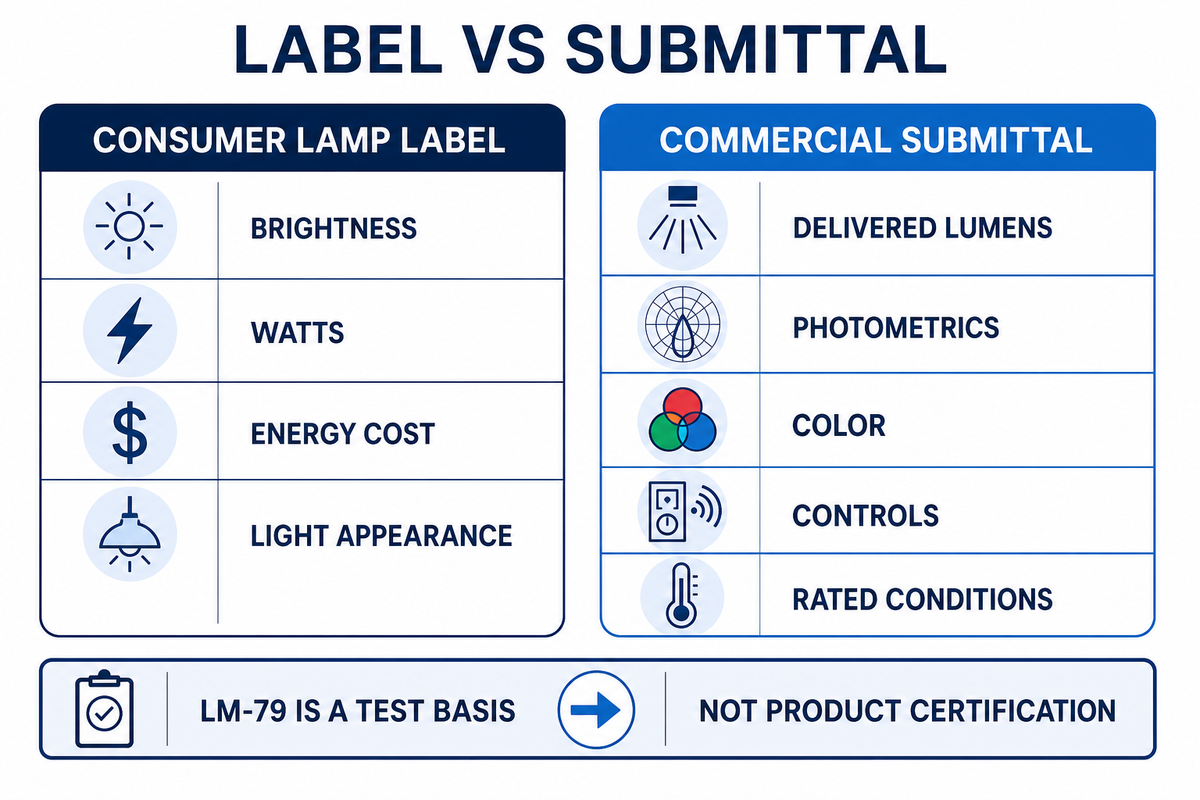
Read a household lamp label for brightness and energy use; read a commercial submittal for tested output, input power, distribution, color, controls, and rated conditions. The first supports a consumer replacement. The second supports an application comparison, and it still needs project-specific photometric review.
Consumer lamp label
For many general-service lamps sold in the United States, the Federal Trade Commission’s Lighting Facts requirements organize data around brightness in lumens, estimated yearly energy cost, life, light appearance, energy used in watts, and a mercury disclosure where applicable. The practical lesson is that brightness and power demand occupy separate fields because they answer separate questions.
Read the brightness field first for a replacement, then use watts and estimated operating information to compare energy demand. Confirm light appearance, dimensions, base, voltage, dimming, and enclosed-fixture restrictions as applicable. A familiar “equivalent” claim should not override the actual lumen value.
Commercial luminaire submittal
A commercial review generally requires more than a lamp or package label. Look for delivered lumens, input watts, efficacy, the photometric test reference, color temperature, color-rendering information, optic or distribution pattern, control options, voltage, rated ambient conditions, and any life or lumen-maintenance information. For lighting replacement projects, compare photometric test files and application calculations rather than just two headline lumen values.
| Comparison category | Question to answer | Typical evidence |
|---|---|---|
| Output | Are whole-product lumens sufficient? | Label, datasheet, or test report |
| Input | How many watts does the product draw? | Rated input power |
| Distribution | Does the beam serve the target geometry? | Photometric file and plot |
| Color appearance | Is the Kelvin rating appropriate? | Correlated color temperature |
| Color quality | Does rendering meet the application need? | Declared color-rendering metrics |
| Controls | Are dimming and control interfaces compatible? | Driver and control documentation |
| Electrical | Do voltage and frequency match? | Nameplate and submittal |
| Environment | Are temperature and enclosure ratings suitable? | Rated-condition documentation |
| Maintained result | Will the design meet the target over time? | Maintenance assumptions and calculation |
IES LM-79 is a measurement method for the electrical and photometric properties of solid-state lighting products. A report may include input power, total luminous flux, efficacy, color characteristics, and intensity distribution. The phrase “LM-79 tested” describes a test basis; it should not be rewritten as an LM-79 product certification.
Watts vs Watt-Hours: How Do You Estimate Energy Use?
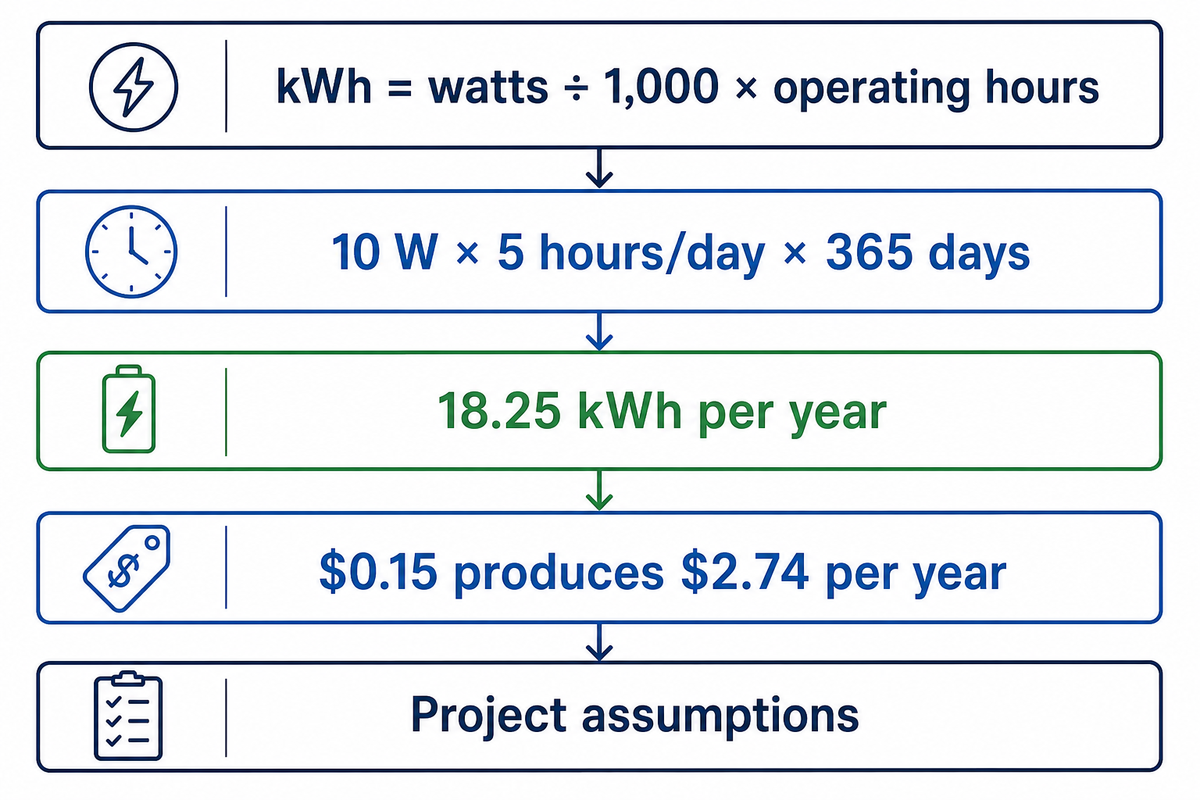
Power becomes energy when time is included. The relationship is energy in kilowatt-hours = watts ÷ 1,000 × operating hours. If a 10-watt lamp operates five hours per day for 365 days, the assumption produces 10 ÷ 1,000 × 5 × 365 = 18.25 kWh per year; the U.S. Department of Energy explains the same output-first energy comparison.
At an assumed electricity price of $0.15 per kWh, the simple energy charge would be 18.25 × $0.15 = $2.74 per year after rounding. This example is arithmetic, not a Guangqi savings or payback claim. Actual hours, tariffs, demand charges, controls, maintenance, and operating conditions vary.
When making comparative choices, hold the necessary lighting result constant. A lower-watt product that does not provide the required output or distribution is not an equivalent energy-saving replacement. For controlled systems, use the expected dimming schedule and measured or modeled power behavior rather than assuming full power for every hour.
The savings risk is overstating energy reduction before the lighting result is matched. Treat operating hours and electricity price as project assumptions, not universal payback facts.
Where Do Lumens Stop, and When Do Lux, Beam, and Distance Take Over?

Lumens stop at total visible-light output. Once the question becomes “How much light reaches this surface?” the analysis moves to illuminance, distribution, beam angle, distance, mounting, aiming, surface geometry, and environmental losses. Equal lumen packages can produce unequal lux values at the same point because their optical distributions differ; the National Institute of Standards and Technology describes the lumen realization separately from an application result.
That handoff—from total lumens to project photometrics—is a separate calculation step.
For the quantity distinction and surface-light calculation boundary, continue to the lumens and lux explanation. For exterior project selection, the LED flood-light wattage guide covers mounting and coverage considerations. You can also review commercial LED flood lights, then request project-specific photometric data rather than choosing from watts alone.
Frequently Asked Questions
How many lumens is a 60-watt light bulb?
A traditional 60-watt incandescent lamp is commonly associated with an approximately 800-lumen output class. The relationship is not universal because 60 watts describes input power, not brightness. For an LED replacement, start with about 800 lumens, then confirm the actual label, base, dimensions, color appearance, dimming, and fixture suitability.
How many watts is 1,000 lumens?
There is no single watt value for 1,000 lumens. Divide 1,000 by the product’s luminous efficacy. At 100 lm/W, the calculation gives 10 W; at 125 lm/W, it gives 8 W. Those are conditional calculations, not real-product ratings, so verify the lamp label or luminaire test data.
What is 500 lumens equivalent to in watts?
The answer depends on technology and whole-product efficacy. Use watts = 500 ÷ efficacy, with efficacy in lumens per watt. The result estimates input power for the stated efficacy; it does not guarantee room brightness because distribution, mounting, distance, area, and surface conditions determine the illuminance actually received.
Do higher watts always mean a brighter light?
No. Higher watts may correlate with more light across similar technology and optics, but the relationship fails across designs and lamp technologies. Compare tested lumens, then watts among products meeting the same output and application requirements. For a commercial substitute, compare distribution, color, controls, rated conditions, and maintained performance. Those checks prevent a lower-efficacy design with unsuitable optics—or a high-efficacy design that sends light to the wrong place—from being selected on one number. Watts show demand, not the complete result.
Do lumens affect color temperature or color rendering?
Lumens, color temperature, and color rendering describe different lighting properties. Lumens quantify visible-light output; color temperature describes warm-to-cool appearance; color-rendering metrics describe how colors appear. Two products can share a lumen rating while producing different color appearance and rendering performance.
References and Sources
- International Bureau of Weights and Measures: SI measurement units
- U.S. Department of Energy: Purchasing Energy-Efficient Light Bulbs
- U.S. Department of Energy: Commercial and Industrial LED Luminaires
- U.S. Department of Energy: LED Lighting Facts program archive
- U.S. Federal Trade Commission: Lighting Facts Questions and Answers
- Illuminating Engineering Society: LM-79-24 measurement method
Guangqi publishes practical lighting education for buyers, contractors, and project teams. This article distinguishes authoritative unit and labeling sources from Guangqi’s self-published catalog specifications; it does not present manufacturer claims as independent laboratory findings. Application decisions should be checked against the current product documents, photometric evidence, and project requirements.