Get in Touch with GUANGQI



Warm white light bulb color is a lower-Kelvin white light, most often around 2700K to 3000K, with a yellowish or amber cast compared with daylight, cool white, or bluish-white light. That quick answer is useful, but it isn’t enough for commercial entries, patios, parking edges, facades, and outdoor work areas.
Fast answer
Choose 2700K when the space needs a soft white lighting mood, low visual intensity, or a warmer match to wood, brick, stone, landscape planting, or hospitality seating. Choose 3000K when the site still needs warm white light but also needs cleaner visibility for retail entries, pedestrian paths, loading-adjacent walkways, and commercial outdoor lighting. For dark-sky-sensitive or wildlife-sensitive sites, neither 2700K nor 3000K may be the final answer; DarkSky guidance supports lower CCT, amber output, shielding, controls, or no added light as better options in some locations.
| Question | 2700K | 3000K | Check before buying |
|---|---|---|---|
| Color impression | Warmer, more amber, close to traditional incandescent bulbs | Still warm white, but cleaner and less orange | Finish color, surface reflectance, and fixture optics |
| Outdoor fit | Comfort, hospitality, landscape accents | Entries, paths, parking edges, task lighting zones | Glare, high-angle light, shielding, controls |
| Main risk | Can look too yellow on pale concrete or modern metal | Can feel too sharp where the goal is quiet comfort | Sample under the actual mounting height |
What Color Is a Warm White Light Bulb?
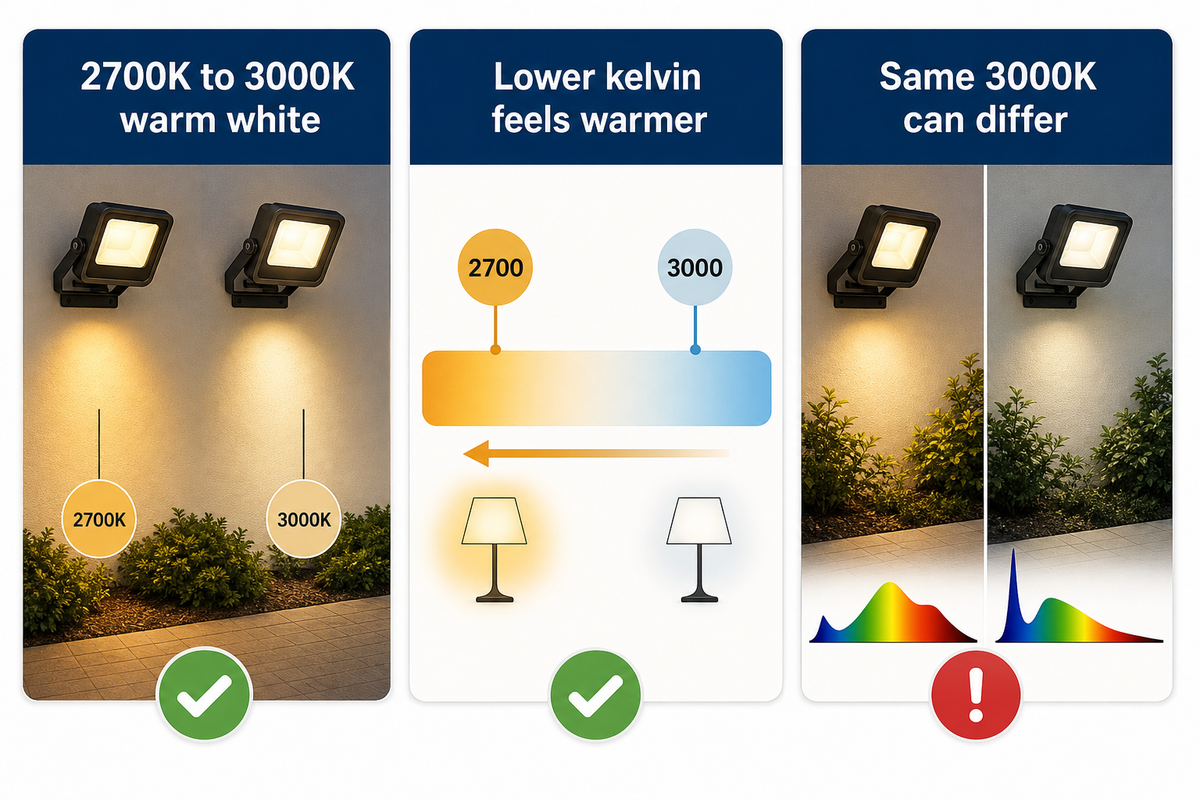
Warm white is the lower end of white light bulb color temperature, usually described in the 2700K to 3000K range. ENERGY STAR lamp guidance frames warm CFL color in that range, while DarkSky guidance describes medium CCTs from 2700K to 3000K as warm white and lower 1800K to 2200K values as very warm or amber.
What color is a warm white light bulb?
A warm white light bulb produces white light with a red-yellow or amber bias rather than the cooler blue tone associated with daylight or cool white light. The bulb color temperature is measured in kelvins: lower kelvin values feel warmer, while higher values move toward neutral white light, bright white light, and then cool white light.
For a home lamp or a soft white light bulb, that definition may be enough. Outdoor lighting also has to match the surface, beam angle, mounting height, shielding, glare sensitivity, and the way people move through the space. Two LED lamp products with the same 3000K label can still differ in spectral content, color rendering, distribution, and how comfortable they feel at night. DarkSky treats CCT and spectral content as separate concepts, which is the key correction to a Kelvin-only decision.
For a supplier or procurement team, the risk is ambiguity: a 2700K bulb, a 3000K fixture, and a certified luminaire can all carry a warm-white label but behave differently in the field because optics, controls, and mounting height change what buyers actually see.
In markets that use British spelling, the same spec may be written as colour temperature. Read color temperature, colour temperature, and CCT as the same buying field; when a datasheet uses “colour temperature,” still check whether the LED technology, optics, and controls make the stated value useful on the actual site.
2700K vs 3000K: What Actually Changes?
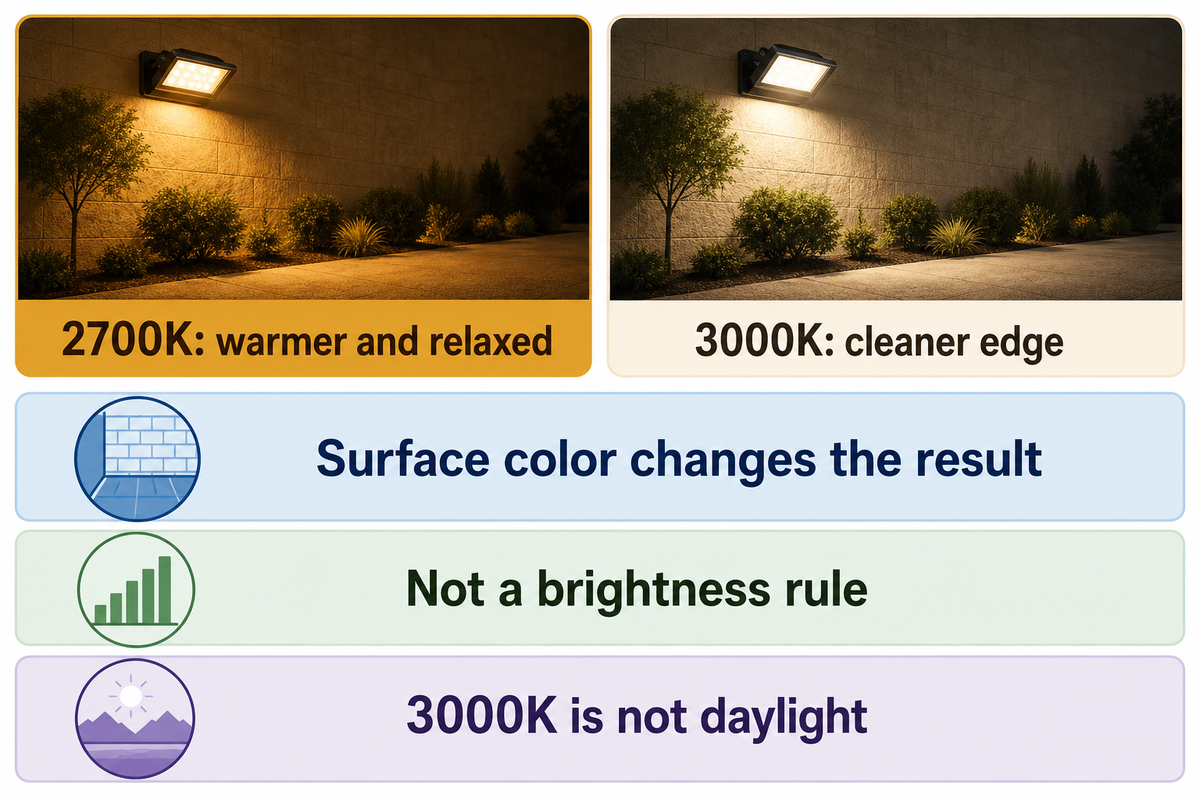
A change from 2700K to 3000K is small on a color chart, but it can be obvious on a wall, path, or facade. 2700K reads as warmer and more relaxed. 3000K stays in the warm white range but gives a cleaner edge to objects, signage, steps, and faces.
| Selection factor | 2700K | 3000K | Why it matters |
|---|---|---|---|
| Mood | Soft, calm, familiar | Warm, cleaner, slightly more active | Comfort areas punish glare faster than task areas. |
| Surface color | Works well with brick, wood, warm stone | Often better on concrete, white walls, steel, glass | The same light bulb can look different after reflection. |
| Visibility | Good for slow movement and low-speed areas | Better for paths, entries, and customer movement | More visible contrast helps wayfinding. |
| Common mistake | Choosing it only because it feels cozy indoors | Treating it as a universal outdoor answer | Outdoor lighting is a fixture system, not just a bulb label. |
Don’t read this as a brightness rule. A 2700K LED light can have more lumens than a 3000K LED light, and a 3000K fixture can still create poor visibility if the beam sends high-angle light into the eye. DOE outdoor area lighting guidance treats color temperature, glare at the intended mounting height, IP rating, distribution, and uniformity as linked checks rather than isolated choices.
Where 2700K Works Best in Commercial and Outdoor Spaces
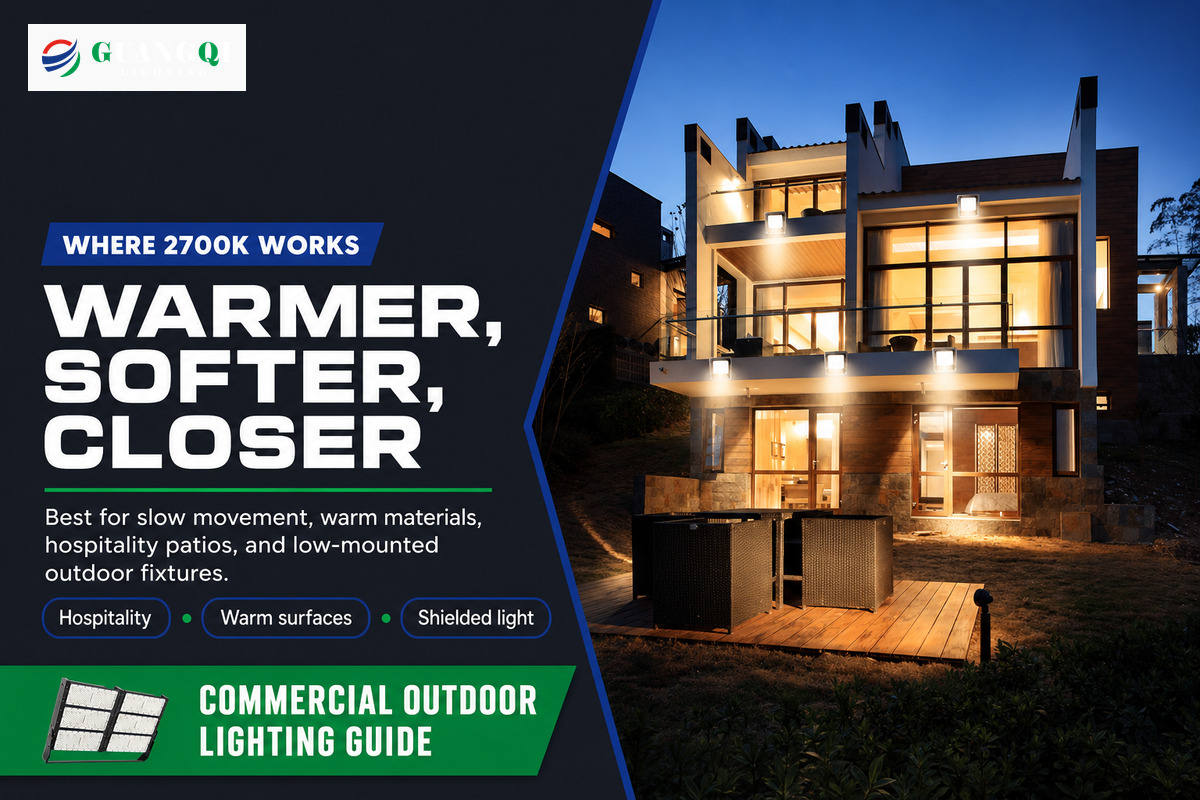
2700K works best when the visual task is slow, the desired feeling is quiet, and the surfaces already lean warm. Hospitality patios, hotel entries, resort walkways, restaurant terraces, garden walls, timber canopies, and brick facades often look better under 2700K than under 3000K or 4000K.
Surface reflection is the practical reason. A warm light on warm brick or wood reinforces the material. A neutral or cool white light can make the same surface feel flatter or more commercial than intended. In outdoor seating, people also notice discomfort glare before they notice small gains in measured brightness, so shielding and aiming should carry more weight than simply moving from 2700K to 3000K.
Sensitive-site boundary
In ecologically sensitive locations, 2700K can still be too broad a shortcut. DarkSky guidance recognizes very warm or amber lower-CCT output and wildlife-tuned luminaires with long-wavelength spectral requirements. Treat parks, coastline, wildlife habitat, observatory areas, and dark-sky communities as a separate design case, not a normal 2700K versus 3000K choice.
Use 2700K when the fixture is close to people, the mounting height is low, and the design goal is a warm light rather than maximum contrast. If you’re comparing soft white lighting against natural light or daylight, 2700K is the closer match to traditional incandescent bulbs, not to noon daylight.
Where 3000K Is the Better Warm White Choice
3000K is the safer warm-white starting point when the site needs a cleaner view of steps, curb edges, entries, service doors, signs, or people moving through the area. It isn’t cool white light, and it isn’t 5000K daylight. It’s still warm white, but it has less amber than 2700K.
Is warm white 3000K or 4000K?
Warm white is normally closer to 2700K or 3000K, not 4000K. 4000K is usually closer to neutral white light and may feel too crisp for comfort-led outdoor areas. DarkSky commercial luminaire criteria also set nominal CCT at no more than 3000K for eligible commercial luminaires, so 3000K is a useful ceiling in many outdoor planning discussions.
In commercial spaces, 3000K often fits retail entrances, pedestrian paths, parking-lot edges, hotel drop-off zones, and outdoor dining service paths. It can also work on modern facades where 2700K makes concrete, glass, white cladding, or brushed metal look too yellowish.
This caution matters: 3000K isn’t a safety guarantee. Poor aiming, excessive output, and visible light sources can create glare even at a warm-white CCT. DarkSky criteria pair the 3000K ceiling with uplight limits, high-angle light limits, shielding options, and dimming or controls. That pairing is the real lesson: 3000K helps, but fixture behavior decides the night experience.
Field note: A buyer choosing 3000K for a retail entry, factory yard edge, or loading-adjacent walkway should test the fixture at the planned mounting height before ordering. The risk is not the Kelvin value alone; it is glare on wet pavement, a visible LED source, or a beam that washes out signs and faces. Use the DarkSky ceiling and DOE glare/uniformity checks as evidence inputs, then ask for a nighttime mockup.
The Commercial Outdoor Checklist: CCT, Glare, IP Rating, Beam Angle, and Controls
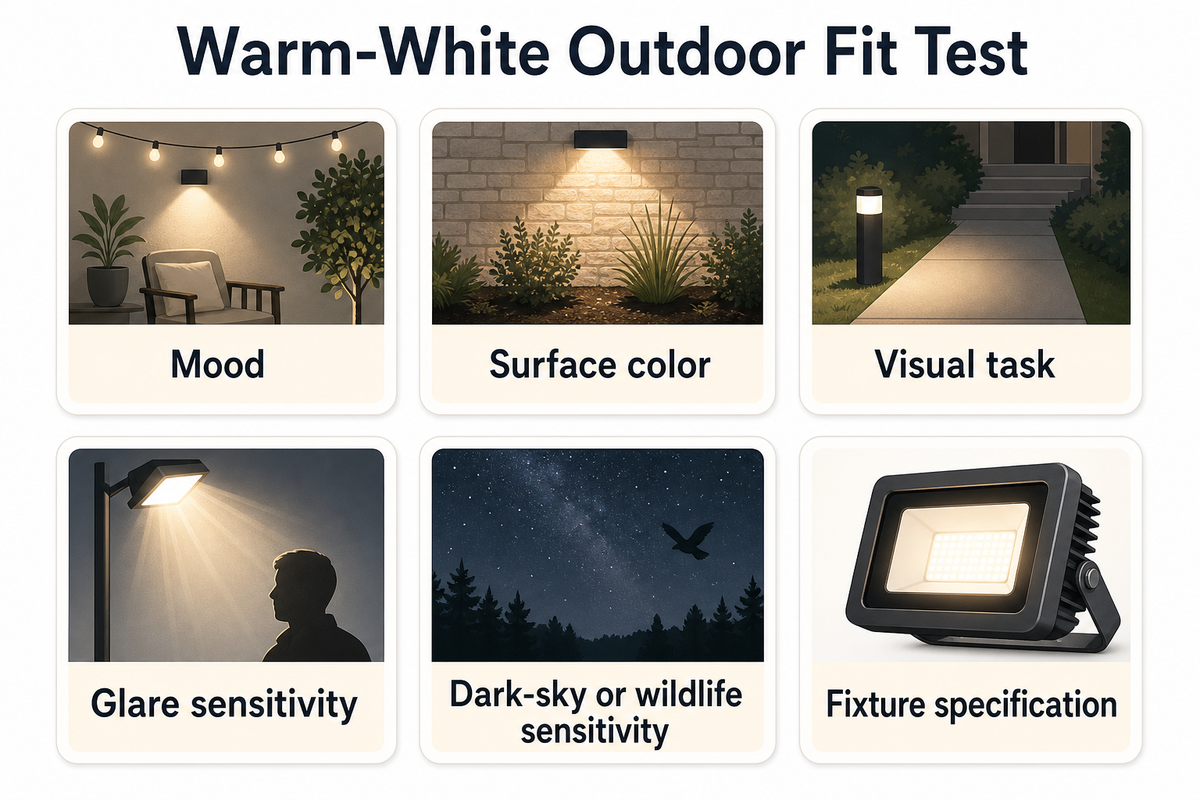
Commercial outdoor lighting should be specified as a system. The light bulb color temperature is one line item; the fixture, mounting, optical control, electrical rating, and site goal decide whether the installation works.
6-Point Warm-White Outdoor Fit Framework
This framework is the practical version of the Warm-White Outdoor Fit Test.
- Mood: should the area feel relaxed, active, premium, or security-led?
- Surface color: will the light hit brick, timber, foliage, concrete, glass, or painted metal?
- Visual task: are people dining, walking, reading signs, loading goods, or checking cameras?
- Glare sensitivity: can people see the light source directly from seats, windows, roads, or paths?
- Dark-sky or wildlife sensitivity: is 3000K still too broad for the site?
- Fixture specification: beam angle, mounting height, shielding, controls, IP rating, and required approvals.
Keep IP ratings narrow. The Intertek ingress protection reference frames IP testing as IEC 60529 enclosure protection validation, which keeps the rating focused on resistance to foreign-object and liquid ingress. IP65 or IP66 is therefore useful outdoor information, but it does not replace local electrical safety, wet-location, UV, corrosion, or installation review.
When choosing beam angle, think about the target, not the catalog page. A narrow beam can make a facade feature stand out, while a wide 90- to 120-degree beam is more likely to spread light across a parking edge or loading approach. GQLAMP’s LED flood light page lists 30 degree, 60 degree, 90 degree, and 120 degree beam choices, alongside IP65/IP66 housings and 30W to 1500W power ranges.
During a field mockup, write down the numbers rather than relying on a visual memory: fixture power in 30 W, 150 W, 200 W, 300 W, or 1500 W classes; beam setting at 30°, 60°, 90°, or 120°; mounting height at 15 ft, 25 ft, or 30 ft; input range such as 120 V to 277 V; target dimming level such as 10%; and expected service context such as 12 hours/day or 50,000 hours. These figures keep the warm-white discussion tied to a real fixture instead of a catalog label.
| Spec Type | Number to check | Use boundary |
|---|---|---|
| Very warm or amber appearance | 1800 K to 2200 K | Sensitive or specialty night environments. |
| Warm white appearance | 2700 K to 3000 K | Normal warm-white commercial and outdoor comparison. |
| Cooler white warning point | 4000 K and higher | More likely to read as cool white or blue in night settings. |
| DarkSky commercial CCT ceiling | 3000 K maximum nominal CCT | Program boundary, not a universal law. |
| Low-output uplight allowance | 50 lumens | Shows why output direction matters, not just CCT. |
| High-angle light threshold | 1.2 m / 4 ft mounting reference | Higher luminaires need extra glare review. |
| Control target | Defined dimming setpoint in the controls plan | Useful where late-night output should fall after business hours. |
| Wildlife-tuned spectral cutoff | Amber or longer-wavelength option only where local rules require it | Use only where species-sensitive rules apply. |
| GQLAMP flood-light power range | 30W to 1500W | Match wattage to mounting height, area, and beam spread. |
| GQLAMP fixture efficacy | 130 to 160 lm/W | Energy planning still depends on runtime and controls. |
| GQLAMP rated life context | 50,000+ hours | Thermal design and controls affect real service life. |
| Flood-light beam options | 30 degree, 60 degree, 90 degree, 120 degree | Beam choice can change glare more than CCT. |
In terms of energy use, color temperature does not determine the energy bill. Runtime, wattage, efficacy, controls, and maintenance matter more. EIA’s May 2026 commercial electricity end-use update gives a commercial electricity cost context, which is why dusk-to-dawn settings, motion control, dimming, and right-sized output deserve attention after the CCT decision.
Common Mistakes When Specifying Warm White Outdoor Lighting
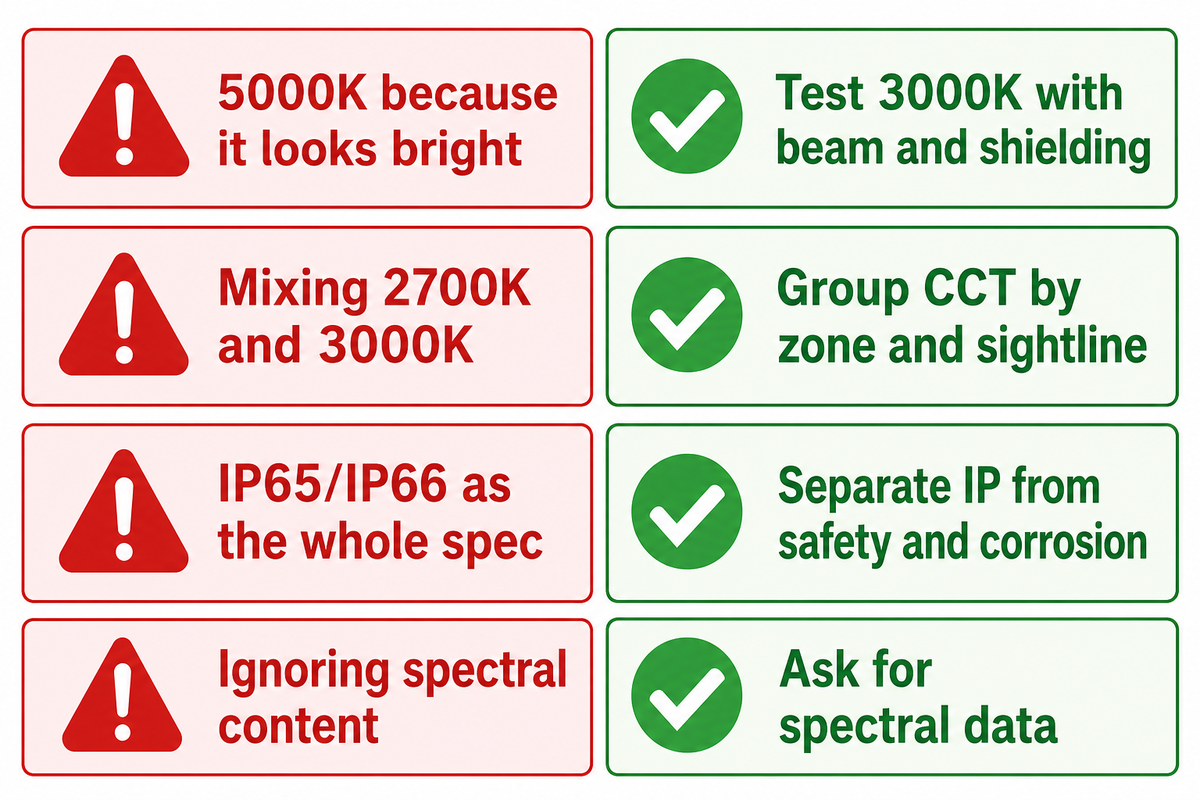
The most common mistake is choosing the kelvin value first and the application second. Start with the space, then choose the color temperature. A hotel entry, a loading walkway, a tree uplight, and a security camera zone can all be outdoor areas, but they do not have the same lighting requirements.
DarkSky commercial luminaire guidance is a useful guardrail here because it treats nominal CCT, shielding, uplight, high-angle light, and controls as one outdoor specification package.
| Mistake | Why it fails | Better decision |
|---|---|---|
| Using 5000K because it looks bright | Bright white light can add glare and a cold appearance. | Test 3000K with correct beam spread and shielding. |
| Mixing 2700K and 3000K in one sightline | The warmer side can look dirty or dim by comparison. | Group CCT by zone and line of sight. |
| Reading IP65/IP66 as the whole outdoor spec | IP describes ingress resistance, not the whole safety and durability picture. | Separate ingress rating from safety listing, enclosure material, corrosion, and installer requirements. |
| Ignoring spectral content | CCT is a color appearance label, not a full description of wavelength output. | For sensitive sites, ask for spectral data or wildlife-tuned criteria. |
Another mistake is forgetting that colour temperature language changes by market. Some documents use “colour temperature,” some use “color temperature,” and some product pages use CCT. Don’t compare different color temperatures by label alone; compare the fixture output, site surface, and mounting condition behind each label. The decision is the same: choose the right lighting for the site, then verify the fixture data.
How to Connect Warm White Decisions to Commercial LED Flood Lights
After the CCT decision is clear, connect it to the actual fixture. For commercial LED flood lights, the buying question isn’t “warm white or cool white” by itself. The better question is: which warm white, at what output, through what beam, from what mounting height, with what control method?
Keep that fixture bridge tied to layout evidence: DOE outdoor area lighting guidance treats CCT, distribution, glare, mounting, controls, and energy use as connected checks, so product comparison should stay site-specific.
GQLAMP’s commercial LED flood light range is positioned for parking lots, building exteriors, sports fields, industrial yards, and other large outdoor areas. The product page lists 30W to 1500W fixtures, 130 to 160 lm/W efficacy, 50,000+ hour life claims, IP65/IP66 housings, CCT options, and beam-angle choices. Those specifications matter because warm white decisions fail when the fixture is too bright, too wide, too high, or aimed into the wrong sightline.
Use GQLAMP’s IP rating guide for lighting to separate enclosure protection from the CCT decision. Use the LED flood light wattage guide when lumen output and mounting height are the harder questions. To judge site style and surface effects, compare the landscape lighting design guide and facade lighting guide. In larger utility spaces, the industrial lighting guide can help separate work-area visibility from comfort lighting.
GQLAMP perspective
Guangqi Lighting, the company behind GQLAMP, has operated since 2010 and serves projects across 50+ countries, with in-house R&D and CE, RoHS, IP65, IP66, and ISO quality signals listed in its brand materials. Use that background as a qualification screen for fixture discussion, not as a substitute for project-specific photometric review.
Ask GQLAMP to review your warm-white outdoor fixture plan
Quick Recommendation Matrix
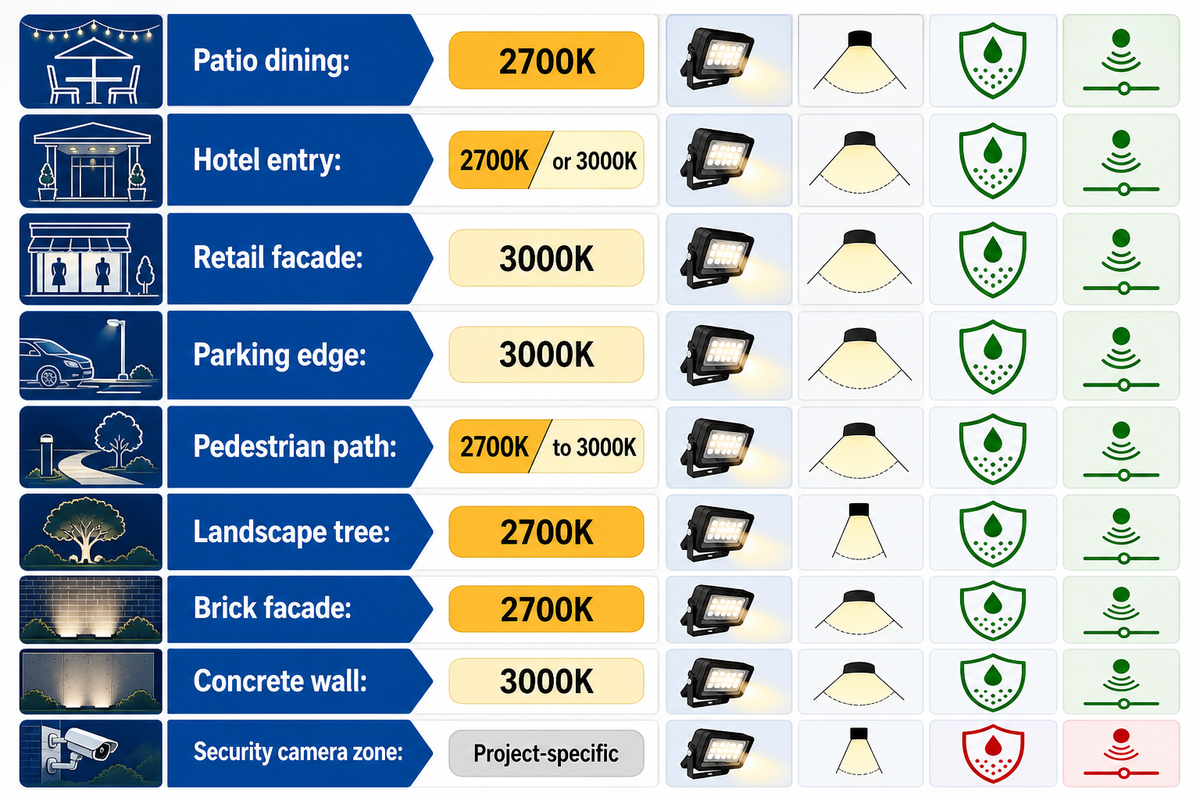
This matrix is a starting point, not a replacement for a sample test. Use it to choose the first fixture sample or mockup setting.
Use it with a photometric check: DOE outdoor area lighting guidance ties outdoor lighting decisions to application, mounting, distribution, controls, and energy use, so CCT should stay connected to the fixture layout.
| Application Type | Starting CCT | Reason | Fixture check |
|---|---|---|---|
| Patio dining | 2700K | Warmth matters more than sharp contrast. | Low glare, shielded, dimmable. |
| Hotel entry | 2700K or 3000K | Depends on facade material and brand mood. | Check faces, signs, and curb edges. |
| Retail facade | 3000K | Keeps warm white while improving product and sign visibility. | Beam width and color rendering. |
| Parking edge | 3000K | Provides clearer visibility of pedestrians and vehicles than 2700K. | High-angle light and spill control. |
| Pedestrian path | 2700K to 3000K | The path task and nearby windows decide the final point. | Shielding, spacing, and dimming. |
| Landscape tree | 2700K | Leaves and bark often look more natural under warm light. | Narrow beam, low output, no sky spill. |
| Brick facade | 2700K | Warm surfaces can look richer under light with a lower color temperature. | Graze angle and shadow pattern. |
| Concrete wall | 3000K | 2700K may look too amber on pale gray materials. | Test for blotchy reflection. |
| Security camera zone | Project-specific | CCT alone cannot prove camera performance. | Coordinate CCT, CRI, sensor, mounting, and glare. |
FAQs
Is warm white very yellow?
Warm white can look yellowish, especially at 2700K, but it should still read as white light rather than orange light. The stronger yellow impression usually comes from comparison with nearby 4000K or 5000K lamps, from pale surfaces, or from overly high output rather than from the warm-white category alone.
The yellow impression depends on surface color, lumen level, and the viewer’s comparison point. If nearby lights are 4000K or 5000K, warm white light bulbs will look much yellower. On brick, wood, and warm stone, that yellow cast may look intentional. On pale concrete or white cladding, it can look aged or underpowered. A small night sample is the fastest way to judge it.
Is 2700K too yellow outside?
2700K is not automatically too yellow outside; it works well for hospitality, landscape, and warm-material areas when glare is controlled. It becomes a weaker choice on pale concrete, work areas, and modern facades where people need a cleaner view of edges, signs, or movement.
It becomes risky on pale concrete, work areas, and modern surfaces where a cleaner view matters. In those cases, 3000K is often the better warm white starting point. Use 2700K where people sit, stroll, or view warm architectural materials at low speed. Avoid choosing it for a security edge or loading-adjacent walkway until you’ve checked visibility and glare at the final mounting height.
Is 3000K good for outdoor lighting?
3000K is often good for outdoor lighting when the goal is a warm appearance plus clearer visibility for movement and wayfinding, but it is not a one-number safety setting. It still needs the right mounting height, shielded optics, controlled output, and suitable beam angle to avoid glare and sky spill.
It still needs the right beam, mounting height, shielding, and controls. DarkSky commercial luminaire guidance uses 3000K as a nominal CCT ceiling, but it also checks uplight, high-angle light, shielding, and dimming rather than CCT alone. That means a 3000K fixture can be a good starting point and still fail if its source is visible from the path or if it sends too much light upward.
Can you mix 2700K and 3000K?
You can mix 2700K and 3000K by zone, but avoid putting both in one direct sightline; keep seating, path, and facade zones visibly separate so the transition feels intentional.
A common approach is 2700K for seating or landscape accents and 3000K for entries, paths, or parking edges. Keep the transition deliberate so one zone doesn’t look mismatched.
Is warm white or cool white better for your eyes?
Warm white is usually more comfortable for relaxed evening spaces, while cool white may fit task-heavy areas when glare is controlled, output is not excessive, and the fixture is aimed away from direct view.
For outdoor sites, the bigger eye-comfort issue is often glare from the fixture, not the label alone. Always judge color temperature together with shielding, aim, and output.
References & Sources
- ENERGY STAR CFL Product Reference Guide – ENERGY STAR
- DarkSky Approved Luminaires Guidelines – DarkSky International
- LED Outdoor Area Lighting Fact Sheet – U.S. Department of Energy
- IP Testing: Ingress Protection per IEC 60529 – Intertek
- Electricity Monthly Update: End Use – U.S. Energy Information Administration