Get in Touch with GUANGQI



A battery operated motion sensor spotlight is a self-contained outdoor LED fixture that turns on when its sensor detects motion and throws a short burst of light where a wired source does not make sense, such as a side door, mailbox, garage, shed, path end, or lane turn. It is not permanent, engineered flood lighting. Usefulness depends on nightly runtime, PIR range, beam profile, weather exposure, and whether the owner can reach the unit safely for battery service.
Fast answer
Use a battery-powered motion sensor spotlight for light-traffic areas, low daily trigger counts, reachable battery changes, and a clear sensor field of view. Choose wired, engineered, or solar lighting when the project needs records, long overnight operating periods, high mounting, repeated security-lighting events, or multiple fixtures.
Field rule: treat a battery spotlight as a trigger-limited convenience light, not as proof of broad, repeatable area coverage.
What a Battery-Operated Motion Sensor Spotlight Can and Cannot Do
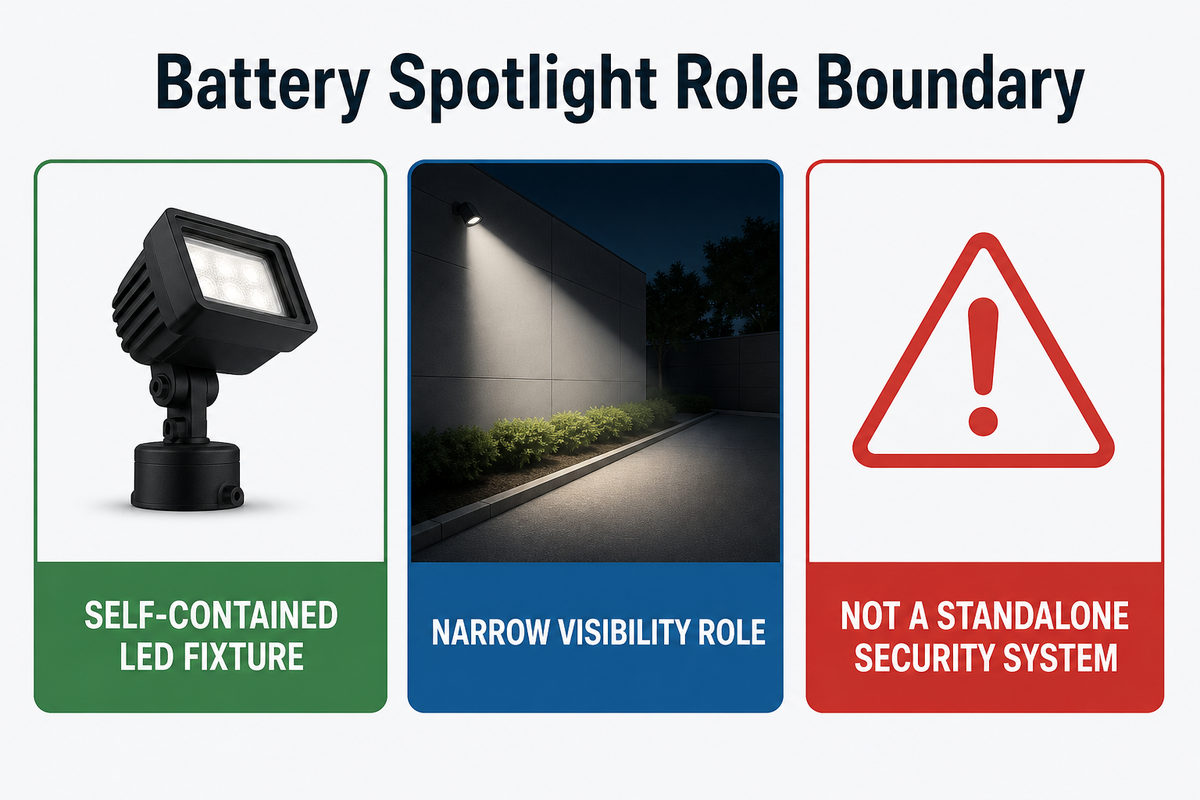
Most battery-operated outdoor motion sensor spotlights are self-contained LED fixtures with an onboard battery pack or cell, charge-management circuitry, and a sensor that turns the light on for a preset time after motion is detected. Buyers like this product type because it avoids grid wiring, conduit, an exterior electrical box, and a switch loop. For a renter, utility alcove, temporary gate, or short trash-bin path, that simplicity can be enough.
Better vision and safety signaling can help a person notice a step, latch, or visitor, but crime-prevention claims need stronger evidence. After reviewing the literature, the Office of Justice Programs Office of Science and Technology concluded that improved street lighting showed some crime-reduction evidence, while nighttime crimes did not fall more than daytime crimes. Keep a small battery fixture in that narrower visibility role instead of presenting it as a standalone security system.
The Guangqi Lighting engineering background frames this guide around product fit, not a promise of lifetime runtime. Ask a more practical question than “does it come on?”: will it come on when needed, at the right time of night, on the correct surface, in enough light, in this weather, and without becoming a maintenance headache?
Runtime: Why Battery Life Is Usually a Trigger-Count Problem
What are “all weather” or “high-capacity batteries” worth in practice? The value is limited unless the seller states the test assumptions. Product descriptions often assume a small number of daily triggers, short dwell times, mild temperatures, and no pets, branches, or reflective surfaces in the sensor field. Those same assumptions would make almost any motion light look better on runtime.
Simple runtime math
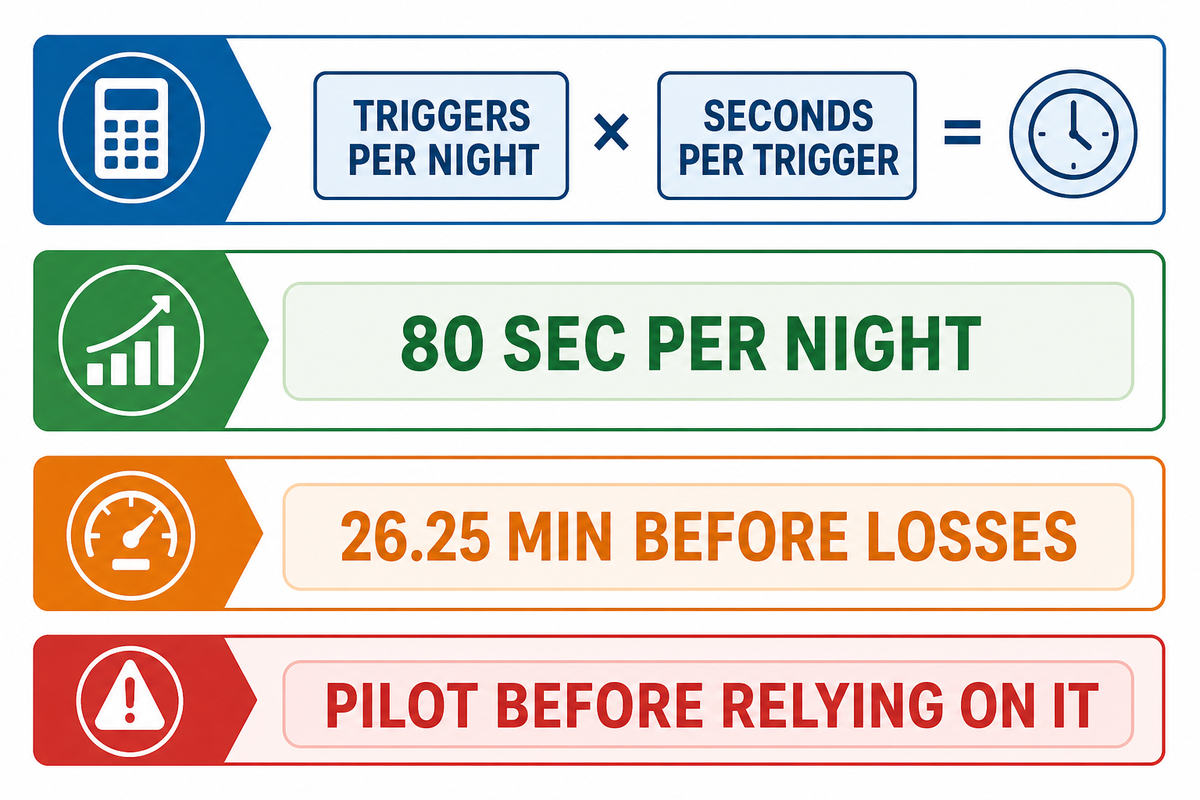
Nightly active time = triggers per night x seconds per trigger. A door light triggered 4 times for 20 sec runs 80 sec per night. A driveway light triggered 35 times for 45 sec runs 1,575 sec, or 26.25 min, before standby current and cold-weather battery loss are counted.
| Location | Night Use Assumption | Daily And 30-Day On-Time | Battery Implication |
|---|---|---|---|
| Side door | 4 triggers x 20 sec | 80 sec/night (0.022 hours/night; 0.67 hours/30 days) | Low duty if access is easy |
| Shed latch | 5 triggers x 20 sec | 100 sec/night (0.028 hours/night; 0.83 hours/30 days) | Reasonable if runoff is controlled |
| Mailbox | 8 triggers x 20 sec | 160 sec/night (0.044 hours/night; 1.33 hours/30 days) | Aim away from road glare |
| Garage side | 15 triggers x 30 sec | 450 sec/night (0.125 hours/night; 3.75 hours/30 days) | Battery service becomes routine |
| Back steps | 12 triggers x 30 sec | 360 sec/night (0.10 hours/night; 3.0 hours/30 days) | Missed detection raises safety concern |
| Driveway | 35 triggers x 45 sec | 1,575 sec/night (0.438 hours/night; 13.13 hours/30 days) | Pilot before relying on it |
| Yard corner | 50 triggers x 45 sec | 2,250 sec/night (0.625 hours/night; 18.75 hours/30 days) | False triggers may dominate life |
| Loading area | 120 triggers x 45 sec | 5,400 sec/night (1.5 hours/night; 45 hours/30 days) | Move to project lighting review |
| Commercial perimeter | 8 hours scheduled | 28,800 sec/night (8.0 hours/night; 240 hours/30 days) | Battery spotlights are the wrong tool |
Long-life claims depend on those assumptions. With rare daytime triggers near a garden entrance, a four-D-cell device can last many months. Put the same fixture by a busy driveway, a moving branch, a reflective wall, or a pet route, and battery changes arrive much sooner. Battery chemistry matters too: patent literature on battery-powered security sensors treats battery chemistry and environmental conditions as design variables, so alkaline and lithium options should not be compared from a battery-life label alone.
How long do battery operated motion lights last?
With life-span claims that run from a few weeks to many months, match the rating to the usage pattern that created it. Request specifics about total triggers, timeout, operating mode, detection field, battery chemistry, standby draw, and test temperature. When a seller cannot state those factors, treat advertised life-span numbers as preliminary comparison tools, not operating guidance.
Detection Range: PIR Coverage, Mounting Height, and False Triggers
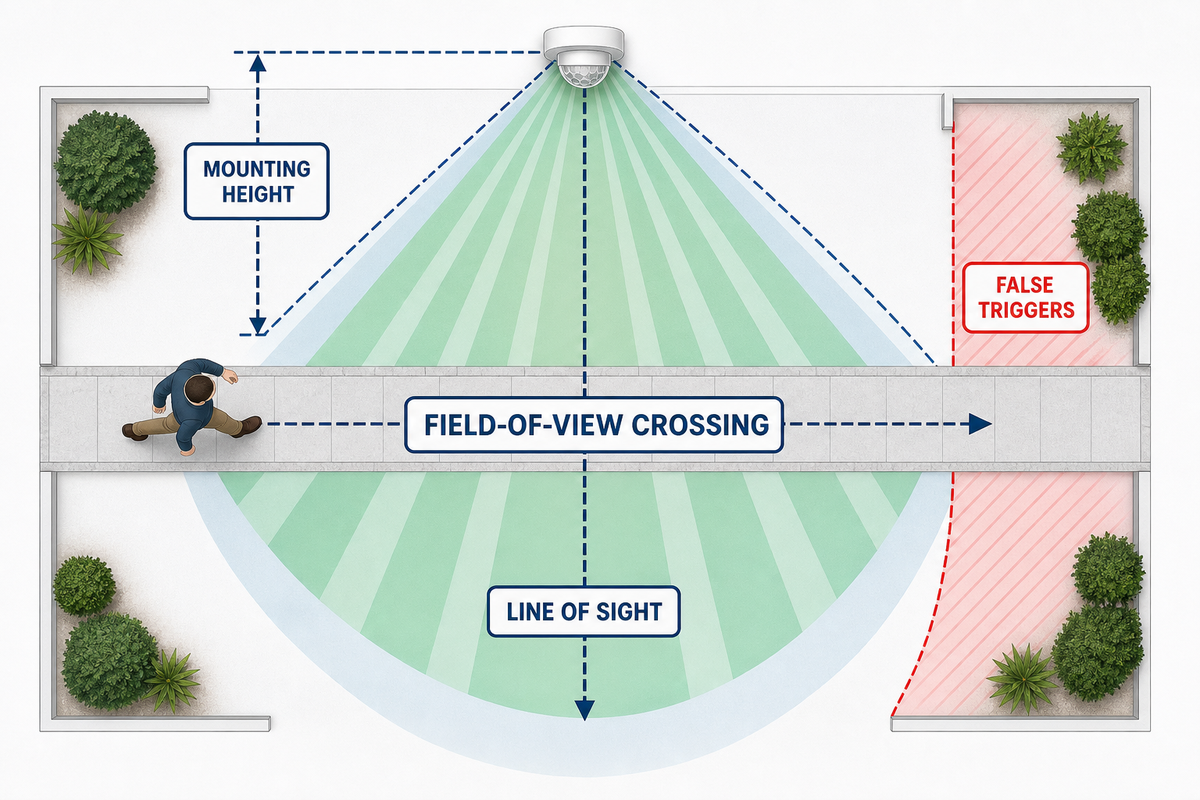
Detection range covers both light coverage and PIR sensor response. Passive infrared outdoor sensors detect changes in human body heat as a person crosses the field of view. Coverage depends on line of sight, body size, sensor angle, ambient temperature, mounting height, and whether motion crosses the sensor field or moves straight toward it.
Outdoor PIR performance becomes harder when temperature contrast is low. The California Lighting Technology Center at UC Davis notes that height, ambient temperature contrast, and movement angle are significant inputs for PIR sensor range. DesignLights Consortium reports similar control-system limits. Compact battery products are built for simple home installation, so their sensor behavior should not be compared with project security sensors unless the manufacturer supplies the same level of testing.
Planning fixture placement brings geometry into the decision and improves placement beyond a single range number. If the sensor points straight down toward the center of a walkway, detection occurs only when a person is close. Positioning the unit across the walking path can record movement sooner. High-mounted sensors may illuminate wider areas, but detection still has to be checked against mounting height, movement direction, line of sight, and temperature contrast. Mounted above a garage door, the same unit can catch people walking to the house but fail to read the far edge of the driveway.
Do motion sensor lights work on batteries?
Batteries power the sensor, fixture, or bulbs; they do not replace lighting design or detection planning. A motion detector label or motion sensing claim still has to be checked against angle, line of sight, mounting height, battery chemistry, standby draw, and nuisance triggers before the fixture is trusted outdoors.
Beam Spread and Lumens: Why a Spotlight Is Not the Same as a Flood Light
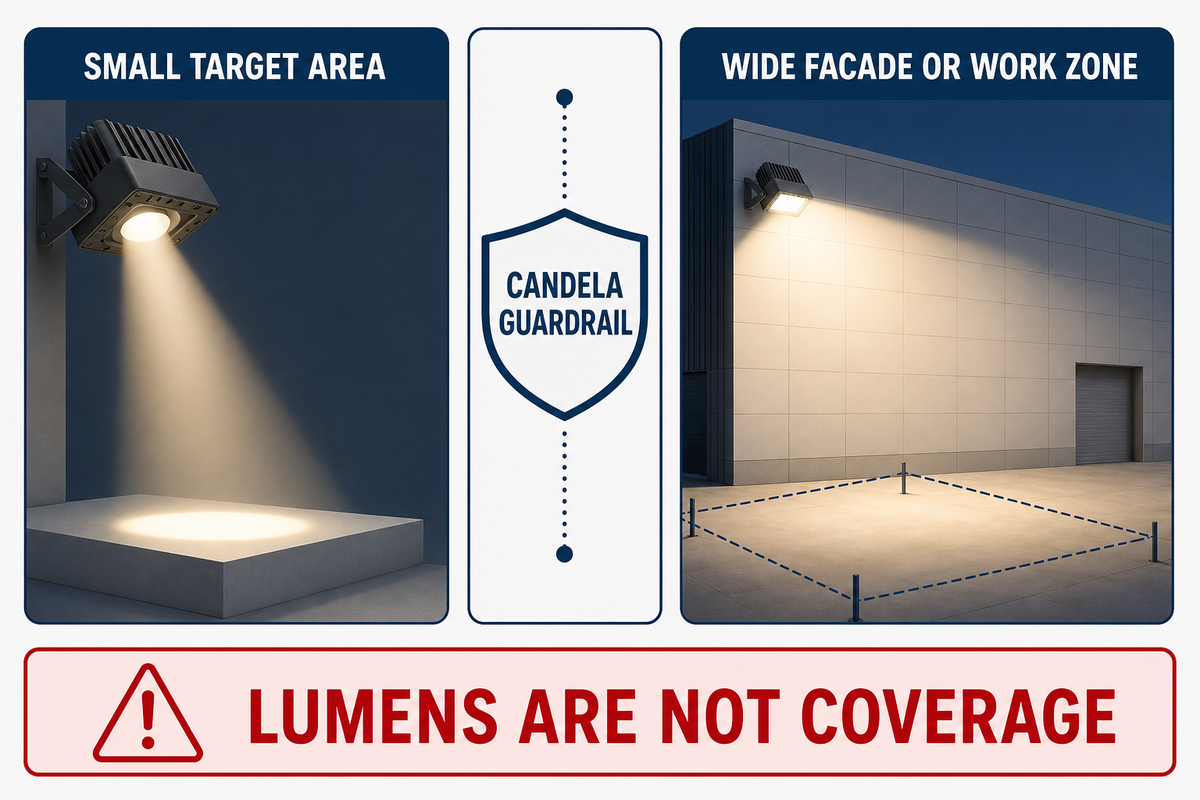
After detection range, beam spread is the next limit: an outdoor spotlight and a broad-beam flood light solve different lighting tasks. Outdoor spotlights suit small target areas, such as a doorknob, stone step, street sign, alcove, stairway, or short path section. A flood light-style fixture spreads light across a facade, loading area, parking lot perimeter, or yard. Calling a product bright does not prove it can replace a documented floodlight design.
Candela is the useful guardrail. Lumens measure total light output; candela measures light in one direction. Useful coverage requires proximity to the target; angle and direction matter for the spotlight’s intended application; beam shape matters; glare must be avoided; and enough illuminance must reach the work or walking surface. Two light fixtures with similar lumen numbers can differ sharply in how well light reaches the target.
| Question | Battery Spotlight | Project Flood Light |
|---|---|---|
| Best target | Door, step, shed latch, short path | Wide facade, work zone, yard, perimeter section |
| Main constraint | Battery drain and sensor placement | Power, mounting, beam angle, controls, design level |
| Spec to ask for | Trigger assumptions, timeout, battery chemistry, detection angle | Wattage, efficacy, beam angle, IP rating, controls, photometric data |
| Risk of overreach | Treating a high lumen label as area coverage | Using too much light, glare, or poor aiming |
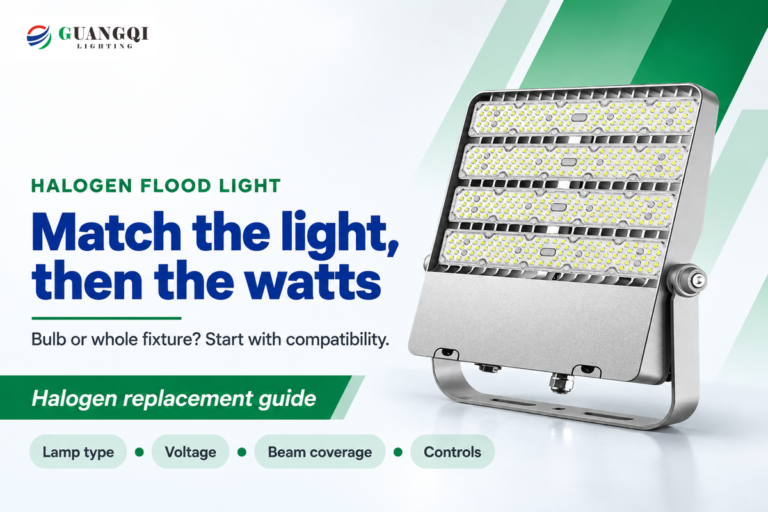
GQLAMP’s outdoor LED flood light range is a project-grade comparison point only. On the first-party flood-light page, model options run from 30 W (0.03 kW) to 1500 W (1.5 kW), with 130 to 160 lm/W efficacy, IP65/IP66 options, and 30, 60, 90, or 120 degree beam choices. Those numbers belong to flood lights, not to battery-operated spotlights.
Retail labels such as super bright, 1500lm, 3 heads, 3 adjustable, 2-pack, USB rechargeable, warm white, dimmable, cordless, built-in battery, upgraded motion sensor, or motion activated LED night mode are useful for filtering products. They aren’t proof of field coverage. Buyers still need the timeout setting, often 20 sec to 45 sec in small products, and the expected trigger load over 30 days or 180 days of service.
Outdoor Limits: Weather, Temperature, and Battery Compartment Risk
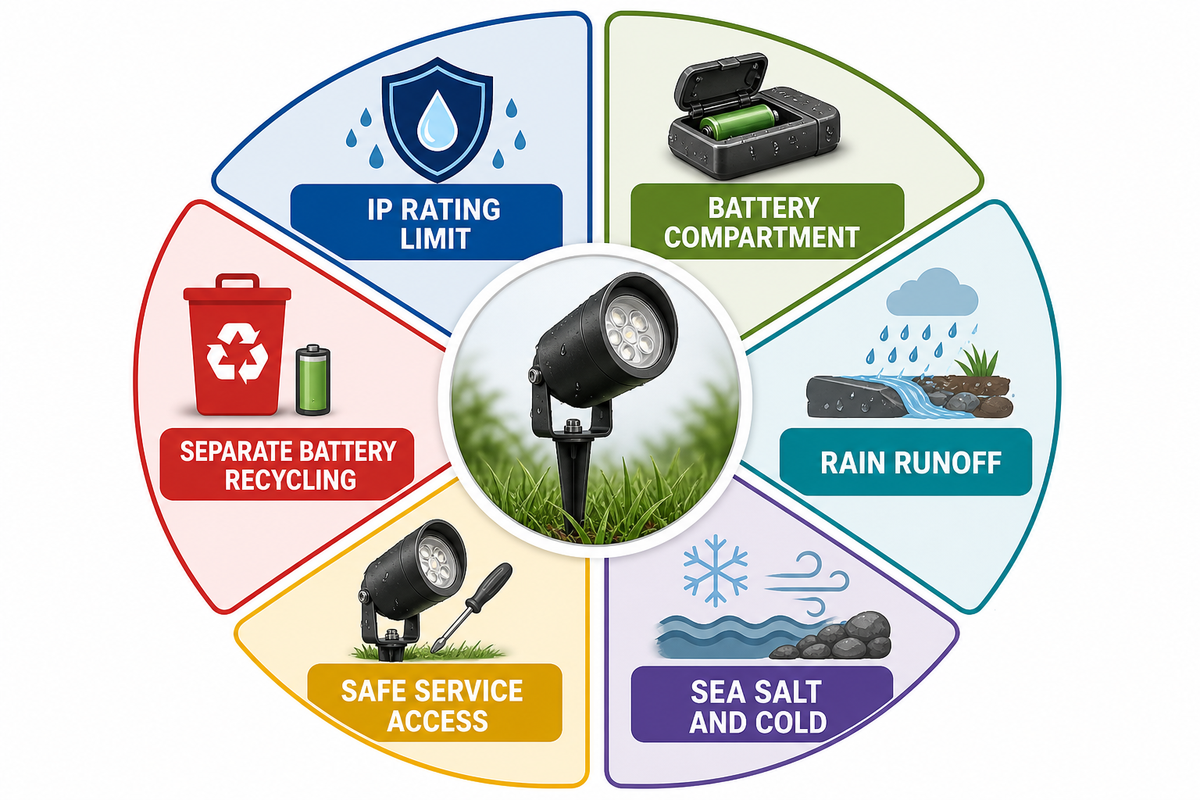
An outdoor-rated light is not maintenance-free. IP system codes describe two measures of protection: resistance to solid-particle contaminants and resistance to liquid water ingress. Those designations define enclosure limits, but they do not stop dust around a wall screw or corrosion around a battery-compartment seal when a spotlight gets hit by misdirected rain runoff for years.
Where can the fixture be reached for battery replacements? How will water runoff around the battery compartment during a storm? Will a stair or garage wall spot get corrosive sea salt in the summer, then endure bitter cold all winter long? Will any fixture over a garage door or public path provide safety of access for servicing or create hazards?
Risk boundary
These recommendations focus solely on lighting selection, placement, maintenance access, and project handoff boundaries. They do not provide wiring instructions, pole design, common-control design, or permit review.
Proper battery end-of-life disposal is part of safe battery spotlight maintenance. According to EPA guidance on used lithium-ion batteries, lithium-ion batteries cannot go in household garbage or municipal recycling bins. Take these batteries to separate recycling drop-off or household hazardous-waste facilities, and tape terminals or place cells in separate plastic bags before transport as directed by the recycler. If your battery-operated device uses lithium cells, disposal belongs in the maintenance plan.
Outdoor light spill is part of placement planning. For reducing unwanted exterior light that wastes energy, creates glare, affects sky clarity, or disturbs nearby habitat, use the U.S. DOE’s Light at Night guidance as a boundary. Even a small 100-lumen LED security light should be aimed at the intended object or walking surface while limiting spill into a neighbor’s window or yard.
Where Battery Powered Spotlights Fit – and When Wiring or Project-Grade Lighting Should Take Over
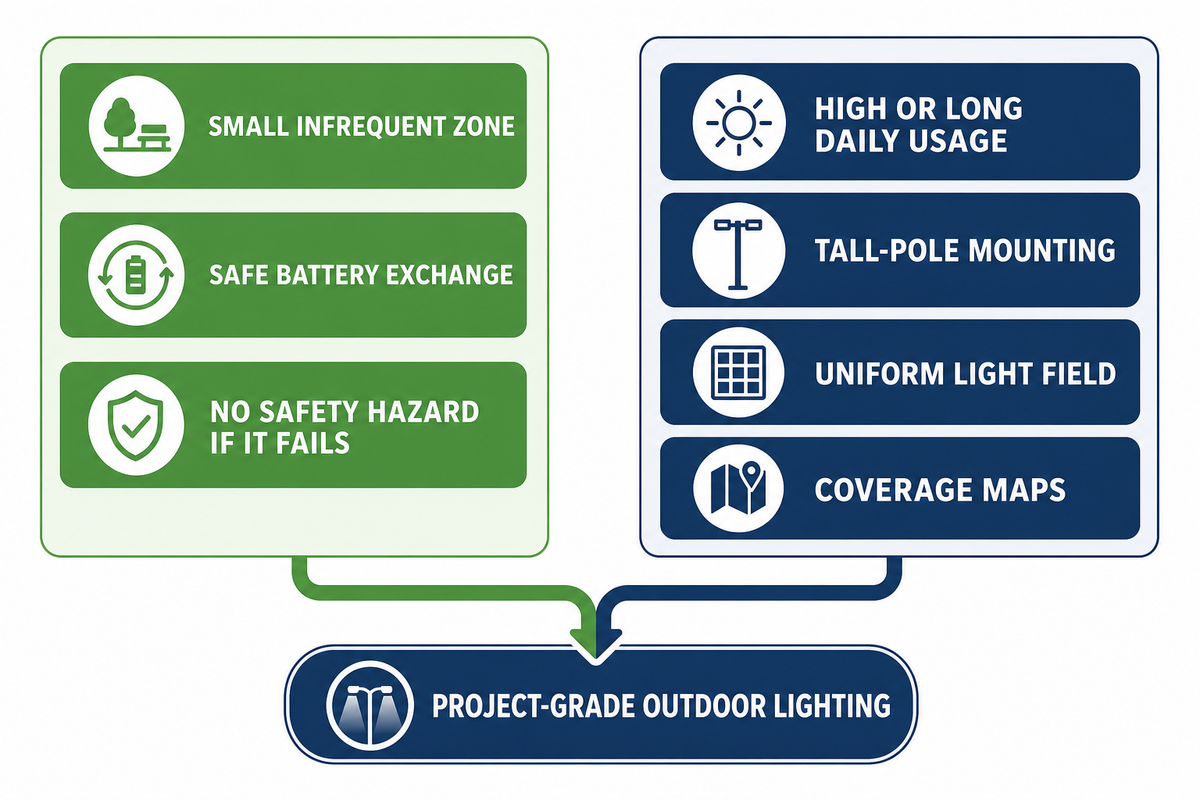
Portable spotlights fit small, infrequent, limited-coverage applications where wiring is not feasible or ladder access supports simple battery exchanges, provided light failure is not a safety hazard. They are not a fit for fixed-location lights requiring high or long daily usage durations, tall-pole mounting, a uniform light field, or detailed specifications such as coverage maps.
Handoff should not be based solely on battery power. DOE notes that engineered DC solar systems with battery storage can be suitable for public-space lighting and general community use. At larger autonomous sites, compare commercial solar flood light systems instead of stretching a small consumer spotlight into commercial perimeter lighting; the real boundary condition is system design, autonomy, controls, maintenance plan, mounting, photometric validation, and risk ownership.
When the site has moved beyond a latch, step, or short approach path, compare project-grade outdoor spot and flood lighting options instead of stretching a small battery fixture into a job it can’t document. GQLAMP’s flood-light category is the right handoff for buyers evaluating wattage range, beam angle, ingress protection, and controlled area coverage. It isn’t a claim that GQLAMP sells battery spotlights.
Runtime-Range-Risk Selector: 3 Checks Before You Buy
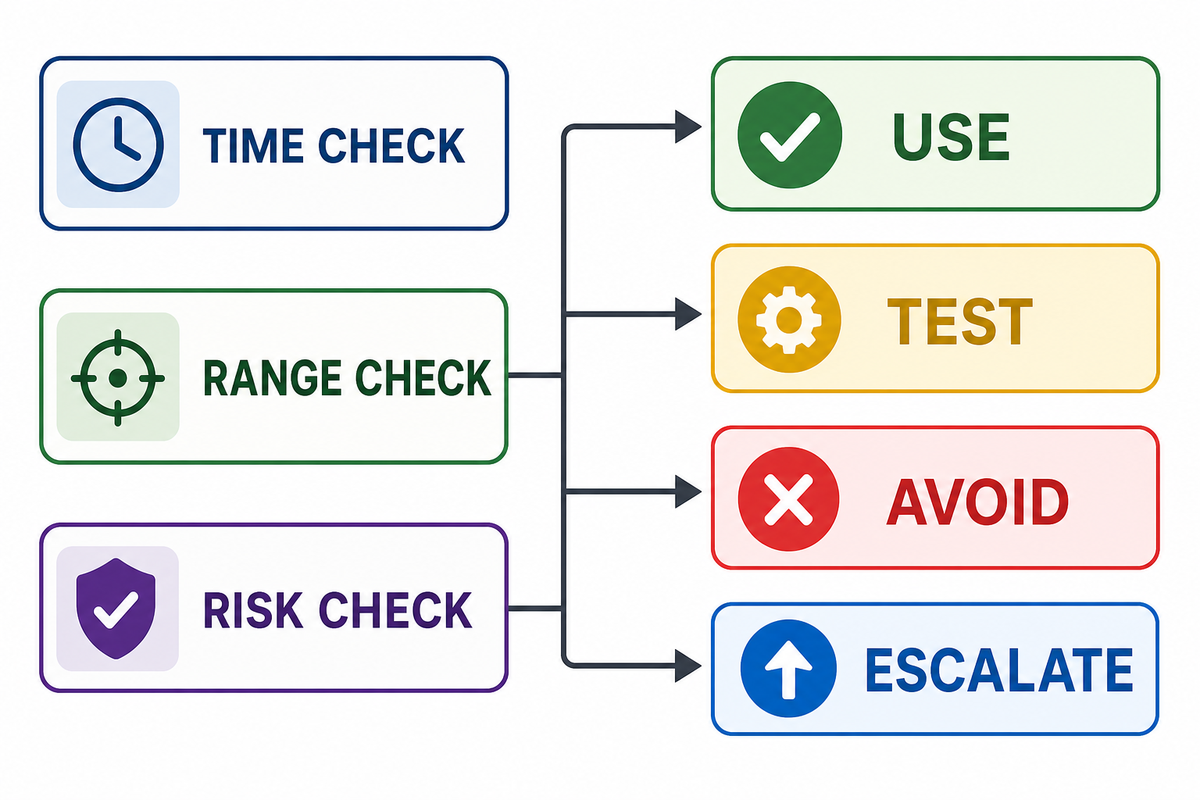
Use runtime, range, and risk to turn product pages into placement decisions. As a shorthand, call it The 3-Part Runtime-Range-Risk Selector: runtime, range, and risk decide the fit before brightness claims do. When a client specifies a controlled area rather than a dark corner, add a fourth check: photometric sufficiency on the target surface or move into formal lighting design services. The core question is not “is the bulb bright in the box?” It is “does the luminaire deliver useful illumination to the target surface under expected triggering and environmental conditions?”
| Zone Type | Runtime Check | Range Check | Risk Check | Likely Fit |
|---|---|---|---|---|
| Side door | 4 to 8 triggers at 20 sec | Short line of sight | Easy battery access | Battery spotlight is often reasonable |
| Shed latch | 1 to 5 triggers at 20 sec | Aim at the latch, not the yard | Check water runoff | Battery spotlight is a fair fit |
| Mailbox or entryway | Brief 20 sec bursts | Person crosses the sensor field | Avoid road glare | Battery powered motion sensor light can fit |
| Garage side | 10 to 25 triggers at 30 sec | Aim across the walking line | Watch reflection and glare | Battery or solar motion light, site dependent |
| Back steps | Short bursts, but cold exposure matters | Motion detection must catch descent | Slip hazard raises risk | Test before relying on it |
| Driveway | 25 to 50 triggers at 45 sec | Vehicles and pets may trigger it | Check target-plane illumination | Pilot first, then decide |
| Yard corner | False triggers can dominate | Detection range is uncertain | Light trespass risk | Consider fixed lighting |
| Loading area | Hours of use may be needed | Tall mounting changes detection | Documentation matters | Use project-grade lighting review |
| Commercial perimeter | 8 hours or scheduled control may be required | Multi-fixture coverage needed | Security and liability claims are sensitive | Use engineered lighting design |
Small-Zone Lighting Fit Matrix
- Use when the zone is small, trigger events are limited, and battery access is safe.
- Use only when solar input, placement, autonomy, or replacement access supports maintenance.
- Avoid when the fixture must perform on schedule, meet design criteria, or operate as part of a documented system.
- Escalate when the site defines a coverage surface, not just a dark volume to fill.
2026 Buying Signals: Wireless Demand Is Mixed, and Project Limits Still Decide
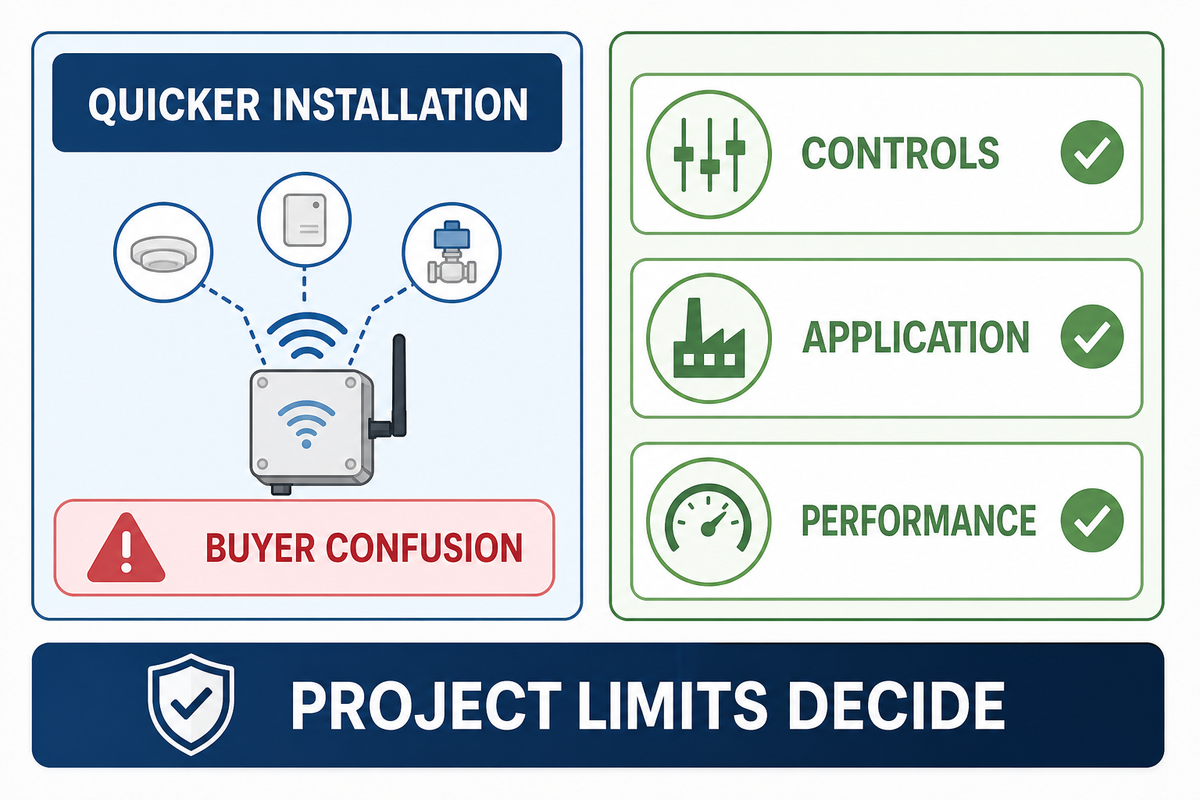
Search demand for wireless outdoor lighting is easy to understand: quicker installation, less wire to pull, and portable LED coverage. Query data also mixes shopping and placement language, including battery operated motion sensor spotlight outdoor, best battery operated motion sensor spotlight, outdoor battery operated motion sensor lights, and best outdoor motion sensor lights battery operated. Treat those phrases as evidence of buyer confusion, not proof that one compact fixture can cover every outdoor job.
From a procurement perspective, convenience is only one input. Dimming, low voltage, warm white or 5000k CCT, motion control, and energy-saving modes can reduce waste when they match the site. The risk is assuming that low setup cost equals low lifecycle cost; DOE exterior-lighting purchasing guidance keeps the decision tied to controls, application, and performance rather than convenience alone.
About This Analysis
Guangqi Lighting’s architectural, industrial, and landscape flood-light product line is used here as a project-level lighting boundary because that range is designed for fixed applications. This discussion of battery light fixtures draws on public data for lighting, outdoor controls, safety, and lifecycle cost.
FAQs
Is there a battery operated motion sensor light?
Yes, but separate outdoor products from indoor labels: motion sensor lights indoor, closet, hallway, lights for hallway, puck lights, stair lights, stairway, warm light, led under cabinet, cabinet kitchen, bedroom under cabinet, rechargeable motion sensor night lights, led night lights for bedroom, 3 pack, 2 pack rechargeable, or stick on anywhere are not weather ratings.
It may use replaceable cells or a rechargeable pack, and it may be sold under wall lights, LED motion sensor, or motion security light product categories. The buying check is the same: confirm runtime assumptions, IP rating, battery access, mounting height, timeout, and PIR coverage before placing it outdoors. Do not use an indoor use label or cabinet lights category as proof that the fixture can handle rain, heat, or freezing weather.
What is the best battery-powered outdoor spotlight?
Choose the LED motion sensor light whose runtime, detection angle, weather rating, and beam pattern match the exact placement; a motion detector label, motion sensing claim, integrated LED phrase, easy to install badge, motion-activated flood light wording, wireless security light claim, or basic LED light label is only a filter.
For a door, a compact battery motion sensor security light may be enough if the user path is short and batteries are easy to reach. For a yard, driveway, or commercial area, ask for photometric evidence or move to project lighting. Product phrases such as bright battery powered, rechargeable LED, wireless motion, or flood light outdoor should be treated as filters, not final proof of useful coverage.
What are the downsides of using motion sensor lights?
Key downsides include false triggers, missed detection, glare, battery maintenance, weather failures, and weak assumptions behind long-lasting claims; solar lights outdoor or four d cell batteries can help only when placement, temperature, trigger load, and battery access are known.
These risks are manageable in a small zone, but they become project issues when coverage must be repeatable or documented. A false trigger can drain a battery, a missed trigger can leave a step dark, and glare can create a different safety problem. For home security language, keep the claim limited to visibility and cue value unless the project has stronger evidence.
Can a battery motion spotlight replace a wired outdoor flood light?
In narrow, low-duty areas, a battery motion spotlight can replace a wired flood light; broad-area lighting needs a wired, solar, or engineered path with beam angle, target-plane illuminance, controls, maintenance intervals, and ownership of risk clearly documented.
If the project needs wide beam coverage, long daily operation, tall mounting, controls, or target-plane illuminance, use a wired, solar, or engineered lighting design path.
References & Sources
- UC Davis CLTC outdoor occupancy sensing research
- U.S. DOE FEMP exterior lighting purchasing guidance
- DesignLights Consortium lighting control strategies
- IEC IP ratings explainer
- CPSC Cooper Lighting battery outdoor LED fixture recall
- NIST candela and lumen measurement context
- U.S. DOE Light at Night guidance
- EPA used lithium-ion battery recycling guidance
- U.S. DOE solar and battery-storage applications guidance
- Office of Justice Programs street-lighting crime review
Need project-grade outdoor lighting instead of a small battery fixture?
Field of coverage, beam intensity, IP rating, and control strategy are all appropriate factors in selecting a luminaire family.