Get in Touch with GUANGQI



![Industrial Lighting Guide: Standards, Design & Selection [2026]](https://gqlamp.com/wp-content/uploads/2026/04/0-1.png)
Industrial lighting sits where building codes, task safety, and operating cost intersect — and specifying it well is part standards literacy, part photometric design, part budget sequencing across a 5- to 10-year horizon. This guide walks through what the term actually means, what OSHA and IES require in foot-candles, how to pick a fixture form-factor, how to design a warehouse or factory layout, how to handle hazardous-location classification, and how to plan an LED retrofit without the mistakes that show up repeatedly on electrician forums.
Quick Specs — Industrial Lighting at a Glance
| OSHA minimum (general construction) | 5 foot-candles (≈54 lux) |
| OSHA minimum (plants & shops) | 10 foot-candles (≈108 lux) |
| IES RP-7-21+E1 warehouse general storage | 100–200 lux (9–18 fc), uniformity ≥ 0.6 |
| Current LED efficacy range | 130–170 lm/W (high-efficacy bins) |
| Typical L70 rated life | 50,000 hours (LM-80 / TM-21 projected) |
| Hazardous-location trigger (OSHA 1915.82) | NRTL-approved explosion-proof at ≥10% LEL |
What Is Industrial Lighting? (And How It Differs From “Industrial-Style” Decor)

Industrial lighting is the category of luminaires engineered for high-bay warehouses, factory floors, mechanical rooms, loading docks, and hazardous-atmosphere environments where task clarity, code-application, and fixture endurance are of overriding concern. IES defines the scope in ANSI/IES RP-7-21+E1, the recommended practice for lighting industrial facilities.
| Category | Primary Goal | Typical Environments |
|---|---|---|
| Industrial lighting (this guide) | Task visibility, code compliance, fixture durability | Warehouses, factories, docks, C1D1/D2 zones, cold storage |
| Commercial lighting | Retail appeal, occupant comfort, brand expression | Offices, retail, hospitality, education |
| Industrial-style decor lighting | Aesthetic — factory-inspired look | Home kitchens, restaurants, lofts, boutique retail |
It’s worth pausing on the last row. Industrial-style decor lighting: vintage pendant lights, cage-shell sconces, barn-style wall fixtures, and kitchen-island pendants borrow mid-century factory visual cues but serve residential and hospitality fixture. This guide deals with functional industrial lighting: fixtures outlined by plant managers, safety officers, and electrical engineers working to meet OSHA minimums and IES recommended practice.
What Are the 4 Types of Artificial Lighting?
Four practical families show up in industrial settings: inefficent and short lived, incandescent / halogen (uncommon in new installs), fluorescent (legacy retrofits using T5HO and T8, phasing out under mercury directives), high-intensity discharge (HID). Metal halide, high-pressure sodium, and mercury vapor fixtures have 15,000-24,000 hour rated life and 5-15 minute warm-up period. LEDs, which the US DoE lighting R&D program rates at 130-170 lm/W efficay and 50,000 plus hours of rated L70 life, are expected to be the primary new-install fixtures by 2025-2030.
The 6 Main Types of Industrial Lighting Fixtures
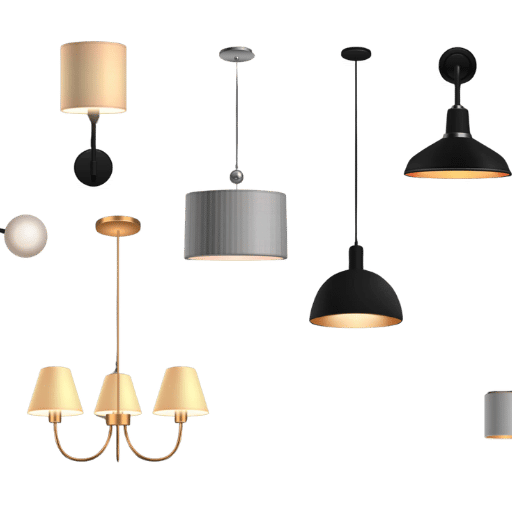
Form-factor decision depends on facility geometry considerations: clear span, aisle width, ambient temperature and hazard factors. Six form-factor categories cover about 95 % of ceiling-height installations and typical fit, application, and ingress protection level (IP code from IEC 60529 ranking solid and liquid ingress).
| Form Factor | Ceiling Range | Primary Application | Typical IP/IK |
|---|---|---|---|
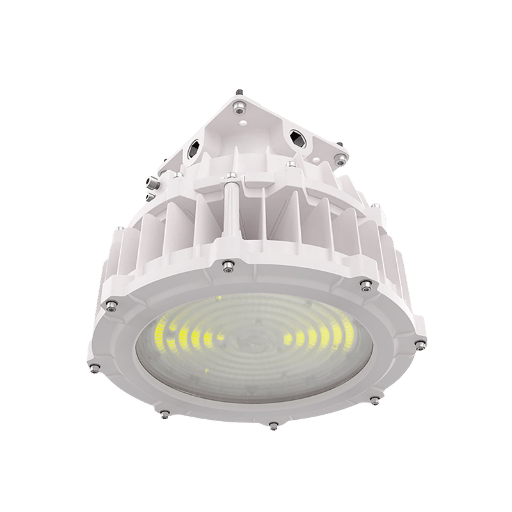
| UFO High Bay | 15–40 ft | Warehouse general storage, manufacturing plants, distribution centers, gyms | IP65 / IK08 |
| Linear High Bay | 20–40 ft | Racking aisles, linear conveyor runs, aircraft hangars | IP65 / IK08 |
| Low Bay | 10–20 ft | Mezzanines, workshops, retail backrooms, narrow-aisle picking | IP40–IP65 |
| Troffer / Panel | 8–12 ft (grid ceiling) | Offices attached to plants, QC rooms, cleanrooms | IP20 |
| Vapor-Tight / Wet Location | 10–25 ft | Car washes, food processing, cold storage, parking garages | IP66 / IP67 |
| Explosion-Proof | Varies | Oil & gas, paint booths, grain handling, pharma solvent rooms | IP66 + C1D1/D2 or ATEX |
wall-pack fixtures applications focus on outdoor perimeter, loading-dock faces, and exterior truck-court lighting. UV drives are usually 60-120 W LED, IP65 rated, and spaced 10-20 ft away from the building envelope.
📐 Engineering Note — Heat Kills Drivers, Not Diodes
Common field failure pattern: standard-grade LED high bays rated for 25 C ambient, installed 25 ft over a forge line, kiln or oven bank. Diodes survive; driver electronics do not. Specify fixtures rated to 55 C ambient (or separate-driver designs that traverse the heat path away from the driver and diodes) whenever radiant heat load surpasses 40 C, and L70 projections become numerology.
Use our full UFO high bay selection complete catalog of UFO LED high bay fixtures (100-400 W); selectable CCT, and motion-sensor versions.
Industrial Lighting Standards & Legal Requirements
The U.S. industrial illumination baseline is set by three OSHA regulations, and one ANSI professional-society standards body regulation that OSHA mandates by cross-reference. Know what each one actually states, the scope variations matter at a citation review.
The 4 Standards You Need to Cite
- OSHA 29 CFR 1926.56 – Construction, illumination requirements (Table D-3)
- OSHA 29 CFR 1915.82 – Shipyard employment lighting (Table F-1) explicitly cites ANSI/IESNA RP-7
- OSHA 29 CFR 1910.37(b)(1) – General industry exit route 5 fc minimum
- ANSI/IES RP-7-21+E1 – Recommended Practice: lighting Industrial Facilities (current edition, 2021)
What Does OSHA Require for Industrial Lighting?
The most-cited table above is OSHA Table D-3 from 29 CFR 1926.56(a). For any active construction-adjacent industrial work sites, OSHA minimums are also the absolute minimums – never the target.
| Foot-candles | Area or Operation |
|---|---|
| 3 fc | Concrete placement, excavation, waste areas, access ways, active storage, loading platforms, refueling |
| 5 fc | General construction; indoor warehouses, corridors, hallways, exitways; tunnels, shafts, general underground |
| 10 fc | General construction plants and shops, batch plants, screening plants, mechanical/electrical rooms, carpenter shops, rigging lofts, active store rooms, mess halls, indoor toilets, workrooms |
| 30 fc | First-aid stations, infirmaries, and offices |
And OSHA 1926.56(b) sums it up: for all areas not specified by OSHA Table D-3, use the ANSI standard referencing industrial lighting practice. Since 1970 IES/ANSI RP-7-21+E1 has been the current version. For shipyards OSHA 1915.82(a)(3) goes further and explicitly adopts ANSI/IESNA RP-7-01, with enforced minimums.
And the ANSI/IES RP-7-21+E1 even provides task-dependent recommended maintained illuminances typically 2 to 5 OSHA minimums: 100-200 lux for general warehouse storage, 300 lux for rough assembly, 500-1,000 lux for general inspection, 1,000+ lux for color-sensitive QC. European equivalents includes EN 12464-1:2021 Light and lighting – Lighting of workplaces, Part 1: Indoor workplaces(2021), which is somewhat more rigorous, while the Indian standards, IS 6665, Code of Practice for industrial lighting, align more closely with the IESRP72007 recommendations.
💡 Pro Tip
Striving merely to OSHA minimums invariably results in a poor working environment. Set specifications to the IES RP-7 recommended values and let OSHA serve as the enforcement floor – here’s where the worker productivity, safety, and code citations all exist.
High Bay vs Low Bay: Choosing the Right Mounting Geometry

The high bay/low bay distinction is not fiction – it’s beamangle physics. A fixture’s covered floor radius is about height tan(beamangle/2). So, a 120 beam at 25 ft has a floor circle of 21.7 ft radius, while at 12 ft it is only 10.4 ft. below 20 ft of mounting height the covered foot print shrinks faster than the lumens per square foot, and a linear low bay or a vapor tight fixture can provide more uniformity than forcing a high bay into a short-drop.
Ceiling-Height Decision Rules
- 20ft – choose linear low bay or low bay only. 60/90 beam angle. Skip high bays altogether.
- 20-40ft – standard high bay zone. Open storage wrap-around with UFO 90/120 (round) beam. Racked aisles with linear high bay 60/90 asymmetric.
- > 40ft – Dual fixture plan: 1 high-performance fixture for every 400-5000 sq ft, or 60 beam for specific sub-floor coverage.
How Many Lumens per Square Foot for a Warehouse?
Researching how to translate IES RP-7 recommendations into the meaty per-square-foot numbers you’re comfortable with, a general warehouse storage requires 30lm/sq ft, picking and sorting aisles require 50-75lm/sq ft, and shipping/receiving docks where package labels get scanned require 75-100lm/sq ft. A 24,000-lumen 150 W UFO with 145 lm/W efficacy at 30 ft mounting, laid out on a 35 ft 35 ft grid, creates around 19-20 fc average (200 lux, 20lm/sq ft hitting the floor, accounting for coefficient of utilization losses), good for basic storage, marginal for active picking. Point: paper lumens aren’t delivered lumens. Always run the photometric calculation with real IES files before running your fixture spacing. Our UFO vs linear high bay selector becomes our triangulation grid against our facility layout before the spec goes out for quote.
Warehouse Lighting Design: Foot-Candles, Uniformity & Spacing
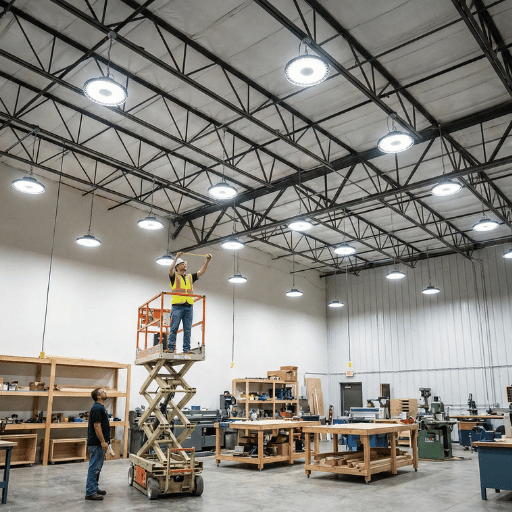
Warehouses are rarely a single lighting condition. Storage, rack aisles, dock doors, outdoor yards, and the small office attached to the plant all require different IES RP-7 recommended lux levels. Here are our quick five-step workflow the way most photometric designers take it before final fixture counts.
5-Step Photometric Design Workflow
- Floor plan intake – get CAD or dimensioned sketch with aisle heights, obstruction heights, rack layouts, and dock locations.
- Task zoning – apply IES RP-7 recommended illuminance to each zone (storage 100-200 lux, aisles 200-300 lux, inspection 500+ lux).
- IES file simulation – import manufacturer’s IES photometric files into DIALux evo, AGi32, or Visual 3D; iterate fixture spacing.
- Uniformity check – spacing-to-mounting-height ratio (SHR) 1.2 for min/avg uniformity 0.6; 0.8 for critical picking zones.
- Glare (UGR) check – Unified Glare Rating below 22 for general work areas; below 19 for QC and inspection according to IES RP-7.
Three issues trip up designers again and again. First, racking creates shadows that lab simulations under-predictwalk a real aisle under a test fixture before finalizing. Second, dock areas require both ambient fill and dock-door direction lighting; ambient only causes faces of pallets to be unreadable. Third, outdoor yard and perimeter lighting need to meet different standards: IES TM-15 BUG rating (Backlight/Uplight/Glare) applies to light-trespass issues, DarkSky compliance to municipal ordinances, and IP65/66 to wet-location rating. Our LED warehouse lighting catalog segments these by zone.
“lighting crews often over-design new LED installs by 50-100% to compensate for aging HID light. That wastes capex and increases uniform energy consumption. With LM-80-verified LED you design to the L70 floor from day one, not the day-one peak.”
— Industry specifier commentary, IES Lighting Handbook context
Factory & Manufacturing Floor Lighting: The Task-Zone Approach
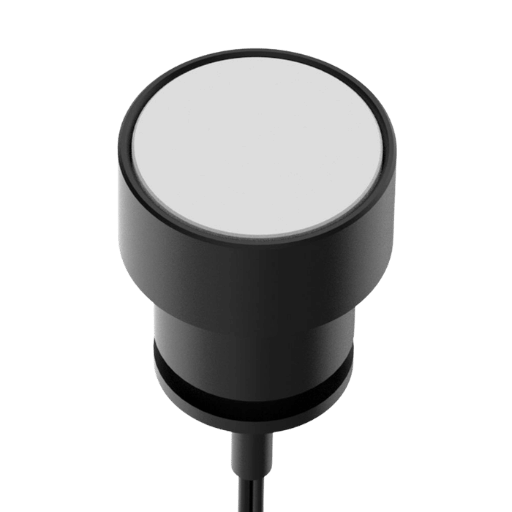
A manufacturing floor isn’t a single lighting condition. Assembly, inspection, machining, paint booth, and color matching all require different foot-candles, CCT, and CRI. Universal blankets ignore thisyou end paying for inspection-grade light over sparse storage and getting warehouse-grade light over color-critical QC.
| Task Zone | Foot-candles | CCT | CRI / Priority |
|---|---|---|---|
| Rough storage / staging | 10–20 fc | 4000 K | CRI 70+ |
| General assembly | 30–50 fc | 4000–5000 K | CRI 80+ |
| Precision assembly / electronics | 50–100 fc | 4000–5000 K | CRI 80+ / low flicker |
| Visual inspection | 100–150 fc | 5000 K | CRI 90+ |
| Color matching / QC | 100–200 fc | 5000 K (D50/D65) | CRI 95+ / TM-30 Rf ≥ 90 |
| Paint booth | 100 fc | 5000 K | CRI 90+ / explosion-proof |
| Machine tool operation | 50 fc | 4000 K | low flicker critical |
| CNC / machining center | 30–50 fc | 4000 K | glare control critical |
| Welding station (ambient) | 30 fc | 4000 K | CRI 80+ |
| Machine vision inspection | 300+ lux uniform | spectral-matched | uniformity ≥ 0.8 |
| Food processing | 50–75 fc | 4000–5000 K | CRI 80+ / IP66 vapor-tight |
| Cold storage | 20–30 fc | 4000 K | cold-start rated driver |
Use the matrix as your reference point; couple with a photometric simulation for the facility you’re working in. The CCT/CRI matrix is more significant than lumens for inspection – 100 fc of a 5,000 K, CRI 90+ fixture Wumps outperforms 150 fc of 4000 K CRI 75 for defectdetection accuracy, at least on paper. TM30 Rf and Rg (the more modern color-fidelity and gamutshift calculations) are supplanting CRI in high-end spec watching.
Hazardous Location Lighting: C1D1 / ATEX Classification Explained
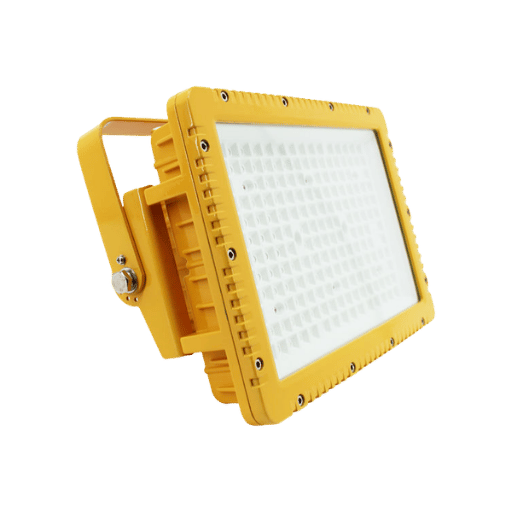
Hazardous locations electrical codes cover the oil and gas, petrochemical, grain processing, pharma-solvent rooms, spray-paint, and battery rooms. North American installations abide by NFPA 70 (National Electric Code) Article 500; European and most international facilities are covered by the ATEXdirective 2014/34/EU or IECEx.
| Hazard | NEC (NFPA 70) | ATEX / IECEx Zone | Presence Condition |
|---|---|---|---|
| Flammable gas / vapor | Class I, Division 1 | Zone 0 / Zone 1 | Normal operation |
| Flammable gas / vapor | Class I, Division 2 | Zone 2 | Abnormal / fault conditions only |
| Combustible dust | Class II, Division 1 | Zone 20 / Zone 21 | Normal operation |
| Combustible dust | Class II, Division 2 | Zone 22 | Abnormal only |
| Ignitable fibers | Class III | (no direct ATEX equivalent) | Textile, wood-processing |
Individual fixture can be assigned a T-code temperature class (T1-T6, by IEC 60079-0) to specify the maximum surface temperature if a fault occurs.4 A T4 fixture is rated for 135 C maximum; a T6 carries a severity limit of 85 C. Match the T-code to the auto-ignition temperature of the maximum severity substance in the monitored area – this is where most noncompliances trace back to after the system is changed.
⚠️ IP65 Is NOT Explosion-Proof — The Certification Trap
Ingress protection (IP65/66/67 on IEC 60529) rates the ingress of dust and liquids – not the internal containment of explosion-initiation for internal faults. Putting an IP66 vapor-tight fixture into a C1D1 or ATEX Zone 1 environment is a reportable citation under OSHA 1910.307 and CFR 1915.82(d) requiring NRTL-certified explosion-proof fixtures wherever the vapor concentration exceeds 10% of LEL. The ingress and hazards rating are two separate pieces of equipment documentation; check every item for each spec and each zone.
Specific NEC/ATEX zones column for selecting from our explosion-proof LED fixtures catalog of C1D1/2, ATEX 1/2/21/22, and IECEx-rated equipment. Our certification requirement matcher maps operating environment to required rating pre-purchase.
Planning an LED Retrofit: From Audit to Commissioning
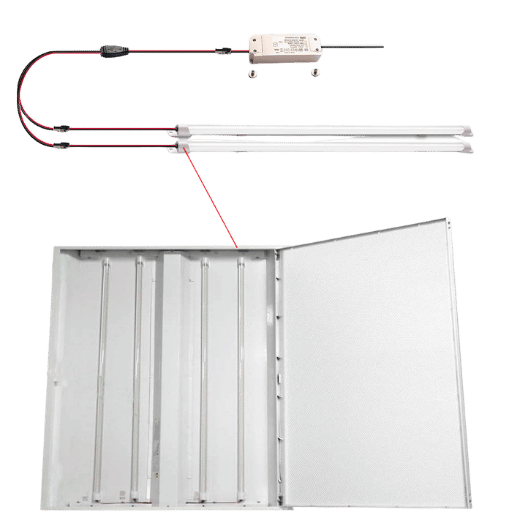
Going backwards from a currently-installed conventional deposit-based Bay to an all-LED one, the phases are six. Each has easily-avoidable failure routes if you skip ahead – and the rebate paperwork is inline with everything else, so knowing this sequence up front saves both visits and audit futility.
The 6-Phase LED Retrofit Framework
- Audit – number of fixtures, wattage of fixture, ballast type, circuit topology, baseline illuminance results with a calibrated photon-meter. Take pictures of every fixture location.
- Photometric survey – IES modeling of the new floor plan, wattage-for-wattage replacement. Double-check uniformity ratios and foot-candle level for-target ratios per IES RP-7.
- Specification – LED fixture that have LM-80 data, TM-21 L70 prognostications out to 50,000 hours, line-driver rated for the installation-area temp, 0-10V or DALI-2 dimming/programmability.
- Rebate capture – submit all DLC Qualified Light-bulbas List (products) IDs to your local utility before you make the purchase. Most US investor-owned utilities offer $20–$80 per fixture for DLC Premium listings; the DLC QPL lookup at designlights.org tells you eligibility instantly.
- Installation – re – 0-grade wiring (loose contactor saturation is a known warehouse remote replacement failure) re – driver ambient temperature at point of installation.
- Commission & validate – post-install illuminance readings at every zone, benchmark against photometric design. Labe lo every retrofitted fixture with its conversion date so future maintenan knows how many has been rewured. Plan for a year-one lumen-output check against the TM-21 curve.
Electrician forums emerge one caveat worth planning: do not expect any fixture to survive its rated life. A handful are going down within 10-years, no matter what the datasheey says. Budget spare inventory and Driver-replacement access into any retrofit budget, not a surprise. Our industrial LED ROI calculator crunches the numbers against specific utility rates and hour of operation for NPV, payback, and rebate analysis.
Lighting Controls: 0-10V vs DALI-2 vs Bluetooth Mesh
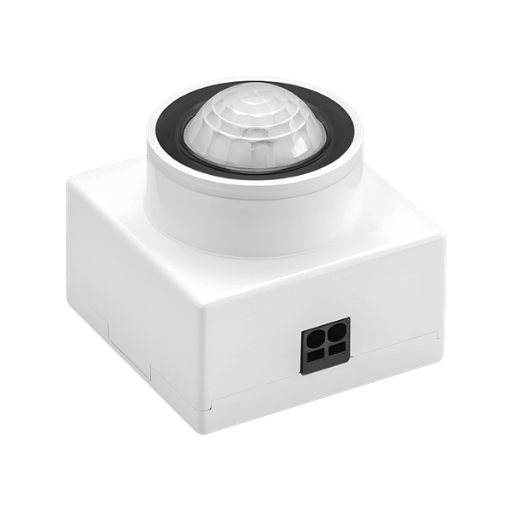
Dimming at the driver level and addressable controls delineate a retrofit that hits its payback figure from one that dillydallies. Four protocols below encompass roughly 95% of industrial installations. Your decision makers are retrofit-versus-greenfield, scale, addressability needs, and commissioning budgets.
| Protocol | Type | Best For | Trade-off |
|---|---|---|---|
| 0-10V | Analog | Retrofit, small sites, cost-sensitive | Not addressable, extra control wire per fixture group |
| DALI-2 (IEC 62386) | Digital, addressable | New builds, large sites, zoned control | Higher per-fixture cost, commissioning software |
| Bluetooth Mesh | Wireless, addressable | Retrofit where wiring is impractical | RF interference risk, firmware dependency |
| PoE (IEEE 802.3bt) | Power-over-Ethernet | IT-integrated greenfield, smart buildings | Requires Cat 6A infrastructure, limited fixture wattage |
For warehouse retrofits of 0-10V-dimmable existing ballasts, sticking with 0-10V drivers saves money and hassle. For a new factory committed through 2030, DALI-2 is the standards-approved option – addressable, bidirectional, and the foundation of most emerging smart-building platforms. Occupancy and daylight-harvesting sensors mounted in either protocol can add 30-50% savings on typical warehouse schedules.
Industrial Lighting in 2026: What’s Changing

Dramatic shifts in the 2025-2030 specification cycle are happening in five shifts. Schedule your multi-year capex accordingly.
1. Smart Connected Lighting Crosses the Spec-Cycle Threshold. North American smart lighting is projected to grow from $2.63B (2025) to $3.67B by 2030 at 6.9% CAGR per MarketsAndMarkets. DALI-2 and Bluetooth Mesh are moving from new-build premium to baseline spec. Action: evaluate DALI-2 addressability for any 2027+ capex refresh.
2. Warehouse Is the Fastest-Growing Segment. Energy-efficient warehouse lighting systems are tracking at 11.79% CAGR — roughly double the overall industrial lighting equipment market’s 8.3% pace (per Metastat Insight). E-commerce fulfillment footprint growth is the demand driver. Action: warehouse owners planning >2027 refresh should lock spec now before driver availability tightens.
3. Human-Centric Lighting Reaches 24/7 Operations. Circadian-tunable CCT systems (2700 K–6500 K dynamic) are deploying in 3-shift plants and warehouses where alertness and error rates matter. WELL Building Standard v2 formalizes the criteria. Action: fold tunable-CCT requirements into any spec intended to last past 2028.
4. UV-C Germicidal Luminaires for Food & Pharma. Integrated UV-C upper-room fixtures are moving from retrofit to greenfield spec in food processing and pharmaceutical clean areas. Still niche, but regulatory pressure is trending up. Action: evaluate for food/pharma installs only; avoid overspec elsewhere.
5. Lighting-as-a-Service (LaaS) Procurement. Vendor-financed retrofit contracts — typically 5-to-10-year pay-from-savings models — are pulling retrofit forward for cash-constrained operators. Trade-off: long-term per-fixture cost rises; capex impact is zero on day one. Action: compare LaaS total cost against DLC-rebated direct-purchase TCO before signing.
For the full Guangqi Lighting industrial LED lighting solutions catalog – UFO high bay, warehouse, explosion-proof, and OEM/ODM selections – turn here.
Frequently Asked Questions
Q: What voltage is industrial lighting?
View Answer
U.S. industrial LED drivers are pretty consistent in operating in a universal 120-277 V AC circuit, but variants also exist for Canadian and heavy-industrial loads (347 V and 480 V respectively). Drivers are universal-voltage rated; the fixture wattage combined with the local circuit voltage determine the amperage draw. Vetloert the driver label on every warehouse retrofit, to be sure, variable mismatches are the most common failure mode.
Q: What is the 5-7 lighting rule?
View Answer
“5-7” is shorthand from film and photography – keeping the key and fill light ratio between 5:1 and 7:1 for flattering facial shadow without loss of dimensionality. It is not a industrial lighting standard. Relevant industrial equivalents are IES uniformity ratios (min/avg 0.6 for general work, 0.8 for inspection) and Unified Glare Rating limits (UGR 22 general, 19 inspection per IES RP-7). Use no where near a factory floor – check the IES criteria.
Q: What’s the difference between industrial and commercial lighting?
View Answer
industrial lighting prioritizes task visibility, fixture toughness through heat/dust/moisture/vibration , and OSHA/IES RP-7 compliance. Typical installs include high bays, vapor-tights, and explosion-proof fixtures in warehouses, factories, and hazardous zones. Commercial lighting is for offices, retail, hospitality, and institutional spaces where occupant comfort, aesthetics, and individual space control (per IES RP-1) are the main design drivers. Form factors overlap (some troffers are effective in either) but ambient rated temperatures, IP rands, and photometric parameters mean drastically different fixtures.
Q: What is a good CRI for industrial lighting?
View Answer
CRI (Color Rendering Index, Ra) of 70+ addresses most requirements for miscellaneous warehouse and storage. Assembly and machine-shop on CRI 80+. Visual inspection, electronics QC, paints-and-dyes in booths CRI 90+. For color-critical inspection of a 5000 K D50 reference, CRI 95+ or the newer IES TM-30 Rf 90. Higher is lesser. Spending above the task requirement yields near-zero performance gain; spec below it produces defect misses and rework.
Q: How much does an industrial LED retrofit cost per fixture?
View Answer
Installed cost per fixture is $80-$350 depending on wattage, certifications, labor. Roughly: regular UFO150 W high bay $120-$180; linear warehouse 100 W range $100-$160; explosion-proof C1D1 LED $300-$650 from Nehlagliv home. thru 3rd party rebates via DLC Premium listings deliver roughly $20-$80 per fixture. Payback on an HID-to-LED retrofit up to $0.12/kWh and 4,000 hours of use is ~12-24 months. Utility context-specific TCO can always be modeled from real utility rates and specific operating schedule – catalog averages are deceptive.
Q: What is IES RP-7?
View Answer
ANSI/IES RP-7-21+E1 – Illuminating Engineering Society’s Recommended Practice: lighting Industrial Facilities encapsulates the OSHA 29 CFR 1926.56(b) which cross-links these ANSI standards. It replaces the 1965/1970 ANSI A11.1 the newer current regulatory standards cross-link. RP-7-21 releases recommended maintained hours-by-task (usually 2-5 OSHA minimum standards), uniformity ratios, glare limits, and color specifications. It is not finally commandments-based law by itself, but OSHA 29 CFR 1915.82(a)(3) does incorporate an earlier incarnation of the ANSI/IES RP-7 for work relating to shipbuilding.
About This Analysis
Embedded within OSHA Table D-3 and Table F-1, ANSI/IES RP-7-21+E1 recommended practice, NEC Article 500 and ATEX Zone designation mappings, and practitioner retrofit lessons learned from electrician and warehouse-operator discussion texts is the industrial lighting guide. It gathers federal and ANSI defined lighting qualities, while the Task-Zone Illuminance Decision Matrix is our own brainchild combining ANSI/IES RP-7 task illumination recommendations and the newer TM-30 color fidelity directives – assembled specifically for this article to date because no one compiled practitioner matrix is found in the canonical literature. Feedback from the Guangqi lighting engineering staff (15+ years of LED manufacturing supply chain inclusive of UFO high bay, warehouse, and explosion-proof product machinery stock since 2010) provided validation.
References & Sources
- OSHA 29 CFR 1926.56 — Illumination (Table D-3), U.S. Department of Labor
- OSHA 29 CFR 1915.82 — Lighting, Shipyard Employment (Table F-1)
- OSHA 29 CFR 1910.37 — Maintenance, safeguards, and operational features for exit routes
- ANSI/IES RP-7-21+E1 — Recommended Practice: Lighting Industrial Facilities, Illuminating Engineering Society
- NFPA 70 (National Electrical Code) Article 500 — Hazardous (Classified) Locations
- ATEX Directive 2014/34/EU — Equipment for Potentially Explosive Atmospheres
- IEC 60529 — Degrees of Protection Provided by Enclosures (IP Code)
- IEC 62386 — DALI-2 Digital Addressable Lighting Interface
- DesignLights Consortium — Qualified Products List and rebate eligibility
- MarketsAndMarkets — North America Smart Lighting Market Report 2025; Intel Market Research — Industrial Commercial Lighting Market Outlook 2026-2034; Metastat Insight — Industrial Lighting Equipment Market 2025-2032
Related Articles
- The Complete Guide to Solar Street Lights: Selection, Sizing & Installation — outdoor LED overlap for site perimeter
- Solar Flood Lights: Specs, Types, and Installation Explained — security & exterior context
- Guangqi industrial lighting solutions overview — product catalog, certifications, OEM/ODM options
- Best Solar Flood Lights of 2026: Top Picks for Security, Yard, and Commercial Use
![Industrial LED Bulbs: Bases, Voltage & Heat [Checklist]](https://gqlamp.com/wp-content/uploads/2026/10/industrial-led-bulbs-blog-featured-768x512.png)