Get in Touch with GUANGQI



Best Solar Flood Lights in 2026: What to Look for and Our Top Picks
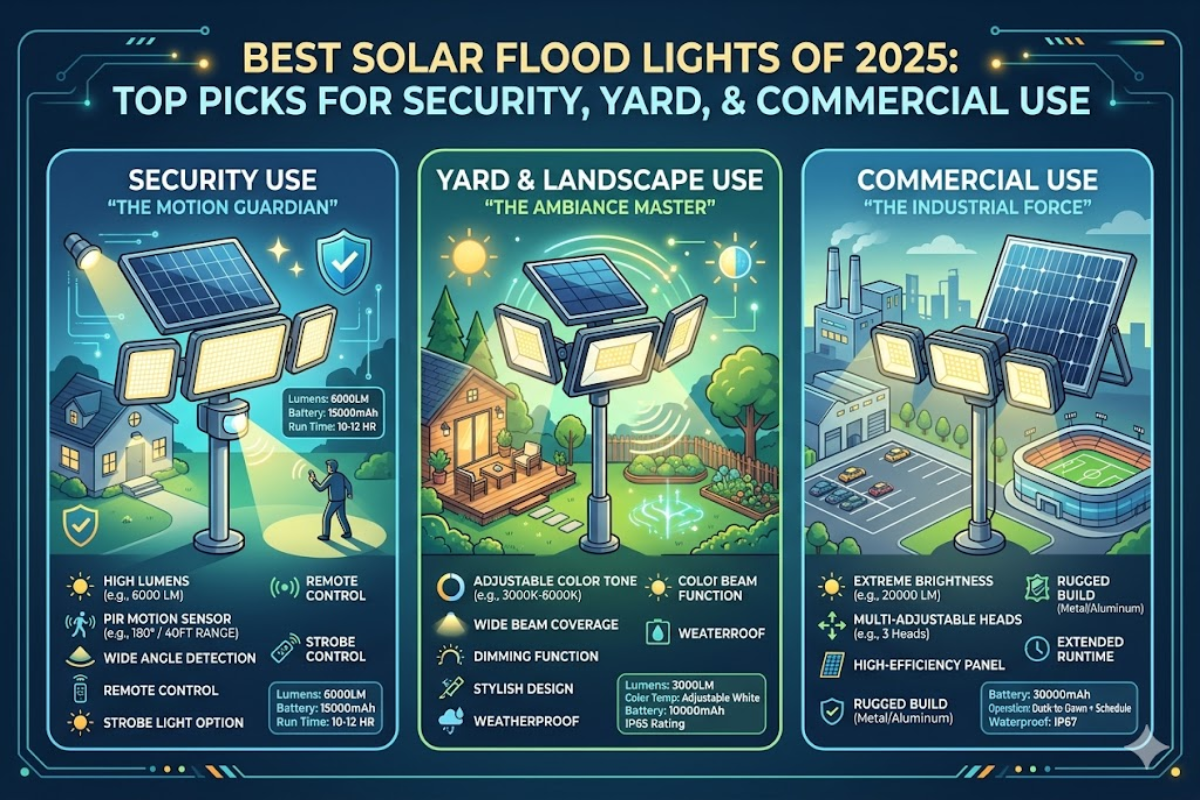
At a Glance: Specs by Category
| Category | Lumens | Key Spec | Min IP |
|---|---|---|---|
| Security (Motion) | 1,500–2,500 lm | PIR 8–22 m range, 20–60 s trigger | IP65 |
| All-Night (Dusk-to-Dawn) | 1,000–5,000 lm | 8–12 hr runtime, photocell sensor | IP65 |
| Brightest (Commercial) | 5,000–20,000 lm | LiFePO4, MPPT controller, pole mount | IP65 |
| Budget (Under $50) | 500–2,200 lm | Li-ion 2,000–4,000 mAh | IP65 |
All categories: IP65 minimum, monocrystalline panels preferred.
“Best” depends on what you need it to do. For a homeowner, a $28 motion-sensor unit effectively protecting a driveway is “best.” For a facility manager, a $3,000 pole-mount is “best” for lighting an entire parking lot. This guide gives the specs–not superlatives–by use.
In each of the four categories, we compare brightness (lumens), battery chemistry (LiFePO4 vs. Li-ion), IP (ingress protection) rating, and sensor type, so you can match each of the four to your application. Whether you are looking for a solar powered motion triggered front door flood light, an all night illuminating backyard garden light, or a commercially certified loading dock light, the sections below details what to buy, and why.
What Makes a Solar Flood Light “Best”? The 5 Specs That Actually Matter
When shopping for solar flood lights, you will see fuzzy marketing phrases – “super bright,” “military grade,” “long lasting.” None of these tell you whether a given light fixture will actually meet the requirements. Five measurable specifications do.
| Criterion | What to Check | Strong Indicator | Watch Out For |
|---|---|---|---|
| Lumens vs Coverage | Total lumen output ÷ area (m²) | 50–100 lm/m² for security | “Bright” with no lumen number listed |
| Battery Chemistry | Li-ion vs LiFePO4 | LiFePO4 for commercial (3,000–5,000 cycles) | “Lithium” without specifying type |
| IP Rating | IEC 60529 certification | IP65+ for outdoor use | Below IP44, or no rating listed |
| Sensor Type | PIR, photocell, or manual | PIR with 8 m+ range for security | Motion sensor with <5 m range |
| Solar Panel | Mono vs polycrystalline | Monocrystalline (18–22% efficiency) | No panel spec, or “amorphous” |
Engineering note: a “100W” rating on a solar light refers to the wattage of the solar panel, not the light output. LED solar arrays typically draw between 15W and 30W. A 20W LED that produces 100 lm/W produces 2,000 lumens.
This is the figure which is important for outdoor solar use. When comparing products, try and find the stated lumen output, not the panel wattage.
The table above is a quick-glance filter, not a checklist. In reality, everything matters a little, but simultaneously. What’s “most important” to a security buyer is very different than what’s most important to a commercial buyer.
Security buyers put range of the sensor as top priority. Commercial buyers put battery cycle life and certification as the top priority. For details of how these numbers interact, see our complete solar flood lights guide.
Best Solar Flood Lights for Home Security
Security lighting applications need a motion-activated floodlight response—not necessarily the highest lumens, but the combination of PIR detection range, trigger speed and dependability in darkness. The top solar flood lights with motion sensor technology emphasize detection zone over raw brightness. Most models can also serve as a wall light when mounted on a bracket to a house perimeter or a fence post.
| Feature | Entry Level | Mid-Range | High-Performance |
|---|---|---|---|
| Lumens | 500–1,000 lm | 1,500–2,500 lm | 3,000–5,000 lm |
| PIR Range | 8–10 m (26–33 ft) | 10–15 m (33–50 ft) | 15–22 m (50–72 ft) |
| Detection Angle | 120° | 180°–270° | 270°–360° |
| Battery | 2,000 mAh Li-ion | 3,000–4,000 mAh Li-ion | 5,000+ mAh or LiFePO4 |
| IP Rating | IP65 | IP65 | IP65–IP67 |
| Price Range | $20–35 | $35–80 | $80–200 |
Important point: when designing security light, the PIR detection range matters more than lamp output (lumen) value. For example, a 2,000 lumen light with 22 m PIR detection range will secure a much larger area than a 5,000 lumen lamp with just 8 m fire range. Meaning the intruder the trigger fires before are the lit zone, that lead distance act as a fear factor:
Most common mistake: Ordering the most powerful fitted with the highest lumen for size of property instead of sensing area consideration. For most home situations of residential driveway (average 10-15 m deep), a mid and common type of FCO with 12 m PIR and 2,000 lumens will better lit during the night than the more powerful lumen performance type with narrow cut 120 detection angle installed in that same location.
Mid-range units (1,500-2,500 lm, 10-15 m PIR) fit most residential driveways/entry-points well. Narrow selection by detection range, not lumen output, to find out what actually works for your property size.
Best Solar Flood Lights for All-Night Illumination
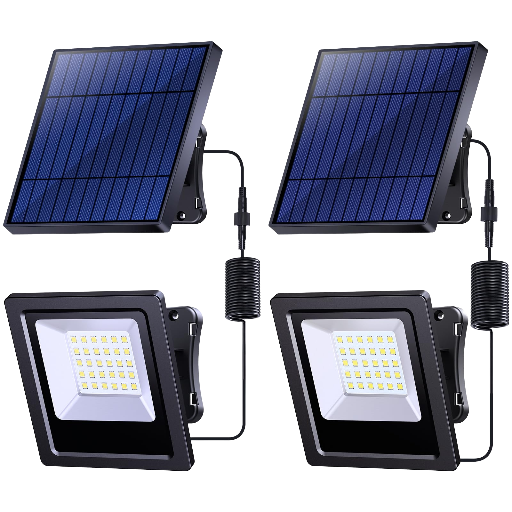
Dusk-to-dawn models operate using a photocell sensor rather than a PIR motion trigger. They switch on at dusk then stay on until dawn (no motion detection required). They are perfect for pathways, walkways, borders of gardens, lighting signage or where you would prefer a background light rather than flashes on motion.
Once defined, the only calculation needed to determine runtime is: Runtime (hours) = Battery capacity (Wh) divided by LED power draw (W). A worked example: a 3.7V 6,000mAh battery has 22.2 Wh of energy. Plopping in a 10W array of LEDs full on at maximum brightness gives you 2.2 hours of runtime.
With the same battery, a 3W dim mode gives you 7.4 hours. This is why nearly all dusk-to dawn units run a hybrid strategy – dim baseline + motion-activated boost modes – to give them an 8-12 hour runtime.
| Feature | Residential | Commercial |
|---|---|---|
| Lumens (Continuous) | 500–1,500 lm (dim mode) | 2,000–5,000 lm (full) |
| Battery | 4,000–6,000 mAh Li-ion | LiFePO4 25.6V pack |
| Runtime | 8–10 hrs (dim + boost) | 10–14 hrs (MPPT managed) |
| Panel Type | Polycrystalline (integrated) | Monocrystalline (separate, adjustable) |
| Price | $40–120 | $700–3,000 |
The more typical approach adopted by most residential duskto- dawn units is a hybrid mode—dim baseline (~30% brightness), with bursts of full brightness when movement is detected—for extending a single charge over 8-12 hours. This approach, which effectively triples the runtime over over using the light at full power, is surprisingly bright. Some more mid-range models feature a remote control allowing for sensitivity-timer adjustments without repositioning the fixture.
A detailed explanation of battery chemistry and panel efficiency is in the technical guide for solar flood lights linked in the related articles below.
Brightest Solar Flood Lights: High-Lumen Options for Large Areas
Business and industry applications need light levels that our home fixtures can not deliver. Fixtures from 5,000 to 20,000+ lumens light parking areas, loading docks, sporting courts and building exteriors. Brightest solar flood lamps in this class combine LiFePO4 cell banks with MPPT charge controllers with LM-79 photometric certified data for real output.
| Feature | Mid-Commercial | Full Commercial | Industrial |
|---|---|---|---|
| Lumens | 5,000–8,000 lm | 10,000–15,000 lm | 15,000–20,000+ lm |
| Solar Panel | 50W mono | 100W mono | 120W+ mono |
| Battery | LiFePO4 25.6V | LiFePO4 25.6V | LiFePO4 51.2V |
| Controller | MPPT | MPPT + 4G modem | MPPT + smart grid |
| CCT | 5000K fixed | 3000K / 4000K / 5000K selectable | 2300K–6500K full range |
| IP Rating | IP65 | IP65 + LM-79 certified | IP65 + LM-79 + LM-80 |
| Mount | Yoke / wall | Pole (3″ tenon) | Pole + dual-head |
| Price | $700–1,200 | $1,900–3,100 | $2,400–5,200+ |
Lumen Inflation Caution: Lumen inflation is prevalent in the budget market. Some brands advertise panel equivalence or potential maximum wattages instead of actual measured lumens. For commercial buys, insist on an LM-79 photometric test report to verify claimed lumens.
This will result in an independent lab report of measured output under standardized tests – this is the only spec worth trusting at this level of magnification.
To get the right product for a commercial installation, as a first step, go directly to the led flood lights category to include products that have published photometric data and are specifiable by mounting configurations.
Best Budget Solar Flood Lights Under $50
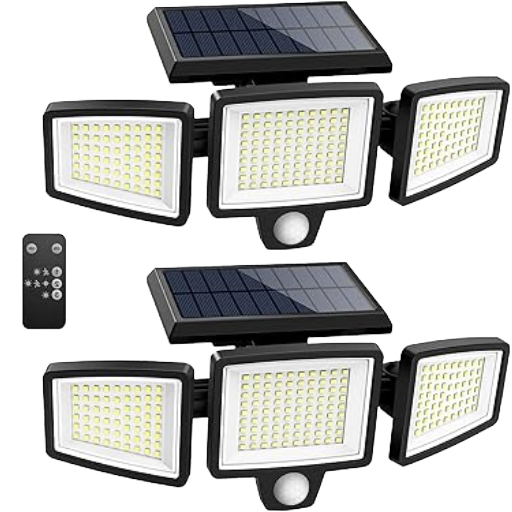
Below 50$ residential solar flood lighting that is functional is available — but you need to keep realistic expectations about what that category offers and what it does not.
What you will receive: Between 500 and 2200 lumens, with Li-ion or Ni-MH batteries, weather proof to IP65, equipped with a motion detector, and 2-3 years worth of battery life in terms of usage prior to replacement.
What you loose: No LiFePO4 cycle life (shorter), no MPPT charge controller (more efficiency), polycrystalline panels on most models (less efficiency in cloudy days), fewer hours in winter due to less sun.
| Budget Tier | Lumens | Battery Life | Runtime (Summer) | Realistic Use |
|---|---|---|---|---|
| $15–25 | 300–800 lm | 1–2 years | 4–6 hrs | Accent / path lighting only |
| $25–35 | 800–1,500 lm | 2–3 years | 6–8 hrs | Driveway / entry security |
| $35–50 | 1,500–2,200 lm | 2–3 years | 8–10 hrs | Yard / perimeter coverage |
Unrealistic claims to ignore: 10000 lumens for a $30 product is ridiculous. When you see advertisements claiming “42000 lumens” from a consumer product, that is in practice the theoretical maximum lumen output in optimum lab testing conditions. A reasonable realistic maximum for a $35-50 fixture is about 2200 lumens depending on the drive current to the LEDs.
At $25-35, focus on the quality of the motion sensor and IP rating first, and the specified lumen count second. A well designed motion sensor and IP65 rated enclosure will last many years longer than peak brightness in determining overall satisfaction.
Best budget upgrade: Use a model with a separate (non-integrated) solar panel. Separating the panel allows full exposure to direct sunlight and the best coverage possible in the spotlight position, overcoming a critical shortcoming of integrated budget fixtures.
Batteries are the biggest ongoing expense within the budget range, too. Calculation of total cost of ownership should account for one replacement cycle at 2-3 years and $10-20 for a compatible Li-ion pack (generally affordable within a residential context) – but it should be noted that this expense can be avoided with costlier commercial tier LiFePO4 fixtures in the same time period.
How to Choose: Solar Flood Light Buyer’s Decision Framework
Use this quick five-step guideline to help narrow down your product before delving into the details:
- Step 1 – Describe coverage: Determine your targeted area in m2, then multiply by 50-100lm/m. This will give the minimum lumens needed. For example, 20 m driveway requires 1000-2000 lumens; 100 m backyard requires 5000-10000.
- Step 2 – Determine time needed: If just security from motion, a Li-ion battery is suffice. However, for all-night or dim-and-boost capability, go with LiFePO4 or 6000+ mAh Li-ion. Commercial use should employ LiFePO4 with 10+ hr use.
- Step 3 – Check average daily sun hours in your area: Use the NREL PVWatts calculator. If your site sees less than 4 hours of peak sunlight, bigger panel(s) and higher-capacity batteries are indicated.
- Step 4 – Set budget target to find appropriate tier: Sub-50$10 budget tier (H2-5). 35-200$10 security or dusk-to-dawn (H2-2 / H2-3). 700+$10 commercial high-lumen (H2-4).
- Step 5 – Confirm IP rating, panel type: Check for a minimum IP65 rating. Prefer monocrystalline panels where possible, as they afford 35-50% more efficiency in low-light and cloudy conditions.
| Your Need | Recommended Category | Key Spec to Prioritize |
|---|---|---|
| Driveway / entry security | Motion Sensor (H2-2) | PIR range ≥ 10 m |
| Yard / garden all night | Dusk-to-Dawn (H2-3) | Battery capacity, dim + boost mode |
| Parking lot / building perimeter | Commercial (H2-4) | LiFePO4 + MPPT + LM-79 cert |
| Basic coverage, tight budget | Budget (H2-5) | Separate panel, IP65 confirmed |
Ready to explore the options for a solar powered security and landscape lighting suitable for your property?
Provide us with your total coverage area, use case etc, and we will guide you to the appropriate product specification.
Frequently Asked Questions
Are solar flood lights worth the investment?
Yes, for most residential applications. The 5-year total cost of ownership is 40-60% lower than wired options, mostly because solar eliminates installation labor – trenching and running the wiring costs $150-1,200 depending on how far you need to go – and it eliminates ongoing electricity costs entirely. In most cases the break-even point versus a wired fixture is 12-18 months from install – the solar unit then runs at zero incremental cost. See our technical guide to solar flood lights for a breakout of cost by battery type and fixture tier at the link at the bottom of this page.
How many lumens do I need for outdoor security?
The standard benchmark is 50-100 lumens per square metre for security-grade visibility. In a typical space that means: a residential driveway (18 m) requires 1,500+ lumens just from one fixture; a backyard (100 m) requires 5,000-10,000 lumens across multiple fixtures; a commercial parking lot (300 m) need 30,000+ lumens total, installed across multiple fixtures. No one fixture will light a large area; plan on multiple fixtures strategically placed rather than one high-powered unit.
What is the best brand of solar flood lights?
No one brand consistently performs best. For various use cases and tiers evaluate: battery chemistry (LiFePO4 vs Li-ion), liecular lumen output (not theoretical maximum brightness), IP rating, and PIR detection range not to brand name. Many brands which publish LM-79 photometric testing data show a number of important indicators of a reliable product, uncovered by those relying solely on spec sheets. Request the testing report from the vendor – any reputable commercial fixture brand should be glad to send it.
Do solar flood lights work in cloudy weather?
Yes, but runtime drops proportionally with available sunlight. Monocrystalline cells provide 35-50% more output than polycrystalline cells when overcast or in low-light conditions as they operate at a higher efficiency. If in a region with long cloudy winters – northern Europe, the Pacific Northwest, mainland China – choose units with larger battery capacities (6,000+ mAh or LiFePO4 pack) to make up for reduced daily charging time.
How long do solar flood lights last?
Hardware durability varies dramatically. LED chips will operate 50,000+ hours (roughly 15 years at 8 hours a night). Solar panels degrade 0.5-1% annually, but often last 20+ years in the field. Batteries are the weak point of any solar path light – Li-ion cells average 2-3 years in residential fixtures; LiFePO4 cells in commercial lights are rated for 3,000-5,000 charge cycles (8-14 years of consistent use). Allow $10-25 every 2-3 years for Li-ion battery replacements on residential path lights.
Can I leave solar flood lights out in winter?
Yes on any fixture rated IP65 or above. LiFePO4 batteries perform to 20C and hold their rated capacity in cold weather. Li-ion batteries cannot operate to 0C and sometimes will shut down unexpectedly – an issue related to the battery management system, not the item itself. If you are in a cold region with temperatures regularly dropping below 0C overnight and you need lights overnight, choose a LiFePO4 fixture.
Find the Right Solar Flood Light for Your Project
Guangqi Lighting – Self-powered lighting, Lighting up the world. We offer products across a wide range, from front porch motion-sensor fixtures to JIS-certified industrial high-lumen lighting.
About This Review
Guangqi Lighting produces solar flood lights from residential through commercial applications. In order of application (not manufacturer) this review references published specifications and standards (IEC 60529, IEC TS 62257-9-8, LM-79, LM-80) and specific product information from multiple manufacturers. The data used documents typical performance in the general market location, your experience will vary given the condition, geographic placement.
References & Sources
- IEC TS 62257-9-8:2020 – VeraSol Quality Standards for Solar Products. verasol.org
- IEC 60529 – Degrees of protection given by enclosures (IP code). International Electrotechnical Commission.
- PVWatts Calculator — National Renewable Energy Laboratory. pvwatts.nrel.gov
- Life Cycle of PV Systems – U.S. Department of Energy. energy.gov
- LiFePO4 vs Lithium-Ion Lifespan Comparison — Leodar Tech. leodartech.com
Related Articles
- Solar Flood Lights: Specs, Types, and Installation Explained
Complete technical guide — battery chemistry, panel efficiency, IP ratings, and installation planning. - Solar Flood Lights Collection — Guangqi Lighting
Browse residential through commercial solar flood light models with full specifications. - LED Flood Lights — Full Category
Wired and solar LED flood lights for residential, commercial, and industrial applications. - LED Street Lights
Road and area lighting solutions for municipalities, campuses, and commercial properties.
![Solar Flood Light vs Wired Complete Comparison [2026]](https://gqlamp.com/wp-content/uploads/2026/04/Solar-Flood-Light-vs-Wired-Complete-Comparison-2026-768x512.png)
![Solar Flood Lights Specs, Types, and Installation Explained [2026]](https://gqlamp.com/wp-content/uploads/2026/04/Solar-Flood-Lights-Specs-Types-and-Installation-Explained-2026-768x512.png)