Get in Touch with GUANGQI



![Solar Flood Lights Specs, Types, and Installation Explained [2026]](https://gqlamp.com/wp-content/uploads/2026/04/Solar-Flood-Lights-Specs-Types-and-Installation-Explained-2026.png)
Quick Specs Reference
Power Range
15W–120W (solar panel input)
Lumen Output
500–20,000 lm (residential to commercial)
Battery Type
Li-ion (500–1,000 cycles) or LiFePO4 (3,000–5,000+ cycles)
Protection Rating
IP65 minimum (IEC 60529); IP67 for submersion-grade
Color Temperature
3000K (warm white) to 6000K (daylight)
Runtime
8–12 hours (dusk-to-dawn, full charge)
Solar flood lights
offer a single feature wired fixtures just can’t match: zero trenching, zero electrical permits and zero monthly electric bills. Simply install them and the sun does the work. However, much of what shows up on search for this topic is literally product listings – pages that inform you a fixture exists but without explanation of if it will serve your intended purpose. This is not that. Here you will find exactly how solar flood lights turn sunlight into light energy, which specs truly distinguish a good fixture from a bad and how to install for optimal operation and which wired options will be better in certain circumstances. By the end of this you will be prepared to interpret any spec sheet and determine the most appropriate product for your needs.
What Are Solar Flood Lights and How Do They Actually Work?
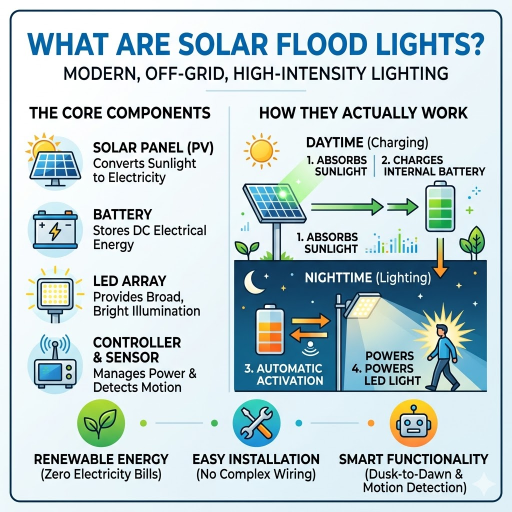
Fundamentally, a solar flood light is a set of PV panels contained in a housing that run a set of LEDs. Reading that energy path from sunlight to light is the single most important thing you can do on the buy side.
The pathway proceeds in four stages: the PV panel (solar cells that convert photons to DC) feeds a battery charge controller, which adjusts voltage and safeguards the battery from over charge. From there, energy accumulates in a rechargeable battery (either LiFePO4 or Li-ion chemistry) until darkness falls and the LED driver converts it into the LED array. Turns on are usually handled with a photoresistor sensor, where the current then turns the light on once the threshold level drops below a certain point.
Panel conversion efficiency determines how much of the sunlight actually becomes energy. Standard test conditions show crystalline panels reach 18-22% conversion efficiency. Cost is 10-20% less for polycrystalline and yields 35-50% less energy in cloudy winter conditions. In the great majority of outdoor security and area lighting applications, crystalline is the most cost-effective.
Another characteristic which impacts practical energy collected is the charge controller style. MPPT (Maximum Power Point Tracking) charge controllers continuously alter the electrical operation point of the panel to achieve the highest current possible. PWM (Pulse Width Modulation) style charge controllers use a more straightforward on/off methodology. MPPT charge controllers call for 20-30% more power off a panel than comparable PWM counterparts do, particularly in diminishing sunlight situations – a value well worth considering in the fall and winter months when timeframes to charge are quite a bit narrower.
From a statements perspective, IEC TS 62257-9-8:2020 mandates that manufacturers of off-grid solar systems support the lumen maintenance standards printed on their packaging. Under this standard lumens are put to the test at 2,000 hours of operation, and the published specs must be observed in the independent performance tests. When shopping fixtures, it can be eye-opening to find out that a product advertised as 3,000 lm has no third-party support.
Engineering Note: To get the maximum information about a particular solar flood light, the best single documentation a manufacturer can supply is an LM-79 photometric test report (for initial lumen output) with LM-80 data (for lumens through time). Lack of either of the two is a noteworthy experience. For reference of a photovoltaic system life cycle, the US Department of Energy provides an extensive reference: Life Cycle of Photovoltaic Systems (DOE/FEMP).
Key Point: How efficient is the panel (mono vs. poly) and what type of controller (MPPT vs. PWM) does it have, can either increase or decrease the actual amount of energy stored in your solar flood light. These two factors are more influential then wattage ratings.
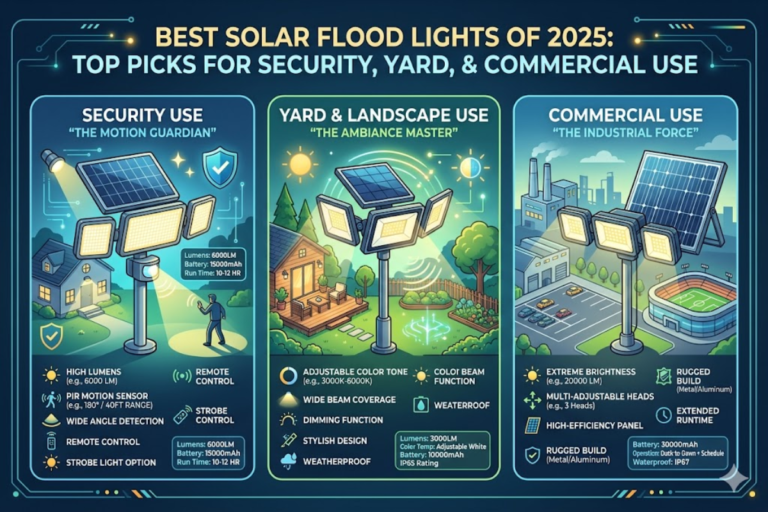
Types of Solar Flood Lights: Motion Sensor, Dusk-to-Dawn, and Commercial Grade

Not however does this mean that all solar lights of this type are alike, or that selecting an inappropriate choice of solar flood light is not a common and easy mistake for consumers to make. Here the market can be split into four logical groups, each with its own hardware profile and uses.
| Type | Lumen Range | Typical Battery | Detection / Activation | Best For | Price Range |
|---|---|---|---|---|---|
| Motion-Sensor | 500–2,200 lm | 2,000–4,000 mAh Li-ion | PIR sensor, 8–12m range, 120°–270° detection angle | Driveways, entries | $20–60 |
| Dusk-to-Dawn | 1,500–5,000 lm | 3,000–6,000 mAh Li-ion | Photoresistor (auto on at dusk, off at dawn) | Yards, pathways | $40–120 |
| Remote-Controlled | 1,000–3,000 lm | 3,000–5,000 mAh Li-ion | Remote (timer: 3/5/8 hr modes) | Patios, signage | $50–150 |
| Commercial / Industrial | 2,000–20,000 lm | LiFePO4 (25.6V–51.2V pack) | MPPT controller + photocell + optional PIR | Parking lots, facilities | $700–5,200 |
The most typical entry level option are solar flood lights with motion sensor. The PIR sensor is looking for body heat profiles of moving people/cars, and switches the light to full brightness for a desired length of time, perhaps 20-60 seconds. They are conservative with battery power, and stay dark or dim when no sensor is sounded, so they can run on smaller 2,000–4,000 mAh batteries than dusk-to-dawn models.
For a driveway and/or front door setup where the light only needs to illuminate sporadically, this is a battery friendly setup.
Commercial solar flood lights represent a different class entirely. They use LiFePO4 battery packs with voltage ratings of 25.6V or 51.2V, MPPT charge controllers, and LED arrays designed for area lighting rather than spot security. Their price premium over residential units reflects genuine engineering differences — not just marketing positioning.
💡 Which Type Do You Need?
Ask 3 questions: Does the light have to be on all night, or do the sensors only come on when people are nearby?What (m) needs to be illuminated?Is this residential or commercial – i.e. is continuous uptime a must?If all night needs to be illuminated for an area over 50m, upscale to dusk-to-dawn with 5,000 mAh+ battery; If needs to be uptime guaranteed commercial grade, focus on LiFePO4 commercial units.
Ask 3 questions: Does the light have to be on all night, or do the sensors only come on when people are nearby?What (m) needs to be illuminated?Is this residential or commercial – i.e. is continuous uptime a must?If all night needs to be illuminated for an area over 50m, upscale to dusk-to-dawn with 5,000 mAh+ battery; If needs to be uptime guaranteed commercial grade, focus on LiFePO4 commercial units.
A mistake that is often overlooked: the purchase of a 270 motion-sensor model for landscape accent lighting. Its wide angle of detection results in activating every time a leaf dangles in the wind or a bird flies by. For landscape accent usage, a dusk-to-dawn model with 3000K color temperature and no motion sensor gives a much more consistent outcome without depleting the battery of power.
Lumens, Wattage, IP Rating, and Color Temperature: What the Numbers Actually Mean
Spec sheets for solar flood lights often show values that you don’t have the context for, and some manufacturers make use of that selective transparency to their advantage. Here’s what each spec is measuring, and what numbers you should consider.
| Spec | What It Measures | Good Range | Red Flag |
|---|---|---|---|
| Lumens (lm) | Light output intensity | 1,000–5,000 lm residential; 5,000–20,000 lm commercial | Under 500 lm for security use |
| Solar Panel Wattage | Panel energy input (NOT light output) | 15W–120W input | Wattage listed as if it were light output |
| IP Rating | Dust + water protection (IEC 60529) | IP65 (water jets); IP67 (submersion 1m/30 min) | Below IP44 for any outdoor use |
| Color Temperature | Light warmth / coolness (Kelvin) | 5000K–6000K security; 3000K–4000K landscape | No CCT listed at all |
| Beam Angle | Light spread in degrees | 120° for area flooding; Type III distribution for commercial roads | Under 90° for area lighting |
| Battery Capacity | Energy storage (mAh or Wh) | 2,000–6,000 mAh residential; 25.6V+ packs commercial | Under 1,500 mAh for dusk-to-dawn claims |
Wattage labeling really needs to be addressed from the outset. If a product is “100W solar flood light” then the panel can take 100W of solar radiation, although the LED array may only actually take 20W, but people are often led to believe that the light output will be the same or close to a 100W incandescent when in fact it’s closer to a 15-30W incandescent.
An easy practical rule of thumb for lumen sizing: assume 50-100 lumens/m 2 for security grade illumination. With a 6m 4m (24m) driveway you would then require 1,200-2,400 lm minimum. Anything below 1,200 lm for that area will give the camera less usable footage and the visual deterrence effect will be greatly diminished.
Engineering note (IP65 test protocol): IP65 rated under IEC 60529 designates a fixture capable of with standing water projected from a 6.3mm nozzle at a flow rate of 12.5 L/min from a distance of 2.517.3m for 15 minutes in any direction. This mimics a heavy rainfall/spray from a garden hose. IP67 specifications add the ability to stand in direct water spray, 1104 mm of submersion for up to 30 minutes. Again, ensure that the IP rating applies separately to the light fixture and to the solar panel if separate components are specified – a few units specs will verify IP ratings do not necessarily apply to both the lamp and the panel.
On lumen depreciation: LED modules tested to LM-80 methodology show up to 20% lumen output reduction over the rated lifetime after extended use. Commercially available rated lumen packs can vary in actual performance, so in this case advertised lumens are the leading number, but the real-life performance is the rated lumens at 15-20% less output after 2,000 hours running time – roughly equivalent to two or three years service at one election cycle per night. The rating allows for this in the final specifications, but your sizing calculation needs to figure the fixture output as compared to the lumen rating at end-of-life, not peak.
For a look at LED flood lights in both wired and solar categories, see our main category page.
Want a side-by-side spec comparison across models?
Solar Panel Efficiency and Battery Life: Reading Between thhttps://gqlamp.com/contact/e Spec Sheet
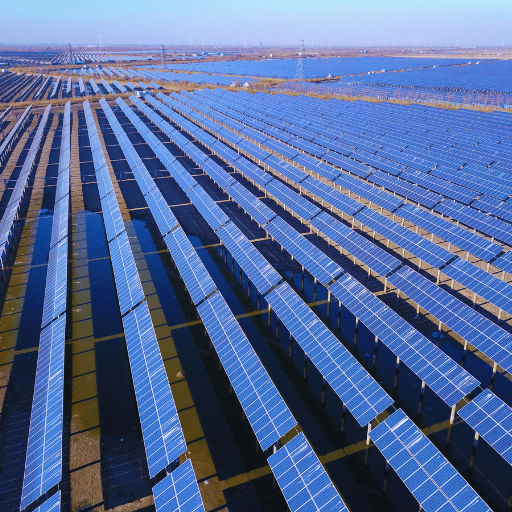
Most buyers fail to notice that the most important specification of a solar flood light is usually the least visible: battery chemistry. The chemistry tells you how long your appliance will continue working, and helps determine if the economics of solar flood lighting even make sense.
| Feature | LiFePO4 | Li-ion (NMC / LCO) |
|---|---|---|
| Cycle Life | 3,000–5,000+ cycles | 500–1,000 cycles |
| Calendar Life | 10+ years | 3–5 years |
| Depth of Discharge | 80–100% safely usable | Prefers under 80% for longevity |
| Thermal Stability | ~270°C before runaway risk | ~150–210°C (higher runaway risk) |
| Energy Density | 90–120 Wh/kg | 150–250 Wh/kg |
| Operating Temperature | -20°C to 60°C | 0°C to 45°C |
| Typical Use Case | Commercial grade ($700+) | Residential grade ($20–200) |
Per-cycle economics are quite concrete when looking at the LiFePO4 numbers: a $80 LiFePO4 pack lasting 5,000 cycles costs only $0.016 per cycle compared to a $20 li-ion pack lasting only 800 cycles costing $0.025 per cycle- 56% more expensive per cycle. This is compounded when the fixtures are located so that replacement requires a big ladder, scaffold, or call out for service.
Here’s the direct answer to the common question: how long do solar flood lights last? For residential units that use a standard battery chemistry, replacements can be expected every 2-3 years for fixtures using the battery nearly every day. Commercial units that use LiFePO4 chemistry, can see 10+ years of operation before the battery needs replacing. The LED chips themselves are common across the industry and achieve a 50,000+ hour work span for LED chips – higher than the expected life of either battery chemistry – therefore in the lifespan calculations it is really the battery choice that defines how long it will be until the unit is EOL.
What the spec sheet won’t tell you:The residential market is far more easily sold on Li-ion because the lower upfront cost and smaller form factor are more attractive in the retail setting. But in installations where access is limited – rooftop perimeter lighting, gate posts, remote sites – the battery replacement cost and hassles of a Li-ion product at year three outweigh the LiFePO4 premium up front. This is a disconnect in the residential market that rarely shows up in product literature.
Pro Tip: When shopping a solar flood light product, ask the manufacturer to confirm battery chemistry in writing. “Lithium battery” can mean Li-ion(NMC) or LiFePO4. The difference makes a huge difference in lifecycle cost. If the spec sheet only mentions “lithium,” assume Li-ion unless it is otherwise mentioned.
Installation and Positioning: Getting Maximum Light from Free Energy
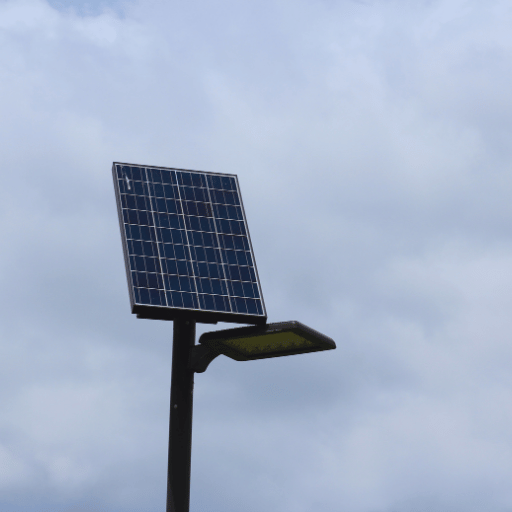
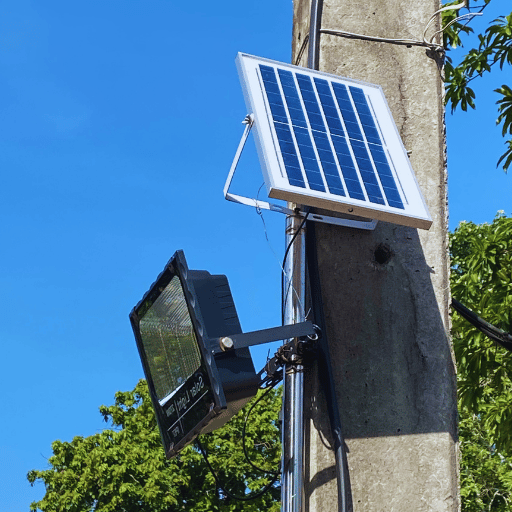
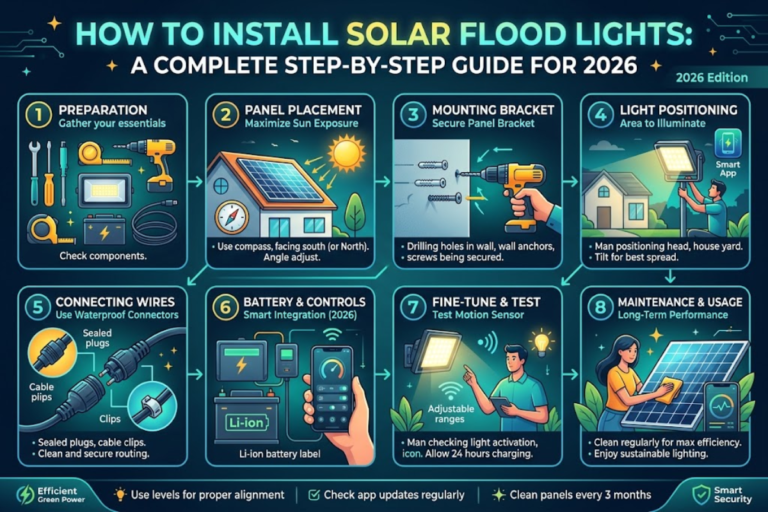
How to install solar flood lights correctly matters just as much as selecting the right product. Even the most well-specified fixture mounted in a suboptimal location (shadowed, incorrect angle, or at too high a mount point) will perform worse than a cheaper fixture mounted correctly. Five critical decisions come into play, in order, as follows.
- Step 1: Select a location with a minimum of 6 unshaded hours of direct sunlight/day. In most Northern Hemisphere locations, north-facing and south-facing morning and mid-day sun offer the highest irradiance, midday sun is less optimal.
- Step 2: Point the solar panel to true south (Northern Hemisphere) or true north (Southern Hemisphere). Use a magnetic compass and adjust for the local magnetic declination, or use the NREL PVWatts tool for verification.
- Step 3: Tilt the panel to your geographic latitude 15. At 40 latitude, tilt 25-55. Steep winter tilt (latitude + 15) maximizes winter energy collection with the shorter days.
- Step 4: Mount the fixture in the 2.5-3.5m range. At 3m with a 120 beam angle, you get a 6m diameter circumscribed circle of ground coverage. Mount multiple fixtures if the area requires more extensive illumination, don’t increase height – it diminishes illumination intensity.
- Step 5: Confirm no shade sources within 1.5m of the panel at solar noon. Even 30cm of shadow from a roof eave can cut daily charge levels in half, negatively impacting basic runtime.
Installation cost savings are again startling. Installing a single solar flood light is a one-person, 30-minute no-cost job, requiring only a drill and fastening hardware. Just compare that to the average time and related costs to hire a licensed electrician, install conduit, and sift for underground cable trenching when necessary ($150 to Seeec or more).
What many forget is the caveat in common solar panel installing practices. The most commonly specified error is placing the solar panel in a location sheltered by roof overhangs or eave covers that are intended to shield the hardware from the weather. Covering the panel with any structure that is angled away from the south – even a 3ccm eave overhang – prevents low winter sunlight from penetrating for 4-6 hours in most Northern Hemisphere locations. This can reduce winter solar input by as much as 60%. Solar panels are not water sensitive and are built specifically to be installed full open to weather.
Pro Tip: Use NREL’s PVWatts Calculator to verify the expected daily solar energy production (kWh) at your site, with your tilt and orientation, before you buy. Simply enter your address, proposed fixture wattage, and tilt—wait five minutes to see monthly energy production data. It will tell you whether any given fixture will be able to turn on and run that long in darkness year-round.
Not sure which fixture covers your specific area?
Solar Flood Lights vs. Wired LED Flood Lights: A 5-Year Cost Comparison
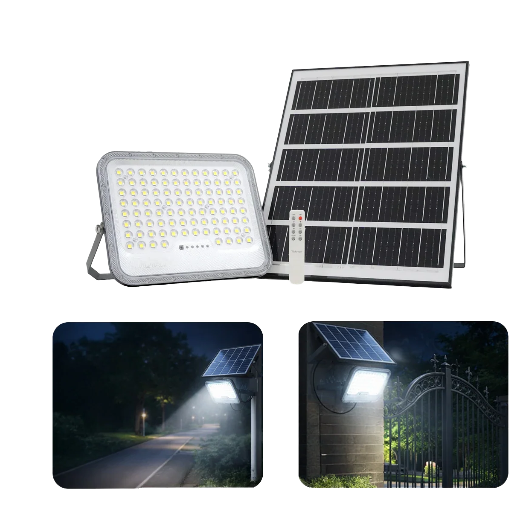
Is solar flood lighting economically feasible? For most residential applications the answer is yes: driveways, perimeter lighting, remote outbuildings, garden pathways—covering the $817.50-1,037.50 5-year total cost of ownership data easily supports the feasibility, however “solar always wins” is still some thing we should address: the cost of battery replacements are inevitable, and panel deterioration (roughly 0.5-1% each year of operation) can and will gradually lower those charging levels. The fair comparison looks like this.
| Cost Category | Solar Flood Light | Wired LED Flood Light |
|---|---|---|
| Purchase Price | $80–250 (mid-range) | $40–120 |
| Installation | $0 (DIY, no wiring required) | $150–1,200 (electrician + conduit/trenching) |
| Electricity (5 yr) | $0 | $235 (100W × 8hr × 365 days × $0.16/kWh × 5 yr) |
| Battery Replacement | $30–60 (Li-ion, approx. year 3) | $0 |
| Maintenance | $0–20 (occasional panel cleaning) | $0–30 (lamp or driver replacement) |
| 5-Year Total | $110–330 | $425–1,570 |
Installation costs drive the energy savings financially, not the price of the luminaire. In new construction where wiring is already making its way through a home then the margin becomes near non-existent; in retrofit situations—adding lighting to a pre-established structure or remote offgrid location—trenches costing $600-1,000 for a typical run alone make the solar option worthwhile thanks to economical and logistical viability as well as the offgrid independence factor.
Where the wired are still proportionally superior: (1) Locations where around-the-clock uptime cannot be compromised even in inclement weather—any solar fixture is dependent on adequate solar input and a long string of cloudy days can have disastrous effects. (2) Locations with more than a few weeks of subzero weather, forcing LiFePO4 batteries to operate near the edge of their temperature spectrum. (3) Locations with serious solar access issues—north-facing walls of the far north, heavily wooded properties, and urban appliances set among skyscrapers.
Pro Note: “Free to operate” applies solely to electricity sources. Battery replacements (every 2-3 years using Li-ion), occasional panel cleaning, and the slow degradation of panel output (roughly 0.5-1% each year of operation)must also be factored into a true 5-year cost-of-ownership calculation, just as you would any electrical fixture. The current 5-year table above has factored them in.
Troubleshooting: Why Your Solar Flood Light Stopped Working (and How to Fix It)
When your solar light goes out, whether you’ve installed a bungalow-pond garden path fixture or an ultra-highpowered flood light, one of five factors is usually at fault. Here’s the most common culprits ranked by frequency of occurrence, after multiple field investigations and troubleshooting analyses of various product categories.
| # | Failure Mode | Signs | Fix |
|---|---|---|---|
| 1 | Dirty or shaded panel | Light dims gradually over weeks; short runtime | Clean panel surface monthly with damp cloth. Verify no new shade sources (tree growth, seasonal sun angle shift). |
| 2 | Dead or degraded battery | Light works for under 2 hours then dies; unit is 2–3 years old | Replace battery ($15–40 for standard Li-ion packs). Confirm chemistry and voltage match. |
| 3 | Faulty PIR sensor | Light triggers randomly or not at all despite motion | Adjust sensitivity dial. Clear obstructions in sensor field of view. Check for nearby heat sources (HVAC vents). |
| 4 | Water ingress | Corroded contacts; visible condensation inside lens | Inspect seal integrity around cable entries. Apply silicone sealant around any cable penetrations. Note: IP ratings can degrade over time if seals age. |
| 5 | Cold-weather shutdown | Light stops working in winter; resumes in warmer weather | Li-ion batteries have a 0°C lower operating limit — this is a built-in safety feature. Upgrade to LiFePO4 chemistry (-20°C operating range) for cold climates. |
Winter dose show up on lithium-powered lamps. Many users report a decrease in charging capacity during 1/4 or less sunlight-saturation areas, which primarily stems from weaker solar rays during winter combined with lithium chemistry sensitive to cold temperatures. If your fixture is in a relative winter-wasteland, recognize that both shorter charging days and low-temperature cutoff will make Enerdrive’s lithium batteries expensive.
Some quick troubleshooting if the light is not functioning:. (1) Is the panel clean? (2) Is there no shade at solar noon? (3) Verify the battery voltage with a digital multimeter – if it drops below 3V per cell it is discharged or has a failed cell. (4) Reset the charge controller if possible. (5) Replace the battery. If the light still fails to come on after step 5 then either the LED driver or the LED array has failed and replacement is more cost effective than completing further repairs.
Important – Cold Weather: Li-ion batteries should never be used below 0. If the solar flood light drops out during the winter and resumes operation once the temperature warms up then the battery management system is functioning as intended – not defective. Budget for chemistry choice when selecting a product (LiFePO4), not troubleshooting.
Frequently Asked Questions
1. Are solar flood lights waterproof?
View Answer
Most solar flood lights meet an IP65 rating per IEC 60529, where the housing is dustproof and protected against water projected from a nozzle (6.3mm) with a volume of 12.5 litres per minute. IP67 is an extended rating where the product survives fully under water conditions for 30 minutes at a max depth of 1 meter. It pays to examine both the light fixture and the solar array to see if they are rated separately or together. For applications around standing water or where long term cleaning with a water hose is planned the entire system should be IP67 rated.
2. How many lumens do I need for a solar flood light?
View Answer
This is the practical recommendation for security level lighting: 50-100 lumens/m 2. Here is how that translates to real world scenario:
A 6m 3m (18m) driveway needs 900 to 1,800 lumens minimum. A 10m x 10m (100m²) backyard area, some where between 5,000 and 10,000 lumens is required, therefore requiring multiple fixtures instead of just one. For garden accent lighting where security phase was not prioritized, then 200-500 lumens per fixture is enough.
In a commercial context—parking lots, loading zones, building surround security lighting—target 100-150 lumens per meter to satisfy security camera standards for facial recognition at long range. As an example: a 20m x 15m (300m²) parking lot 100 lumens/m comes to 30,000 lumens altogether for which 4-6 fixtures of 5,000-8,000 lumens per luminaire creates a consistent light pattern.
Always be sure to calculate the lumen value at end of life (initial lumens 15-20% depreciation) rather than the best case scenario posted on the product packaging.
3. Do solar flood lights work in winter?
View Answer
Certainly, but with less runtime. In winter mid-latitude locations, may have 3-4 peak sun hours a day as opposed to 6-8 hours in summer meaning there is 40-50% less charging energy to accumulate in a day-night cycle. Correspondingly, this limits the runtime at night. A luminaire with a 10-hour runtime in July will only supply 5-6 hours if used in December at the same latitude.
This is also where the chemistry becomes relevant. If a Li-ion battery reaches its lower operating temperature limit and in sub zero weather conditions fails then it requires replacement. For deep mid-latitude installations (say Chicago or New York City) then LiFePO4 chemistry of -20C becomes the correct selection.
4. How much do solar flood lights cost?
View Answer
Cost of LED floodlight fixtures – estimates by tier
Residential entry-level motion-sensor models: $25-60 Mid-tier dusk-to-dawn with more lumen output: $60-150 Commercial grade fixtures with LiFePO4 batteries and MPPT controllers: $150-400 Industrial grade all-in-one parking lot/facility fixtures: $400-5,200++. The variation in cost within each tier is proportional to lumen output, battery capacity and implementation build quality (IP rating, materials, certification).
5. Can solar flood lights replace wired security lights?
View Answer
For residential? Yes. State-of-the-art mid-tier solar flood lights output 2,000-5,000 lm during 8-10 hour runtime on a full charge — minimum equivalence to many wired security fixtures. For 24/7 commercial security during multiple consecutive overcast days, hybrid solar-plus-grid-backup is the architectural precursor for maximum uptime certainty. Pure solar for critical 24/7 commercial security still incurs weather dependency residuals that wired systems do not.
6. What is the best color temperature for outdoor solar flood lights?
View Answer
The recommended Kelvin range for security lighting and CCTV camera focus: 5000K-6000K (cool white/daylight). All else being equal, this distance range yields the highest contrast available in human vision and camera sensors; standard for perimeter security and parking lot coverage.
The recommended Kelvin range for landscape and aesthetic accent lighting: 3000K-4000K (warm white). Warmer temperatures are more comfortable to neighbors, do not produce glare, and are substantially less attractive to insects compared to cooler white lights. Some fixtures now enable dual switching (e.g., 3000K landscape /6000K focus-lighting) which can function as a sensible midpoint for entry areas serving dual needs.
Guangqi Lighting
Ready to Specify Your Solar Flood Light Project?
Efficient Lighting, Guiding the Future
About This Guide
Guangqi Lighting produces LED flood light fixtures, including a selection of solar-based units. Our recommendations rely upon our engineering expertise, publicly obtainable regulatory standards (IEC 60529, IEC TS 62257-9-8:2020, LM-80), and independently validated third-party data. Market price points for opposite ends of the product spectrum are referenced among available options; individual circumstance for results may vary by location, applications, and vendor.
References & Sources
- IEC TS 62257-9-8:2020 – VeraSol Quality Assurance Framework for Off-Grid Solar Products: verasol.org
- IEC 60529 – Degrees of Protection Provided by Enclosures (IP Code) – International Electrotechnical Commission
- Life Cycle of Photovoltaic Systems – U.S. Department of Energy / FEMP: energy.gov
- PVWatts Calculator – National Renewable Energy Laboratory: pvwatts.nrel.gov
- Mono vs. Poly Solar Panels Low-Light Performance – EcoFlow: ecoflow.com
- LiFePO4 vs Lithium-Ion Lifespan Comparison – Leodar Tech: leodartech.com
Related Articles
- LED Flood Lights: A Complete Buyer’s Guide
- Solar Flood Lights — Product Collection
- How to Choose the Right LED Street Light
- Outdoor LED Lighting Solutions
![Solar Flood Light vs Wired Complete Comparison [2026]](https://gqlamp.com/wp-content/uploads/2026/04/Solar-Flood-Light-vs-Wired-Complete-Comparison-2026-768x512.png)
![Industrial LED Bulbs: Bases, Voltage & Heat [Checklist]](https://gqlamp.com/wp-content/uploads/2026/10/industrial-led-bulbs-blog-featured-150x150.png)