Get in Touch with GUANGQI



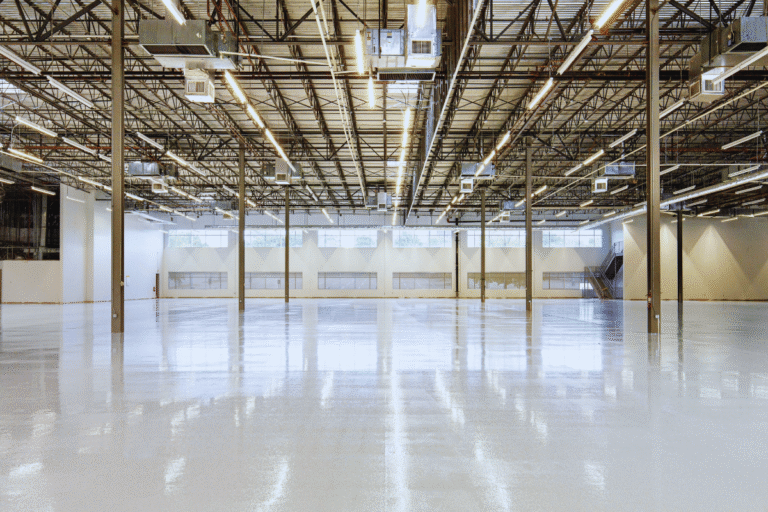
Three code documents referenced in most specifications but rarely read cover-to-cover govern warehouse lighting design: OSHA 29 CFR 1926.56, the IES Lighting Handbook (formerly RP-7), and ASHRAE 90.1-2022. Lighting plays a controlling role in forklift safety, pick accuracy, and energy-code compliance — miss a point in the calculations and you fail the plan review first, then get forklift drivers complaining about dark stripes between racks. This guide walks through the foot-candle requirements, the lumen calculation, the spacing grid, and the uniformity math that turn a fuzzy warehouse lighting spec into a solid fixture count.
Quick Specs — Warehouse Lighting Design Reference
| IES open warehouse (horizontal avg) | 20 FC (range 10–30) |
| IES warehouse with aisles (vertical) | 10 FC vertical + 20 FC horizontal |
| OSHA 29 CFR 1926.56 minimum | 5 FC indoor warehouse (construction period) |
| ASHRAE 90.1-2022 warehouse LPD | 0.66 W/sq ft (building-area method) |
| Typical high-bay spacing rule | Row spacing ≤ 1.0 × mounting height |
| Uniformity ratio target (Emin/Eavg) | ≥ 0.4 storage / ≥ 0.6 pick / ≥ 0.7 inspection |
| Efficacy target (DLC Premium) | ≥ 150 lm/W |
Why Most Warehouse Lighting Designs Fail Before the First Fixture Ships
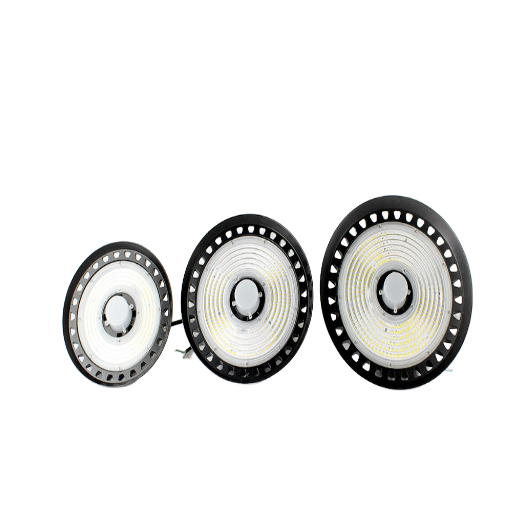
Warehouse lighting problems rarely yield to an office-type calculation. Ceilings soak up photons, vertical shelving blocks light to rack faces, and forklift traffic demands uniformity ratios no office layout ever considers. That is why you cannot specify a target foot-candle per square foot, divide by fixture lumens, and walk away from the spec sheet.
Industry practitioners auditing retrofit projects continue to flag the same four failure modes: catalog-lumen math with no accounting for the light loss factor (LLF), horizontal-only calculations that fail to account for vertical rack-face illumination, spacing grids copied from an open-plan layout and dropped onto narrow-aisle racking, and fixture counts that overshoot the ASHRAE 90.1 Lighting Power Density ceiling — which fails the energy-code plan review. Each fails in a predictable way. Proper lighting comes from sequencing these decisions correctly: standards first, then calculation, then fixture selection, then layout, then beam angles, then controls, then field-mistake mitigation.
Warehouse Lighting Standards — IES, OSHA 1926.56 & ASHRAE 90.1
Three complementary standards shape US warehouse lighting design: IES recommended practice for foot-candle setpoints, OSHA 29 CFR 1926.56 for construction-period minimums, and ASHRAE 90.1-2022 for the LPD ceiling under the energy code. They are not overlapping — each answers a different question.
IES Recommended Foot-Candle Levels (Illuminating Engineering Society)
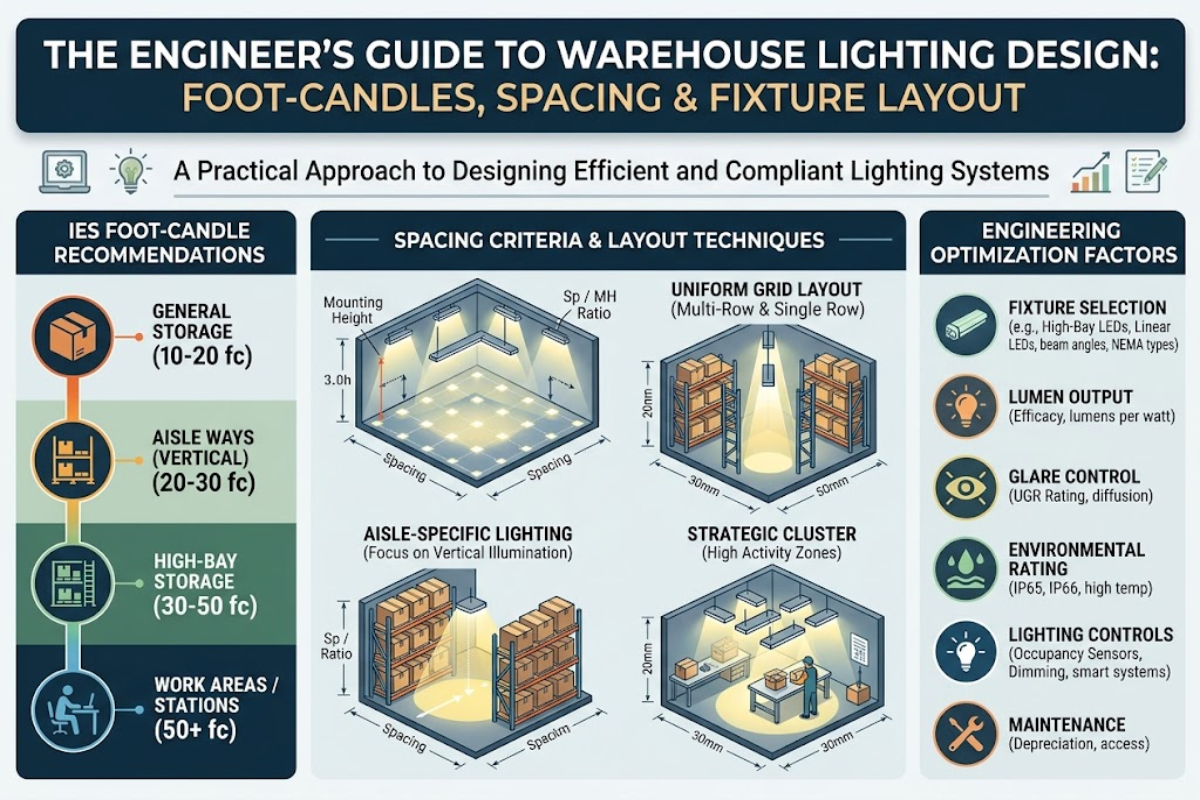
The Illuminating Engineering Society (IES) produces the illuminance tables that every professional warehouse lighting design relies on. The values below are average maintained foot-candles and come from the IES-aligned publication produced by Energy Trust of Oregon and Lighting Design Lab.
| Warehouse Zone | Horizontal FC (avg) | Vertical FC (avg) | Range |
|---|---|---|---|
| Bulky items / large labels | 10 | 5 | — |
| Open warehouse | 20 | — | 10–30 |
| Warehouse with aisles | 20 | 10 | 10–30 / 5–15 |
| Cold storage | 20 | 10 | 10–30 / 5–15 |
| Small items / small labels (pick / pack) | 30 | 15 | — |
| Loading dock / shipping-receiving | 30–50 | — | — |
Source: Lighting Design Lab Footcandle Guide, compiled from the IES Lighting Handbook 10th edition.
OSHA 29 CFR 1926.56 — The Construction-Period Minimum
This is where most warehouse lighting guides fall short. OSHA 29 CFR 1926.56 Table D-3 sets the federal minimum at 5 foot-candles for “indoors: warehouses, corridors, hallways, and exit ways” — not 10 FC as several manufacturer blogs would have you believe. The 10 FC figure in that standard applies to “general construction plants and shops” including active storerooms, which is a different OSHA category. More importantly, 1926.56 is a construction-period safety rule; OSHA 1926.56(b) explicitly defers operational values to ANSI A11.1-1965 R1970, the predecessor of the current IES recommended practice. Treat 5 FC as a code floor, not a design target.
ASHRAE 90.1-2022 — The LPD Ceiling Your Fixture Count Must Not Exceed
Lighting Power Density (LPD) is the watts-per-square-foot cap that total fixture wattage cannot exceed under the energy code. Under ANSI/ASHRAE/IES Standard 90.1-2022, warehouse buildings under the Building Area Method carry an LPD of 0.66 W/sq ft. Modern LED high bay lighting delivers target illuminance at 0.20–0.40 W/sq ft, comfortably below the ceiling, but the check is mandatory at plan review — fail it and the permit drawings go back to the engineer for a fixture-count reduction.
How to Calculate Foot-Candles, Lumens & Lighting Power Density
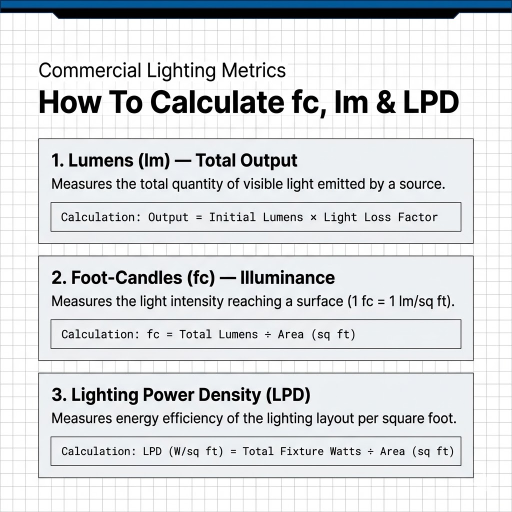
Any competent warehouse lighting system starts with the lumen method. Four steps convert zone targets into a defensible fixture count that satisfies both IES illuminance recommendations and the ASHRAE LPD ceiling simultaneously.
📐 Engineering Note — The Lumen Method Formula
Total lumens required = (Area in sq ft × Target FC) ÷ (CU × LLF)
Where CU (Coefficient of Utilization) runs 0.6–0.85 for high bay fixtures, and LLF (Light Loss Factor) runs 0.75–0.85 after L70 lumen depreciation plus dirt depreciation.
One foot-candle by definition equals one lumen per square foot — no multiplier needed. Some online lighting calculators insert a ×10 factor, which produces a 10× overshoot in fixture count.
Step 1 — Determine the target light level by zone
From the IES table above, an open warehouse averages 20 FC horizontal. Pick-and-pack zones jump to 30 FC. Inspection or QC stations push to 50–100 FC. Never use a single facility-wide number on a mixed-use floor plan — lighting requirements are zone-specific.
Step 2 — Calculate total lumens required
For a 10,000 sq ft open warehouse at 20 FC target, assuming CU = 0.75 and LLF = 0.80:
(10,000 × 20) ÷ (0.75 × 0.80) = 333,333 lumens
Step 3 — Divide by fixture lumen output to get fixture count
A 150W LED high bay at 150 lm/W efficacy delivers about 22,500 lumens. 333,333 ÷ 22,500 ≈ 15 fixtures. That is the target count before you start drawing the spacing grid.
Step 4 — Validate against the ASHRAE LPD ceiling
Fifteen 150W fixtures across 10,000 sq ft equals 0.225 W/sq ft — comfortably below the ASHRAE 90.1-2022 warehouse ceiling of 0.66 W/sq ft. If your calculation lands above the ceiling, either reduce fixture wattage (switch to a higher-efficacy LED high bay) or reduce count and accept a lower maintained FC target within the IES range.
High Bay Lighting Design — UFO, Linear & Low Bay Fixture Selection
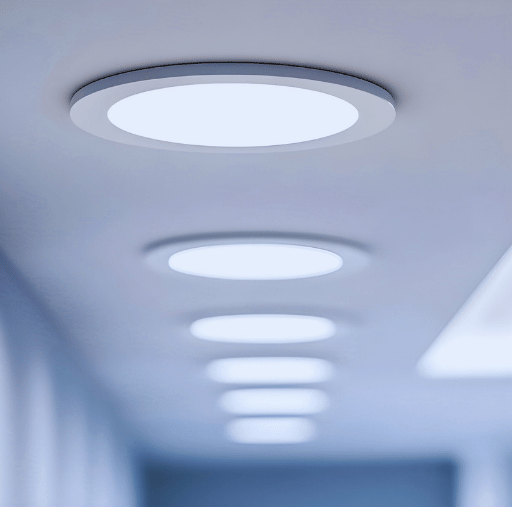
Three fixture families cover almost any warehouse lighting solution. Match form factor to ceiling height and aisle geometry; the wattage follows from the lumen method calculation above.
UFO LED High Bay (Round) — Open Floors, 15–40 ft Ceilings
Round UFO high bay lighting is the default for open warehouse floors with 15–40 ft mounting heights. Symmetric 90° or 120° beam distribution, compact form factor, single-pendant mounting. Common wattages run 100–240W, lumen output 15,000–36,000 lumens, efficacy 150 lm/W or better on current-generation DLC Premium models — the right lighting class for distribution centers, cold storage, bulk warehousing, and general manufacturing bays.
Linear LED High Bay — Narrow-Aisle Racking
Linear fixtures produce an asymmetric 60° × 120° beam directed along the aisle axis with minimal spill onto rack faces. This is the right answer for narrow-aisle racking where uniform vertical illuminance on pallet faces drives pick accuracy. Linear high bay led lights run 160–320W in 4-ft or 8-ft housings, delivering 24,000–48,000 lumens with the asymmetric lens.
Low Bay — Ceilings Under 15 Feet
Low bay fixtures handle loading docks, mezzanines, shop lights applications, and warehouse ceilings under 15 ft. 80–120W, 120° symmetric beam, 12,000–18,000 lumens. Often replacing T8 or T5HO fluorescent tubes on a one-for-one basis without changing the mounting infrastructure, while delivering higher light quality (CRI 80+) than the fluorescent source they replace.
| Application | Ceiling | Fixture Type | Wattage | Spacing |
|---|---|---|---|---|
| Open warehouse floor | 25–40 ft | UFO high bay | 200W | 18–20 ft grid |
| Narrow-aisle racking | 20–30 ft | Linear high bay | 240W | 12–15 ft rows |
| Cold storage / freezer | 20–35 ft | UFO (-40°C rated) | 200W | 16–18 ft grid |
| Loading dock / mezzanine | 10–15 ft | Low bay | 100W | 10–12 ft grid |
| Manufacturing / assembly | 15–25 ft | Linear high bay | 200W | 14–16 ft rows |
For detailed product specifications by ceiling height and environment, see our complete range of LED warehouse lighting fixtures covering UFO, linear, and low bay configurations.
Warehouse Lighting Layout — Spacing, Grid & Ceiling Height Tables
With fixture count established, warehouse lighting layout translates that number into a grid. The governing variable is the Spacing-to-Mounting-Height (SMH) ratio — the ratio between fixture row spacing and the height at which fixtures hang above the working plane. Keep it at 1.0 or less for general storage, 0.8 or less when the project involves picking or inspection, and the uniformity ratio math takes care of itself.
Spacing-to-Mounting-Height Ratios by Zone
| Zone Type | Max SMH Ratio | 25 ft Mount Example | 35 ft Mount Example |
|---|---|---|---|
| Open bulk storage | 1.0 | ≤ 25 ft spacing | ≤ 35 ft spacing |
| Active pick / pack | 0.8 | ≤ 20 ft spacing | ≤ 28 ft spacing |
| Inspection / detail | 0.7 | ≤ 17 ft spacing | ≤ 24 ft spacing |
| Narrow-aisle racking | 0.6–0.8 | Centerline over aisle | Centerline over aisle |
Grid Layout for Open Warehouse Floors
A square grid works best in warehouses with high ceilings and no racking. Start from the lumen method fixture count, then divide floor area by that number and take the square root to get an approximate grid dimension. For our 10,000 sq ft / 15-fixture example, 10,000 ÷ 15 ≈ 667 sq ft per fixture, resulting in a grid of about 25 × 25 ft — consistent with the 1.0 SMH ratio at a 25 ft mounting height.
Scale the same math across facility sizes to estimate fixture counts quickly:
| Area (sq ft) | Target 20 FC | 150W UFO count | 200W UFO count |
|---|---|---|---|
| 10,000 | 333k lumens | 15 | 11 |
| 25,000 | 833k lumens | 37 | 28 |
| 50,000 | 1.67M lumens | 74 | 56 |
| 100,000 | 3.33M lumens | 148 | 112 |
Row Layout for Narrow-Aisle Racking
Warehouse racking changes the math. Mount fixtures directly over aisle centerlines rather than on a uniform grid. Use asymmetric linear high bay units oriented along the aisle axis, so the long-axis distribution (C0–180° plane) fills the aisle length while the short-axis distribution (C90–270° plane) limits spill onto rack tops. The goal is vertical illuminance on pallet faces at all rack levels — not just horizontal FC at floor level.
Beam Angles, Uniformity Ratios & Aisle Illumination
Beam angle selection follows mounting height directly. Uniformity ratio — the relationship between minimum and average illuminance across the working plane — governs how tightly the grid can be spaced before dark stripes appear between fixtures.
Beam Angle by Mounting Height
Under 15 ft mount
120° wide beam. Low bay or wide-beam UFO. Covers broad floor area without hot spots.
15–25 ft mount
90° to 120° medium beam. Typical UFO configuration for most warehouse operations.
25–40 ft mount
60° to 90° narrow beam. Deep ceilings require concentrated photons to reach the floor.
Symmetric vs Asymmetric Light Distribution
Symmetric light distribution is ideal for open floors where coverage needs to spread evenly in every direction. Asymmetric lighting is the answer for racking aisles, where photons need to travel along the aisle axis without spilling onto rack tops. Substituting symmetric high bay units into a narrow-aisle design often drops delivered FC by a third and compromises uniformity below the 0.6 target — a common failure mode in warehouse design simulations.
Uniformity Ratio (Emin/Eavg) Targets
A layout that hits average FC but fails uniformity ratio creates visibly uneven illumination — bright pools under fixtures with dim gaps between. Keep Emin/Eavg at or above 0.4 for general storage, 0.6 for active picking, and 0.7 for inspection or quality control. Drop below these values and forklift operators start reporting depth-perception problems and barcode-scan failures at aisle mid-points, even when the overall lighting system technically passes the FC average test.
Smart Controls — Dimming, Occupancy Sensors & Daylight Harvesting
Warehouse lighting controls are no longer optional under ASHRAE 90.1-2022 — automatic shutoff, occupancy sensing, and continuous dimming are prescriptive requirements for most warehouse spaces, not design upgrades. Modern LED lighting systems should ship with 0–10V dimmable drivers as a baseline; networked controls add another 20–50% in daily run-time savings on top of the LED efficiency gain.
Occupancy Sensors in Low-Traffic Aisles
Bi-level sensors are the standard approach: full output when presence is detected, dimmed output (typically 10–30%) during empty periods. Low-traffic storage aisles in large distribution centers deliver some of the highest controls ROI in any building type — idle time in a warehouse often exceeds 60% of operating hours.
Daylight Harvesting for Clerestory or Skylit Facilities
Photocell-driven dimming can reduce lighting energy use by 20–60% in spaces with significant daylight penetration, according to research from Lawrence Berkeley National Laboratory. Under ASHRAE 90.1-2022, any primary sidelit or toplit daylight zone must include automatic controls that dim electric lighting in response to available natural light. Position photocells at least 10 ft inboard from the daylight aperture to avoid false trigger.
DLC Premium & Utility Rebate Qualification
DesignLights Consortium (DLC) qualified LED high bay lights with networked controls typically qualify for utility rebates of $20–$100 per fixture depending on the program. Check DSIRE for state-specific programs — energy-efficiency rebates in the US commonly offset 15–30% of total project cost, which can tilt the ROI math on any warehouse lighting solution involving controls.
Common Warehouse Lighting Design Mistakes (and How to Fix Them)
MEP engineers and electrical contractors flag these five mistakes more than any others during warehouse retrofit reviews.
⚠️ Mistake 1 — Designing to catalog lumens instead of delivered FC
Fixture datasheets publish initial lumen output. Actual delivered illuminance after L70 depreciation plus dirt accumulation runs 25–35% lower. Divide by CU × LLF in the lumen method; do not skip the step.
⚠️ Mistake 2 — Ignoring vertical plane on racks
A design can hit 20 FC horizontal at floor level and still leave racks in dim vertical illumination. The IES tables specify vertical FC separately (5–15 FC for warehouse-with-aisles) — check both planes during design review.
⚠️ Mistake 3 — Mixing color temperatures on retrofits
Running 4000K and 5000K fixtures on the same floor creates visible color bands. Pick one CCT per contiguous zone. 4000K suits most general warehouse applications; 5000K is preferred for cold storage and high-detail picking where blue-weighted light improves alertness.
⚠️ Mistake 4 — Exceeding the LPD ceiling at plan review
Plan review fails when total fixture wattage ÷ floor area exceeds 0.66 W/sq ft for warehouse buildings (ASHRAE 90.1-2022). Cap total wattage during the quote stage, not after the permit submission.
⚠️ Mistake 5 — High lumens without uniformity check
A warehouse can hit a 30 FC average and still fail the uniformity ratio test. When fixtures are spaced too widely relative to mount height, Emin/Eavg drops under 0.4 and aisle mid-points turn dim. Always run the uniformity calculation before signing off on fixture count.
Warehouse Lighting Design FAQ
Q: How many lux should a warehouse be?
View Answer
Open general warehouse storage targets about 200 lux (≈ 20 FC) average maintained horizontal illumination per IES recommended practice, with a range of 100–300 lux depending on activity level. Pick-and-pack zones scale up to 300 lux, loading docks 300–500 lux, inspection and QC stations 500–1,000 lux. Narrow-aisle racking needs separate vertical illumination on rack faces (typically half the horizontal value). Specialty zones like battery-charging rooms and hazardous-material storage have their own IES targets — check the current Lighting Handbook for the specific zone. One foot-candle equals approximately 10.76 lux, so IES FC ranges convert cleanly to the metric values used in EN 12464-1.
Q: What is the best lighting for a warehouse?
View Answer
LED high bay fixtures are the default answer: efficacy at or above 150 lm/W, IP65-rated enclosure, 4000K or 5000K color temperature, CRI 80 or higher, and 0–10V dimmable drivers. UFO-form high bay lights suit open floors; linear high bays are better for narrow-aisle racking. L70 rated life of 100,000 hours eliminates re-lamping on 20+ ft ceilings for roughly a decade in two-shift operation.
Q: What is the 5:7 lighting rule?
View Answer
The 5:7 rule is an informal guideline some lighting designers use for high-bay spacing: keep the ratio between mounting height and fixture-to-fixture distance around 5 to 7 for acceptable uniformity. In practical terms, this translates to a Spacing-to-Mounting-Height (SMH) ratio near 0.7, which generally keeps Emin/Eavg above 0.5. Formal IES guidance uses SMH ratios of ≤ 1.0 for open storage and ≤ 0.8 for task-intensive zones.
Q: What are IES warehouse lighting standards?
View Answer
The Illuminating Engineering Society publishes recommended illuminance ranges for industrial and warehouse environments in its Lighting Handbook (historically issued as RP-7). Typical targets: 10 FC horizontal for bulky-item storage, 20 FC for open warehouse floors, 30 FC for small-item picking, 30–50 FC for loading docks, and 50–100 FC for inspection stations. Vertical illuminance on rack faces is specified separately and generally runs half the horizontal value.
Q: What is the OSHA requirement for warehouse lighting?
View Answer
5 FC for indoor warehouses during construction — not 10 FC. OSHA 1926.56(b) defers operational values to ANSI A11.1, where IES recommended practice sets higher targets.
Q: How do I choose between UFO and linear high bay fixtures?
View Answer
UFO for open floors; linear for narrow-aisle racking. UFOs use symmetric 90°–120° beams from a single pendant. Linear units use asymmetric 60°×120° beams that track aisle centerlines and deliver vertical illuminance on rack faces.
Q: What is Lighting Power Density (LPD) and how do I calculate it?
View Answer
LPD equals total fixture wattage divided by floor area in square feet. Under ASHRAE 90.1-2022 Building Area Method, warehouses are capped at 0.66 W/sq ft. Example: 15 fixtures × 150W ÷ 10,000 sq ft = 0.225 W/sq ft — below the cap. If the calculation exceeds 0.66, either switch to higher-efficacy fixtures or reduce count while staying within the IES FC range for the warehouse zone.
Get a Custom Warehouse Lighting Layout
Send us your floor plan dimensions, ceiling height, and target FC — our team returns an itemized fixture schedule, DIALux-verified layout, and ROI projection within two business days.
About This Warehouse Lighting Design Guide
The foot-candle tables, LPD values, and spacing rules in this guide are drawn from primary standards documents — osha.gov, energycodes.gov (DOE ASHRAE 90.1-2022 reference), and IES-aligned publications from Lighting Design Lab and Energy Trust of Oregon. Where field data comes from warehouse lighting practitioners, we note the source framing rather than claiming first-hand audits. The 2025 US warehouse retrofit market still shows high variance in design quality, so every fixture schedule deserves a verification pass against these three documents.
References & Sources
- OSHA 29 CFR 1926.56 — Illumination — U.S. Department of Labor, Occupational Safety and Health Administration
- ANSI/ASHRAE/IES Standard 90.1-2022 Performance Rating Method Reference Manual — U.S. Department of Energy, Building Energy Codes Program
- Illuminating Engineering Society (IES) — publisher of the Lighting Handbook and industrial lighting recommended practice
- Footcandle Light Guide (IES-derived) — Energy Trust of Oregon & Lighting Design Lab
- DSIRE Database of State Incentives for Renewables & Efficiency — N.C. Clean Energy Technology Center
Related Articles
- LED Warehouse Lighting — High Bay & Industrial Fixtures — UFO, linear, and low bay product specifications
- Warehouse Lighting Calculator — interactive fixture-count estimator
- LED vs HID Energy Savings Calculator — 5-year TCO comparison for retrofit projects
- Industrial & Hazardous Area Lighting Solutions — heavy-duty fixtures for corrosive and high-temperature environments