Get in Touch with GUANGQI



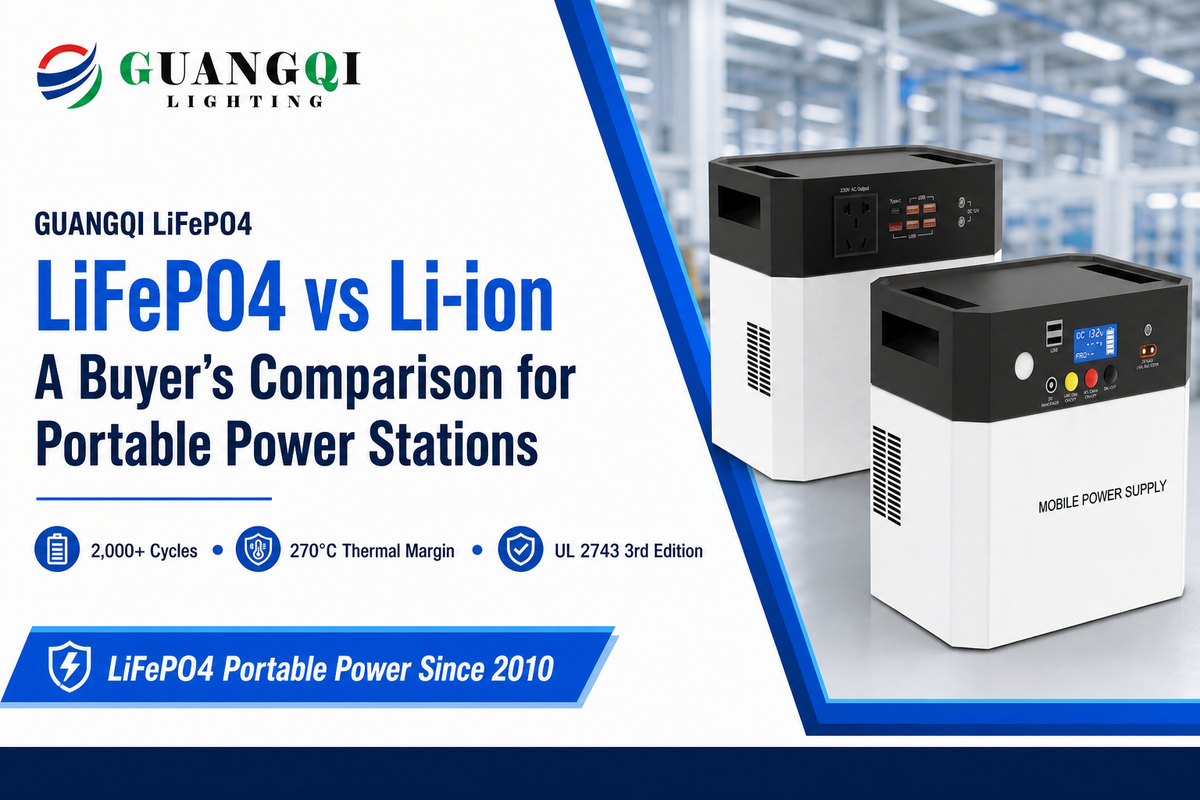
Lifepo4 vs li-ion battery for portable power stations is, at its core, a choice between two lithium chemistries, not two unrelated technologies: lithium iron phosphate (LiFePO4) and typical lithium-ion (NMC, generally). LiFePO4 delivers more charge cycles on the label and in real life, plus a wider thermal safety margin; lithium-ion (NMC), on the flip side, holds the same capacity in less space, lighter by means of its energy-density cells. Sometimes brands offer such units, calling them “solar generator” rather than portable power station, however the same chemistry comparisons are still valid. Portability limits, your cycle count expectations, and, what’s really important, which certification class the product falls under together decide the optimal choice. This guide covers the same ground whether you phrase the search as LiFePO4 vs lithium-ion batteries, lithium-ion or LiFePO4, LiFePO4 or lithium-ion, LiFePO4 vs NMC, or lithium-ion vs LiFePO4, and whether you call LiFePO4 by its full name or the shorthand iron battery.
Quick Specs — LiFePO4 vs Li-ion (NMC) at a Glance
| Cycle life (independently tested, ideal conditions) | LiFePO4 2,000+ cycles vs NMC 1,000-2,000 cycles |
| Specific energy (cell level) | LiFePO4 90-120 Wh/kg vs NMC 150-220 Wh/kg |
| Thermal runaway onset | LiFePO4 ~270°C (518°F) vs NMC ~210°C (410°F) |
| Governing US standard (under 20 kWh) | UL 2743 (Portable Power Packs), 3rd Edition, effective 2025-09-24 |
LiFePO4 vs Li-ion at a Glance
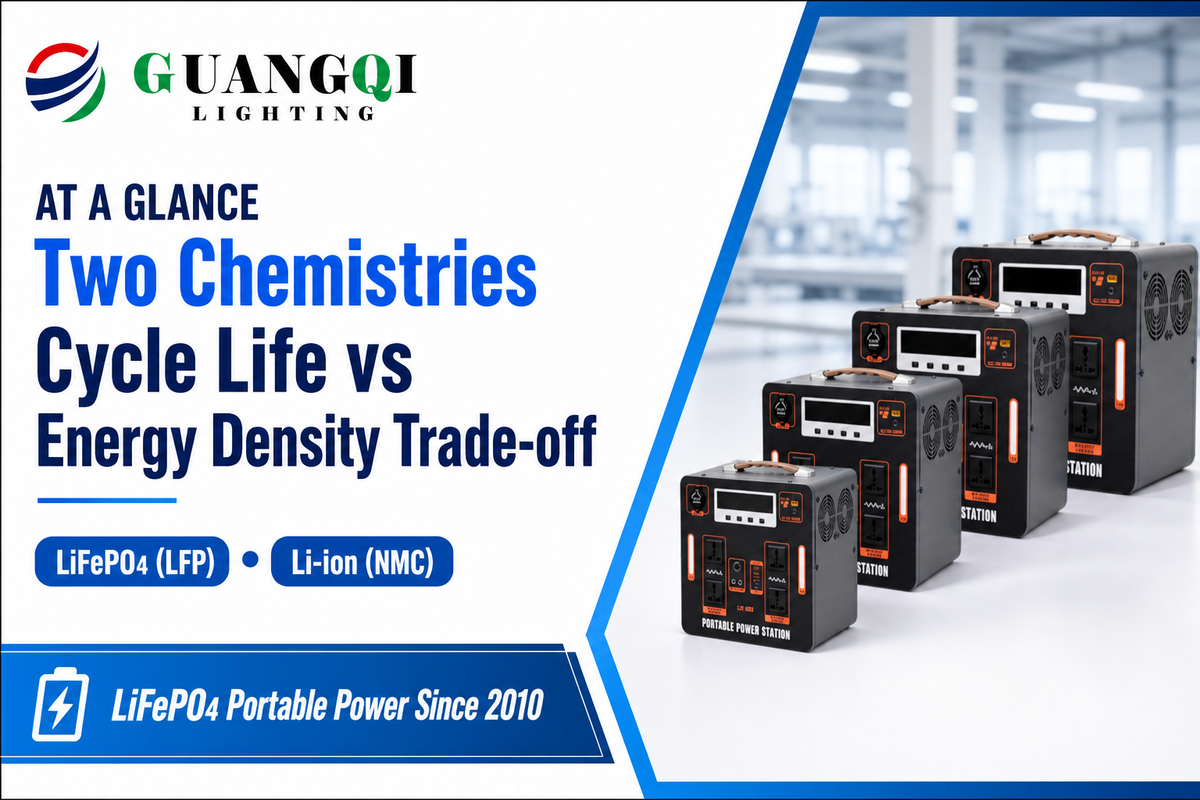
Portable power stations run on one of two battery chemistries: either lithium iron phosphate (LiFePO4, LFP) or nickel-manganese-cobalt lithium-ion pack (NMC, commonly referenced to as simply “lithium-ion”). In laboratory tests, LiFePO4 cells are able to endure over 2,000 charge cycles before they reach 80 percent of capacity. This number is compared to the 1,000 to 2,000 charge cycles that NMC cells can handle under similar laboratory conditions. For the same weight, the NMC cells can offer approximately 25 percent to 80 percent more capacity thanks to higher energy density. This higher capacity makes it the battery chemistry of choice for hand-carried devices, though plenty of portable power stations use LiFePO4 as the default rather than the exception, and power stations with LiFePO4 have become the norm for stationary and semi-stationary use. This comparison, among other purchasing decisions such as cost versus premium and device portability versus the amount of capacity that will be needed, impacts the decision on purchasing a portable power station — the reliable power delivery and longer lifespan that lithium batteries provide is exactly why the category moved away from lead-acid in the first place, and a poorly built battery may still under-perform its rated spec regardless of chemistry. A peer-reviewed comparative review of LFP and NMC battery technologies reaches the same conclusion: neither chemistry wins outright, the right pick depends on which trade-off (cycle life vs energy density) matters more for the use case.
2,000+LiFePO4 rated cycles, ideal lab test
90-120 Wh/kgLiFePO4 cell-level specific energy
20 kWhUL 2743 lithium-ion portable-pack ceiling
270°CLiFePO4 thermal runaway onset
| Attribute by chemistry type | LiFePO4 (LFP) | Li-ion (NMC) |
|---|---|---|
| Cycle life (80% capacity, ideal test) | 2,000+ cycles | 1,000-2,000 cycles |
| Specific energy (cell level) | 90-120 Wh/kg | 150-220 Wh/kg |
| Thermal runaway onset | ~270°C (518°F) | ~210°C (410°F) |
| Nominal cell voltage | 3.2-3.3V | 3.6-3.7V |
| Cobalt content | 0% | 10-20% (higher in some NCA blends) |
| Example commercial cell (peer-reviewed test) | JGNE JGPFR26650, 83.5g / 3.0Ah | Samsung INR21700-40T, 70g / 4.0Ah |
| Sub-freezing charge tolerance | Requires BMS low-temp cutoff below 0°C | Requires BMS low-temp cutoff below 0°C |
| Governing US certification (<20 kWh) | UL 2743, 3rd Edition | UL 2743, 3rd Edition |
| Typical retail price premium | ~20-30% higher than equivalent NMC pack | baseline |
✔ LiFePO4 Advantages
- 2,000+ tested cycles versus 1,000-2,000 for NMC
- 270°C thermal-runaway onset, the widest margin of common lithium chemistries
- Zero cobalt, shorter and less contested supply chain
- Flat discharge curve holds voltage until the pack is nearly empty
⚠ LiFePO4 Limitations
- 25-80% less energy per kilogram than NMC, so packs run heavier
- Can’t be charged safely below freezing without a BMS low-temperature cutoff
- Higher sticker price per Wh at purchase
- Not automatically “safer on every axis” — see the thermal-runaway section below
What’s Actually Different: Chemistry, Not Just a Brand Name
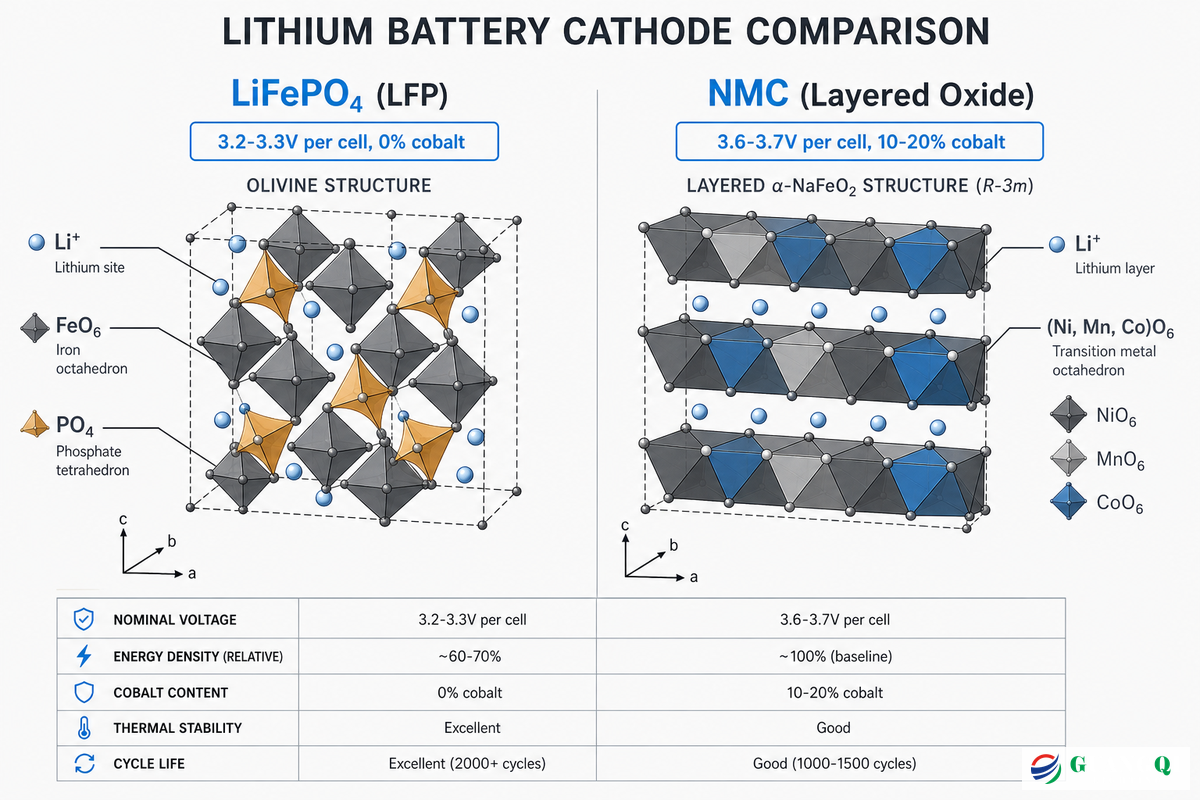
LiFePO4 differs from typical lithium-ion at the cathode: it swaps the nickel-manganese-cobalt oxide (NMC) cathode for iron phosphate, running at a lower 3.2-3.3V per cell versus 3.6-3.7V for NMC. This single change is why LiFePO4 counts as a lithium-ion subtype rather than a separate battery family, even though buyers often treat the two as unrelated chemistries.
Even without taking into account the actual raw materials, this single chemical change has significant impacts down the line. This indicates that, to attain the same voltage level, a LiFePO4 pack requires a larger quantity of series cells, hence contributing to higher cost of manufacturing the LiFePO4 packs for every kilowatt hour. Most electronic devices such as phones and laptops produced before approximately 2020 used the NMC or NCA (nickel-cobalt-aluminum) chemistry for high energy density. However, LiFePO4 technology has increasingly dominated the lower voltage and high-cycle count sector of the battery market. That segment now spans power tools, home energy storage, and more recently portable power stations. This cathode material difference is why LiFePO4 counts as a subtype of lithium-ion rather than a wholly separate lithium battery chemistry, and it’s why buyers still ask about the differences between LiFePO4 and traditional lithium-ion batteries — or NMC lithium-ion batteries, to use the fuller name — when deciding whether to replace the battery in an aging unit rather than assuming NMC batteries are the default choice. Compared to lithium-ion batteries used in portable power stations a decade ago, LiFePO4 batteries are much closer to reaching price parity today, which is the real story whether you read it as LiFePO4 and lithium-ion batteries or lithium-ion and LiFePO4 batteries. Some sellers still market the chemistry as a “LiFePO4 lithium battery” or bundle it under “LiFePO4 LFP batteries” branding; both phrases describe the same cathode chemistry covered here, and the Li ion NMC vs LiFePO4 question always comes back to the same cycle-life, weight, and certification trade-offs.
Regardless of the chemistry type, the improper protection of a battery could lead to failure. Whether a battery counts as a “real” lithium battery has little to do with that factor, though it’s a recurring point of confusion on battery forums. Actually, LiFePO4 belongs to a family of lithium-ion cathode chemistry technologies, similar to LCO (lithium cobalt oxide), NCA and NMC, that were responsible for battery fires aboard the Boeing 787 in 2013. Therefore, simply grouping the word “all” lithium-ion together under one risk group doesn’t accurately represent the range of products that fall into this grouping. According to an experienced technician who specializes in marine batteries and has been working in the field for 17 years with the same battery, “Not even in the same universe” in terms of safety of LiFePO4 versus LCO, even though both batteries have “lithium” in their name. A 2025 Journal of Power Sources study on long-term LiFePO4 cell storage underscores the same point from the lab side: cathode chemistry, not the “lithium-ion” label, is what drives a cell’s long-term behavior.
Cycle Life & Lifespan — The Cycle-to-Cost Crossover Point
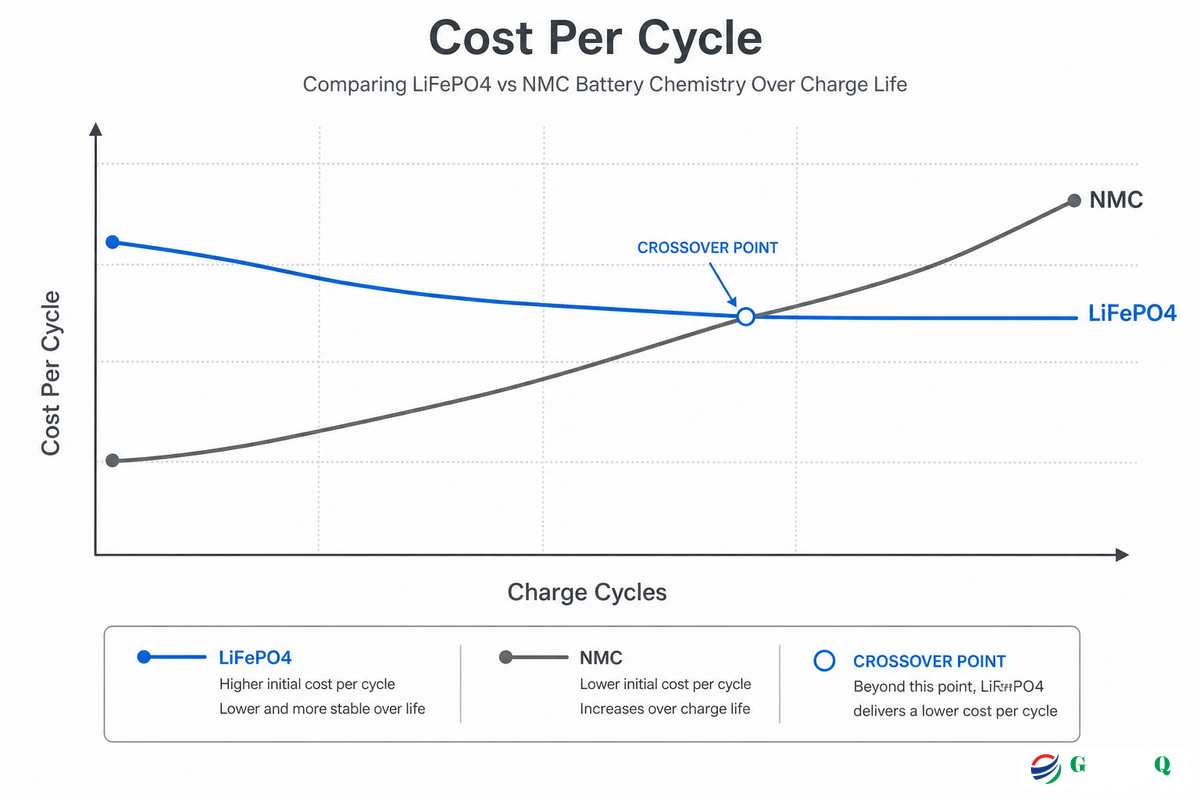
LiFePO4 has a rating of 2,000 or more full cycles to 80 percent capacity under lab conditions, almost double the 1,000-2,000 cycles of NMC in the same protocol. In the real world, that gap grows much larger: one 2026 commercial LiFePO4 pack that an independent test lab measured out reached 4,000 cycles at 100 percent depth of discharge (DoD), 6,000 at 80 percent, and 15,000 cycles at 60 percent DoD. It’s the same cell chemistry, but three vastly different numbers.
That’s because a pack’s cycle life depends on how deeply you use it, and how often. The figure of ‘X cycles’ by itself means nothing unless depth-of-discharge and temperature are included, a point a peer-reviewed comparative review of LFP and NMC battery technologies makes as well when it qualifies its own “beyond 2000 cycles” figure for LFP.
Guangqi’s own line of portable power stations uses the cycle-life bands for each model tier instead of a one-size-fits-all number: 2,000 cycles for the compact LK-series models, 6,000 cycles for the stationary-adjacent MS series and as much as 11,000 cycles for specific large systems under the stated test conditions. That tiered structure lines up with a more recent Canadian federal benchmark: Natural Resources Canada’s battery ecosystem benchmarking report puts the current industry standard at 6,000-8,000 cycles for LFP versus 500-1,000 cycles for NMC, with a 2035 target of 10,000 cycles for LFP and 2,000 for NMC — well above Battery University’s conservative “ideal lab” figures above, underscoring how much cycle-life claims can shift with the benchmark you use.
That structure mirrors the DoD dependence shown above, not a broad marketing statement.
Key takeaway
A higher LiFePO4 sticker price still produces a lower cost per cycle at the conservative low end of independently tested ranges — the crossover happens well before the battery is half worn out.
To find the break-even point between the two chemistries, let’s use conservative low-end figures from independent tests of the chemistries (1,000 cycles for NMC, 2,000 cycles for LiFePO4): Let’s say you can get a 1,000Wh pack of either chemistry, and the NMC version costs $400, so its cost per cycle is $400 ÷ 1,000 = $0.40. A comparable 1,000Wh pack made with LiFePO4 is about 30 percent more, $520, but the 2,000-cycle rating makes its cost per cycle $520 ÷ 2,000 = $0.26.
At this point, it’s already 35 percent cheaper per cycle than the low-end NMC, and the difference increases if you look at the 3,000-4,000-cycle performance you see from today’s real-world products. You can cross-check these numbers against a specific unit using Guangqi’s model comparison table.
Safety & Thermal Runaway Risk
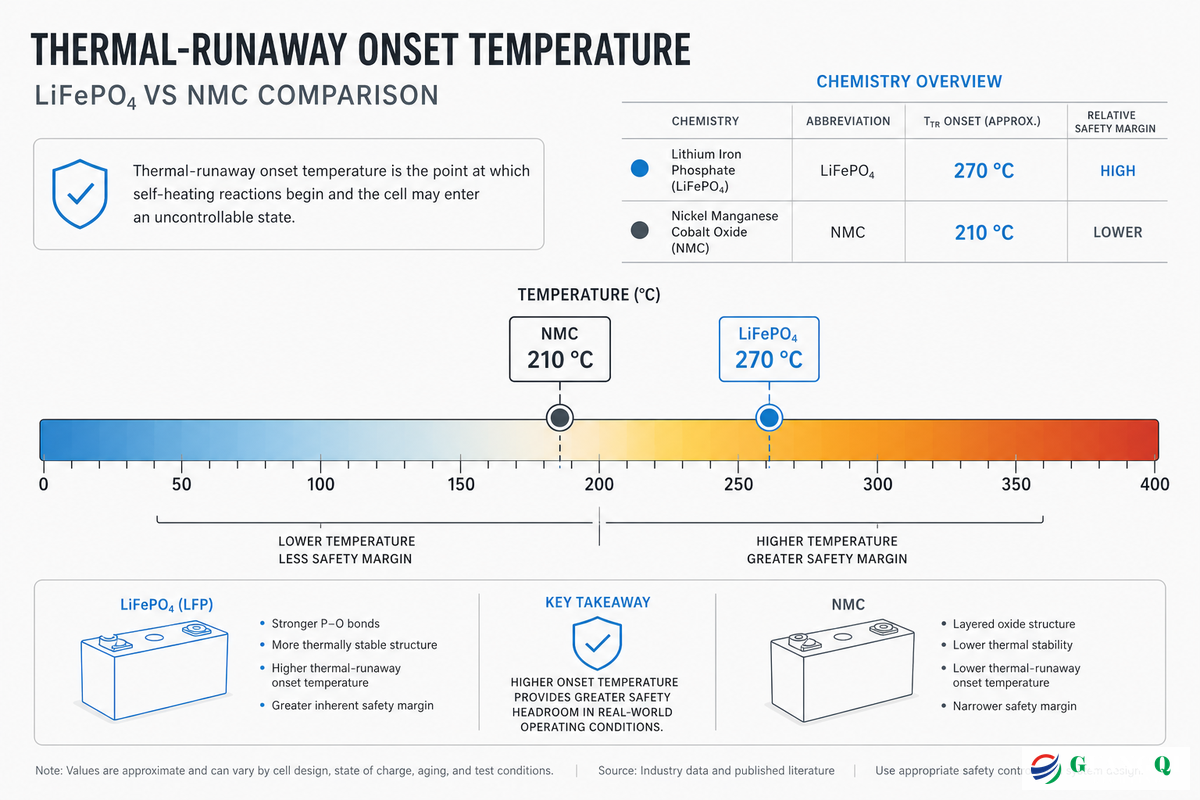
LiFePO4 has much better thermal stability than NMC, so it’s less likely to catch fire or explode, but just being ‘more stable’ isn’t ‘safe in all cases,’ and treating it that way is where most comparisons overreach. LiFePO4 batteries are known for this wide thermal margin, which is exactly why buyers specifying a battery system for an enclosed space, like a van build or a bedroom closet, still ask for it by name. Anyone researching NMC vs LiFePO4 safety specifically for that kind of confined installation should weigh this section closely before the cost comparison later in this guide.
A literature review commissioned by the US Department of Transportation found LiFePO4 cell thermal runaway at full charge produced between one-third and one-half the peak heat output of NMC cells – a measured improvement, not a marketing claim.
“LFP is less expensive than cobalt and nickel, and all the minerals can be obtained here in North America, which means much lower transportation costs and a more secure supply chain.”
— Stanley Whittingham, 2019 Nobel laureate in Chemistry, Binghamton University
However, the narrative of “LiFePO4 always wins on safety” isn’t entirely straightforward, and two caveats should be made before you take that as the ultimate truth: First, according to Sandia National Laboratories, the lower heat-release rate of LiFePO4 doesn’t eliminate runaway propagation – even a poorly insulated module can transfer heat to its neighbors, regardless of cell chemistry, so your module/pack/enclosure design matters just as much as the cell itself. Second, in studies conducted at UK universities, LiFePO4 reached its flammability limit at lower volumes of released gas than NMC and produced a more toxic gas mixture when operating at low states of charge, details missing from the marketing material for almost every competing page that you’ll see online.
Most battery safety fires, according to reports on the r/batteries forum, stem from manufacturing defects, the use of “no name” batteries that are designed to cut costs, or physical trauma like puncturing the pack with something sharp – not because a well-constructed lithium-ion pack has “failed.” Provided that the manufacturer has supplied real, unbiased cell-level and pack-level data (regardless of chemistry), you can significantly mitigate the real-world risk of the pack catching fire.
Energy Density & Weight: Why One Chemistry Is Lighter
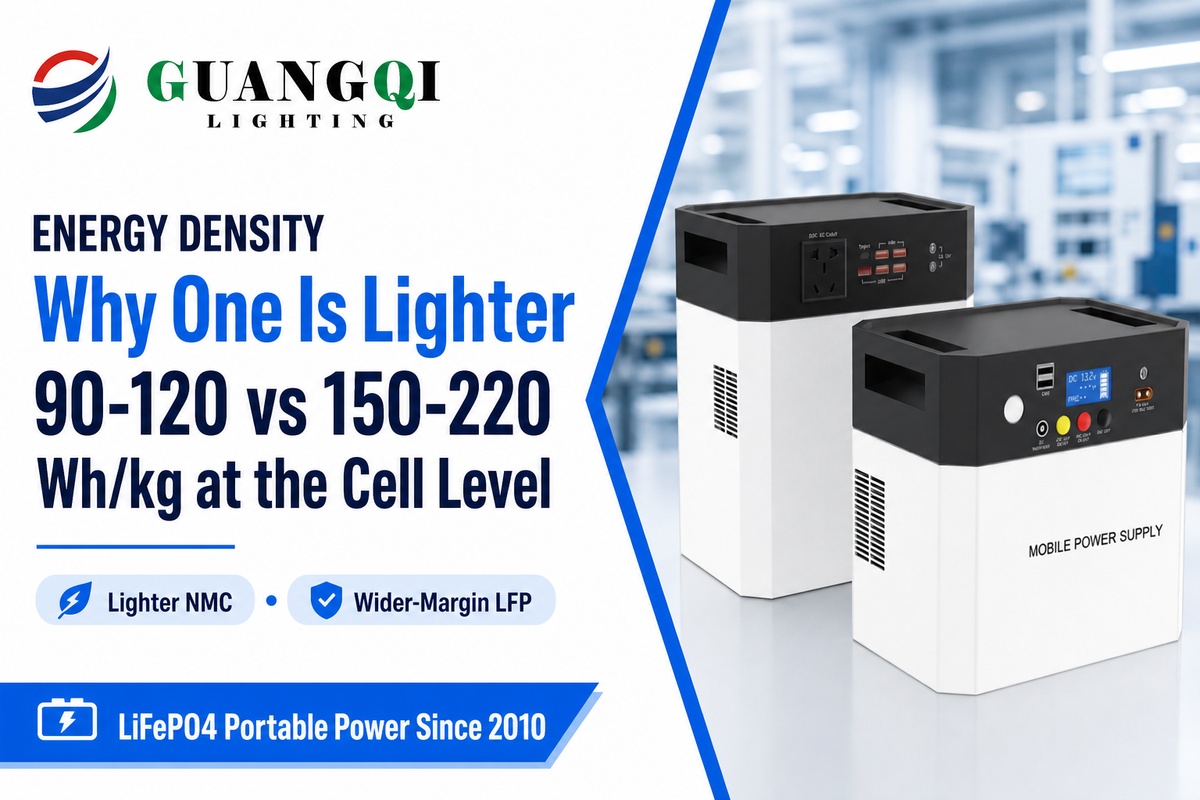
Compared to the 90-120Wh/kg of LiFePO4 cells, NMC cells can deliver between 150 and 220Wh/kg of cell-level capacity. That translates into an advantage of between 25 and 80% weight advantage. In a peer-reviewed cell-testing dataset of tested cells, a 3Ah LiFePO4 cell weighed 83.5 grams compared to 70 grams for a 4Ah NMC cell of similar specifications. In other words, you can get more capacity in a lighter, smaller package using NMC.
Choose LiFePO4 weight trade-off when
- The unit sits in one place most of the time (home backup, garage, van build)
- You cycle it frequently and want the pack to still be alive in year six
- Fire margin outweighs a few extra kilograms for you
Choose Li-ion (NMC) weight trade-off when
- You carry the unit — backpacking, hiking, tight aircraft-cabin weight limits
- Usage is occasional (a few dozen cycles a year), so cycle life matters less
- Maximum runtime per kilogram is the deciding factor
Real product tables make the trade-off concrete: in the case of Guangqi’s LK-series, pack level density ranges from 68Wh/kg in their compact 300W version up to 81Wh/kg in their 1000W series. These numbers are naturally lower than the chemistry cell numbers listed above due to BMS, inverter and enclosure overhead found in the completed pack. That gap between a product’s published pack-level Watt-hours-per-kilogram figure and the equivalent cell-level calculation is a good indication of what you actually get in the finished package.
The Cold-Start Charging Gap: Charging Behavior by Chemistry
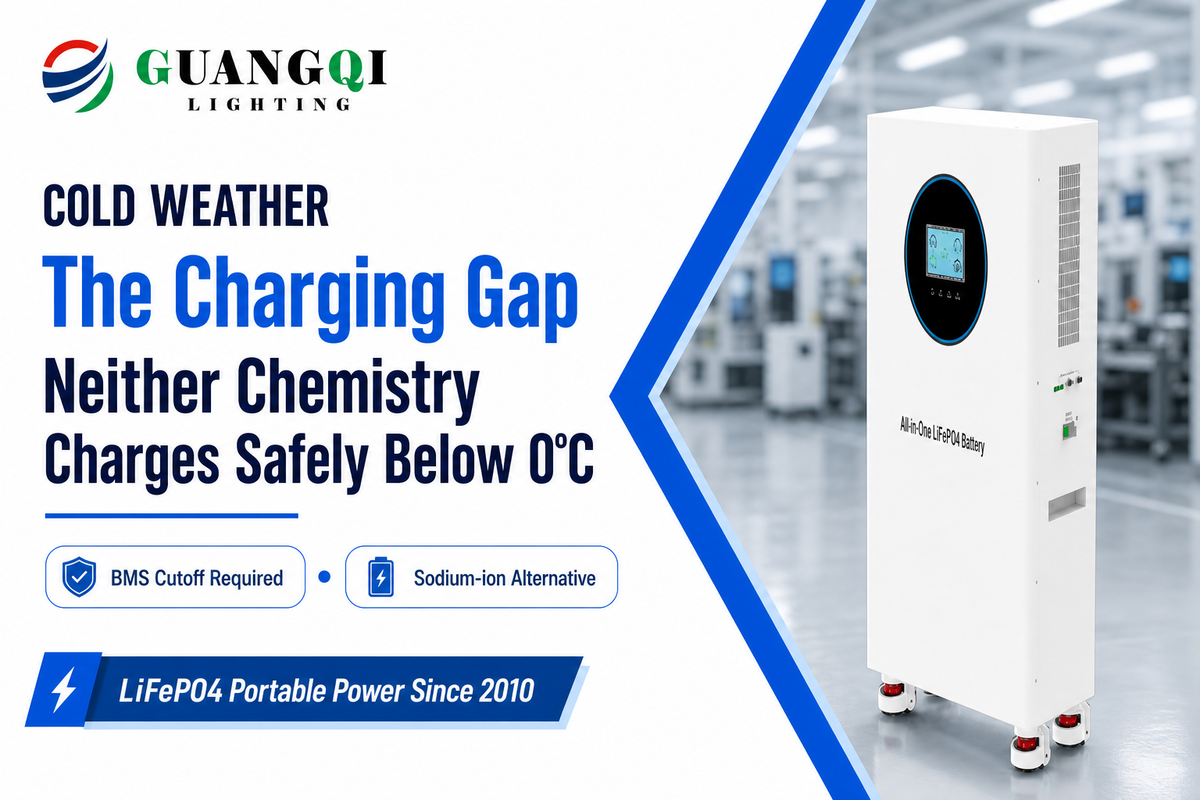
One hard rule applies to both chemistries that virtually all comparison sites miss or obscure: Don’t charge a lithium cell, whether it’s NMC, LiFePO4, or something else, in below freezing conditions. Attempting to charge your pack below 0°C (32°F) risks lithium plating, a phenomenon which causes irreparable degradation of your cell capacity and doesn’t go away even after warming up. While a quality battery management system will prevent this from occurring by simply ceasing charge current flow at an established temperature setpoint, many of the cheaper options won’t, turning the question of “safety” into one of build quality.
That rarely bites anyone who’s charging inside a heated structure; it’s a limitation that affects garage installations, unheated van builds and winter camping more severely. For users with an actual need to charge in subfreezing temperatures, a new option exists in the market in the form of sodium-ion chemistry: Bluetti’s Pioneer Na, launched worldwide October 15, 2025, is built for exactly this: BLUETTI’s own product announcement confirms reliable discharge down to -25°C (-13°F), and trade press coverage reports a cold-charge threshold around -15°C (-5°F) with a modest weight penalty versus an equivalent LiFePO4 unit — figures worth confirming against the datasheet before you buy, since the manufacturer’s own release does not spell out the exact cold-charging and weight numbers. For the vast majority of consumers operating out of a heated home or garage, the tradeoff isn’t justified at this time; for the unheated set, it represents the first credible alternative to “just don’t charge it when it’s cold.” The principles discussed here also apply to outdoor solar products (refer to Guangqi’s solar flood lights guide).
Portable Pack vs Stationary ESS: The UL Line — Certification & Category Boundaries
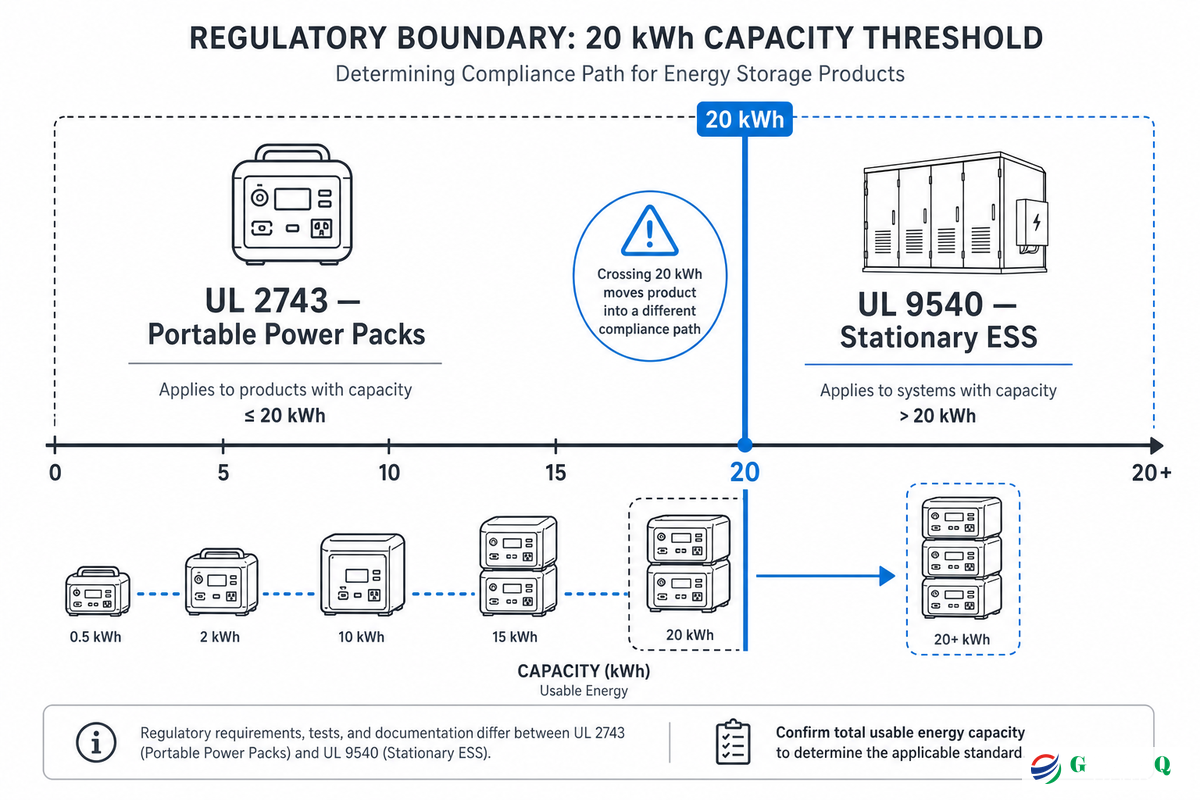
Regardless of chemistry, any portable power station sold in the United States falls under one of two UL safety standards, and which one applies depends on two things together, not capacity alone: the unit’s maximum capacity, and whether it’s used as a true portable device or installed as fixed, grid-connected home storage. UL’s own guidance is explicit that intended stationary use can trigger UL 9540 requirements even for a product that looks “portable,” so the 20 kWh threshold below is necessary but not by itself sufficient — check installation type too, not just the marketing designation. The 20 kWh cutoff, in particular, was hardcoded in the Third Edition (published September 24, 2025) of UL 2743, “Standard for Portable Power Packs.” Units exceeding that capacity require UL 9540 certification instead — the standard that governs the design of stationary energy storage systems. For example, Guangqi’s own mobile-storage MS-T04 through MS-T16 (4.04-16.07 kWh) are well below the 20 kWh limit. Double-check any manufacturer’s spec sheet to see whether its massive “portable” power station is covered under the lighter-weight portable standard.
| Question | Portable pack answer (UL 2743) | Stationary ESS answer (UL 9540) |
|---|---|---|
| Capacity ceiling | 20 kWh lithium/sodium-ion aggregate | 20 kWh residential / 50 kWh non-residential, higher if UL 9540A tested |
| Grid-connected or hardwired? | No — explicitly excluded from UL 2743 scope | Yes, this is the scope UL 9540 governs |
| Files to request | UL 2743 listing mark, battery transport papers | UL 9540 system listing, UL 1973 battery subsystem, UL 1741 power conversion, NFPA 855 install compliance |
This reveals a major gap in the market: UL Solutions’ guidance warns that devices solely certified under UL 2743 are being strung together and marketed as 50-100 kWh whole-home backup systems, which exceed the 20 kWh limit but lack UL 9540 certification for stationary-energy storage — a requirement mandated by installation codes. According to UL, the simple act of linking together several independently certified portable units in the field doesn’t constitute a certified system. If you’re shopping for a large “portable” unit for home backup, ask to see the UL 9540 certification directly; a UL 2743 label on the individual batteries isn’t sufficient (Guangqi’s IP rating durability guide touches upon this principle in relation to outdoor lighting).
Cost Comparison: Upfront Price vs Cost Per Cycle
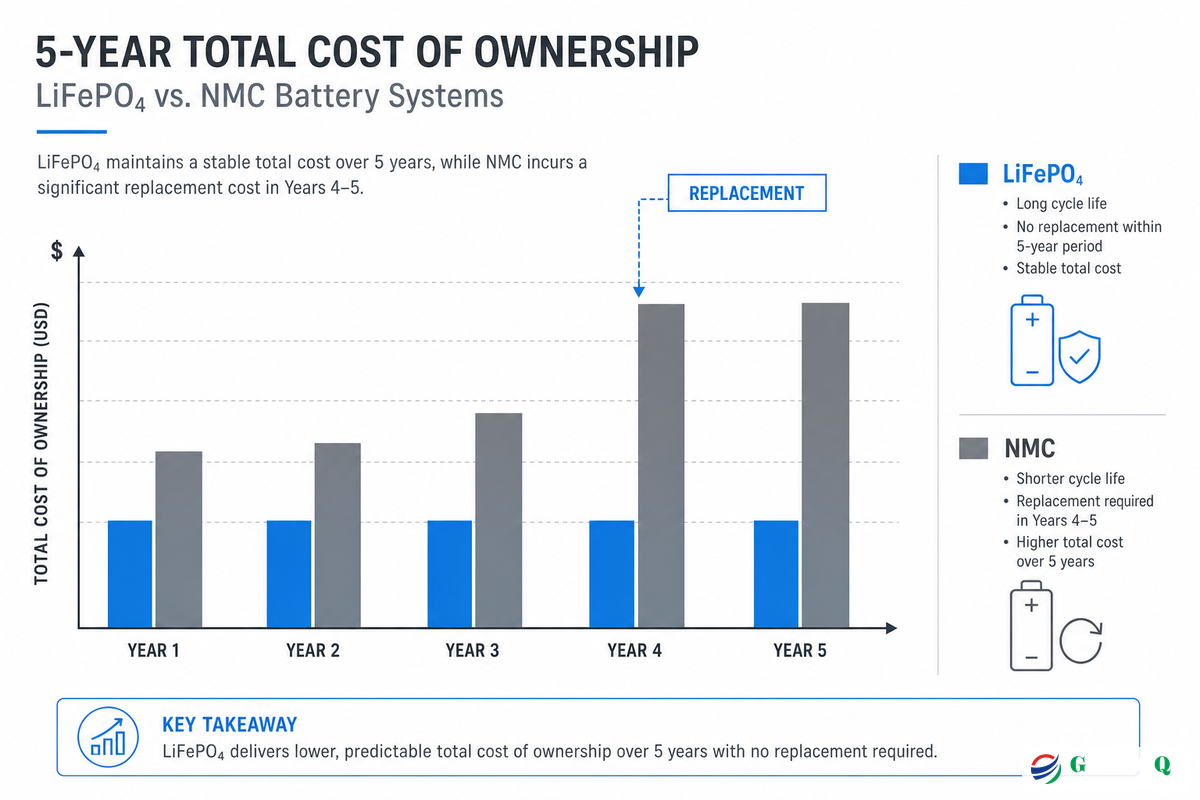
Portable lithium-ion packs have decreased in cost by roughly 80 percent over the last decade — from $580 per kWh ten years ago to approximately $115 per kWh today. This price decline applies to all lithium-ion chemistries, including the shrinking price difference between NMC and LiFePO4, which maintains its longevity advantage. As the H2-3 crossover math above illustrates, even at conservative tested-range parameters, LiFePO4 costs less per cycle than its competitors, and the LiFePO4 vs li-ion battery for portable power stations price gap keeps narrowing every year as cell manufacturing scales — the same downward cost trend the U.S. Department of Energy’s storage-cost overview documents for battery storage paired with solar generally. The 5-year view below shows replacement cost factored into the calculation.
5-year cost of ownership, 1000Wh-class unit, ~200 cycles/year usage:
| Cost item | LiFePO4 | Li-ion (NMC) |
|---|---|---|
| Purchase price (illustrative) | $520 | $400 |
| Installation & commissioning | $0 (plug-and-play) | $0 (plug-and-play) |
| Cycles used over 5 years (~1,000/yr planning basis) | 1,000 of 2,000+ rated | 1,000 of 1,000-2,000 rated |
| Replacement risk within 5 years | Low — still within rated range | Moderate-to-high at the low end of the rated range |
| Total realistic 5-yr cost (incl. 1 likely replacement for NMC low-end units) | $520 | $400-$800 |
Payback example: at roughly 200 cycles per year, a 5-year window uses about 1,000 cycles. LiFePO4 units rated at 2,000+ cycles finish the period with headroom to spare. NMC units rated at the low end of their 1,000-2,000-cycle range may need a $400 replacement partway through year five — pushing realistic 5-year NMC cost to $800 against LiFePO4’s flat $520, even though LiFePO4 cost 30 percent more on day one. Treat this as a cycle-driven approximation, not a complete lifetime forecast: real packs also lose some capacity to calendar aging (time spent at rest, regardless of cycling) and to inverter and BMS conversion losses, so a unit’s actual usable years can vary from the cycle math above.
Which Should You Choose? — 5-Signal Load Profile Selector (Camping, Off-Grid & Home Backup)
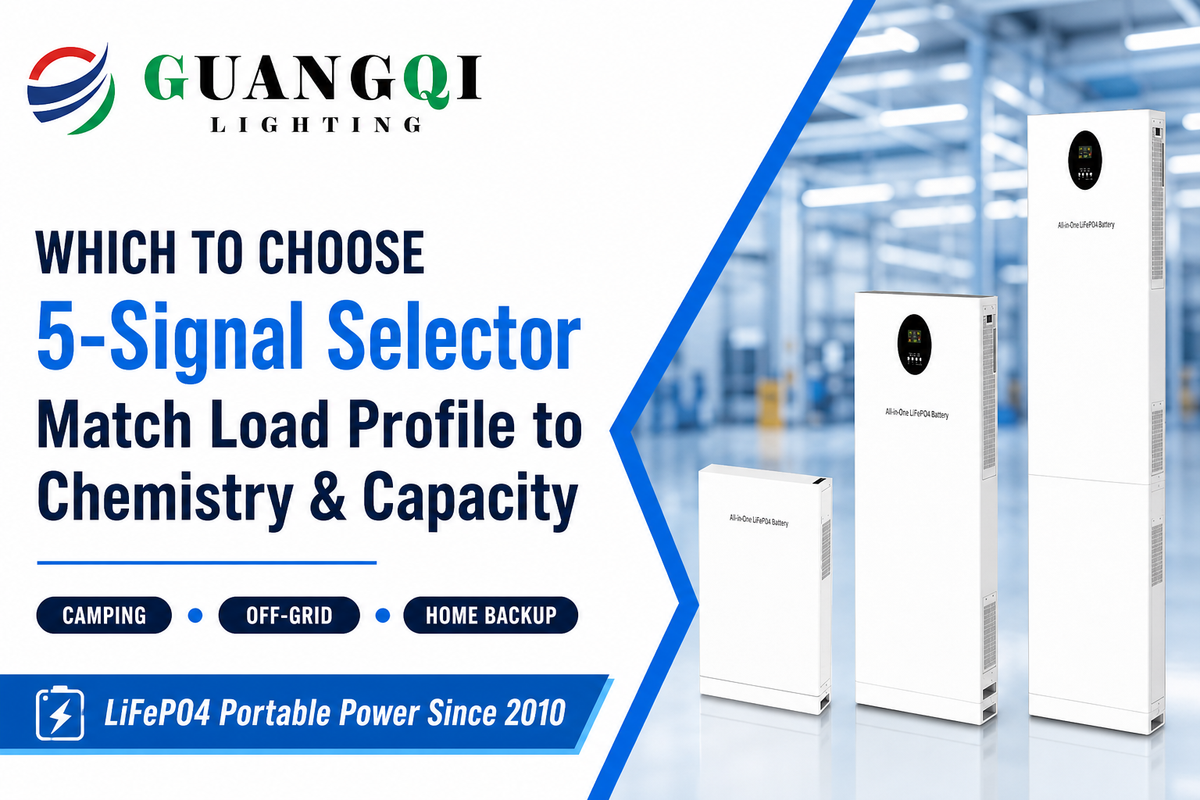
Chemistry choice should follow how the unit will actually be used, not the other way around: camping, backup power during a home outage, off-grid power paired with solar power, and whole-circuit stationary coverage each favor a different point on the capacity-and-chemistry scale, even when battery type looks similar on paper. Duty cycle and certification decide the right pick, not raw power solutions marketing.
Guangqi’s product-class divisions, spanning compact camping packs to full power backup and power systems for whole-circuit coverage, give a useful benchmark for matching capacity and chemistry to your typical load profile (see below). Both chemistries deliver consistent power within their duty cycle.
| Signal | Load profile | Recommended fit |
|---|---|---|
| 1. Weight-critical, occasional use | Backpacking, phone/light charging, <20 cycles/year | NMC, compact class (~230-300Wh) |
| 2. Frequent camping / shared use | Car camping, weekly trips, 50-150 cycles/year | LiFePO4, mid-range class (~600-1,500Wh) |
| 3. RV / marine, temperature swings | Daily-use house battery, wide temp range | LiFePO4 with BMS low-temp cutoff, verify charging spec below 0°C |
| 4. Home outage, selected circuits | Refrigerator, router, lights during outages | LiFePO4, mobile-storage class (~4-16kWh, e.g. Guangqi MS-T series) |
| 5. Whole-home / stacked capacity >20kWh | Multi-day outage, whole-house transfer switch | Move to UL 9540-listed stationary ESS, not stacked portable packs |
Guangqi’s runtime and model calculator can transform your list of appliance loads into a specific Wh target, once you select a row above, and compare against the full Guangqi portable power station lineup. One cautionary tale from the field: an off-grid forum member noted that a cheap inverter could fail years before a well-built LiFePO4 cell does – the battery’s cycle-life advantage is only realized if the balance of the unit is built to its standards, so factor in the quality of the inverter and BMS in addition to the cell chemistry. Row 5 above is not optional guidance: stacking multiple portable packs past 20 kWh without a genuine UL 9540 system listing is exactly the daisy-chaining gray zone covered in the certification section above. For an explanation of how the same “match component to load” logic applies to low-voltage 12V/24V power architecture, see Guangqi’s solar street lights coverage.
Industry Outlook: Where Portable Power Storage Is Headed
UL 2743’s September 2025 update draws a line more consequential for buyers than any market size estimate. It formally qualifies sodium-ion as a certified chemistry within the same standard that covers LiFePO4, adds a peak discharge current test, and, crucially given the daisy-chaining gap discussed previously, clarifies the line between a portable power pack and a full-blown stationary storage system. Expect this divide to become more significant annually, as consumer reviewers already report on flagship devices offering 4-6.4 kWh for sale explicitly as home-backup replacements, nibbling away from below toward 20 kWh.
Sodium-ion’s commercial debut (Bluetti Pioneer Na, October 2025) offers a first truly alternative technology for addressing LiFePO4’s cold-charging limitations, rather than simply a lab claim. It’s worth watching if cold climates are a major concern, although currently sodium-ion sacrifices weight to do so. Evidence of continued near-term engineering interest in LiFePO4 includes patents, such as those from a U.S. manufacturer for LiFePO4 power-case design filings submitted every few months through 2025, and 2024-2025 filings out of China targeting specific LiFePO4 issues like state-of-charge drift and vibration-resistant assembly. Market size estimates vary 5- to 7-fold based on which analyst definition is used — Grand View Research figures $4.2 billion in 2025 and a 22.4% compound annual growth rate (CAGR), but narrower, Li-only or regional figures fall well below that, so treat any single market size figure as background, not as a number to build a decision on.
Frequently Asked Questions
Q: What are the disadvantages of LiFePO4 batteries?
LiFePO4’s main disadvantages are lower energy density (25-80% less than NMC), a higher upfront price per Wh, and the need for a BMS low-temperature cutoff to charge safely below freezing.
An NMC pack of equivalent capacity costs less and weighs less than an equivalent LiFePO4 pack. And, contrary to much of the marketing material, research has demonstrated LiFePO4 cells can reach flammability levels at smaller volumes than NMC in some conditions.
Q: Does Jackery use LiFePO4 batteries?
Jackery’s product line includes both chemistries, and it varies by model and generation rather than one blanket answer: newer Jackery models increasingly default to LiFePO4, while older or budget lines still ship with NMC cells.
Leading portable power station brands (including Jackery) are gradually moving over to LiFePO4 in their latest generation models while older legacy models or budget ones still rely on NMC. Don’t assume based on brand alone, but check the specific model’s spec sheet or datasheet for cell chemistry – this is true for all manufacturers, not just Jackery.
Q: Is LiFePO4 worth the higher upfront cost compared to lithium-ion?
Yes for regular users: at the conservative end of tested cycle ranges, LiFePO4’s cost per cycle runs roughly 35% lower than NMC despite a 30% higher sticker price.
That crossover point occurs long before you’ve run out of even half the battery – look back at the cost-per-cycle worked example above. For occasional use at fewer than a few dozen cycles a year, the cycle life advantage is less of a factor and the lower weight and cost of NMC might be a better trade-off.
Q: Can I charge LiFePO4 batteries below freezing?
No — charging below 0°C (32°F) risks permanent capacity loss from lithium plating on the anode, a form of damage that does not reverse once the pack warms back up.
Quality battery management system (BMS) technology prevents this by disabling charging below certain temperatures; discharge (i.e., the unit is used as a power source) is usually OK to lower temperatures. Only sodium-ion offers truly effective cold charging.
Q: Why do LiFePO4-based power stations cost more if the battery cells themselves are cheaper?
LiFePO4’s lower per-cell voltage (3.2-3.3V vs 3.6-3.7V for NMC) means more cells in series are needed to reach the same pack voltage, adding cell count, wiring, and BMS complexity that raises the finished-pack price even though raw LiFePO4 materials cost less than cobalt-containing chemistries.
The reduced cobalt and nickel content actually cuts raw material cost and supply chain risk, but you lose some of that advantage to the ~10-15% additional cells you’ll need to achieve the same system voltage and a more complex BMS. That trade-off produces the ~20-30% retail price markup over equivalent NMC power stations we generally see, despite the raw materials not being intrinsically more expensive.
Q: What size portable power station do I need for my RV?
Add up the running watts of everything you’ll use at once, multiply by expected daily hours, and add 20-30% headroom for inverter and BMS losses before matching to a Wh capacity.
A weekend of running a refrigerator, a few lights, and a fan falls within the 1,000-2,000 Wh range; add a rooftop AC or cook extensively each day, and you’re in the 3,000+ Wh category. Worked example: a 60W fridge running 8 hours a day draws 480Wh, three 10W LED lights running 5 hours add 150Wh, and a 40W fan running 6 hours adds 240Wh — 870Wh of daily draw before headroom. Add the recommended 20-30% margin for inverter and BMS losses and you land around 1,050-1,130Wh per day, which points to a 1,200Wh-class unit at minimum if you want a full day of runtime without recharging. Guangqi’s runtime and model calculator will run this same calculation automatically once you enter your own appliance list and wattage. A LiFePO4 power station 1000 watt-class unit covers the fridge-plus-lights scenario above with margin to spare; a dedicated LiFePO4 RV battery bank makes more sense once you’re past the 3,000Wh mark or running the AC daily.
Why We Write This
Guangqi Lighting, based in Guzhen, China, began manufacturing LED lighting fixtures in 2010 and later applied this in-house design process (including mold design, driver electronics, thermal management, and in-house testing) to their LiFePO4 portable power station product line, featured on this page. The cycle-life and Wh/kg estimates provided for our LK and MS series power stations come directly from our 2026 Photovoltaic Energy Storage brochure, not a marketing flyer.
Related Articles
References & Sources
- UL 2743, Standard for Portable Power Packs, 3rd Edition (2025-09-24) — UL Standards & Engagement
- UL 9540, Standard for Energy Storage Systems and Equipment, 3rd Edition — UL Standards & Engagement
- Q&A: Portable Power Packs and Stationary ESS Certification — UL Solutions Code Authority
- Lithium Battery Fire and Explosion Mitigation Literature Review — U.S. DOT, Pipeline and Hazardous Materials Safety Administration
- Grid-Scale Battery Storage Hazard Analysis — Sandia National Laboratories
- Solar Plus Storage 101 — U.S. Department of Energy
- Navigating Battery Choices: LFP vs NMC Battery Technologies — Evro et al., Future Batteries (Elsevier), 2024
- Long-Term Shelf Storage Effects on LiFePO4 Cells — Journal of Power Sources (Elsevier), 2025
- BU-205: Types of Lithium-ion — Battery University (Cadex Electronics)
- How Safe Are Lithium Iron Phosphate Batteries? — pv magazine, reporting University of Sheffield / Imperial College London / University of St Andrews research
- LFP Becoming the Battery of Choice for Electric Vehicles — Reuters, via Asia Financial
- Portable Power Station Market Report — Grand View Research
- Benchmarking the Canadian Battery Ecosystem — Natural Resources Canada