Get in Touch with GUANGQI



Updated July 2026
Commercial led street lights are LED fixtures engineered to replace outdated high-pressure sodium and metal halide lighting on roads, parking lots, and public properties, cutting energy draw by 50-70% in most conversions and pushing rated service life beyond 100,000 hours. Finding the right fit means considering the road classification for which you’re lighting, and not simply the fixture with the highest number on its spec sheet; match your fixture to your wattage and mounting height for consistent light, not just your desire for brightness. This lighting solution guide covers outdoor applications from highways down to residential streets.
In this guide:
- Four fixture families – cobra head, post top, shoebox, and solar – and their suitable applications
- A roadmap for relating road classifications to the proper wattage type based on IES illuminance data
- A 10-year cost comparison to HPS, detailing assumptions about ownership
- Procurement requirements for municipal and highway projects – DLC listings, certifications, and the 2025 roadway lighting standard update
Quick Specs
| Wattage range | 50-300W |
| System efficacy | 120-170 lm/W |
| L70 rated lifespan | 50,000-100,000+ hours (varies by manufacturer and driver quality) |
| Ingress protection | IP65/IP66 |
Source: Guangqi Lighting commercial fixture catalog.
Fixture Types, Cobra Head, Post Top, Shoebox and Solar
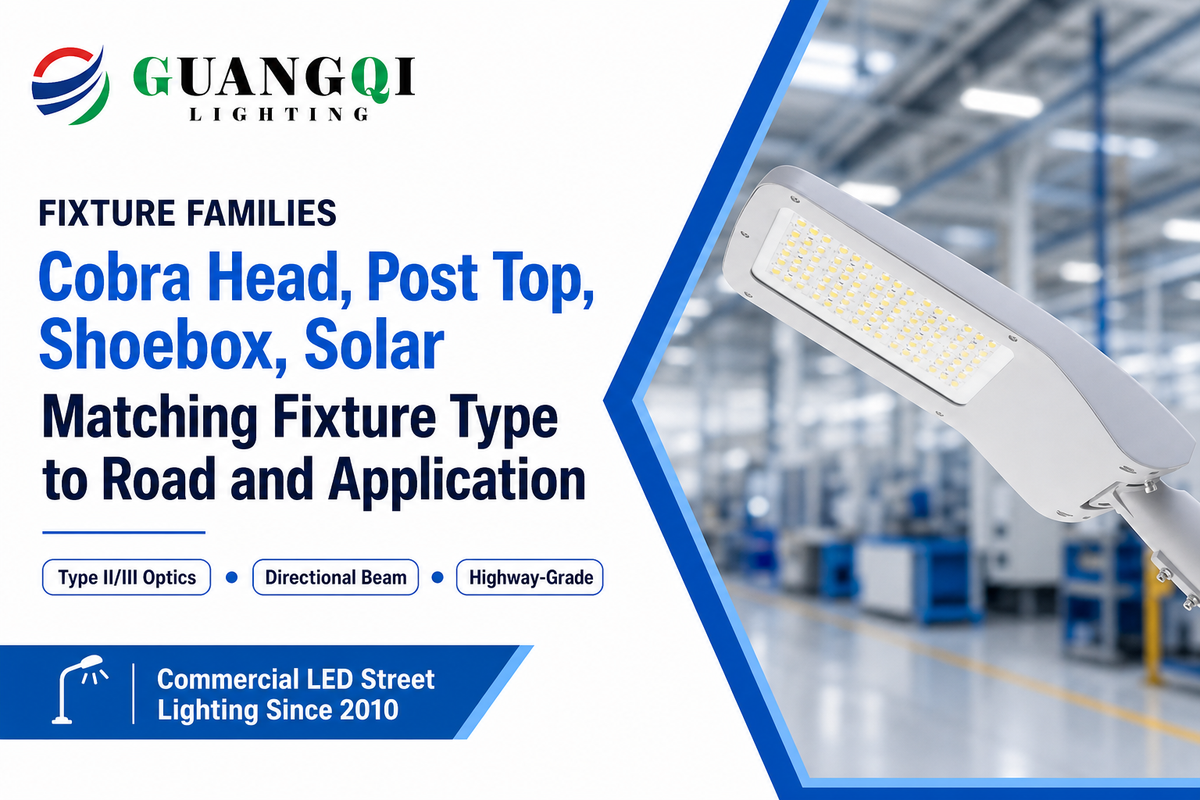
LED cobra head lights — the familiar curved fixture that mounts to pole arms — feature directional optics that project light down a roadway rather than laterally. This makes them the go-to choice for highway and major arterial road applications. According to U.S. Department of Energy data on solid-state roadway lighting, this directional quality measurably improves illuminance compared to older HID equivalents at a lower wattage cost. Cobra head fixtures provide consistent illumination and visibility and minimize the uplight that reduce nighttime driver safety. Per the Federal Highway Administration’s roadway lighting safety data, nighttime fatality rates run about three times higher than during the day despite nearly three-quarters of vehicle miles occurring in daylight — getting the fixture and optic right is the concrete lever a project has over that gap. For residential collector roads with shorter poles and pedestrian scale, commercial decorative street lights — post top fixtures with wide, symmetric (Type V) distributions — are more appropriate.
Cobra Head / Shoebox (Roadway, Type II/III)
- 50-300W, 6,500-45,000 lm
- Directional optic — light stays on the road
- Highways, arterials, parking lots
Post Top / Solar (Local, Type V)
- 30-150W, 7,500-30,000 lm
- Wide, symmetric distribution
- Municipal streets, campuses, off-grid roads
Shoebox area lights, characterized by their flat, rectangular housings, are designed for broad and even coverage in areas like parking lots, drive lanes, and industrial sites — vendor catalogs list the same fixture family under several names, so an led area light, a commercial led area fixture, and a shoebox area light usually describe the same physical product. Solar lights and other solar powered street fixtures, which use batteries for autonomy instead of wattage, are suited for remote locations without grid access, but they represent a different design consideration and aren’t extensively covered here. Note that street lights and led flood light fixtures are distinct categories, although both are LED. Flood lights produce an unfocused flood of light for general security or facades, whereas street lights employ engineered optics to confine light within the intended roadway or lot.
Naming gets even less consistent on the decorative side: a led post top light may also be listed as post top lights (plural), a decorative lighting post, or a led barn light on catalogs aimed at rural and campus buyers, even when the underlying head led optic and housing are nearly identical. If a listing separates “led road” from “led road lighting” or “highway street” from “commercial properties” lighting, that split is almost always about mounting height and pole spacing, not a different core technology — a cobrahead street light for a highway differs from a large outdoor area fixture for a commercial lot mainly in beam angle and lumen output, both of which the tables above already break down by application.
| Fixture | Optic | Best for |
|---|---|---|
| Cobra head | Type II/III | Highways, arterial roads |
| Post top | Type V | Municipal streets, campuses |
| Shoebox / area | Type III/V wide | Parking lots, industrial yards |
| Solar all-in-one | Type II/III | Off-grid rural roads |
💡 Key takeaway
Prioritize matching your fixture to the road – a highway project should use the correct roadway optic, not a shoebox fixture simply because it is cheap, and a Type III optic will likely over-light a street of residences.
Wattage, Lumen Output and Color Temperature Specs
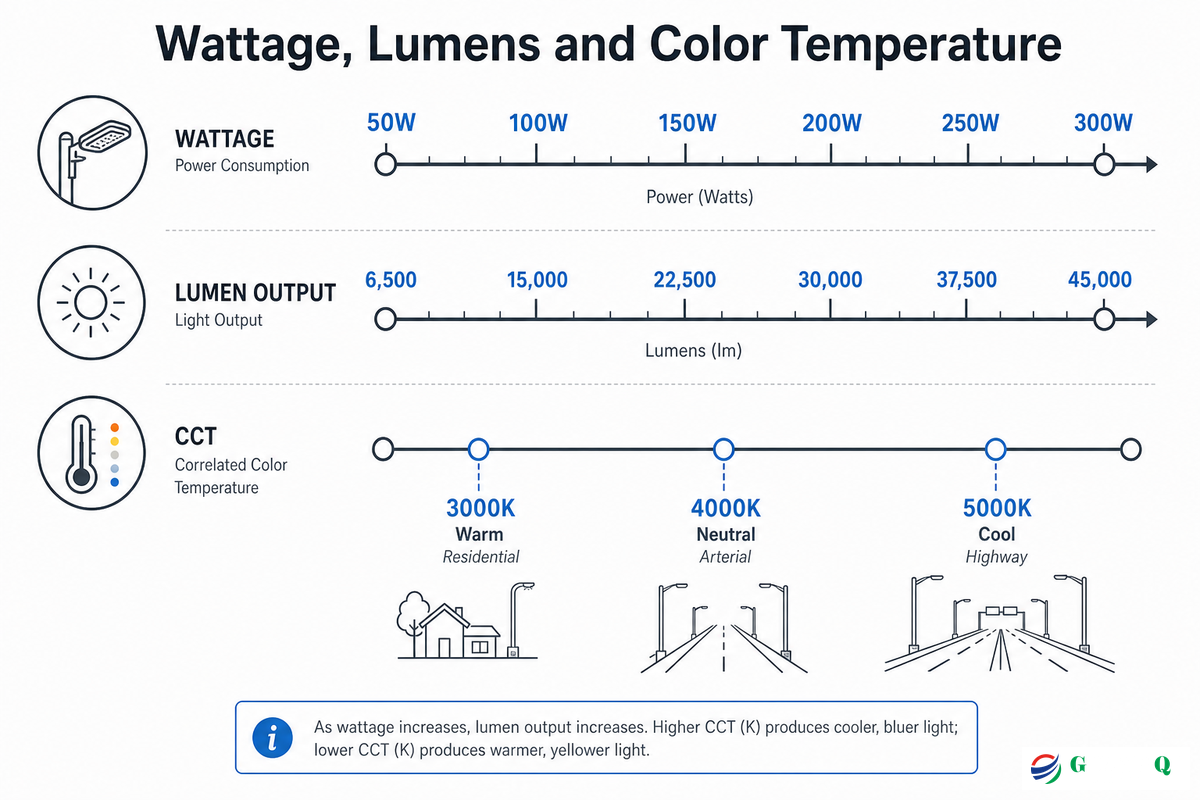
Commercial led street lights range from a 50w led entry model to a 300w led high-output fixture, producing 6,500 to 45,000 lumens depending on fixture family — with 100w led and 200w led steps in between covering most mid-size roadway and lot projects. The useful point of comparison is lumens per watt (efficacy) and not raw wattage since a well-optics 100W fixture could out-illuminate a poorly-optics 150W one. Guangqi’s commercial line achieves 120-170 lm/W across these led technology platforms in its cobra head and post top products, some 30-50% better than HPS typically found at 80-110 lm/W. Per Iowa State University’s street lighting design reference, there are two basic color temperatures (CCT) in common use among types of led street fixtures: 3000K warm white for streets near residential areas where a more inviting ambiance is desirable, and 4000-5000k neutral-to-cool white where visual clarity on highways and commercial centers are of greater importance.
Cct selectable and selectable-wattage fixtures – now available from several manufacturers – allow a contractor to field adjust both values after installation if there’s a change to a project’s photometric design or a municipality opts for standardizing on one SKU for a mix of roads. Most current fixtures also ship with a dusk to dawn photocell built in, so the light comes on automatically at dark without a separate control panel to wire in.
120-170lm/W system efficacy
3000-5000KCCT range, residential to highway
70W→9,900lmtypical 250W-HPS replacement
If you’re replacing a 250W HPS cobra head, you might typically choose a 70W LED cobra head which is good for roughly 9,900 lumens – the important comparison point isn’t to try to match wattage for wattage, but to match light output and distribution for the intended classification that the existing fixture was designed for. This is the reason a simple led street light bulb replacement kit or led lamp retrofit for an existing HPS or metal halide housing wouldn’t compare favorably with a purpose-built LED fixture — the drop-in replacement keeps the existing housing’s optics and durability rating, which may not be the correct match for distribution.
IES RP-8-25 Roadway Illuminance and Mounting-Height Guidance
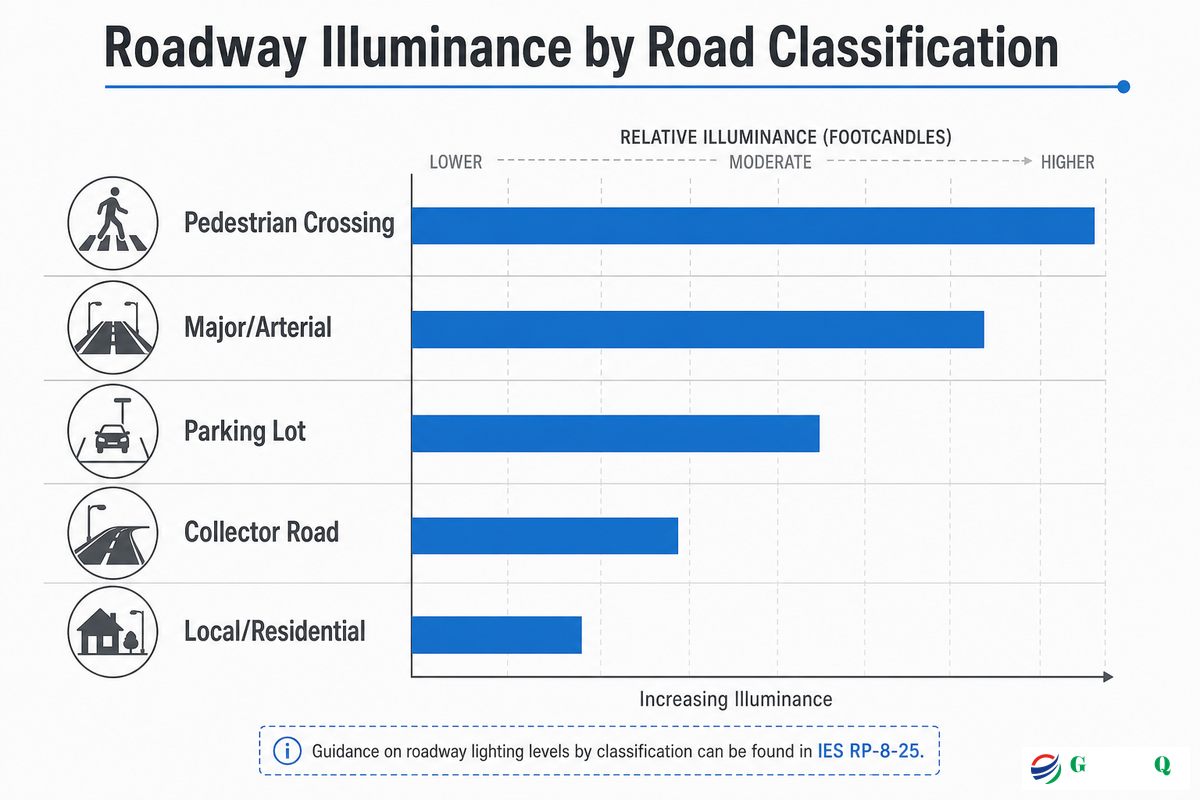
The Illuminating Engineering Society has published ANSI/IES RP-8-25, setting minimum and maximum illuminances for roadways. This version replaces RP-8-22 — approved by IES in 2025 — the version that many of the lighting vendors’ guidance documentation refers to if they mention any standard at all. This document is voluntary, not federal; however many state DOTs and local municipalities incorporate the IES recommended practice into their local code, making reference in the code the requirement and not simply in the IES document itself.
📐 Engineering Note
IES RP-8-25 illuminance targets range from 0.4 footcandles (fc) minimum for local residential streets up to 2.0 fc minimum at pedestrian crossings — freeway and arterial roads sit in between at 0.6-1.2 fc minimum, with tighter uniformity ratios (3:1) required as speed and traffic volume increase.
Most commercial led street light manufacturers guide documents stop at presenting wattage and lumen values. What they fail to mention is that the given wattage value doesn’t inherently indicate that the fixture is a good fit for the specified road it’s intended to illuminate. To ascertain this, one needs to cross-reference the wattage and lumen output against the specified roadway’s classification according to the IES table for illuminance range, which would explain the problems related to over-spec and mounting height.
| Road classification | Min. illuminance | Uniformity | Typical wattage band | Mounting height | Limitations / Not suitable for |
|---|---|---|---|---|---|
| Freeway / highway | 0.6 fc | 3:1 | 150-300W cobra head | 30-40 ft | Not for poles <25 ft — uniformity fails |
| Major / arterial | 1.2 fc | 3:1 | 100-200W cobra head | 25-35 ft | Not for high-pedestrian arterials without added crossing fixtures |
| Collector road | 0.8 fc | 4:1 | 70-150W cobra head / shoebox | 25-30 ft | Not for mixed retail frontage — glare complaints common |
| Local / residential | 0.4 fc | 6:1 | 30-80W post top | 12-18 ft | Not for through-traffic collector roads — under-lights at speed |
| Parking lot | 0.5 fc | 4:1 | 100-300W shoebox | 20-30 ft | Not for perimeter/roadway lighting — Type V spreads too wide |
| Pedestrian crossing | 2.0 fc | 4:1 | 30-60W post top, supplemental | 10-14 ft | Not a substitute for main roadway lighting — supplemental only |
| Campus / private road | 0.6-0.8 fc | 4:1 | 50-100W post top / shoebox | 16-25 ft | Not for public-road DOT approval — private-standard only |
| Historic / decorative district | 0.4-0.6 fc | 6:1 | 30-80W decorative post top | 10-16 ft | Not for high-speed roads — decorative optics underperform at distance |
| Off-grid / rural road | 0.4-0.6 fc | 6:1 | 30-120W solar all-in-one | 18-25 ft | Not for low-insolation regions without battery oversizing |
The given illuminance and uniformity values reflect the long-established IES roadway-lighting ranges (which have remained constant from RP-8-14 through RP-8-25); the wattage and mounting height ranges correspond to the Guangqi commercial fixture line cross-referenced against the IES figures. The 2025 version of RP-8 also incorporates other changes from RP-8-22; check the precise current requirements against RP-8-25 document or local DOT/municipal requirements since this document is recommended, not mandatorily adopted.
Pole spacing is a related calculation that’s somewhat less precise (3-4 times mounting height for uniform coverage), and it’s dependent on the particular fixture beam pattern and would best be done via a photometric layout tool, rather than a rough guide line, once you know which led roadway wattage band to consider — most manufacturers or independent lighting experts can run this light distribution calculation from a spec sheet in a day or two. Local wind-load code and the light pole’s own weight rating also need checking before you settle on a design. Confirm this with your pole supplier before deciding on a retrofit project, especially if you know you need a taller pole than the original.
Parking Lot and Commercial Property Applications
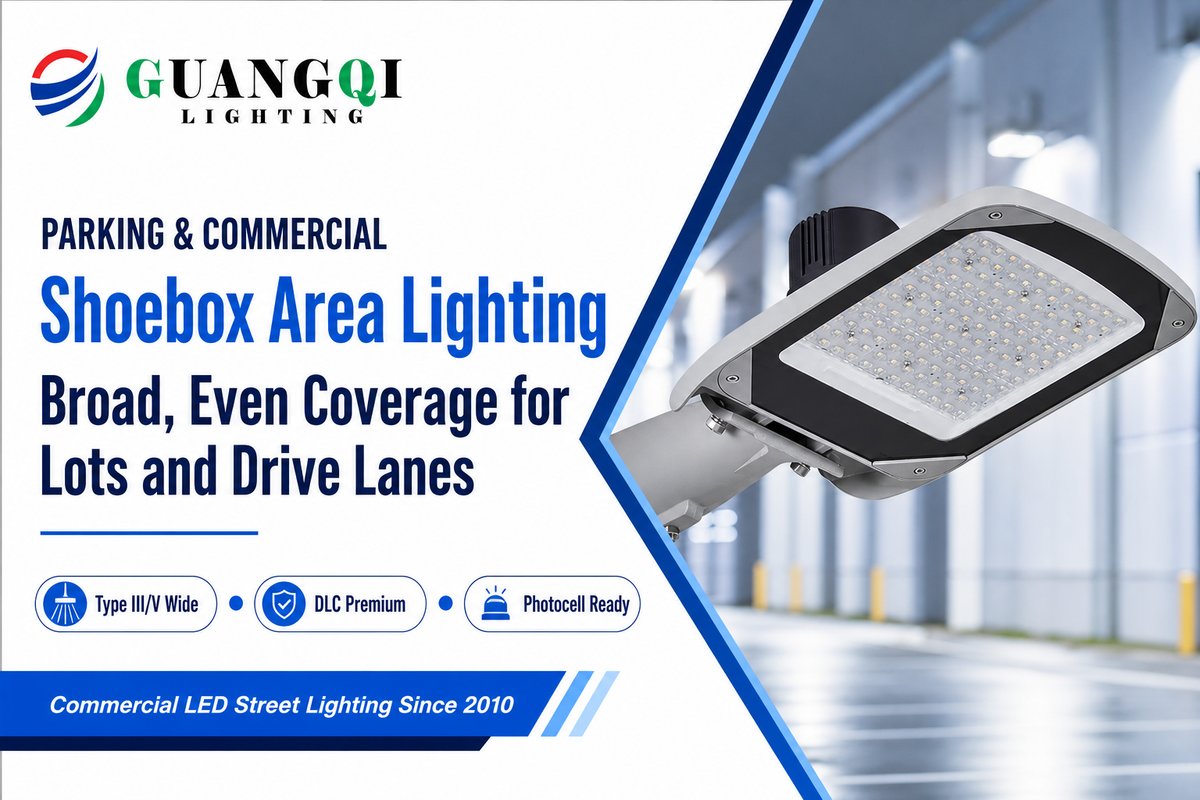
Led parking lot lights and other commercial outdoor area lighting carry their own IES band — a minimum of 0.5 fc and a maximum of 5.0 fc — because parked vehicles, backing traffic and pedestrians need a smoother, more glare-controlled distribution than a straight roadway calls for. Shoebox fixtures with Type III or Type V wide optics dominate this outdoor application because their distribution pattern matches a rectangular lot in a way a street led roadway beam cannot.
When NOT to buy the highest-wattage option
A classic and avoidable specification error on parking lots is to consider higher wattage to be extra safety. Don’t fixate on bigger being better; if fixtures are too bright they create glare that blinds pedestrians standing in the shadowed areas. (That’s why IES parking lot bands end at 5.0 fc; to do more doesn’t help safety, it helps people complain about glare and increases the electricity bill). Per FHWA’s own roadway lighting research, glare directly reduces visibility — with their highly directional light compared to more diffuse HID lighting, very bright fixtures can even cause your pupils to contract, decreasing your ability to focus into the surrounding shadows beyond the parking lot.
Commercial property managers get the best results treating the IES parking-lot band as a ceiling to design toward, with only a small comfort allowance, rather than a floor to exceed — the fixture-selection framework in the last section of this guide walks through matching wattage to lot size directly.
10-Year Total Cost of Ownership: LED vs HPS
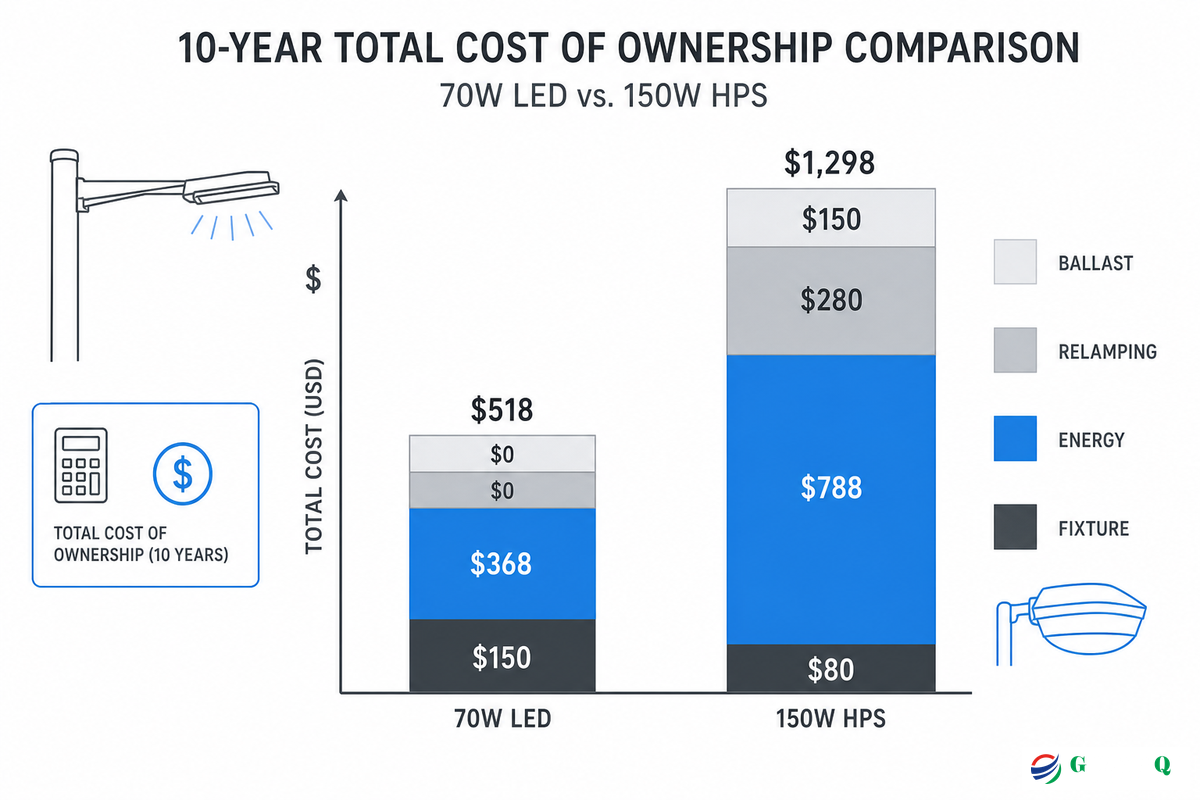
That 70W LED cobra head costs around $518 to own and operate over 10 years versus $1,298’s alternative 150w HPS fixture, saving 60% – mainly by wiping out relamping costs, not just a smaller electric bill. That estimate presupposes the fixture has been bought free-and-clear (as opposed to lease, loan or financed through a performance contract) operating under an average commercial utility price of about $0.12/kWh at about 4,380 hours of operation annually; your own ownership arrangement, utility pricing and install method may alter payback, but this example illustrates a sample case that you can plug your own figures into. For a deeper side-by-side on lumen output, color rendering and failure modes, see our full LED vs. metal halide performance comparison.
5-year total cost of ownership, per fixture:
| Cost item | 70W LED | 150W HPS |
|---|---|---|
| Fixture purchase | $150 | $80 |
| Installation & commissioning | Comparable (same pole/wiring) | Comparable |
| Energy (5-yr, $0.12/kWh, 4,380 hr/yr) | $184 | $394 |
| Relamping (parts + labor) | $0 | ~$140 |
| Ballast/driver replacement | $0 | ~$75 |
Payback example: the ~$70 higher upfront fixture cost is offset by roughly $105/year in energy and maintenance savings for the LED — a straightforward two-thirds-of-a-year payback on the fixture premium alone, before counting the full 10-year relamping avoidance.
A larger example of this phenomenon occurs at the municipal level, although in terms of different cost units than the above TCO table for fixtures: the Los Angeles LED street lighting retrofit case study, one of the largest such conversions ever, replacing 140,000 of more than 209,000 streetlights, reported an internal rate of return for the project of 10% from energy and maintenance savings alone. Including a utility rebate program, that number increased to 23%. This 23% figure reflects the return on investment of the $56.9 million retrofit project as a whole rather than a per-fixture comparison and the financing and utility-rebate structure of the program was unique to LA’s context at the time, so use this as a rough order-of-magnitude example for large projects and not a guarantee of a similar result.
Smart controls provide a secondary layer of savings on top of LED conversion savings. Most current commercial fixtures include standard 0-10V dimming; higher levels of dimming, such as with DALI and networked controls — the kind of low-cost integrated-driver dimming described in US9232587B2, a low-cost LED driver patent with integral dimming capability — can add meaningful savings on top of the LED conversion itself through scheduled or occupancy-based dimming. In one documented case from the same DOE consortium source above, a UC Davis pathway-lighting pilot recorded a 46% additional energy-use reduction from occupancy-sensor dimming layered onto already-converted static LED fixtures — savings from the controls alone, separate from the LED swap. See our guide to commercial lighting control systems for how 0-10V, DALI and networked scheduling compare on a real installation.
Municipal and Highway Procurement, Certifications and Rebates
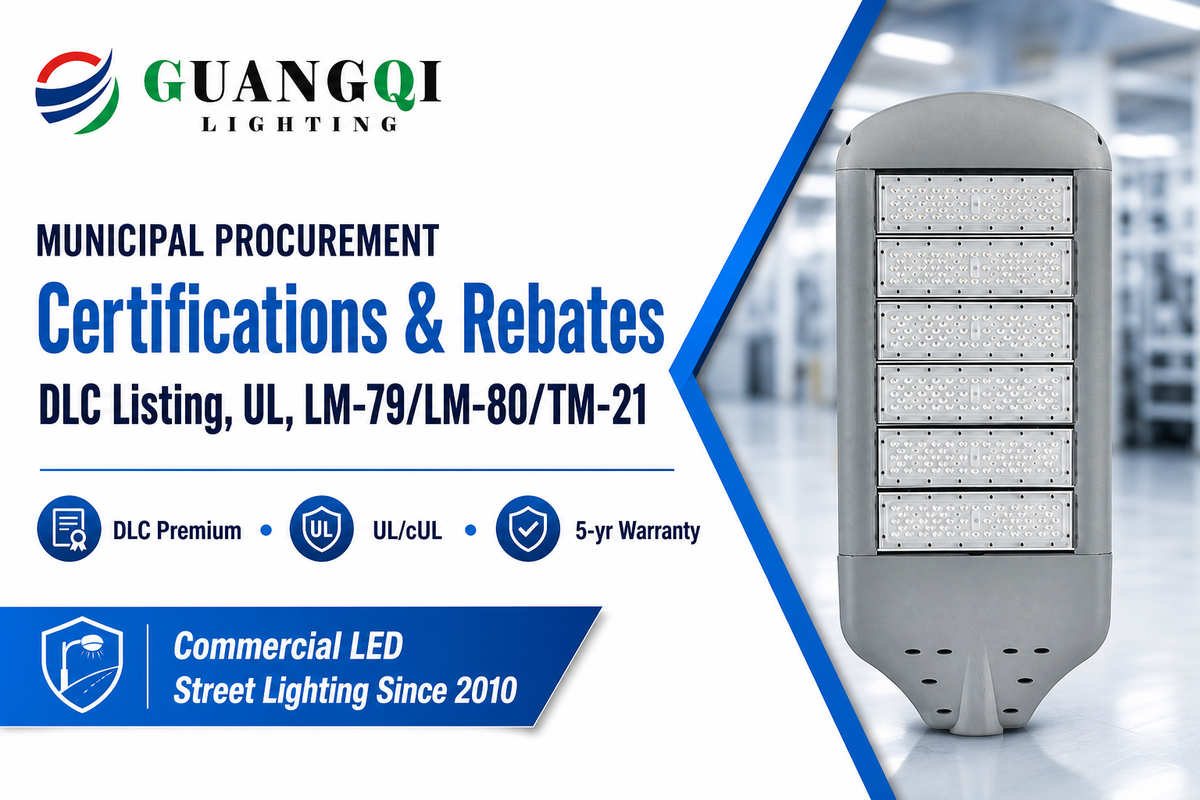
DLC (DesignLights Consortium) listing is the certification most utility rebate programs actually require. Nearly 700 utility and energy-efficiency programs use the DLC’s Qualified Products List as a reference, and DLC notes that “more than 90% of its member utilities require DLC listing for participation in a rebate program.” Both statistics are important but related, not the same. Municipal and highway lighting specifications also call for UL or cUL listing, IP65 or IP66 ingress protection, and photometric proof under LM-79 (whole-fixture testing) with reliability data (LM-80 and TM-21 projections for degradation) – the four items serve as a good proxy for real-world performance because fixtures can appear identical in a spec sheet but perform very differently after a couple of years on a pole.
RFQ checklist — copy these into your quote request:
| Parameter | Recommended range | Why it matters | How to verify |
|---|---|---|---|
| DLC listing | DLC Premium preferred | Gates utility rebate eligibility | Check DLC Qualified Products List (QPL) |
| Safety listing | UL or cUL | Required by most municipal codes | Request UL test report/label copy |
| Ingress protection | IP65 (min) / IP66 (preferred) | Weatherproofing for outdoor 24/7 duty | IEC 60529 test certificate |
| Photometric test | LM-79 report on file | Confirms actual lumens/efficacy, not nameplate | Request LM-79 report for exact SKU/CCT/wattage |
| Lumen maintenance | LM-80 + TM-21 projection | Validates L70 lifespan claim | Request LM-80 raw data + TM-21 calculation |
| Warranty | 5 years minimum | Signals driver/LED quality confidence | Get warranty terms in writing, check driver brand |
Quality control matters in addition to paperwork: budget fixtures have been documented developing a visible color shift from white to purple or violet over time because of defects in phosphor manufacturing — a defect that a valid LM-80 and TM-21 test package on file is specifically designed to catch before it reaches the road.
Dark Sky Compliance and Growing Light-Trespass Rules
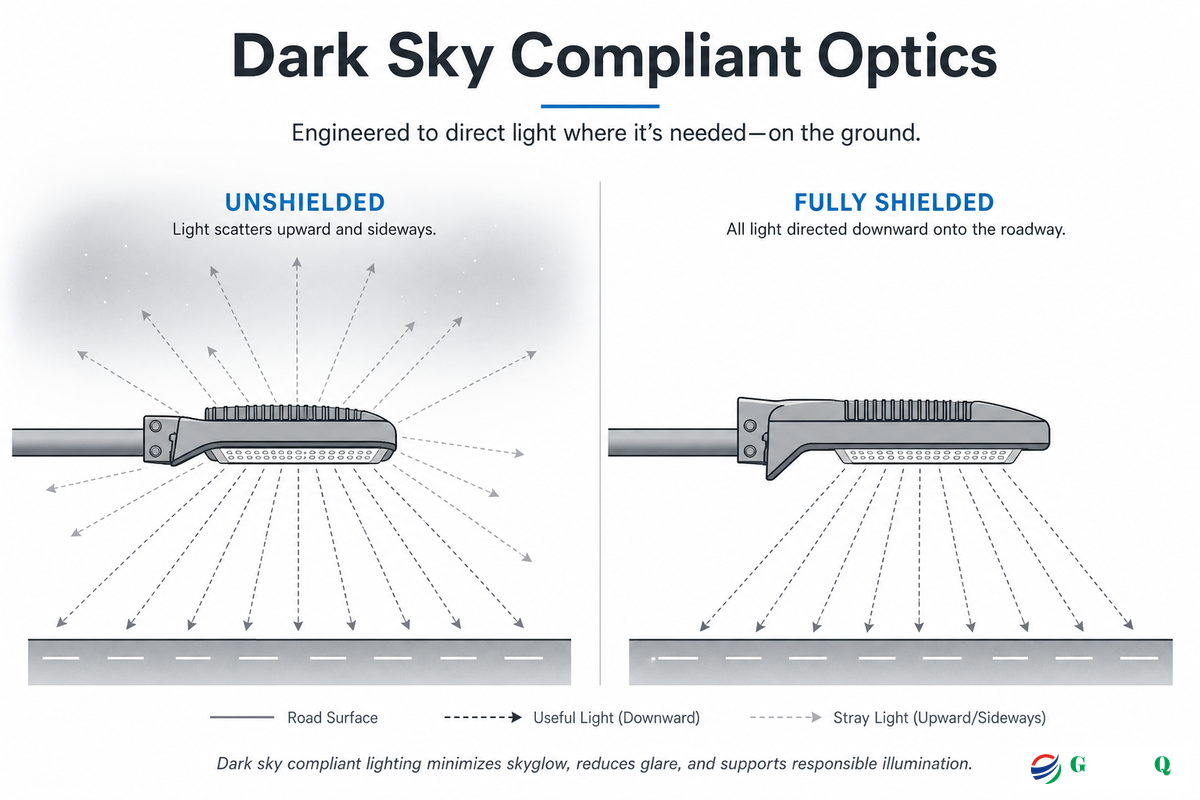
Municipal and state governments are becoming more sensitive to issues of light pollution, and it’s worth checking whether these factors might come into play in your fixture selection. Palo Alto, CA recently approved and implemented a Dark Sky compliant street lighting ordinance which went into effect in early 2026; and NJ S1610/A2196 and NY Dark Skies Protection Act (S5007) are examples of outdoor lighting ordinances under active consideration in two states.
When applied in practice, the dark-sky criteria are two-fold: optics that are entirely shielded with no uplight, and-in some localities-a cap on color-temperature (often 3000K max) to limit blue-light content. DarkSky International maintains a municipal-code template, and cities are increasingly adopting this and amending it rather than creating their own dark-sky rules from scratch. Palo Alto, California’s updated lighting ordinance is one enacted example, effective in early 2026. What this means for an RFP issuer is: Ask upfront whether the jurisdiction has or is planning to implement a dark-sky ordinance; after a fixture order has been shipped, changing CCT or retrofitting optics will cost more than ordering it correctly up front.
💡 Pro Tip
Be aware that state bills-like New Jersey’s S1610 or New York’s S5007-have not yet passed. Even so, a municipality may implement dark sky compliant lighting rules at the local level ahead of the state. Contacting your local public-works or planning department directly is the best way to find out where things stand.
How to Choose the Right Commercial LED Street Light
Buyers searching for the best commercial led street lights usually start from a wattage table, and a quick lighting led catalog search turns up dozens of options for any single type of street light — but in too many cases vendor purchasing guides and municipalities fail to match the IES illuminance band to the actual road classification, which results in under-lit streets or complaint-producing glare. (This latter phenomenon can result when agencies upgrade old HPS lights one-to-one, and don’t realize the original layout was flawed to begin with, especially on installations designed before the current IES standards were available).
Start with the Road-Classification Wattage Ladder illustrated earlier in this guide. Read off the appropriate illuminance value and fixture range for your road, then use the table below to select the specific fixture family and verify that your desired mounting height and color temperature are supported.
| Application | Fixture Type | Wattage | Mounting | CCT | Optic |
|---|---|---|---|---|---|
| Highway / freeway | Cobra head | 150-300W | 30-40 ft | 4000K | Type II/III |
| Arterial road | Cobra head | 100-200W | 25-35 ft | 4000K | Type II/III |
| Residential street | Post top / decorative | 30-80W | 12-18 ft | 3000K | Type V |
| Parking lot | Shoebox | 150-300W | 20-30 ft | 4000-5000K | Type III/V |
| Pedestrian walkway | Post top | 30-60W | 10-14 ft | 3000K | Type V |
| Off-grid / rural road | Solar | 30-120W | 18-25 ft | 4000K | Type II/III |
| Campus / private drive | Post top / shoebox | 50-100W | 16-25 ft | 4000K | Type III |
| Historic / decorative district | Decorative post top | 30-80W | 10-16 ft | 3000K | Type V |
| Dark-Sky-restricted zone | Fully shielded post top/shoebox | 30-150W | 12-25 ft | ≤3000K | Full cutoff |
“The recurring failure mode we see isn’t a bad fixture, it’s a good fixture put on the wrong road classification. Specify to the IES band for that specific application first, then shop wattage within the band it gives you.”
Key takeaway
Identify your road classification first, read the illuminance target and wattage band off the Road-Classification Wattage Ladder, then match fixture family, mounting height and CCT from the selection matrix above — in that order, not wattage first. Commercial LED street lights offer the biggest savings when the spec is right the first time, not after a glare complaint forces a redesign.
FAQ, Commercial LED Street Lights
Q: What is a cobra head street light?
A cobra head street light is a curved, pole-arm-mounted fixture with directional Type II or Type III optics designed to concentrate light along a roadway rather than spread it sideways.
The reason the cobra head fixture is ubiquitous for highways and main arterials is its optic, which drives the light down the roadway rather than toward neighboring properties and homes. Cobra head wattages typically run from 50W to 300W, outputting anywhere from 6,500 to 45,000 lm, and nearly all of them include a photocell that automatically activates at dusk and turns off at dawn. Cobra head fixtures take their name from the optic housing shape, which — when viewed from the side — resembles a cobra with its hood raised.
Q: How high should commercial LED street lights be mounted?
Mounting height depends on road classification under IES RP-8-25 — roughly 30-40 ft for highways, 25-35 ft for arterial roads, and 12-18 ft for residential streets.
There is no single correct mounting height for every situation; the proper mounting height depends on the specific illuminance target and uniformity ratio for the road being illuminated. In general, mount poles at about 3-4 times the mounting height for evenly spaced illumination (this spacing is approximate, and varies depending on the beam pattern of the fixture, as will be detailed in a separate photometric layout); municipal and DOT regulations are a reliable source of actual required mounting height and spacing requirements.
Q: How much does it cost to convert street lights to LED?
A typical commercial LED cobra head fixture runs $150-$350 per unit before installation, with total 10-year cost around $518 against roughly $1,298 for the HPS fixture it replaces.
Much of the difference between the two figures comes from eliminated relamping labor and ballast replacement, not just savings from a lower electric bill. HPS lamps usually need to be replaced every 5-6 years, while LED fixtures rated for 100,000+ hours can go a decade or more without a bulb change. Real-world cost also depends on whether existing poles and wiring can be reused, local labor rates, and whether a utility rebate applies — get a project-specific quote once fixture count and wattage are known.
Q: What’s the LED equivalent of a 400W metal halide fixture?
A 150W LED cobra head at roughly 20,000-25,500 lumens is a common commercial-grade replacement for an older 400W metal halide street or highway roadway fixture.
Base this against actual lumen output from your existing fixtures, rather than wattage alone, since metal halide output declines with age.
Q: What does “Dark Sky compliant” mean for street lighting?
Dark Sky compliant fixtures are fully shielded to direct all light downward with zero uplight emission, often paired with a CCT cap around 3000K to limit blue-light content.
A growing number of cities cite a template municipal code prepared by DarkSky International. Different jurisdictions are at various stages-Palo Alto, CA, has officially adopted formal ordinances, while other municipalities are still going through legislative bodies. Consult with your local public works or planning department before finalizing a fixture spec.
Q: Are commercial LED street lights compatible with smart dimming controls?
Yes — 0-10V dimming is standard on most current commercial LED street light fixtures, with DALI and networked control options available for scheduled or adaptive dimming on top of that baseline.
Smart controls can add substantial savings on top of the base LED conversion when lights dim during low-activity periods. In a documented case from DOE’s street lighting consortium, a UC Davis pilot recorded a 46% additional energy-use reduction from occupancy-based dimming controls layered onto already-converted static LED pathway fixtures.
Why We Write This
Since 2010, Guzhen Town in Zhongshan, China’s lighting manufacturing center, has been the location of commercial and industrial LED fixtures from Guangqi Lighting. Our catalog commercial street light wattage bands and TCO calculation were cross-checked against IES RP-8-25 and FHWA safety guidelines, not presented solely as our own calculations. Reviewed by the Guangqi Lighting technical team.
References & Sources
- Lighting, Proven Safety Countermeasures — Federal Highway Administration
- Appendix A: Roadway Lighting Details — Federal Highway Administration
- ANSI/IES RP-8-25: Recommended Practice, Lighting Roadway and Parking Facilities — Illuminating Engineering Society
- IES Announces Three Recently Approved Revised Standards — LightNOW (IES-affiliated)
- DesignLights Consortium Quick Facts — DesignLights Consortium
- Prepare for Commercial LED Lighting Rebates — DesignLights Consortium
- Municipal Outdoor Lighting Codes — DarkSky International
- Lighting Ordinance Update — City of Palo Alto
- Los Angeles LED Street Lighting Retrofit — Energy Sector Management Assistance Program (World Bank)
- Adaptive Street Lighting Controls — U.S. Department of Energy
- US9232587B2, Low Cost LED Driver with Integral Dimming Capability — USPTO / Google Patents