
Contacte a GUANGQI



Atualizado em julho de 2026
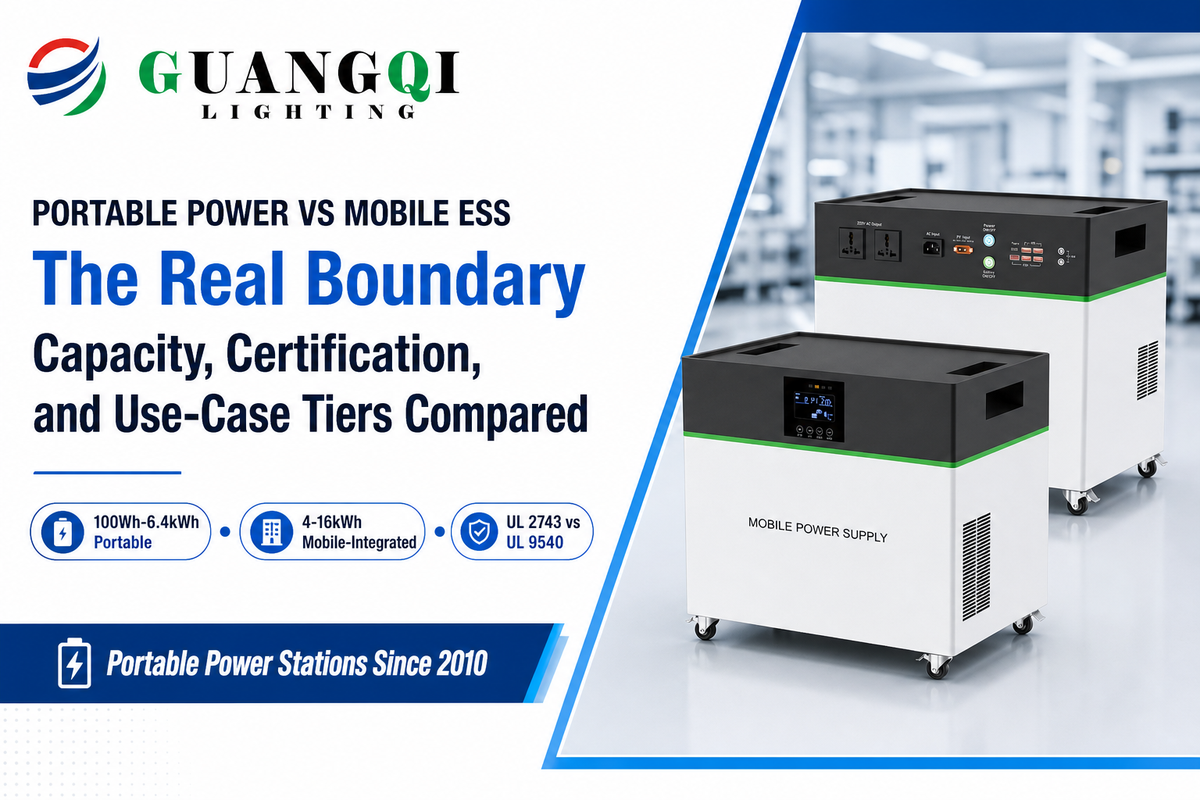
Uma pesquisa por «estação de energia portátil vs sistema móvel de armazenamento de energia» apresenta dois produtos como se fossem a mesma coisa, embora pertençam a categorias completamente diferentes. As estações de energia portáteis são unidades com bateria e inversor, dimensionadas para alimentar cargas de curta duração de uma só pessoa. Já os sistemas maiores, transportáveis em veículos e também designados por alguns fabricantes como «armazenamento móvel de energia», destinam-se a fornecer energia durante vários dias ou a aplicações industriais. É compreensível que um comprador fique confuso ao encontrar a indicação «móvel» na página de um produto e «bateria» na de outro. Um equipamento pode ser levantado e colocado na bagageira de um automóvel para levar para um parque de campismo; o outro, no sentido industrial pleno, é um equipamento montado num reboque ou contentor, que requer uma grua ou um camião articulado para ser transportado. Entre estes dois extremos existe uma terceira categoria, ainda pouco reconhecida, de sistemas móveis de vários fabricantes — incluindo os produtos Guangqi destacados nos exemplos deste artigo — que essas empresas designam por «armazenamento móvel de energia».
«Os resultados da pesquisa desta expressão misturam atualmente uma bateria de campismo de $200 e um reboque para estaleiro de construção de $200 000 na mesma página. Chamemos-lhe a armadilha do nome partilhado.»
Especificações rápidas
| Estação de energia portátil | 100Wh-6,4kWh, portátil à mão por uma pessoa |
| Categoria integrada móvel | 4-16kWh, com rodas ou montada em painel, transportável num único veículo |
| Sistema MESS verdadeiramente industrial | 10kWh a vários MWh, montado em reboque ou contentor marítimo |
| Norma aplicável | UL 2743 (portátil, ≤20kWh de iões de lítio/sódio) vs UL 9540 (estacionário/de maior dimensão) |
| Confusão sobre a dimensão do mercado | As empresas de análise divergem 14x quanto ao que mede o «sistema móvel de armazenamento de energia» |
Estação de energia portátil vs sistema móvel de armazenamento de energia: comparação em 60 segundos

Uma estação de energia portátil é um conjunto completo com bateria, inversor e portas de saída, com capacidade entre 100Wh e 6,4kWh, que pode ser levantado e colocado na bagageira de um automóvel. Os sistemas móveis de armazenamento de energia abrangem uma gama mais ampla: alguns fabricantes aplicam o termo a unidades de 4-16kWh, com rodas ou montadas em painel, concebidas para as instalações ou o estaleiro de um único comprador. No segmento industrial, o termo abrange sistemas de 10kWh a vários megawatts-hora, transportados para estaleiros de construção ou filmagens em reboque, camião ou grua. Segue-se uma visão geral das três categorias, que serve de contexto às secções seguintes deste guia. A fronteira de certificação entre as duas primeiras categorias é regida pela norma UL 2743, explicada em pormenor mais adiante.
| Categoria | Intervalo de capacidade | Modo de transporte | Comprador típico |
|---|---|---|---|
| Estação de energia portátil | 100Wh-6,4kWh | Transportada à mão | Autocaravanista, inquilino, preparador para emergências |
| Armazenamento integrado móvel | 4-16kWh | Com rodas ou em painel, transportável num único veículo | Comprador para emergências domésticas ou estaleiros de construção |
| Sistema MESS verdadeiramente industrial | 10kWh a vários MWh | Reboque, caixa de carga de camião ou grua | Construção, eventos, serviços públicos |
Os catálogos de fabricantes como a própria Guangqi abrangem as duas primeiras categorias. Por exemplo, a série LK tem uma potência de saída de 300W-6000W e uma capacidade entre 230Wh e cerca de 6,4kWh, enquanto a linha MS-T se enquadra na categoria de armazenamento integrado móvel de 4,04-16,07kWh. Nenhum dos produtos destas séries pode ser considerado um sistema MESS industrial montado em reboque. É precisamente esta distinção que justifica a existência deste guia: a maioria dos outros guias tende a abordar apenas um dos extremos e a sugerir que representa toda a categoria. Enganar-se nesta distinção pode sair caro; não se trata apenas de uma questão de rotulagem. Pode pagar-se por uma capacidade de categoria de reboque que um conjunto portátil teria assegurado por uma fração do preço, ou comprar um conjunto portátil insuficiente para uma carga que exigia a maior autonomia da categoria integrada móvel. Como o catálogo da Guangqi abrange precisamente as duas primeiras categorias desta tabela, as fichas técnicas da marca são uma referência útil para identificar o início de cada uma.
Estação de energia portátil: definição, intervalo real de capacidade e finalidade
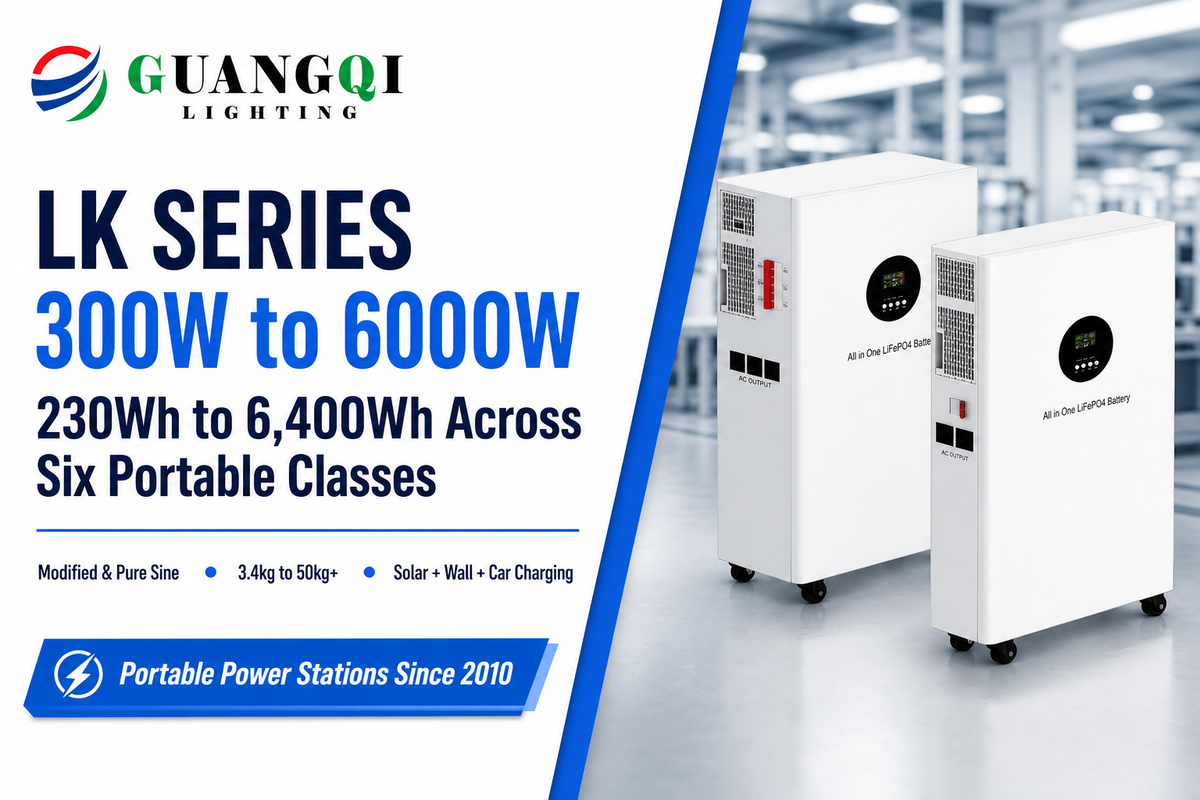
Uma estação de energia portátil inclui uma bateria portátil, um inversor e várias saídas (AC, USB e DC), integrados numa caixa portátil. Pode ser recarregada através de uma tomada de parede, da porta de 12V de um automóvel ou de energia solar armazenada através de um painel dobrável. Por exemplo, a linha LK da Guangqi inclui modelos desde o LK-300W até ao LK-6000W. O LK-300W, modelo de entrada, pesa 3,4kg e fornece uma onda sinusoidal modificada, com capacidade de 230Wh. Já os modelos LK-1000W e LK-1500W fornecem uma onda sinusoidal pura, têm capacidades de 1 024Wh e 1 280Wh, respetivamente, e pesam aproximadamente 12,6-19,5kg. Os modelos Guangqi LK de maior capacidade — LK-5000W/6000W — têm uma capacidade de 5 120Wh a 6 400Wh e pesam mais de 50kg, pelo que ainda podem ser levantados por duas pessoas.
✔ Vantagens
- Sem instalação: basta ligar e utilizar, logo após desembalar
- Carregamento por energia solar, tomada de parede ou porta de automóvel
- Funcionamento silencioso, seguro para utilização em interiores
⚠ Limitações
- A onda sinusoidal modificada dos modelos de entrada pode impedir o funcionamento de cargas com compressor ou motor
- Nos modelos abaixo de 1,5kWh, a entrada para painel solar está limitada a cerca de 200W na maioria dos casos
- Sem classificação para alimentar uma casa inteira ou para funcionamento industrial contínuo
| Modelo / categoria | Potência de saída | Capacidade da bateria | Forma de onda | Peso |
|---|---|---|---|---|
| LK-300W | 300W | 230Wh | Sinusoidal modificada | 3,4kg |
| LK-600W | 600W | 576Wh | Sinusoidal pura | 10,6kg |
| LK-1000W | 1 000W | 1 024Wh | Sinusoidal pura | 12,6kg |
| LK-1500W | 1 500W | 1 280Wh | Sinusoidal pura | 19,5kg |
| LK-2500W / LK-3500W | 2 500-3 500W | 2 432-3 072Wh | Sinusoidal pura | confirmar antes da encomenda |
| LK-5000W / LK-6000W | 5 000-6 000W | 5 120-6 400Wh | confirmar antes da encomenda | mais de 50kg |
| MS-T04 (integrado móvel) | ao nível do sistema | 4,04kWh | análise do sistema | com rodas/painel |
| MS-T08 (integrado móvel) | ao nível do sistema | 8,03kWh | análise do sistema | com rodas/painel |
| MS-T12 (integrado móvel) | ao nível do sistema | 10,49kWh | análise do sistema | com rodas/painel |
| MS-T16 (integrado móvel) | ao nível do sistema | 16,07kWh | análise do sistema | com rodas/painel |
Um teste prático da CleanTechnica a uma estação de energia de consumo de 2026 (a Bluetti Apex 300/B300K) mostra que as características desta categoria continuam a centrar-se nos mesmos aspetos de sempre — o inversor, a forma de onda e a velocidade de carregamento — como se vê na ficha técnica da Guangqi. É uma confirmação útil caso encontre um equipamento que pareça barato para a capacidade em watt-hora anunciada. Quem compara uma estação de energia portátil para campismo com opções de marcas de consumo — as linhas Jackery power station, Bluetti power station e EcoFlow são as três mais frequentemente comparadas — está, na realidade, a comparar os mesmos aspetos fundamentais abordados neste guia: capacidade, forma de onda e entrada PV, independentemente de o rótulo dizer gerador de eletricidade portátil ou fonte de energia portátil.
Sistema móvel de armazenamento de energia: dois produtos muito diferentes com o mesmo nome

A designação sistema móvel de armazenamento de energia aplica-se corretamente a equipamentos de 10kWh a vários megawatts-hora, transportados em reboque, camião ou grua para apoio à rede elétrica, construção e eventos. Não se trata de um conjunto para transportar à mão. Uma análise temática da NeuronWriter para esta expressão de pesquisa identificou, de forma independente, «Reboque (veículo)», «Camião» e «Vehicle-to-grid» como entidades reconhecidas. É a mesma conclusão ao nível do processamento de linguagem natural: os motores de pesquisa já associam a expressão completa a equipamento industrial móvel, mesmo quando alguns vendedores a aplicam a equipamentos muito menores.
Esta interpretação industrial não é forçada. Os sistemas da NextG Power montados em camiões de 10ft têm uma capacidade de 250-600 kWh, e os reboques contentorizados de 20ft ultrapassam 1MWh. Existem publicações independentes da imprensa especializada sobre este novo segmento industrial. Segundo a ESS News, o MESS 2000 da Sunwoda é apresentado como «o primeiro veículo do mundo com sistema móvel de armazenamento de energia de 2MWh e 10 metros», enquanto as unidades móveis plug-and-play da Alfen têm capacidades de 360-540 kWh. Os registos públicos demonstram que esta aplicação não foi inventada pelos fabricantes e que as empresas de serviços públicos estão a adquirir a tecnologia. A California Public Utilities Commission aprovou recentemente uma subestação móvel em reboque de 28 MVA; o New York’s Public Service Department tem documentos sobre sistemas móveis BESS detidos por empresas de serviços públicos para responder a necessidades imediatas da rede; e um relatório do NREL sobre a preparação das empresas de serviços públicos descreve o projeto-piloto de bateria de 1 MW / 4 MWh da Con Edison, montada num reboque trator, como equipamento que «se desloca facilmente para onde é mais útil».
📐 Nota de engenharia
As unidades das séries MS-T04 a MS-T16 da Guangqi (4,04-16,07 kWh) têm uma capacidade talvez duas ordens de grandeza inferior à das unidades MESS mais pequenas montadas em reboque, aqui abordadas. Os materiais de marketing da Guangqi designam esta categoria de equipamentos, com franqueza, por «armazenamento móvel de energia» e descrevem-na como o passo seguinte em termos de capacidade face a um sistema portátil individual — não como concorrente dos sistemas montados em reboque ou contentor. Uma empresa de construção que esteja a analisar um pedido de proposta ou uma necessidade de apoio à rede com armazenamento de energia superior a 10 kWh em reboque deve recorrer a um fornecedor de sistemas MESS industriais, em vez de consultar um catálogo de estações portáteis.
Nas conversas em fóruns e redes sociais entre adeptos da vida em carrinha e de viagens fora de estrada, os compradores reduzem tudo isto a uma única designação: «estação de energia» pode referir-se a tudo, desde um sistema para carregar telemóveis num veículo de expedição até uma bateria doméstica de emergência durante um corte de energia prolongado, sem distinguir entre a «categoria integrada móvel» e a «categoria de reboque». A classificação em três categorias usada neste guia responde a um problema real e persistente na forma como os compradores falam destes produtos atualmente; não é um artifício de SEO inventado.
Nem sequer há consenso sobre onde traçar a fronteira da categoria. A Fortune Business Insights publicou uma estimativa de 58.28 mil milhões de dólares para 2025 para o seu «mercado de sistemas móveis de armazenamento de energia», distribuído por três categorias: sistemas autopropulsionados (VE), soluções em contentor e soluções montadas em reboque. A própria análise indica que o segmento autopropulsionado/VE representará 94,42% em 2026. Por outras palavras, a maior parte desse valor corresponde apenas a veículos elétricos que funcionam como armazenamento móvel vehicle-to-grid, e não a enormes reboques ou contentores. Multiplicando o valor restante pelo fator necessário para o reconduzir às três principais categorias de mercado, a parcela «restante» fica em cerca de $3-4 mil milhões — um valor curiosamente próximo dos $4,2 mil milhões estimados pela Grand View Research para o «mercado de sistemas móveis de armazenamento em bateria». Em todo o caso, esta explicação é melhor do que atribuir a diferença de uma ordem de grandeza aos valores principais publicados por duas empresas de análise de mercado. Depois de retirar a grande parcela dos VE ao valor mais elevado, o que resta não difere muito do valor principal indicado pela outra empresa. Este erro não se limita a criar confusão semântica: um comprador que peça um orçamento para «armazenamento móvel de energia» sem especificar a escala corre o risco de receber uma proposta com o preço de um sistema completo em reboque, quando uma unidade com rodas que custa uma pequena fração desse valor seria suficiente, ou de acontecer o inverso. Como a linha MS-T da Guangqi ocupa o espaço intermédio de forma transparente, em vez de se situar num dos extremos, oferece uma referência concreta para os compradores posicionarem corretamente as suas necessidades neste espectro.
A tecnologia de armazenamento de energia não constitui uma única categoria monolítica. Para além dos sistemas de baterias de lítio, o campo mais vasto das tecnologias de armazenamento inclui armazenamento térmico, armazenamento de hidrogénio e outras soluções de longa duração. Ainda assim, para quem procura equipamentos portáteis e de armazenamento integrado móvel, as baterias de fosfato de ferro-lítio continuam a ser a opção prática dominante. Ligada à rede elétrica de uma casa ou instalação, uma unidade estacionária de armazenamento de energia desempenha uma função diferente da de uma unidade portátil: pode ser combinada diretamente com a produção de energia renovável, armazenando durante o dia o excedente de energia solar para utilização depois do pôr do sol. Um conjunto portátil limita-se a transportar a carga que recebeu antes de ser utilizado. Esta diferença é importante para quem avalia soluções energéticas em grande escala: a integração de energias renováveis em grande escala e os sistemas de armazenamento de energia em baterias à escala dos serviços públicos resolvem problemas de oferta e procura que nunca foram o objetivo de uma unidade transportada à mão ou com rodas.
Fronteira de certificação: UL 2743, UL 9540 e o limite de 20 kWh

A UL 2743 Edition 3 (publicada em 24 de setembro de 2025 e ainda em vigor) é a norma aplicável aos conjuntos de energia portáteis e estabelece, na Tabela 1.1, um limite de capacidade agregada de 20kWh para composições químicas de iões de lítio e sódio. A mesma tabela define um limite de 70kWh para conjuntos de chumbo-ácido e de 3kWh para unidades com condensadores eletroquímicos. A norma exclui expressamente os bancos de energia (abrangidos separadamente pela UL 2056), os sistemas com ligação fixa e interação com a rede e a cablagem de carregamento de VE. Quando um conjunto de lítio ultrapassa os 20kWh, o produto passa a estar abrangido pela UL 9540, Edition 3, revista pela última vez em 7 de março de 2025, que rege as instalações estacionárias e de maior dimensão para armazenamento de energia residencial.
| Categoria do produto | Norma aplicável | Limite de capacidade |
|---|---|---|
| Conjunto portátil (iões de Li/Na) | UL 2743 Ed.3 (2025-09-24) | 20 kWh agregados |
| Conjunto portátil (chumbo-ácido) | UL 2743 Ed.3 | 70 kWh agregados |
| Sistema de armazenamento estacionário/residencial de maior dimensão | UL 9540 Ed.3 (rev. 2025-03-07) | Acima do limite da UL 2743 |
Outro caso-limite a ter em conta é a 5.ª edição da UL 9540A. Uma apresentação da IEEE PES feita por um engenheiro da UL Solutions assinalou que era prevista para 2025. Embora esta revisão provavelmente não altere o limite de 20kWh, um guia concorrente sobre equipamentos portáteis parece classificar como portáteis sistemas com cerca de 20kWh, em conflito com a UL 2743 numa das categorias disponíveis no mercado.
Para além do produto, quando uma instalação passa para a categoria de sistemas MESS verdadeiramente industriais, a certificação é apenas metade do trabalho. O 2024 International Fire Code, por exemplo, estabelece uma nova série de requisitos obrigatórios para o armazenamento móvel temporário de energia no local: limita a utilização a 30 dias, exige uma licença de funcionamento e define regras próprias de distâncias de separação e vedação, que se aplicam além dos requisitos da UL 9540. Os compradores comerciais e as empresas de serviços públicos devem também contar com um conjunto de normas muito mais amplo do que a UL 2743/9540, incluindo os ensaios de propagação de incêndio UL 9540A, a NFPA 855 e normas de ligação à rede, como a IEEE 1547, caso haja ligação à rede elétrica pública.
Escolha a categoria adequada à utilização (campismo, bateria de reserva doméstica ou estaleiro industrial)

O teste «fim de semana vs semana de trabalho» elimina grande parte desta confusão entre categorias com uma pergunta simples: a carga vai funcionar durante uma escapadinha de fim de semana ou durante uma semana de trabalho? No primeiro caso, provavelmente será necessária uma unidade portátil. No segundo — por exemplo, para alimentar ferramentas elétricas num estaleiro durante cinco dias seguidos ou equipamento de apoio a um evento de vários dias na rede elétrica —, é provável que a necessidade se enquadre na categoria integrada móvel ou na categoria de sistemas MESS industriais. Quando a instalação entra nessa categoria, começam a aplicar-se as regras de 30 dias e de licenciamento do International Fire Code descritas acima na secção sobre certificação.
| Utilização | Categoria recomendada | Motivo |
|---|---|---|
| Campismo, telemóvel/computador portátil, corte de energia breve | Conjunto portátil (categoria LK-300W-1500W) | Carga para um fim de semana, transportável por uma pessoa |
| Circuitos domésticos selecionados, energia de reserva durante um corte de energia | Integrado móvel (MS-T04-T16) | Autonomia de vários dias; frigorífico/router/luzes |
| Ferramentas elétricas para estaleiros, eventos, apoio à rede | MESS verdadeiramente industrial (reboque/contentor) | Funcionamento contínuo durante uma semana de trabalho, 10kWh ou mais |
Um exemplo do r/Generator mostra por que motivo convém fazer estimativas realistas da autonomia numa emergência, sobretudo durante cortes de energia prolongados: «Os furacões costumam trazer vários dias de céu nublado, o que não é propriamente favorável ao recarregamento solar». A conclusão é que se deve prever carregamento adicional a partir da rede elétrica ou de um gerador para qualquer conjunto verdadeiramente portátil que tenha de suportar um evento prolongado. Da mesma forma, no r/prepping, uma pessoa que arrendava casa referiu uma limitação semelhante de capacidade durante uma evacuação: «o micro-ondas ficaria para último porque temos de carregar [a energia]», exprimindo, na prática, uma necessidade de gerir a capacidade, mais do que um defeito do produto.
Para a maioria das famílias, planear a energia doméstica em torno de um conjunto portátil ou integrado móvel é mais simples do que parece: basta identificar as poucas cargas essenciais durante um corte de energia, dimensionar o sistema para essas cargas e considerar tudo o resto um extra. Os sistemas de baterias domésticas de maior dimensão e os verdadeiros sistemas solares portáteis (um conjunto com uma matriz dobrável) prolongam essa mesma lógica para períodos mais longos sem ligação à rede e sem supervisão. Nada disto envolve a transmissão de energia ou o planeamento integrado à escala dos serviços públicos, nem exige uma análise da energia eólica e solar como num projeto à escala dos serviços públicos. O que importa é o impacto na energia de que uma casa realmente precisa, não a composição da oferta da rede elétrica mais ampla.
Capacidade e autonomia: de quantos watt-hora precisa realmente? (o precipício da capacidade)

O quadro de implementação de armazenamento da NREL distingue a potência disponível (kW, a rapidez com que a energia pode ser fornecida) da capacidade energética (kWh, durante quanto tempo dura) — uma distinção também apresentada, de forma independente, pela PNNL, por um relatório do U.S. GPO sobre definições de armazenamento e por um estudo revisto por pares sobre investimento em capacidade, publicado na ScienceDirect. Para projetos de armazenamento de longa duração, o programa Storage Innovations 2030 do DOE acrescenta uma perspetiva complementar: centra-se em sistemas concebidos para determinada duração (mais de 10 horas) e no custo nivelado do armazenamento, em vez de considerar apenas os valores brutos de kW/kWh. Esta abordagem é mais relevante para um contrato de MESS móvel à escala de uma empresa de serviços públicos do que para dimensionar uma estação portátil, mas convém conhecê-la caso o pedido de um comprador comece a aproximar-se desse cenário. Para dimensionar uma estação de energia portátil, multiplica-se a potência de funcionamento pelos números de horas pretendidos, acrescenta-se uma margem para a potência de pico exigida no arranque por um compressor ou motor e confirma-se que a própria bateria consegue fornecer esse pico, em vez de comparar apenas o valor de potência anunciado na caixa.
Exemplo de cálculo: frigorífico de campismo de 150W a funcionar durante 8 horas, com um pico de 600W no arranque do compressor
| Etapa | Cálculo | Resultado |
|---|---|---|
| Necessidade energética de base | 150W × 8h | 1 200Wh |
| Margem de planeamento (85% utilizável) | 1 200Wh ÷ 0.85 | Objetivo: ~1 412Wh |
| Verificação do pico de potência | Pico de 600W no arranque do compressor vs potência de pico do inversor | Requer onda sinusoidal pura e capacidade para um pico de ≥600W |
| Gama escolhida | 1 412Wh + margem para o pico de potência | A gama LK-1500W (1 280Wh) fica no limite; a LK-2500W (2 432Wh) é a opção mais segura |
A mesma margem de planeamento, com cerca de 85% da energia utilizável, serve de base à calculadora de autonomia da Guangqi, que permite aos compradores comparar a potência das cargas e as horas pretendidas com as gamas de modelos LK e MS-T da empresa antes de pedirem um orçamento. Uma discussão num fórum de overlanding deixa um ponto prático a considerar em qualquer cálculo de dimensionamento: a capacidade de carregamento de entrada da maioria das estações portáteis é bastante limitada, pelo que «usar apenas a entrada de carregamento DC habitual» pode ser a única forma prática de recarregar no terreno, em vez de instalar um sistema solar completo.
Todas as unidades desta comparação, portáteis ou integradas em soluções móveis, dependem de um sistema de gestão da bateria para proteger as células de armazenamento contra sobrecarga, descarga excessiva e temperaturas extremas; a mesma lógica de gestão aplica-se tanto a uma unidade portátil como a um sistema de baterias maior integrado numa solução móvel. Do lado das redes de serviços públicos, o operador valoriza os equipamentos móveis por outra razão: podem fornecer energia temporária durante períodos de manutenção planeados ou interrupções imprevistas, apoiar o funcionamento do sistema elétrico nos picos de carga e, em alguns projetos-piloto, servir de fonte de alimentação de emergência para uma subestação de bairro — uma utilização pouco relacionada com a necessidade de um proprietário manter um router e algumas lâmpadas ligados. A energia eólica e outras fontes renováveis também alimentam a rede. Uma bateria ligada a painéis solares ou a um parque eólico ajuda a estabilizar o fornecimento, mas esse equilíbrio à escala da rede é um problema diferente do dimensionamento de uma estação portátil para uma escapadinha de fim de semana.
Comparação de custos entre gamas: quanto custa passar à gama seguinte

Quem chegou aqui através de uma pesquisa por preço ou custo de uma estação de energia portátil face a um sistema móvel de armazenamento de energia encontrará abaixo a comparação detalhada. O custo por kWh tende a diminuir com o aumento da escala, mas não segue uma curva simples. A Annual Technology Baseline da NREL acrescenta uma nuance importante: o custo instalado por kWh diminui com o aumento da duração, enquanto o custo por kW pode subir. Por isso, não é seguro assumir como regra geral que «maior significa sempre mais barato por kWh». Quatro fontes independentes apontam, em termos gerais, na mesma direção, embora não concordem nos valores exatos. Esta divergência também convém ter em conta antes de esperar uma tabela simples. O armazenamento residencial de baterias instalado custa aproximadamente $700-1 300 por kWh; os sistemas em contentores, com uma escala superior a 100kWh, aproximam-se mais de $180-300 por kWh; e uma média global de 2024, atribuída a dados da BNEF através de uma republicação secundária no LinkedIn, não confirmada de forma independente neste artigo, apontava para cerca de $165 por kWh em sistemas de armazenamento prontos a utilizar, uma descida de 40% face ao ano anterior. Estes valores são coerentes em termos gerais, mas não devem ser tratados como uma fórmula única e verificada.
A volatilidade dos preços da eletricidade é uma das razões que levam as empresas de serviços públicos a investir em armazenamento de baterias: armazenar energia quando a eletricidade está barata e descarregá-la nos picos de procura é uma estratégia central à escala da rede, embora tenha muito menos importância para quem avalia soluções energéticas portáteis ou integradas em veículos. Para esse comprador, o cálculo mais relevante é a poupança direta com combustível e aluguer de geradores que deixam de ser necessários, e não a arbitragem na rede. Uma estação portátil, um conjunto de baterias de armazenamento ligado a um inversor e um painel solar dobrável fornecem energia limpa a uma casa ou a um local de trabalho, disponibilizando energia quando necessário sem depender de uma cadeia de abastecimento de combustível. O cálculo energético total é o mesmo, quer a fonte seja uma tomada, uma estação de carregamento DC de um automóvel ou um painel solar, e quer a carga seja constituída por dispositivos móveis, um frigorífico ou ferramentas elétricas. Um sistema de baterias maior utiliza os mesmos recursos energéticos e está sujeito ao mesmo compromisso entre capacidade e potência explicado anteriormente neste guia — armazenar energia agora para a utilizar mais tarde —, mas numa escala em que o fornecimento e a produção de energia começam a ser tão importantes como a capacidade total. As vantagens do armazenamento móvel de energia vão muito além da alimentação de emergência quando entram em cena as empresas de serviços públicos e os operadores de eventos. Os grandes projetos energéticos e o aumento do consumo de energias renováveis estão a impulsionar o crescimento do armazenamento à escala da rede e das soluções móveis, mas o planeamento energético para essa escala é uma questão diferente das soluções de alimentação de emergência que procuram os proprietários de casas e os responsáveis por locais de trabalho.
Custo total de propriedade ao longo de 5 anos, por gama (valores ilustrativos, não constituem um orçamento)
| Rubrica de custo | Estação portátil (~1,3kWh) | Sistema integrado móvel (~8kWh) |
|---|---|---|
| Preço de compra | ~$700-1,300/kWh × 1,3kWh ≈ $910-1 690 | ~$300-500/kWh × 8kWh ≈ $2 400-4 000 |
| Instalação e colocação em serviço | $0 (ligar e utilizar) | Recomenda-se a verificação do comutador de transferência |
| Energia (5-yr, recarregada com energia solar) | Custo marginal quase nulo | Custo marginal quase nulo |
| Manutenção e peças sobresselentes (5-yr) | Baixo (unidade selada) | Baixo a moderado (verificação do BMS/inversor) |
| Risco de indisponibilidade (5-yr) | Baixo (substituição por uma estação de reserva) | Moderado (um único equipamento de maior dimensão) |
Exemplo de retorno: um comprador que escolha a gama integrada móvel em vez de três estações portáteis para alimentar os mesmos circuitos selecionados da casa durante uma falha de energia paga cerca de 1,5-2.5x mais no início, mas evita gerir várias unidades pequenas e os respetivos ciclos de carregamento.
Uma discussão no Reddit entre pessoas que se preparam para emergências destaca um fator que pode afetar os preços anunciados: nos Estados Unidos, «as unidades de baterias de 3kW ou mais podem beneficiar do crédito fiscal previsto na IRA», um aspeto relevante para os compradores que procuram opções na gama inferior do mercado de armazenamento móvel integrado.
Desvantagens e situações em que NÃO deve comprar nenhuma das opções

As limitações de uma estação de energia portátil prendem-se com a autonomia e o tempo de carregamento: capacidade total limitada em watt-hora, corte da saída do inversor quando o consumo real de um aparelho ligado ultrapassa a capacidade, recarga mais lenta apenas com energia solar do que através de uma tomada e redução gradual da capacidade da bateria ao longo dos anos de utilização. A maioria dos erros de compra está relacionada com a capacidade — escolher uma capacidade insuficiente ou excessiva «por precaução».
Evite comprar uma estação portátil para alimentar uma casa inteira, aparelhos com compressores ou motores cujo pico de arranque exceda a potência de pico nominal, ou aplicações que exijam vários dias de funcionamento sem fontes de alimentação externas. Não escolha diretamente um sistema integrado móvel ou industrial para cargas de uma única pessoa durante um fim de semana; o peso, o custo e a capacidade adicionais não trazem benefícios.
As avaliações dos utilizadores confirmam a informação de marketing. Uma discussão no Reddit recomenda reduzir o aquecimento e o ar condicionado para prolongar a autonomia da estação, uma técnica de gestão das cargas com mais impacto do que o valor nominal em watt-hora. Ultrapassar os valores nominais de potência contínua ou de pico da estação, avaliados segundo a norma UL 2743, pode fazer disparar os circuitos de segurança ou até criar risco de incêndio. A causa é simples: o inversor e o BMS de uma estação portátil são concebidos para um limite fixo de potência contínua. Ultrapassá-lo, mesmo durante alguns segundos, pode ativar o circuito de proteção ou, numa unidade envelhecida, provocar uma acumulação real de calor.
Qual deve escolher? Um método de decisão em 3 gamas

Este guia utiliza dados de dimensão do mercado e de certificação provenientes de relatórios oficiais de analistas, documentação das normas UL e declarações oficiais — não materiais de marketing. Quando as estimativas divergiam muito, o guia esclareceu as diferenças de âmbito (por exemplo, a inclusão de veículos elétricos), em vez de apresentar valores brutos sem explicação.
Imagine um responsável por um estaleiro que encomenda uma pequena estação portátil para uma betonagem de 5 dias: fica sem energia antes da hora de almoço do primeiro dia. Já um comprador que adquire um sistema do tamanho de um reboque para acampar aos fins de semana comete o erro oposto e paga por uma capacidade que nunca utiliza. A gama adequada depende diretamente da duração e da necessidade de portabilidade, porque um sistema dimensionado para uma escapadinha de fim de semana não tem a potência de pico nem a autonomia necessárias para vários dias de utilização num estaleiro. A gama de três níveis da Guangqi oferece uma referência concreta para tomar essa decisão. Eis um método simplificado de seleção: para uma carga portátil, de fim de semana, transportada por uma pessoa, é adequada uma estação como as da série Guangqi LK-300W a LK-3500W. Para alimentação de emergência prolongada de determinados circuitos domésticos ou utilização num local de trabalho com um único veículo, o passo seguinte é um sistema integrado móvel (MS-T04 a MS-T16) — recomenda-se uma análise profissional do sistema em vez de um simples orçamento de venda a retalho. Para necessidades de grande escala, como estaleiros, eventos ou contratos de apoio que exijam o transporte de 10 kWh+ num veículo, são necessárias soluções industriais móveis de armazenamento de energia, que pertencem a uma categoria diferente dos sistemas portáteis ou integrados da Guangqi.
Para quem considera baterias portáteis ou sistemas integrados móveis e pretende conhecer os detalhes das baterias lifepo4 da Guangqi — vida útil em ciclos, limitações em tempo frio e segurança face às baterias de iões de lítio convencionais —, o nosso guia complementar, «Química das baterias LiFePO4 vs Li-ion para estações de energia portáteis», apresenta informação detalhada sobre os sistemas portáteis de armazenamento de energia baseados nesta tecnologia.
Antes de pedir um orçamento: lista de especificações para evitar escolher a gama errada

Uma boa gestão de energia começa com um pedido de orçamento preciso: os compradores que enviam os dados certos desde o início evitam receber propostas para a gama errada. Numa instalação de maiores dimensões, um sistema de gestão de energia automatiza parte destas decisões de equilíbrio das cargas. Numa compra pontual de uma estação portátil ou de um sistema integrado móvel, porém, cabe ao comprador calcular manualmente a potência e a energia antes de pedir um orçamento — comparando as necessidades elétricas (alimentação móvel para um dispositivo ou alimentação contínua para um estaleiro) com as opções de armazenamento de grande capacidade, em vez de fazer suposições. A lista de verificação dos documentos de conformidade da Guangqi para encomendas de armazenamento portátil e móvel de energia inclui cinco elementos que todos os compradores devem preparar antes de pedir um orçamento:
Lista de verificação do pedido de orçamento — copie estes elementos para o pedido:
| Parâmetro | Intervalo recomendado | Porque é importante | Como verificar |
|---|---|---|---|
| Potência de funcionamento e de pico | Placa de características + 2-3x para cargas com motor/compressor | Define a gama de inversores adequada | Fotografia da placa de características do aparelho |
| Autonomia pretendida | Horas por dia, número total de dias | Define o objetivo em Wh/kWh | Lista de cargas com ciclo de funcionamento |
| Utilização | Campismo / circuitos selecionados em casa / estaleiro | Permite escolher a gama adequada | Indicar desde o início, sem pressupostos |
| Plano de entrada fotovoltaica | Potência dos painéis + intervalo de tensão | Permite verificar a compatibilidade da velocidade de carregamento | Ficha técnica do painel |
| Certificados necessários | UL 2743 / UL 9540 / documentação para transporte de baterias | Confirma a conformidade da gama/modelo; o transporte aéreo ou por carga de células de lítio acima de 160Wh exige documentação para mercadorias perigosas | Solicitar o relatório de ensaio específico do modelo + classificação para transporte |
Uma lista de cargas com fotografias das placas de características dos aparelhos, a autonomia pretendida e a gama desejada indicada explicitamente transformam um pedido de orçamento que poderia exigir várias trocas de e-mails numa escolha de modelo em 5 minutos — e são, de longe, a forma mais rápida de garantir que não recebe um orçamento para a gama errada. Os pedidos de certificados devem mencionar a norma específica aplicável: UL 2743 para uma estação portátil ou UL 9540 quando a encomenda abrange sistemas estacionários ou de maiores dimensões.
Perguntas frequentes
P: Quais são as desvantagens de uma estação de energia portátil?
As principais desvantagens de uma estação de energia portátil são a capacidade total limitada em watt-hora, o limite de potência do inversor, a recarga mais lenta apenas com energia solar e a perda de capacidade da bateria ao longo dos anos e dos ciclos de utilização.
Como a bateria e o inversor estão integrados numa única unidade, a estação de energia portátil não pode aumentar a capacidade para além dos valores indicados em watt-hora ou em potência de saída da mesma forma que um sistema modular. As cargas acionadas por motores ou compressores que excedam a capacidade de pico do inversor fazem disparar a proteção em vez de funcionar, e os modelos sem saída de onda sinusoidal pura podem ter efeitos imprevisíveis em equipamentos eletrónicos sensíveis. Numa configuração exclusivamente solar, a velocidade de recarga também depende da capacidade de entrada fotovoltaica, normalmente inferior a 200W nos modelos abaixo de 1,5kWh, o que poderá ser insuficiente durante vários dias nublados.
P: Quais são as desvantagens de um BESS ou de um sistema móvel de armazenamento de energia?
A passagem para um BESS maior ou para um sistema móvel de armazenamento de energia implica um custo inicial muito superior, exige a análise da instalação e dos certificados e corresponde a um único equipamento de maiores dimensões, com mais risco de indisponibilidade do que várias unidades pequenas.
Quando se passa de uma estação portátil para uma solução integrada móvel ou para um sistema MESS verdadeiramente industrial, a compra deixa de ser uma simples solução de ligar e utilizar. Nesta fase, é necessário considerar a análise do comutador de transferência, a compatibilidade da tensão e da corrente do conjunto fotovoltaico e, a partir do limite de 20kWh de lítio, o processo de certificação UL 9540. Se um equipamento maior avariar, perde-se toda a capacidade de uma só vez, em vez de se poder substituir uma unidade por outra, como acontece com várias unidades portáteis mais pequenas.
P: Vale a pena comprar uma estação de energia portátil?
Sim, para cargas durante um fim de semana, como campismo, falhas de energia curtas ou alimentação de emergência adequada a uma casa arrendada. Mas é a escolha errada para alimentar uma casa inteira ou fornecer energia contínua durante vários dias; nesses casos, um sistema integrado móvel ou industrial adapta-se melhor à necessidade.
As estações de energia portáteis são dimensionadas para utilizações específicas e limitadas: carregar telemóveis e computadores portáteis, alimentar luminárias LED, manter um frigorífico de campismo a funcionar ou deixar um router e algumas lâmpadas ligados durante falhas de energia curtas. Quando uma carga tem de funcionar durante vários dias seguidos ou a necessidade passa a ser alimentar toda a casa, uma estação portátil maior deixa simplesmente de ser a solução certa — a resposta está numa gama integrada móvel ou verdadeiramente industrial, não apenas numa estação portátil de maiores dimensões.
P: Uma estação de energia portátil consegue alimentar uma casa inteira?
Não, apenas circuitos selecionados; não a casa inteira.
Até o maior produto da Guangqi, o LK-6000W, tem uma capacidade máxima de 6,4kWh — suficiente apenas para alimentar aparelhos como um frigorífico, um router e a iluminação, não o consumo contínuo de uma casa inteira. A alimentação de emergência de toda a casa requer soluções integradas móveis ou estacionárias.
P: O que é um sistema portátil de armazenamento de energia com baterias (PBESS)?
PBESS é outra designação usada no setor para a mesma categoria das estações de energia portáteis, que abrange normalmente unidades com capacidades de cerca de 100Wh a 20kWh. Na prática, quem pesquisa por qualquer uma das designações encontrará muitas opções que se sobrepõem.
Embora vários fabricantes usem «estação de energia portátil» como sinónimo de «PBESS», há também concorrentes que alargam a sua própria definição de «PBESS de alta capacidade» até aos 20kWh, tocando diretamente no limite de capacidade agregada estabelecido pela UL 2743 para equipamentos ainda classificados como «portáteis». Isto pode gerar confusão na comparação de produtos: uma unidade PBESS na extremidade superior da sua capacidade especificada poderá estar próxima do limite de certificação referido acima e exigir documentação adicional por parte do fornecedor.
P: Quando devo escolher o armazenamento móvel de energia em vez de uma estação de energia portátil?
Opte por armazenamento móvel integrado quando precisar de uma capacidade de vários kWh, mais horas de alimentação de emergência, maior entrada fotovoltaica ou alimentação de emergência de determinados circuitos domésticos que o inversor e a bateria de uma estação portátil simplesmente não conseguem assegurar.
O fator decisivo é a capacidade e a duração, não a fidelidade a uma marca: se precisar de > ~3 kWh, se a utilização se prolongar por vários dias ou abranger vários circuitos da casa em vez de apenas alguns aparelhos, uma solução integrada móvel como a série MS-T da Guangqi é um ponto de partida mais prático do que uma bateria maior.
Porque escrevemos este guia
Fabricamos luminárias LED desde 2010 e começámos a produzir soluções portáteis e móveis de armazenamento de energia em 2026. Por isso, os distribuidores fazem-nos todas as semanas a mesma pergunta: «Isto é uma bateria portátil ou um sistema móvel?». Criámos este guia porque essa pergunta continuava a surgir na página dos nossos produtos sem uma resposta específica e porque, atualmente, uma pesquisa na Internet sobre o tema apresenta uma bateria de campismo e um reboque de construção na mesma página de resultados.
Referências e fontes
- UL 2743, edição 3 (24/09/2025) — UL Standards
- UL 9540, edição 3 (rev. 07/03/2025) — UL Standards
- As quatro fases da implementação do armazenamento — National Renewable Energy Laboratory (NREL)
- Definições da capacidade de armazenamento de energia — Pacific Northwest National Laboratory (PNNL)
- Registos de implementação de subestações móveis — California Public Utilities Commission
- Sunwoda MESS 2000: veículo móvel de armazenamento de energia de 10 metros e 2MWh — ESS News
- Energia limpa sem ligação à rede: o crescimento do armazenamento móvel de energia — Energy-Storage.news
- Bluetti Apex 300 e B300K: teste à estação de energia portátil — CleanTechnica
- Relatório sobre a dimensão do mercado das estações de energia portáteis — Fortune Business Insights
- Relatório sobre a dimensão do mercado dos sistemas móveis de armazenamento de energia — Fortune Business Insights
- Método de programação de sistemas móveis de armazenamento de energia (CN114117743A) — Google Patents
- 2024 International Fire Code, capítulo 12 (sistemas de energia) — International Code Council
- Storage Innovations 2030 — U.S. Department of Energy
- Armazenamento de baterias à escala da rede, Annual Technology Baseline — National Renewable Energy Laboratory (NREL)
Artigos relacionados
- Gama de estações de energia portáteis da Guangqi — famílias de modelos LK e MS-T, especificações e ferramentas para pedir orçamento
- Química das baterias LiFePO4 vs Li-ion para estações de energia portáteis — vida útil em ciclos, segurança e carregamento em tempo frio
- Calculadora de autonomia e modelos — indique a potência das cargas e a autonomia pretendida para identificar uma gama de modelos inicial
- Tabela de comparação de modelos — compare lado a lado as famílias de modelos Guangqi
O site da Guangqi reúne estes recursos numa secção dedicada às estações de energia portáteis e às opções de baterias domésticas e, noutra secção, em páginas específicas para estações de energia e baterias domésticas concebidas para utilização em estaleiros — a mesma divisão em três gamas abordada ao longo deste guia, que também ajuda a planear os sistemas elétricos.


![Lâmpadas LED industriais: casquilhos, tensão e calor [lista de verificação]](https://gqlamp.com/wp-content/uploads/2026/10/industrial-led-bulbs-blog-featured-150x150.png)