Get in Touch with GUANGQI


ISO Certified
LED CONTROLLER
Commercial-Grade LED Controllers for Architectural & Outdoor Lighting
Manufacturer-direct LED controller systems for facade, landscape, and industrial applications. DMX512, DALI-2, 0-10V, and wireless mesh – engineered, certified, and shipped from our Guzhen factory to specifiers in 50+ countries.
- CE · FCC · RoHS · IP66 Certified
- MOQ 50 OEM friendly
- 7-day stock Standard SKUs
DMX · DALI · 0-10V
Protocols supported
14+ yrs
In-house R&D
50+
Countries served
ENPROCMGR
Specifying LED Controllers for Commercial Projects: What Engineering and Procurement Teams Need
An LED controller is the device that converts a control signal – DMX512, DALI, 0-10V, or wireless mesh – into the current and PWM waveform that energizes an LED fixture. On a commercial project, the controller dictates if your facade scene plays smoothly across 800 fixtures or stutters at the third universe; if the warehouse dimming achieves 1% seamlessly or hops; if the BMS scheduler receives visual occupancy feedback or simply dispatches one-way commands.
For architectural, landscape, and industrial applications the questions before engineering or procurement teams are largely the same: which protocol meets the project spec, how many channels does the system need, what certifications survive a third-party audit, and – under your breath – is the company behind the data sheet a brand-direct manufacturer or a label-repackager. Brand recognition isn’t a substitute for any of these answers, which is why this page focuses on hard facts not buzzwords.
“Most controller failures we observe on returning fixtures go back to two root causes: a power budget that’s too small for the channel and a missing 120-ohm DMX terminator on the last fixture. Neither is a controller malfunction – but both are knowable if the project specs the controller without defining the network topology.”
Guangqi Lighting engineers, molds, drives, and certifies its controllers internally at our Guzhen, Zhongshan plant. That ownership chain – design through firmware through compliance test – is what informs every bottom line in the sections below.
Choose the Right Protocol: DMX512 vs DALI vs 0-10V vs Wi-Fi vs Casambi vs Bluetooth Mesh
Most dmx light controller consumers don’t really need multiple protocols – they need the one that matches their fixture family, their building management system, and their installer’s comfort level. The table below compares the eight protocols we see in live commercial requests for quote, on key variations that influence project proposals: number of addresses per channel, distance of network, type of feedback, type of certification, and common use cases. On projects using multiple protocols (like DMX desks from Chauvet, ADJ, etc talking directly to DALI-sensitive fixtures), each ring speaks a translator between protocols.
| Protocol | Channels / line | Range / topology | Bidirectional | Wiring | Standard | Best fit | Avoid when |
|---|---|---|---|---|---|---|---|
| DMX512 / DMX512-A | 512 / universe | ~300 m daisy chain, 32 devices/segment | No (DMX) · Yes (RDM) | 3-pin XLR or RJ45 EIA-485 | ANSI E1.11-2008 (R2018) | Architectural facade, pixel mapping, stage | Hazardous-area projects (no error checking per ANSI E1.11) |
| DMX over Ethernet (sACN / Art-Net) | Multi-universe (theoretically 63,999) | LAN-distance via Cat5e/Cat6 | Yes | Standard Ethernet | ANSI E1.31 (sACN) | Multi-universe pixel installations, large facades | Single-universe small jobs (overkill) |
| DALI-2 | 64 short addresses / line, 16 groups, 16 scenes | ~300 m bus, polarity-free 2-wire | Yes | 2-wire low voltage data | IEC 62386 (Parts 101+) | Smart commercial interiors, BMS integration | Color-changing dynamic facade (slow refresh) |
| 0-10V (1-10V) | 1 dim level / circuit | ~50 m typical, longer with care | No | 2-wire low voltage analog | IEC 60929 Annex E (1-10V) | Simple zone dimming, retrofits | Anywhere you need addressing or scenes |
| Casambi (BLE Mesh) | Up to 250 nodes / network | Mesh hop, ~30 m / hop indoor | Yes (app commissioning) | Wireless | Bluetooth Core Spec 5.0+, Mesh Profile | Wireless retrofit, no-cabling jobs | Outdoor large coverage with metal interference |
| Zigbee 3.0 | Mesh, hundreds of nodes | ~100 m / hop outdoor LOS | Yes | Wireless | IEEE 802.15.4 + Zigbee Alliance | Smart building interoperability | Latency-sensitive scene calls under load |
| Wi-Fi (per-fixture) | Limited by AP capacity | ~40 m indoor | Yes | Wireless 2.4 / 5 GHz | IEEE 802.11 | Small smart-home or pilot installations | Multi-zone commercial scaling |
| RF 2.4 GHz remote | Per-controller, no addressing | ~30 m clear LOS | No | Wireless | FCC Part 15 (general) | Single-zone color or brightness | Any specification audit |
How to read the matrix in two minutes
In projects requiring a building management system, begin with DALI-2: IEC 62386 compliance is mandated by many new European environmental codes, and it offers two-way feedback for device-level control. If the project is a pixel-mapped facade with scene fades, DMX512 (or DMX-Via for multi-universe projects) is the norm – ANSI E1.11-2008 has been the control protocol of choice for almost twenty years and connects to every architectural control console available.
0-10V is the right answer for retrofit projects with the conduit already pulled, and all that remains is “can this circuit dim from 100% down to 1%”. Wireless mesh – Casambi, Zigbee, BLE Mesh – wins on cabling labor, but trades against metal interference, mesh self-healing latency, and the big risk factor every wireless lighting system features: when the lighting control vendor goes bankrupt, the mobile app eventually stops getting updated. Open-protocol systems (DMX, DALI, 0-10V) can survive that; closed mesh environments cannot.
Engineering Note — Vendor Lock-In Risk
Pro-installer mailing lists re-hash the same one-off failure: a system integrator builds all their clients with a proprietary lighting control system, and later on, the manufacturer is out of business, and the building owner is stuck. Open protocols (DMX512, DALI-2, 0-10 V) are vendor-independent; built in the 00-10V world, appliances, wallboxes, and typesets can be swapped out without replacing the installation. Avoid single-vendor mesh ecosystems, as you would a tech-dependent process platform – good for the proofs, not so much for the 15-year project capital back-end.
Guangqi LED Controller Product Lines: DMX, DALI, 0-10V, Pixel and Wireless
Five commodity product types cover those protocols above. Each product family has a handful of options, which in turn vary in channels, maximum load current, and Ingress protection class. Below, the family datasheet explains details, and the decision matrix shows how they fit in with project typology. Brand-specific datasheets and price listings are published by request through the OEM quote generator.
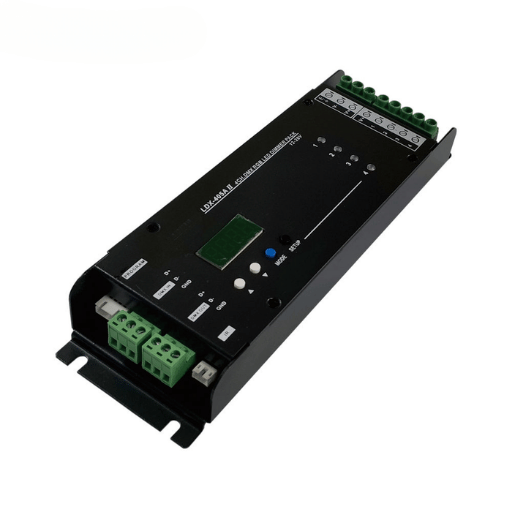
GQ-DMX
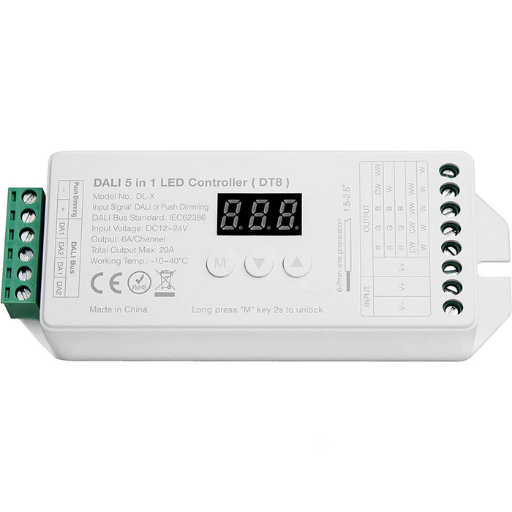
GQ-DALI
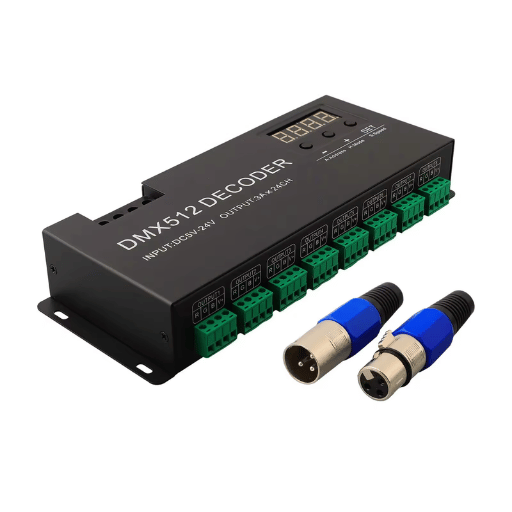
GQ-Analog
GQ-DMX Series — Professional DMX Controllers, Decoders and Lighting Consoles
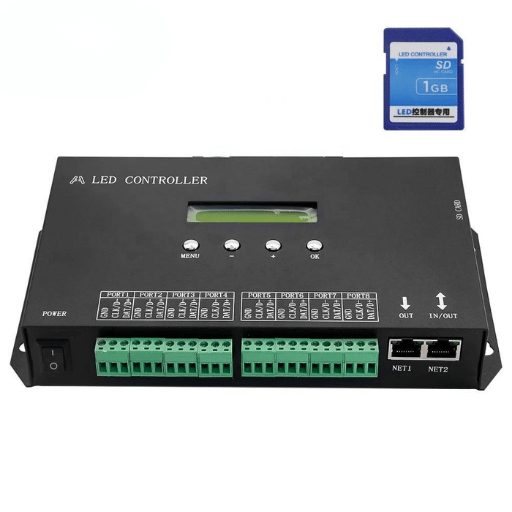
Stand-alone architectural DMX controllers, dmx decoders for tape lights and strips, DMX-over-Ethernet (sACN / Art-Net) gateways, and pixel-mapping drivers – collectively covering the job of DMX lighting console in wall or server racks when decorating facades or setting the step lights of a stage set. Configured to the ANSI standard E1.11-2008 protocol, the RDM enabled counters deliver feedback of fixture identity and DMX address to the bus.
Channels4-ch / 8-ch / 24-ch / pixel
VoltageDC 12-24V / 12-48V / 100-240V AC
Output / channel5A standard, 8A heavy-duty
IP ratingIP20 indoor, IP66 outdoor variants
Connectors3-pin XLR, RJ45, terminal block
Operating temp-30°C to +55°C
GQ-DALI Series — DALI-2 Drivers, Gateways and Wall Stations
DALI-2 application controllers, BMS-bridge gateways (DALI BACnet / Modbus), and two-wire bus power supplies. Suitable for projects where service is downstream of a BMS, and a spec calls for fixture-by-fixture device level feedback. Fully compliant with IEC 62386 Parts 101 / 102 / 103.
Devices / lineup to 64 short addresses
Groups / scenes16 groups, 16 scenes
Bus length~300 m typical (per IEC 62386)
BMS bridgeBACnet IP, Modbus RTU, KNX
IP ratingIP20 (indoor controller standard)
GQ-Analog Series — 0-10V and 1-10V Dimmers
Pure 2-wire analog dimming for retrofit and zone oriented work. Excellent for projects where the conduit is already pulled, and the spec is “track that circuit steadily from 100% to 1% brightness”. No addressing, one channel per controller, the idea being you install as many channels as you need in a box and assign them to specific fixtures.
Dimming range1% – 100% smooth
Voltage10V DC analog signal
Load capacityup to 600W / channel
PairingCompatible with 0-10V drivers from major brands
GQ-Pixel Series — Addressable Digital Pixel Controllers
SPI-output drivers for IC-driven LED strip light runs and addressable pixel arrays (WS2811, WS2812B, SK6812, APA102, and their clones). Designed for architectural facade pixel mapping, mesh systems, and detail-light scenes where each pixel needs an individual color command, plus a DMX-to-SPI converter variant for projects that mix standard DMX fixtures with addressable pixel strings on the same controller bus.
IC supportWS28xx, SK6812, APA102, TM1814
Pixels / portup to 2,048 typical
InputsSPI, DMX, sACN/Art-Net
IP ratingIP66 outdoor option
GQ-Wireless Series — RF, Wi-Fi, Bluetooth Mesh, Wireless DMX and Casambi-Compatible
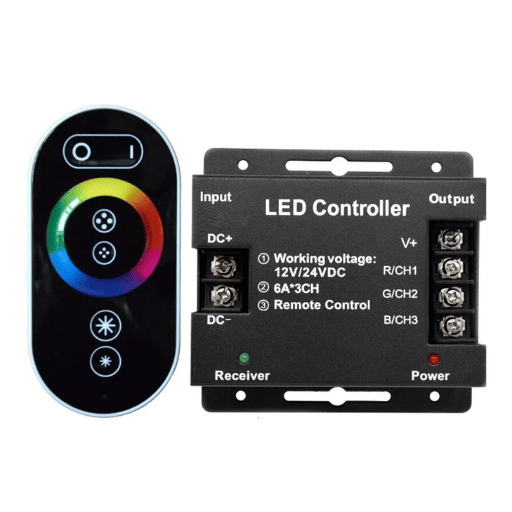
RF wireless dimmers with hand-held remotes, wifi based control panels (suitable for light CCT and color lighting in app-enabled installed fixtures), wireless DMX trans-receivers for high road extension, and Bluetooth mesh / Casambi nodes for retrofit needs, where no new runs can be laid. Useful for a retail or corporate pilot project to test-drive a smart-building story with an open-config approach.
RF range~30 m line of sight
Wi-Fi2.4 GHz, 802.11 b/g/n
MeshBluetooth 5.0+, Casambi-compatible firmware option
App supportiOS, Android, Amazon Echo voice control
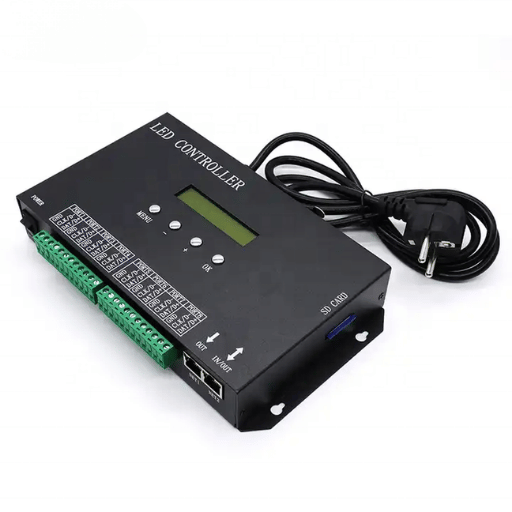
GQ-Pixel
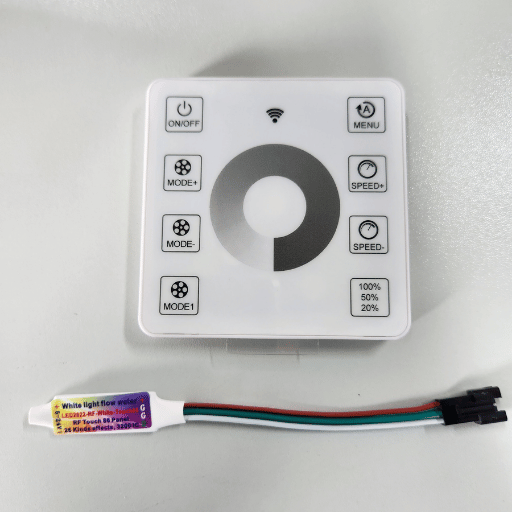
GQ-Wireless
Decision Matrix — match the family to the project type
| Project type | Recommended family | Channel range | Voltage / IP | Why this fits |
|---|---|---|---|---|
| Architectural facade — pixel mapping (multi-universe setup) | GQ-DMX (sACN/Art-Net) + GQ-Pixel | 1024-8192 ch (multi-universe) | DC 24V / IP66 | Multi-universe addressing for facade detail; outdoor housing |
| Hotel landscape, BMS integrated | GQ-DALI gateway + GQ-Analog (zone) | 64 / line × multi-line | Bus + 100-240V / IP20-66 | Bidirectional feedback for occupancy logic in BMS |
| Industrial warehouse — zone dimming | GQ-Analog 0-10V | 1 dim per circuit | 10V DC signal / IP20 | Reuses existing conduit; pairs with 0-10V driver line |
| Outdoor wall washer, RGBW dynamic | GQ-DMX 8-ch + RGBW | 4-8 ch / unit | DC 24V / IP66 | RGBW color mixing under DMX control; outdoor IP |
| Stadium / sports area — multi-zone | GQ-DALI + GQ-Analog hybrid | per zone | Per fixture spec | Pairs with high-bay DALI drivers; central scheduling |
| Retail retrofit — wireless | GQ-Wireless (Bluetooth mesh) | up to 250 nodes | Per fixture spec | No new wiring; app commissioning |
| Stage / event temporary | GQ-DMX standalone | 192-512 ch | DC 12-24V / IP20 | Standard XLR connectors, scene memory |
EN
Performance Specifications That Matter (and How to Verify Them)
A true controller spec sheet that lists “high-quality dimming” and “industry-leading reliability” is not a spec sheet-it’s marketing. Engineers writing a project spec need numbers tied to standards. Here are the seven that determine whether a controller passes any third-party commissioning audit.
Every one of those numbers can be verified. PWM frequency appears on a fast oscilloscope in seconds. Power factor and Total Harmonic Distortion are mandated to be included on IEC 61347 driver compliance certificate. Surge protection class appears on the EMC test report behind the FCC Part 15 / CE sticker. If a controller supplier cannot present those reports for the SKU you are about to spec, the CE sticker on the enclosure is decoration.
Why these specs change the install — Pain → Cause → Solution → Proof
Outdoor commercial fixtures over a high-traffic facade fail commissioning audits when low-level dimming visibly steps or strobes — that is the visible problem. Root cause: PWM frequency runs too low and modulation depth crosses the IEEE 1789-2015 low-risk envelope in the lower dimming bins. Our solution is standard 25 kHz PWM paired with controlled modulation depth, which keeps the fixture inside IEEE 1789’s low-risk zone across the full 1-100% dimming range. Proof: each batch is verified on the factory test bench against a calibrated photodiode-and-oscilloscope rig before it ships.
Reference Performance Envelope — Guangqi Standard SKUs
PWM frequency: typical 25 kHz (high-frequency PWM reduces visible flicker per IEEE 1789-2015 recommended practices)
Power factor: >0.9 at full load (commercial AC-input variants)
Total harmonic distortion (THD): <20% (commercial AC-input variants)
Dimming range: 1% – 100% smooth, no visible step at low end
MTBF: 50,000 hours target (industry baseline, per IEC 61347 driver-safety ecosystem) [QUALIFIED — request batch-specific MTBF data]
Operating temperature: -30°C to +55°C ambient
Surge protection: 4 kV common mode / 2 kV differential mode
EN primary
PROC secondary
Sizing Guide: Match Channels, Voltage, Wattage and IP Rating to Your Installation
Three steps separate “I need a controller” from “I need this controller”. Skip the first and the bid arrives wrong; skip the second and the BoM has the right protocol on the wrong voltage; skip the third and the outdoor fixture housing fails the first storm.
1
Step 1 — Read the light fixture spec, not the controller spec
Pull the fixture datasheet. Identify: control protocol input (DMX? DALI? 0-10V? SPI?), channels per fixture (single white=1 channel, RGB=3, RGBW=4, RGBWA-UV=6), drive voltage (12VDC, 24VDC, 100-240VAC), and current per channel at full output (typical LED strip = 60-72 watts/m at 24V; landscape spot fixture = 0.4-0.8A/channel). For mixed runs that include integrated bulb fixtures(such as par cans or smart bulbs along with linear strip lights), verify each units input protocol before size the controller-this assures you spec the right protocol but the wrong voltage.
2
Step 2 — Multiply, then add 20%
Channels the fixtures current per channel = total amps the computer must source. Then add a 20% headroom for surge, voltage drop along the run, and the operating-temperature derating curve. A 24VDC led tape light controller operating at 95% of its current rating in a +50C ambient enclosure is a service call waiting to happen–and a controller for led strip lights spec’d without that headroom is the most common warranty claim we see.
Ex
Worked example — 50-fixture RGBW facade run
50 facade wash fixtures, 4 channels, 1 A per channel = 200 A total controller current draw at 24 V DC. Headroom 20%, 240 A required source. Solution: 4 60 A 4-channel DMX decoders in parallel topology, with appropriate size DC supplies. Each decoder is given a dedicated fairly short DMX address block on the same universe, requires common 0 V reference.
3
Step 3 — Match the IP rating to the install environment
Indoor commercial: IP20 acceptable. Wetlocation indoor (pool deck, kitchen): IP65 minimum. Outdoor exposed: IP66 — the seal that keeps direct rain out of the controller housing. Buried in landscape with risk of submersion: IP67 or sealed enclosure. Match or exceed the IP rating of the wettest fixture in the run; an under-sealed controller is the failure point in 6 months of monsoon.
PROC primary
MGR secondary
OEM / ODM and Procurement: MOQ, Lead Times, Custom Firmware
Procurement teams shopping an LED controller manufacturer need a framework, not a brochure. The table below summarizes how Guangqi addresses the four governance dimensions that appear in every B2B vendor checklist: minimum order quantity, lead time, scope of customization, and payment policy. Numbers are starting points; the RFQ cover sheet is where final commitments are made.
Pricing Factors Framework — what shifts the unit cost
We do not publish unit prices here because the controller’s bill depends on five variables:
(1) family of protocol (DALI gateways with BACnet bridges are priced differently from a 4-channel DMX decoder);
(2) output current per channel (5A versus 8A heavy-duty);
(3) ingress protection (IP20 versus IP66 enclosure);
(4) scope of customization (standard SKU versus private label versus dedicated firmware);
(5) order quantity tier.
Request a quote with your fixture spec and hypothesized volume and we will reply within 24 hours with a per-SKU breakdown.
Standard procurement terms
| Dimension | Standard | Notes |
|---|---|---|
| Sample order | Welcomed (1-10 units) | For pilot validation before volume |
| Stock SKU MOQ | 50 units | Industry-typical for OEM controller orders |
| Custom firmware MOQ | 500 units | NRE quoted separately; lead time extends |
| Stock SKU lead time | 7-10 days | From PO confirmation, ex-factory |
| OEM (private label) lead time | 25-35 days | Logo printing, custom packaging included |
| Custom firmware lead time | 35-50 days | Hardware + firmware + revalidation |
| Payment | 30% deposit / 70% pre-shipment | T/T, L/C accepted |
| Logo / private label | Yes | Pad printing, laser, sticker — your spec |
| Documentation | CE / FCC / RoHS / IEC certificates per SKU | Direct from issuing body, not images |
PROC primary | EN secondary
Certifications and Standards Compliance
One concern dominates certification discussion in B2B sourcing communities: counterfeit stickers are common. Treat any LED controller manufacturer — including Guangqi — as guilty until they provide the certificate number, the issuing organization, and an authoritative reference. Each badge below corresponds to a certificate Guangqi can supply per SKU on request, traceable to its origin.
CE
EU LVD + EMC
FCC Part 15
US EMC
RoHS
EU 2011/65/EU
IP65 / IP66
Outdoor housing
IEC 61347
Driver safety
IEC 62386
DALI-2
ANSI E1.11
DMX512-A
ETL / UL Recognized
Selected SKUs
Application Case Studies: Architectural Facade, Hotel Landscape, Industrial Warehouse
Three application groupings comprise the overwhelming majority of our shipped controller volume. The synopses below put the configuration, the channel math, and the resultant dimensions requested by procurement teams into a usable context. The project-specific numbers are masked to protect intellectual property and customer confidentiality, which are divulged at quotation time on NDA.
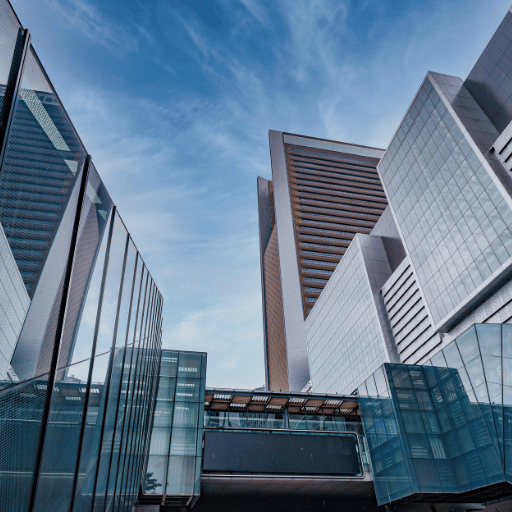
Architectural facade — multi-universe DMX with pixel mapping
Configuration
~1,400 RGBW linear wash fixtures across a 12-story fenestration facade, delivered as 6 sACN universes with content “pushed” by a Pharos-class architectural controller over a Cat6 aisle loop through 6 Guangqi GQ-DMX 8-ch decoders, plus GQ-Pixel SPI drivers for the perimeter detail line.
Channel math
1400 fixtures @4 channels = 5600 control channels 11 DMX universes used (with spare), scaled and summed through gigabit switch.
Outcome dimensions
Single-source supply for decoders + pixel drivers kept specification (BoM) tight. Outdoor IP66 housing removed the additional weatherproof enclosure line item.
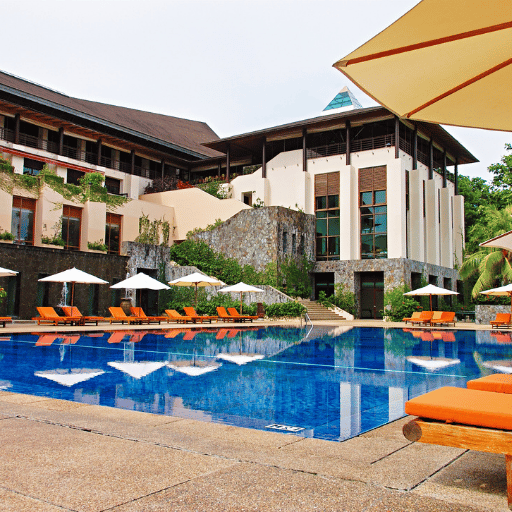
Hotel landscape — DALI-2 with BMS integration
Configuration
~280 inground and tree-uplight fixtures segregated onto 6 DALI bus lines (each encapsulating 64 devices), bridged to the property BMS via GQ-DALI BACnet/IP gateway pair. Scening centrally managed by BMS; override implemented via the wall station.
Why DALI
The property requested device-specific feedback as part of operations dashboard (which fixtures are not responsive/were) and per-zone dimming for occupancy / time-of-day integration. 0-10V offered the addressing, DMX would have delivered more features than necessary.
Outcome dimensions
Maintained maintenance team slashed “lights-out” maintenance calls by reviewing the dashboard rather than walking the property.
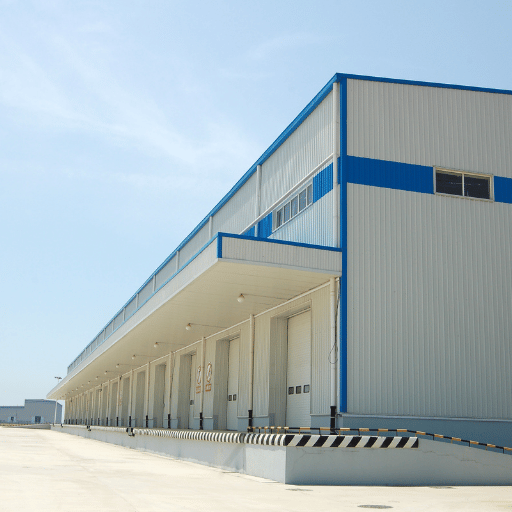
Industrial warehouse — 0-10V zone dimming retrofit
Configuration
High-bay LED fixtures already installed with 0-10V input ballast drivers, so a retrofit was performed with one GQ-Analog 0-10V ballast driver per aisle zone, with both motion and light sensors.
Why 0-10V
No new installation control wiring required – existing pair “reused”. Scope of work was limited to processors, sensors, commissioning, and fixture switchover.
Outcome dimensions
Installed overnight on the weekend at a time when the building remained operational in order to avoid disrupting daytime operations.
1 – 3 years
Typical payback range
Typical payback range for commercial LED retrofit + controls upgrades
Industry estimate (Rayvern Lighting 2024 ROI analysis; PKK Lighting retrofit guidance). Project-specific ROI varies with energy rate, occupancy profile, and incentive availability — request a custom calculation with your kWh rate.
EN
Wiring and System Integration: From Fixture to Controller to BMS
The control chain on a commercial installation seems on paper shorter than it actually is in the field, as it is controlled by the pile of fixture optional decoders, repeaters, or controls (console, BMS, wall station, app) which might sit anywhere in the chain. The topology rule for each phase must be obeyed in order for the install to pass commissioning.
[Power Supply]
DC
[Controller / Decoder]
PWM
[Fixture chain]
control input (DMX, DALI, 0-10V, SPI)
[Console / BMS Gateway / Wall Station]
Cat6 / 2-wire loop
[Optional Repeater / Splitter for long runs]
Four-step install checklist
Power the channel. The sum of all fixture amps per channel +20% headroom shall not exceed the power controller’s maximum mandated output in amps. In practice, undersized power is the leading cause of mid-life controller failures.
1 Communicate with the bus
DMX devices require discrete starting addresses (programmatically, electrically, temporarily); these addresses are separated by fixture channel footprint (a 4-channel RGBW fixture uses 4 consecutive DMX addresses – the next fixture is mapped 4 addresses away). DALI fixtures, if supported, auto-discover, but lines must be commissioned to assign short addresses and groups.
2 Terminate the line
A 120-ohm terminator at the last fixture on a DMX bus is not optional, it is required. Data from forum archives indicates lack of termination is responsible for the vast majority of “controller worked on the bench, fails in the field” reports.
3 Confirm the BMS bridge
If a site uses a BACnet, Modbus, or KNX BMS, configure the gateway object map prior to site commissioning. Protocol mismatch is the second most common unexpected hiccup for BMS-controlled lighting.
4 Engineering Note — Check causes
Troubleshooting guides associated with each bus type repeatedly cite unmanaged 120-ohm DMX data line termination as the top reason for a “working” DMX controller failing after system commissioning. The passive resistor, placed at the end of the EIA-485 bus, prevents infinitely long reflection loops that trigger intermittent fixture freezes and color artifacts. Always place the terminator at the last fixture on every run.
5 For deeper dives
For deeper dives on specific topologies, visit our companion resources: BMS integration compatibility for DALI and 0-10V projects, our interactive Protocol Selector to choose between DMX and DALI, and the LED driver selection guide ensuring control to downstream driver compatibility. Additionally, the commercial lighting control system overview explains system-level architecture for multi-building campuses, DMX wall-mount controller install patterns, and embedded-fixtureintelligence.
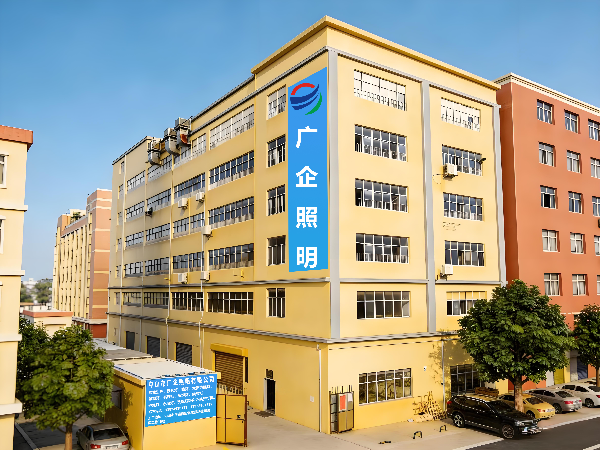
Advanced Manufacturing & Quality Control Center
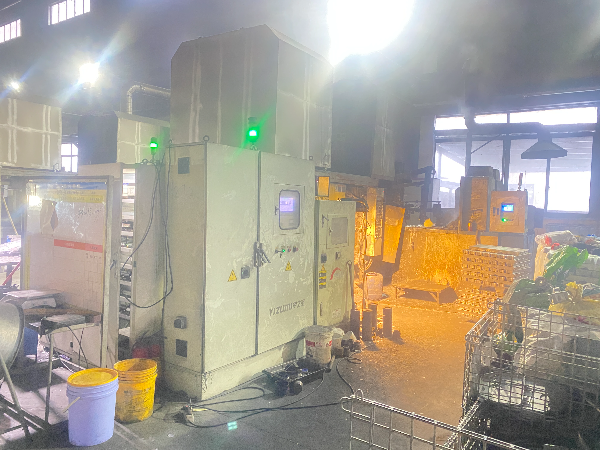
Main Manufacturing Facility
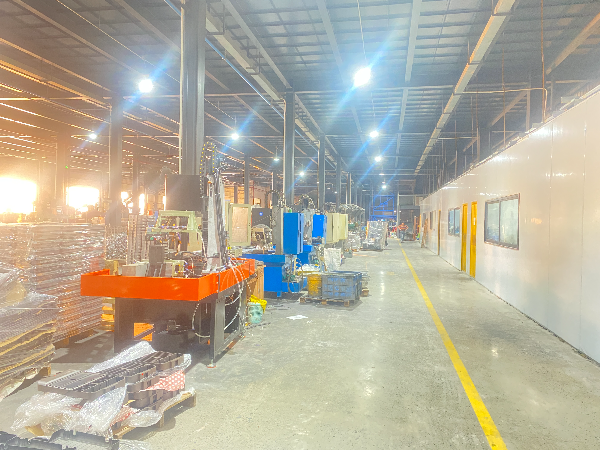
Precision Assembly Line
Automated Testing
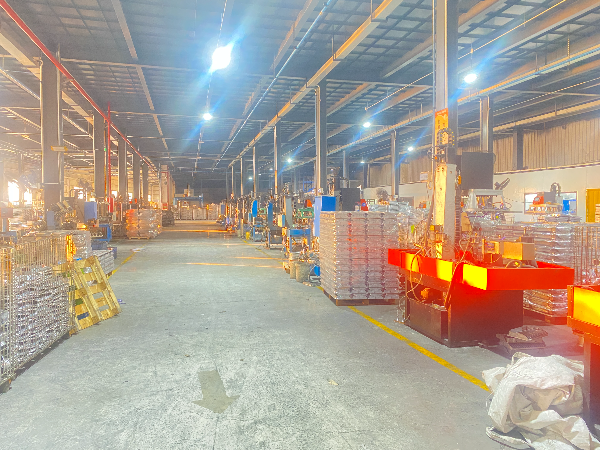
Quality Control
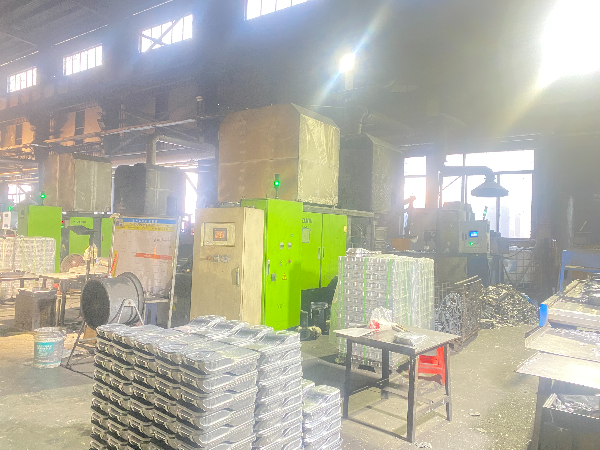
Engineering Testing Lab
×
Professional LED Controller Engineering Tools
01
LED Controller Channel & DMX Universe Calculator
Estimate total control channels and the number of DMX universes your installation needs. Use the result to size GQ-DMX or sACN/Art-Net controllers from Guangqi’s product line.
02
LED Controller Power Sizing & Voltage Drop Calculator
Calculate the power supply current rating and the voltage drop along your DC run. Avoid the most common controller-side service call: undersized power and unmanaged voltage drop on long fixture chains.
03
LED PWM Flicker Risk Indicator (IEEE 1789-2015)
Estimate the flicker-risk zone for a controller’s PWM output based on frequency and modulation depth, against the IEEE 1789-2015 recommended-practice envelope. Use the result before specifying a controller for healthcare, classroom, or facade installations where flicker is a documented health concern.
EN
PROC
MGR
Frequently Asked Questions
A LED controller is the device between the lighting control source and the fixture. It receives a control signal — DMX, DALI, 0-10V, RF, Wi-Fi, or Bluetooth — and translates that signal into the precise current and PWM dimming waveform that the LED needs. Without a controller, addressable color, scene memory, dimming, and BMS integration are not available.
No. The controller and the fixture must speak the same protocol (DMX, DALI, 0-10V, SPI, etc.) and must match on voltage and channel layout. A 4-channel RGBW DMX decoder controls a 4-channel RGBW fixture; it cannot drive a single-color 0-10V high-bay. Always read the fixture spec first, then size the controller to it.
A DMX controller transmits a continuous serial data stream over an EIA-485 bus, with up to 512 channel slots per universe. Each fixture on the bus has a unique starting DMX address; it reads the channels assigned to it and ignores the rest. Updates run typically 44 frames per second, fast enough for smooth dimming and color fades. The standard is ANSI E1.11-2008 (R2018).
A DMX address is the starting channel slot a fixture listens to on the bus. A 4-channel RGBW fixture set to address 1 reads slots 1-4; the next fixture starts at address 5; and so on, up to 512 per universe. Most fixtures set address via DIP switch, on-board buttons, or RDM. RDM-enabled controllers and decoders (like Guangqi GQ-DMX RDM variants) can read and write addresses from the controller, no ladder required.
Yes. One DMX universe carries 512 channels; depending on channel footprint, that supports anywhere from ~64 RGBW fixtures (8-channel each) to 512 single-channel dimming circuits. Beyond 512 channels, you scale to multi-universe with a sACN / Art-Net gateway over Ethernet — a single network can address tens of thousands of fixtures.
DMX512 is a one-way, fast, 512-channel-per-universe protocol designed for entertainment and architectural color/scene control. DALI is a slower, two-way, 64-device-per-line protocol designed for smart-building integration with feedback. 0-10V is a simple two-wire analog dim signal — no addressing, one channel per circuit, but trivial to wire and pair with retrofit. The matrix earlier on this page compares all eight common protocols on eight dimensions.
Channels = number of fixtures × channels per fixture (single white = 1, RGB = 3, RGBW = 4, RGBW + tunable white = 5+). Multiply, then add 20% headroom for future expansion. If the result exceeds 512, plan for multi-universe with a sACN / Art-Net gateway from day one — retrofitting universes after install is more expensive than designing them in.
50 units for stock SKUs with private-label printing; 500 units for custom firmware. Sample orders of 1-10 units are welcomed for pilot validation before committing to a volume run. Sample lead time is 5-7 days from confirmed PO.
Stock SKU with standard packaging: 7-10 days from PO confirmation. OEM with private-label printing and custom packaging: 25-35 days. Custom firmware (additional channels, BMS object maps, custom protocol bridges): 35-50 days, including hardware revalidation and EMC re-test where the change requires it. Air freight is available; sea is the default.
Yes — CE (Low Voltage Directive + EMC Directive), FCC Part 15 Subpart B, and RoHS (EU Directive 2011/65/EU) are baseline across the line. IP65 and IP66 ratings apply to outdoor variants. ETL / UL Recognized Component status is held on selected SKUs intended for the North American commercial market — we confirm per SKU at quotation. Each certificate is supplied as a PDF with the issuing body and certificate number, not as a sticker image.
Yes. Pad printing, laser etching, and label sticker are all available; custom packaging (printed boxes, branded inserts, multilingual quick-start cards) is included in the OEM lead time. Private-label MOQ is 50 units. Logo files in vector format (AI, EPS, SVG) are required at PO confirmation.
Request a free sample kit covering three controller families (typically GQ-DMX, GQ-DALI, and GQ-Analog) — we ship within 5-7 days. Sample-quality SKUs are pulled from the same production line as volume orders, with the same firmware and certification. After sample testing, the volume PO references the same SKU, no re-spec required.
Standard warranty is 2 years from shipment date for stock SKUs; OEM and custom firmware variants follow the same baseline unless a different term is specified in the contract. RMA process: notify within warranty period, return-ship the failed unit, replacement ships within 7-10 days of receipt and root-cause analysis. Failure analysis report is available on request for any returned unit.
Trending now
![Industrial LED Bulbs: Bases, Voltage & Heat [Checklist]](https://gqlamp.com/wp-content/uploads/2026/10/industrial-led-bulbs-blog-featured-150x150.png)