Get in Touch with GUANGQI




Choosing an UFO LED high bay should be a straightforward engineering exercise, but things are confusing when you get to the marketplace. One product page will tell you that a 150W fixture covers the same space as a 400W metal halide, while others tell you to go as high as 200W. One section advises to space fixtures according to ceiling height; other sections emphasize beam angle. This guide cuts through the complexities with the real decision math that powers facility-lighting projects – ceiling-height-to-wattage mapping, footcandle outcomes from OSHA, levels to score the new DLC Premium approval, and the ROI model we call the 70/50 Rule.
Quick Specs: UFO LED High Bay Light at a Glance
| Wattage range | 50W – 400W (specialty fixtures to 1000W) |
| Lumen output | 6,900 lm – 52,000 lm |
| Efficacy | 130 – 160 lm/W (quality fixtures) |
| Color temperature | 3000K / 4000K / 5000K or selectable CCT |
| Beam angle | 60° / 90° / 120° (narrow to wide) |
| Voltage | 120–277V standard; 347–480V for industrial |
| Ingress protection | IP65 (dust-tight, low-pressure water jets) or IP66 (stronger jets) |
| Rated lifespan (L70) | 50,000 – 100,000 hours |
What Is a UFO LED High Bay Light?
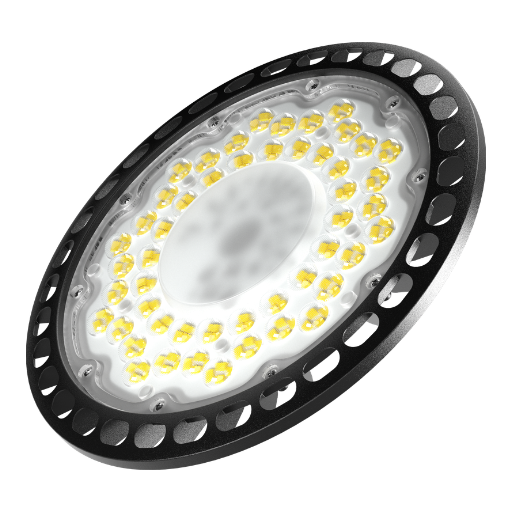
An UFO LED high bay light is the round industrial lighting fixture designed to light large indoor spaces from ceilings 10-15 feet high. The term derives from the round shape and flush mounting of this low-profile fixture, which creates a disc footprint just over a foot wide and houses LED modules, drivers, and heat sinking. Round LED high bays uniformly cast a downward cone, the reason why they’re the default solution in warehousing, manufacturing, aerospace, arena, and general-storage.
Compared to HID (High-Intensity Discharge) fixtures, 120-160 lumens per watt is typical efficacy for quality LED HID replacements, versus 65-75 lumens per watt after ballast losses for 400W metal halides. This efficacy differential is the primary driver behind the retrofit economics discussed throughout this guide. Where warehouse lighting retrofits are concerned, this is the paramount reason why buildings are shifting away from HID even when LED upfront costs are higher than remaining HID assets. Round high bay led fixtures are different from linear high bays in beam spread: the round housings have concentrated beams, while linear fixtures flood a rectangular pattern best for shelving aisles. In less intense environments – workshops, two-car garages, fitness areas – the same fixtures are available as UFO shop lights or garage lights, built to less wattages but the same specifications.
Most commercial-grade UFO high bays are UL-listed, DLC-qualified, and rated at IP65 for ingress protection from dust and water. For a full range of product specs available as a filter search, see our UFO LED high bay light solutions.
UFO vs Linear High Bay: When to Choose Which
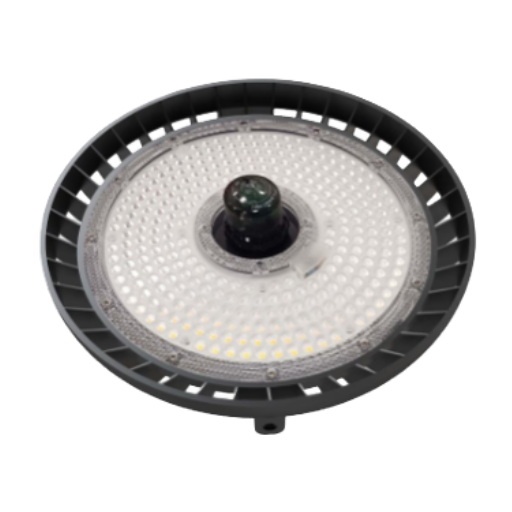
The single most common error when selecting UFO and linear high bays is assuming you can use either form. They’re not interchangeable. UFO fixtures cast a circular cone of light, linear ones produce a rectangular one. Whether you’d be better with one or the other depends on the layout of your space, not fixture prices.
| Attribute | UFO High Bay | Linear High Bay |
|---|---|---|
| Beam footprint | Circular (60°/90°/120°) | Rectangular, elongated |
| Best-fit layout | Open floor, square/round bays | Aisles, rack fronts, vertical shelf faces |
| Vertical illuminance on shelving | Lower (hotspot under fixture) | Higher (spread along shelf face) |
| Typical mounting height | 15 ft – 40+ ft | 10 ft – 25 ft |
| Fixture count for same area | Fewer, higher-lumen units | More, lower-lumen units |
| Cost per fixture | Higher per unit | Lower per unit |
The selection rule: make this decision based on ceiling height and layout. When ceilings are high and space is open, UFOs are best value in both number of fixtures and cost: load these up. When ceilings are high but aisled, and vertical faces of shelving should be lit, linear high bays win across both factors. Facilities with mixed open/closed spaces often use a combination of UFO high bays and linear fixtures.
The retrofit we most often see is just installing UFO fixtures one-for-one to replace rectangular high bay units. That creates bright spots beneath each fixture and dark zones between rows- cause a round beam doesn’t tile base to base like a rectangular beam.
How to Choose the Right Wattage for Your Ceiling Height
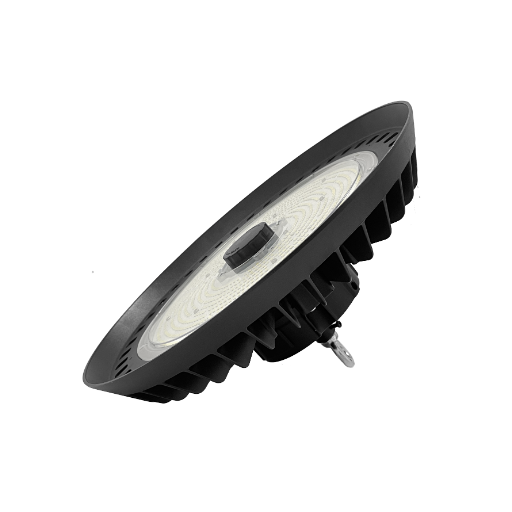
Wattage is the wrong place to start. Start with footcandles needed at your floor area and for your tasks, then find your wattage using fixture efficacy. But since your purchasing department shops in watts, this is the decision tree most facility managers follow when shopping between 150 watt led high bay lighting and comparable units at 200W and 240W. Same decision tree if you call your product a high bay ufo fixture, 200w high bay light, or LED round high bay.
How Many Watts Is the UFO High Bay Light I Need?
Size wattage to ceiling height, then fine tune based on task light demand. High ceilings require more lumens and narrower beam widths per fixture to reach the same footcandles on the work surface. For all-open ceiling bay layouts, a 150W LED UFO replaces a 400W metal halide fixture in spaces under 25 feet. Above 25 feet, upgrade to 200-240W. And above 40 feet, begin planning for 400W+ fixtures with 60 degree narrow beam widths to keep on floor footcandles high without installing twice the number of fixtures.
| Ceiling height | UFO LED wattage | Lumen output | Replaces HID | Beam angle |
|---|---|---|---|---|
| 10 – 15 ft | 50W – 100W | 6,900 – 13,000 lm | 175W – 250W MH | 120° |
| 15 – 25 ft | 150W – 200W | 20,000 – 30,000 lm | 400W MH | 90° – 120° |
| 25 – 40 ft | 240W – 400W | 36,000 – 52,000 lm | 750W – 1000W MH | 60° – 90° |
| 40+ ft | 400W+ | 52,000 lm+ | 1000W MH or dual-unit | 60° (narrow) |
The 150W-replaces-400W-MH ratio reflects actual efficacy math. A flash rate 130-160 lumen per watt LED fixture can produce roughly the same lumens on the ground as a 400W lamp/ballast /j/ system that only manages 65-75 lumens /j/ per watt after ballast losses and lumen depreciation. Acuity Brands’ published conversion chart recommends using roughly 24,000 lumens to replace a 400W MH, which a 150W LED UFO easily delivers at 150 lm/W. The 67% reduction in energy cost per fixture is what brings the payback analytics into scope.
Lumens, Beam Angle & Footcandles: Designing the Lighting Layout
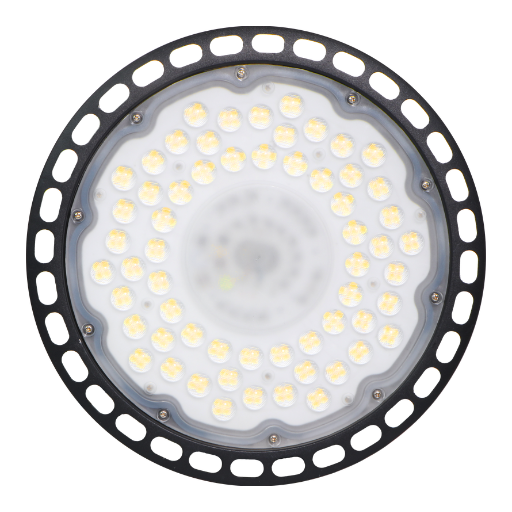
Wattage indicates how much power the fixture consumes. Lumens indicates how much light emerges from the fixture. Footcandles indicate the actual amount of light on the ground or work surface and is the metric that directly relates to safety and worker comfort.
What Footcandle Level Does My Warehouse Need?
OSHA 29 CFR 1915.82 Table F-1 mandates effective minimums for landside industrial facilities: 10 foot-candles for machine shops, electrical machine and storage rooms, carpenter shops, lofts, tool rooms, warehouses, outdoor work zones. Office/lunch rooms and first-aid stations mandate 30 fc. Other general work zones and stairwells must have 5 fc. Construction sites under 29 CFR 1926.56 have a minimum of 5 fc in general work areas. These are the floors, not targets. IESNA RP-7-17 recommends 30-50 fc for floors that must sustain task work.
| Area or task | OSHA minimum (fc) | IES recommended (fc) |
|---|---|---|
| General warehouse (bulk storage) | 10 | 10 – 30 |
| Machine shop / fabrication | 10 | 30 – 50 |
| Corridors, stairs, walkways | 5 | 5 – 10 |
| Pick aisles, fine assembly | 10 (minimum) | 50 – 75 |
| Offices, first aid, inspection | 30 | 50 – 100 |
📐 Engineering Note: Spacing is not simply ceiling height.
The traditional shop lighting guideline “space UFO fixtures the same as the ceiling height” is only valid for 120 beam fixtures at 15-25 ft mounting height. Modern photometric design should always take into account the ratio of Spacing-to-Mounting-Height (S/MH). As a rule of thumb, the fixture spacing should be adjusted according to the S/MH ratio and the beam angle of light emitted by the fixture. For instance, a 60 N narrow beam angle LED high bay fixture mounted at 40 ft should be spaced closer to 0.7 MH than the old rule in order to avoid dark spots in the layout, whereas a 120 W wide beam fixture at 20 ft can be spaced up to 1.2 MH apart. For every fixture at the ceiling higher than 30 ft or furnishings, equipment or columns shortening the layout, it is more advisable to ask for a photometric plan than to apply a fixed number rule- this is where industrial and commercial lighting planning stops being a shortcut and a laborious task.
Color Temperature, CRI & Certifications: DLC, IP65, UL
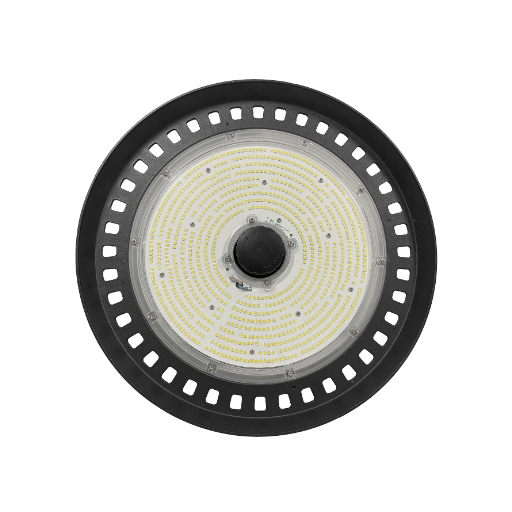
The color temperature, color rendering and certification marks take out the guess work from choosing a dimmable LED high bay fixture for the right application and price point, and ensure it will actually last the rated 50,000 hours.
CCT (colored temperature) is expressed in units of Kelvin (K). 3000K is warm white light, with an orange bias dominant to incandescent light- best suited for hospitality or retail spaces. 4000K is nice crisp neutral white, the most versatile color choice for most general purpose spaces. 5000K (or 5500K) is cool white light, a great choice for manufacturing or cold storage-having been found to improve worker performance by improving human alertness and contrast detection. Fixtures with selectable CCT (3000/4000/5000K color switch) add $5-$15 to the cost without adding much in efficiency, and adds versatility for changing conditions or other color occupants.
Color Rendering Index (CRI) measures a light source’s ability to express a standard palette of color- daylight (point of reference, 100%) compares light source color to base spectrum. Industrial LED high bays have figures of CRI 70-80 from top manufacturers. Electively, for color-sensitive work on plants, auto body, paint shops, or textiles, choose CRI 80+. Work of art or lighting to fashion show parade standards, CRI 90+.
| Certification | What it means | Why it matters |
|---|---|---|
| UL Listed | Underwriters Laboratories safety testing | Required for commercial insurance and electrical inspection |
| DLC Standard | DesignLights Consortium qualification | Entry threshold for most utility rebate programs |
| DLC Premium | Higher efficacy + stricter color and lumen maintenance | 15–30 lm/W above Standard; unlocks top-tier utility rebates |
| IP65 | Dust-tight; protected against low-pressure water jets | Needed for wash-down zones, damp environments |
| IP66 | Dust-tight; protected against powerful water jets | Food-processing, outdoor covered, heavy wash-down |
| RoHS / CE | EU material restriction + conformity marks | Mandatory for European export shipments |
Here is the DLC Premium distinction most buyers miss. A Standard-qualified fixture at 125 lm/W and a Premium-qualified one at 150 lm/W both carry “DLC” logos in marketing copy — but only Premium unlocks the top rebate bracket with most utilities. On a 200-fixture project, that efficacy gap can swing rebate dollars by $40,000 or more. Check the DLC Qualified Products List directly; do not trust vendor claims alone.
ROI & Cost: HID-to-LED Payback Analysis (The 70/50 Rule)
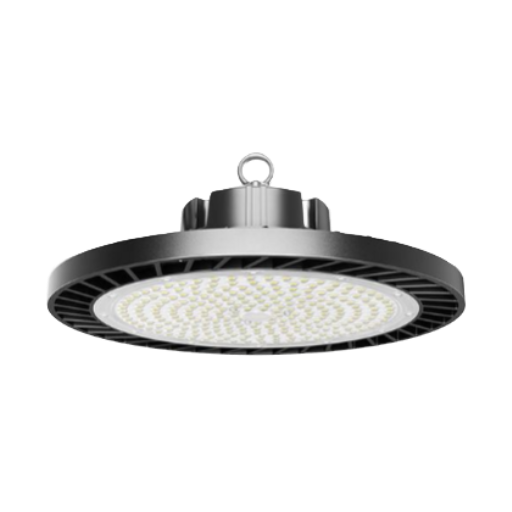
The retrofit calculation for a UFO LED high bay is actually easier than the retrofit one: we teach it as the 70/50 Rule- a quality, energy efficient LED high bay retrofit high bay fixture from the top manufacturers delivers about 70 percent reduction in energy versus the same installation using the HID it replaces- and earns an approximate 50,000 hours of included rated life (enough for ten years of use before output drops to 70% of initial lumen levels). Those two optimistic figures can result in payback periods of 18-36 months; meaning top LED high bay lights in search result are very often at their best fit within just one calendar year- which is why most retrofit searches resulted in retrofit projects in record time.
How Much Do You Save Switching from Metal Halide to UFO LED?
Take a warehouse with fifty 400W metal halide fixtures running 4,000 hours a year at $0.12 per kWh. Each MH fixture actually draws closer to 460W once ballast losses are factored in. Replace them with a 150W UFO LED at comparable lumen output, and per-fixture annual energy cost drops from about $221 to $72 — a $149 saving. Across 50 fixtures that is $7,450 per year before you count maintenance savings. A typical 400W MH lamp requires replacement on a 2-3 year cycle at $25 per lamp plus labor; an LED rated at 50,000 hours L70 holds its lumen output for the full ten-year period. The DOE 2020 report on LED adoption in common lighting applications projects energy cost savings at roughly $10 billion per year at scale across the U.S. commercial sector, with low/high bay among the fastest-growth retrofit categories.
Key Factors in Payback Calculation
- Fixture count x hours of operation annually (multiply, then multiply by rate/kWh)
- Actual HID system draw, including ballast (add ~15% above rated lamp wattage)
- Utility rebate eligibility (DLC Standard v Premium- 20-50% of fixture cost in many service regions)
- Savings in maintenance costs: lamp replacements, lift rental, labor for relamping
- Controls overlay (motion sensors and daylight harvesting can cut energy 20-40% beyond the LED baseline)
💡 Pro Tip
The 70/50 Rule is meant to be a quick sanity check, not an alternative to a site audit. If actual energy cost does not record this 5% approximate savings, there is an error-something else not accounted for in the audit-gas supply voltage tap, a driver is pulling more than its specified wattage, a fixture count mismatch for the actual used floor area.
For retrofit analysis, our UFO high bay product line is available in 100W, 150W, 200W, 240W, and 400W packages with DLC-listed options for rebate qualification.
Installation & Mounting: Height, Hooks, and Electrical Safety
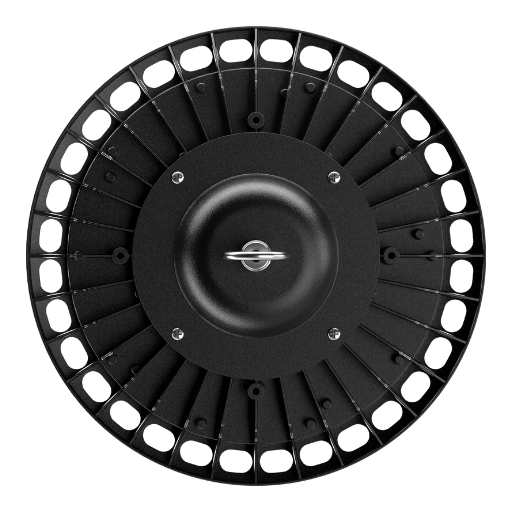
UFO high bays are lighter than comparable HID fixtures-6-12 pounds versus 20+ pounds housing ballast for a metal halide. That makes hanging them easier but the safety envelope for high-ceiling electrical work remains unchanged.
Can I Install a UFO LED High Bay Myself?
One-for-one retrofit for (the common) 120-277V circuit at matching voltage, a licensed electrician is responsible for wiring and an operator for hanging. DIY wiring in a building you own and following inspection is proper in many states, but above 6 feet up is subject to OSHA 29 CFR 1926.501 fall protection guidelines. If the voltage is anything other than 120V on the circuit, adhere to the manufacturer’s specific installation requirements, specifically to make sure you use the proper voltage tap. (100, 200, 277, etc).
| Mounting option | Best for |
|---|---|
| Hook mount | Standard warehouse ceilings with exposed joist or open-web truss |
| Pendant mount (chain or cable) | High ceilings where you want the fixture to hang lower than structure |
| Trunnion / yoke mount | Angled installation over sloped rooflines or side-lit applications |
| Surface / flush mount | Lower ceilings where pendant intrusion would be a hazard |
⚠️ Important
Do not free the fixture from the LED driver or data wire. Driver input wiring must maintain the factory configuration. Support all fixtures according to path of travel or mounted according to the listing (ceiling height and support must be listed) standards. Do not run fixtures in parallel unshielded drooping power wire.
Common Pitfalls and How to Avoid Them
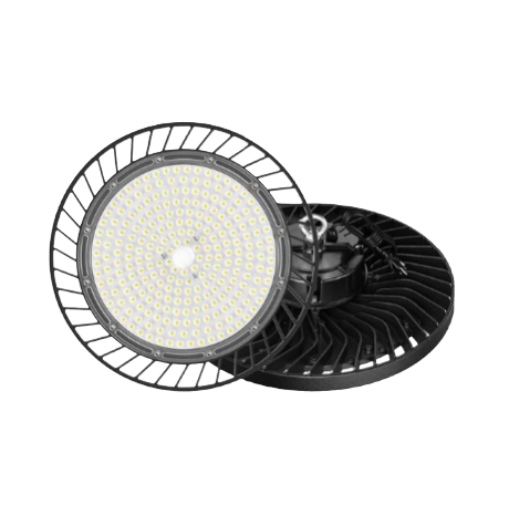
Most UFO high bay retrofits that underperform or fail prematurely share the same handful of root causes. Electricians on r/electricians and r/Lighting threads share these pitfalls more plainly than any product datasheet can – the common patterns below condense what practitioners report at dozens of threads and retrofit reviews.
- ✔
Picking wattage by HID equivalent alone. Ignore the “replaces 400W MH” sticker and match lumens to your actual ceiling and footcandle target. A 150W LED at 150 lm/W delivers 22,500 lm — not every 150W fixture hits that number. - ✔
Wrong voltage tap at commissioning. A 120V fixture on a 277V circuit is an instant driver failure. Multi-voltage fixtures (120–277V auto-sensing) cost slightly more and prevent the most common installer error. - ✔
Buying sub-commercial drivers on price alone. Field reports converge on one pattern: discount UFO high bays fail at the driver — often within 12 months, often because heat from the LED module transfers directly into an undersized driver compartment. Specify Mean Well, Inventronics, or equivalent name-brand drivers; the $5–$20 premium pays back the first time you do not have to send a lift crew up to swap a unit. - ✔
Skipping controls at purchase. Retrofitting motion sensors or dimming control into an already-hung fixture means re-wiring on a lift. Specify 0–10V dimming and integrated motion sensors up front if there is any chance you will add controls later.
Frequently Asked Questions
Q: Are LED high bay lights worth the upfront cost?
View Answer
Yes, almost any commercial high-ceiling facility operates 2000+ hours per year. The 70/50 Rule covers the core math – around 70% energy reduction and 50k-hour L70 lifespan. Typical payback is between 18 and 36 months; DLC Premium fixtures with utility rebates will payback inside a year.
Q: How long do UFO LED high bay lights last?
View Answer
Quality fixtures will have an L70 rating of 50-100k hours. L70 refers to lumen 70% of initial levels – and does not imply fixture failure. At continuous 24/7 operation that is 5.7 to 11.4 years. At single-shift 10 hours/day 5 days/week operation it extends into the 19+ year range.
Q: Can UFO LED high bays replace 400W metal halide?
View Answer
Yes. A 150W LED UFO high bay at 150 lm/W will produce about 22,500 lumens, reaching or surpassing the ~24k initial lumen level quoted by Acuity Brands for a 400W MH replacement. For most warehouse retrofits under 25 feet ceiling height, this one-for-one replacement is standard.
Q: What is the difference between DLC and DLC Premium?
View Answer
DLC Standard is the entry qualification – stripped utility rebate programe threshold. DLC Premium requires 15-30lm/W higher efficacy along with better lumen maintenance and color consistency. Premium qualifies the top-tier utility rebate bracket which generally doubles the rebate per fixture.
Q: Can UFO LED high bay lights be used outdoors?
View Answer
Yes, if rated IP65 or IP66 and used in covered outdoor applications. Most UFO high bays are rated for indoor or covered outdoor uses (open gas-station canopies, loading-dock overhangs). Exposure to snow, rain, or UV automatically shortens driver life even with IP66 rated product. For sources that will see completely exposed outdoor uses, select a conventional outdoor flood or area light.
Q: How much does a UFO LED high bay light cost?
View Answer
Prices will generally range from $70 for 100W-150W entry level commercial fittings, to $230 for 240W DLC Premium, motion sensing, emergency capable fixtures. Volume contractor pricing on projects with more than 50 fixtures can be 40% or more lower. Driver brand and warranty length, not simply fixture wattage, is the real cost driver.
Planning a Warehouse or Facility Retrofit?
See complete line of UFO high bay specifications, DLC qualification data, and voltage options.
About This Buyer’s Guide
This UFO LED high bay guide has been assembled by the industry experts at the Guangqi Lighting engineering team using OSHA regulation data, DOE LED usage research, DLC V5.0 Technical Requirements, retrofit pattern data from industrial lighting forums. From our line of commercial and outdoor LED fixtures sent from factories in Asia, North America, Europe, and the Middle East since 2010, we certify to IP65 and IP66 standards with most designs. Wherever we found materials that simplify with industry oversimplifications (the biggest is the “spacing equals ceiling height” rule of thumb) we note the sensitivity.
References & Sources
- OSHA 29 CFR 1915.82 — Lighting (Table F-1 Minimum Lighting Intensities) — U.S. Occupational Safety and Health Administration
- OSHA 29 CFR 1926.56 — Illumination (Construction) — U.S. Occupational Safety and Health Administration
- OSHA 29 CFR 1926.501 — Fall Protection Duty — U.S. Occupational Safety and Health Administration
- Adoption of Light-Emitting Diodes in Common Lighting Applications (2020) — U.S. Department of Energy
- LED Lighting Fact Sheet — U.S. Department of Energy Energy Saver
- ANSI/IES RP-7-17 — Recommended Practice for Lighting Industrial Facilities — Illuminating Engineering Society
- DLC Qualified Products List & Technical Requirements V5.0 — DesignLights Consortium