14 Years · LED Manufacturer · Zhongshan, China

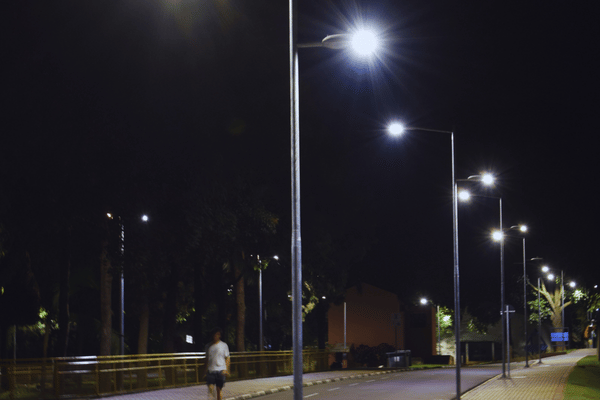
Solar Street Lights with Pole

Solar Street Lights with Pole — 150-170 lm/W Off-Grid Systems by Guangqi

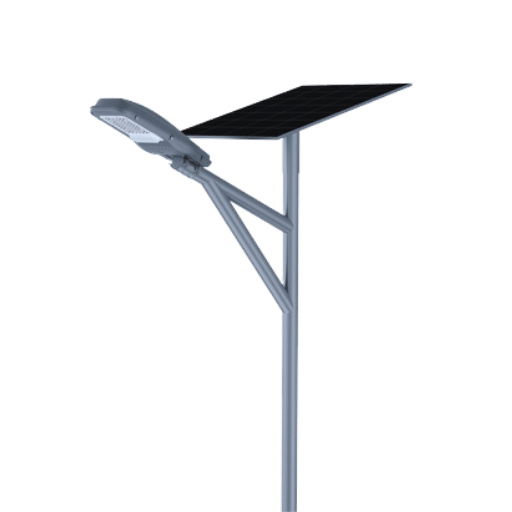
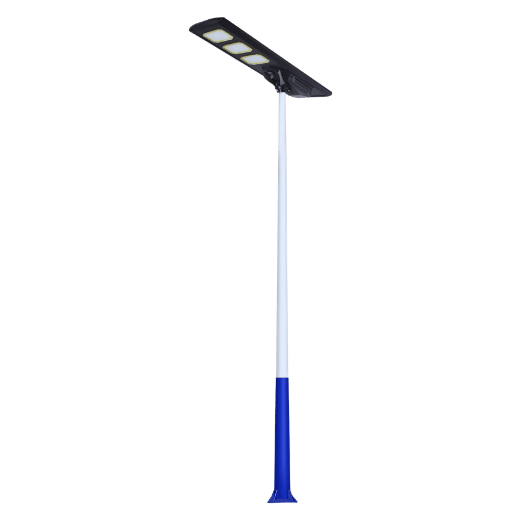
Engineer-grade integrated and modular solar street lights – a off the shelf solar powered street lighting package featuring LiFePO4 batteries exceeding 2,000 life cycles, IP65 LED light fixtures from 100 W to 500 W, and bundled pole options for parking lot, roadway, and remote site applications
Request Engineering Quote
CE · RoHS · IP65
2-year warranty (5-year optional)
Ships to Asia, Europe, North America, Middle East
50,000 h L70B50 rated LEDs
Solar Street Lights with Pole

When Grid Wiring Costs More Than the Lights — Why Solar Street Lighting Wins from Day One

Solar powered street lighting with pole installation allows users to light parking lots, access roads, perimeter fences, and remote sites without any buried conduit. From an economic standpoint, the case is straightforward: for commercial projects, installed cost per pole for a solar system often runs below a grid-tied alternative once trenching, permitting, and utility extension fees are factored in.

Grid trenching cost
$1,200-3,500
per pole, installed
Solar installed cost
$800-2,000
per pole, no trenching
Annual grid electricity
$200-400
per pole, ongoing
Solar annual electricity
$0
sunlight is the fuel

A solar-powered street lighting system is a stand-alone photovoltaics installation comprised of a top-tier monocrystalline solar module, an MPPT charge controller, a lithium battery, and LED street lighting chips. A solar-powered street light circumvents the hundreds of feet of trenching and complex utility advancements (including hundreds of dollars of fees) it takes to extend utility service out to rural access roads, highway off-ramps, and perimeter fences, providing a continuous infrastructure-independent amenity after the electric grid falls silent.

Real pain most buyers describe: facility managers waste thousands on trenching costs and ongoing electricity bills for traditional street lighting when the site already has poor sun exposure assumptions or untested battery sizing. Cheap $17 residential-grade units amplify the problem — but that is a different product class than what a municipal or industrial fleet actually needs.

Four failure modes of low-tier solar street lights (and how engineering prevents each one)

1

A fully packed 200 Wh lead-acid battery cannot power a 100 W luminaire through the entire night, particularly if it is a rainy day. Lithium iron phosphate batteries with 3.2 V 60 Ah cells, combined with the right sized PV array, correct this deficiency.

2

Uncontrolled battery chemistry – deep discharge and overcharge kills lead-acid fast and prematurely. Lithium iron phosphate cells with a proprietary Battery Management System ((BMS)) keeping the range of state-of-charge between 20% and 90% preserve the 2,000+ life cycles necessary to amortize a good solar street light.

3

Inexpensive LED modules – 60-80 pro lm/W LEDs are wasteful; they cook off half of the battery capacity before restoring it. Our 5054 SMDs coupled with PC lens-T2-S optics produce a system efficacy of 150-170 lm/W on the GQ-TKJ line.

4

The absence of dusk-to-dawn intelligence – fixtures which are incapable of dimming at night still burn 100% power until sunrise. Polycrystalline photovoltaic modules and optional reaction sensing can minimize poastmidnight energy expenditure by 40-60%.

The Guangqi Solar Street Light Lineup

All-in-One, Modular, and Split Systems (20 W to 500 W). Engineered around specific panel-battery-LED balances for ultimate reliability.

GQ-TKJ-A Integrated Solar Street Light

GQ-TKJ-A — Integrated Solar Street Light, 100-400 W

Optimized for commercial parking lot, internal road and campus perimeter applications where panel pitch can directly track true south. Flat-voltage 3.2 V controller.

100W

GQ-TKJ-A-100W

3,600 lm typical
60 Ah / 3.2 V LiFePO4

200W

GQ-TKJ-A-200W

2-Group module
80 Ah / 3.2 V LiFePO4

300W

GQ-TKJ-A-300W

3-Group module
100 Ah / 3.2 V LiFePO4

400W

GQ-TKJ-A-400W

4-Group module
120 Ah / 3.2 V LiFePO4
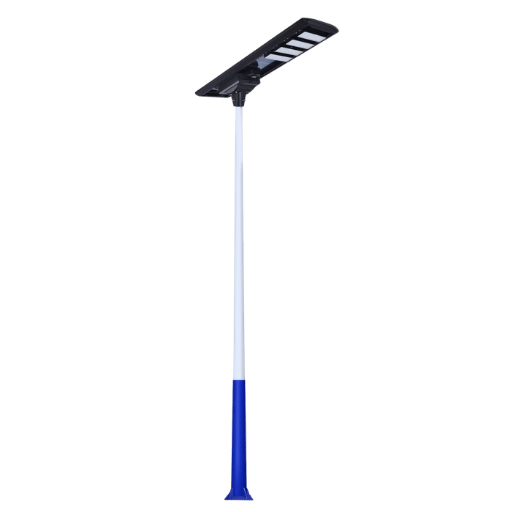
GQ-TKJ-B Modular Solar Street Light

GQ-TKJ-B — All-in-One Modular Solar Street Light, 200-500 W

12.8 V boost controller, increases system efficacy to 170 lm/W, reduces fixture weight, and improves thermal dissipation. Die-cast aluminum modular enclosure.

200W

GQ-TKJ-B-200W

2-Module · 2,400 lm
15 Ah / 12.8 V boost

300W

GQ-TKJ-B-300W

3-Module · 3,800 lm
20 Ah / 12.8 V boost

400W

GQ-TKJ-B-400W

4-Module
25 Ah / 12.8 V boost

500W

GQ-TKJ-B-500W

5-Module · max output
30 Ah / 12.8 V boost
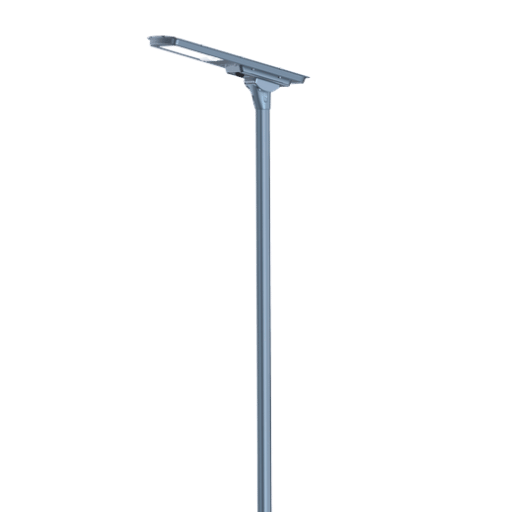
GQ-STSL Series Solar Street Lights

GQ-STSL Series — Pathway, Split, and Endurance Variants

Seven other model families fill edge cases. Features split solar fixtures (60-120 W) allowing the array to be mounted separately from the head for partial tree cover scenarios.

GQ-STSL01

Garden-style modern pathway with wall-mount option.

GQ-STSL06

Standard integrated, 50 / 90 / 100 W tiers.

GQ-STSL07

Small format pathway, 20 / 35 W.

GQ-STSL08

Split solar street light, 60 / 90 / 120 W.

GQ-STSL09-11

Extinction- and voyage-grade modular fixtures.
Decision Matrix

Application Recommended Series Pole Height Spacing Target Illuminance
Pedestrian pathway / park trail GQ-STSL07 (20-35 W) 3-4 m 15-20 m 0.5-1.0 fc avg maintained
Residential driveway / fence line GQ-STSL06 (50-100 W) 4-5 m 18-22 m 0.6-1.0 fc
Commercial parking lot GQ-TKJ-A-100W / -200W 5-6 m 20-25 m 0.5-1.0 fc (IES RP-20)
Local / collector road GQ-TKJ-B-200W / -300W 6-8 m 25-30 m 0.6-0.9 fc, 3:1 uniformity (AASHTO RP-8)
Arterial road / highway exit GQ-TKJ-B-400W / -500W 8-10 m 30-40 m 0.9-1.4 fc, 3:1 uniformity

Generation 1 vs Generation 2 — The 150→170 lm/W System Efficacy Upgrade, Explained

Picking a fixture based on wattage alone and ignoring how the LED array, charge controller, battery chemistry, and solar panel were sized as a system is a common purchasing practice. That mismatch is precisely what the transition from Gen 1 to Gen 2 fixture engineers worked to correct—and we publish the full side-by-side specification so it can be checked yourself.

Most competitors won't publish side-by-side generation comparison. Reason: revealing how well your previous platform functioned makes its future claims falsifiable. We publish it because the differences are measurable, defensible, and helpful when you balance out one 2025 budget project against a 2026 budget project.

Why the two generations coexist: Gen 1 remains in production because its flat-voltage 3.2 V topology is cheaper to service in remote regions and tolerates higher ambient temperatures without derating. Gen 2 is optimized for efficacy and modular retrofit. Both ship today.

Parameter GQ-TKJ-A (Gen 1, TAIKONG-1) GQ-TKJ-B (Gen 2, TAIKONG-2)
System efficacy ≥150 lm/W ≥170 lm/W
Controller topology 3.2 V flat-voltage (direct-drive) 12.8 V boost (MPPT)
Battery chemistry LiFePO4, 3.2 V LiFePO4, 12.8 V
Battery capacity (per model step) 60 / 80 / 100 / 120 Ah 15 / 20 / 25 / 30 Ah (higher voltage)
LED chip type 5054 SMD 5054 SMD
LED count (per wattage class) 50-200 pcs 72-180 pcs (denser modular layout)
Heatsink / housing Galvanized steel, powder-coated Die-cast aluminum modular
Lens optics PC lens T2 (injection) PC lens T2-S (injection)
Mounting arm Fixed slip-fitter Adjustable slip-arm (±30° tilt)
Fixture height (500 W class) 175 mm 254 mm
Battery cycle life >2,000 cycles >2,000 cycles
Rated LED lifespan (L70B50, Ta=25°C) 50,000 h 50,000 h
Ingress protection IP65 (IEC 60529) IP65 (IEC 60529)
Operating temperature −20 °C to +50 °C −20 °C to +50 °C
Standard warranty 2 years 2 years

What the 150→170 lm/W gap actually means for a project

A 20% efficacy improvement is not a marketing upward-linchpin: that is twenty percent more harvestable light from the same sized battery, or twenty percent less battery capacity requirement for the same amount of light—which directly translates to twenty percent more pole count for the same luminaire output, or twenty percent longer autonomypausebeam. On a 300 W / 30-fixture deployment, this results in roughly twenty percent more lumens of nightly output.

Never gives when we keep Gen 1 in production: flat-voltage 3.2 V architecture is the single easiest system on earth to maintain when a fleet of them is deployed across a rural grid of badly-matched replacement parts. Gen 2 is where we pile every efficacy tweak we played with including boost topology, die-cast thermal path, densified LED pattern. Two product lines, two deployment values, zero overlap in ideal use case.

— Guangqi Engineering Team, R&D Department, Zhongshan, China

Where Guangqi Solar Street Lights Work — Parking Lots, Roadways, Campuses, and Remote Sites

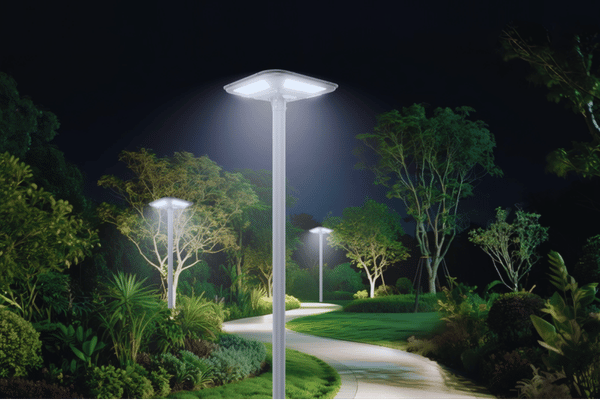
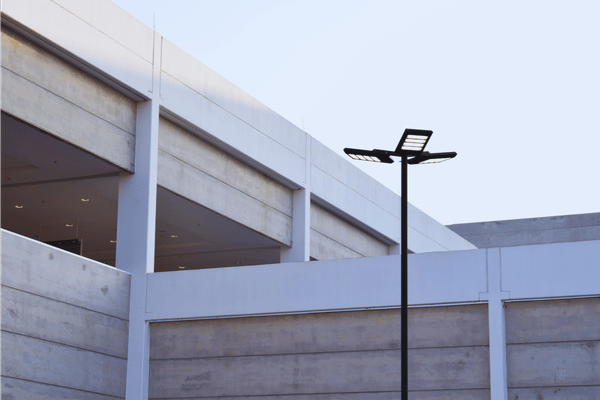
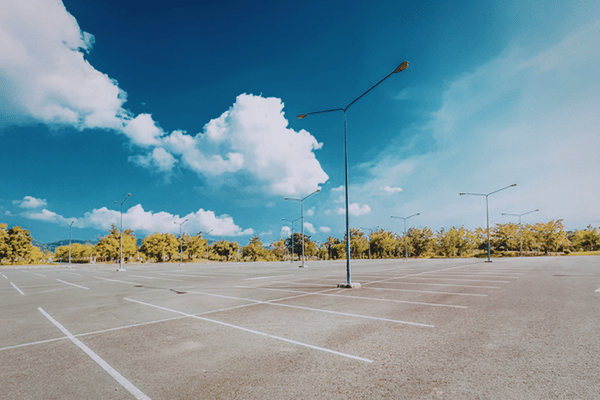
Solar-powered parking lot lights form the lion's share of our installed base of systems in this class because parking lots are the easiest application: complete sunlight, relaxed spacing tolerances, and a site owner who already penetrated the excavation bill. But it can work in city streets, park pathways, college quads, and remote mine yard: pick an application above, we match a Decision Matrix to it.

ROI Card — Solar vs Grid-Tied, 30-Fixture Parking Lot Benchmark

$49,943 10-year savings over grid-tied
3-7 yr Typical payback period
10-20% Annual ROI range
30% US Federal ITC through 2032
Commercial parking lots

Commercial parking lots

60-100 W GQ-TKJ-A or TKJ-B fixtures on 5-6 m poles spaced 20-25 m to meet IES RP-20 parking illumination standards.
Zero trenching · 0.5-1.0 fc · retrofit-friendly
Local and collector roads

Local and collector roads

100-150 W Gen 2 fixtures on 6-8 m poles spaced 25-30 m to meet AASHTO RP-8 local-road illumination category.
0.6-0.9 fc average · 3:1 uniformity
Campus perimeters and quads

Campus perimeters and quads

GQ-STSL06 or TKJ-A fixtures on decorative or utility poles, silent through night, discrete conduits don’t bisect landscaped zones.
Preserves grounds · no wiring through turf
Remote industrial yards

Remote industrial yards

TKJ-B modular fixtures with optional radar motion-sensing output, the ultimate all-in-one solar LED street light system for 24/7 perimeter illumination without amplification from site power.
Continues operating through grid outages

A note on climate and autonomy

Our default autonomous rating on the TKJ fixtures is two rainy days' autonomy--a cautionary rating assuming average output every night without any dimming. In reality, adaptive dimming (100% early evening, 30-60% late night) yields 3-5 rainy days of effective autonomy in temperate zones. For deployment at high latitudes or among monsoon-tramped regions, we engineer oversize-autonomy variants with massive bank packs, with the best of the premium manufacturers claiming a 5-7 day rating from giant packs (overspeed only, not exotic chemistry).

Compliance and Engineering Standards — IP65 Waterproof, CE, RoHS, and LM-80 Tested

A common theme among our loyal buyers who research on the time side of the box is suppliers' reporting adhering to standards but not triggering the test review. We make our test chain explicit in every standard; every standard we cite is a what-to-do.

CE Marked
RoHS Compliant
IP65 (IEC 60529)
LED lamp rated to LM-80
Life via TM-21
ANSI/IES RP-8 alignment

Standards we test and cite — and why each one matters to procurement

Standard What it covers Why procurement should ask for it
IEC 60529 — IP65 Ingress protection against dust and low-pressure water jets Third-party test gives you weather warranty standing
ANSI/IES LM-80-20 LED package lumen maintenance measurement Distinguishes real life-rating from copy-paste marketing
ANSI/IES LM-79-19 Complete luminaire photometric measurement Proves the fixture output, not just the chip
ANSI/IES TM-21 Projection method for L70 life rating The math behind our 50,000-hour claim
IEC 60598-2-3 Outdoor luminaire electrical safety Required for CE marking in most EU tenders
ANSI/IES RP-8-22 US roadway and parking facility lighting design Defines footcandle and uniformity targets for your road class
EN 13201 European road lighting classes Equivalent framework for EU procurement
ANSI C136 Roadway luminaire photometric type (I through V) Matches lens optics to road width
RoHS Directive 2011/65/EU Restriction of hazardous substances Required for EU import and most municipal tenders
FCC Part 15 Electromagnetic emissions (controller) Required for US commercial installation

What we send with every shipment, on request

  • CE declaration of conformity with test-house reference number
  • RoHS conformity statement with material-level test reports
  • IP65 accreditation from an approved lab ( IEC 60529 protocol )
  • The LED package implemented in your model, with LM-80 testing data.
  • TM-21 life projection sheet with calculation parameters
  • Photometric IES file (for AASHTO / IES RP-8 compliant modeling)

Procurement Guide for Solar Street Light Manufacturer Orders — MOQ, Lead Time, Bundled Poles, and Pricing Factors

As such Guangqi has been a direct LED manufacturer since 2010 - fourteen years in business, four regional service centers covering Asia, Europe, North America, the Middle East, and certification files that we generate on first request not first audit. The following is the procurement structure we implement on every solar light project from a retrofit of 20 HOA poles to a 500 pole municipal deployment of street light poles and luminaires:

Pricing factors framework (we quote against your site, not a list price)

Pricing for solar street lights is driven by six variables. Two quotes for the same wattage can vary by over 30% due to selections made within these variables; hence, a similar configuration quote from a reliable solar street light manufacturer, is a more reasonable purchasing guidance than a published retail price.

  • Wattage class 20 W pathway vs. 500 W arterial pathways panel and battery sizing
  • Critère d'autonomie configuration conservatrice du potentiel à 2jours versus configuration étendu sur 5-7jours
  • Pole specification bundled galvanized steel, octagonal or aluminum, height 3-10 m
  • Controller option photocell only, photocell plus PIR or photocell plus radar motion sensing
  • Warranty level standard 2-year or extended 5-year (parts and labor)
  • Conditions de livraison FOB Zhongshan, CIF port de destination, ou DAP lieu de livraison (pour commande importante)

On first request we publish wattage-family indicative ranges, and within five business days of receiving site specs we issue a fully itemized quotation. Stock builds take four to six weeks from contract date; custom pole and color variants add a further two to three weeks. Contact our project team for a detailed quote using your wattage, pole, and autonomy parameters.

What is bundled with a solar street light with pole order

  • Complete luminaire (series inclusive panel, battery, LED module, controller built-in/interchangeable)
  • Pole - galvanized steel or aluminum, octagonal or round, corresponding to fixture mount and local wind load
  • Anchor bolts and foundation template drawings
  • Slip-fitter or flange bracket sized to fixture
  • Installation manual and commissioning checklist
  • Optional: radar or PIR sensor, extended-autonomy battery pack, custom housing color

Minimum order quantity is flexible — we ship sample units for technical verification and full projects from roughly ten poles upward. For municipal tenders, we respond to RFQs with full certification files, customized cut sheets, and optional on-site installation training for local contractors.

Ready to configure solar street lights with pole for your project?

Send us the dimensions of your installation, road classification, environmental region, and permanence level. We deliver a photometric model, illumination count, quote-breakout sheet, and full compliance documentation set in five working days.

Solar Street Light FAQ — Lifespan, Battery, Installation, and Cost

The LED array and luminaire are rated for 50,000 hours L70B50 at 25 °C ambient — about 11 years of nightly 12-hour operation before output drops to 70% of initial. LiFePO4 batteries carry a 2,000+ cycle rating, equivalent to 6-8 years of daily cycling, and remain field-replaceable in both the Gen 1 and Gen 2 architectures. Panels retain 80-85% of rated output at 20 years in field deployments.
Pricing is driven by the six key variables represented in the Procurement Guide above - wattage, autonomy, pole, controller, warranty tier, and delivery terms. Commercial-grade installations on industry-standard metrics are installed cost in the range of $800 to $2,000 per pole, versus $1,200-3,500 for a grid-tie equivalent assuming honest pricing of trenching work. We provide quotes against your site spec; a typical 30-pole parking lot project will have a detailed itemized proposal within 5 business days.
MOQ is negotiable. We ship sample fixtures for technical validation and will accept project units from 10 poles and above. Ready-made units ship 4-6 weeks from order and specification approval. Custom pole heights, housing colors, and higher-autonomy battery packs will need an additional 2-3 weeks lead time. Municipal and large commercial RFQ's are delivered with complete certification package including proposal.
Yes, all GQ-TKJ and GQ-STSL fixtures arrive with CE declaration of conformity, RoHS conformance declaration, and IP65 test reports under IEC 60529. LED packages are tested for ANSI/IES LM-80-20 and life through ANSI/IES TM-21. Certification package is fully delivered upon initial inquiry with no audit necessary to access test reports.
Yes, each order receives the pole, slip-fitter or flange bracket, anchor bolts, foundation template, and commissioning check list as included items. For large-scale municipal and commercial orders we have a local installation training option for contractors and provide a 2 year contract for troubleshooting, diagnostics, commissioning, and warranty issues.
Lead-acid cells collapse to 70% capacity within 300-500 charge cycles when used in outdoor deep-discharge applications — one to two years of nightly operation, no more. LiFePO4 chemistry retains 70% capacity through 2,000+ cycles under the same profile, with a battery management system controlling the overcharge and deep-discharge events that burn out lead cells. Battery chemistry is the single largest cost driver between a $300 fixture and a $1,500 fixture delivering the same installed wattage.
Our standard TKJ spec rates two rainy-day autonomy at full nightly output. Adaptive dimming extends that to 3-5 cloudy days in practice, and we build extended-autonomy variants with oversized battery packs for monsoon-climate or high-latitude deployments. A site-specific sun-hour calculation is included with every project quote so the autonomy figure is matched to your geography rather than a marketing round number.
Gen 1 (GQ-TKJ-A) uses a 3.2 V flat-voltage controller and a galvanized steel housing — simpler to service, cheaper to replace in remote regions, and rated at 150 lm/W system efficacy. Gen 2 (GQ-TKJ-B) uses a 12.8 V boost MPPT topology with die-cast aluminum modular housing, raising system efficacy to ≥170 lm/W and adding ±30° arm adjustability. Full side-by-side spec table is in the Gen 1 vs Gen 2 section above.
Four failure modes dominate the literature: under-sized batteries that cannot sustain nightly load, unmanaged battery chemistry that cycles outside its safe window, low-efficacy LED chips that waste energy as heat, and missing dusk-to-dawn intelligence. Each failure is a component-matching problem, not a solar limitation. Gen 1 and Gen 2 engineering addresses all four directly — which is why a correctly specified Guangqi fixture sees service-life outcomes that match the rated numbers.
Match to the Decision Matrix in the Product Lineup section: pathway (3-4 m poles, 20-35 W), parking (5-6 m, 60-100 W), local road (6-8 m, 100-300 W), arterial (8-10 m, 300-500 W). The table makes mention of the IES RP-20 for parking and AASHTO RP-8 for road classifications; our proposal team runs a photometric model against your particular geometry and produces a lighting count with uniformity acknowledgment.
Standard fixtures are listed 20 C to +50 C run temperature, 40 C to +60 C storage, and include IEC 60529 IP65 ingress protection. For projects in high-wind areas (above class 4 on the Beaufort scale) or high-latitude Polar regions receiving limited winter sun, the assembly is pre-sized for reinforced poles and semiautonomous battery packs. Cited evidence in competitive writing includes deployments in -22 F Helena, Montana appearing as a case sample for premium-tier solar street lighting in cold areas.
Yes, substantially. A photocell removes all manual control and adjusts run hours to actual night time hours (10-12 hours). Adaptive dimming - 100% just after sunset, 30-60% post-midnight - reduces overall power use by 40-60%, which prolongs reactive session length by almost the same factor. Motion sensors or radar or PIR field sensing maintains dim-standby power levels and returns to full power only if a vehicle or a pedestrian enters the sensing zone.