Get in Touch with GUANGQI



October 2026 · Continuing the History of Solid-State Lighting & Architectural Lighting Design
The LED invented for electronics refers to practical infrared experiments conducted by Texas Instruments in 1961 and a visible red diode built by Nick Holonyak Jr. on October 9, 1962 at General Electric. Physics advances in multiple countries formed a foundation for these experiments. British Marconi engineer Henry Joseph Round recorded silicon carbide crystal electroluminescence in 1907, and Soviet and Russian scientist Oleg Losev published diode-emission papers starting in 1927. In 1955, RCA physicist, Rubin Braunstein, reported room-temperature infrared emission. High-brightness 1993 blue gallium nitride and 1996 phosphor conversion completed the six-step process for commercial white LED technology.
Quick Specs: Key Milestones in How the LED Was Invented
| Milestone Parameter | Verified Historical & Engineering Benchmark |
|---|---|
| First Electroluminescence Observation | 1907 by Henry Joseph Round (Marconi Labs) using 10 V to 110 V direct current on silicon carbide (SiC) |
| First Diode Theory & Subsequent Patent | Oleg Losev published diode-emission work starting in 1927 (16 papers total) and later patented an optical Light Relay |
| First Patented Practical Infrared LED | 1961 GaAs p-n junction discovery by James Biard & Gary Pittman at TI; filed Aug 8, 1962 (U.S. Patent 3,293,513) |
| First Visible Spectrum Red LED | October 9, 1962 by Nick Holonyak Jr. at General Electric (~650 nm GaAsP laboratory and instrument diode) |
| First High-Brightness Blue & White LEDs | 1993 InGaN/GaN blue LED (>1 cd) by Akasaki, Amano & Nakamura; 1996 Nichia YAG:Ce white package (~5 lm/W) |
| Commercial White Luminaire Efficacy | 120–170 lm/W in standard outdoor street luminaires; >200 lm/W in top commercial fixtures per IEA (235 lm/W is package-only) |
How Was the LED Invented? Pioneers From Round and Losev to Holonyak’s 1962 Red Diode
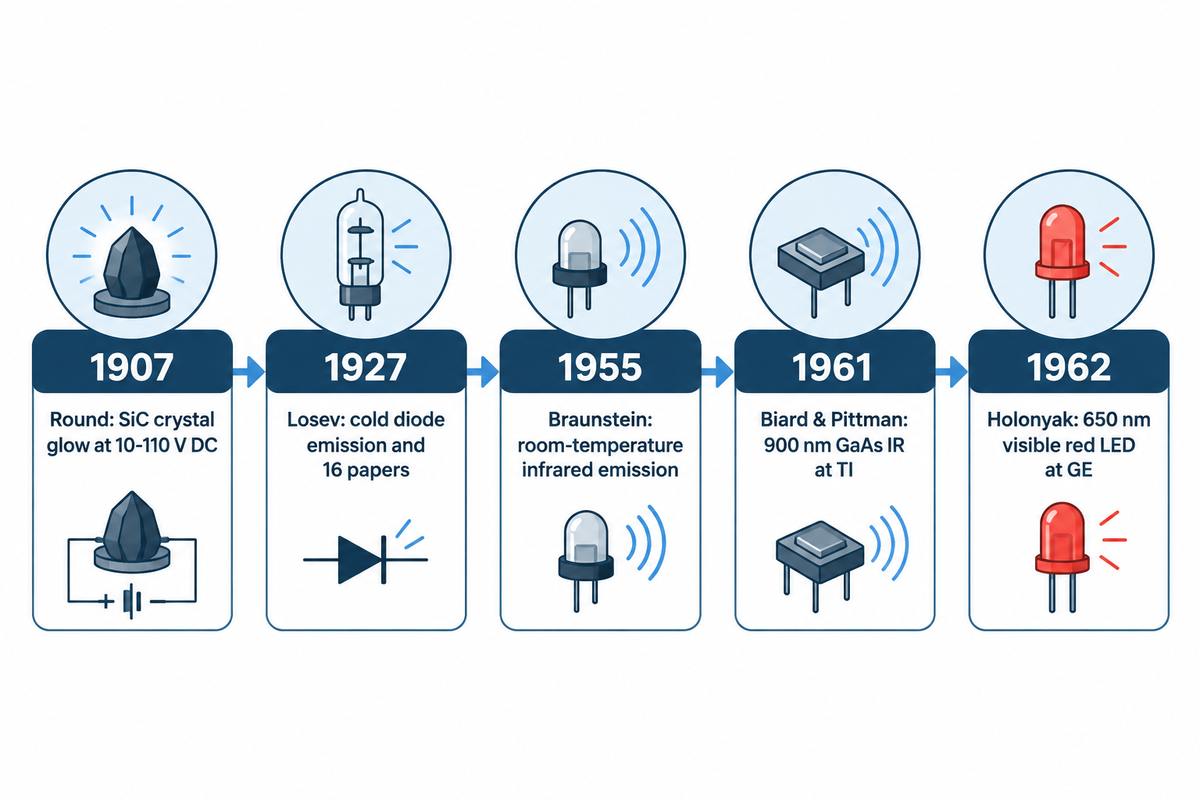
When engineers ask who built the first LED, historians credit five sequential breakthroughs for the first 1907-1962 pre-blue milestones. Henry Joseph Round observed crystal glow, Oleg Losev proved cold diode emission, and Rubin Braunstein measured infrared output. James Biard, Gary Pittman, and Nick Holonyak Jr. then provided practical infrared and visible diodes.
1907SiC crystal glow at 10–110 V DC
1961900 nm GaAs IR discovery at TI
1962650 nm visible red LED at GE
1993>1 cd InGaN blue chip
A brief history of LED research begins with Henry Joseph Round in 1907 working at Marconi Labs. There Round applied 10 V to 110 V of direct current across a cat’s-whisker contact on silicon carbide. He reported yellowish, green, and blue sparks that emitted light when current crossed the crystal junction. Round was testing radio detectors and never pursued a commercial lamp.
In the 1920s, Oleg Losev worked on zinc oxide and silicon carbide rectifiers in Nizhny Novgorod. Starting in 1927, Losev showed that cold semiconductor junctions emit light without an incandescent filament and could produce non-thermal light emission. He published 16 scientific papers and patented an optical Light Relay before he died in 1942 during the Siege of Leningrad.
Physics relating to junctions advanced after William Shockley and Bell Labs formalized semiconductor transistor theory in the late 1940s. In 1955, RCA physicist Rubin Braunstein reported room-temperature infrared emission from gallium arsenide, gallium antimonide, indium phosphide, and silicon-germanium diodes. In 1961, Texas Instruments (TI) researchers James Biard and Gary Pittman reported observing bright 900 nm infrared output from a zinc-diffused gallium arsenide p-n junction. TI filed a patent application on August 8, 1962, and the commercial SNX-100 infrared emitter was released in the Fall of 1962. U.S. Patent 3,293,513 for a semiconductor radiant diode was granted on December 20, 1966.
Later in 1962, General Electric engineer Nick Holonyak Jr. was responsible for the introduction of compound emitters into the visible spectrum. While other groups were concerned with infrared gallium arsenide and laser diode work, Holonyak was successful in synthesizing vapor-phase gallium arsenide phosphide crystals in Syracuse. On October 9, 1962, Holonyak demonstrated a visible 650 nm red LED, recognized as the father of the LED for visible solid state lighting.
Full Color Spectrum Timeline: Infrared, Red, Yellow LED, and Green Milestones (1955–1976)
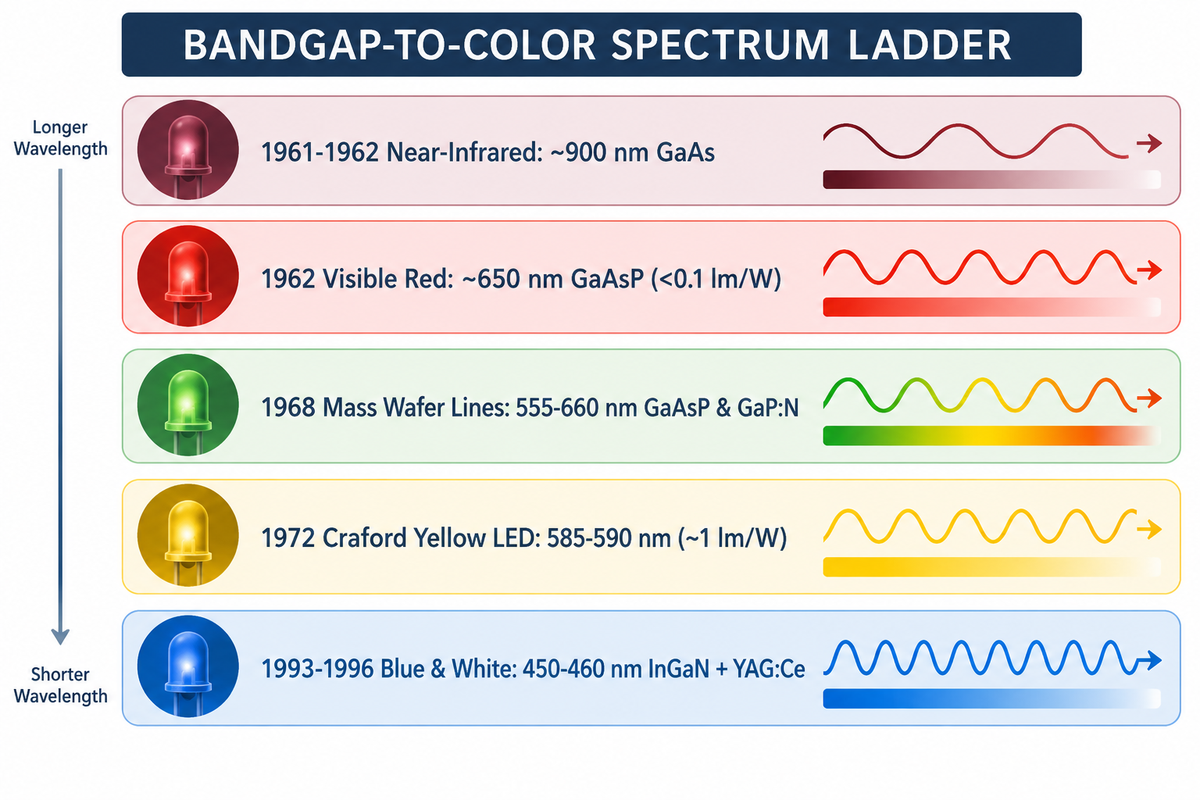
Early 1962 red diodes delivered under 0.1 lm/W at high hand-built unit cost, restricting adoption to laboratory gear. From 1968 to 1976, epitaxial wafer lines and nitrogen doping by Monsanto, Hewlett-Packard, and Bell Labs reduced LED indicator costs and allowed the commercial production of orange, yellow LED, and pale-green emitters.
General Electric produced its 1963 red packages in small batches. Monsanto changed the history of LED lighting in 1968 with the launch of automated gallium arsenide phosphide wafer production. Monsanto supplied red LED arrays to Hewlett-Packard for digital calculators, wristwatches, and instrument panels. Throughout the 1970s, visible light emitters were used mainly as numeric readouts and status indicators.
Another milestone came from George Craford, a former Illinois doctoral student of Holonyak profiled by the University of Illinois Holonyak Micro and Nanotechnology Laboratory. Leading Monsanto’s solid-state team in 1972, Craford added isoelectronic nitrogen into GaAsP crystals. He invented the first yellow LED near 585 nm to 590 nm and raised red output tenfold to roughly 1 lm/W. Parallel nitrogen-doped gallium phosphide (GaP:N) work produced pale 555 nm to 565 nm green LEDs.
Bandgap-to-Color Milestone Ladder
| Year | Color & Peak Wavelength | Semiconductor Material & Bandgap | Pioneer / Laboratory | Initial Output & Early Application |
|---|---|---|---|---|
| 1907 | Yellowish / Green / Blue spark | Impure Silicon Carbide (SiC, indirect bandgap) | Henry Joseph Round (Marconi Labs, UK) | Faint crystal glow at 10–110 V DC; radio detector tests |
| 1927 | Greenish-yellow junction glow | Zinc Oxide (ZnO) & SiC point-contact diode | Oleg Losev (Nizhny Novgorod, USSR) | Cold diode emission mapped; later Light Relay patent |
| 1955 | Near-Infrared | GaAs, GaSb, InP, SiGe alloys | Rubin Braunstein (RCA, USA) | Room-temperature III-V diode emission verified |
| 1961–1962 | Near-Infrared (~900 nm) | Gallium Arsenide (GaAs p-n junction) | James Biard & Gary Pittman (Texas Instruments) | 1961 discovery, Aug 8, 1962 patent filing; SNX-100 infrared LEDs |
| 1962 | Visible Red (~650 nm) | Gallium Arsenide Phosphide (GaAsP) | Nick Holonyak Jr. (General Electric, USA) | <0.1 lm/W; costly early bench & aerospace indicators |
| 1968 | Red & Pale Green (555–660 nm) | Epitaxial GaAsP & GaP:N (~1.8–2.2 eV) | Monsanto, Hewlett-Packard & Bell Labs | Mass-produced calculator displays & status lamps |
| 1972 | Yellow (~585–590 nm) & Bright Red | Nitrogen-doped GaAsP:N | George Craford (Monsanto, USA) | ~1 lm/W (10x red brightness gain); instrument displays |
| 1993 | High-Brightness Blue (450–460 nm) | InGaN / GaN double heterostructure (~2.6–3.4 eV) | Akasaki, Amano & Shuji Nakamura (Japan) | >1 candela; full-color outdoor signs & signals |
| 1996 | Broad-Spectrum White | 450–460 nm InGaN chip + YAG:Ce3+ phosphor | Nichia Corporation (Tokushima, Japan) | ~5 lm/W initial package; commercial white lighting base |
In the 1980s, liquid-phase aluminum gallium arsenide and aluminum gallium indium phosphide increased red light efficiency beyond filtered incandescent lamps. Brighter red and amber diodes started being used in barcode readers, fiber-optic links, and automotive brake lights. However, the short wavelength blue end of the spectrum of light was still lacking.
The Blue LED Breakthrough: How Akasaki, Amano, and Nakamura Mastered Gallium Nitride
Full-color displays using a bright blue LED remained missing for three decades after 1962. Between 1986 and 1993, Isamu Akasaki, Hiroshi Amano, and Shuji Nakamura solved crystal-defect growth and p-type hole conduction in wide-bandgap 3.4 eV gallium nitride. Their work contributed to the recognition they received from the Nobel Prize in Physics in 2014.
Blue candidates in the past performed poorly in device testing. Silicon carbide had an indirect bandgap with a ~0.02% to 0.03% external quantum efficiency, resulting in dim millicandela output. Zinc selenide rapidly degraded under continuous current, and most corporate labs stopped pursuing gallium nitride after the early 1970s metal-insulator trials.
What made the blue LED so hard to make?
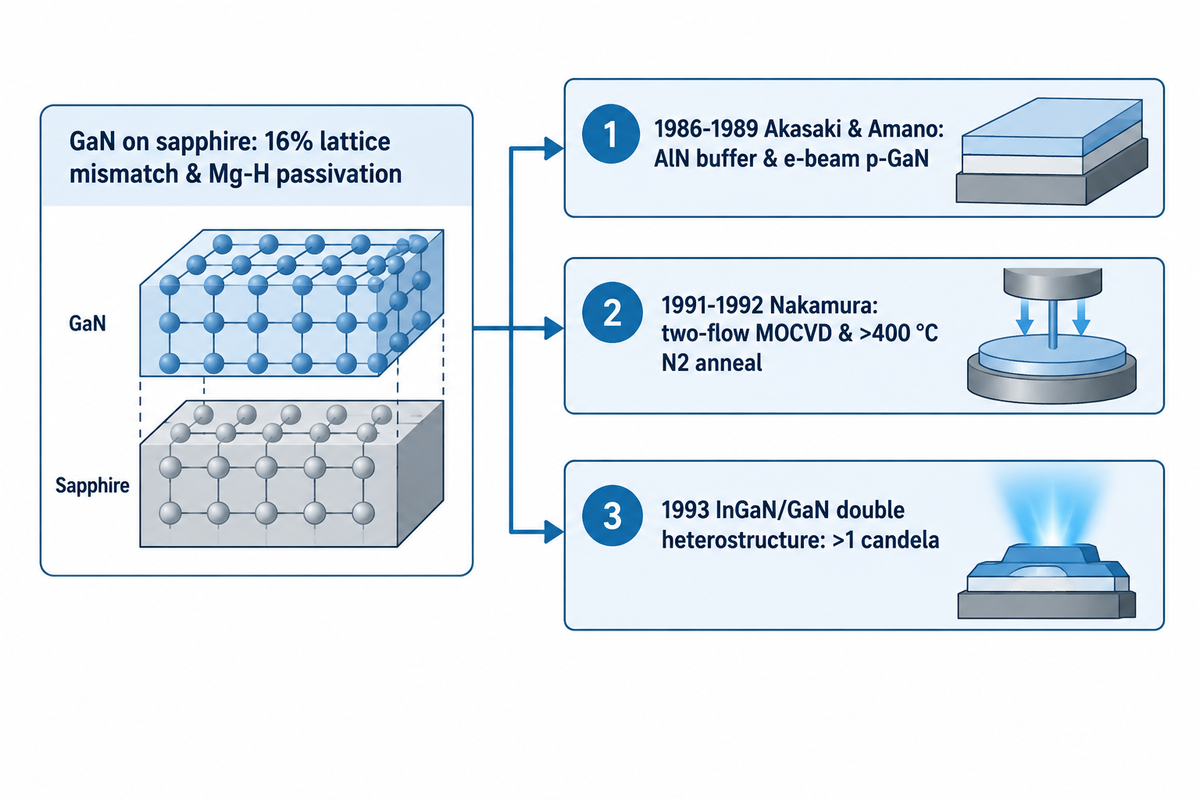
Fabricating a bright blue LED demanded a direct wide bandgap semiconductor of 2.6 eV to 3.4 eV. However, gallium nitride had no native wafers and was refractory to p-type doping. Growing GaN on sapphire caused roughly 16% lattice mismatch and high threading dislocation density. MOCVD growth of GaN introduced hydrogen from ammonia which passivated magnesium acceptors to form neutral Mg-H complexes.
Solving concurrent issues of buffer nucleation, acceptor activation, contact resistance and carrier confinement was the key to commercializing blue LEDs. In 1986, Akasaki and Amano at Nagoya University were successful in growing a low-temperature aluminum nitride buffer on sapphire, thereby reducing crystal defects and non-radiative recombination. In 1989 they showed that electron beam irradiation activated magnesium-doped p-type GaN.
While working at Nichia Chemical Industries, Shuji Nakamura built a two-flow MOCVD reactor and introduced a low temperature GaN buffer in 1991. In 1992, Nakamura explained Mg-H passivation and performed wafer-scale thermal annealing at temperatures above 400 °C in nitrogen to activate p-type layers. Nakamura then patented the 1993 InGaN/GaN double heterostructure blue LED (U.S. Patent 5,578,839) and pushed blue output above 1 candela.
From Blue Chip to White LED Bulb: YAG:Ce Phosphor Conversion and Package Evolution
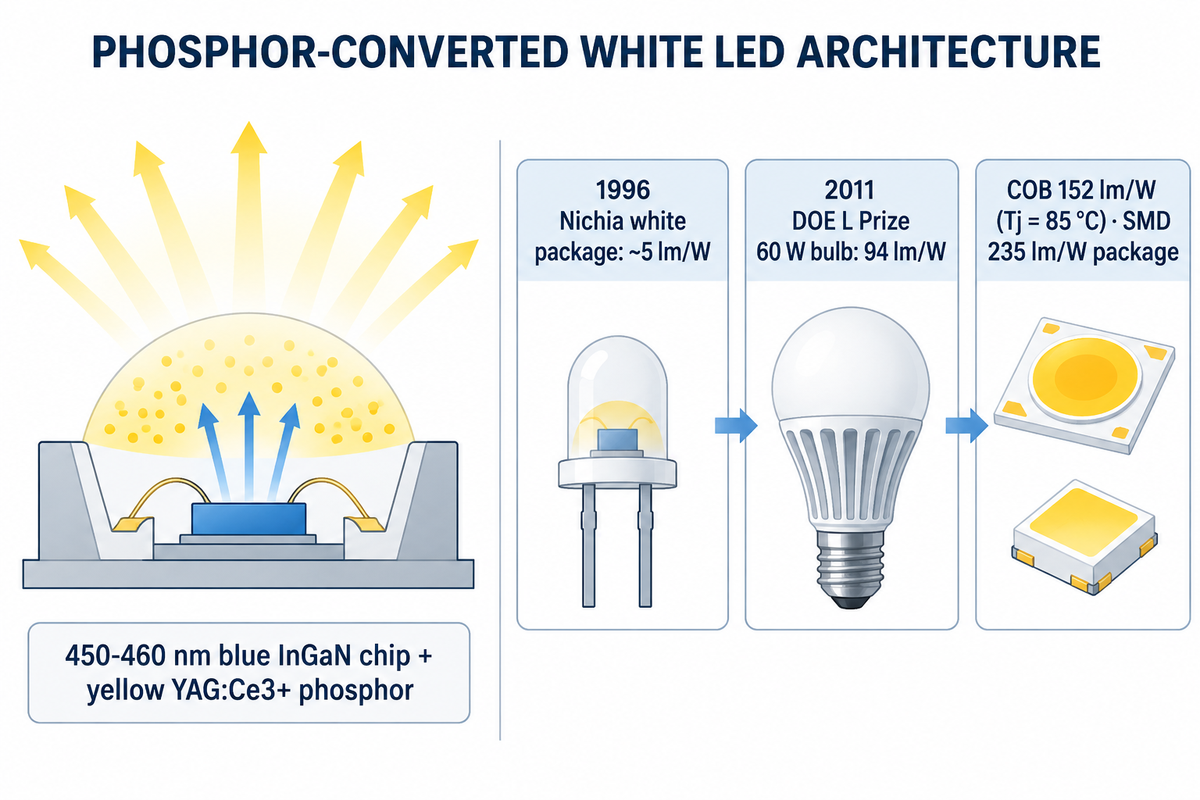
While devices incorporating tunable RGB arrays allow for customizable mixing of primary colors, the general white LED relies predominantly on phosphor conversion. Introduced by Nichia in 1996, cerium-doped yttrium aluminum garnet (YAG:Ce3+) coats a 450 nm to 460 nm blue InGaN LED chip to blend blue light with yellow fluorescence into white light.
Single-chip phosphor conversion solved a tough optical dilemma. A quantum efficiency drop in Green InGaN emitters is known as the green gap. Additionally, separate RGB dies in LEDs drift differently as heat rises. Driving one blue InGaN die with a YAG:Ce phosphor and a red nitride phosphor solved the optical dilemma and simplified power electronics across indoor lamps and outdoor LEDs in an LED versus traditional lighting comparison.
When was the first white LED light bulb commercialized for general illumination?
Screw-base A19 white LED light bulb replacements formed the first generation of mainstream general illumination from 2008 to 2011 through the U.S. Department of Energy L Prize competition. Philips won that 60 W incandescent replacement category at 94 lm/W, building on Nichia’s 5 lm/W white LED package in 1996 and late-1990s 1 W packages.
Subsequent packaging split into ceramic surface-mount devices (SMD 3030 and 5050) and chip-on-board (COB) modules. In published component specifications, Nichia’s dual-phosphor NF2W757H-V3H6 (0.17 W at IF = 65 mA, Tj = 25 °C, 5000 K) reaches Ra ≥ 90, R9 ≥ 50, and R15 ≥ 85. Trade testing reported by LEDs Magazine shows a 3000 K, 90-CRI, 15 mm light-emitting-surface (LES) COB version holding around 152 lm/W at Tj = 85 °C. Packaged mid-power emitters such as Samsung’s LM301B EVO reach 235 lm/W in component tests.
Semiconductor Bandgaps, Compound Materials, and Electrical Polarity Inside Modern Emitters
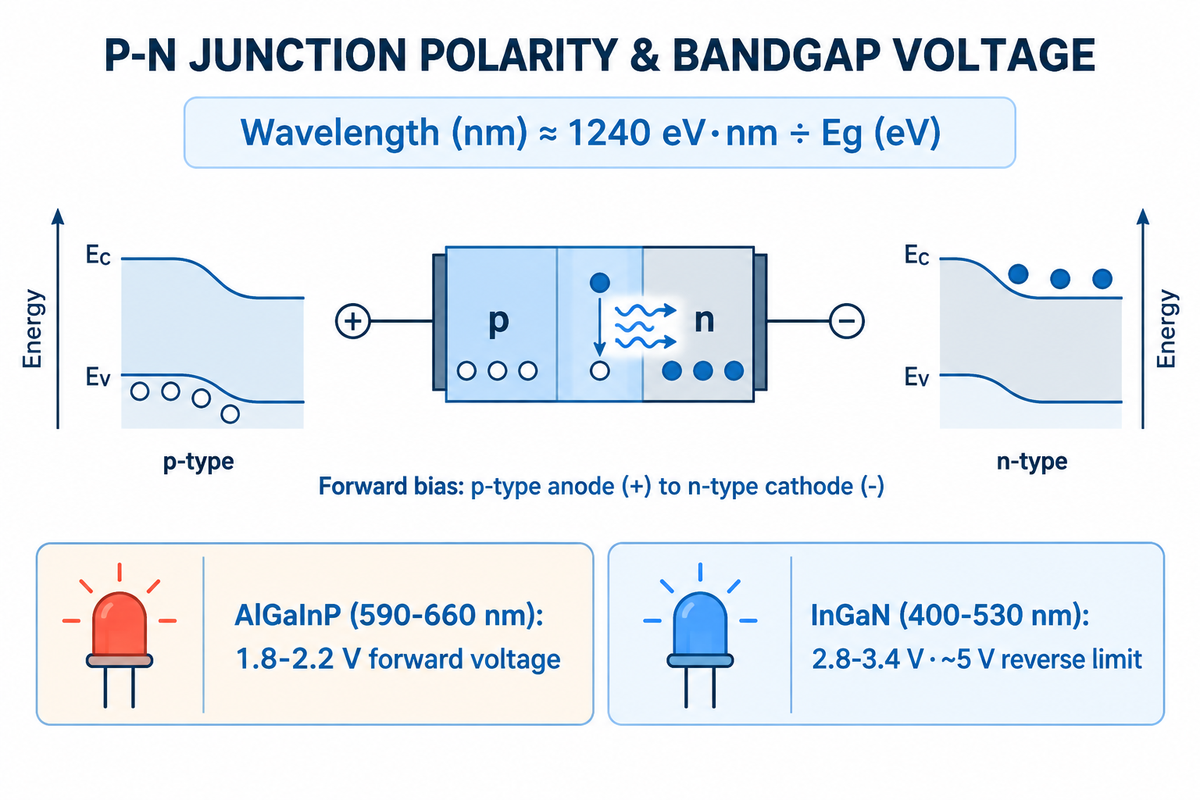
Unlike an incandescent light filament that converts roughly 10% of input energy into visible light, solid-state electroluminescence turns electron energy directly into photons. Photon wavelength in nanometers is approximately equal to 1240 eV·nm divided by bandgap energy Eg in electronvolts. Chipmakers pair AlGaInP (590–660 nm) with InGaN (400–530 nm) across the LED material palette.
Standard silicon has an indirect bandgap which releases heat into crystal vibration instead of producing visible photons. Direct-bandgap III-V alloys are ideal for light emission. Control of crystal layers on sapphire is grounded in most of the fundamental nitride patents, including U.S. Patent 5,290,393 on gallium nitride growth. This allows engineers to adjust the exact peak colors without glass filters.
What is the polarity of LEDs and how does a p-n junction emit visible photons?
Every LED is a polarized semiconductor diode which conducts direct current and emits photons only under forward bias. Positive voltage connects to the p-type anode (the longer lead on 5 mm indicator lamps), while negative voltage connects to the n-type cathode. Forward current drives electrons and holes to combine in quantum wells and release their energy through photon emission.
Forward voltage is directly proportional to the bandgap of the compound. Red and yellow AlGaInP diodes typically operate near 1.8 V to 2.2 V, whereas blue and white LEDs built on InGaN typically drop 2.8 V to 3.4 V. A reverse-voltage tolerance of about 5V limits the use of AC mains in luminaires.
Luminous Efficacy Trajectory: LED vs Incandescent, Fluorescent, HID, and OLED Benchmarks
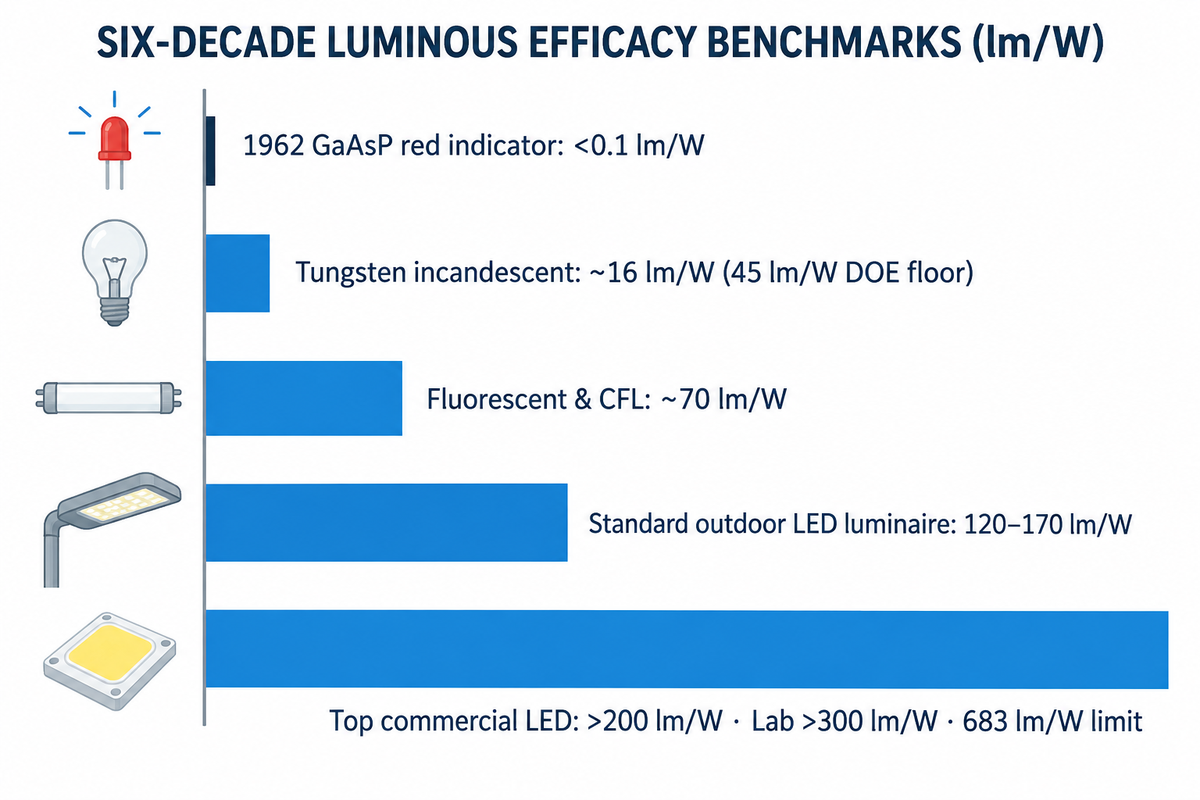
Solid-state efficacy climbed more than three orders of magnitude after 1962. Early GaAsP indicators emitted under 0.1 lm/W, whereas standard commercial outdoor white LED luminaires today deliver 120 lm/W to 170 lm/W. Top professional luminaires exceed 200 lm/W, and 2014 Nobel Physics press benchmarks note laboratory records above 300 lm/W against a 683 lm/W theoretical ceiling.
Buyers also compare inorganic LED lamps against organic light-emitting diode (OLED) panels and legacy discharge lamps. Thin-film OLED panels produce soft, diffuse indoor light. High-intensity discharge lamps served outdoor lighting for many years, yet III-V compound semiconductor LEDs improved light output, directional control, and efficiency when retrofitting street, roadway, and sporting facilities.
Six-Decade Solid-State Efficacy Matrix
| Light Source Benchmark | Emission Mechanism | Verified Efficacy (lm/W) | End-of-Life & Rated Service Profile | Application & Regulatory Status |
|---|---|---|---|---|
| 1962 Early GaAsP Red Indicator | III-V p-n junction electroluminescence | <0.1 lm/W | Low-current solid-state indicator | Monochromatic red lab & instrument lamp |
| Standard Tungsten Incandescent Bulb | Resistive tungsten filament (~10% visible conversion) | ~16 lm/W (Nobel / DOE benchmark) | Sudden filament breakage | Phased out under U.S. DOE 45 lm/W backstop (July 2023) |
| Fluorescent & CFL Lamps | Low-pressure mercury UV + phosphor | ~70 lm/W (Nobel / DOE benchmark) | Flickering, ballast failure & gradual lumen drop | EU RoHS mercury revisions ended most linear T8 sales Aug 2023 |
| High-Pressure Sodium (150 W HPS Pole) | High-pressure sodium gas discharge | Legacy roadway discharge baseline (varies by ballast) | Lumen depreciation & periodic bucket-truck relamping | Guangqi model: 1,298 USD decade-long pole TCO vs 518 USD for 70 W LED |
| 1996 First Nichia White LED Package | 450–460 nm InGaN + YAG:Ce3+ phosphor | ~5 lm/W | Gradual solid-state depreciation | First single-die white package; backlights & flashlights |
| Consumer Replacement LED Bulbs (DOE L Prize) | Phosphor-converted InGaN in screw-base lamp | 94 lm/W (2011 Philips 60 W replacement winner) | Gradual dimming; household hours vary with enclosed socket heat | Residential & light commercial A-lamp sockets |
| High-CRI 3000K COB Module (15 mm LES) | Multi-die InGaN array + dual YAG/nitride phosphor | ~152 lm/W at Tj = 85 °C | LM-80 / TM-21 package lumen maintenance | 90-CRI retail, hospitality & architectural spotlights |
| Modern Commercial White LED Luminaire | Ceramic SMD 3030/5050 or COB + constant-current driver | 120–170 lm/W standard outdoor; >200 lm/W top fixtures | 50,000–100,000+ hr L70 (driver & thermal design govern fixture life) | Municipal street, parking lot, flood & industrial high-bay |
| Top Professional LED Luminaire & Lab Limit | Next-wave high-efficiency SSL + smart driver | >200 lm/W fixture (IEA); >300 lm/W lab vs 683 lm/W ceiling | 50,000–100,000+ hr L70 with modular serviceable gear trays | 2026–2030 second-wave commercial & municipal upgrades |
Efficiency rules accelerated the retirement of incandescent light bulbs and fluorescent lights. In the United States, the Department of Energy 45 lm/W minimum standard took effect in July 2023. In the European Union, RoHS mercury-exemption revisions ended market placement of most linear T8 fluorescent tubes in August 2023. Separately, European Commission Ecodesign Regulation (EU) 2019/2020 sets light-source efficiency and flicker limits.
Haitz’s Law Scaling, Kilolumen Cost Collapse, and Commercial LED Lighting Payback
Formulated by scientist Roland Haitz in 2000, Haitz’s law described solid-state lighting’s multi-decade scaling curve. Every decade after the late 1960s, light output per LED package increased by a factor of 20 while cost per lumen fell by a factor of 10. Package and lamp prices in USD decreased steadily per lumen across commercial lighting markets after 2008.
According to the U.S. Congressional Research Service Report R42028, sustained Haitz’s law scaling and greater luminous efficiency lowered the steep upfront price barrier of early solid-state indicators. By 2026, energy-efficient white LED light systems are projected to make up over 90% of new commercial building construction lighting specifications, according to Flume.
Practical benefits of LED lighting technology show clearly in roadway lifecycle math. In Guangqi Lighting’s street-light model, replacing a 150 W high-pressure sodium lamp and ballast with a 70 W municipal roadway LED luminaire cuts 10-year pole ownership cost from 1,298 USD to 518 USD. That 60% total-cost reduction for a 120–170 lm/W, 100,000+ hour L70 luminaire combines electricity savings at 4,380 hours/year and 0.12 USD/kWh with avoided HPS relamping. Commercial payback (years) and unit prices require project quotes because of optics, utility tariffs, surge protection, installation factors and labor.
Thermal Droop, Phosphor Shift, and Specifying Commercial LED Light Lifespan
InGaN semiconductor devices don’t usually fail by sudden burnout like tungsten filaments. High-current efficiency droop, phosphor color shift, age of the optics, solder joint fatigue, and heat stress of the AC-DC LED driver shape the real service life of a commercial LED light.
Commercial-grade fixtures carry rated chip L70 projections of 50,000 to over 100,000 operating hours, typically backed by 3-year to 5-year economy or 5-year to 10-year industrial warranties. Residential screw-base bulbs lack one fixed hour figure because enclosed household sockets trap heat and shorten driver life. Engineering guidance on commercial LED luminaire lifespan confirms that quality LED packages dim gradually while AC-DC LED driver stress causes most premature whole-fixture failures. Sustained junction temperature rise also cuts expected diode lifespan and accelerates lumen depreciation.
What determines the real-world L70 lifespan of commercial LED bulbs and luminaires?
The actual L70 lifetime is limited by how long package case temperatures can be held under the conditions specified in IES LM-80 tests, with IES TM-21 projections capped at 6x the test duration and driver heat isolated. L70 refers to how long, in operational hours, it takes a light source to decay to 70% of its initial luminous flux.
Tracking diode luminosity via L70 alone tells us little about how long a whole luminaire will survive. Because L70 tracks diode lumen maintenance alone, whole-luminaire survival also requires preventing driver capacitor dry-out, lens yellowing, solder fatigue, and color shift. As a result, buyers specify constant-current LED drivers and DALI dimming controls in the same tender as the four-gate tender filter.
Four-Gate Commercial Luminaire Specifier Filter
- Require verified photometric and TM-21 files: collect IES LM-79 fixture files, LM-80 package data at tested case temperatures, TM-21 L70 projections capped at 6x test hours, and separate driver thermal ratings.
- Match phosphor CRI to the visual task: select standard YAG:Ce outdoor packages for roadway lm/W, or dual-phosphor spectrum LED emitters (Ra ≥ 90, R9 ≥ 50) for retail and architectural spaces.
- Verify flicker and dimming compatibility: for products within the EU Ecodesign Regulation (EU) 2019/2020 scope, apply PstLM ≤ 1.0 and SVM ≤ 0.4, then test 0-10V or DALI drivers across dimming curves.
- Lock ingress, surge, and luminaire safety editions: specify IP65 or IP66 sealing, outdoor surge protection, photobiological testing, and IEC 60598-2-1:2025 third-edition fixed luminaire compliance for supplies up to 1,000 V.
Architectural, Industrial, and LED Lights for Street Lighting: Chip Milestones in Outdoor Fixtures
Each major breakthrough in compound-semiconductor technology created a new class of dedicated outdoor fixtures. The combination of AlGaInP and InGaN chips enabled DMX512 building facade pixels. High-power ceramic YAG:Ce white packages delivering 120 lm/W to 170 lm/W made municipal LED lights for street lighting, sports floodlights, and warehouse high-bays practical.
Before the introduction of high-power white and blue LEDs, off-the-shelf exterior flood lights were limited to metal-halide, mercury-vapor, and high-pressure sodium discharge lamps. Omnidirectional metal-halide arc tubes lost light to deep reflectors and were slow to restrike after a voltage dip. The forward-hemispherical projection of semiconductor light chips made directed-light roadway solutions possible.
These rules also apply to architectural facade LED lighting systems and industrial high-bay LED luminaires. Heatsinks made of die-cast aluminum fins pull heat away from SMD 3030, SMD 5050, and COB arrays. Isolated driver chambers and breather valves, along with IEC 60598-1:2024 tenth-edition general luminaire requirements (replacing the 2020 ninth edition), protect outdoor luminaires against moisture and dust.
Semiconductor Pioneers, Commercial Luminaire Suppliers, and the Second-Wave Smart SSL Outlook
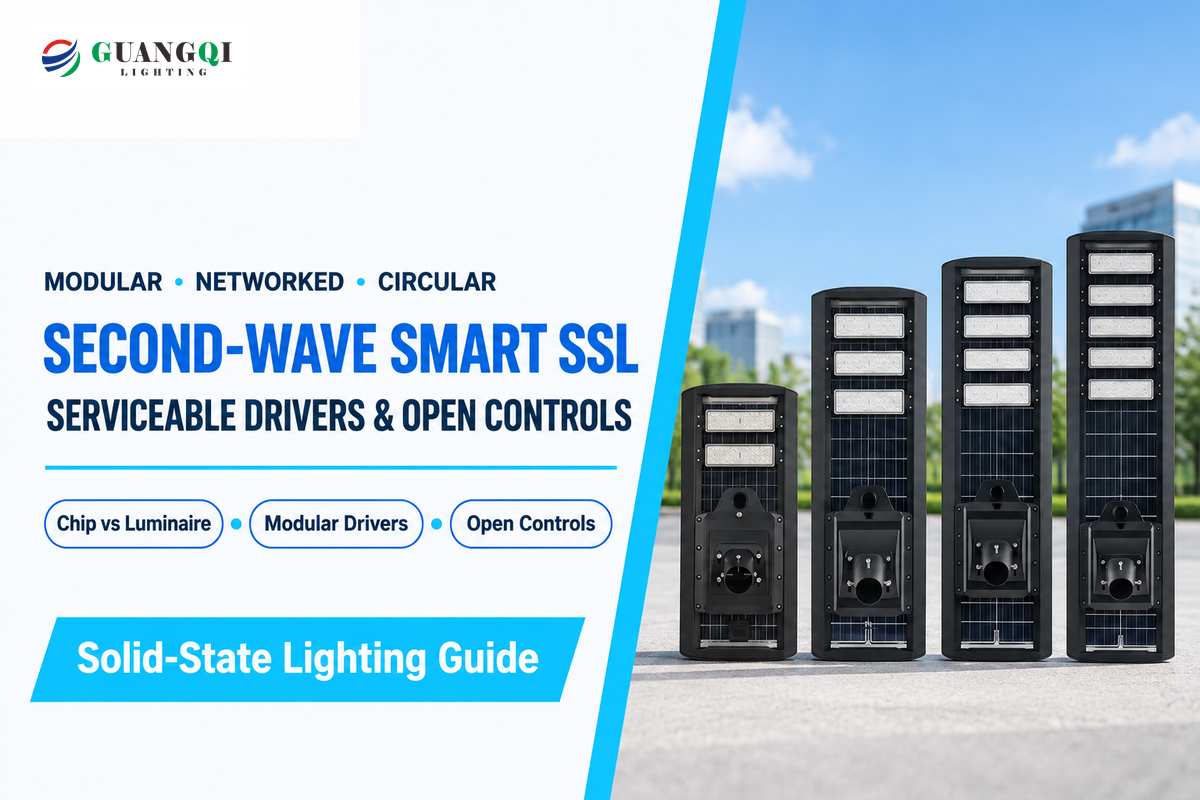
Currently, there’s a solid-state supply chain divide between upstream epitaxial chip companies and downstream luminaire companies. High-brightness compound LED dies are developed by Nichia, Lumileds, ams OSRAM, Cree LED and Toyoda Gosei. Downstream commercial luminaire companies include global brands such as Signify, Acuity Brands and Zumtobel, as well as direct-factory project manufacturer Guangqi Lighting.
Per the International Energy Agency’s 2026 LED lighting analysis, building and outdoor lighting (excluding industry and agriculture) used roughly 2,200 TWh in 2024. That equals around 8% of global electricity demand, while LEDs now exceed 85% of lighting sales in China, 75% in India, and 50% to 85% across emerging global regions. Grand View Research values the global LED lighting market at 106.9 billion USD in 2025, rising from 115.2 billion USD in 2026 to 197.0 billion USD by 2033 at an 8.0% annual rate.
As aging first-generation LED installations reach replacement age, the second wave prioritizes energy efficient luminaires exceeding 200 lm/W, replaceable modular drivers, and networked lighting control systems. Now, as those LEDs reach the end of their useful life, the focus is on modularity and networked lighting controls. The IEA, however, cautions against elevated lighting intensity levels per square meter alongside high upfront capital costs, the fragmentation of smart control protocols, and sealed vendor-locked devices. Specifying designs that are open and serviceable will avoid those pitfalls and ensure that energy savings continue.
Key takeaway
From Holonyak’s <0.1 lm/W red diode in 1962 to >200 lm/W commercial luminaires in 2026, long-term project value depends on verified LM-80/TM-21 thermal ratings, serviceable drivers, and open smart controls.
Frequently Asked Questions About How the LED Was Invented
Did one single scientist invent the LED, or did multiple laboratories share credit?
Multiple laboratories shared credit across six sequential semiconductor breakthroughs from 1907 electroluminescence to 1996 white LEDs.
James Biard and Gary Pittman discovered a practical GaAs infrared diode in 1961 (filed August 1962). Engineer Nick Holonyak Jr. then demonstrated the first visible red LED in October 1962, before Akasaki, Amano, and Nakamura enabled 1993–1996 blue and white GaN lighting. Earlier, Henry Joseph Round recorded silicon carbide glow in 1907, Oleg Losev published diode papers starting in 1927, and Rubin Braunstein reported infrared emission in 1955.
When was the first green LED invented and what semiconductor compound made it work?
Pale-green indicator LEDs emerged between the late 1960s and 1972 using nitrogen-doped gallium phosphide (GaP:N), followed by high-brightness green indium gallium nitride diodes in the early 1990s.
Bell Labs and Monsanto researchers doped indirect-bandgap GaP wafers with nitrogen centers to emit yellow-green 555 nm to 565 nm light for calculators and instrument panels. Akasaki, Amano, and Shuji Nakamura’s breakthroughs in GaN and InGaN in the early 1990s lifted green and blue diode brightness by several orders of magnitude.
Which company patented the first practical infrared LED before visible red diodes existed?
Texas Instruments patented the first practical gallium arsenide infrared LED following 1961 experiments by Gary Pittman and James Biard.
Testing zinc-diffused GaAs p-n junctions in Dallas, Biard and Pittman observed bright near-infrared emission at 900 nm under forward bias. Their application for a patent, which was filed on August 8, 1962, was published as U.S. Patent 3,293,513 in December 1966, and Texas Instruments shipped the commercial SNX-100 infrared emitter in autumn 1962.
Which country produced the earliest semiconductor light-emitting diode research?
Four countries fostered early work in this area. The United Kingdom first published silicon carbide glow in 1907, the Soviet Union published diode emission papers in 1927, the United States commercialized infrared, red, and yellow LEDs (1955–1972), and Japan pioneered blue and white GaN emitters.
Why did the 2014 Nobel Prize in Physics exclude Nick Holonyak Jr.’s 1962 red LED?
The Royal Swedish Academy rewarded blue light-emitting diodes that enabled the ability to produce efficient white light sources.
Nobel Physics statutes limit each prize to at most three living laureates: Isamu Akasaki, Hiroshi Amano and Shuji Nakamura. The panel recognized work in solving the 30-year wide-bandgap gallium nitride bottleneck needed for white general illumination, and inventor Nick Holonyak Jr. received major honors for his 1962 work on diode emission in the visible region.
When were flexible LED light strips introduced for architectural and cove lighting?
Flexible copper-circuit LED tape strips became commercially practical for architectural and cove lighting in the early 2000s as compact surface-mount white and RGB packages replaced bulky 5 mm through-hole indicator lamps.
About This Solid-State History & Engineering Report
This engineering guide traces how the LED was invented from early silicon carbide electroluminescence through blue gallium nitride and phosphor-converted white LED technology. Compound-semiconductor chip innovations related to thermal management, constant current drivers, and optical engineering for luminaires in the street, industrial and architectural markets are also highlighted. Published by the Zhongshan Guangqi Lighting Co., Ltd. technical team.
References & Sources
- U.S. Patent 3,293,513: Semiconductor Radiant Diode (Filed Aug 8, 1962; Granted Dec 20, 1966) James Biard & Gary Pittman, Texas Instruments Inc.
- Who Was Nick Holonyak Jr.? Visible LED Pioneer (Oct 9, 1962) University of Illinois Urbana-Champaign Holonyak Micro & Nanotechnology Lab
- Blue LEDs: Filling the World With New Light (2014 Popular Science Background) Royal Swedish Academy of Sciences
- U.S. Patent 5,578,839: Light-Emitting Gallium Nitride-Based Compound Semiconductor Device Shuji Nakamura et al., Nichia Chemical Industries
- U.S. Patent 5,290,393: Crystal Growth Method for Gallium Nitride-Based Compound Semiconductor Shuji Nakamura, Nichia Chemical Industries
- The History of the Light Bulb: Incandescent, CFL, and L Prize White LEDs U.S. Department of Energy
- The Nobel Prize in Physics 2014 Press Release: Efficient Blue Light-Emitting Diodes Royal Swedish Academy of Sciences
- Ecodesign and Energy Labelling Requirements for Light Sources (Regulation EU 2019/2020) European Commission
- CRS Report R42028: Lighting Industry Trends & Haitz’s Law Scaling U.S. Congressional Research Service
- How Long Do Commercial LED Lights Maintain Output? L70, LM-80, TM-21 & Driver Guide LED Pros WorldWide Solid-State Lighting Report
- IEC 60598-2-1:2025 (Edition 3.0): Particular Requirements for Fixed General-Purpose Luminaires International Electrotechnical Commission (iTeh Standards Catalog Preview)
- IECEE CB Scheme Luminaires Safety Standard: General Requirements and Tests International Electrotechnical Commission
- The Next Wave of LED Lighting: Smarter, Circular and More Efficient (March 2026) International Energy Agency (IEA)