Get in Touch with GUANGQI




Updated November 2026
RGB lights are LED light sources with separate red, green and blue emitters that mix by additive color to make thousands of shades. The letters after “RGB” tell you what else is inside. RGBW adds one white chip, RGBCCT adds warm and cool white chips, and RGBWW can mean either RGB plus warm white or RGB plus both whites. RGBIC adds a control chip so each section of a strip can show its own color.
Those extra letters determine two things buyers care about when considering color changing lights: how good the white light looks, and how many control channels the controller has to drive. A strip for a gaming setup, a color changing wall washer on a hotel facade and a smart bulb for a bedroom all start from the same three primaries. They differ in how they produce white light and how they are controlled.
Short answer: Buy plain RGB for color effects only. Buy RGBW for one fixed white and RGBCCT for white you can tune from warm to cool. Choose RGBWW only after confirming whether it has one warm white channel or separate warm and cool white channels. Pick RGBIC or addressable pixels only when different parts of the run must show different colors at the same time.
Key points
- In Cree’s tests, a 4000 K white chip couldn’t reach CRI 70 once the mix was pulled warmer, so a white chip should match the warmth you use most.
- The US Department of Energy notes that three primaries are the minimum for acceptable color-mixed white, and most white LEDs use phosphor conversion instead.
- “RGBWW” has two meanings on the market: RGB plus warm white (4 channels) or RGB plus warm and cool white (5 channels).
- One DMX512 universe holds 512 channels and can control up to 128 four-channel RGBW fixtures or 170 three-channel RGB pixels.
Quick Specs: RGB Light Types
| RGB | 3 control channels, no white chip |
| RGBW | 4 channels, one fixed white (often 2700-6500 K options) |
| RGBWW / RGBCCT | 5 channels when both warm and cool white are fitted |
| RGBIC / addressable | Data line plus power; per-segment or per-pixel color |
| Typical strip supply | 12 V or 24 V DC (5 V for many addressable strips) |
| DMX512 capacity | 512 channels per universe, 32 unit loads per line |
RGB Lights Basics: How an RGB LED Mixes Color
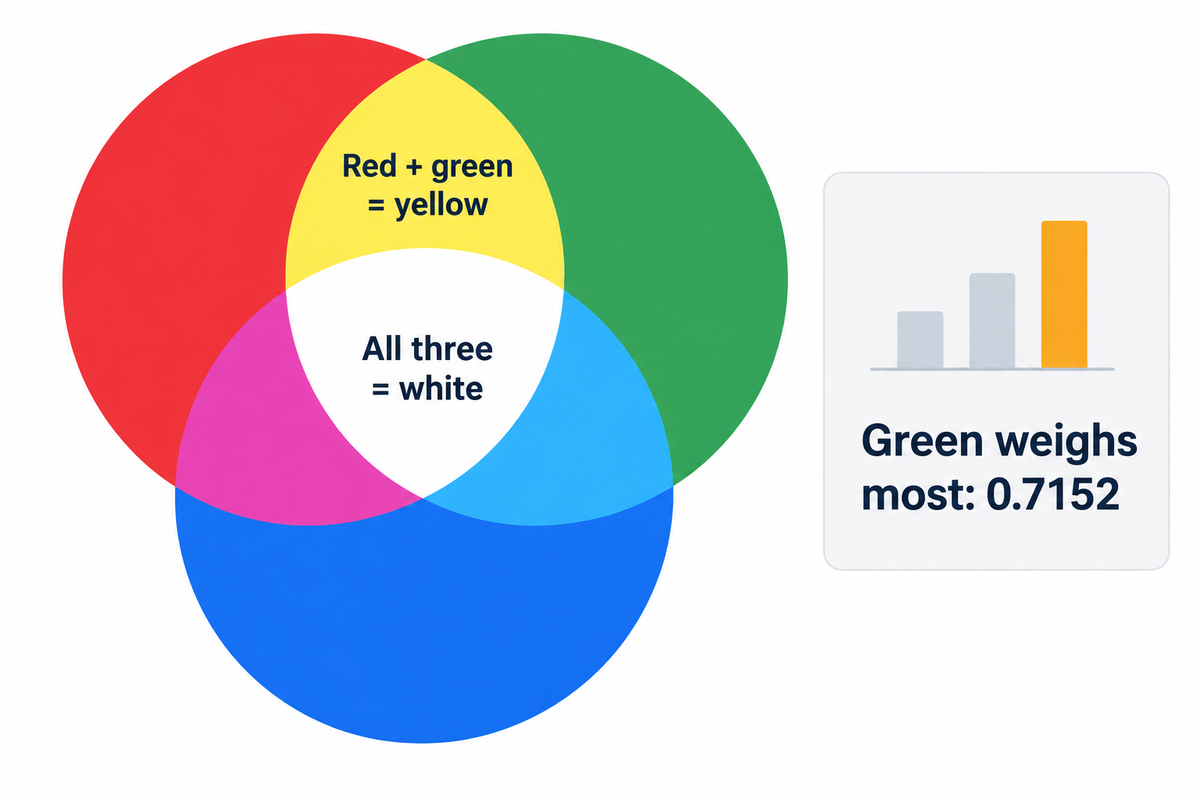
An RGB LED contains a red, a green and a blue emitter in one package or cluster, and a controller dims each RGB color channel with fast on-off pulses (PWM). Your eye adds the three outputs together, so red plus green reads as yellow and all three together read as white. That’s additive color mixing, the opposite of mixing paint, and it’s how a single LED RGB package becomes a multicolor light.
| Red | Green | Blue | Color you see |
|---|---|---|---|
| Full | Off | Off | Red |
| Full | Full | Off | Yellow |
| Off | Full | Full | Cyan |
| Full | Off | Full | Magenta |
| Full | Half | Off | Orange |
| Half | Off | Full | Violet |
| Full | Full | Full | White with a tint (balance varies by chip) |
The three channels don’t count equally towards brightness, because the eye is most sensitive to green. The W3C definition of relative luminance for the sRGB color space weights red at 0.2126, green at 0.7152 and blue at 0.0722. That formula describes display colors, not any one strip. On LEDs, a neutral white usually needs a different drive level on each channel, and Cree’s color mixing tests run a different current through each of the red, green and blue LEDs for every white point. Setting all three channels to full is a starting point, not a calibrated white.
The famous “16 million colors” figure is controller arithmetic: 256 brightness steps per channel, cubed, gives 16,777,216 combinations. These code combinations are not 16 million visually distinguishable colors. The blue LED that made both white LEDs and full RGB mixing practical is a fairly recent invention; our article on how the blue LED made white LEDs possible covers that history.
What does RGB stand for?
RGB is the abbreviation for red, green and blue, the three primary colors of light that an RGB LED mixes. TVs and computer monitors use red, green and blue primaries too. In RGB lighting, each channel’s share of the brightness is set by its own chip output and drive level.
Chases and fades are lighting effects made by changing the three color channels over time. On lighting products the letters following RGB are more important than RGB itself. W means white, WW usually means warm white; CW means cool white and IC means an integrated control chip. CCT means correlated color temperature, and in a label like RGBCCT it usually signals separate warm and cool white channels.
Why White From RGB Lights Looks Off
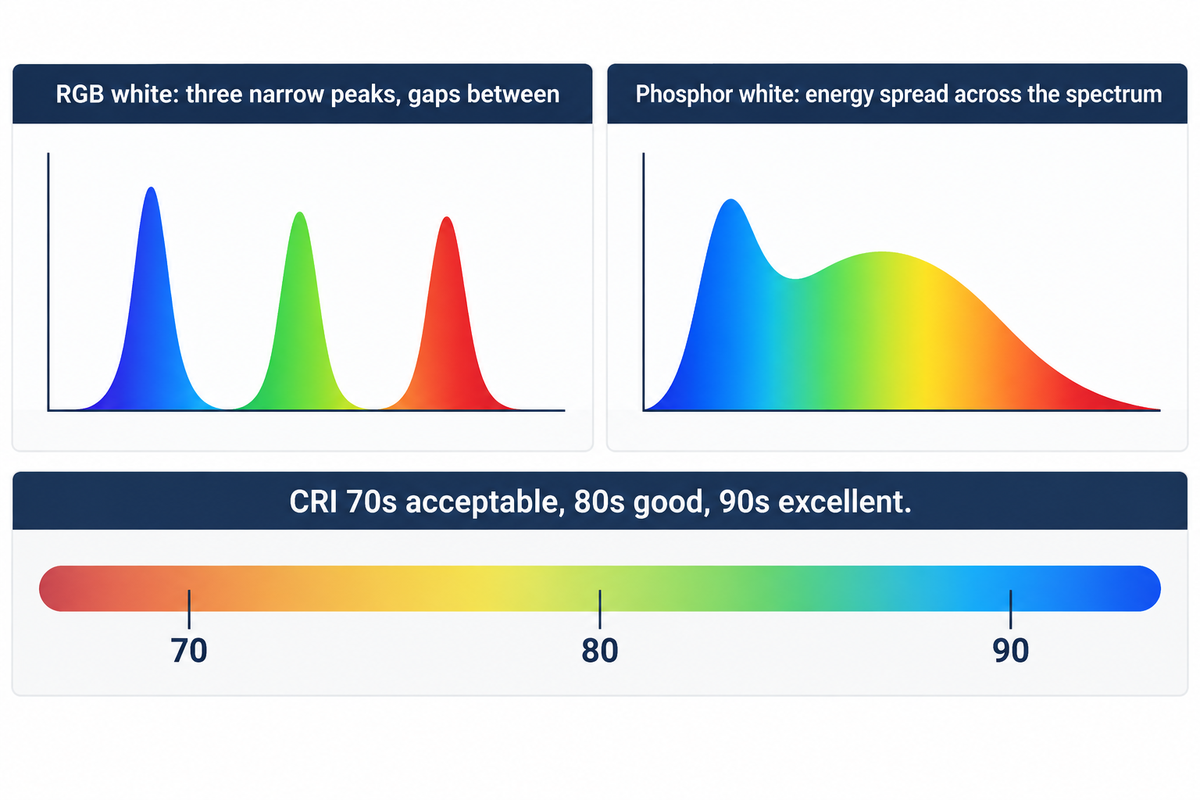
White from RGB lights looks off because three narrow red, green and blue peaks leave gaps in the spectrum, and an uncalibrated mix can also lean blue, pink or green. Even a balanced mix renders skin, wood and food poorly. The US Department of Energy notes that three primaries are the minimum for acceptable color-mixed white.
Color rendering index (CRI) is the usual score. DOE describes CRI in the 70s as acceptable for interior use, the 80s as good (specification grade) and the 90s as excellent. Few RGB strip datasheets publish a CRI for their mixed white at all, which is itself a signal. Cree’s color-mixing application note states that adding a phosphor-converted white LED to RGB “gives a more balanced spectrum and often better color rendering.” For background on the metric, see our guide to what a CRI score measures.
Most white LEDs resolve both issues by using a blue chip with a phosphor coating, which spreads the energy across the spectrum. A white chip also allows a fixture to make good white on a single channel, as Cree’s note points out, so white no longer depends on balancing three colors at once.
Can RGB lights make white?
Yes, RGB lights can make a white that reads as white at a glance, but it’s weak for lighting a room. The tint depends on how the three channels are balanced, and objects under it appear flat because the narrow red, green and blue peaks leave gaps in the spectrum.
For a TV backlight or gaming room that’s primarily colored, RGB white is acceptable. For a kitchen under-cabinet run, a reading corner or a shop window, find a product with a white chip, and check its CRI on the product spec sheet. The DOE’s bands indicate that 80 is the point where white starts to count as good.
RGB vs RGBW vs RGBWW vs RGBCCT: The Channel-Letter Decoder
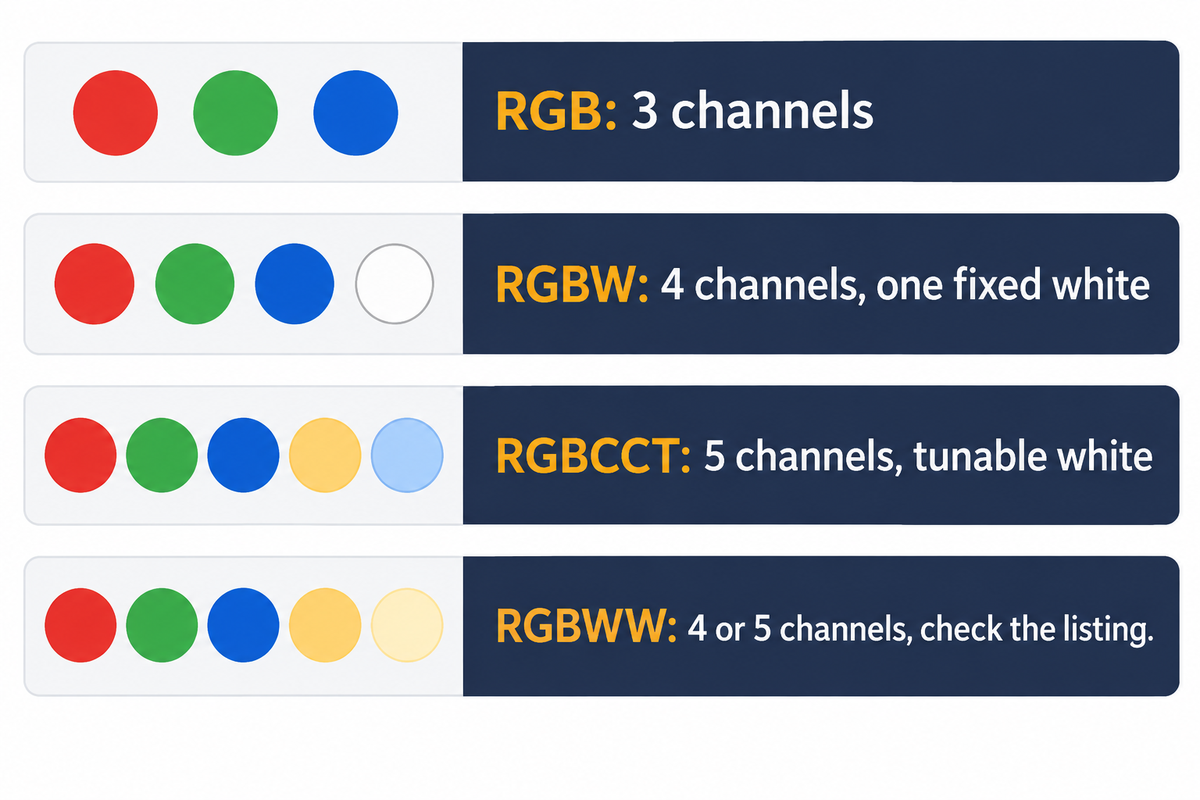
RGBW adds one white channel (4 channels total), and RGBCCT adds a warm and a cool white channel (5 channels total). Sellers use RGBWW for either RGB with warm white (4 channels) or RGB with warm and cool white (5 channels). Verify the channel count, and check the wiring diagram before purchasing. Also confirm that the controller has enough outputs for the channels at the strip’s voltage and current.
| Label | Chips inside | Control channels | White you get |
|---|---|---|---|
| Single white | One phosphor white | 1 | Fixed CCT, e.g. 3000 K |
| CCT (dual white) | Warm white + cool white | 2 | Tunable, often 2700-6500 K |
| RGB | Red, green, blue | 3 | Mixed only, tinted |
| RGBW | RGB + one white | 4 | One fixed white |
| RGBWW (meaning 1) | RGB + warm white | 4 | Fixed warm white |
| RGBWW (meaning 2) | RGB + warm + cool white | 5 | Tunable white |
| RGBCW | RGB + cool white (some sellers add warm) | 4 or 5 | Cool white or tunable |
| RGBCCT / RGB+CCT | RGB + warm + cool white | 5 | Tunable, generally 2700-6500 K |
| RGBA / RGBWA | RGB + amber (+ white) | 4 or 5 | Warmer pastels and skin tones |
| RGBIC | RGB (sometimes + W) with driver ICs | Data line, per segment | Depends on the added W |
The same decoder applies to RGB LED strip lights, bulbs and fixtures, because color options on a spec sheet are listed by channel. The two RGBWW meanings aren’t a typo. One strip maker’s guide says RGBWW can be read as “RGB plus warm white light, or RGB plus a white and a white light.” Another vendor’s guide says plainly that it depends on the vendor. Guangqi’s controller guide sizes channels the same way: one for single white, three for RGB, four for RGBW and six for RGBWA-UV. Its RGBW LED wall washer lights use 4-in-1 SMD5050 chips with each channel driven separately over DMX512.
The white chip also sets how warm the fixture can go with good color. In Cree’s 4-channel tests, a 4000 K, CRI 90 white LED in the fourth position couldn’t reach CRI 70 once the mix was pulled to lower CCTs. A 3000 K, CRI 90 white, by contrast, was lifted to 96.5 CRI at 3000 K with help from a red LED. Those results come from Cree’s own test arrays, so they show a direction rather than a rule. If warm white is the main use, start from a warm white chip and let the red channel fine-tune it.
What is the difference between RGBW and RGBWW?
RGBW gives four channels, one of them a fixed white. Meanwhile, RGBWW can mean that same layout with a warm white chip, or a five-channel layout with warm and cool white that together can vary from approximately 2700 K to 6500 K.
A quick check is physical. On common-terminal analog strips, a four-channel strip has five pads per cut (one common and four colors) and a five-channel strip has six. Addressable strips use data pads instead. If the listing does not state the white color temperature or the number of channels, ask for clarification before purchasing, because a four-channel controller cannot run the tunable white half of a five-channel strip.
Choosing Color Changing LED Lights by Room and Project
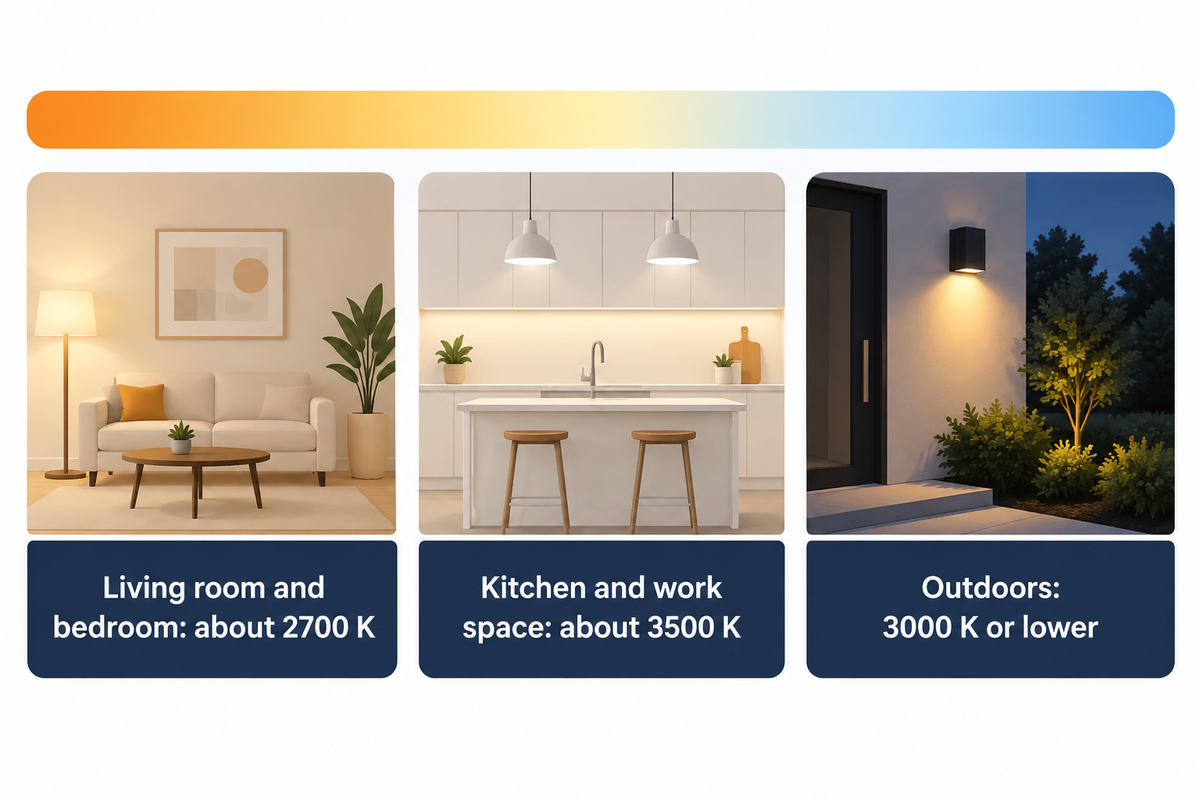
Color changing LED lights should be chosen by how often you need white. If white light is used most nights, pay for a white channel and pick its color temperature to match the room; if the lights are decoration, plain RGB or RGBIC is enough. Energy Trust’s guidance gives about 2700 K for living rooms and bedrooms and about 3500 K for kitchens and work spaces.
| Use | Recommended type | White channel | Notes |
|---|---|---|---|
| Bedroom ambient lighting | RGBWW (warm) | About 2700 K | Dim warm white at night; bedroom decor colors on weekends |
| Living room cove | RGBCCT | 2700-4000 K tunable | White most evenings |
| TV or LED monitor backlight | RGB or RGBIC | None needed | USB powered LED kits on 5 V are common |
| PC case and gaming setup | Addressable RGB | None needed | Software can sync gaming effects to the screen |
| Kitchen under-cabinet | RGBW or CCT | About 3500 K, CRI 80+ | Task light first, color second |
| Retail window | RGBW | 3000-4000 K, CRI 90 | Merchandise color matters |
| Building facade wash | RGBW wall washer | 2700-3000 K | IP65-IP66, DMX512 |
| Media facade | RGB or RGBW pixels | Optional | IP67, DMX512 or SPI |
| Landscape wall or tree | RGBW | 2700-3000 K | Match the other garden fixtures |
| Pool or fountain | RGB or RGBW underwater | Optional | IP68 and low voltage |
RGB gaming setups are one use where color effects matter more than a dedicated white. Gaming RGB lights are judged on immersive color and speed, so an addressable strip is worth more than a white chip there; most gaming lights never use white at all. Strip lights for bedroom use are the opposite, because a strip for bedroom reading spends most nights in warm white. Outdoor architecture leans warm too. Guangqi’s wall washer FAQ states that warm white of 2700-3000 K is by far the most common color temperature for facade fixtures, with 4000 K suiting concrete or glass. For homes, DarkSky International advises choosing outdoor lamps of 3000 K or lower; limiting brightness and aiming light down also cut light pollution. An RGBW facade fixture should therefore be ordered with a white channel that matches the static white lights already on the building. Outdoor LED color schemes can then return to that warm white after an event. For Kelvin values in other rooms, see our guide to light colors and Kelvin values.
RGB vs RGBIC Light Strips and Addressable Pixels
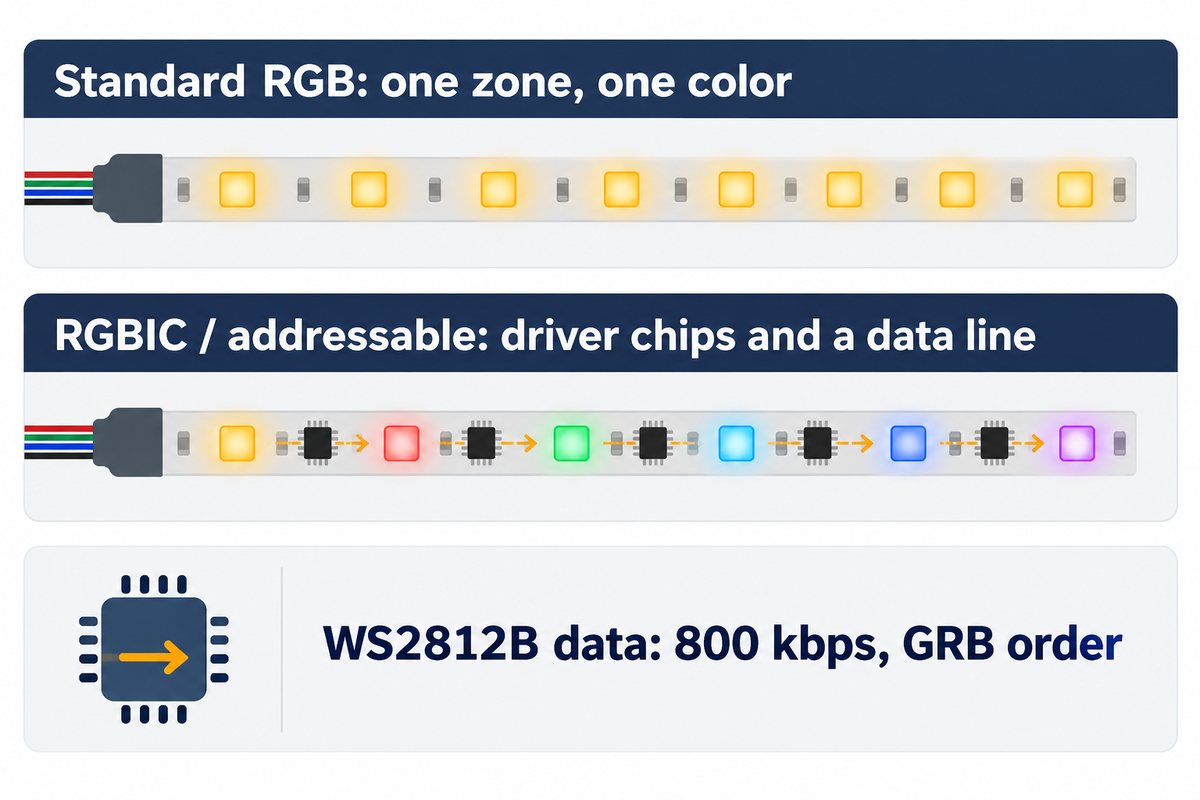
A standard RGB strip is one zone. The classic RGB color changing tape has every RGB LED group on the run display the same color at the same time, controlled over three color wires plus power. RGBIC and addressable strips contain driver chips and a data line, so separate segments or single pixels can display different colors at once for chases, gradients and moving effects.
The data line has its own limits. The WS2812B, one of the most common addressable LEDs, receives data at 800 kbps and expects the bytes in green, red, blue (GRB) order. Its datasheet states a chain of at least 1,024 points at a 30 fps refresh rate. Longer runs or faster effects need more controller outputs, not just a bigger power supply.
Facade pixels follow the same logic at a larger scale. Guangqi’s addressable LED pixel lights are offered in RGB and RGBW, and the maker plans about 500-1,000 pixels per SPI data line and 128 to 170 pixels per DMX universe. Those are planning figures for its own fixtures; the exact count depends on the chip and the controller.
Addressable control also shows up in RGB neon. LED neon flex is a strip inside a diffusing silicone body, and the RGB versions of those neon lights come in both single-zone and addressable, so the same zone-or-pixel question applies.
What is RGBIC?
RGBIC means RGB with an independent control IC: the strip carries small driver chips that allow different sections of the strip to be different colors. It’s more of a marketing term, as one control IC may be in charge of several or a group of LEDs.
Addressable control is worth paying extra for only if you need to control different colors at different points along the run simultaneously. Otherwise, you can get single-zone color from a standard RGB strip with a compatible three-channel controller, without pixel programming.
RGB Controller Options: Remote, Wi-Fi, Zigbee and DMX512
Use an IR or RF remote with one strip, Wi-Fi or Bluetooth app control for a room, and Zigbee for a smart home with voice control. Wired DMX512 works well for facades, stages and large installations. Consider the number of channels the control protocol supports, as every protocol has a limit.
Convenience is the main consideration when choosing a control method at home. A light with remote control is the simplest kit, but an IR remote requires a line-of-sight to the receiver, while an RF wireless remote can work through walls. Kits controlled via Bluetooth stay local to the phone. A smart light adds Wi-Fi or Zigbee, so the strip can follow a schedule while you are away.
A smart LED bulb that works with Alexa can take voice control. Many smart RGB strips also work with Alexa and Google Assistant. Some apps also offer scene modes and music sync. An RGB dimmable controller sets the brightness of a dimmable LED strip, but smooth fades also need fine dimming steps, so check the controller’s dimming resolution.
The best smart LED light strips for a home are usually the ones that join the app or hub you already use, so check Wi-Fi, Zigbee or Bluetooth support before comparing colors.
DMX512 is the professional default. ENTTEC’s explanation of ANSI E1.11 puts it this way: “A DMX512 line carries up to 512 independent control channels, and each channel sends a value from 0 to 255.”
The same line runs on EIA-485 at 250 kbit/s and refreshes a full universe about 44 times per second. It can also handle 32 unit loads on one line before a splitter is required. Guangqi’s controller guide lists DALI-2 with 64 addresses per line and Casambi Bluetooth mesh with up to 250 nodes for comparison. The same table lists Zigbee 3.0 at about 100 m per hop (line of sight, outdoors) and Casambi at about 30 m per hop indoors.
“Electrically, DMX512 is an EIA-485 (RS-485) balanced differential link running at a fixed 250 kbit/s (4 µs per bit).”
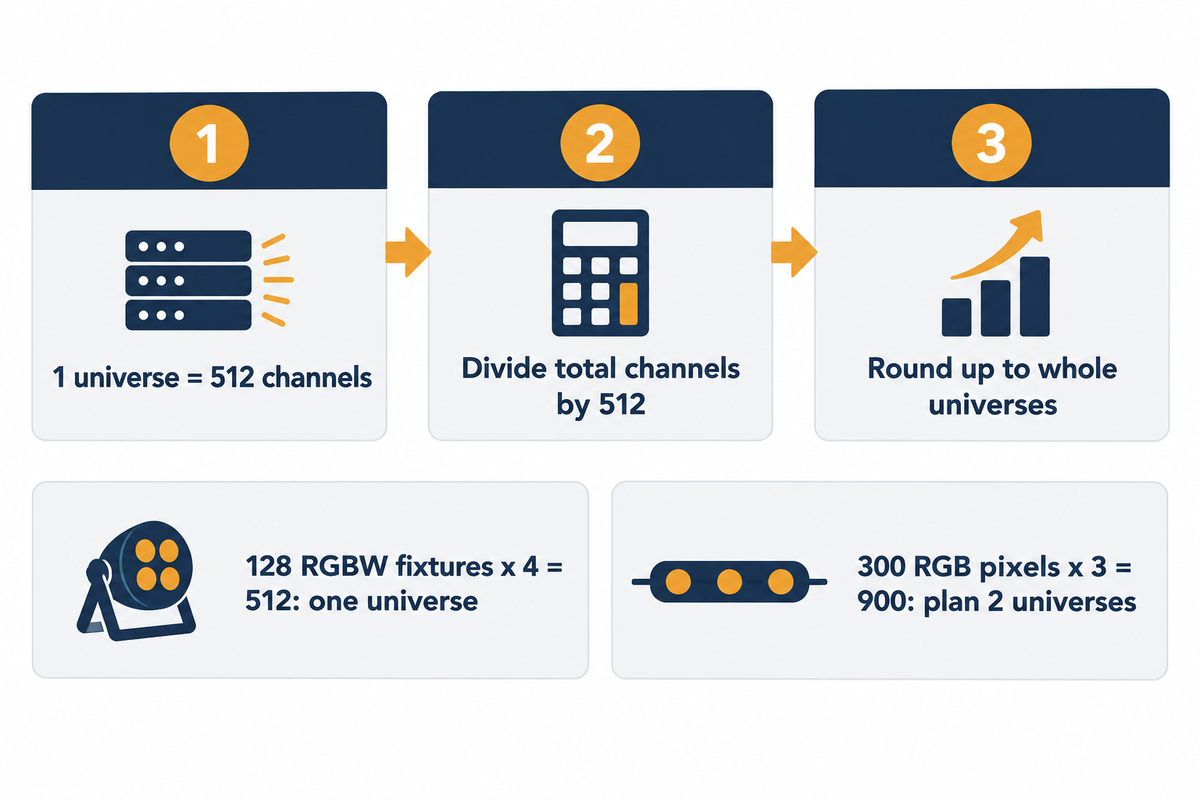
The DMX Universe Headcount is the check to run before placing an order. Multiply the number of fixtures by the number of channels per fixture, then divide by 512 and round up.
- Count channels: 128 RGBW wall washers at 4 channels each use 128 × 4 = 512 channels, exactly one universe.
- Add pixels: 300 RGB pixels at 3 channels use 900 channels; 900 ÷ 512 = 1.76, so plan 2 universes.
- Count runs: if each fixture input is one unit load, 128 fixtures need at least 4 separate DMX runs or a splitter with 4 outputs.
- Size the current: Guangqi’s controller guide works a 50-fixture RGBW run at 4 channels and 1 A per channel to 200 A at 24 V DC, then adds 20% headroom for 240 A of decoder capacity.
Guangqi has a DMX universe calculator to help with larger calculations. For other components of the setup, see how to choose a DMX controller for LED lighting, and DALI lighting control for building management dimming.
Power Use and Lifespan of RGB LED Strip and Fixtures
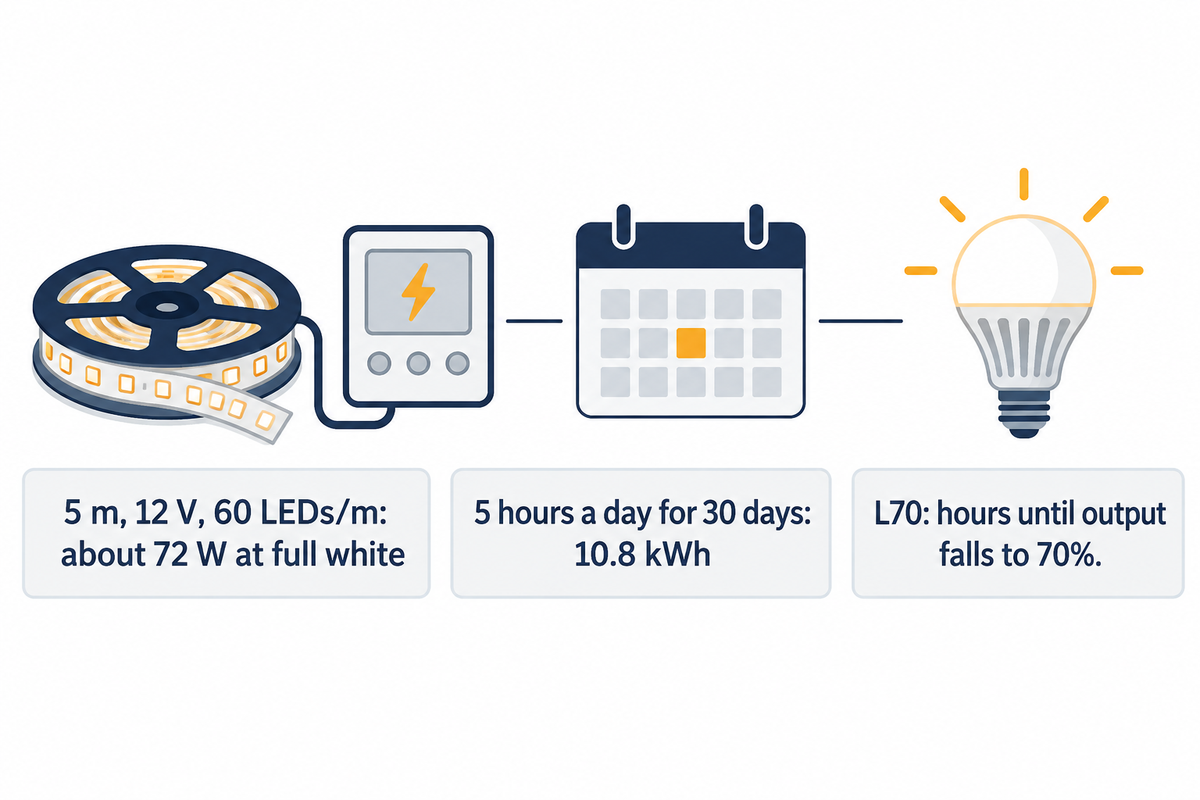
By household standards, RGB lights don’t use much power: the 5 m, 12 V strip at 60 LEDs/m that Adafruit measured would draw about 72 W with all three channels at full, and less when the channels are dimmed. Rated life is usually an L70 figure, meaning the hours until light output falls to 70% of new, not the hours until the strip stops working.
The power figure comes from one measured reel, so treat it as a guide for other small lighting systems rather than a rule. Adafruit’s guide to analog RGB strips measures about 60 mA per three-LED segment at 12 V, which works out to 1.2 A per meter on a 60 LED/m strip. At 12 V that’s 14.4 W per meter, so a 5 m reel draws 1.2 × 5 × 12 = 72 W at full white. That measurement covers one 12 V analog strip at 60 LEDs/m; denser or 24 V strips differ, so read your own label.
1.2 A/m12 V analog RGB strip, 60 LEDs/m, full white
72 W5 m reel at 12 V, all channels on
10.8 kWhper month at 5 h a day
Worked example: 72 W × 5 hours × 30 days = 10,800 Wh, or 10.8 kWh a month. Multiply that by the rate on your bill, or look up your state in the EIA table of average electricity prices by state. The power supply adds its own losses, so the draw at the wall socket is a little higher than at the strip. Dimming or lowering channel output cuts the draw, and a pastel color can still use all three channels.
Lifetime claims need the same care. A 2011 LM-80 and TM-21 briefing by Philips Lumileds engineer Mark Hodapp, hosted by the US DOE, defines L70 as the time to achieve a lumen maintenance of 70%, and states that lumen maintenance isn’t the dominant failure mode for most solid-state lighting products. On cheap strips, the adhesive, the solder joints, the controller and the power supply typically fail before the LEDs fade. Color is a second failure mode: Pacific Northwest National Laboratory found that many LED lamps installed in museums had changed color beyond a reasonable tolerance well before their rated lifetime. For comparison, ENERGY STAR’s luminaire guide required L70 lives of 25,000 or 35,000 hours, and Guangqi rates its own facade pixels at 50,000 hours, about 11-13 years at 10-12 hours a day.
Do RGB lights use a lot of electricity?
No: even at full white for five hours a day, the example reel above uses about the same energy in a month as one 60 W incandescent bulb run six hours a day, and dimmed or single-color scenes use less. Strips at other voltages and densities draw different amounts, so read the watts on the label.
For the same white output, a dedicated white chip usually draws less than mixing all three color channels. Size the power supply about 20% above the strip’s load for a capacity margin; Guangqi’s pixel and controller pages recommend the same 20% margin.
Are RGB Lights Safe? Eyes, Flicker and Vehicle Rules
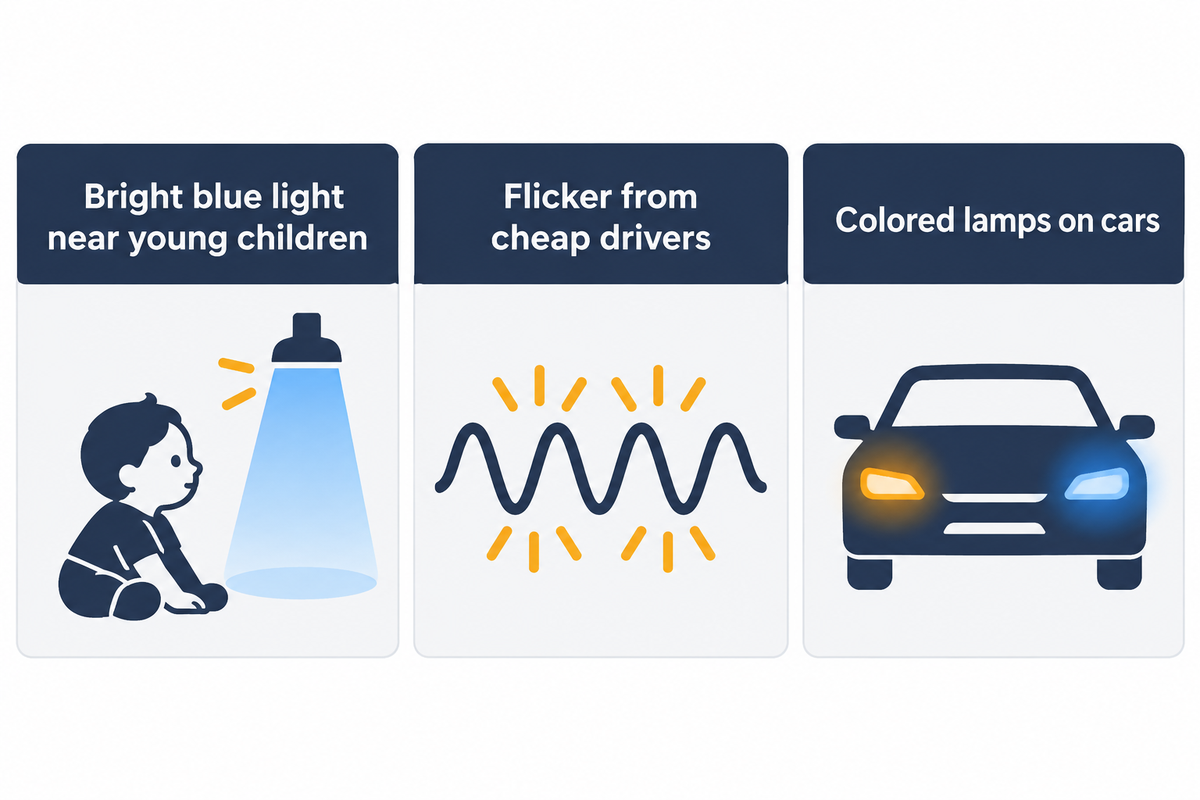
For the general healthy population, the EU’s Scientific Committee on Health, Environmental and Emerging Risks (SCHEER) found no evidence of direct adverse health effects from LEDs in normal use. The cautions are very bright blue light near young children, flicker from cheap drivers, including flicker too fast to see, and colored lamps on cars, which vehicle lighting rules restrict.
“The Committee concluded that there is no evidence of direct adverse health effects from LEDs emission in normal use (lamps and displays) by the general healthy population.”
European Commission SCHEER, Potential risks to human health of LEDs, 2018
The same SCHEER opinion adds that children are more sensitive to blue light and that blue LEDs between 400 nm and 500 nm, including those in toys, can be very dazzling. The concern is greatest below three years of age. It also notes that some LEDs raise concerns through flicker at 100 Hz and above. For a child’s room, keep RGB effects dim and warm at bedtime and avoid pointing bare blue LEDs at a crib.
Flicker is driver dependent. IEEE 1789-2015 recommends practices to alter LED current to reduce negative health effects of flicker; a strip that looks steady to the eye can still strobe on a phone camera. For more information on LED flicker and its causes, please see our article on LED flicker.
Vehicle use has its own rules. 49 CFR 571.108, the federal lighting standard, says in S6.2.1 that no additional lamp may be installed that impairs the effectiveness of required lighting equipment. Individual states add rules regarding what colors may be displayed while driving. Check your state’s vehicle code to be certain before fitting underglow or colored lights that show to the front or rear.
Troubleshooting RGB LED Lights: Wrong Colors, Flicker and Dim Ends
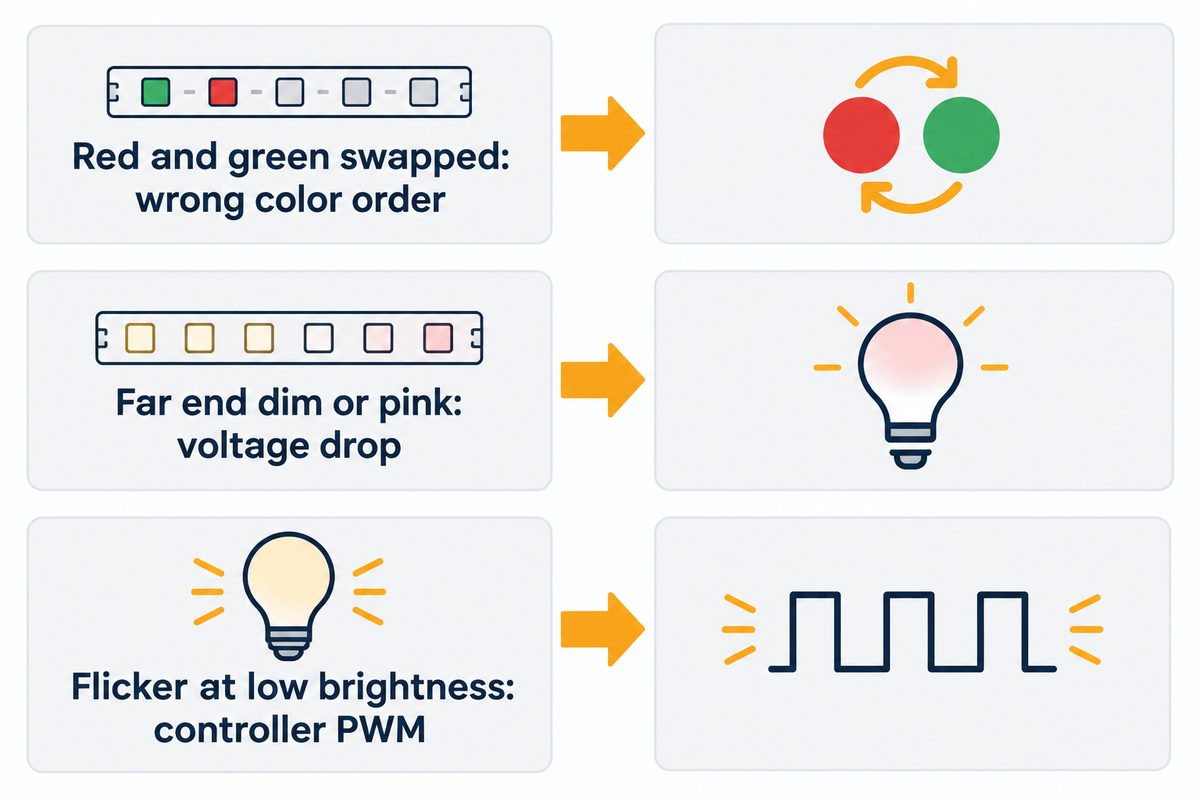
In most cases, RGB issues are wiring, setting and power issues rather than bad or dead LEDs. Set the controller to pure red, green and blue to test. A bad color suggests swapped wiring or bad order setting. A missing color may be due to a loose connection, controller setting or dead channel, and a far end of the run that’s dim or pink means voltage is dropping along that run.
- Red and green swapped: the WS2812B takes data in GRB order, so a controller set to RGB order swaps the first two colors. Other chips use other orders; Cornell’s embedded-systems course notes that an APA102 frame carries blue, green and red after a 5-bit brightness value. Set the color order to match the chip named on the reel.
- Far end dim or tinted: an EDN engineer measured only 10.0 V and 10.3 V at the far end of two 12 V strips, with LED current falling from 19 mA to 7.7 mA on one of them. For equal power per meter, conductor size and run length, a 24 V strip draws less current and has a smaller voltage drop than a 12 V strip. Flexfire recommends 24 V for runs over 40 feet. Guangqi’s pixel page recommends 24 V when the cable from the power supply to the pixels runs longer than 5 m. Feed power at both ends or every reel.
- Flicker at low brightness: The controller’s PWM frequency or shared power supply is normally the cause; try another controller before replacing the strip.
- Wrong colors after a new power supply: a 5 V adapter on a 12 V strip gives weak, wrong colors; match the supply voltage to the label.
Spec Sheet Fields to Check Before Buying RGB Lights
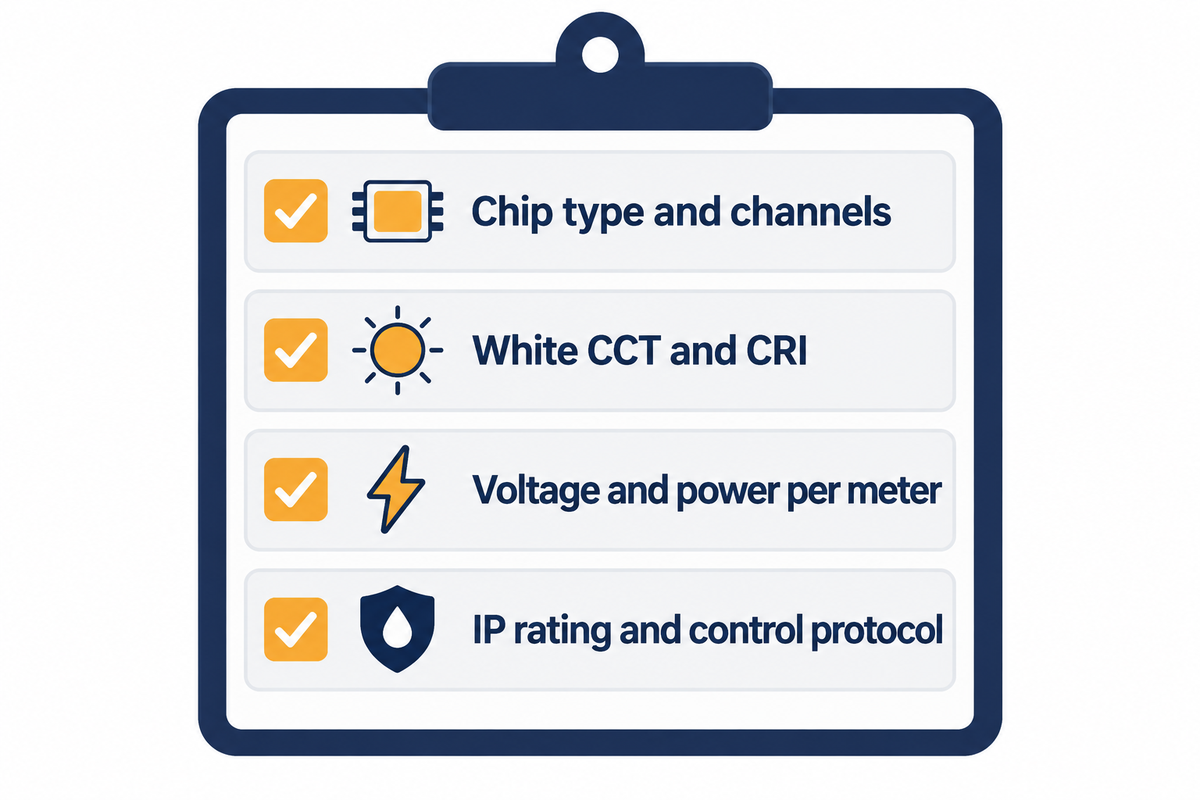
As a starting point for comparison of the RGB lights, consider channel count, white color temperature and control protocol. “16 million colors” and “music sync” describe the controller, not the light. If you can’t find these specifications, consider a different product. Compare price per meter at the same channel count and LED density, because a 5-channel RGBCCT reel carries more chips than an RGB reel of the same length.
RGB lights spec checklist: fields to compare across any brand
| Field | What to look for | Why it matters |
|---|---|---|
| Chip type and channels | RGB 3, RGBW 4, RGBCCT 5 | The controller must match |
| White CCT | 2700 K for homes, 3000-4000 K for retail | Sets the everyday look |
| White CRI | 80 or more; 90 for display | Skin, food and wood look right |
| Power | W per meter or per fixture | Sizes the supply |
| Voltage | 12 V, 24 V or DC24V pixels | Run length before voltage drop |
| Protection | IP65 waterproof against water jets; IP67 for temporary immersion; IP68 for immersion on the maker’s stated terms | In-ground and underwater sites need fixtures designed for them |
| Control | RF remote, Wi-Fi, Zigbee or DMX512 | Scale and integration |
| Dimming | Dimmable range and PWM rate | Smooth fades without flicker |
Format is a separate consideration from the chip type. A flexible LED tape light bends around coves and is cuttable at marked points. COB LED strip lights pack the chips so closely together that the line appears dotless; FCOB means flexible COB. Flexible neon rope lights or LED rope lights suit railings, and a rigid LED light bar suits shelves and stair treads. All these lights are available in RGB, RGBW and RGBCCT versions. Pick the format of the light dependent on the mounting surface and then consider the chip type. A plain LED light strip is often enough for a simple cabinet or shelf and is often the best LED choice where only color accents are wanted. For colored flood lights on buildings, see our guide on RGBW colored flood light specification.
What Is Changing in RGB Lighting Control for 2026
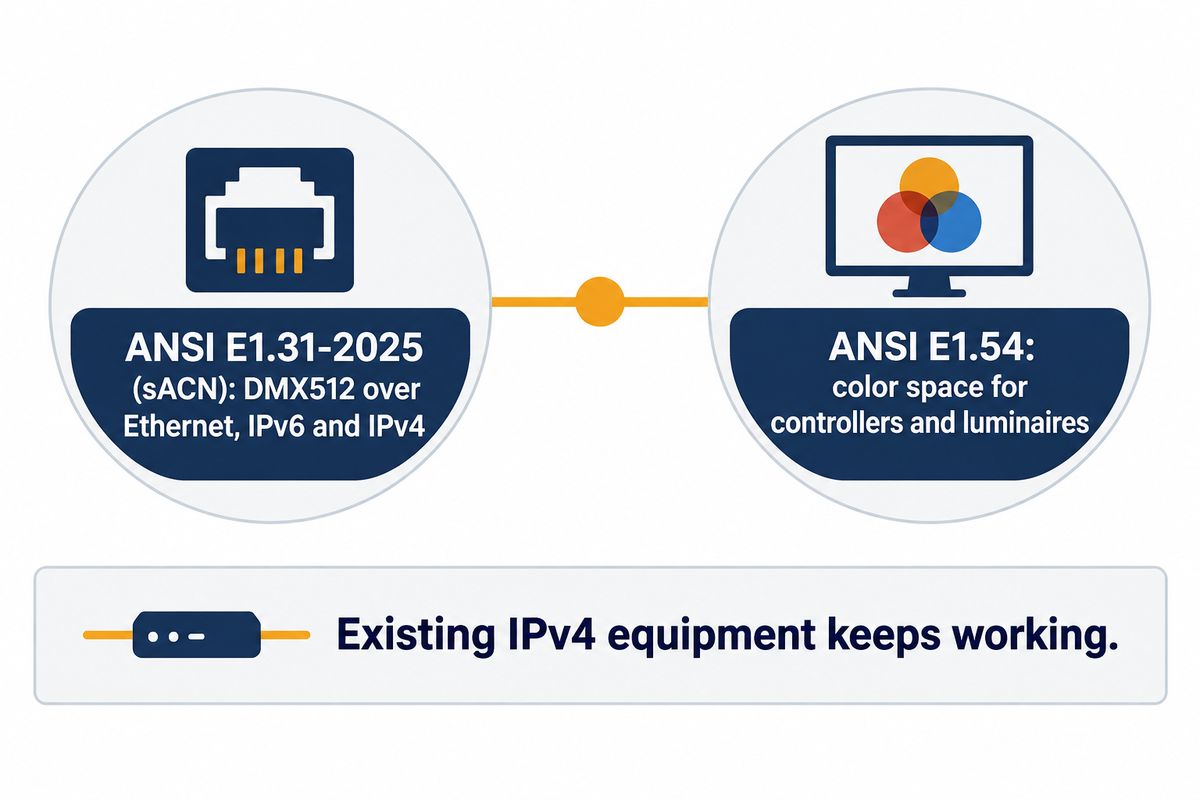
The main change for networked RGB lighting is a standards revision: ESTA published ANSI E1.31-2025, the sACN protocol that carries DMX512 data over Ethernet, and this revision includes support for both IPv6 and IPv4. Large RGB facades that run many universes over a network should ask for E1.31-2025 support on new controllers; existing IPv4 equipment keeps working.
ESTA also reaffirmed ANSI E1.54 in 2025, so the color space that lighting controllers and color-changing luminaires use to communicate color stays valid.
Frequently Asked Questions
Q: Are RGB lights LED?
Yes, virtually all RGB lights sold today are LEDs, because red, green and blue LEDs can be combined to emit light at the same time, and each of the three primary colors can be dimmed to set the mixed color.
Older color-changing units used colored filters over white lamps, which wasted most of the light. An LED strip, RGB bulb or facade fixture uses 3 colored LEDs, sometimes combined with a white LED, and a controller that sets the brightness of each channel.
Q: Do RGB lights attract bugs?
RGB lights attract fewer insects on warm or red settings than on blue, green or cool white settings, because many insects see short wavelengths best.
Outdoors, it’s suggested to keep the scene warm or amber and to save blue and white effects for short shows. Our article on whether LED lights attract bugs discusses the studies related to insects and the colors of LEDs.
Q: Are RGB lights waterproof?
Some RGB lights are waterproof, and many aren’t; the IP rating on the label will let you know.
An IP20 strip is for dry, indoor, coved ceilings, and an IP65 strip is suitable for eaves and a splash zone. Guangqi’s pages describe IP67 as rated for temporary immersion; pools and fountains need IP68 fixtures rated for the intended immersion. Connections also need to be of the same rating in order to be watertight.
Q: Can RGB lights make black?
No. Black is the absence of light, therefore an RGB light shows “black” only by turning off all of the channels.
Q: Are RGB lights good for plants?
RGB lights are a poor replacement for a grow light, as they don’t provide the light dose plants require.
Plants use red and blue light heavily, so an RGB strip on a red-blue setting can look like a grow light, but its output is low and rarely published in plant terms. A shelf of herbs near a window gets way more useful light from the sun. If you need a supplemental light, buy a grow light that states its output and keep RGB strips for decoration.
Q: Can RGB lights cause a fire?
Yes, RGB lights can become a fire risk if an overloaded power supply, a pinched cable, or a cheap unlisted adapter overheats. LEDs also generate heat, so do not bury strips in insulation; use a supply rated about 20% above the load.
Q: What is the purpose of RGB lighting?
RGB lighting adds multi-color accents for mood, branding, gaming and stage shows.
Planning Color Lighting for a Building?
Guangqi Lighting supplies RGBW wall washers, addressable pixel lights and DMX controllers for facades, bridges and other large scale landscape lighting. For a given facade, send the size and viewing distance, and the team can suggest fixtures, channel counts and a control plan.
About This Analysis
This RGB lights guide consolidates color-science definitions, LED data sheets, limits of the DMX512 standard and conclusions of health-related committee reviews. Figures were taken from cited pages in November 2026, and Guangqi product figures are from its own catalog pages.
References & Sources
- W3C WCAG 2.2, definition of relative luminance (World Wide Web Consortium)
- LED Color Characteristics fact sheet (U.S. Department of Energy)
- Optimizing 4-Channel Color Mixing Systems for Color Rendering, application note (Cree LED)
- 4-channel color mixing test results (Cree LED)
- What is DMX512? Channels, universes and timing (ENTTEC)
- Four ESTA standards recently published (ANSI E1.31-2025, E1.54) (USITT)
- WS2812B intelligent control LED datasheet (WorldSemi, hosted by Adafruit)
- RGB LED Strips guide (Adafruit Learning System)
- IESNA LM-80-08 and TM-21-11 briefing (U.S. Department of Energy workshop; slides by Philips Lumileds)
- Electric Power Monthly, Table 5.6.A average price of electricity by state (U.S. Energy Information Administration)
- Potential risks to human health of Light Emitting Diodes (LEDs), SCHEER opinion 2018 (European Commission)
- IEEE 1789-2015, recommended practices for modulating current in high-brightness LEDs (IEEE Standards Association)
- 49 CFR 571.108, Standard No. 108 lamps, reflective devices and associated equipment (eCFR)
- Color matters when choosing light bulbs (Energy Trust of Oregon)
- TrendForce 2026 Global LED Lighting Market Trends report summary (LEDinside)
- How to prevent voltage drop in LED strip lights (Flexfire LEDs)
- Color Maintenance of LEDs in Laboratory and Field Applications, 2013 (Pacific Northwest National Laboratory)
- Responsible home outdoor lighting (DarkSky International)
- The skinny on LED strips, voltage measurements (EDN)
- ECE 4760 LED strips: WS2812 and APA102 data formats (Cornell University)