Get in Touch with GUANGQI



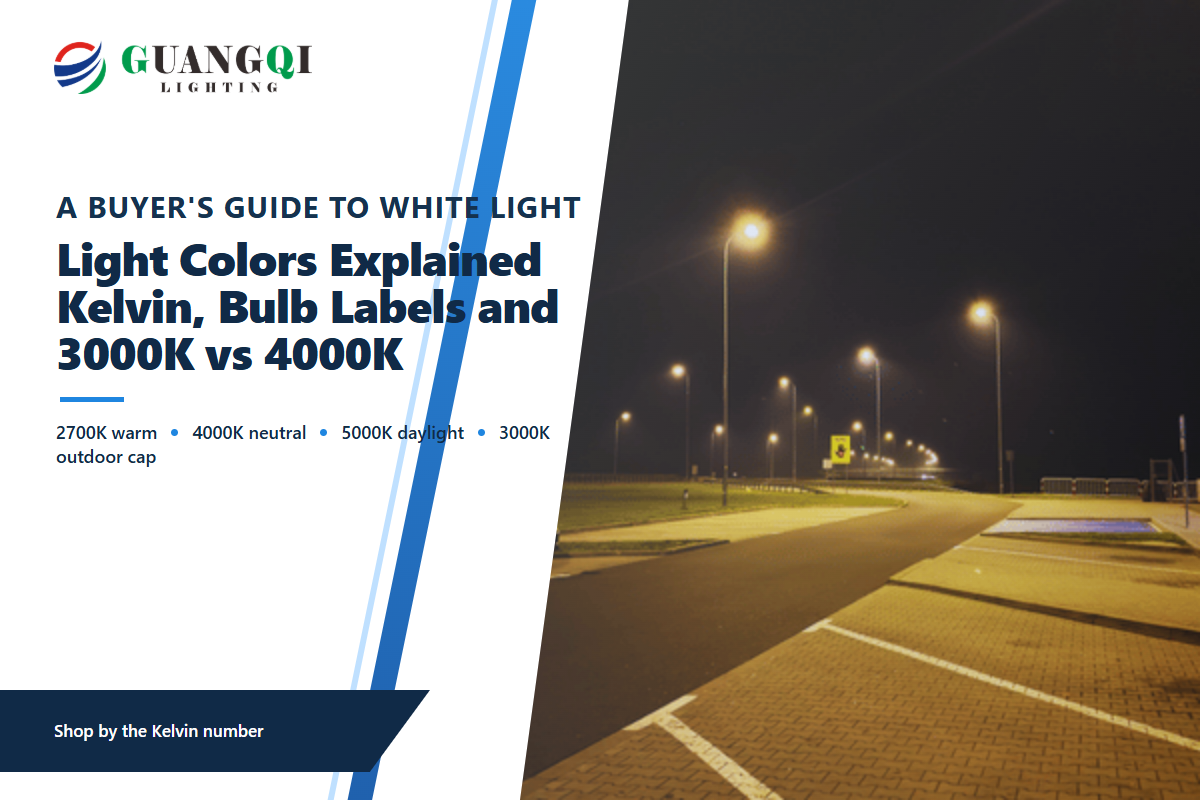
Light colors on a bulb or fixture are described by correlated color temperature, a number in kelvins that tells you how warm or cool white light looks. Low numbers such as 2700K give a yellow, incandescent-like tone; 4000K looks neutral; 5000K to 6500K reads as crisp daylight. (If you came here for pale paint shades, see the FAQ: that’s a different meaning of the same words.)
Two lamps can be labeled with the same number (like 3000K), but look different when next to each other. The retail names “soft white” and “bright white” mean different Kelvin ranges from one source to the next, and many outdoor projects now face a 3000K cap. This guide covers matching whites, room choices, outdoor choices and how to get the right lights for a fixture. It’s updated November 2026.
Quick Specs: Light Color at a Glance
| Unit | Kelvin (K), correlated color temperature (CCT) |
| US label scale | 2,600 K to 6,600 K on the Lighting Facts label |
| Warm white | 2,700 K to 3,000 K |
| Neutral white | 3,500 K to 4,100 K |
| Daylight | 5,000 K to 6,500 K |
| Class Duv tolerance | ±0.006 around each class target; the 4000K target is +0.001 (ANSI C78.377) |
| Common outdoor cap | 3,000 K (DarkSky Approved; Boulder, Colorado) |
What Light Colors Mean for Bulbs and Fixtures
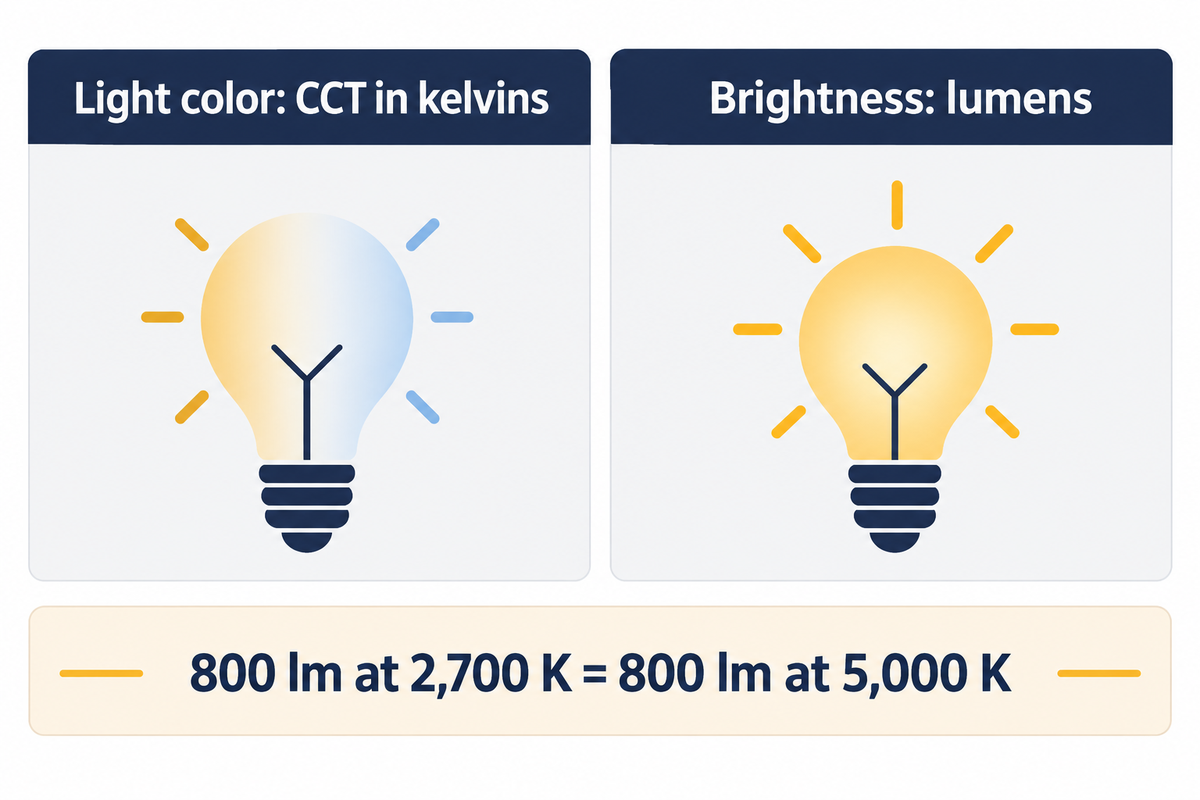
Light color is the color appearance of white light and is measured with correlated color temperature (CCT) in kelvins. According to the U.S. Department of Energy, CCT is a comparison of a lamp’s light with a source that has been heated to a certain temperature. On this scale, 2,700 K represents the color of an incandescent lamp, and higher values appear more white and blue.
The scale is opposite to the usual experience with heat. Lower numbers read as “warmer,” and higher numbers produce cooler tones. The color of daylight changes throughout the day. An overcast sky looks bluish. These colors of light run from orange to blue-white, though real sky light does not sit exactly on the blackbody line. Federal rules make the number easy to find on packaging. According to the FTC Lighting Facts label rules, each lamp’s CCT (Correlated Color Temperature) must be shown under “Light Appearance,” with a marker on a scale from 2,600 K to 6,600 K.
Kelvin has nothing to do with how much light a lamp produces. Brightness is lumens: an 800-lumen 2,700 K lamp and an 800-lumen 5,000 K lamp put out the same amount of light, though the cooler one is often perceived as brighter. Many people perceive the 5,000 K lamp as brighter, but that difference is perception, not output. Color Rendering Index (CRI) can indicate how true-to-life colors look under a given lamp. This is covered later in the post.
What Determines Light Color?
The spectrum determines light color: how much energy a source emits at each wavelength from about 380 nm (violet) to 700 nm (red). A white lamp’s warm or cool look comes from the balance across its whole visible spectrum: a larger share of red and yellow light reads warm, a larger share of blue reads cool. In a white LED, a blue chip excites phosphor, and the phosphor mix sets where the result lands on the Kelvin scale.
For LED lamps, CCT is determined by phosphor recipes, so lamps with the same CCT may not have the same spectral signature. Incandescent and halogen lamps are thermal sources, so their color follows the filament temperature closely; an LED lamp has no hot filament, and its “temperature” is a match, not a physical heat. Dimming an incandescent lamp decreases color toward 2,000 K, whereas a typical LED lamp doesn’t change its CCT when dimmed, unless it’s a warm-dim model.
The Kelvin Light Scale: Color Temperature Chart From 1800K to 6500K
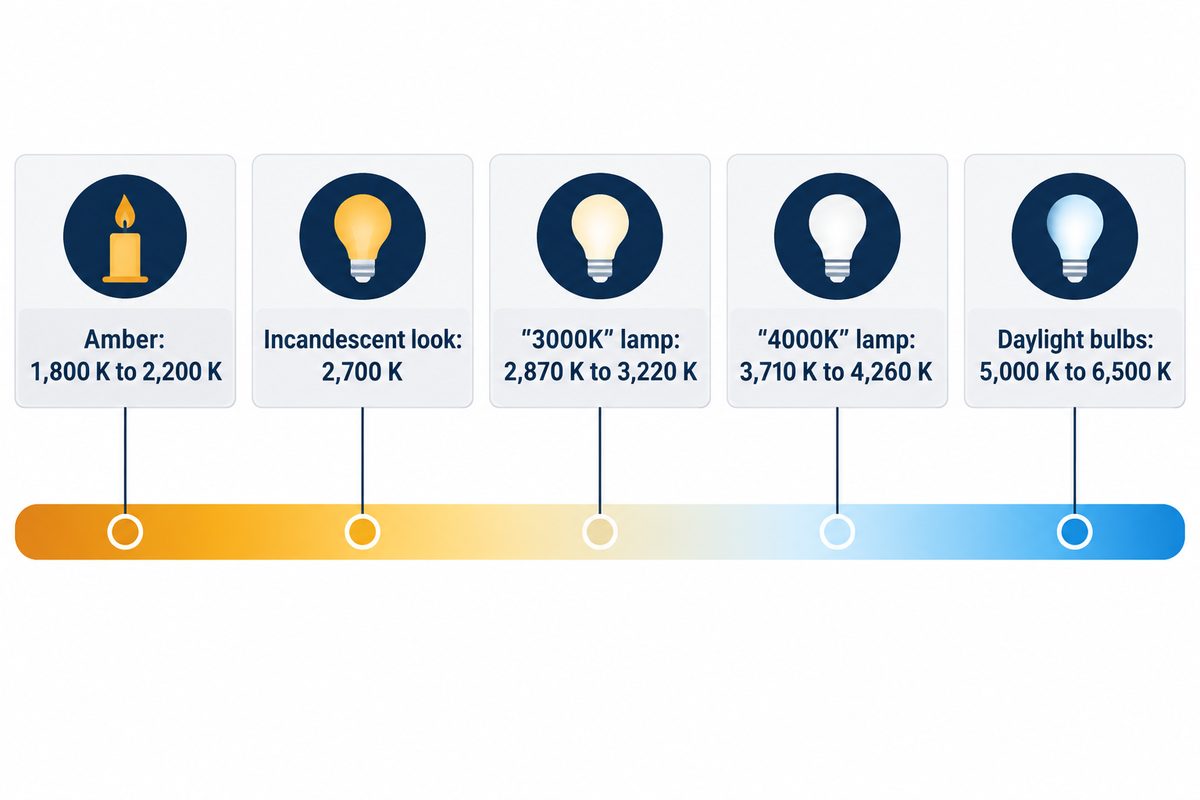
ANSI C78.377-2008 lists eight nominal white-light classes from 2,700 K to 6,500 K. Amber products sit below them near 1,800 K to 2,200 K, and natural sky light can run above 6,500 K. Each step is a band, not a point: in the ANSI C78.377-2008 table, a “3000K” lamp may measure anywhere from 2,870 K to 3,220 K.
| Kelvin | Common name | How it looks | Typical use | Measured band (ANSI 2008) |
|---|---|---|---|---|
| 1,800 K to 2,200 K | Amber, candle | Orange glow, low blue | Wildlife zones, warm-dim lamps | Not in the 2008 table |
| 2,700 K | Warm white / soft white | Yellow, incandescent-like | Bedrooms and living rooms | 2,580 K to 2,870 K |
| 3,000 K | Warm white / soft white | Soft yellow-white | Homes, lobbies, restaurants, facades | 2,870 K to 3,220 K |
| 3,500 K | Neutral / bright white | Balanced white | Kitchens, reception areas | 3,220 K to 3,710 K |
| 4,000 K | Cool white / natural white | Clean white, slight blue | Offices, classrooms, parking lots | 3,710 K to 4,260 K |
| 4,500 K | Cool white | Crisp white | Workshops, retail | 4,260 K to 4,746 K |
| 5,000 K | Daylight | Bright blue-white | Warehouses, security, reading | 4,745 K to 5,311 K |
| 5,700 K | Daylight | Blue-white | Industrial yards, inspection | 5,310 K to 6,020 K |
| 6,500 K | Cool daylight | Blue, overcast sky | Specialty and task lighting | 6,020 K to 7,040 K |
Bands computed from the ANSI C78.377-2008 targets and tolerances (for example 3045 ± 175 K for nominal 3000 K). The 2024 edition reportedly adds nominal 1800 K and 2000 K amber product classes.
Read charts by bands, not by the headline numbers. A “4000K” lamp measured at 3,710 K shares its CCT with a “3500K” lamp at the cool end of its band. Another “4000K” lamp can measure 4,260 K, and a Duv difference can still separate two lamps with the same CCT. Variation inside one band is where most “these two lights don’t match” complaints begin.
What Color Is Daylight on the Kelvin Scale?
Bulbs marketed as “daylight” commonly fall around 5,000 K to 6,500 K; natural daylight can fall below or above that range. Direct midday sun is closer to 5,000 K to 5,500 K, while light from a clear north sky or heavy overcast runs higher, often above 6,500 K. Morning and evening sunlight drops below 3,500 K as the light passes through more atmosphere.
Natural light changes during a day, so a single “daylight” lamp imitates one moment of it, not the whole gradient from sunrise to sunset. The light from the moon is reflected sunlight, but looks cooler to the eye at night, because our color vision fades at very low light levels. For interiors, a 5,000 K lamp can appear daylight-like under bright conditions; at low evening light levels, the same lamp can look harsh.
Soft White vs Bright White vs Daylight: What Bulb Labels Mean in Kelvin
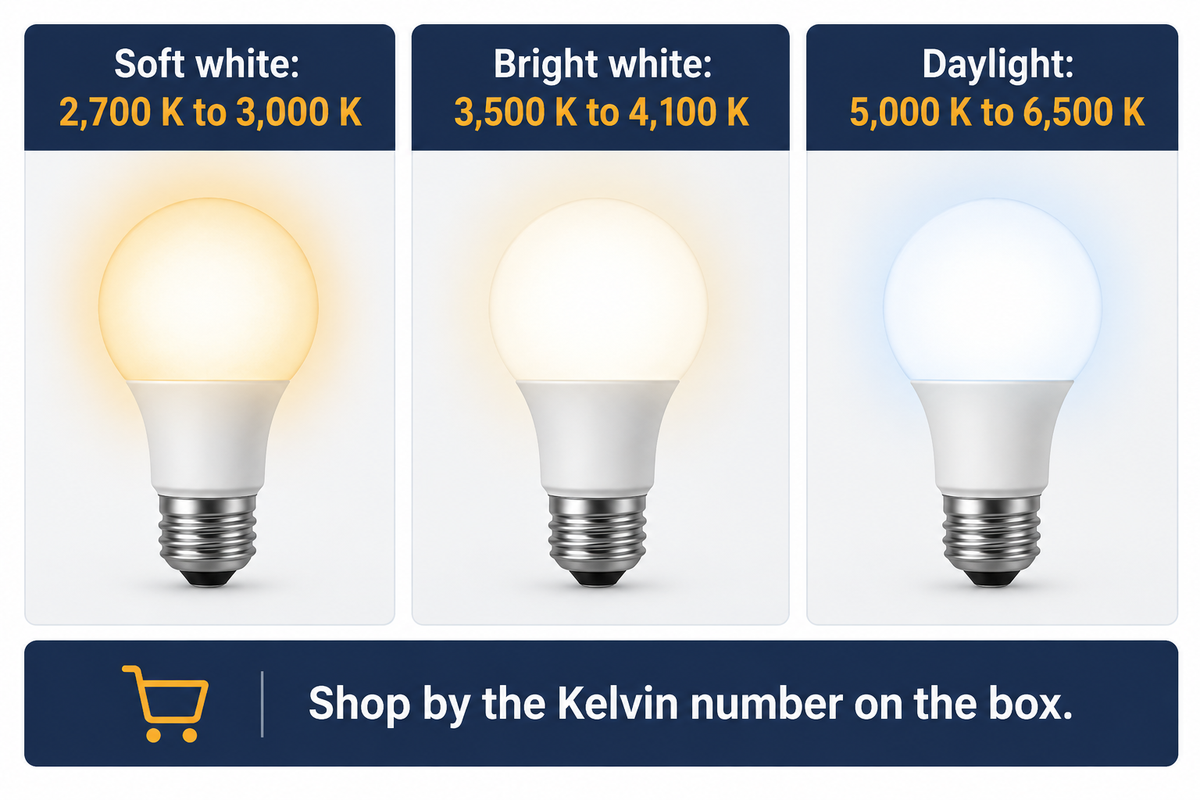
Soft white bulbs run about 2,700 K to 3,000 K, bright white about 3,500 K to 4,100 K, and daylight about 5,000 K to 6,500 K. Names like these are marketing tools, and they aren’t consistent: even two U.S. government consumer pages use different bands for them, so the Kelvin number on the box is the only reliable way to tell.
| Label | DOE federal guidance | Ohio Consumers’ Counsel | Common retail use |
|---|---|---|---|
| Warm / soft white | Warm 2,700 K; Soft 3,000 K | Soft white about 3,000 K; warm white 3,000 K to 4,000 K | 2,700 K to 3,000 K |
| Neutral / bright white | Neutral 3,500 K | Bright white 4,000 K to 5,000 K | 3,500 K to 4,100 K |
| Cool white | Cool 4,100 K | Cool white 5,000 K to 6,500 K | 4,000 K to 4,500 K |
| Daylight | — | Daylight 5,100 K to 6,500 K | 5,000 K to 6,500 K |
Sources: DOE FEMP, Purchasing Energy-Efficient Light Bulbs (Table 3); Ohio Consumers’ Counsel, How to Shop for Lightbulbs.
The practical tips come down to two: shop by number and keep one number per space. A box marked “bright white” at 3,500 K and another at 5,000 K will look like two different products in the same ceiling. A common complaint in forum threads is buying “daylight” bulbs to make a living room brighter and ending up with a cold and clinical tone. A higher-lumen 2,700 K or 3,000 K lamp solves the dimness without changing the color.
Daylight vs Soft White: Which Is Brighter?
Neither produces more light by virtue of its color alone. 800 lumen daylight bulbs and 800 lumen soft white bulbs produce the same amount of light. At the same output, daylight at 5,000 K looks brighter to many viewers, while soft white at 2,700 K looks warmer.
For a desk or workspace, a 4,000 K to 5,000 K bulb will improve detail and focus for close-up work. For bedrooms and living rooms in the evening, soft white supports relaxation and a cozy atmosphere; many people find warm, dim light calming and soothing at night, while 5,000 K lighting that suits the daytime feels too stark after dark.
Why Two 3000K Lights Can Look Different: The Two-Number White Check
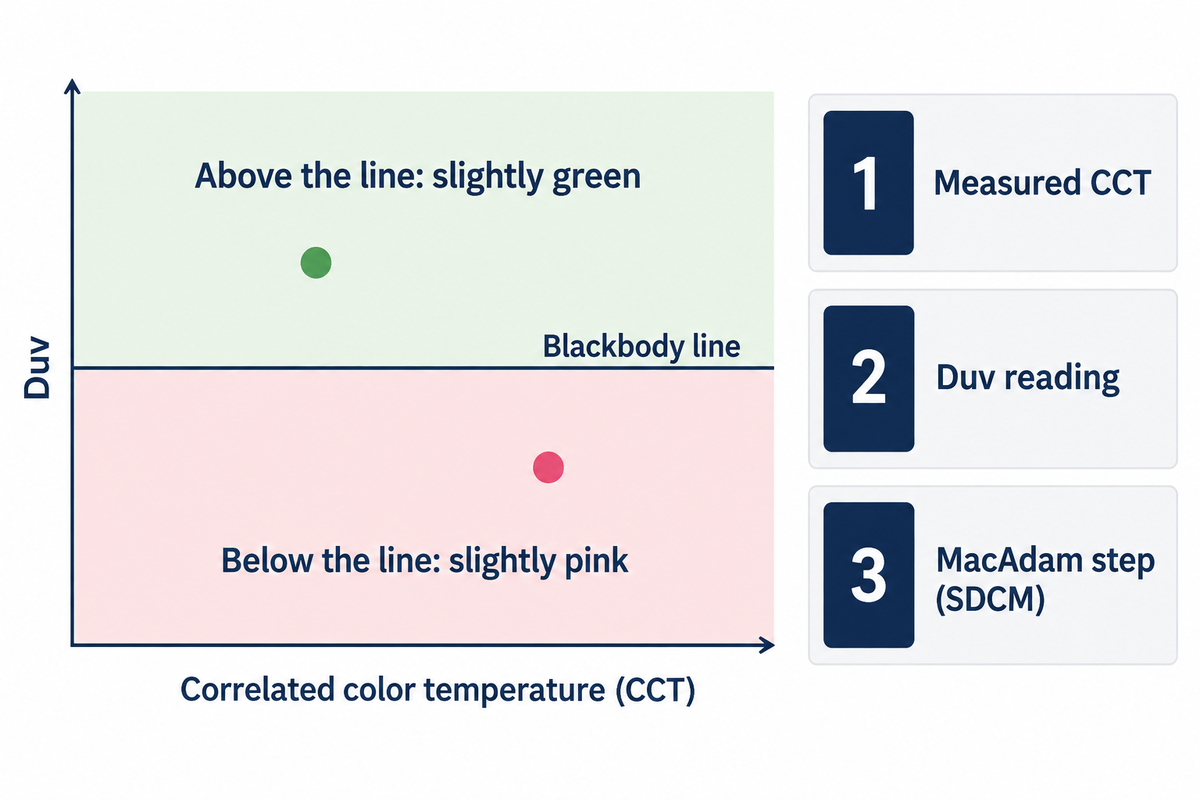
Two 3000K lights look different when their measured CCT or their tint sits in different parts of the same nominal band. A lamp’s Duv (distance above or below the blackbody line) may sit up to 0.006 either side of the class target, which is 0.000 at 3000K and +0.001 at 4000K. Above the line looks slightly green, below looks slightly pink.
The DOE fact sheet on LED color states it directly:
“The difference in either CCT or Duv alone does not characterize the perceptual difference.”
U.S. Department of Energy, LED Color Characteristics fact sheet, 2016
The Two-Number White Check turns that into a test you can run before mixing fixtures on one site. It compares two numbers from a datasheet or spectrometer reading, not box names:
- Measured CCT: the 3000K class spans 350 K and is too wide for fixtures in a row. Perceived differences between neighboring fixtures depend on base CCT, Duv and other conditions, therefore set a tighter band than the class in the order.
- Duv: read it with CCT, because the two numbers interact. Two fixtures just either side of the blackbody line can match better than two far apart on the same side; a +0.004 fixture next to a −0.003 fixture at the same CCT reads as green beside pink.
- Color Consistency step: ask supplier for the MacAdam step (SDCM) of the LED bin; in a row, consistent fixtures matter; a looser step is OK for separate rooms.
The check covers chromaticity, so it narrows a mismatch rather than ruling one out: two fixtures with different spectra can pass both numbers and still look slightly different on a white wall. That is why the signed pre-production sample in the order checklist below is the final test.
This check matters most for replacements. DOE’s federal buying guidance says that radically changing the CCT, like from 2,700 K to 4,100 K, is noticeable and can result in occupant dissatisfaction. A repair order should also specify the original CCT and Duv and not just the label. For a facade lit by 40 wall washers, ordering the second batch from the same LED bin reduces the risk of a visible color step halfway along the building. Fixtures that have aged a few years can still differ from new ones.
Color Temperature Is Not Color Quality: CRI, R9 and TM-30 in Brief
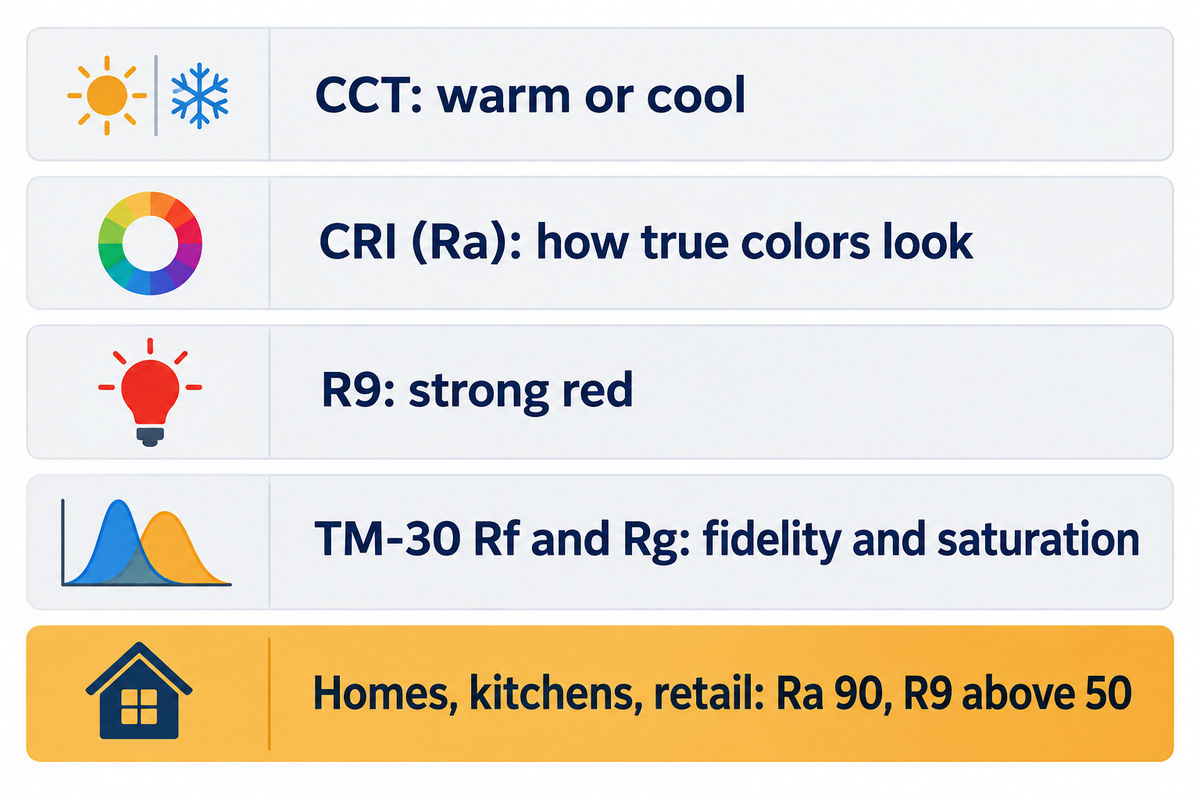
Color temperature tells you the color of the light; color rendering tells you how true objects look under it, and you need both numbers. ENERGY STAR-qualified bulbs had to reach a CRI (Ra) of at least 80, and its downlight criteria, before the lighting sunset at the end of 2024, added R9 above 0, the saturated-red score that the standard average leaves out.
Read four numbers on a datasheet. CCT tells you if the bulb is warm or cool, and Ra is the average fidelity across pastel samples. R9 scores strong red, which shows in skin, wood and meat. IES TM-30 Rf and Rg, where listed, cover fidelity and saturation on 99 samples. A 3,000 K lamp at Ra 70 and a 3,000 K lamp at Ra 95 share one light color but make a red brick wall or a kitchen countertop look very different. For homes, kitchens and retail, Ra 90 with R9 above 50 is a common target; for parking lots, Ra 70 to 80 is usual. The full explainer on what CRI, Ra and R9 measure explains the test samples as well as TM-30 charts.
Which Light Color Is Good for Each Room and Task
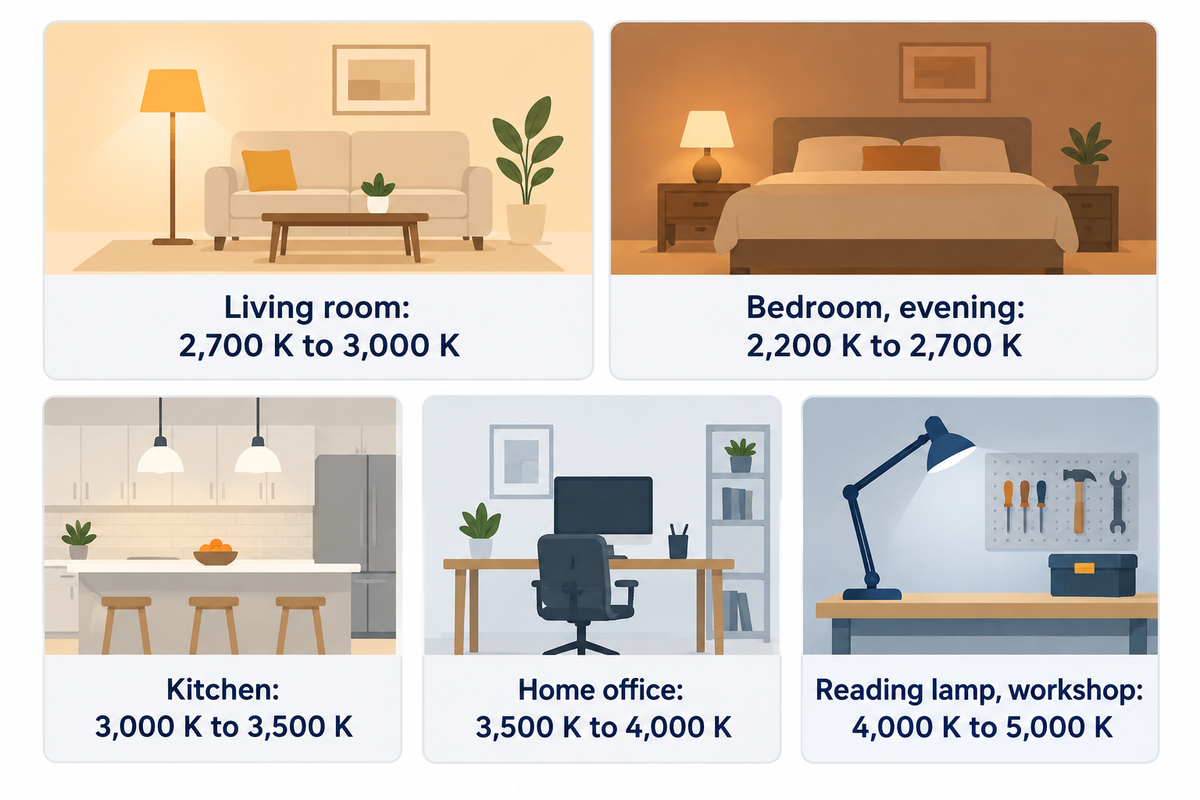
The best light color for living rooms is 2,700 K to 3,000 K, and for bedrooms in the evening 2,200 K to 2,700 K. Kitchens suit 3,000 K to 3,500 K with 3,500 K to 4,000 K task lights, and reading lamps and workshops 4,000 K to 5,000 K. Energy Trust puts kitchens and work spaces at about 3,500 K and desk lamps at about 5,000 K.
| Space | Kelvin | CRI floor | Why |
|---|---|---|---|
| Bedroom | 2,200 K to 2,700 K | Ra 80 | Low-blue evening light, relaxation |
| Living / dining room | 2,700 K to 3,000 K | Ra 90 | Cozy ambiance, skin and wood look natural |
| Kitchen (general) | 3,000 K to 3,500 K | Ra 90 | Food colors read true |
| Under-cabinet task | 3,500 K to 4,000 K | Ra 90 | Contrast for knife work |
| Bathroom vanity | 3,000 K to 4,000 K | Ra 90, R9 above 50 | Makeup and skin tones |
| Home office | 3,500 K to 4,000 K | Ra 80 | Alertness without glare on screens |
| Commercial office | 3,500 K to 4,100 K | Ra 80 | The 4,100 K level long used in offices |
| Garage / workshop | 4,000 K to 5,000 K | Ra 80 | Detail and color checks on parts |
| Reading lamp | 4,000 K to 5,000 K | Ra 90 | Print contrast |
Offices are where advice splits most: some guides say 5,000 K to 6,500 K for productivity, others 3,500 K to 4,000 K. DOE’s federal guidance says about 4,100 K is the long-standing level for office fluorescent lighting. Screen glare depends more on fixture position and brightness than on Kelvin, and a productive home office does well at 3,500 K to 4,000 K. Light levels matter and color is equally important; the criteria for the workplace lighting cover the lux side.
For an open-plan home, choosing the right lighting for your space means that for every group of rooms that have a clear line of sight of each other, they should have the same Kelvin family. A kitchen at 4,000 K that opens onto a living room at 2,700 K shows a hard color edge where the two spaces meet. Spaces that share a sightline should keep one Kelvin family, with dimming or a warmer lamp in one fixture for an evening mood, instead of three different lighting options across the ceiling.
What Light Color Is Best for Sleep?
Warm light at 2,700 K or lower is the best light color for the hour before sleep, kept dim, because it carries less short-wavelength blue light than 4,000 K to 6,500 K sources. Kelvin is only a rough guide here: a 2022 Scientific Reports study found that at a single CCT, the melanopic effect of light can vary by up to 123 lx.
The study, by Esposito and Houser in Scientific Reports, simulated a five-channel tunable LED system at 300 lx and found melanopic equivalent daylight illuminance of 123 to 354 lx across 2,500 K to 6,000 K. At 5,000 K alone, it ran from 196 to 319 lx. For a bedroom, low light level matters more than the exact Kelvin: a dim 2,200 K to 2,700 K lamp at the bedside, no overhead 5,000 K light after dark, and screens set to a warm mode. Research on mood is less settled: a 2021 laboratory study of 48 adults in Scientific Reports notes that earlier work had established effects of daytime light on mood, although not always.
Outdoor and Commercial Projects: 3000K, 4000K or 5000K
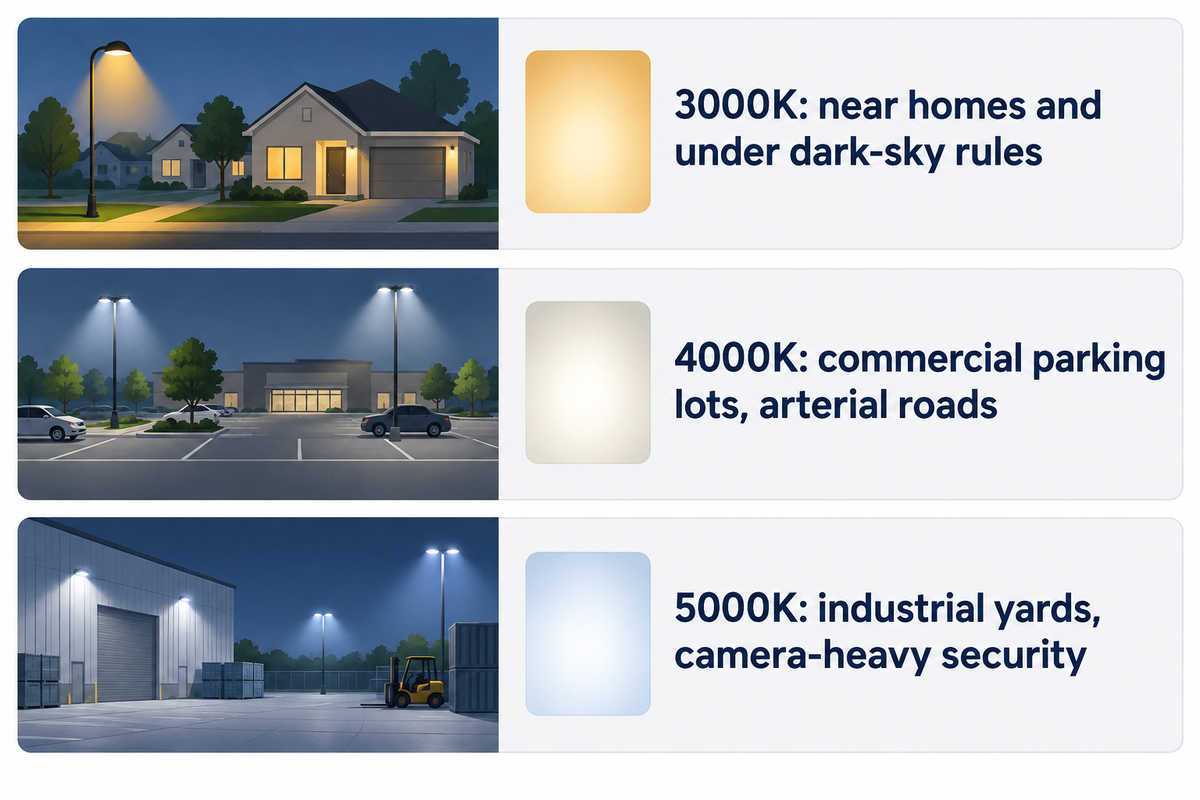
For outdoor and commercial projects, 3000K is the default near homes, on warm-toned facades and under any dark-sky rule. 4000K is the usual choice for commercial parking lots and arterial roads, and 5000K for industrial yards and camera-heavy security. DarkSky Approved fixtures must not exceed a nominal 3000 K, and Boulder, Colorado requires owners of single-family homes to use no outdoor bulbs over 3,000 K.
The energy cost of the warmer choice is small. The American Medical Association’s 2016 report on LED community lighting put the gap at only 3% (3000K versus 4000K, for the products of that year). The AMA encourages 3000K or lower for outdoor installations such as roadways. The Illuminating Engineering Society disputes the health basis: its 2017 position states the AMA’s 3000 K limit “lacks scientific foundation.” On most sites, local rules and neighbor complaints now decide the CCT, not efficacy.
| Site | CCT | Why | Rule or practice |
|---|---|---|---|
| Dark-sky park, coast, wildlife edge | Amber LED, or 1,800 K to 2,200 K warm white | Low blue share; check the spectrum, not only the Kelvin value | Local wildlife lighting rules; ANSI 2024 reportedly adds 1800K and 2000K classes |
| Residential street | 2,700 K to 3,000 K | Warm look; shielding and aiming control glare near bedrooms | AMA 2016; Guangqi post-top default 3000K |
| Pathway, park, plaza | 3,000 K | Pedestrian comfort | DarkSky pedestrian luminaire limit |
| Hotel or resort car park | 3,000 K or below | Guest comfort, sky glow | DarkSky resort guidelines |
| Brick, stone or timber facade | 3,000 K | Warm materials read rich | Hospitality practice, 3,000 K to 4,000 K |
| Glass or steel corporate facade | 4,000 K to 5,000 K | Crisp, modern look | Guangqi practice: 5000K for corporate facades |
| Retail parking lot | 3,000 K to 4,000 K | Color recognition of cars and people | Guangqi CCT guide lists 4000K for commercial lots; local ordinance first |
| Arterial road | 4,000 K | Driver alertness | Guangqi CCT guide: 4000K for arterial roads |
| Loading dock, warehouse exterior | 4,000 K to 5,000 K | Task visibility | Industrial practice |
| Security perimeter with CCTV | 5,000 K | Camera contrast | Port and perimeter projects |
| Sports field | 4,000 K to 5,700 K | Ball and player visibility, broadcast | CRI 80 to 90 with the CCT |
| Site under an enacted 3,000 K cap | 3,000 K maximum | Compliance with the local rule | Boulder ordinance |
Two zones on one property can have two CCTs. A split like 4,000 K flood lights on the parking lot and 3,000 K outdoor wall lights for facades near the entrance is common. Keep each zone to one value to help clarify the boundary. Street projects have their own guide on the street light color temperature by road class page and the CCT color temperature selection guide for street lights. Lot layouts are in the guide to parking lot lighting standards, and the dark-sky compliance checker tests a fixture list against the 3,000 K cap.
A pending New York bill shows where rules are heading: Assembly Bill A739A (2025-2026 session) would cap new and replacement outdoor fixtures installed by New York state agencies at 3,000 K, excluding public-safety uses, sports fields and the decorative lighting of facades, landscape features and entertainment effects. Until such a rule reaches your site, a request for 4,000 K for a retail lot is still normal. A project near a residential area should expect 3,000 K CCTs and budget for those fixtures instead of swapping at the permit stage.
Colored Light: Amber, Red, Blue and RGB
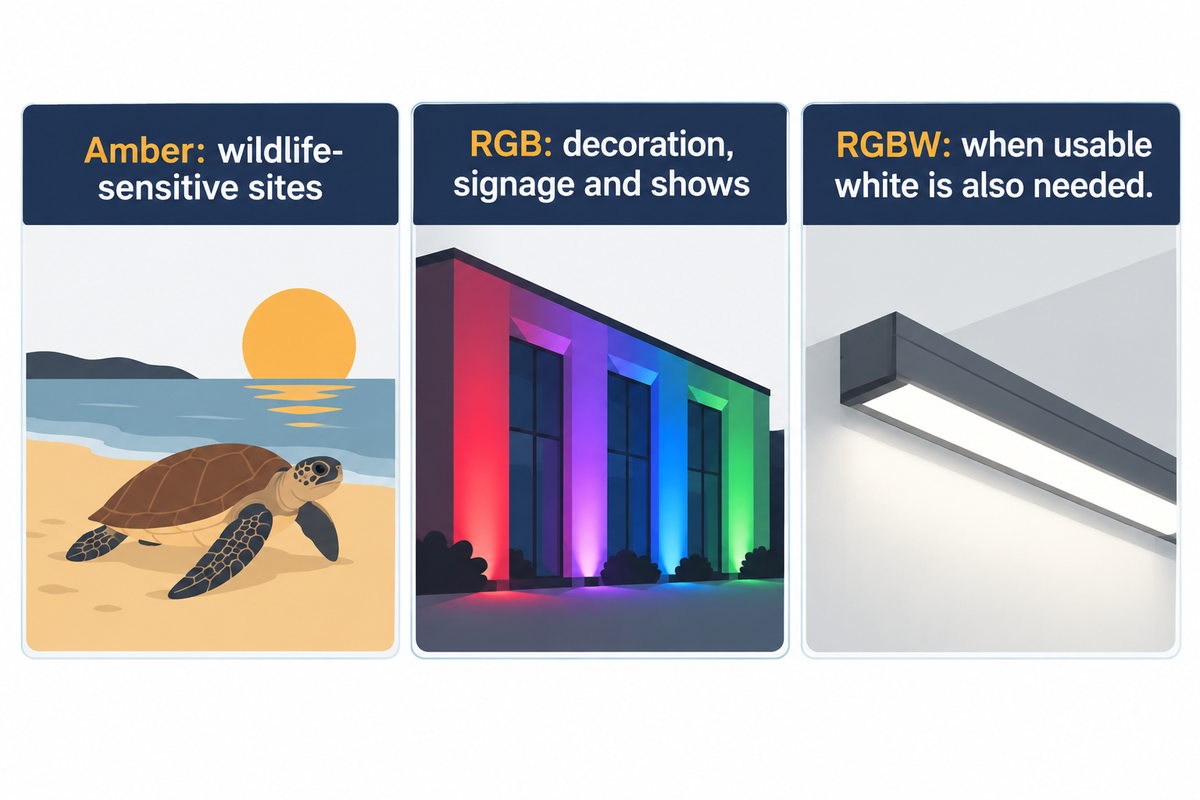
Saturated colors are described by wavelength or color coordinates rather than Kelvin. Amber is the working color for wildlife-sensitive sites; RGB is for decoration, signage and shows, not for tasks that need true color.
Amber and the old high-pressure sodium look (about 2,000 K) are still specified along turtle-nesting beaches and in dark-sky reserves, and the 2024 edition of ANSI C78.377 reportedly added nominal 1,800 K and 2,000 K classes for such products. Their color rendering is low, so a security camera brief usually rules them out. The history of that orange glow is in the guide to the sodium-vapor street light, and the switch away from it is in LED vs HPS street lights.
RGB LED fixtures mix red, green and blue channels to produce millions of hues, set by a color code such as an RGB triplet or DMX values. These fixtures are versatile for facades, events and accent lighting design, where vibrant color is of primary importance. An RGB mix can make skin, blues and greens look over- or under-saturated. A fixture that must also give usable white is usually specified as RGBW for this reason. Tunable white fixtures change only the white tone, not saturated color. Color can change the mood of a space, and some restaurants use warm tones to stimulate appetite. Claims that a given hue will promote productivity rest on thin evidence, so use colored light for effect and white light for work. To incorporate color into a white scheme, put it on a separate circuit so the white layer stays fixed.
How to Specify Light Color for an LED Fixture Order
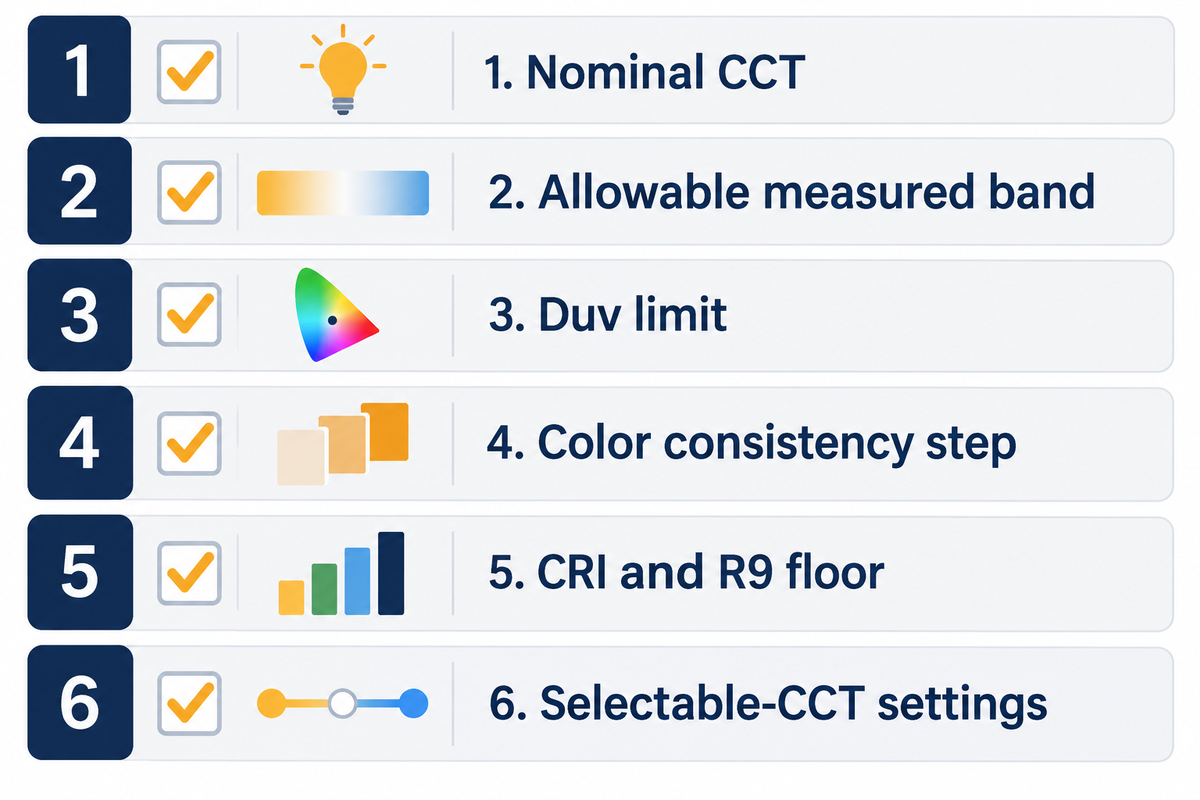
To specify light color for an LED fixture order, write six things. These are the nominal CCT, allowable measured band, Duv limit, color consistency step, CRI and R9 floor, and settings the driver allows for selectable fixtures. A purchase order that simply states “warm white” gives the factory the freedom to ship anything from 2,700 K to 4,000 K.
At Guangqi Lighting, outdoor flood lights are offered at 2700K, 3000K, 4000K, 5000K, 5500K and 6500K, with 5000K as standard and selectable CCT on the 100 W to 400 W models. CRI 80 is standard and CRI 90 is available on request. Guangqi’s outdoor flood light page lists a multi-CCT driver as adding 8% to 12% to the flood light price. The premium is worth paying when the final color is still open at order time; when a local rule fixes one CCT, a fixed build avoids the extra cost. For street projects, Guangqi ships post-top and decorative fixtures at 3000K by default.
RFQ checklist for light color: copy these rows into your quote request
| Parameter | Recommended value | Why it matters | How to verify |
|---|---|---|---|
| Nominal CCT | One value per zone, e.g. 3,000 K | Fixes the look and permit compliance | Datasheet and Lighting Facts or LM-79 report |
| Measured CCT band | Within the ANSI band (tighter for fixtures in a row), e.g. 2,870 K to 3,220 K for 3,000 K | Stops cross-bin substitution | Spectrometer reading on a sample |
| Duv | A narrow agreed range around the approved sample, inside the class tolerance of 0.006 (target 0.000 at 3,000 K, +0.001 at 4,000 K) | Limits green or pink tint between batches | LM-79 test report |
| Color consistency | 3-step MacAdam (3 SDCM) for rows; 5-step for separate areas | Fixtures side by side match | Binning statement from the LED supplier |
| CRI and R9 | Ra 80 outdoors, Ra 90 indoors; R9 above 0, or above 50 for retail | True object color | LM-79 report with R1 to R15 |
| Selectable CCT range | Capped at 3,000 K where DarkSky approval is required | Selectable units that reach 4,000 K are not DarkSky-eligible | Switch positions listed on the datasheet |
| Lumens and color per setting | Listed for each CCT setting and at minimum dim | Warm settings can lose output; mixed settings can drift off the white line | LM-79 data per position |
| Sample approval | Signed pre-production sample | Locks the color for later batches | Retained sample at both ends |
The selectable-CCT row is where buyers get caught. DarkSky’s luminaire guidelines (version 3.1, updated October 2025) set 3,000 K as the maximum for color tunable or field-selectable products. Products with a switch that can access a higher setting aren’t eligible, even if the installer leaves it at 3,000 K. On a dark-sky project, order a fixed 3,000 K build or a selectable unit limited to 2,700 K and 3,000 K. The outdoor flood light page linked above lists wattages and optics, and the commercial LED street lights cover pole top and roadway builds.
Frequently Asked Questions
Q: What type of light is 4000K?
4000K is commonly described as neutral or cool white, and it looks cooler than 3000K warm white while sitting below daylight.
It is often used for offices, classrooms, and other commercial spaces, as well as some busier roads because it provides good detail at a lower color temperature than 5,000 K. Under ANSI C78.377, the nominal 4000 K product measures between about 3,710 K and 4,260 K, so make sure to verify the measured value when color matching fixtures.
Q: Which light color is best for a bathroom?
A bathroom works best at 3,000 K to 4,000 K with a CRI of 90 or higher at the vanity mirror.
The warmer end of the spectrum is great for an overhead bath fixture and the cooler end is good for a shaving or makeup mirror. An R9 value above 50 keeps red tones in skin from looking gray.
Q: Do light colors make a room look bigger?
Yes, pale wall colors make a room look bigger because they reflect more light back into the space.
Light-colored walls, ceilings and floors bounce light around, so corners stay bright and edges feel farther away. The light source helps too: an even wash of 3,000 K to 4,000 K light on the walls opens a room more than a single bright central lamp, which leaves dark edges.
Q: What light colors do not attract bugs?
Warm amber and yellow light near 2,000 K to 2,700 K attracts fewer insects than cool white or UV-rich light.
More information broken down by insect group can be found in the guide to whether LED lights attract bugs.
Q: What’s a lighter color?
In paint and design, a lighter color is a hue mixed with white, such as a light blue, cream, or light gray.
Those pale shades reflect more light and appear softer, which is why designers build an airy palette from them. That meaning is about surfaces; on a bulb, “light color” means the Kelvin value of the light itself.
Q: Does light color affect plant growth?
Yes, plants do respond to the light spectrum and are able to use mainly blue and red wavelengths for photosynthesis and growth signals.
Cooler white light in the range of 5,000K to 6,500K is considered blue-rich light and tends to help keep plant seedlings compact. On the other hand, warmer white or red lights promote flowering and stem growth in plants. Any white LED of the right intensity placed close enough works for houseplants. The Kelvin value matters less than the amount of light reaching the plant leaves, which growers measure as photosynthetic photon flux density. Commercial grow lights are rated in micromoles per second, not Kelvin, so a 6,500 K “daylight” bulb isn’t a grow light by itself. A plant leaning toward a window is following directional light; long, weak stems are the usual sign that it needs more light.
References & Sources
- Purchasing Energy-Efficient Light Bulbs U.S. Department of Energy, FEMP
- LED Color Characteristics fact sheet U.S. Department of Energy
- The FTC Lighting Facts Label: Questions and Answers for Manufacturers Federal Trade Commission
- Downlights Key Product Criteria ENERGY STAR
- DarkSky Approved Luminaires guidelines, version 3.1 DarkSky International
- Positions and statements on CCT and blue light DarkSky International
- CSAPH Report 2-A-16, Human and Environmental Effects of LED Community Lighting American Medical Association
- PS-09-17: IES Board Position on AMA CSAPH Report 2-A-16 Illuminating Engineering Society
- Outdoor Lighting Ordinance City of Boulder
- Assembly Bill A739A, 2025-2026 session New York State Senate
- How to Shop for Lightbulbs Office of the Ohio Consumers’ Counsel
- Color matters when choosing light bulbs Energy Trust of Oregon
- Correlated color temperature is not a suitable proxy for the biological potency of light Scientific Reports, 2022
- Effects of illuminance and correlated color temperature on daytime mood PubMed Central, 2021
About This Light Color Guide
Guangqi Lighting builds outdoor lighting solutions (flood lights, street lights and facade fixtures); its outdoor flood lights are offered from 2,700 K to 6,500 K, and its street light CCT guide covers 3000K, 4000K and 5000K options. The Kelvin bands, label ranges and outdoor CCT rules in this case were traced to DOE, FTC, ANSI, DarkSky and AMA documents, and CCT options and multi-CCT price effect are taken from our product pages. Reviewed by Zhongshan Guangqi Lighting Co. Ltd.