Get in Touch with GUANGQI



Do LED lights attract bugs?
Yes, LED lights still attract insects, but they tend to attract fewer bugs than incandescent or compact fluorescent bulbs: in a 2016 field trial, LEDs drew about half as many insects as a CFL and roughly four times fewer than a tungsten filament bulb. Without one site that caught an unusually large number of insects, the gap between the CFL and the filament bulb was no longer significant.
Updated October 2026.
How Many Fewer Bugs LED Lights Attract Than Incandescent and CFL Bulbs
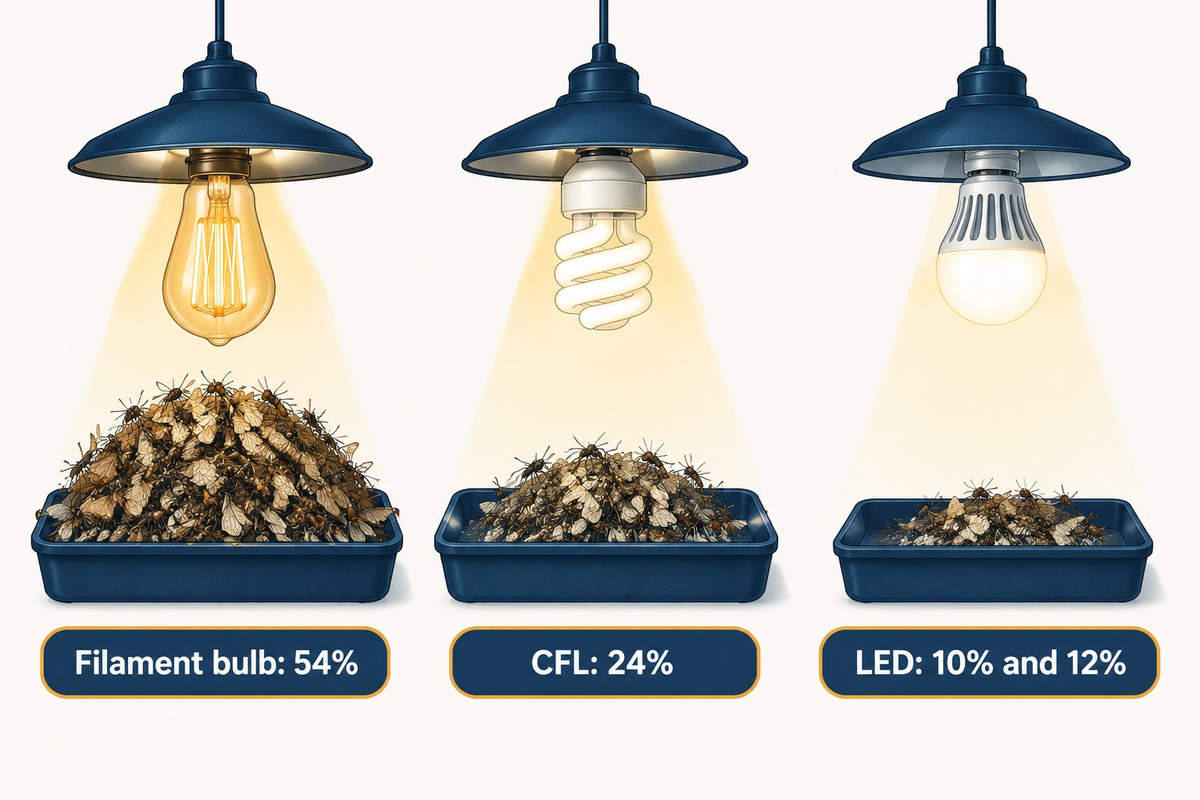
In a 2016 University of Bristol field comparison at 18 sites in southern England, LEDs drew 50% to 58% fewer insects than a CFL and 78% to 81% fewer than a tungsten filament bulb. LEDs took 10% and 12% of the evening catch, against 24% for the CFL and 54% for the filament bulb.
All four lamps gave similar light: a 100 W filament bulb at 970 lm, a 20 W CFL at 1,100 lm, a 13 W cool-white LED at 5,000 K and 1,130 lm, and a 13 W warm-white LED at 2,700 K and 1,060 lm. Each hung 1.3 m above the ground and 40 m from the next lamp. All were lit within 10 minutes of sunset on one night per site, from 15 July to 10 September 2014. Across all sites the traps held 4,086 invertebrates, 4,046 of which were insects. The study was part-funded by LED maker Integral LED; the authors state the funder did not influence their results.
Percent fewer equals 1 minus the LED share divided by the other lamp’s share. Set against the CFL, the warm-white LED gives 1 – 12 ÷ 24 = 50% fewer and the cool-white LED gives 1 – 10 ÷ 24 = 58% fewer. Against the filament bulb, the same sums give 78% (1 – 12 ÷ 54) and 81% (1 – 10 ÷ 54). Summarizing their result, the authors say LEDs caught about half as many insects as the CFL and about four times fewer than the filament bulb.
A seasonal trap experiment in Appomattox, Virginia showed smaller gaps. It alternated six A19 bulbs of 790 to 800 lm nightly from 26 April to 28 September 2014 and counted 8,887 insects and spiders. Mean nightly captures per hour were 8.18 for incandescent, 6.73 for CFL, 5.78 for halogen, 5.08 for cool-white LED and 4.47 for warm-white LED. That puts the warm-white LED 45% below incandescent and 34% below CFL, though the work is a preprint by Justice and Justice and not yet peer reviewed.
When comparing LEDs to older sodium lamps, the outcome is reversed. In a New Zealand study, Pawson and Bader (2014) reported that LED traps captured 48% more insects than traps fitted with high-pressure sodium lamps. The authors reported no evidence to suggest that adjusting the color temperature of white LEDs would minimize the impact, therefore, a city that replaces sodium with LED street lights may attract more insects to the road, not less. For the cost and performance side of that swap, see this comparison of LED against high-pressure sodium street lights.
Take a porch fixture that holds a 100 W filament bulb. Swapping in a 13 W LED of about the same brightness, 1,060 lm against 970 lm as in the Bristol lamps, matches the trial’s step from 54% of the evening catch for the filament lamp to 12% for the warm-white LED, roughly 78% fewer insects at the lamp. The fixture, the height of the mount, and the shrubs next to the door stay the same, so the difference is in the lamp and not the garden around it.
LED lights are generally less attractive to insects than incandescent or fluorescent lights. Differences in brightness can’t explain the difference in the number of bugs around lights, since the Bristol lamps provided similar light. The authors suggest the type of light: the ultraviolet (UV) light of the CFLs and possibly the heat of the filament bulb. An LED will emit less UV light than a CFL. In the amber-and-red table row, only the red band at 630 nm was tested in the Dutch traps; amber was not. In the cool-white row, the strong grade comes from the Bristol trial; in the Virginia preprint the cool-white LED did not differ significantly from the incandescent or CFL bulb.
| Lamp type | Spectrum feature | Insect evidence | Evidence strength | Source type |
|---|---|---|---|---|
| Incandescent (tungsten filament) | Broad spectrum with strong infrared heat | 54% of the evening catch; 8.18 captures per hour | Strong: two trials | Peer-reviewed trial, preprint |
| Halogen | Hot filament, similar broad spectrum | 5.78 captures per hour, between CFL and LED | Thin: one trial | Preprint |
| CFL | Mercury discharge with phosphor; UV is the likely cause of its higher catch | 24% of the evening catch; 6.73 captures per hour | Strong: two trials | Peer-reviewed trial, preprint |
| High-pressure sodium | Narrow yellow-orange output | LED traps caught 48% more insects than HPS traps | Moderate: one trial | Peer-reviewed trial |
| Cool-white LED (5,000 K) | Blue chip plus phosphor, almost no UV | 10% of the evening catch; 5.08 captures per hour | Strong: two trials | Peer-reviewed trial, preprint |
| Warm-white LED (2,700 K) | Same blue chip, lower blue share | 12% of the evening catch; 4.47 captures per hour; level with cool white in the Bristol trial (p = .928) | Strong against CFL; conflicting against cool white | Peer-reviewed trial, preprint |
| Yellow bug light | Yellow bulb sold to avoid insects | 4.56 captures per hour, level with warm LED; 0.48 earwigs per hour | Thin: one trial | Preprint |
| Amber and red LED (560 nm and longer) | Long wavelengths only | Longer wavelengths at low intensity drew the fewest insects in Dutch forest traps | Moderate: one trial | Peer-reviewed trial |
| UV LED or black light (about 380 nm) | Short-wavelength output | Moths responded mostly to ultraviolet at 382 nm; extension guidance calls UV the wavelength most attractive to insects | Strong: several trials | Peer-reviewed trials, extension guidance |
Why Bugs Are Attracted to Light: Wavelength, Heat and Navigation
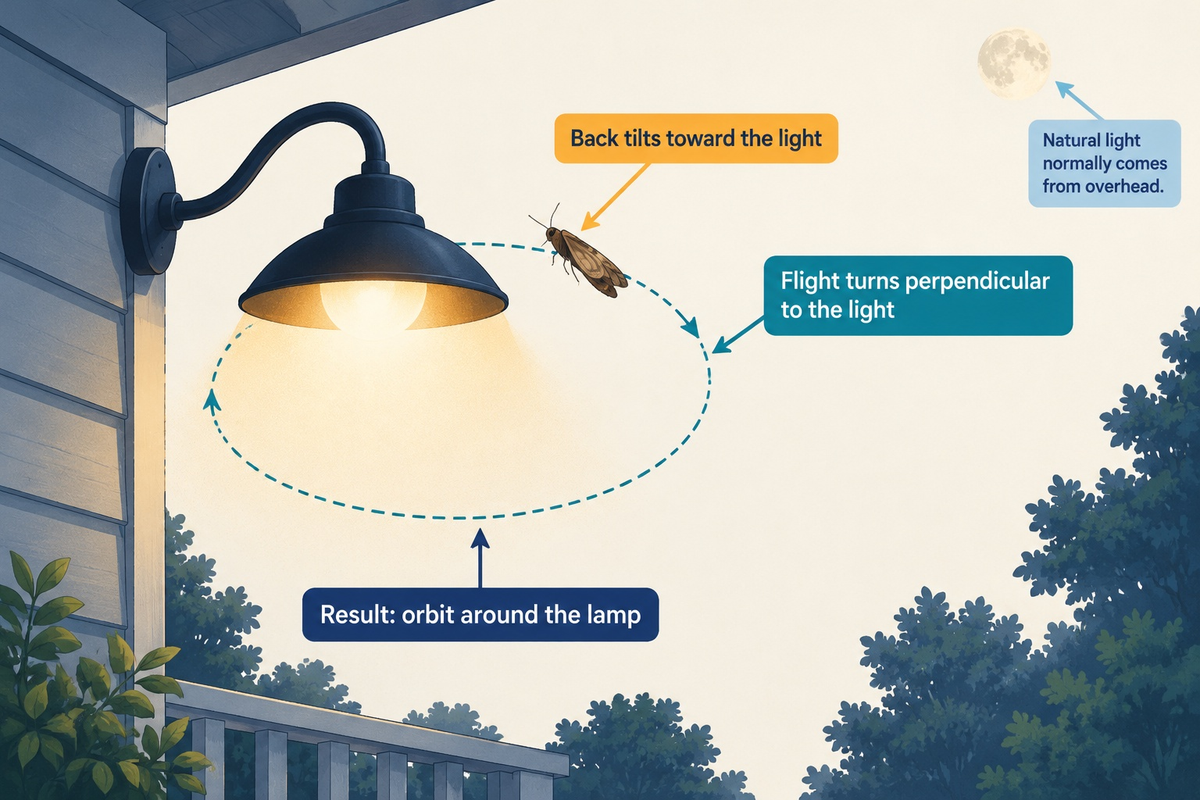
Bugs are attracted to lights because of the colors they see and the way they steer by light. Most night-flying insects see ultraviolet, blue and green best and a 2024 motion-capture study in Nature Communications found they don’t fly straight at a lamp. They tilt their backs toward it and circle.
Bugs are drawn to light partly because natural light sources, such as the sky and the moon, sit overhead, and tilting the back toward the brightest part of the sky keeps an insect level in flight. Near an artificial source the same reflex produces flight bouts perpendicular to the light and can trap the insect in orbit around it. That explains the erratic loops at a porch lamp. Therefore, attraction to light is partly a navigation error.
Insect vision peaks toward the ultraviolet, below 380 nm, though species differ. Cabbage moths (Mamestra brassicae) have visual pigments peaking at 360, 460, 540 and 580 nm, while wax moths (Galleria mellonella) peak at 510 nm, as the Bristol authors note. In Dutch forest traps with narrowband LEDs peaking at 382, 450, 514 and 630 nm, flies were strongly attracted to green and blue and moths responded mostly to ultraviolet. Stronger light drew more insects at every color. UV light is the strongest pull for moths, so outdoor lighting with any UV light tends to bring them in.
| Band | Wavelength cited | What insects do | Where the light comes from |
|---|---|---|---|
| Ultraviolet | Below 380 nm; the Dutch traps used 382 nm | Moths respond mostly to UV; a small UV share can draw a disproportionate crowd | Black lights, fluorescent and CFL lamps; white LEDs emit almost none |
| Blue | The Dutch traps used 450 nm; Lepidoptera peak near 400 nm | Flies respond strongly; moths respond to UV and blue, with a peak near 400 nm | Cool-white and daylight LEDs, blue accent LEDs |
| Green | The Dutch traps used 514 nm | Flies respond strongly in the Dutch traps; the cabbage moth has pigments at 540 and 580 nm | Green LEDs, the phosphor part of white LEDs |
| Long wavelengths | 630 nm | Red-sensitive receptors are usually absent in insects but evolved in several families | Amber and red LEDs, warm incandescent output |
Are bugs attracted to blue light?
Yes. Blue light attracts many insects: flies were strongly attracted to blue and green in Dutch forest traps, and moths responded mostly to ultraviolet. Most white LEDs pair a blue-emitting chip with a phosphor, so a cool-white lamp may attract insects even though it emits no UV.
The amount of blue light rises with color temperature, so cool-white and daylight LEDs have more of that blue share than warm-white ones, yet the 2016 trial counted similar catches at 5,000 K and 2,700 K. Blue share is a better figure to ask a supplier for than the color temperature label, but none of the trials cited here tested it as a selection rule. Wakefield’s team adds that “blue-green” light attracts various biting flies, and broad-spectrum white LEDs emit those wavelengths. How a white LED makes light explains the same design.
LED lights emit little to no UV light, which is why LEDs drew fewer bugs compared to lights that emit UV light, such as the CFL. In the end, amount of UV light matters, because even a small amount has a disproportionate pull on insects.
Heat adds a second cue for some insects. The near-infrared heat from the filament bulb may act as a thermal attractant, especially for the Culicoides biting midges, suggest the Bristol authors. As LEDs run cool, heat plays less of a role.
Some kitchens already make use of this phenomenon. A reader of a lighting retailer’s blog described blue plug-in fixtures that allegedly eliminated fruit flies from a university cafeteria. The retailer stated that such units attract flies onto a trap.
Which LED Colors Attract Fewer Bugs: Warm White, Amber and Cool White
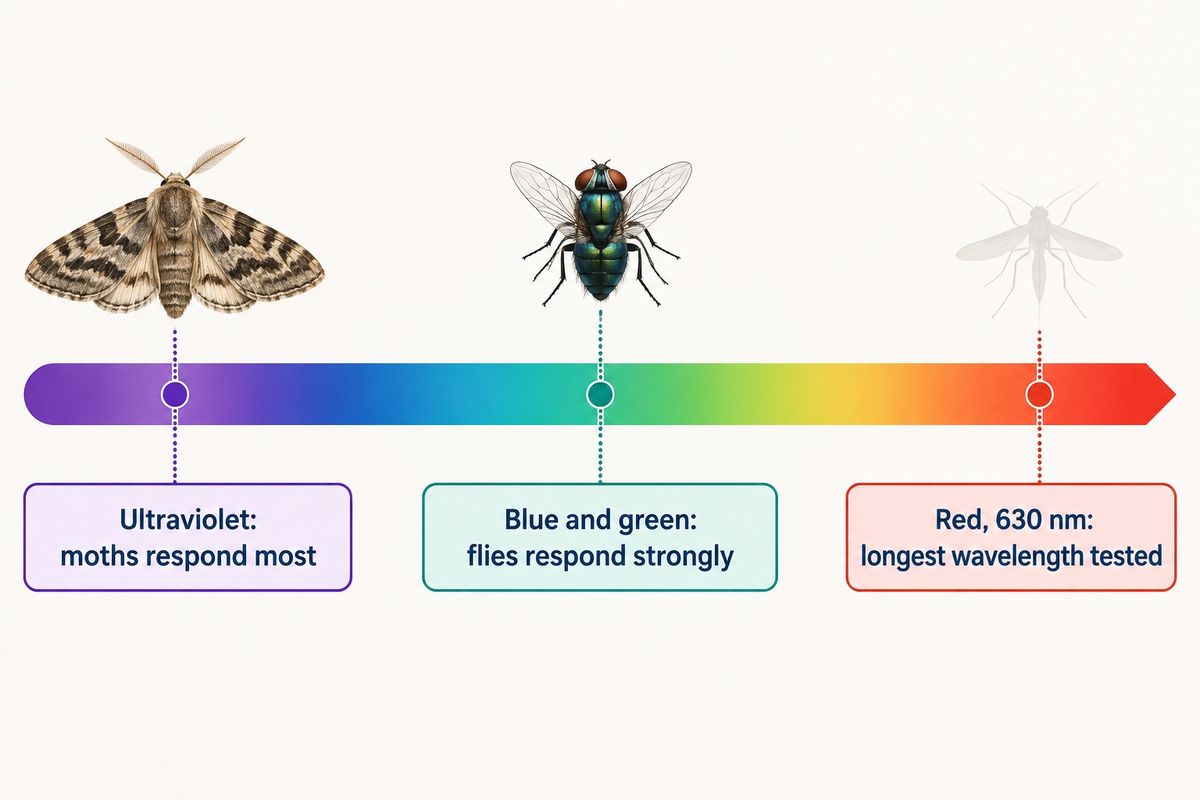
Long-wavelength light at low intensity, such as red, drew the fewest insects in the Dutch trap study, but no LED color is proven insect-proof and warm lamps can still attract bugs. A 2,700 K and a 5,000 K LED drew similar catches in the 2016 trial, so the field evidence on Kelvin values is thinner than most guides say.
“CCT is an inadequate metric to measure the emissions of a light, although it is commonly used by lighting engineers and retailers to describe lighting products.”
Different manufacturers use different approaches to obtain the same color of light (CCT), so lights with the same CCT can have different emission spectra. Below, the Colour Claim Audit grades each color claim by the field evidence behind it. Strong indicates several studies agree. Moderate indicates a single peer-reviewed trial. Thin indicates one study or guidance only. Conflicting indicates studies don’t agree. None means no trial in public sources compared that setting directly with other white lights.
| Light | What the studies measured | Evidence grade | What a buyer can conclude |
|---|---|---|---|
| UV or black light (about 380 nm) | Moths responded mostly to ultraviolet at 382 nm | Strong | Keep it away from doors and seating |
| Violet and blue (about 400 to 450 nm) | Flies responded strongly to blue; moths peak near 400 nm | Strong | Blue accent lighting can draw bugs, so skip it outdoors |
| Cool white (5,000 K and above) | 10% of the evening catch against 12% at 2,700 K, p = .928; a German street-light study reported more insects at cool white | Conflicting | Do not expect a large gain from changing 5,000 K to 2,700 K alone |
| Neutral white (4,000 K) | 4000 K white LEDs and high-pressure sodium lamps | None | Treat it as sitting between its neighbors |
| Warm white (3,000 K) | Conventional 3,000 K LED road lights drew 7.7 times the insects of an unlit control at 30.6 lx and 5.4 times at 5.6 lx | Thin | 3,000 K alone did not keep insects away; shielding did |
| Warm white (2,700 K) | 12% of the evening catch; 4.47 captures per hour, level with the yellow bug light | Strong against CFL and incandescent | A sensible default for a porch |
| Very warm (2,200 K) | DarkSky describes 1,800 to 2,200 K as very warm or amber; no field trial of a 2,200 K white LED was found | None | Ask for the spectrum chart before relying on it |
| Phosphor amber (about 1,800 to 2,000 K) | 1800 K to 2200 K appear very warm or amber | Thin | A candidate where color accuracy is not needed |
| Narrow-band amber (560 nm or longer) | Longest band in the Dutch traps was red at 630 nm; no trial of narrow-band amber was found | None | Plausible, with no field count behind it yet |
| Red (about 630 nm) | Long wavelengths at low intensity gave the lowest attraction in the Dutch traps | Moderate | Draws few insects, not none |
Kelvin is a weak proxy. Longcore and colleagues altered the spectrum of white lamps using published attraction curves for honeybees and moths, and their lamps drew fewer arthropods than commercial LED and CFL lamps of similar color temperature. Pawson and Bader found no evidence that adjusting the color temperature of white LEDs reduced their ecological impact. An extension service guide states that lights with cooler tones above 3,600 K attract more insects, and the Bristol trial which compared 2,700 K and 5,000 K, showed no such gap.
A consumer compares two bulbs, both labeled 2,700 K, and one is at half the price. Longcore’s result is the reason to look at the spectrum chart: two lamps at a similar color temperature can attract different numbers of arthropods. For 2,700 K and 3,000 K lamps, see warm white bulb color. For street lighting teams comparing 3,000 K and 4,000 K, see street light color temperature.
What color light is least likely to attract bugs?
Long-wavelength light of low intensity, e.g. red, is the least likely to attract bugs, though amber was not tested in that study. In the Dutch trap study, long-wavelength light of low intensity worked the best, and the longest wavelength was red at 630 nm. For white light, a 2,700K LED is a good choice.
DarkSky defines 1,800 to 2,200 K as very warm or amber, and its sea-turtle-sensitive category requires emitted light at wavelengths of 560 nm or longer. Amber color can be used where color accuracy isn’t critical, e.g. at a side door or on a path, and 2,700 K white can be used elsewhere. Warmer color temperatures are often described as less appealing to bugs, but the field trials above did not confirm a gap between 2,700 K and 5,000 K.
Are bugs attracted to red light?
Red light draws few insects but not none. Colors like red sit at the long-wavelength end, where red-sensitive receptors are usually absent in insects, yet red sensitivity evolved independently in several families, including certain beetles, bees, moths and butterflies. Even so, the Dutch study found that longer wavelengths at low intensity reduce attraction best.
Bug Light Bulb or Warm White LED: Which Attracts Fewer Insects
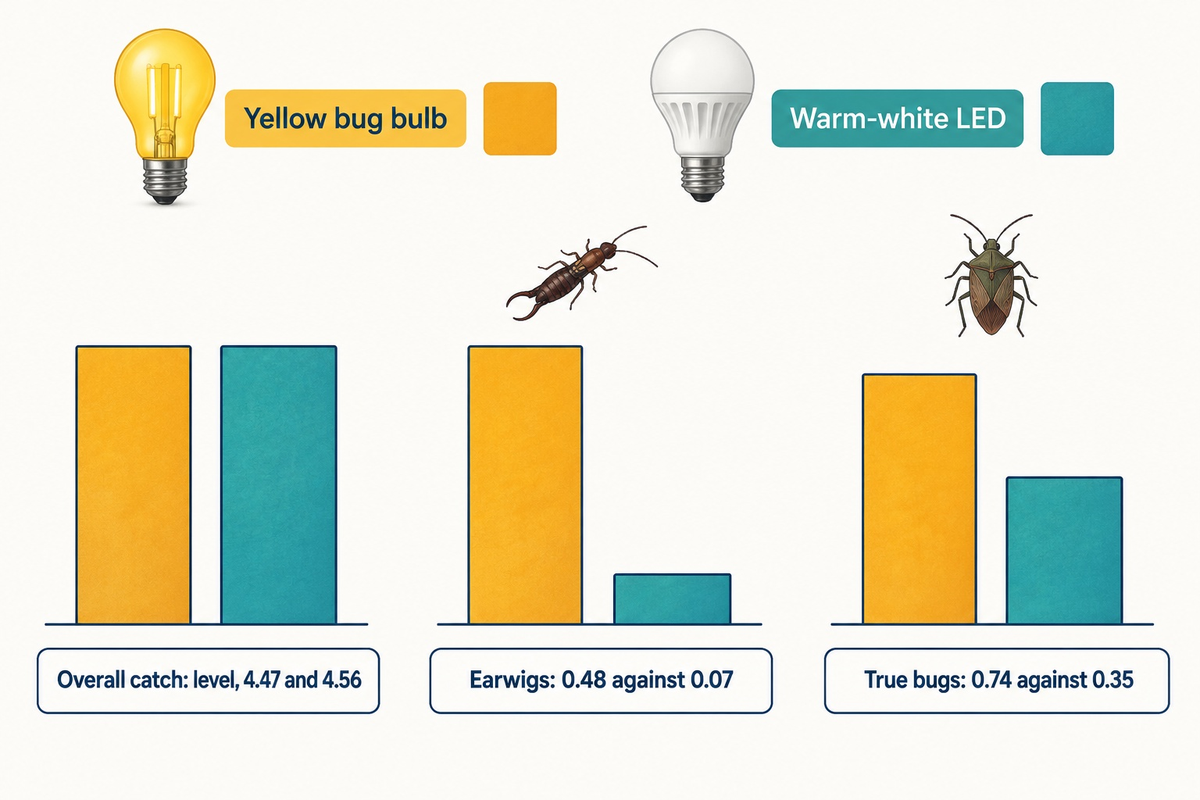
A warm-white LED attracts about the same as a yellow bug light bulb and draws fewer earwigs and true bugs. In the Virginia preprint the two ended level overall, at 4.47 and 4.56 captures per hour, while the bug light drew 0.48 earwigs per hour against 0.07 for the warm LED.
| Option | Overall and by group | Pests it still draws | Evidence |
|---|---|---|---|
| Yellow bug bulb | 4.56 overall; flies 0.75; moths 0.16 | Earwigs 0.48; true bugs 0.74 | One preprint |
| Warm-white LED | 4.47 overall; flies 1.13; moths 0.26 | Earwigs 0.07; true bugs 0.35 | Preprint and Bristol trial |
| Amber or red LED | Lowest attraction among the Dutch trap colors at low intensity | Insects with long-wavelength receptors | One peer-reviewed trial |
Both options were less attractive to bugs than an incandescent bulb and, for the different species, not equally so. Incandescent light bulbs caught the most overall, and the warm LED was the only bulb that significantly beat both the incandescent and the CFL. Yellow bulbs beat the incandescent but not the CFL. The amber-or-red row rests on the Dutch trap study, which tested red at 630 nm and no amber.
⚠️ Common mistake
Buying a yellow bulb to solve an earwig problem. In the Virginia trial the bug light drew 0.48 earwigs per hour, against 0.01 to 0.09 for every other bulb, and it can also attract true bugs: 0.74 per hour against 0.35 for the warm LED.
On mosquitoes, the American Mosquito Control Association FAQ says these bulbs don’t attract mosquitoes like other incandescent lights, but aren’t repellent either.
If a porch already holds a 2,700 K LED, a bug bulb trades one pest for another: the preprint’s hourly counts show fewer flies (0.75 against 1.13) and moths (0.16 against 0.26) than the warm LED, but more earwigs and true bugs. If a fixture still holds an incandescent or CFL bulb, opt for LED first: an LED bulb is the bigger step, since in the Bristol trial both LEDs caught significantly fewer insects than CFL and filament bulbs, while in the Virginia preprint only the warm-white LED differed significantly from them.
How to Keep Bugs Away From LED Lights: Placement, Brightness and Run Time
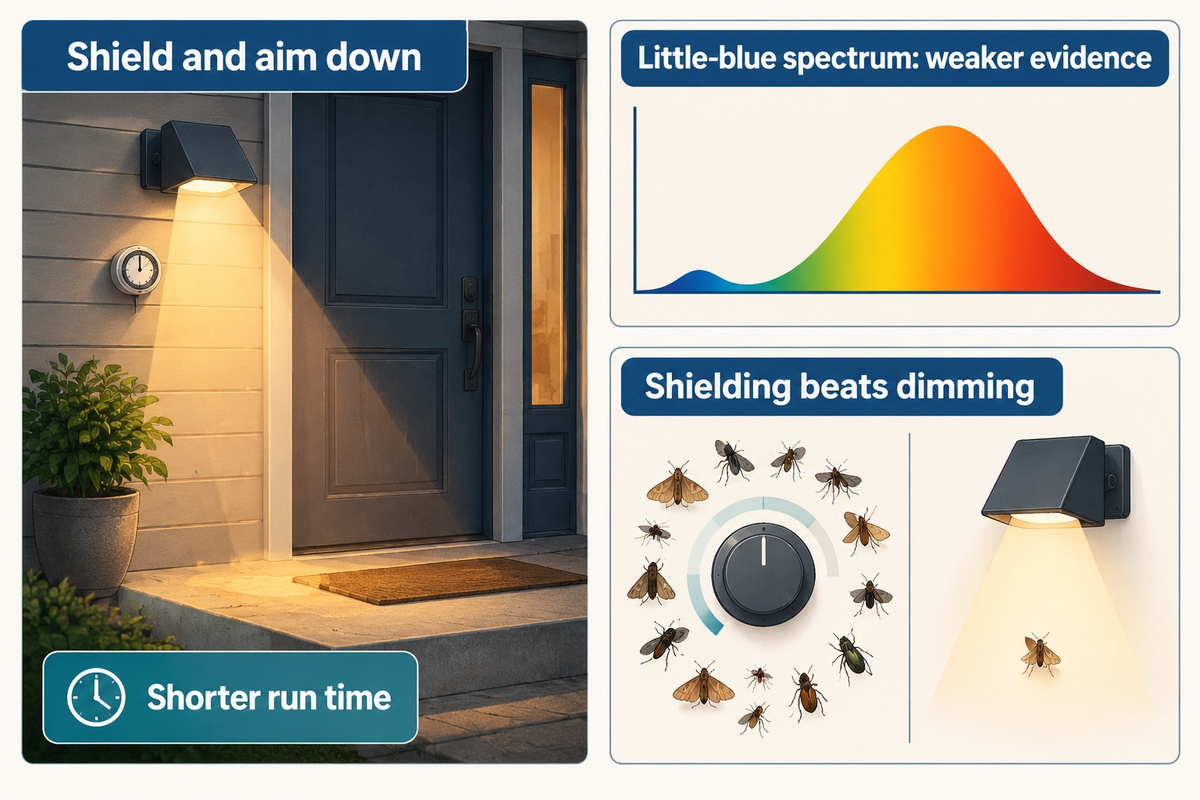
Shielding and aiming reduce insect catches more than dimming does. At a German field site, dimming conventional 3,000 K LED road lights to 18% of the original illuminance left them drawing 5.4 times the insects of an unlit control, against 7.7 times at full level. Tailored, shielded lights at 5.2 lux drew 1.3 times as many.
Dimming made no statistically significant difference (p = 0.812), while the shielded design did (p < 0.001). The Communications Biology study ran for four years on road luminaires, not household bulbs, and the tailored luminaires weren’t different from the dark controls. In contrast, many bugs gathered where the amount of light was highest in the Dutch trap study, which found stronger attraction at higher intensity for every color. Lamps and traps differed between the two, and neither studied a porch.
Shielded fixtures are less likely to attract bugs than open ones, and bugs may still gather around LED fixtures that are bright and unshielded. Keep lights away from doors and seating where you can, and send the light downward onto the task.
| Spot | Lamp | Fixture and aim | Controls |
|---|---|---|---|
| Front door | 2,700 K LED, or amber where color accuracy is not needed | Shielded and aimed down at the step | Sensor or timer; off when nobody is out |
| Patio seating | Amber or 2,700 K LED at the lowest output that works | Shielded, not visible from the yard | Dimmer set low; DarkSky asks for a 10% or lower dimming option above 500 lumens |
| Walkway | 2,700 K LED or amber | Downlight with a shield | Motion sensor |
| Work or camera zone | Cool white only if the camera needs it | Fully shielded and aimed at the task | Motion sensor and photocell |
Shielding and a shorter run time are the best-supported ways to reduce bugs around a doorway; a spectrum with little blue has less field evidence, since the white-LED trials found little difference between warm and cool lamps. Treat each outdoor space as its own zone, with its own lamp, shield, and timer.
Is it bad to leave outdoor lights on overnight?
Yes for insects: UF/IFAS Extension calls turning the light off at night the best option. Outdoor lights attract insects all night when they’re left on, so bugs at night keep circling the fixture, and frogs and lizards then gather at the door to feed on them. Where safety needs light, shield it, dim it and put it on a sensor or timer.
Motion-sensor flood lights switch or dim the beam when motion is detected. Strip, string and solar lights follow the same rules: a spectrum with little blue, a shielded position and a short run time. LED illumination that meets all three gives insects the least reason to gather. Guangqi’s light pollution solutions guide lists the same fixes of aim, shielding and operating time.
Do LED Lights Attract Spiders, Mosquitoes and Moths? What Lighting Changes
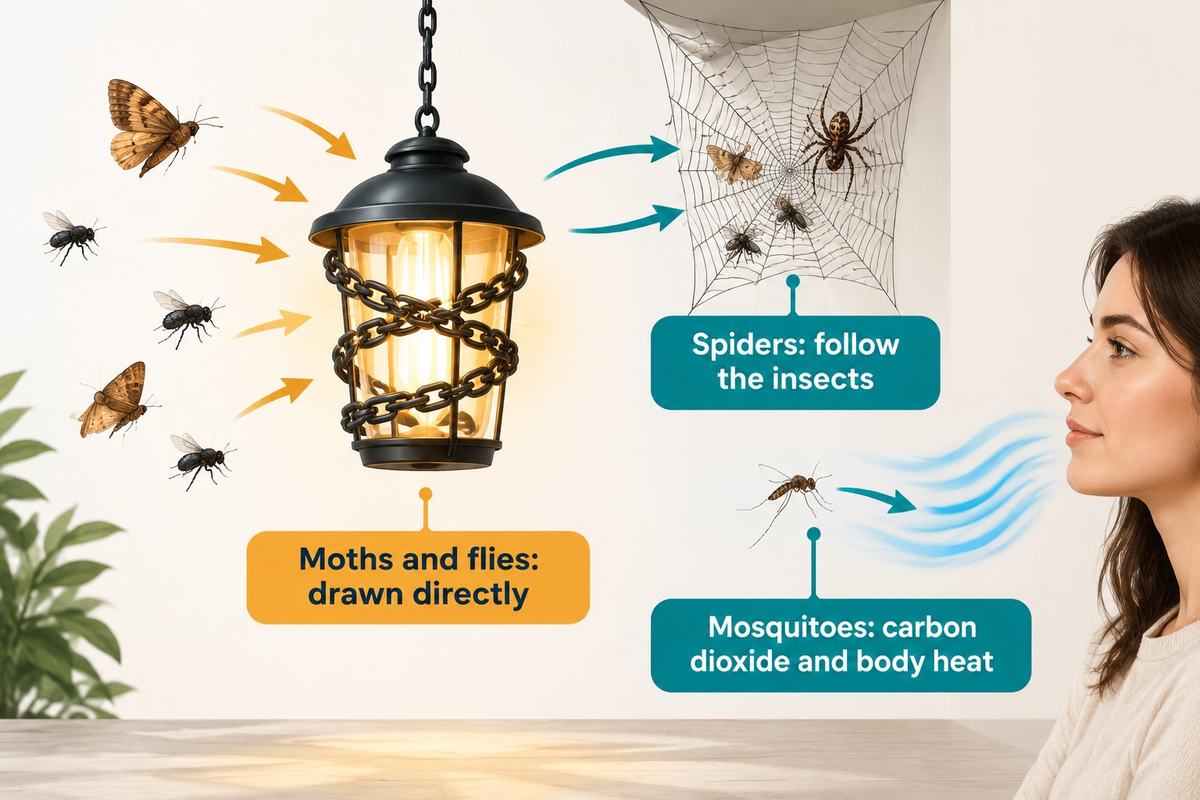
LED lights attract moths and flies directly, spiders indirectly and mosquitoes weakly. Moths are drawn mostly to ultraviolet and blue light, spiders construct webs to catch insects, and mosquitoes are drawn mainly by CO2 and body heat. A color change is of little use for mosquitoes.
Moths and flies are drawn to light as discussed previously. In the Bristol study, LEDs caught significantly fewer Lepidoptera (moths and butterflies) than CFL and filament lights. Blue and ultraviolet are known to attract moths, and Longcore’s work puts the response peak near 400 nm.
Spiders follow food, so lights that attract insects also feed the spiders. The Ohio State University Extension reports that insects are attracted to lights at night and spiders build their webs near lights that stay on. Cutting the insects at the fixture removes the reason for the web.
Lights can attract predators as well. Frogs and lizards are known to congregate at porch lights, according to UF/IFAS Sarasota County Extension. A porch light usually brings a change in the food supply, and predators soon arrive.
Mosquitoes are attracted to carbon dioxide and can detect it from as far as 35 meters away according to the American Mosquito Control Association. A review in Trends in Parasitology states carbon dioxide is the long-range cue beyond 1 meter and short-range cues include skin odors, body heat and humidity. Vision also helps them with orientation when they’re closer to their host. So, changing the color of a light bulb does little to change the number of mosquitoes around the person.
Fewer Bugs at the Lamp Is Not the Same as Less Harm to Insects
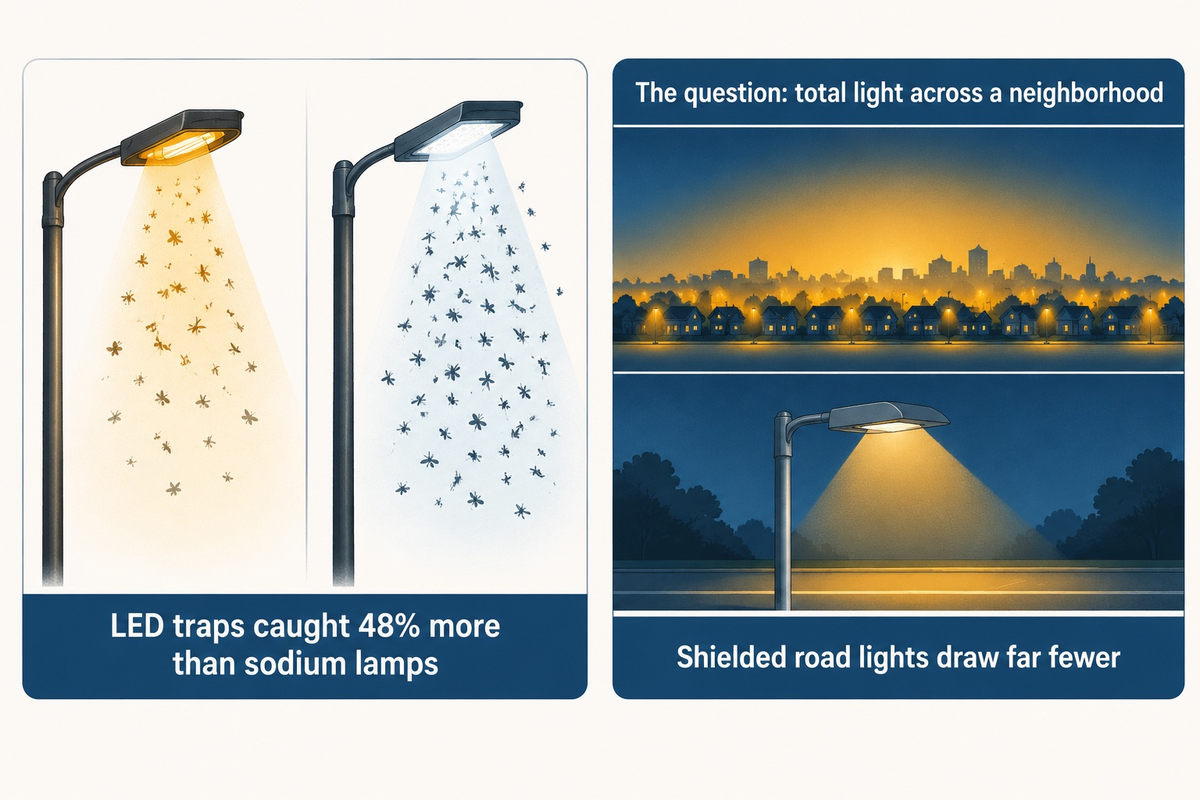
A bug-light that attracts fewer insects to your porch isn’t automatically better for insects. In New Zealand field traps, white LEDs caught 48% more insects than high-pressure sodium lamps, and the authors found no evidence that adjusting the LED’s color temperature reduced the impact. That suggests LED streetlights can attract more insects than the sodium lamps they replace, though the trial used five replicate pairs of lamps at an industrial site.
Fewer insects congregating around one light is better for your home. Ecologically the question becomes total light across a neighborhood. The authors of the study in Bristol raise the question when they discuss how as LEDs decrease in cost and become more commonplace we’ll see net increases in lighting. The review in artificial light at night and nocturnal insects by Owens and Lewis provides a framework to organize the effects beyond flight-to-light behavior into five categories.
Spatial design illuminates a pathway. Tailored and shielded road luminaires attract flying insects far less than conventional luminaires at the same illuminance on the ground, according to the 2024 Communications Biology study.
Dark-sky rules put numbers on it. DarkSky’s Approved Luminaires guidelines, version 3.1, updated October 2025, cap the light-source color temperature at a nominal 3,000 K and require products over 500 lumens to offer dimming to 10% or less of full output. Amber sources are accepted for sea turtle sensitive luminaires when readings are 560 nm or longer. LED lighting designed for dark-sky approval combines a warm spectrum, low uplight and an option to dim to 10% or less. In a 2022 LEDs Magazine article, DesignLights Consortium lighting scientist Leora Radetsky described the LUNA V1 requirements and noted that amber sources were left out because standards and performance thresholds for them were still missing.
To compare luminaires with respect to the application of the requirements, use the dark-sky checker provided by Guangqi. Although the checker is for information only, and doesn’t substitute official approval, it checks the lumens, uplight, color temperature and minimum dim level you enter against DarkSky’s commercial criteria.
Spec-Sheet Check Before You Buy: What to Ask a Supplier For
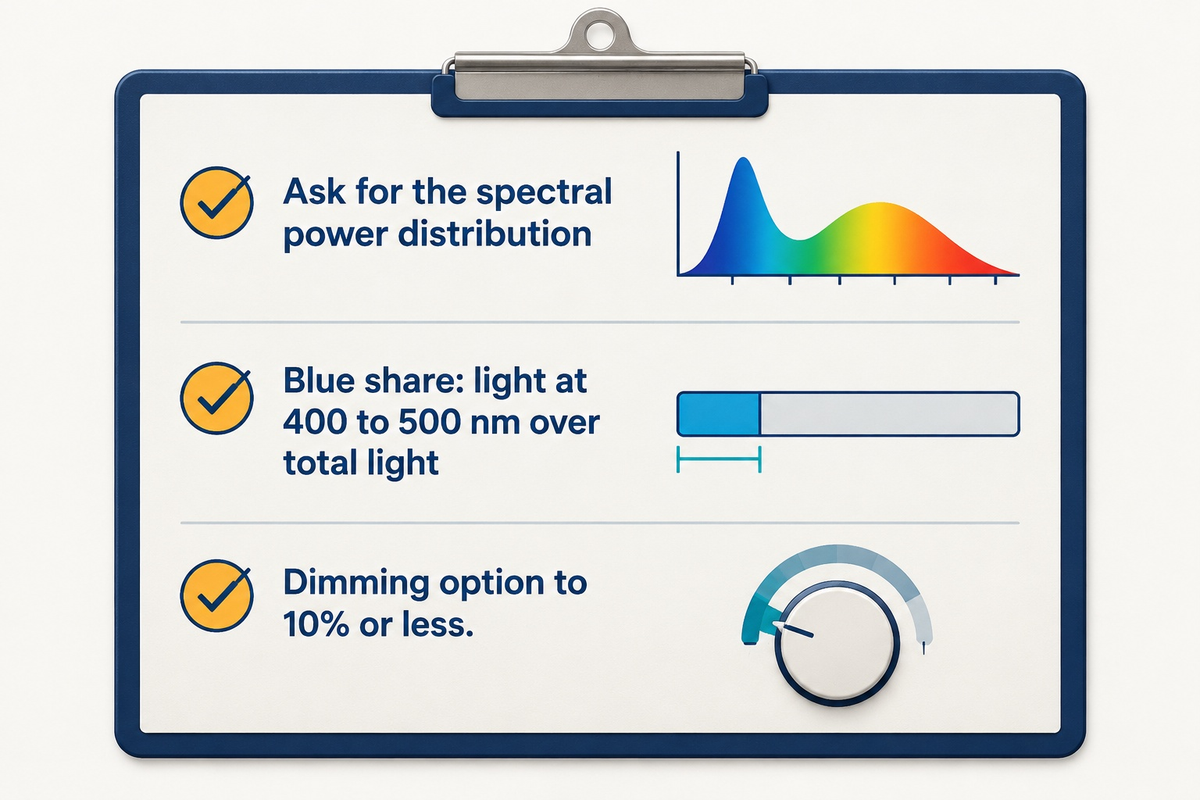
Ask the manufacturer for the spectral power distribution of the lamp. Although a lamp may be 3,000 K, it doesn’t explain how much blue is emitted. To evaluate sources, look at the amount of light a source emits at 400-500 nm, divide it by the total light output, and compare candidates based on that single number.
Blue-Share Read-Off requires only a supplier’s spectrum chart, a few minutes, and some math skills to compare sources of light using a single figure. Flies responded to blue in the Dutch trap study, and moths responded to blue as well as ultraviolet in Longcore’s work, so a 400 to 500 nm window, which spans the roughly 400 nm moth peak and the 450 nm blue band, is a reasonable band to count. Longcore and his colleagues showed that tuned white-lamp spectra attracted fewer arthropods than commercial lamps of similar color temperature, so the spectrum not the label is the number to ask for. The tuned lamps were prototypes made by Philips, and one of the study’s authors works for Philips.
Assumed inputs, round numbers for illustration and not a measurement: lamp A, labeled 2,700 K, puts 24 of every 100 radiant units between 400 and 500 nm. Lamp B, also rated 2,700 K, puts 14. The blue share of A is 24/100 = 24%, and blue share of B is 14/100 = 14%. So, lamp B carries 10 fewer points of blue-band output, and makes 58% of lamp A’s (14/24).
RFQ checklist, copy these into your quote request:
| Parameter | Recommended range | Why it matters | How to verify |
|---|---|---|---|
| Color temperature | Nominal 3,000 K or lower; 2,200 K or lower for amber | DarkSky caps nominal CCT at 3,000 K, yet two lamps at one CCT can differ in blue content | CCT line on the datasheet |
| Spectral power distribution | Chart or table, about 380 to 780 nm, for the shipped model | Lets you compute blue share; CCT cannot | Test report with spectral data for the exact model |
| Blue share, 400 to 500 nm | Report it for each candidate and pick the lower | Moths and flies respond in this band | Read-Off on the spectral data |
| Ultraviolet output | Little or no output below 400 nm | UV draws moths most strongly | Spectral data that reach below 400 nm |
| Dimming | Option to dim to 10% or less of full output | DarkSky requires it for products over 500 lumens | Driver and fixture datasheet |
| Shielding and aim | Fully shielded or a shield option, aimed down | Shielded luminaires drew 1.3 times an unlit control; open ones 5.4 to 7.7 times | Photometric file and mounting drawing |
| Controls | Sensor, timer or dusk-to-dawn photocell | Fewer hours lit means fewer insect visits | Control specification |
| Ingress protection | IP65 or IP66 for outdoor fixtures | Dust and water protection for the installation | Datasheet; see the IP rating guide |
See if the data originate in an LM-79 report: the U.S. Department of Energy lists ANSI/IES LM-79 among its standard test methods as the approved method for optical and electrical measurements of solid-state lighting products.
If the sheet contains no spectral chart, request for a spectral chart. If the supplier can’t provide one, the Kelvin value is the only evidence in hand, and the choice will rest on shielding, dimming and control above. Retail bug bulbs are easy to find; for projects, the requests above are more important than the brand on the box.
Guangqi Lighting’s LED flood light range shows the kind of headline specs to compare: the GQ-FL100 lists 100 W, 14,500 lm, 60°, 90° or 120° beams, IP66 and 100–277 V AC input, and the GQ-FL50 lists 50 W, 6,500 lm, a 120° beam and IP65. Standard models list 3000 K, 4000 K and 5000 K, while its outdoor LED flood lights page lists custom color temperature among the engineering options and recommends 5,000 K to 6,500 K for camera contrast at security sites. Neither page presents a model as designed to attract fewer insects, and the headline specs do not include a spectrum chart, so treat the warm option as something to confirm: send the checklist with your project brief and ask whether warm (2700K or 3000K) or amber LED options are available, with their spectrum charts, in the same quote. For street projects, the CCT selection guide sets out the 3,000 K and 4,000 K choices.
Frequently Asked Questions
Q: Do LED lights attract spiders?
Not directly, but spiders gather where lights draw their food. Ohio State University Extension says insects come to lights at night and spiders build webs near lights that stay on.
Fewer insects at the fixture, through shielding, a shorter run time and a long-wavelength lamp, leave spiders less to catch.
Q: What color are spiders attracted to?
Spiders follow food, not color: webs go up where flying insects arrive. Ultraviolet and blue, the colors that draw insects most, bring spiders indirectly. In this chain the insects are the draw and the spiders are the consequence, so the lamp you choose matters through the insect supply.
Lamps with little blue leave spiders less to catch, and wiping the webs near the door removes what you can see.
Q: Can LED lights repel mosquitoes?
No. LED lights don’t repel mosquitoes, and a lamp isn’t what leads them to people.
Carbon dioxide draws mosquitoes from up to 35 meters, according to the American Mosquito Control Association, and skin odors and heat take over closer in. A yellow bug light attracts mosquitoes less than other incandescent lights, but it repels nothing.
Q: Are moths attracted to LED lights?
Yes, mainly through ultraviolet and blue output. In the Bristol trial, LEDs caught significantly fewer Lepidoptera, the moth and butterfly order, than CFL and filament lights.
A lamp with little UV and blue draws fewer.
Q: Do LED strip lights attract bugs?
Yes, mostly when they’re bright and left on. LED strips follow the same rules as any LED lamp: insects respond to the spectrum, the brightness and the hours of operation.
A strip dimmed low and switched off when nobody is outside gives insects less reason to gather. A bright strip running all night gives them the most. Choose strips by their spectrum chart, and place them where they don’t shine into open air.
Q: Do motion sensor flood lights help reduce bugs?
Yes, because they shorten the hours insects meet the light.
A sensor switches or dims the beam when motion is detected, and UF/IFAS Extension calls turning outdoor lights off at night the best way to cut insect visits.
Q: Can I reduce bugs without sacrificing security lighting?
Yes: keep the light where security needs it and nowhere else.
Use a fully shielded fixture aimed at the area to watch, a sensor or timer, and the lowest output the camera or guard needs. In the German field test, tailored, shielded luminaires drew 1.3 times the insects of an unlit control, against 5.4 to 7.7 times for conventional LED road lights. Cool white stays an option where the camera needs the contrast, as long as the lamp is shielded and on a sensor.
Q: Do fairy lights and string lights attract bugs?
Yes, as much as the spectrum and the hours allow. A string of small LEDs follows the same rules as any LED lamp.
Lower output and shorter hours mean fewer insects, so a string on a timer should draw fewer than one left on overnight.
About This Analysis
Zhongshan Guangqi Lighting Co. Ltd prepared this guide from the field studies listed under References and from its own outdoor LED flood-light pages.
References & Sources
- Wakefield A, Broyles M, et al. Experimentally comparing the attractiveness of domestic lights to insects. Ecology and Evolution, 2016
- Justice MJ, Justice TC. Insect attraction to the six major types of traditional-style, residential light bulbs (bioRxiv preprint)
- Pawson SM, Bader MK-F. LED lighting increases the ecological impact of light pollution irrespective of color temperature. Ecological Applications, 2014
- Longcore T, et al. Tuning the white light spectrum of light emitting diode lamps to reduce attraction of nocturnal arthropods. Philosophical Transactions of the Royal Society B, 2015
- Fabian ST, et al. Why flying insects gather at artificial light. Nature Communications, 2024
- Dietenberger M, et al. Reducing the fatal attraction of nocturnal insects using tailored and shielded road lights. Communications Biology, 2024
- Charvalakis GA, et al. Intensity and colour of artificial light at night affect insect attraction in a taxon-dependent manner. Insect Conservation and Diversity, 2025
- Wang L-Y, et al. Insect visual sensitivity to long wavelengths enhances colour contrast of insects against vegetation. Scientific Reports, 2022
- Owens ACS, Lewis SM. The impact of artificial light at night on nocturnal insects: A review and synthesis. Ecology and Evolution, 2018
- Coutinho-Abreu IV, Riffell JA, Akbari OS. Human attractive cues and mosquito host-seeking behavior. Trends in Parasitology
- American Mosquito Control Association. Frequently asked questions
- UF/IFAS Sarasota County Extension. Shining a Spotlight on Exterior Lighting, 2023
- Ohio State University Extension, BYGL. Spiders and Lights: What’s the Connection
- DarkSky International. DarkSky Approved Luminaires Guidelines, version 3.1, October 2025
- Radetsky L. LUNA requirements look to balance ecosystem and human needs in practice. LEDs Magazine, 2022
- U.S. Department of Energy. Solid-state lighting metrics and test methods