Get in Touch with GUANGQI



Types of light switches can be grouped based on circuit type (single-pole, double-pole, three-way, four-way), operating style (toggle, rocker, push-button, slide or rotary) and type of added control (dimmer, sensor, timer, smart). The type of circuit determines what can be substituted. The style and type of added control determines the feel of the switch and its requirements from the wall box.
A light switch is a humble light switch only until it fails to match the lamp. The selection of light switches on the market is fairly large. Among the various types of switches, the toggle light designs along with rocker switches are the most popular designs. A push button switch is rare and a few of them are sold with outlets and switches in the same faceplate.
Choosing the right light switch means matching the kind of switch to the circuit first. The light switch design comes second. Light switch types differ in how they’re built, and the types of electrical switches used for lighting are a small part of that family.
Updated October 2026.
Types of Light Switches at a Glance
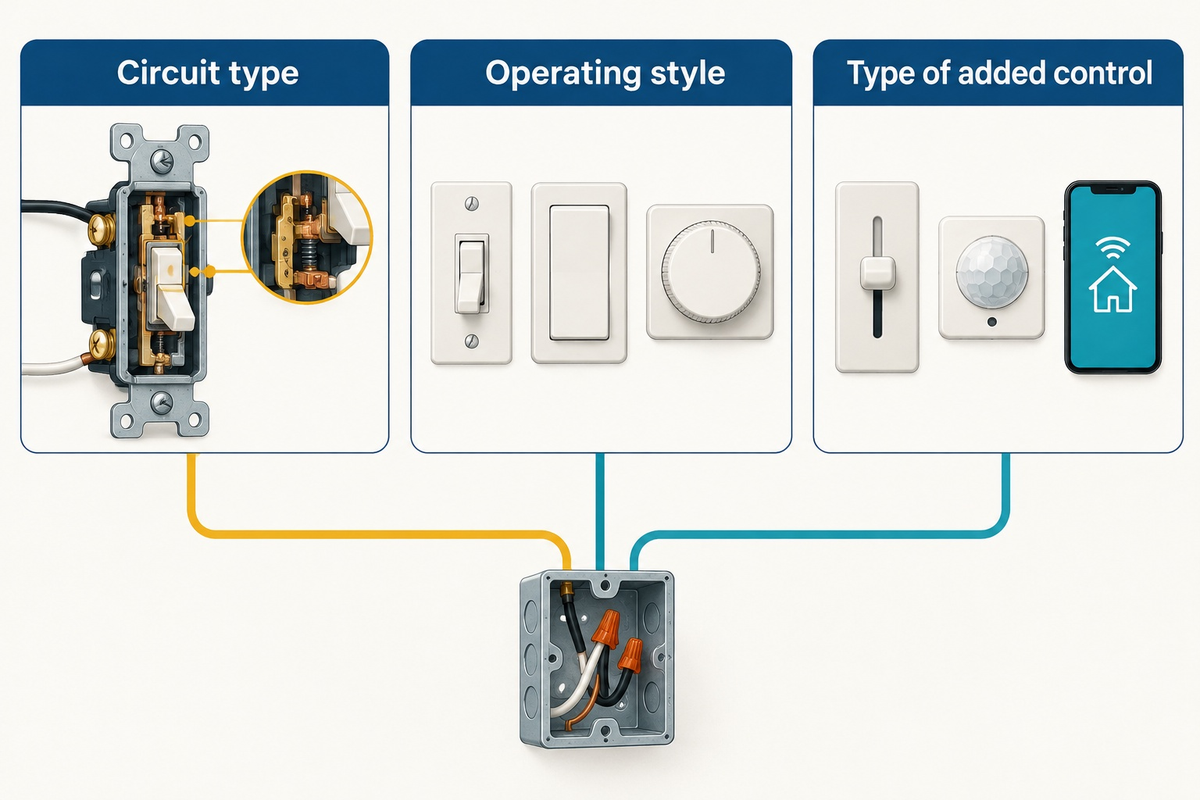
A light switch is a device that opens or closes a path for current to the lamp. Inside, a movable contact either touches a fixed terminal or doesn’t. A Northwestern University mechatronics page describes the vocabulary: a switch with a single throw has two terminals that are connected only when the switch is operated, and a double throw adds a terminal for each pole. Everything else, from a dimmer to a smart switch, adds electronics around that basic contact. A single light on one switch needs only the simplest type. A single-pole switch handles one light from one location, so it can control a light from a single wall box. One kind of switch controls two live conductors at once, and another lets a second switch control a light from two locations. Other devices adjust the brightness of a light, and some turn the light on and off without being touched.
The table below is a Wall-Box Switch Finder, covering the various types of light switches found in homes. Read down the first column until you find your situation, and then read across the last column to see what’s recommended before purchasing. Screw counts are standard for a mechanical switch, and the green ground screw is excluded. Always follow the diagram printed on the device that’s being installed.
| Situation | Switch type | Typical screws | Operating style | Check before you buy |
|---|---|---|---|---|
| One light, one place | Single-pole | 2 | Toggle or rocker | Current rating against the lamp load |
| One light, two places | Three-way (a pair) | 3 (one common, two travelers) | Toggle or rocker | Which screw is the common |
| One light, three or more places | Two three-way switches with a four-way between them | 4 on the four-way | Toggle or rocker | One four-way per extra place |
| Two live conductors switched at once | Double-pole | 4 | Toggle | Circuit voltage and rating |
| Adjustable brightness | Dimmer, single-pole or three-way | Per maker diagram | Rotary, slide, tap | LED rating and compatibility list |
| Lights should switch off on their own | Occupancy or vacancy sensor switch | Line, load, ground; a neutral on many models | Automatic | Line of sight and local code |
| Light on a fixed run time | Timer switch | Per maker diagram | Countdown or digital | Load type it is rated for |
| App or voice control | Smart switch | Line, load, ground, usually neutral | Rocker plus app | Neutral wire and protocol |
| Switch and socket in one box | Combination device | Per maker diagram | Toggle or rocker | Box size and faceplate |
| Switch in a wet or outdoor spot | Weatherproof switch or cover | Same as the indoor type | Toggle or rocker | Rating for wet locations |
Of all the different types of light switches, two of the rows above hide most buying mistakes. A dimmer or sensor switch must be matched to the lamps it controls, and that’s discussed in the dimming section. A three-way switch must be matched to the circuit it replaces, and that’s covered in the multi-location section.
Single-Pole, Double-Pole and What Pole and Throw Mean
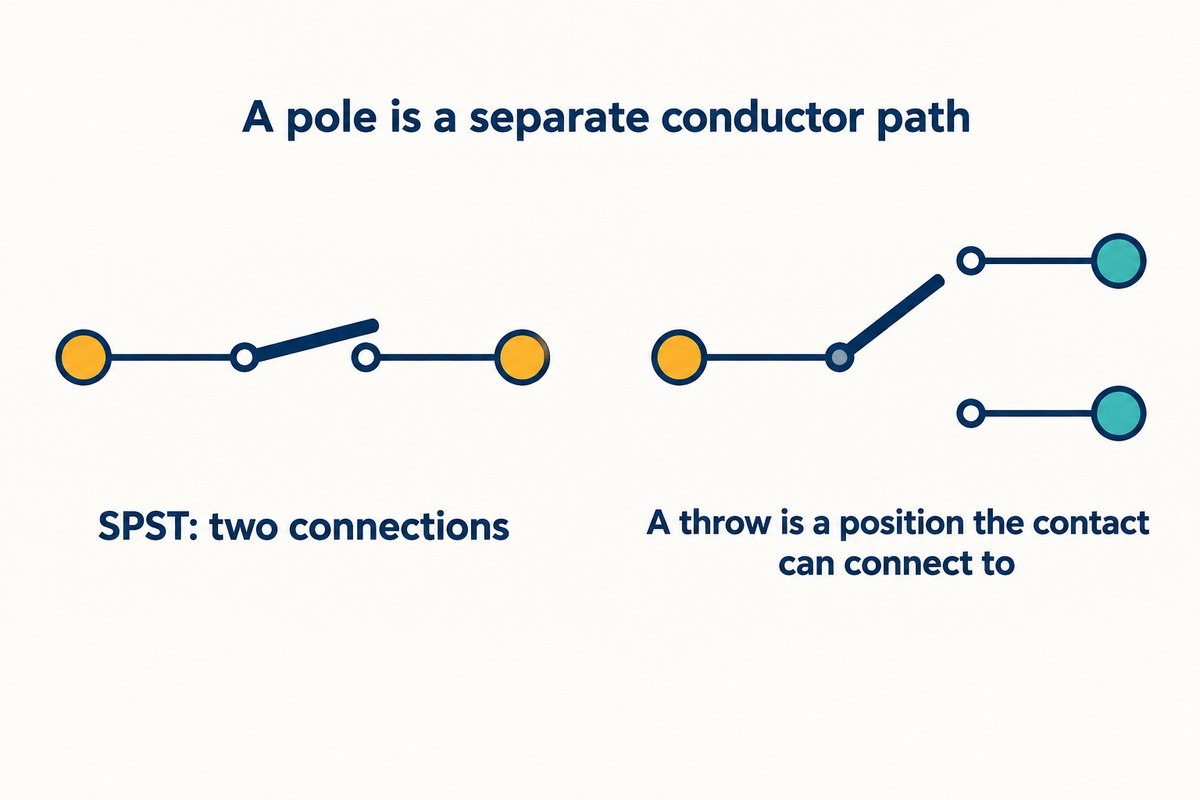
A pole is a separate conductor path through the switch, and a throw is a position the contact can connect to. A single-pole switch has one path and two connections; a double-pole switch has two paths and switches both live conductors together.
A University of Texas at Austin embedded-systems textbook states that a single pole single throw (SPST) switch has two connections. Adding a throw gives each pole a second place to connect, and adding a pole doubles the paths. Counting contacts this way gives the decoder below. The counts exclude the ground screw that a wall switch also carries.
| Label | Plain meaning | Contact connections | Usual wall use |
|---|---|---|---|
| SPST | One pole, one throw | 2 | Single-pole switch |
| SPDT | One pole, two throws | 3 | Three-way switch |
| DPST | Two poles, one throw | 4 | Double-pole switch |
| DPDT | Two poles, two throws | 6 | Four-way switch (four terminals, wired as a reversing pair) |
For a lighting circuit choose single-pole; choose double-pole when both the live conductors must be broken. Most homes use single-pole switches for ordinary rooms. A double pole switch earns its place when both the live conductors must be broken, such as a 240 V load; a lighting circuit rarely needs a double pole switch.
Does It Matter If You Use L1 or L2 on a Light Switch?
In a two screw, single pole switch, the screws are usually not marked line and load, so either wire can be connected to either screw. However, in a dimmer, sensor or smart switch, the markings are important and the wires have to be connected accordingly.
Devices with electronics need a defined line side to power their circuit. Reversing the wires on a marked device can render it dead or unreliable. Always read the label.
Three-Way and Four-Way Switches for Controlling One Light from Several Places
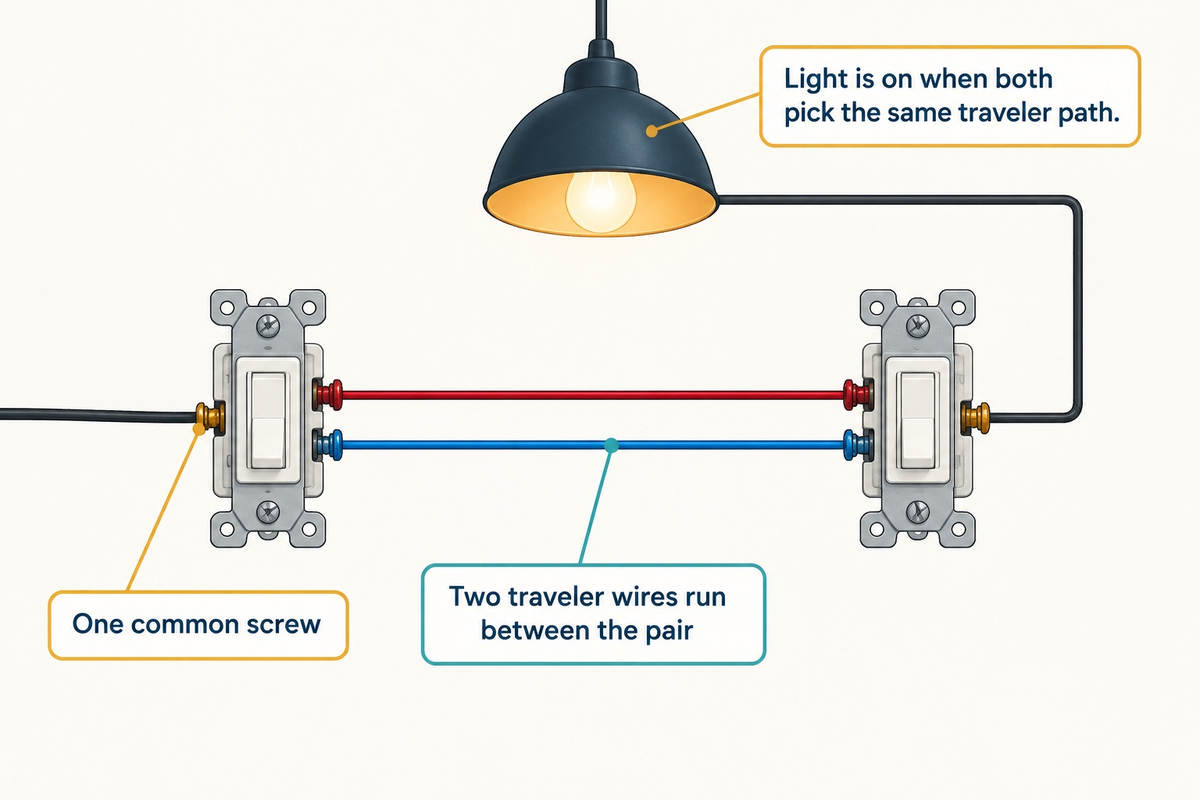
A three-way switch lets two switches control one light from two different locations, such as at the top and bottom of a staircase. In electrical engineering terms the pair forms one electrical circuit with two switching points. The electrical wiring and the electrical system of a house decide which type is already behind the wall. Each type of switch has its own wiring, and a three-way switch allows control from either end. A four-way switch is placed in between two three-way switches to allow control of a single light from three or more places.
The National Electrical Code requires that three-way and four-way switches are wired so that all the switching is done on the ungrounded circuit conductor, according to an EC&M summary of Section 404.2(A). Local adoption of the Code varies, so treat this as the model rule that most inspectors start from.
How Do 3 Way Light Switches Work?
Flipping a three-way switch moves the current from one of two traveler wires to the other, and the light is on only when the two switches are set to select the same traveler path. Each switch has one common screw and two traveler screws, and two traveler wires run between the pair.
Because the state of the light is controlled by both switches, a three-way switch has no defined on or off state. Therefore, a three-way switch is usually printed without ON or OFF on the lever. Swapping a single-pole switch into a three-way circuit may power the light from one switch position only. For the colours of the wires, see our guide to wire colour codes.
How Can You Tell Whether a Switch Is Single-Pole, Three-Way or Four-Way?
One place with two screws is a single-pole switch, two places with three screws is a three-way switch, and three or more places with a four-screw switch in the middle is a four-way switch. To identify a switch, use the Three-Count Switch ID: count the places that control the light, count the screws, and then read the markings.
The third count, the markings, settles doubtful cases, because a three-way switch usually has a darker or labelled common screw.
| Count 1: places | Count 2: screws | Count 3: markings | Switch type |
|---|---|---|---|
| 1 | 2 | ON and OFF printed | Single-pole |
| 2 | 3 | Common screw labelled or darker | Three-way |
| 3 or more | 4 on the middle switches | Two pairs of screws | Four-way |
| 1 (two live conductors) | 4 | Often a two-pole label | Double-pole |
Three switches on one light don’t mean three four-way switches. The two end switches are three-way and only the switches in between are four-way. A This Old House electrician identifies a common wiring mistake where the common wire and a traveler wire were swapped, which makes a three-way circuit work from one switch only.
Toggle, Rocker, Push-Button and Other Switch Styles
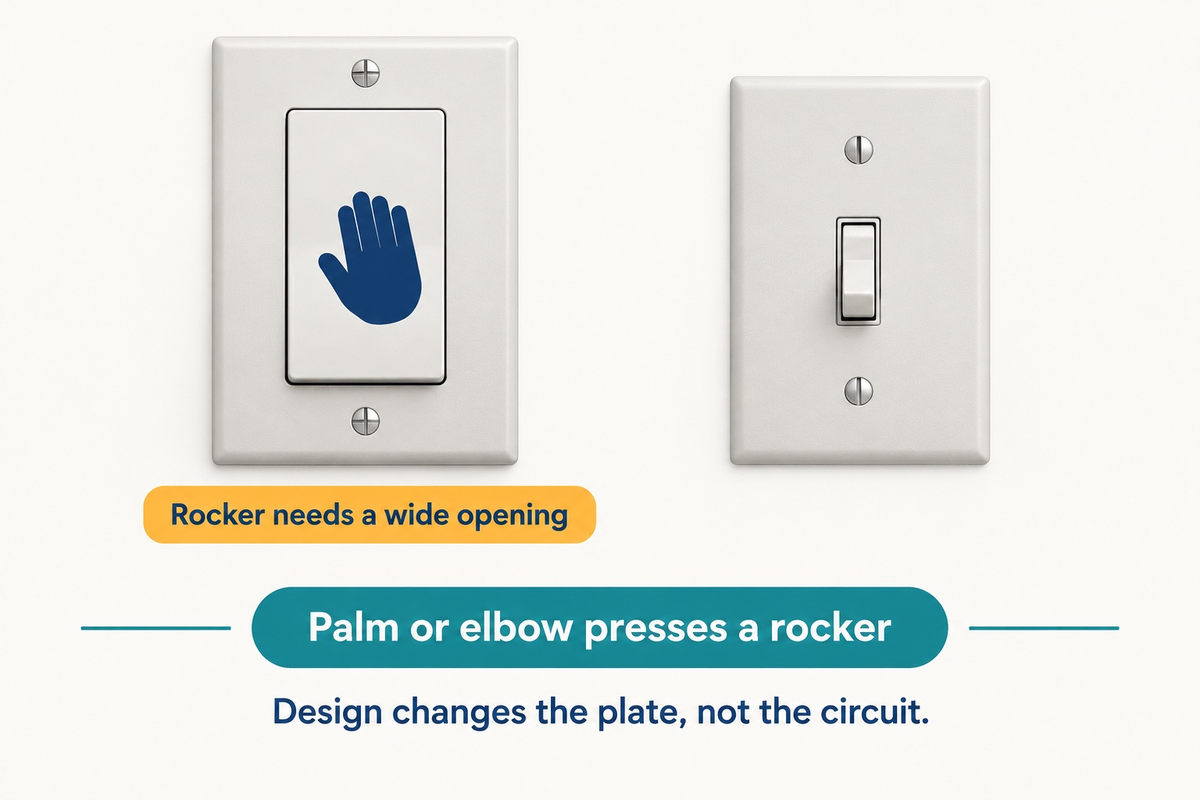
Style differences change how a switch looks and feels but not what it does in a circuit. Switches come in various styles, and a rocker rocks back and forth on a pivot while a toggle flips. The cover that encloses either one is also different. Interior design does affect the finish of that plate but not the circuit. Toggle light switches, rocker switches and a push button switch can all be made as single-pole or three-way switches.
| Style | How it operates | Faceplate | Note |
|---|---|---|---|
| Toggle | Small lever flips up or down | Narrow slot | Clear on or off position |
| Rocker (Decora style) | Wide flat paddle rocks | Large rectangular opening | Easy to press with a palm |
| Push-button | Plunger presses in and latches | Round or square | Often found in older homes |
| Rotary | Knob turns to set brightness | Round knob | Dimmers only |
| Slide | Slider moves along a track | Long slot | Dimmers only |
| Pull cord | Cord is pulled to toggle | Ceiling mount | Common in bathrooms in some regions |
Which Is Better, a Toggle or a Rocker Switch?
Neither is better electrically. A toggle gives a clear on or off position and fits a narrow faceplate; a rocker has a larger pressing surface and is easier to use with a palm or elbow.
The faceplate is the practical limit: a rocker needs a wide opening, a toggle a narrow slot, so swapping styles means changing the plate. The US Access Board lists light switches among operable parts that must work without tight grasping, pinching or twisting of the wrist and with no more than 5 pounds of force in accessible spaces, which favours a large rocker where those rules apply. That rule covers accessible spaces and routes, not every private home.
Dimmer Switches and Which Ones Work with LED Bulbs
Among the different types of switches, dimmers are the ones that set brightness. Dimmer switches allow a range of light levels, and an LED-rated dimmer works with LED bulbs only when the bulbs are marked dimmable and the dimmer’s load limits and compatibility list include them. The ENERGY STAR program says not every LED light works well with every dimmer switch and advises checking the dimmer maker’s list of recommended bulbs.
| Dimmer type | How you adjust it | What to check |
|---|---|---|
| Rotary | Turn a knob | LED rating and lamp count |
| Slide | Move a slider, often with a separate switch | LED rating and lamp count |
| Tap or touch | Tap for on and off, slide or press for level | Minimum load |
| Smart dimmer | App, voice or paddle | Neutral wire and protocol |
| Phase-cut wall dimmer | Cuts part of each mains cycle | Forward or reverse phase fit for the driver |
| 0-10 V controller | Low-voltage signal to the driver | Driver must have a 0-10 V dimming input |
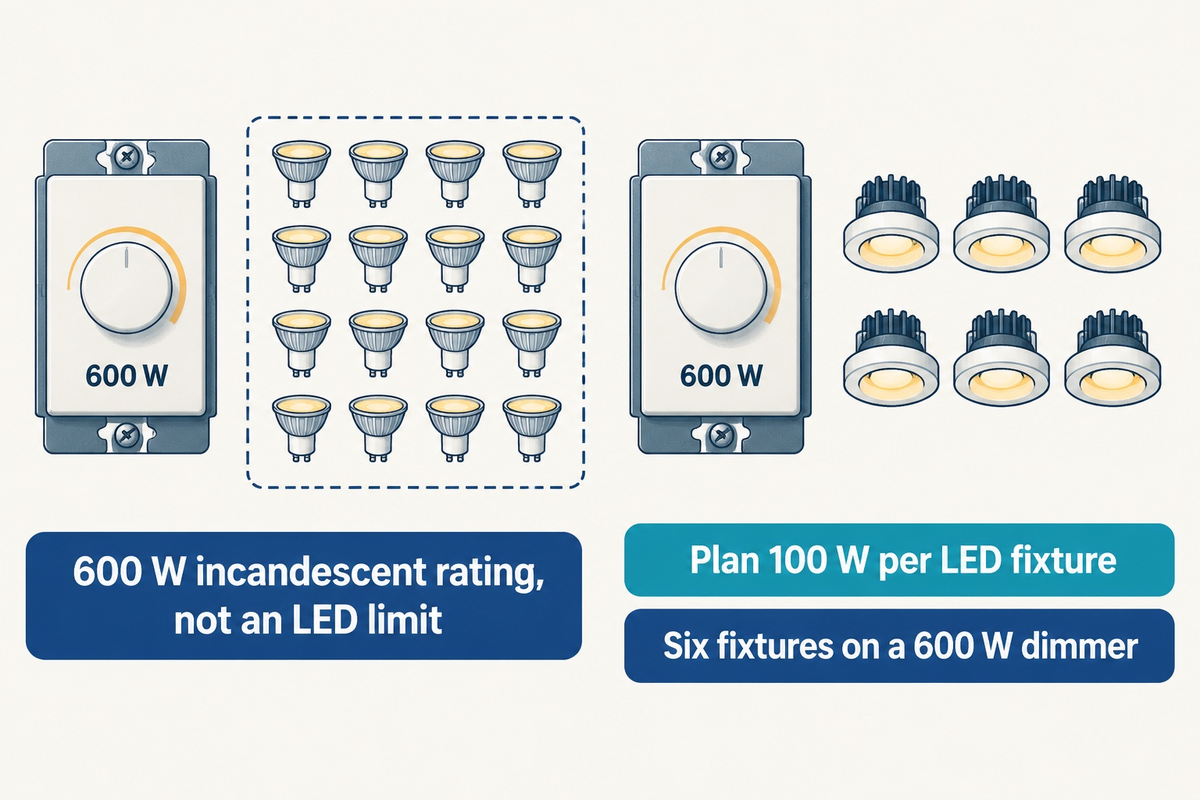
The load limit is where most buying mistakes occur. One dimmer maker’s load sheet states that the watt and volt-ampere ratings on many of its products are based on incandescent and halogen lamps and don’t apply to LED and CFL loads; for LEDs the limit is a number of lamps that depends on the lamp model and the dimmer. The same sheet gives an example: a dimmer with a 600 W incandescent rating appears to allow 60 lamps of 10 W, but that 600 W figure doesn’t apply to LED lamps, so the real maximum needs testing.
A lighting applications engineer at Lighting Services Inc suggests a planning rule for inrush current: allow 100 W for each LED fixture, so a 600 W dimmer handles six fixtures. That’s an industry rule of thumb from one source, not a standard or a product rating. Treat it as a cautious starting point and replace it with the maker’s lamp-count table when one exists.
| LED lamp | Naive count (600 W ÷ lamp watts) | Planning count at 100 W per fixture | What decides the real limit |
|---|---|---|---|
| 10 W PAR30 | 60 | 6 | Maker test of that lamp on that dimmer |
| 25 W fixture | 24 | 6 | Inrush current of the driver |
The inputs are the 600 W incandescent rating, the lamp wattages and the 100 W planning allowance given above. The result is a count of lamps, not a watt limit: ten 5 W lamps on that dimmer total only 50 W, but the maker’s tested lamp count still decides how many fit.
Too few lamps cause the opposite problem. The same load sheet lists glow when off, flashing when off, a reduced dimming range, intermittent operation and flicker as problems an insufficient minimum load may cause. The US Department of Energy adds that the current waveform delivered to an LED depends on the driver loading, the dimming level and the waveform the dimmer delivers to the driver, which is why the same lamp can flicker on one dimmer and not another. Our guides to why LED bulbs flicker and to the LED driver go deeper on the causes.
A standard exists for the phase-cut case. NEMA SSL 7A-2015 (R2021) provides compatibility requirements for phase-cut dimming for LED light engines and is suitable for global use. California’s 2025 residential lighting guidance goes further and says forward phase cut dimmers controlling LEDs must comply with NEMA SSL 7A in newly constructed single-family buildings. When the luminaire’s driver takes a low-voltage signal instead, the wall control is a different device; read our guide to the 0-10 V dimmer and to DALI lighting control.
Occupancy, Vacancy, Timer and Daylight Switches
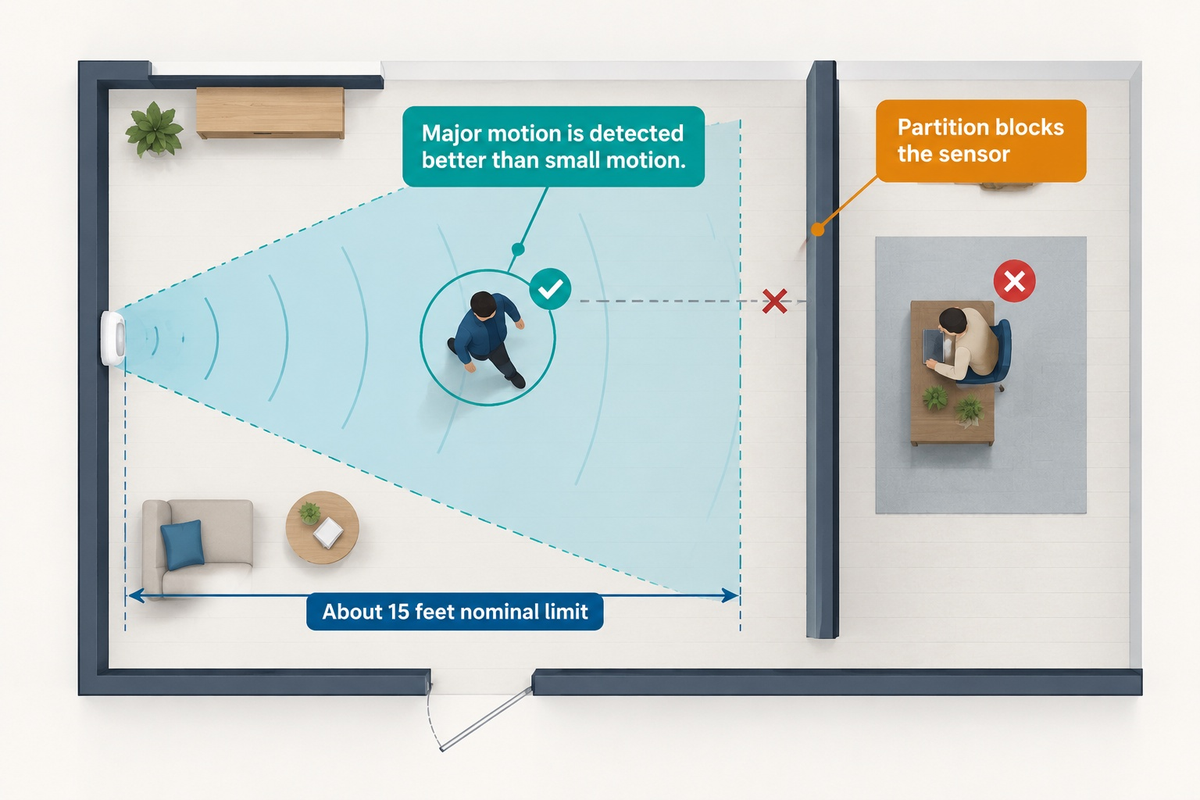
Occupancy sensors turn lights on with motion, and turn them off after a time delay. Vacancy sensors fit behind a switch plate, turn on lights with a button, and turn them off by themselves; this is ideal for bathrooms and closets, for example, where a surprise light is undesirable.
“In electric equipment rooms, the illumination may not be controlled by automatic means only.”
That OSHA rule applies to workplaces with electric equipment rooms, so a sensor switch there needs a manual way to keep the light on. It’s a workplace rule, not a residential one.
Detection technology sets the limits. The Pacific Northwest National Laboratory guide says passive-infrared sensors need motion and line of sight and have a nominal limit of about 15 feet, and they detect major motions better than small ones such as someone sitting in a chair. A partition or large furniture can block the sensor, so a bathroom stall or a desk behind a screen can lose its light mid-task. One maker’s PIR wall switch offers delayed-off time settings of 30 seconds, 5, 10 and 30 minutes.
Codes set timing as well. California’s guidance says occupant sensors must turn lights off or down no more than 20 minutes after the area becomes vacant, and a manual-on sensor needs a 15 to 30 second grace period to bring lights back on after timing out. The same guidance requires an automatic-off control for at least one light fixture in a bathroom, garage, laundry, utility room, or walk-in closet in a newly built single-family home. Offices in California are subject to the occupancy sensor rules under the 2022 Title 24 energy code, regardless of size. Other countries and states may vary, so check your local codes; we cover other sensing in our motion sensor light guide.
Some switches need a neutral wire. Motion sensor switches suit large rooms and shared spaces where nobody reaches for a switch. In these spaces, switches automatically turn the lights off after a delay. A timer switch turns a load off after a set time or on a schedule, which is ideal for a fan, outdoor or porch lights, or a hallway light. A daylight sensor switches lights by ambient brightness and suits porches and entrances.
Smart and Wireless Switches: Neutral Wire, Protocols and Hubs
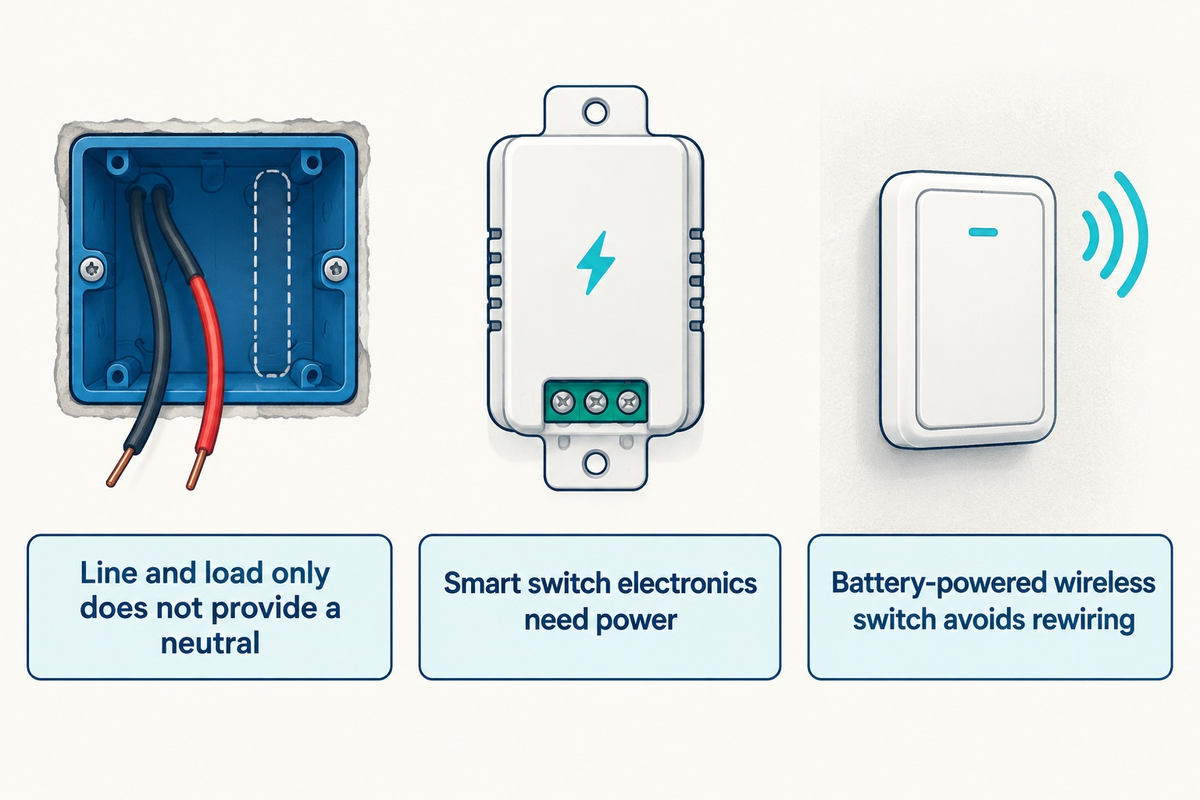
A smart switch contains electronics that require power, and as such, most models require a neutral wire in the wall box. A switch loop wired with only line and load doesn’t provide one.
The National Electrical Code expects a neutral at new lighting switch locations in many spaces. EC&M’s summary of Section 404.2(C) says the connection requirement shall become effective on January 1, 2020, with an exception for replacement switches in older locations where the neutral can’t be extended without removing finish materials. The same summary notes that electronic lighting control switches without a neutral are limited to five per branch circuit and 25 per feeder. That text comes from the 2017 to 2020 editions; check the edition your area has adopted.
No-neutral smart switches exist for older boxes, but they pass a small current through the lamp to power themselves, so they carry load limits and may need a bridge or hub. Check the maker’s minimum load before ordering. Protocols add another choice: Wi-Fi, Zigbee, Z-Wave and Matter all appear on current switches. A 2026 independent review notes that the way Amazon, Apple, Google and others implement Matter sometimes contradicts its product promise, so a Matter label doesn’t guarantee the same features on every app.
When rewiring isn’t feasible, say to only switch a light from across the room, a battery-powered wireless switch is an option. Our guide to remote control light switch discusses this in more detail.
Which Light Switch for Which Room
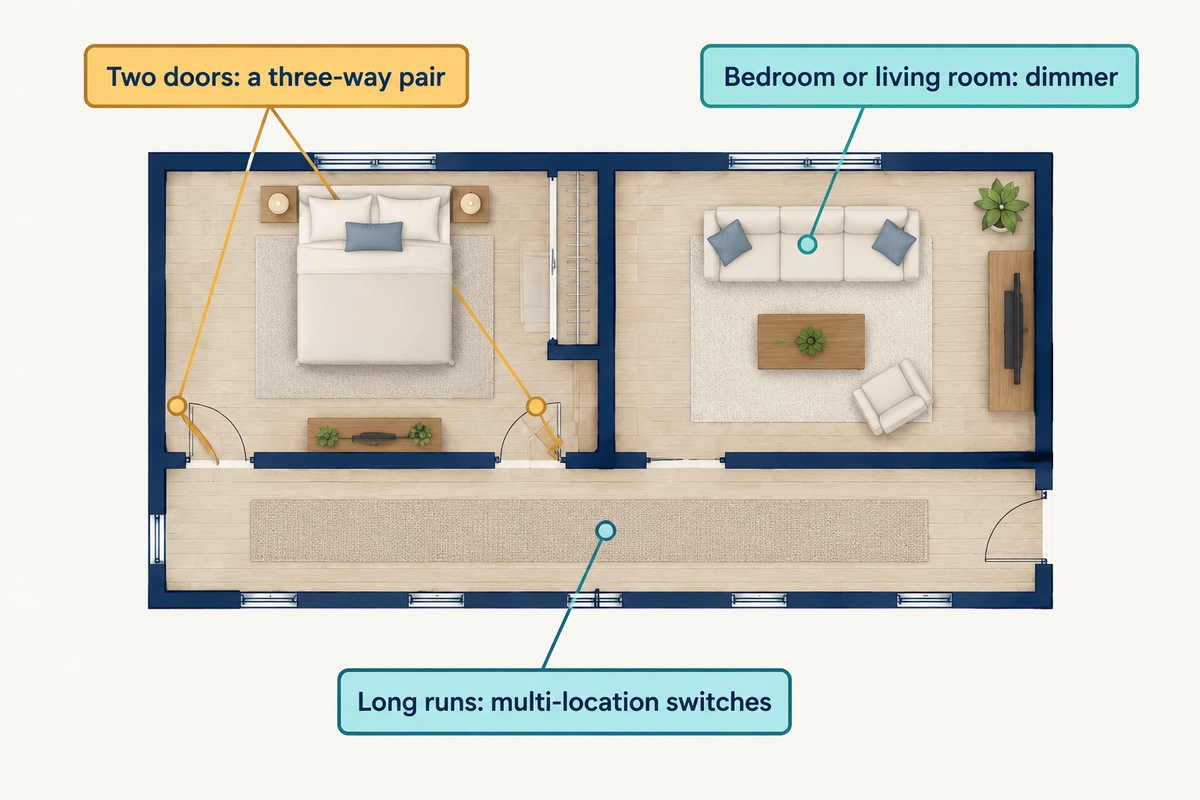
In a living room or bedroom the dimmer is the usual answer, and dimmers suit living rooms where mood matters. Use automatic switches where lights are often left on, and multi-location switches for long runs. The following table shows a room map based on the information above.
| Room | Usual switch | Reason |
|---|---|---|
| Bedroom | LED-rated dimmer | Adjustable brightness for evening use |
| Living room | Dimmer, often with three-way control | Several entrances and moods |
| Kitchen | Single-pole plus a dimmer on ambient lights | Task lights need full output |
| Bathroom | Vacancy sensor or timer for the fan | Lights and fans left on |
| Hallway and stairs | Three-way pair | Control from both ends |
| Garage and laundry | Occupancy or vacancy sensor | Hands full on entry |
| Outdoor entrance | Weatherproof switch with a daylight or timer control | Wet location rating |
| Office or warehouse | Occupancy sensor with manual override | Energy rules and large floor plates |
What Type of Light Switch for a Bedroom?
The bedroom typically has a dimmer rated for LED loads. A three-way pair is used for two doors, or for a bed side control.
California’s 2025 requirements show the direction of the residential codes with wall-mounted dimmers in habitable spaces of single family homes. These include bedrooms. Wall-mounted dimmers are also required in living rooms in the same locations. Elsewhere wall-mounted dimmers are comfort upgrades, not legal requirements.
What Light Switches Cost and When the Upgrade Pays
In October 2026 US retail listings showed a 15 A single-pole rocker switch at about $3 for a basic model and about $10 for a quiet-switch version, and an LED-rated Lutron Diva dimmer at about $26 to $32 depending on the store. Sensor and smart models are priced higher again, and retail prices change often, so compare current listings for the exact model. The bigger costs are around the device: a neutral wire pulled to an old box, a bridge or hub for a smart system, and labour for each location.
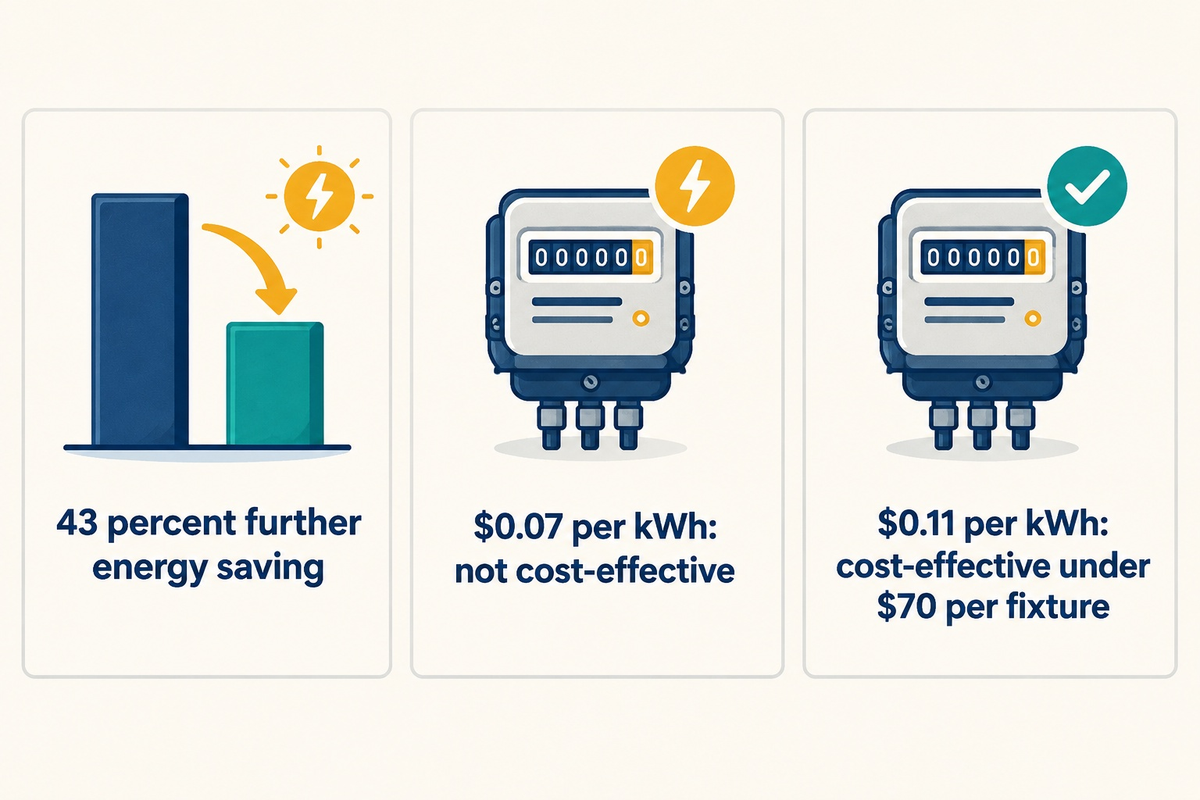
Payback is improved as electricity rates rise and as the added cost of the control per fixture falls. A General Services Administration trial in a 76,000 square foot Fort Worth office found that after an LED conversion, light-level tuning and occupancy sensing cut lighting energy by a further 43 percent. At $0.07 per kWh the added cost of the controls was not life-cycle cost-effective, while at $0.11 per kWh controls can be cost-effective when the added cost is under $70 per fixture. The trial covered one commercial office in 2018.
For a home, the upgrade pays best when lights are left on in garage, closets, or basement. A dimmer replaces a second lamp where one fixture serves two light levels. Sensors and timers raise energy efficiency by cutting run time. In a room used for ten minutes a day comfort is the reason to upgrade. Payback isn’t the point.
Specification Checklist Before You Order
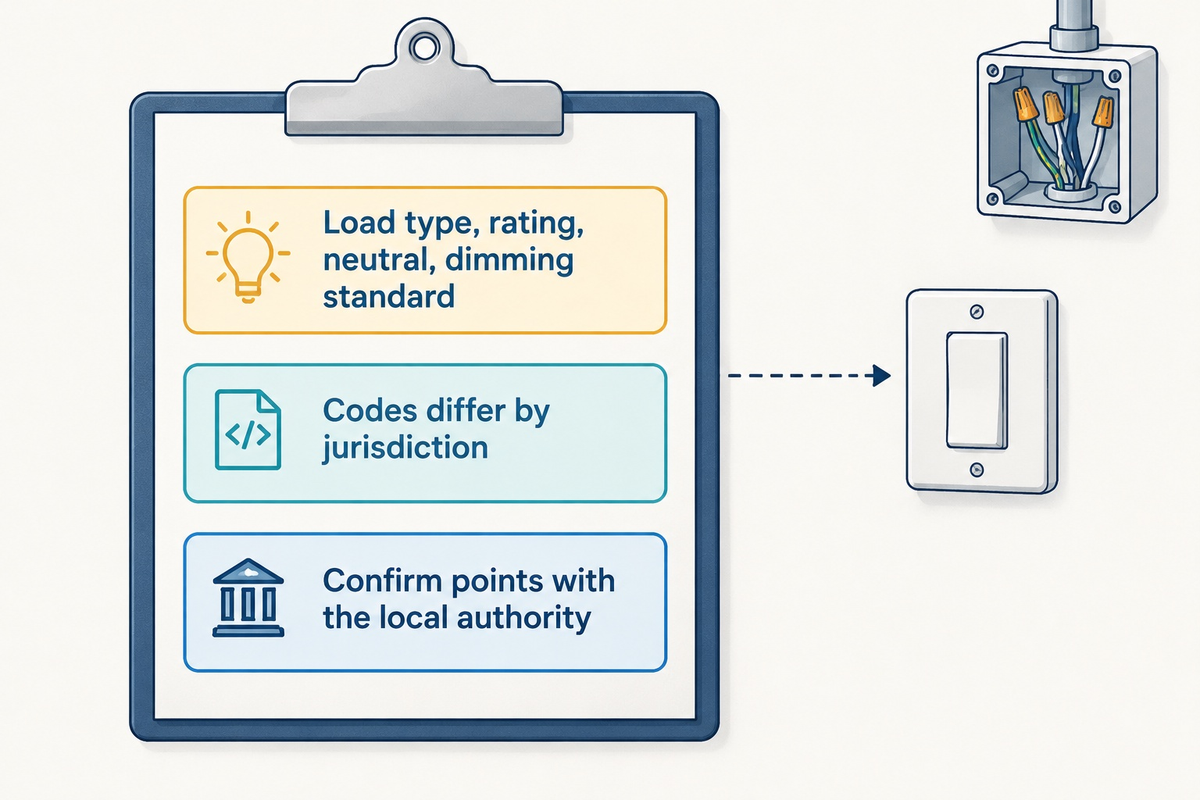
When a buyer orders switches for a project, they need to provide load type, rating, neutral requirement, and dimming standard on the request. Codes differ by jurisdiction. The checklist below is to assist in confirmation of points with the local authority.
RFQ checklist: copy these into your quote request for light switches
| Parameter | Recommended range | Why it matters | How to verify |
|---|---|---|---|
| Load type rating | Rated for LED lamps, stated as a lamp count | Incandescent watt ratings do not apply to LED loads | Maker load sheet for the exact model |
| Maximum LED load | Plan at 100 W per fixture unless the maker states a lamp count | LED driver inrush current exceeds steady wattage | Maker compatibility list |
| Dimming standard | Forward phase-cut LED dimmers meet NEMA SSL 7A | Compatibility between dimmer and driver | Datasheet statement of conformity |
| Neutral requirement | State yes or no for each model | Electronic switches draw standby power | Wall box inspection and maker diagram |
| Sensor coverage | About 15 feet for a passive-infrared sensor, with line of sight | Small movements and blocked views cause false shut-offs | Coverage diagram on the datasheet |
| Operating force | No more than 5 pounds where accessible rules apply | Accessible spaces and routes | Sample test before bulk order |
For projects with a lot of switch points, a networked system can be cost-effective compared to using individual devices. See our guide to a commercial lighting control system and our overview of lighting control systems. Guangqi Lighting offers LED luminaires and controllers for outdoor, commercial and architectural projects, and our team can source the right controllers to match the luminaires you’ve specified.
Frequently Asked Questions
Q: What is the most common type of light switch?
The single-pole switch is the most common type in homes. It controls one light, or one group of lights, from one place.
It has two screw terminals plus a ground, and it’s usually a toggle or a rocker. When a second switch controls the same light, the pair becomes three-way.
Q: What are the four main types of light switches?
Light switches come in four main types: single-pole, three-way, four-way and dimmer, with sensor and smart switches as modern additions.
Among all types of electrical switches, single-pole controls from one place, three-way from two, and four-way adds a third or more. A dimmer sets brightness and is built to match the lamps it controls.
Q: What type of light switch do I need for stairs?
Stairs normally need a pair of three-way switches, one at the top and one at the bottom, so the light can be switched from either end.
If the stairs have a landing door or a third entry, a four-way switch goes between the two three-way switches. Check which type is already on the wall before buying a replacement.
Q: Are toggle switches compatible with smart home systems?
Yes, as long as the smart device is built for the style you want.
Many smart switches use a rocker, so a toggle may need a smart relay or a different model with the same behaviour.
Q: Do smart switches need a neutral wire?
Most smart switches need a neutral wire, because the electronics inside draw a small standby current that a line-and-load pair can’t supply without passing current through the lamp.
No-neutral models exist for older boxes, but they carry load limits and may need a bridge or hub. The National Electrical Code expects a neutral at new lighting switch locations in many spaces, with exceptions for replacements where the neutral can’t be extended. Check the maker’s minimum load before you order one for LED lamps.
Q: Can I use any dimmer with LED bulbs?
No, use a dimmer rated for LED loads and bulbs marked dimmable.
ENERGY STAR notes that not every LED works with every dimmer, so check the maker’s compatibility list.
Q: Can a motion sensor switch control LED lights?
Yes, a motion sensor switch can control LED lights if it’s rated for LED loads, and a sensor that doesn’t list LED lamps can leave a light glowing or switching erratically.
Sensors need a small current to run their own circuit, so a very low lamp load can cause the same ghosting seen with dimmers. Pick a model whose rating names LED lamps, and for a bathroom or closet choose a vacancy type so the light stays off until you switch it on. Read the lamp-count or minimum-load note on the datasheet.
Do you need help finding a controller to match your lighting project? Send us a list of your luminaires and the control strategy that you would like to implement and we can provide potential controller solutions as well as wiring approaches for your project.
About This Switch Guide
This comparison reviews the types of light switches according to public codes, standards and trade guidance and defines the scope of each. Guangqi Lighting manufactures luminaires and controllers rather than wall switches, so the information provided is from the resources cited, rather than from product tests conducted by us. This comparison is published by Zhongshan Guangqi Lighting Co. Ltd.
References & Sources
- Occupational Safety and Health Administration. 29 CFR 1910.303, General (electrical)
- ENERGY STAR. Light fixtures
- U.S. Department of Energy. Solid-state lighting flicker research
- California Energy Commission. 2025 Energy Code support, residential and nonresidential lighting
- U.S. Access Board. Guide to the ADA Standards, Chapter 3: Operable Parts
- Pacific Northwest National Laboratory. Lighting controls in multifamily buildings
- U.S. General Services Administration. Advanced lighting controls and LED findings, 2018
- National Electrical Manufacturers Association. NEMA SSL 7A-2015 (R2021), Phase-Cut Dimming for Solid State Lighting: Basic Compatibility
- Northwestern University. Mechatronics: switch contact configurations
- University of Texas at Austin. Valvano and Yerraballi, Embedded Systems textbook, Section 8.2
- EC&M. The Apprentice’s Guide to Article 404
- EC&M. Title 24 requirements for sensors and controls
- This Old House. How to diagnose and repair three-way switch problems
- matter-smarthome.de. The Matter Standard in 2026: a status review