Get in Touch with GUANGQI



Updated July 2026
DALI lighting control explained is simply this: DALI, a Digital Addressable Lighting Interface standardized globally as IEC 62386, allows one two-wire bus to address, dim, group, and read status for every light fixture in the system. This guide explains how the bus and addressing actually work, how DALI holds up against protocols like 0-10V, DMX, and wireless alternatives, what the shift from DALI-1 to DALI-2 means, and where the protocol is heading next.
This setup goes by several names depending on who’s asking: installers might call the wall station a DALI lighting control panel, spec sheets refer to the whole thing as a DALI lighting control system, facility teams manage it day to day through DALI lighting control software, and the commissioning step itself is what electricians mean by DALI lighting programming. Whichever term brought you here — including anyone who just wants DALI lighting control explained for dummies — the mechanics below are the same.
Quick Specs
| Governing standard | IEC 62386, maintained by the DALI Alliance (DiiA) |
| Bus wiring | 2-wire, polarity-free, line/tree/star topology |
| Max cable length | 300 m per line |
| Addressing per line | 64 control gear addresses + 64 control device addresses (64+64) |
| Groups / Scenes | 16 groups, 16 scenes per line |
| Signal type | Manchester-encoded digital command-and-response |
What Is DALI? (Digital Addressable Lighting Interface)
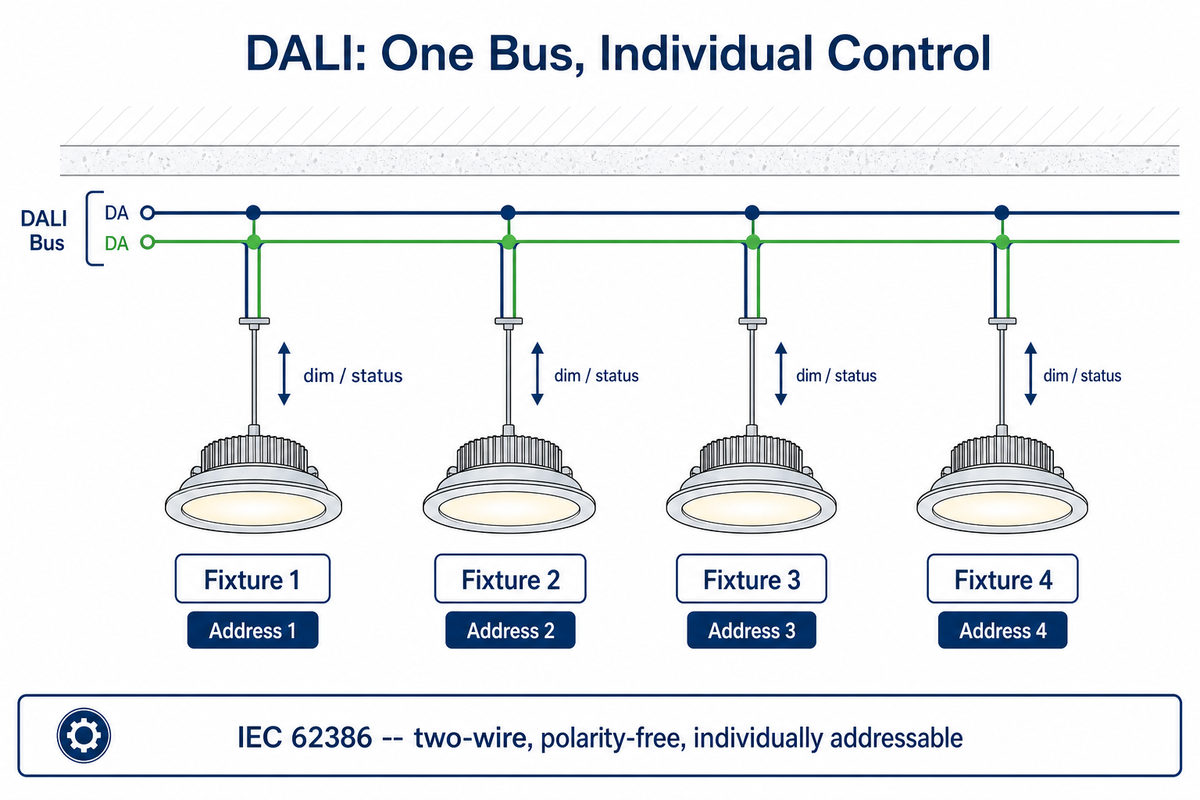
DALI is the protocol for digital lighting control – that is, a communication interface which has become standardized internationally, with the designation IEC 62386, that can be used to talk to, dim, group and get back status information from all your digital light fittings on one two-wire bus.
This is quite unlike a single analog dimming line on which all light fittings on a circuit will do exactly the same thing in response to the same single voltage. It means one two-wire system can convey a multiplicity of lighting instructions all at once to a multitude of individually controllable lights.
IEC 62386 is an international standard published in several Parts by the International Electrotechnical Commission and is day-to-day managed by DALI Alliance – originally the Digital Illumination Interface Alliance (DiiA) – the industry organization that develops new Parts, prepares certification tests and hosts the public DALI products’ certified list. This protocol isn’t a proprietary product of any company, and the latest version doesn’t make a compromise with multi-supplier commitment; it is how a driver from manufacturer one, the sensor of manufacturer two, and controller of manufacturer three can work together on a single DALI network.
Two-way communication is the piece of detail that most differentiates DALI from older analog tech: a driver doesn’t just get a dimming command, but reports back actually. With this, you could query a fixture for its current level, power state or if it’s faulted, and get an accurate answer back over the very same pair of wires you commanded it on. A facilities team can read that status directly from the DALI bus and catch a system failure the moment it happens, rather than waiting for a walkthrough to spot a dark fixture.
📐 Engineering Note
DALI is a fixture-level light system bus – not an entire building automation. It sits underneath everything else in Guangqi’s DALI, DMX512, and 0-10V control-system lineup. Usually, DALI buses will extend up through the building by way of a gateway (more on that later).
If you’re like me and need to see a concrete, real-life bus-power size, you can look to WAGO’s DIN-rail DALI power supply, which supplies 230 V from the mains and is sized to run multiple bus devices from a single supply rather than wiring each line separately.
How a DALI System Is Built: Bus, Addressing, Groups, Scenes & Inputs
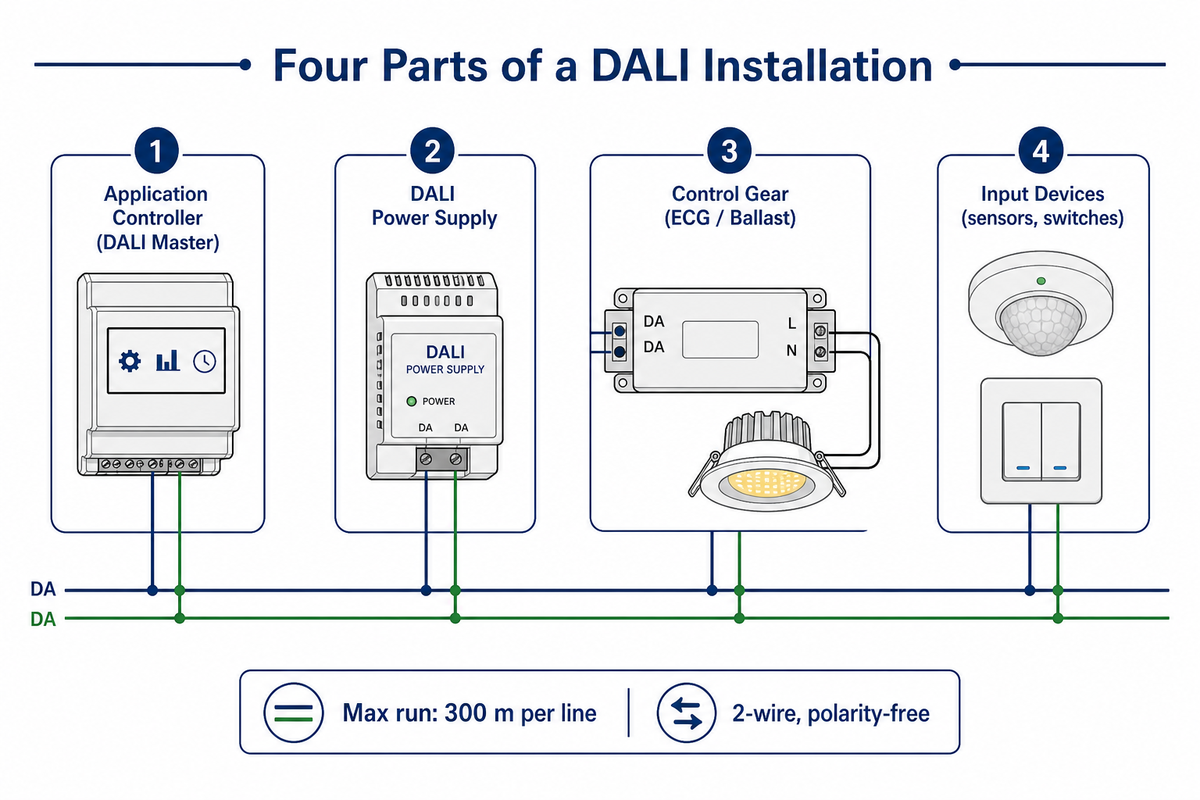
A fully-functional DALI installation involves four main components: an application controller — sometimes still called the DALI master out of habit from earlier protocol generations — that handles the logic of control; a dedicated DALI power supply from which the bus is powered; individual control gears (ECGs, or ballasts, as the formal DALI name is) incorporated into each fixture; and a set of user-defined interface devices, input devices, such as sensors and switches, which feed information back to the controller.
Control gear is powered entirely through the bus using low-voltage provided by the DALI bus – no separate low-voltage feed is required. Wiring stays simple too: the bus itself makes for an easy installation; it’s a simple two-wire arrangement, not polarity sensitive, with a maximum run distance of 300 m per line (though it can be wired in a line, tree or star configuration, never a closed loop), which has a good part in making DALI wiring a relatively simple digital lighting control device to install.
Addressing is the feature that makes intelligent control possible in the first place, and it’s more nuanced than most summaries let on. Each individual DALI subnet can address up to 64+64 devices; these are 64 control gear addressed devices and 64 control-device addressed devices. More commonly read descriptions of DALI often simplify these into a singular “64 devices per line” statistic, which tends to understate how much available address space there’s once you’ve factored in all control inputs.
The Broadcast → Group → Scene Addressing Ladder
DALI’s control model works as a four-rung ladder, from broadest to narrowest, giving a lighting designer dynamic control over how a space behaves: Broadcast commands every driver on the line at once, regardless of address. Group commands one of up to 16 lighting groups — “all fixtures in Meeting Room 3” is one command instead of nine, and grouping is assigned entirely in software rather than by which physical circuit a fixture sits on. Scene recalls one of up to 16 stored brightness-control level-sets with a single instruction, such as a presentation preset that dims the front of a room and holds the back at full. Individual short address (0-63) talks to exactly one driver. Reconfiguring a space for a different lighting layout means moving fixtures between rungs in software — regrouping and rescening — not re-pulling cable, which is what makes DALI genuinely scalable lighting infrastructure as a tenant’s floor plan changes over time.
How Many Devices Can a Single DALI Line Support?
Up to 64 control gears and up to 64 control devices (in the case of sensors and switches) can be accessed on a single DALI line at any one time – as you’d expect 64+64 in the DALI Alliance’s own IEC 62386 standard documentation.
In practice, installers rarely max this out: on a recent 5,000-plus luminaire, 6.5km installation, the DALI team specified a practical limit of roughly 60 devices per line to ensure capacity to accommodate later modifications to the system and the 300m cabling limit. (Although 2.5 mm² cable was used for the wiring run and I would expect a bit more than that from such gauge wire).
In fact input devices – occupancy sensors, colour sensors and push-button types – were not originally part of the DALI protocol until being standardised by DALI-2 through the IEC 62386 Parts 301-306 standardisation process; it’s a major reason why DALI-2 certified sensors are now reliably interoperable with DALI-2 certified controllers.
DALI Dimming Explained: Digital Signal vs Analog (0-10V/TRIAC)
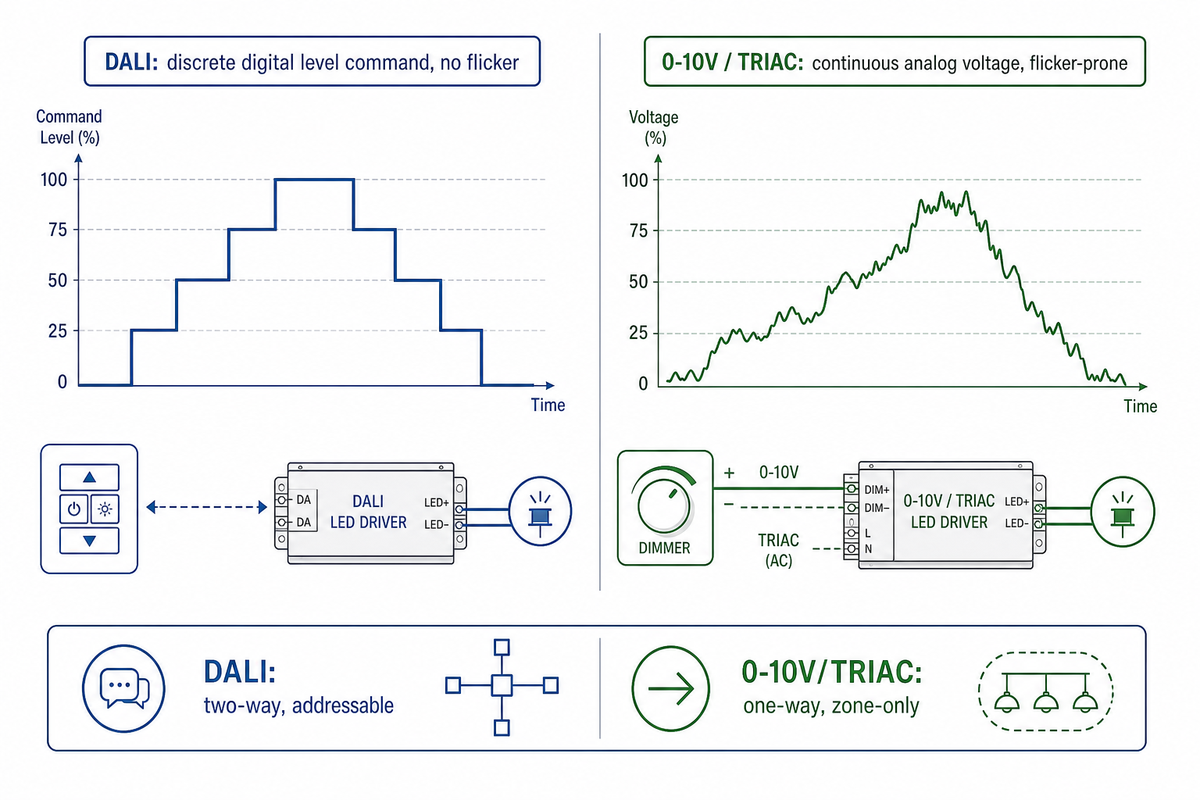
Dimming in DALI involves sending an explicit digital level command to the individual control gear rather than forcing an analog voltage up or down as might occur with old 0-10V or a phase-cut (TRIAC) dimmer. By sending an individual digital command the individual control gear will dim to the required level without flicker or buzz that a TRIAC-control led dimmer can impart on an LED load and will also prevent light-level variation between fittings.
The Department of Energy’s Pacific Northwest National Laboratory guidance puts the basic difference plain: analog control is one-way and zoned only by wiring, while digital control — naming DALI and DMX512 specifically as the two dominant wired digital protocols — is two-way and addressable, with zoning that can be reconfigured entirely in software.
| Attribute | Analog (0-10V / phase-cut) | Digital (DALI) |
|---|---|---|
| Data exchange | One-way | Two-way, with status feedback |
| Luminaire addressability | No — circuit-level only | Yes — individual, group, scene |
| Zoning flexibility | Fixed by wiring; rezoning means re-wiring | Reconfigured in software |
| Typical use | Single dimming zone, low cost, no commissioning | Per-fixture control, feedback, frequent reconfiguration |
None of this makes 0-10V a poor choice by default: for a single dimming zone with no reporting requirement, it remains cheaper and needs no commissioning at all.
Further down this guide, the decision framework covers exactly when that trade-off favors analog instead of DALI.
DALI Drivers & Controllers: DT6, DT8, DT1, and Device Types
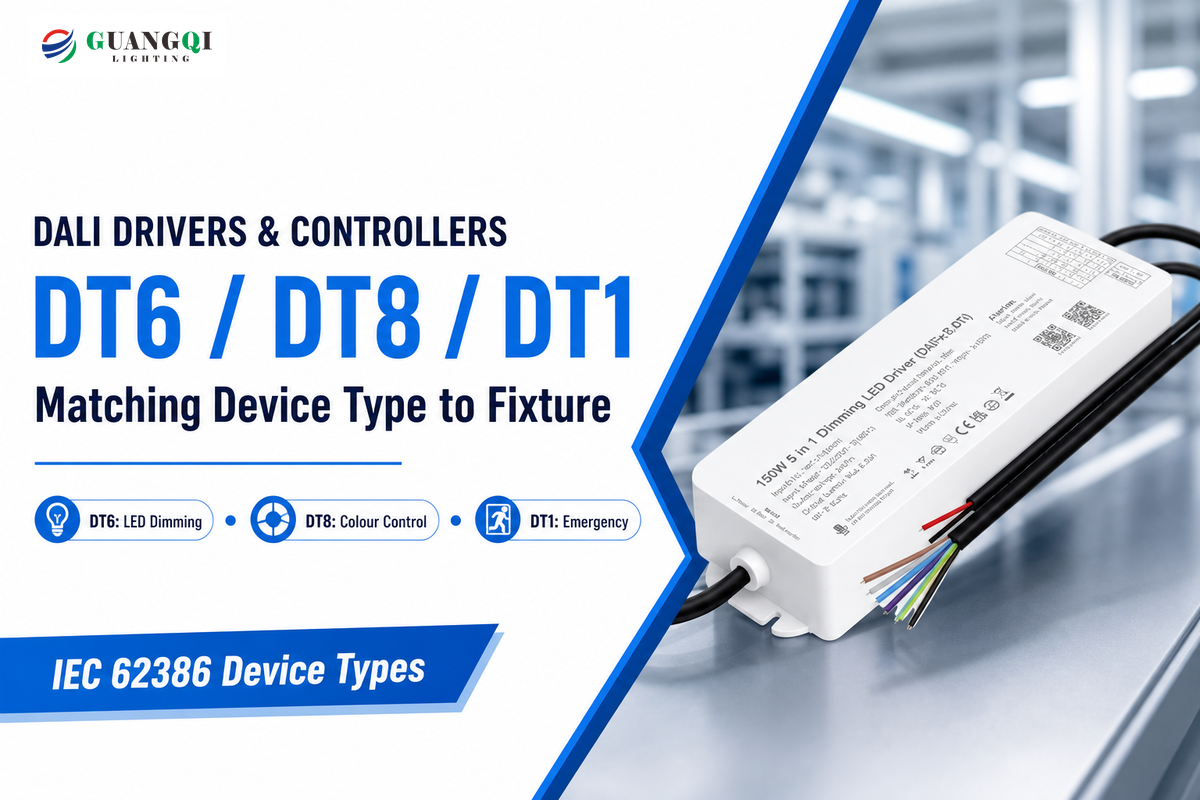
Every DALI driver and controller is built to a specific IEC 62386 “device type” (DT) definition — part of the DALI standard IEC 62386 as a whole — and the type in the fixture determines what it can actually do on the bus.
DT6 (IEC 62386-207) is the standard profile for DALI led drivers used for straightforward dimming, and remains the most common device type on flexible lighting projects. DT8 (IEC 62386-209) adds colour control, covering tunable-white and RGB fixtures that need more than a single brightness channel. DT1 (IEC 62386-202) is reserved for self-contained emergency lighting-automated function and duration testing, with results recorded and reportable back over the bus.
Certification Parts move as the standard develops, so it is worth confirming any device type’s current DALI-2 certification status directly against the DALI Alliance’s live product database at order time rather than relying on a datasheet printed months earlier.
| IEC Part | Device type | Covers | DALI-2 status |
|---|---|---|---|
| 201 | DT0 | Fluorescent lamps | Not planned |
| 202 | DT1 | Self-contained emergency lighting | Check current status |
| 206 | DT5 | Conversion to DC (0/1-10V) | Aligned |
| 207 | DT6 | LED modules | Aligned |
| 208 | DT7 | Switching | Aligned |
| 209 | DT8 | Colour control / tunable white | Aligned |
| 218 | DT17 | Dimming curve selection | Aligned |
| 220 | DT19 | Centrally-supplied DC emergency | Aligned |
| 250 (DiiA) | DT49 | Integrated bus power supply | D4i-certifiable |
Matching device type to fixture matters at the RFQ stage: a driver spec’d as DT6 can’t deliver DT8 colour-tuning behavior no matter how the controller is programmed, and an emergency fixture needs a genuine DT1 driver-built around the electronic control gear (DALI ECG) inside it-rather than a DT6 driver on an emergency circuit.
This device-type discipline is exactly why the lighting industry increasingly treats “DALI control” and “DALI-2 certified control” as two different claims worth asking apart on a quote. Guangqi’s LED driver selection guide walks through fixture type, install environment, dimming requirement, and project scale before recommending a driver series.
RFQ checklist — copy these into your driver/controller quote request:
| Parameter | Recommended range | Why it matters | How to verify |
|---|---|---|---|
| Device type | DT6 (LED) / DT8 (colour) / DT1 (emergency), matched to fixture use | Wrong DT means the fixture cannot do what the sequence of operations calls for | Driver datasheet DT declaration |
| DALI-2 certification | Independently verified, not self-declared | Self-declared DALI v1 gear has known cross-brand interoperability gaps | Search the product on dali2.org/products |
| Line address budget | Design to ~60 of the 64 control-gear addresses per line | Leaves headroom for later fixture or sensor additions | Controller spec sheet + as-built address schedule |
| Cable run length | Stay under 300m per line, even with heavier-gauge cable | Bus timing and signal quality degrade past this regardless of conductor size | As-built cable schedule per DALI line |
| Emergency compliance | DT1 driver with self-test reporting for any emergency circuit | Life-safety fixtures need genuine self-test/duration-test capability, not just dimming | Datasheet DT1 declaration + local emergency lighting code |
DALI vs 0-10V vs DMX vs Wireless: Full Comparison Table
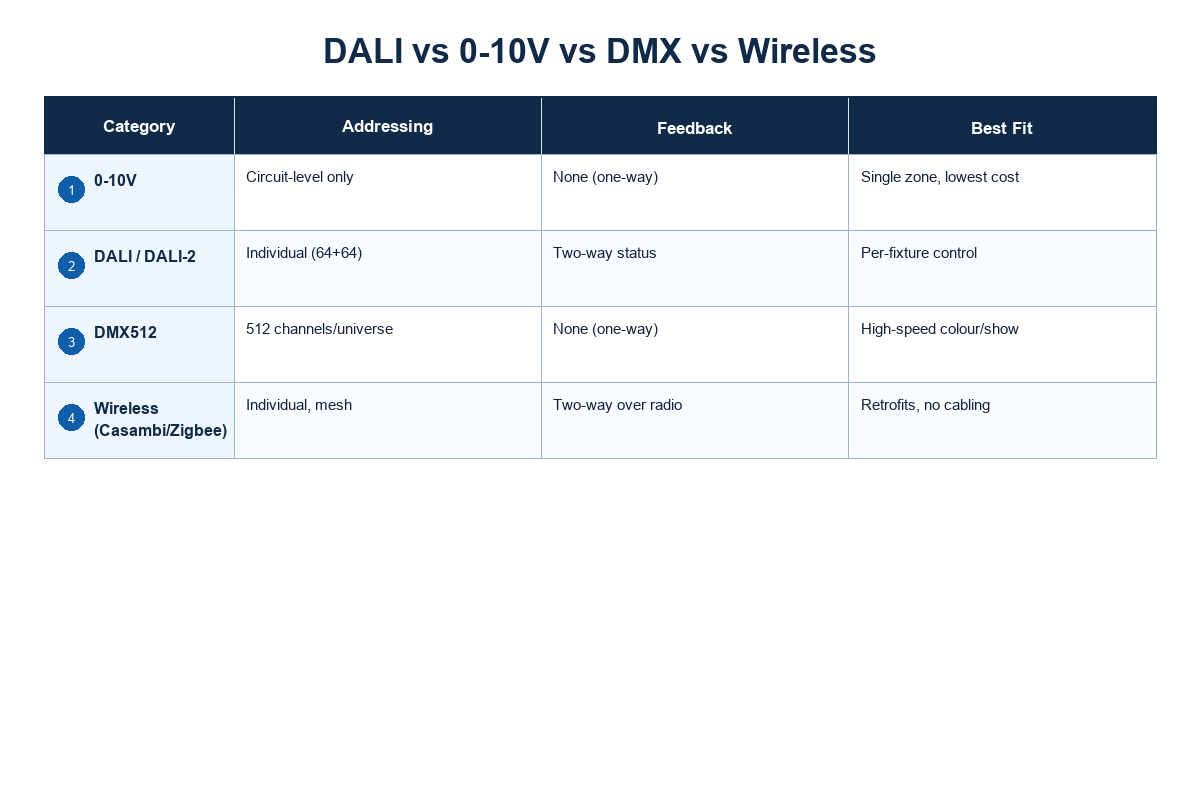
Choosing a lighting control protocol comes down to how much per-fixture control, feedback, and future flexibility a project actually needs, weighed against cable-pull cost and commissioning effort. Guangqi’s own protocol selector tool asks four questions to make this call — building type, new-build versus retrofit, BMS integration need, and fixture count per zone — and its underlying logic is a useful lens even outside the tool itself.
| Protocol | Addressing | Feedback | Best fit |
|---|---|---|---|
| 0-10V | Circuit-level only | None (one-way) | Single zone, lowest cost, no commissioning |
| DALI / DALI-2 | Individual (64+64), 16 groups, 16 scenes | Two-way: level, status, lamp/driver failure | Per-fixture control, reporting, frequent reconfiguration |
| DMX512 | Up to 512 channels per universe | None in base spec (one-way) | High-speed colour/show control, entertainment and facade lighting |
| Wireless (Casambi / Zigbee) | Individual, mesh-networked | Two-way over radio | Retrofits with finished or occupied ceilings |
The Retrofit-vs-New-Build DALI Fork
- Retrofitting an occupied space with a finished ceiling -> favor a wireless bridge (Casambi/Zigbee) to avoid pulling new control cable.
- Need individual addressing, scene recall, or fault reporting on a new build or accessible ceiling -> specify wired DALI/DALI-2.
- Large venue running synchronized colour or show effects -> DMX512, or a DALI/DMX hybrid where DALI handles general illumination and DMX drives the effects layer.
- Building already runs a KNX or BACnet BMS -> specify DALI with certified gateway rather than standalone wireless system so lighting is integrated on same head-end as the HVAC and access control.
DALI-1 vs DALI-2: What Actually Changed
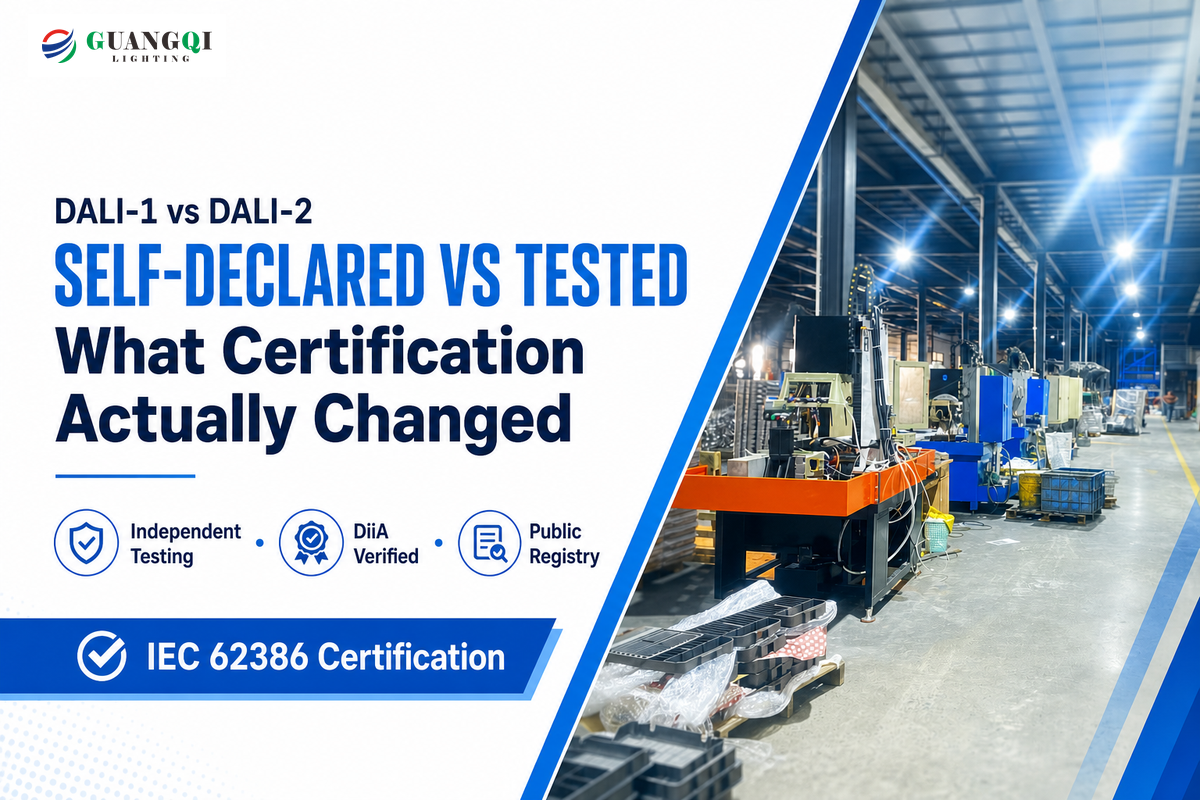
Per the DALI Alliance’s own DALI-2 certification overview, DALI-2 did not replace DALI protocol — it replaced how compliance is evidenced.
Under the original DALI, now officially referred to as DALI version-1, compliance could simply be self-declared by a manufacturer with no verification testing of control lighting behavior. DALI-2 brought in mandatory, independently assured testing by the DALI Alliance: a manufacturer performs real tests against the DALI standard, IEC 62386, and DiiA approves it before listing the product in the public dali2.org registry of certified DALI devices and authorizing use of the DALI-2 trademark.
That verification doesn’t come free. Membership of DiiA (a prerequisite for any certification) is EUR 15,000 annually for “Regular” membership or EUR 5,000 for “Associate” membership, plus a one-off purchase credit of test fees for each product. The implication for a specifier is simple: if a device isn’t found in the DALI Alliance’s public database, it hasn’t been independently tested and verified by DiiA for conformance, even if the datasheet says otherwise.
As well as closing this certification gap, DALI-2 also addressed what many felt was another deficiency in the original DALI specification by formally standardizing input devices at this stage (push-buttons, occupancy sensors, daylight sensors, and colour sensors — defined in Parts 301-306 of IEC 62386). This means that a certified sensor from one manufacturer is reliably interoperable with a certified controller from any other supplier, and this, more than anything else, is being hailed as the end of much of the cross-brand grouping and commissioning disputes that dogged DALI v1 installations.
While existing DALI version-1 hardware can typically operate on a DALI-2 bus, simply using DALI-1 gear does not give you any certification-based guarantees.
DALI Gateways: Bridging KNX, BACnet, and Building Management Systems
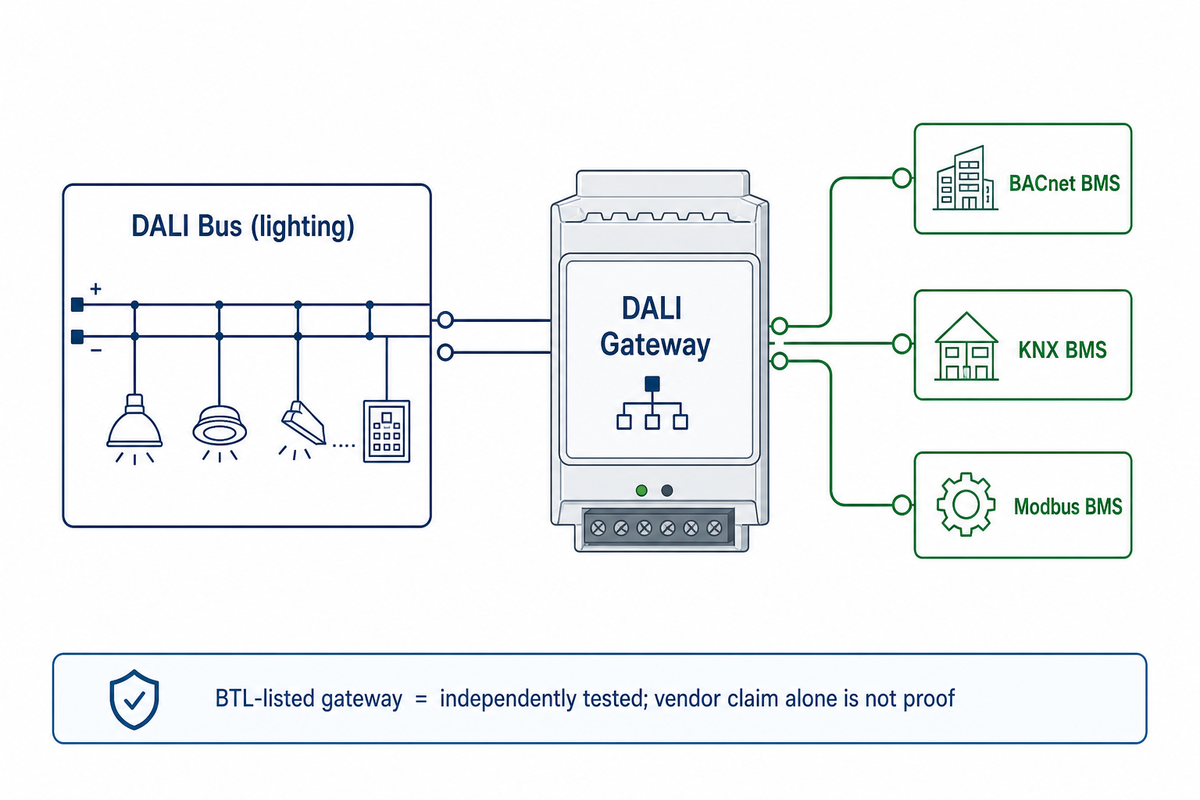
In a nutshell, a gateway allows a building management system to communicate with lights, translating between DALI’s fixture-level commands and a building’s own building automation control language.
It specifically knows about KNX, BACnet, and Modbus buildings, so your lights function as one more controllable system rather than isolated islands like access and building energy. Guangqi’s own BMS Integration Compatibility Checker names Honeywell WEBs-AX/Niagara, Johnson Controls Metasys, Siemens Desigo, Schneider EcoStruxure, and Trane Tracer as head-ends it verifies against, across four control-depth tiers from basic on/off scheduling up to full per-fixture status reporting.
The Device-Type-to-Gateway Compatibility Chain
| Device type | KNX gateway | BACnet gateway | Zigbee gateway (DiiA Part 342) | Bluetooth NLC gateway (DiiA Part 341) |
|---|---|---|---|---|
| DT6 (LED dimming) | Yes, via KNX-DALI gateway | Yes, BTL-listed gateway recommended | Yes | Yes |
| DT8 (colour/tunable white) | Yes, with scene-object mapping | Yes, if gateway exposes colour objects | Yes | Yes |
| DT1 (emergency) | Limited — check gateway self-test object support | Limited — verify BACnet emergency-status objects | Not typical | Not typical |
| Input devices (301-306) | Yes, sensor objects map to KNX group addresses | Yes, via BACnet binary/analog input objects | Yes | Yes |
For BACnet specifically, naming a BMS brand isn’t the same as proving conformance. Based on ASHRAE Standard 135.1P, the BACnet Testing Laboratories (BTL) mark is the industry’s actual conformance signal — a gateway or controller that’s BTL listed has been independently tested, while a vendor’s own “BACnet compatible” claim hasn’t. Specifiers integrating DALI into a BACnet BMS should ask for the BTL listing, not just the brand name.
Connecting lighting into an IP-connected BMS, or cloud dashboard, also adds to the attack surface of a building, not just its capabilities – something receiving much less press in the lighting control literature compared with protocol mechanics – and deserving a line in any integration spec on a par with the usual commissioning checklist.
Industry Outlook: DALI-2, D4i, and the Gateway-Convergence Era
The DALI road forward is as much about speaking out to other systems as it’s about controlling a luminaire with a dimmer. D4i, a technology leveraging the DALI-2 implementation, extends control intelligence “into” the luminaire, and now a D4i-enabled driver captures and communicates its own data on the same two-wire bus for streetlighting and other smart-luminaire-type connected lighting applications. Now, the DALI Alliance is opening the door to broader connectivity through a new certification program for wireless-to-DALI gateways, translating standard DALI control commands onto Bluetooth NLC and Zigbee, alongside DALI+ — a Thread-based extension aimed at IP-connected, IoT-ready smart buildings.
“It’s a significant milestone to have these testing and certification specs put in place for wireless to the DALI gateway. […] As we expand the market for these intelligent building devices, we’re now enabling developers, manufacturers, and building professionals to deliver far greater variety.”
Paul Drosihn, General Manager, DALI Alliance
The wireless-gateway Certification Program is the concrete milestone here — introduced and showcased at the DALI Alliance’s own Light+Building 2026 announcement, Frankfurt, March 8-13, 2026. DALI+ with Thread is a related but separate initiative: the DALI Alliance’s own materials describe its certification tests as still in development, expected to take several months, so treat it as something headed toward trial rather than already implemented on any current DALI-2 system. If your project is being designed this year, make sure your gateway meets the wireless-gateway certification before ordering rather than just assuming it’s automatically DALI+ capable.
Compared to all that, DOE’s own connected lighting research offers a healthy perspective: it frames smart, data-reporting lighting systems as still needing project-by-project justification. There will be convergence, sure, and it’s accelerating. But the need now is to plan for gateways and data-reporting capability – not to over-specify it.
Common DALI Misconceptions, Commissioning, and Installation Pitfalls
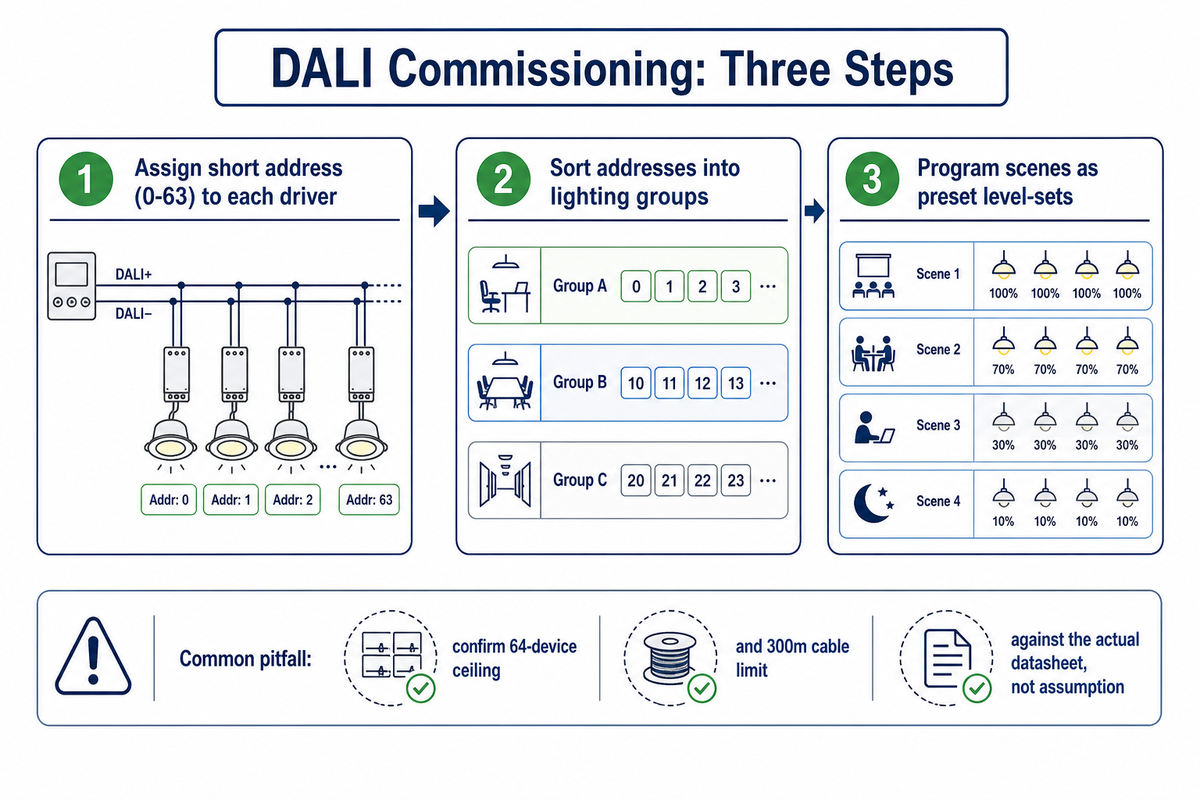
Commissioning a DALI line follows a fixed three-step sequence: assign a unique short address (0 to 63) to each driver on the line, sort those addresses into lighting groups that match how the space is actually used, then program scenes as preset level-sets that a single command can recall.
Dedicated commissioning software – run from a laptop, tablet, or handheld tool – talks directly to the DALI bus using the same Manchester encoding the drivers themselves use. It discovers every control gear address on the line and writes the group and scene assignments into each driver’s own memory. Because addresses, groups, and scenes live in the electronic control gear itself, the installation keeps running even after the commissioning tool is disconnected, and a driver can still report a failure back to the controller without it.
This is also where intelligent lighting management earns its name over a simple dimmer: a lighting design team can present a facility with a day-one working schedule showing every group and scene, and facilities can later use the same commissioning software on a floor-plan remodel with no rewiring.
Is DALI Polarity Sensitive?
No — and this mistake heads in the opposite direction than much DALI confusion.
The DALI bus is expressly intended to be polarity-free, which is why it’s relatively forgiving to wire in comparison with old analog control cabling that needs correct polarity.
The misconception with more real-world damage runs the other way: assuming that DALI-2 certification alone guarantees any two certified devices will simply work together.
A named trade-press analysis makes exactly this case: DALI-2 certification confirms that a device has met the protocol’s test requirements, but it doesn’t guarantee flawless real-world interoperability — especially among input devices like sensors and controllers, which rely on more complex event-based logic and often carry manufacturer-specific behavior on top of the shared standard. Systems built entirely from certified parts can, in the author’s own words, “work in theory, but not always in practice.” The practical fix isn’t to distrust certification — it’s to bench-test devices together before final installation and, where the project allows it, lean toward a single manufacturer for the input-device layer to keep one party accountable for system-level behavior.
Real installation reviews surface a second, more mundane pitfall: disagreement over whether the 64-device ceiling applies per controller or per channel on multi-channel hardware, and cable runs that quietly creep past 300 m once several circuits are combined. Confirming both numbers against the actual controller datasheet — not against general DALI folklore — is what separates a design that works from one that needs a costly rework after the ceiling is installed.
DALI Limitations: When It’s Not the Right Fit
✔ Advantages
- Individual, group, and scene addressing without dedicated per-fixture wiring
- Two-way status and fault reporting
- Reconfigurable in software, not by re-wiring
- Open, multi-vendor interoperability under DALI-2 certification
⚠ Limitations
- Commissioning labor: someone must plan the addressing, groups, and scenes for every fixture on the line
- 64+64 address ceiling per line on larger installations
- Higher driver/controller cost than analog 0-10V
- Requires a dedicated DALI power supply
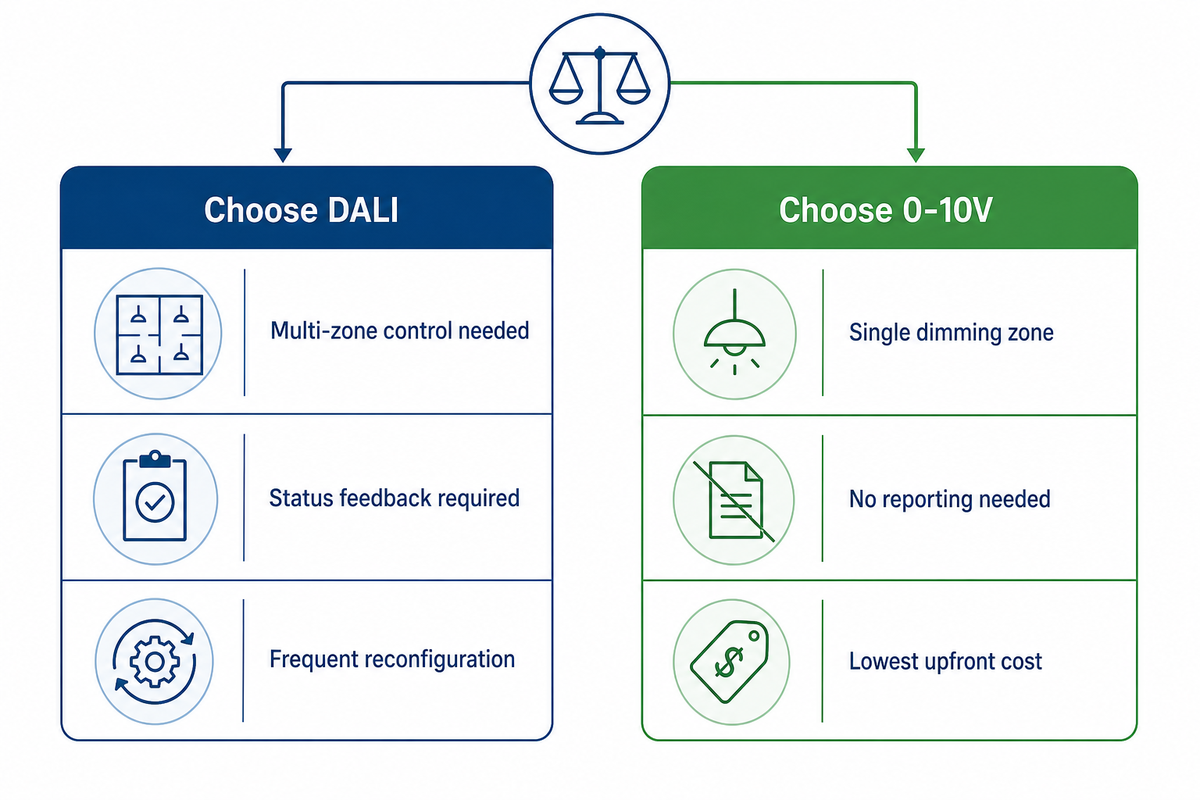
For a single room with one dimming zone and no reporting need, 0-10V is still cheaper and needs no commissioning at all-DALI’s extra cost buys individual control, feedback, and flexibility that a single-zone room simply doesn’t use.
Connected, data-reporting lighting layered on top of DALI isn’t an automatic win either: DOE’s own connected-lighting research frames energy-savings and value from networked systems as still needing project-by-project justification, not an assumed benefit that comes free with the protocol. Specify DALI where the addressing and reporting will actually get used; specify analog where it won’t.
Our Perspective
Guangqi makes DALI-2 lighting control tools alongside 0-10V and DMX512 lines, and we built the BMS Integration Compatibility Checker and Protocol Selector because almost every industrial-building job quotation we see asks this exact protocol question. These tools follow that same logic (building sort, renovation condition, need for BMS integration and also quantity of components per zone), which also represents the rationale of this guide somewhat than a general vendor-agnostic guide.
Reviewed by the Zhongshan Guangqi Lighting Co., Ltd. technical team
Frequently Asked Questions
Q: What is DALI lighting control, in plain terms?
A digital protocol, DALI gives each light fixture its own address on a shared two-wire bus, so it can be dimmed, grouped, and checked for status individually.
Rather than sending one analog signal that would dim everything on a circuit to exactly the same degree, each of DALI drivers includes a digital address that is unique to that one driver.
That would allow someone to tell fixture #12 to go 40 percent bright, fixture #13 to go to maximum intensity, and fixture #14 to turn off — all on the same pair of wires — and would permit that same someone to query each driver as to whether it is actually following orders.
Q: How do you program or commission a DALI lighting system?
Commissioning is a three-step sequence: address every driver with a unique short address, sort addresses into groups, then program scenes — all stored locally in the drivers themselves.
Someone could then use a configuration tool — a commissioning device or app — that scans the line and assigns each driver a unique short address number between 0 and 63.
That identified driver could be grouped with other drivers, to control lighting in a particular room or zone — as many as 16 groups can be addressed — and given a programmed light level, or stored scene — again, up to 16 scenes are allowed. Since the addresses, group assignments, and scenes are stored within the driver itself, the configuration tool can be unplugged, and the installation can continue to operate normally.
Q: What are the disadvantages of DALI lighting?
Compared with analog 0-10V, DALI costs more up front, needs commissioning effort, and is capped at 64 control-gear plus 64 control-device addresses per line — though the added cost buys real control.
That does mean that someone still has to take the time to address, group, and scene each individual line, a task required by no analog control system. It would also require an additional component — what the DALI manufacturers call a DALI power supply (and what most everybody else calls a relay module) — that is needed by no single-zone analog control installation.
Q: Can DALI and DMX be used on the same project?
Yes — a common split on hybrid commercial projects is DALI for general, addressable illumination and DMX512 for high-speed colour or show-control effects layers, with a gateway bridging the two where needed.
The two products do address two very different issues: DALI addresses steady and reportable general lighting control applications, whereas DMX addresses high-speed, high-channel count color sequencing and effects.
Q: What cable is required for a DALI installation?
Wiring-wise, the protocol needs a simple two-wire, polarity-free control cable, run alongside mains wiring, kept under 300 m for a single continuous line between any two devices on the bus.
Since the bus pair is polarity free, integrators will not be required to track which conductor controls which fixture or which of the two conductors controls what on a line, as many analog control wirings require, and the dual wire pair usually can run parallel with the main power conductors supplying each fixture, so it will not need a unique wiring raceway.
Nevertheless, real-world experience in installations has found integrators imposing a practical limit of around 300 meters per line, even when running the heavier-gauge, 2.5 mm² two-conductor cable, not because of cumulative voltage loss, but because cumulative time delay across the bus also compromises signal timing and a quality signal across many fixtures.
Q: Is DALI more expensive than 0-10V dimming?
Yes, per-fixture and per-controller costs both run higher for DALI than for 0-10V, though the added cost buys real capability: addressing, feedback, and software-level reconfiguration.
While reports vary widely in the field, industry estimates place a DALI controller at about $200 US or more, compared to around $40 to $70 US for a comparable 0-10 V controller (that is before one adds a power supply and DALI power supply to the 0-10V installation).
That extra expenditure is the price that must be paid for addressing individuality, two-way data transmission and software upgradeability — benefits that a single zone with no reporting or remote control needs really does not require.
Related Articles
- Commercial Lighting Control System Overview the broader control-system landscape this DALI deep-dive supports
- LED Controller Guide controller selection beyond DALI-specific devices
- IP Rating Guide for Lighting ingress protection for DALI fixtures in wet or outdoor zones
- LED High-Bay Light Buying Guide DALI-compatible high-bay fixture selection
- Facade and Architectural Lighting scene-control applications for DALI-2/D4i
References & Sources
- IEC 62386 Standard, Status of Parts DALI Alliance (DiiA)
- Overview of DALI-2 Certification DALI Alliance (DiiA)
- DALI-2 Systems & Components DALI Alliance (DiiA)
- DALI Alliance at Light + Building 2026 DALI Alliance (DiiA)
- Selecting Lighting Control Systems U.S. Department of Energy / Pacific Northwest National Laboratory
- Connected Lighting Systems U.S. Department of Energy
- BTL Listing of Tested Products BACnet International
- DALI-2: Why Certification Matters and Why It’s Not the Whole Story Electrical Connection (Daniel Walker)