Get in Touch with GUANGQI


Motion Sensor Flood Light: PIR Range, Mounting Height, Coverage, and False-Trigger Control

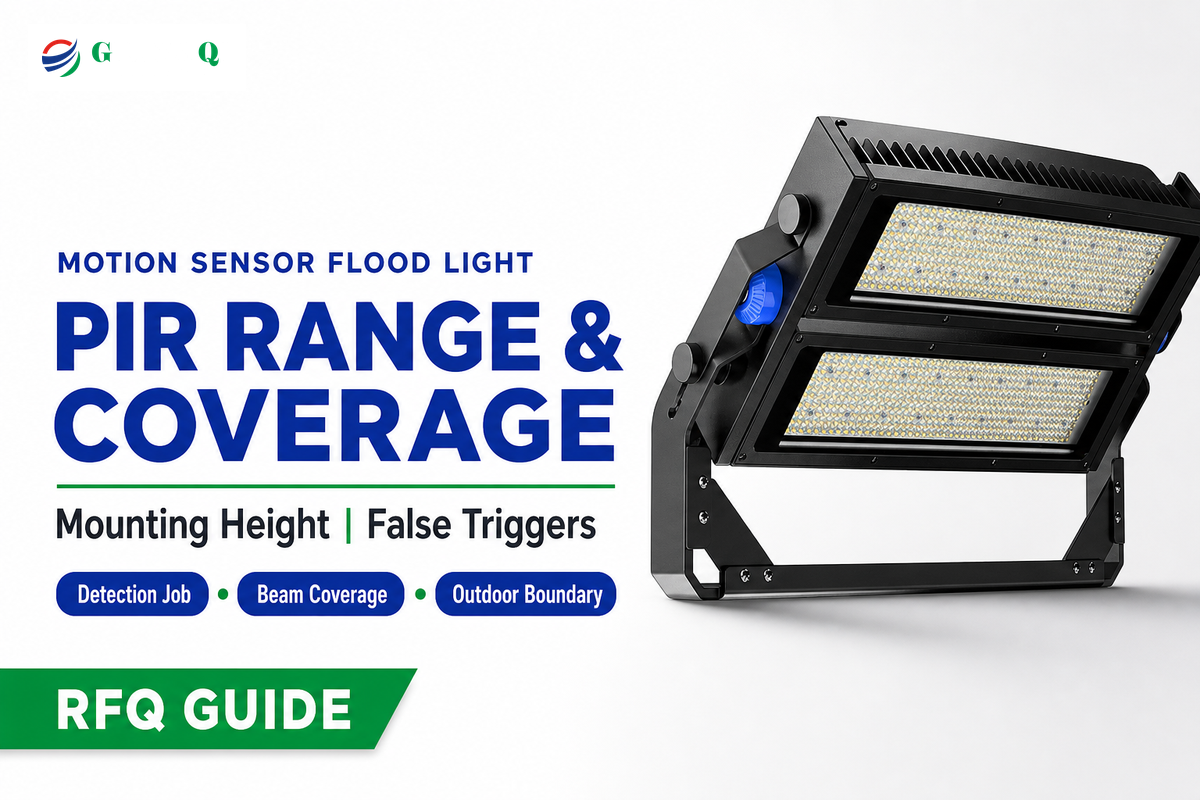
A motion sensor flood light is an outdoor flood light with a PIR sensor or similar control that switches or dims the beam when motion is detected. It should still be compared by the job it must do, not by a wattage number alone. The useful quote separates four things: what the PIR sensor can detect, where the fixture will be mounted, where the beam will land, and which site conditions could make the light turn on too often or fail to turn on when needed.
Treat the product as a motion sensor light or security light shortlist only after brightness, motion detection, and adjustable control settings are tied to the actual site.
Direct answer: ask for the selected model’s PIR detection distance and angle, rated mounting-height range, line-of-sight assumptions, major-motion or minor-motion test condition, target size and speed, photometric file or measured intensity-distribution data, input power and efficacy, aiming limits, sensitivity adjustment, time delay, daylight threshold, manual override, and outdoor suitability. For required lighting, exit routes, exterior entries, pedestrian paths, or protected outdoor sites, pause before using full-off motion control as the only lighting strategy.
This guide is for non-networked PIR-based outdoor flood lights. It’s a purchasing and RFQ guide, not an installation manual, product-certification statement, legal compliance opinion, emergency-lighting design, roadway-lighting design, or security-system design.
1. Define the PIR Detection Job
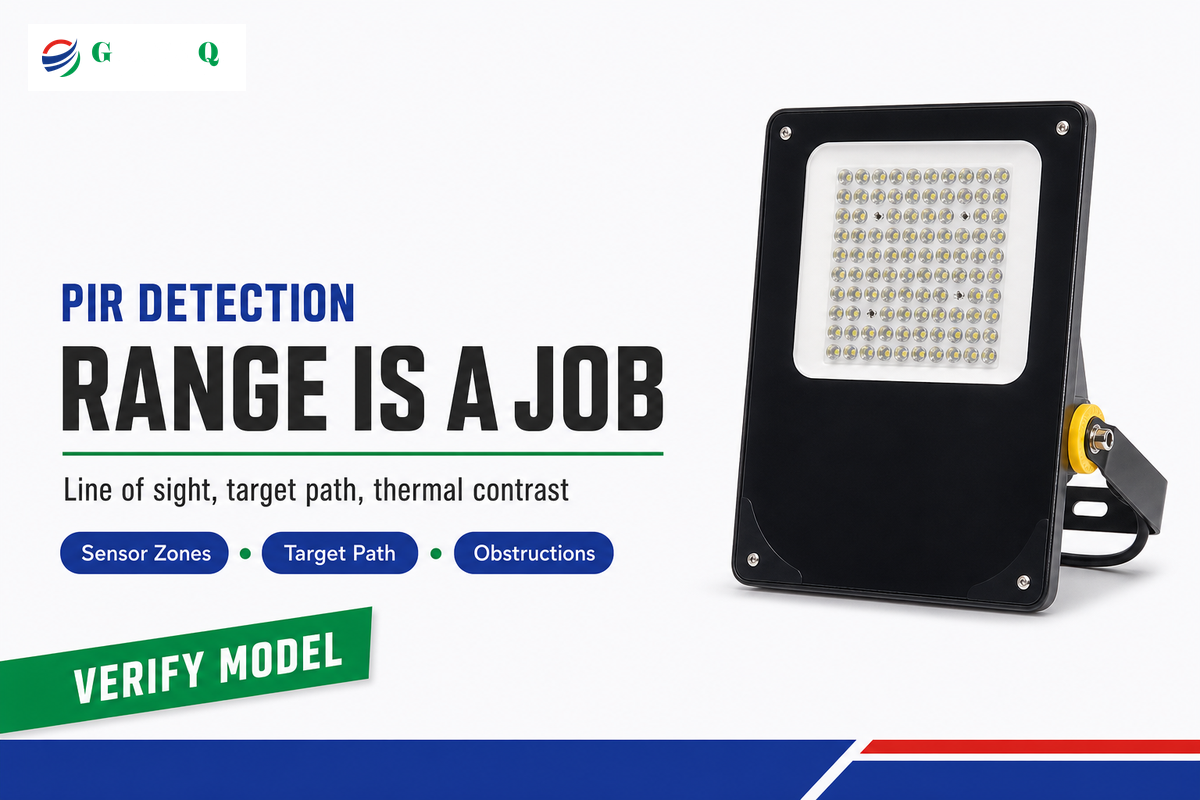
PIR range isn’t one universal number. A PIR sensor responds to changes in infrared energy across lens zones, so detection depends on line of sight, lens pattern, mounting angle, movement direction, target speed, target size, thermal contrast, background temperature, and obstructions. A clear visual path through glass or plastic should still be treated as a selected-model verification question because it may not be a clear PIR sensing path.
Use the next table as a 3-Zone PIR Control Matrix: detection path, mounting geometry, and site interference must all be checked before the quote is treated as comparable.
| Question | Why it matters |
|---|---|
| What detection distance and angle apply to this exact model? | Catalog ranges are not always measured under the same conditions. |
| What mounting height and aiming angle were used? | Height and tilt can move the strongest sensing zones away from the trigger point. |
| Was the range checked with major motion or minor motion? | Walking across a zone and standing with small movement are not the same detection job. |
| What measurement basis or supplier test condition was used? | An unlabeled coverage diagram is harder to compare across models. |
| What target size, speed, and path were used? | Too-fast movement, edge-of-range movement, or a different approach direction can change results. |
| Are glass, clear panels, vegetation, signs, doors, or stored goods in the sensing path? | Obstructions and clear barriers can turn a printed range into a poor field result. |
| Outdoor documentation to request for the quoted model | Wet-location, IP, temperature, corrosion, UV, impact, and vibration notes should be model-specific. |
| Control-driver evidence to request | Switching duty, standby power, surge or EMC immunity, and TLM/flicker data affect acceptance. |
2. Choose Mounting Height Around the Sensor Pattern
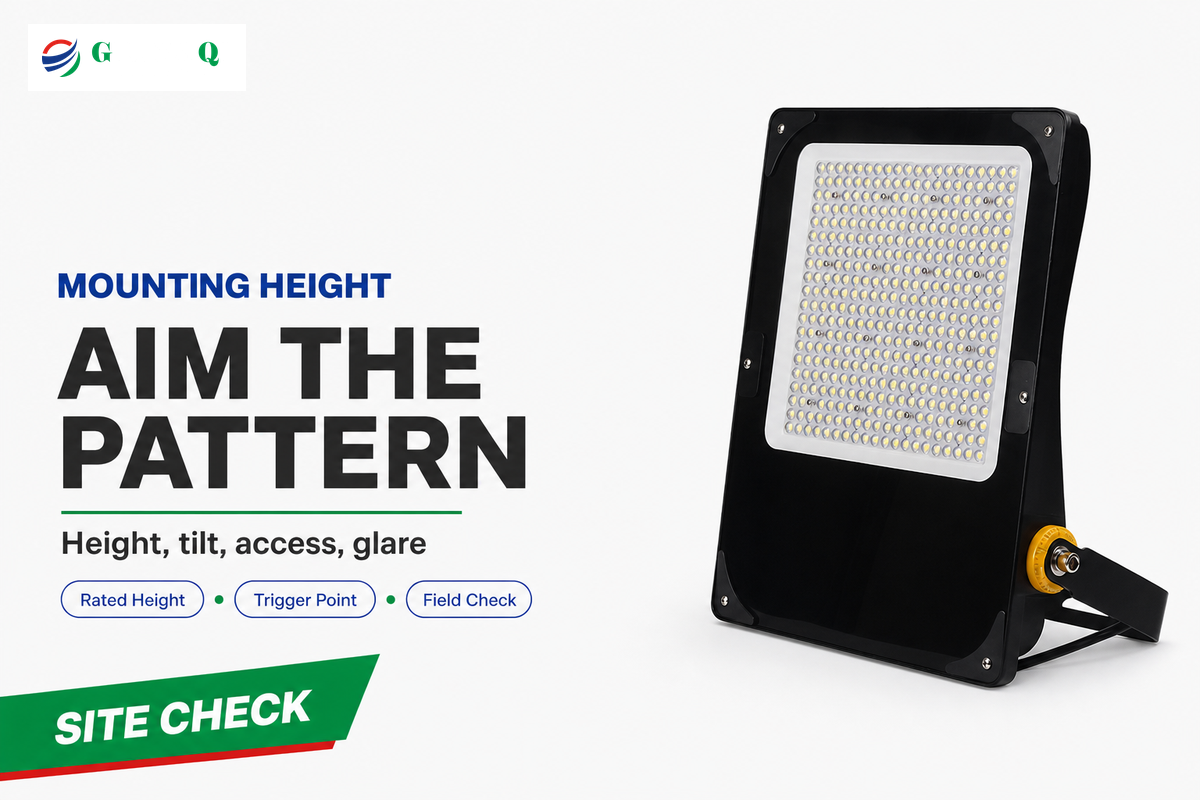
There’s no best mounting height for every motion sensor flood light. A higher mount can widen the lit area and reduce tampering, but it can also make aiming harder and create glare from more viewing positions. A lower mount may improve adjustment access, but it can be easier to block or damage.
Buyer check: mark the expected trigger point on a site sketch, then ask whether that point sits inside the selected model’s detection pattern at the planned height, aim, and sensor-head position. Before handoff, define a simple initial field check: required trigger path, no-trigger boundary, turn-on response, timeout or low-output setting, false-off task, pass/fail result, responsible verifier, and whether one checked unit represents only itself or a sample group. Don’t treat one checked unit as proof that every unit in a multi-fixture order will detect identically.
The supplier should confirm the rated height range, bracket options, sensor-head adjustment limits, shielding accessories, and access needs before the height is fixed. If the sensor pattern can’t be explained at the proposed height, treat the printed range as a starting point, not a design margin.
3. Separate Sensor Coverage from Light Coverage
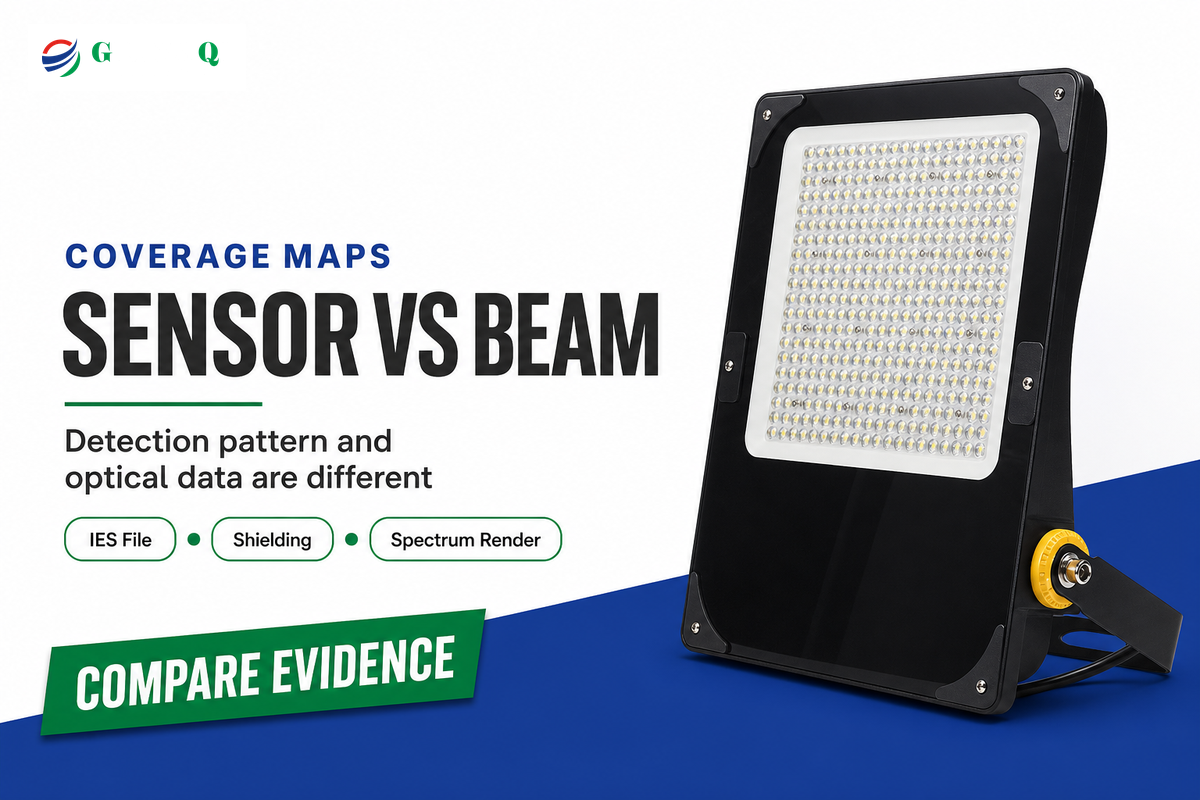
A motion sensor flood light has two coverage maps. The sensor map shows what can trigger the light. The optical map shows where light lands after the fixture is aimed. They can overlap, but they aren’t the same. A product can trigger correctly and still send light into the wrong area, or it can light the right area while missing motion at the edge of the sensor field.
For the light coverage, ask for selected-model photometric data, an IES file, or equivalent measured intensity-distribution data for the configuration being quoted. Also ask for lumen output, input power, efficacy, beam angle, final aim, shielding, and whether the data apply to the planned installed orientation and tilt.
Outdoor coverage also needs glare, spill, uplight, and spectrum discipline. BUG or LCS data can help compare distribution, but it doesn’t prove every viewing position, light-trespass concern, skyglow context, or protected-site decision. Where appearance, neighbors, dark-sky expectations, or habitat sensitivity matter, ask for color temperature and spectral-power-distribution information, and consider a shielded downward fixture or lower-output approach instead of a laterally aimed floodlight.
4. Control False Triggers and False-Off Events
False triggers should be diagnosed from site conditions, sensor condition, and electrical or control symptoms, not from one setting alone. Common site candidates include moving vegetation, animal movement, moving shadows across sunlit surfaces, wind-driven warm objects, direct sunlight, reflected images, adjacent activity in the sensor’s view, mechanical vibration, and poor sensor aim. If the behavior remains unexplained, ask about sensor accuracy or health, control-driver compatibility, undervoltage or other electrical faults, and the service path. For animal-trigger questions, don’t treat all animals as one class; ask how target size, distance, body temperature relative to the background, and movement across lens zones affect the selected model.
Weather and season should be treated as validation variables, not one-direction explanations. Rain, fog, snow, hail, temperature swings, vegetation growth, and high ambient temperature can change field results. When ambient temperature approaches body temperature, reduced thermal contrast can create missed-detection risk. A sensitivity setting that works in one season may need review after the site change.
False-off events are the opposite problem. PIR is strongest when motion crosses sensing zones; it shouldn’t be treated as proof that a person who pauses, stands still, or moves subtly will keep the light on. Where residual visibility is needed at an exterior entry, perimeter, or pedestrian area, ask about maintained low output, longer timeout, manual override, or a different control approach instead of relying only on full-off PIR behavior.
5. Check the Outdoor Boundary Before Ordering
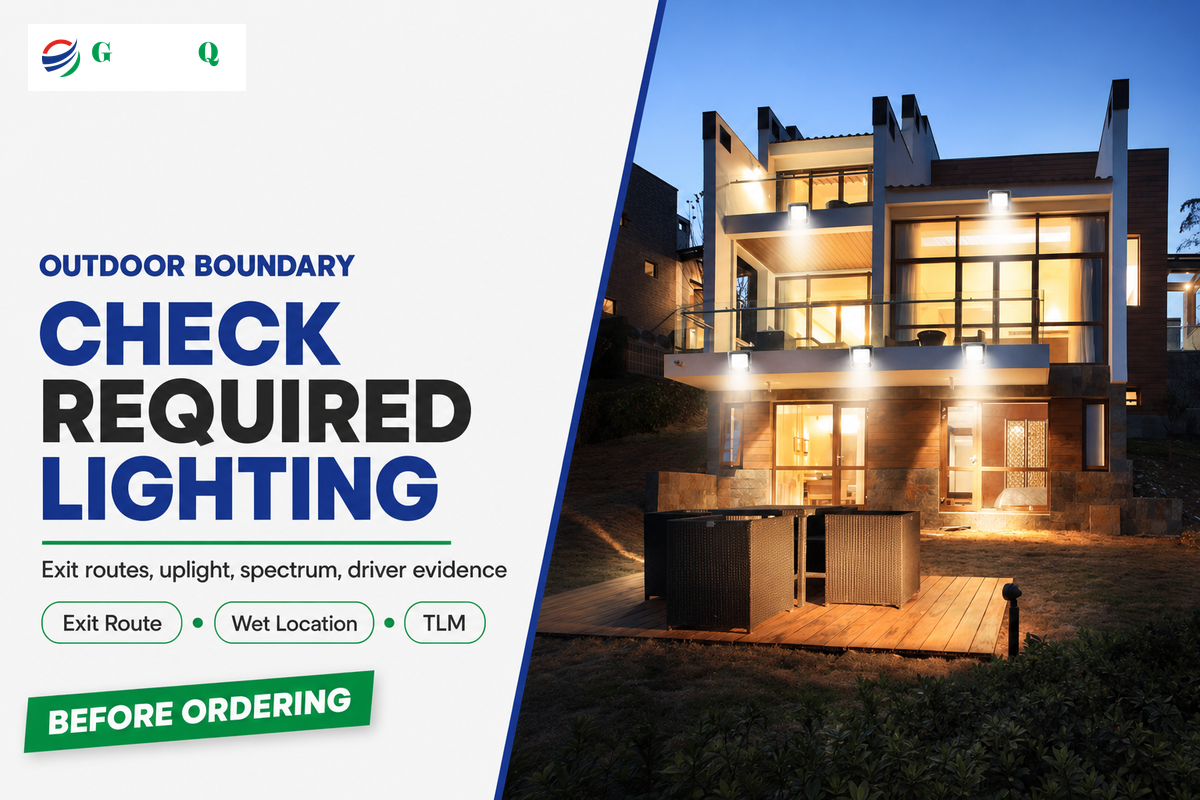
A product quote shouldn’t decide whether motion control is allowed on a required route. If the area may be a U.S. workplace exit route, use that as a recognition trigger for employer-side compliance review before specifying full-off motion behavior. Emergency egress, public-route, security, roadway, and other required-lighting contexts need their own project review.
Keep the outdoor documentation short but explicit. Request wet-location documentation separately from IP information; rated supply nature, input-voltage range, and frequency; operating-temperature limits; corrosion, UV, impact, or vibration notes where relevant; daylight-threshold and photosensor placement basis; control-to-driver and electronic-load compatibility; expected switching duty; surge or EMC immunity where relevant; standby or non-active-mode power if control gear remains energized; sensor service path if the lens is blocked, damaged, or drifting from the intended field of view; and warranty language that separates LED lumen maintenance, driver failure, control failure, and color shift.
For the RFQ schedule, leave value fields blank until the supplier confirms documented entries such as 120 V, 277 V, 50 Hz, 60 Hz, 0 °C, 40 °C, 10%, and 24 hr.
For dimmed, low-output, control-waveform, or full-output states where visual performance, fatigue, health sensitivity, or moving-object perception matters, ask which temporal-light-modulation or flicker metric, waveform, and measurement basis are reported for the selected model. If vehicle triggering matters, don’t rely on a pedestrian walk test; request selected-model evidence for that target and approach or use a sensing method designed for that duty.
6. RFQ Checklist for a Motion Sensor Flood Light
- Detection job: trigger point, approach direction, people or vehicles, target size, target speed, obstructions, and whether anyone may remain still in the lit area. Record site values in the right units, such as 2 m/s movement, 5 m distance, 3 m height, and 0 °C ambient notes where relevant.
- PIR range: selected-model distance, detection angle, major/minor motion condition, measurement basis, mounting height, aiming angle, line-of-sight assumptions, and edge-of-range margin. Do not copy example values such as 10 m or 120° unless they match the selected model’s datasheet.
- Mounting: rated height range, bracket options, sensor-head adjustment limits, tamper risk, adjustment access, and glare from common viewpoints.
- Light coverage: photometric file or measured intensity data, installed orientation, lumen output, input power, efficacy, beam angle, shielding, final aim, uplight/glare screen, color temperature, and spectral data where relevant. Quote electrical values as project facts, for example 100 W or 200 W input class, 220 V or 240 V supply, 50 Hz or 60 Hz frequency, and 110 lm/W efficacy only when documented.
- Controls: sensitivity, time delay, daylight threshold, manual override, low-output option, photosensor placement, control-driver compatibility, switching duty, standby power where relevant, TLM/flicker metric and measurement basis where relevant, initial field-check criteria, sample applicability, sensor or electrical-fault handoff, and seasonal re-check plan. State timing as 30 sec, 5 min, 1 min, or another verified setting, and record any commissioning tolerance such as 10% only when supplied.
- Boundary review: exit-route or required-lighting use, residual-visibility needs, dark-sky or protected-site constraints, outdoor documentation, and warranty or service path.
If the project is ready to compare fixture families, GQ Lamp’s LED flood lights page is the correct internal product path before narrowing the sensor specification.
Need model-level flood-light options?
GQ Lamp supplies outdoor LED flood-light products for buyers who need model documentation, practical fixture selection, and manufacturer communication before project approval.
FAQ
What PIR range should I ask for?
Ask for the selected model’s detection distance, detection angle, mounting-height range, line-of-sight assumptions, major-motion or minor-motion condition, target size, target speed, movement path, and detection diagram. Treat the advertised edge of range as a risk item unless the supplier can support it for the site conditions, especially when a driveway, loading bay, gate, or entry path depends on repeatable detection rather than a best-case catalog claim under one clean test setup and the intended traffic pattern.
What mounting height is best for a motion sensor flood light?
Use the selected model’s rated height range, then verify it against the trigger path. The right height preserves sensor line of sight, keeps the beam on the task area, allows adjustment, avoids glare from common viewing positions, and gives the installer a reachable adjustment point.
Can a motion sensor flood light be used on an exit route?
Don’t decide that from a buying guide. If the area may be a U.S. workplace exit route, treat it as an employer-side compliance review before specifying PIR timeout or full-off behavior. The buying step is only to flag the route, separate required illumination from optional security response, and ask the responsible project party which maintained-lighting strategy is acceptable before the fixture schedule is frozen and before any full-off control sequence is promised and approved by the responsible safety reviewer.
How do uplight and spectrum fit into the purchase?
Motion control shouldn’t be treated as proof of lower operating time or energy savings if the sensor is poorly placed, misconfigured, or bypassed. It also doesn’t automatically solve glare, spill, uplight, excessive output, or spectral concerns. Ask for aiming, shielding, selected-model photometric data, color temperature, and spectral-power-distribution information where the site calls for it.
Does one site check prove year-round PIR performance?
No. One check represents the temperature, weather, vegetation, target movement, and setup conditions during that check. Plan a seasonal review after vegetation growth, cleaning, re-aiming, changed obstructions, or repeated false triggers, especially when summer heat or winter contrast changes the PIR result.
What causes false triggers?
Possible false-on candidates include moving vegetation, animal movement, moving shadows, wind-driven warm objects, direct sunlight, reflections, adjacent activity, vibration, and poor sensor aim. Background temperature and weather can also reduce thermal contrast and create missed-detection risk during actual site commissioning.
References & Sources
- Better Buildings Solution Center, Exterior Lighting Control Guidance.
- UC Davis CLTC, Exterior Occupancy Sensor Development.
- Office of Justice Programs, Passive infrared intruder sensor reliability evaluation.
- DOE, TM-37 responsible outdoor lighting impact summary and Color and Spectrum.
- DOE FEMP, Purchasing Energy-Efficient Commercial and Industrial LED Luminaires.
- DOE SSL, Flicker Basics and Flicker Research; CIE, Visual Aspects of Time-Modulated Lighting Systems.
- DOE SSL, Sensors and Fault Detection.
- USGS, Variation in detection among passive infrared triggered-cameras.
- California Energy Commission, 2025 NRCA-LTO-02-A Outdoor Lighting Controls.
- NIST, LEDs Get a Life Sentence.
- National Park Service, Outdoor Lighting Principles.
- ANSI Webstore, NEMA JSC 10410-2023 lighting controls and switching devices with electronic drivers.
- IEC Webstore, IEC 61547:2020 electromagnetic immunity requirements and IEC 61000-3-2 harmonic current emissions.
- OSHA, 29 CFR 1910.37 Maintenance, safeguards, and operational features for exit routes.
- GQ Lamp, About Us and LED flood lights.
Trending now
![Industrial LED Bulbs: Bases, Voltage & Heat [Checklist]](https://gqlamp.com/wp-content/uploads/2026/10/industrial-led-bulbs-blog-featured-150x150.png)