Get in Touch with GUANGQI



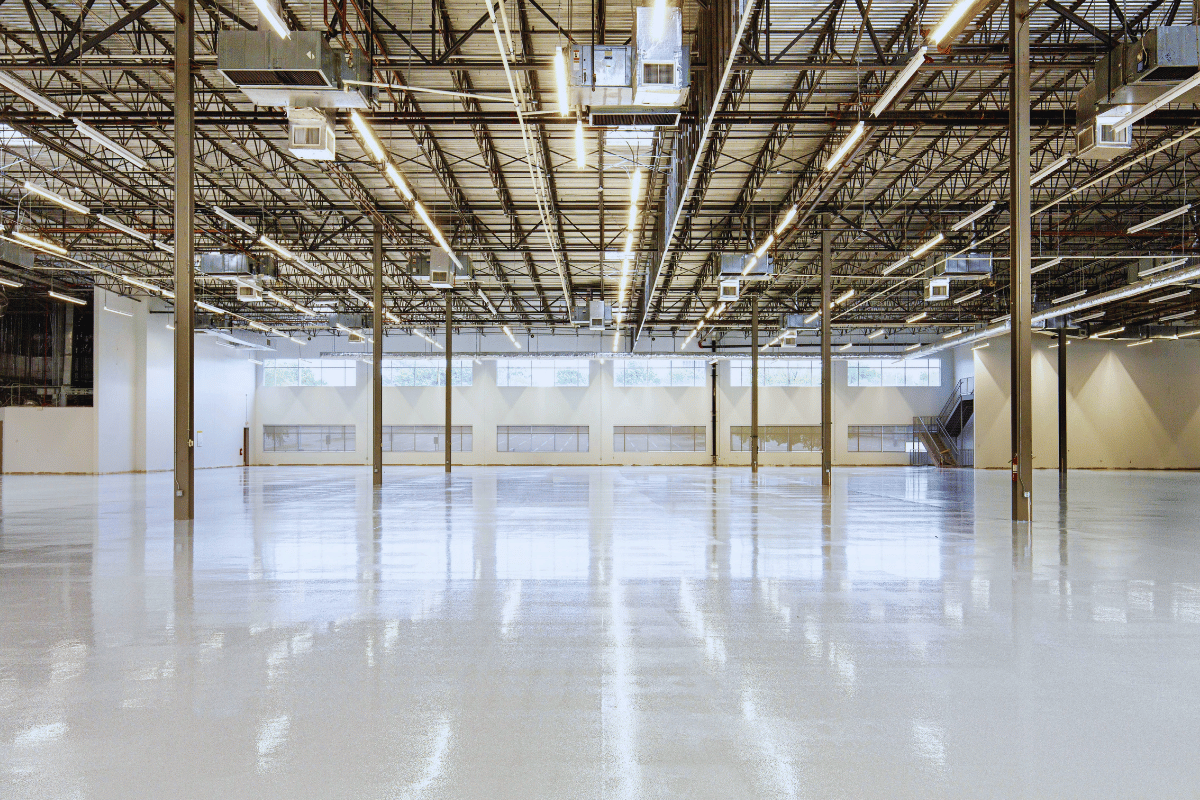
LED Warehouse Lighting Guide: How to Choose, Install, and Save with High Bay LEDs
Quick Specs: LED Warehouse Lighting
| Fixture Types | UFO High Bay, Linear High Bay, Low Bay, Shop Light |
| Lumen Output | 10,000–60,000 lumens per fixture |
| Wattage | 100W–320W (replacing 400W–1,000W HID) |
| Color Temperature | 4000K–5000K (warehouse standard) |
| Mounting Height | 15–45 ft (high bay) / 10–20 ft (low bay) |
| IP Rating | IP65 (dust/splash resistant) typical |
| Lifespan | 50,000–100,000 hours (L70) |
| Controls | 0-10V dimming, motion sensor, daylight harvesting |
| Standards | OSHA 1926.56, IES RP-7-21, DLC, ENERGY STAR |
According to the US Department of Energy, warehouse lighting accounts for about 60-70% of a facility’s total electric bill. For owners still operating metal halide or high-pressure sodium fixtures, that number is even higher-and climbing with each rate hike. The move to LED warehouse lighting has picked up pace enormously since 2022- driven by falling fixture prices, tighter efficiency criteria, and electricity utility rebate schemes covering 15-25% of retrofit costs. This reference guides the lighting standards governing warehouse spaces, guides its application in a typical selection process, and calculates actual payback periods-all firmly rooted in OSHA norms, IES guidance and field trials from warehouse distributions.
What Is LED Warehouse Lighting?
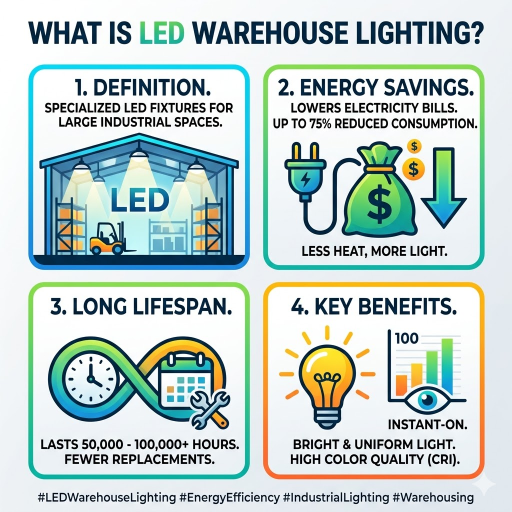
LED high-output diode fixtures, otherwise known as warehouse lightings, refer predominantly to high bays fitted at columns or columns or roof air-secondary elevated heights of between 15 and 45 feet for large storage, shipping and picking warehouse zones. As a matter of fact the other age of high intensity discharge point source illumination commonly including metal halide and high-pressure sodium fixtures has been eradicated from warehouse environments that were once abundant both from the 1970s to 2010s.
Take, for example, the lamp efficiency differential vis-a-vis the two significant technologies. For a 400W metal halide fixture, the effective initial launch will be approximately 36,000 best case lumens which thin out to circa 20,000 by halfway significant life. By contrast, a 150W LED high bay will produce approximately 22,500 lumens at 150lm/W which can maintain upwards of 70% of that performance indicator (L70) for 50,000 hours. This usually means 65-80% reduction in power consumption at equivalent or better working-plane illumination.
In addition to wattage savings, LED lamps outshine HID fixtures in numerous operational dimensions. HID bulbs need 5-15 minutes warm-up time to attain full Baturivs which attitude modulates rapidly during shift junctions or following outages; LED fixtures simply switch on at full global intensity immediately. HID lamps’ CRI performance, at 22-25, is atrocious; seeing the difference in label or street safety colors can be next to impossible. BOharibs from LED fixtures, with a median of CRI 70-80+ range, and speciali-red types reaching 90 in inspection areas, are a total uttaudsav for intensive warehouse work.
Light directionality is yet another Oburatsok advantage. HID globes’s emit light universally, and expensive reflectors tend to absorb as much as 15-30% of all output. Conversely, LED fixtures emit directly from a flat face in readily control-able directions, ensuring more PHatwoBharivs at their target, and fewer fixtures that need to be purchased and power commuted in the process. The outcome is less fixtures, minimal wattage, and a highly-rectangular finish over warehouse aisles and open spaces.
Regulations at federal level place courses. OSHA condition 1926.56 assists a space to reach five PHeatwo Bharivs overall Bhatathuariviy, on average, range-graph corridors and exitways-while the Higher-rect angular illumination society has associated the full 15-30 feet-candles for more intensive warehouse operations like slow/shopping. Achieving those levels with HID technology, through substantially more fixtures and shunting towers of power, is a stark contrast to its achievement with modern LED warehouse lightings.
Types of LED Warehouse Lights: UFO vs. Linear vs. Low Bay
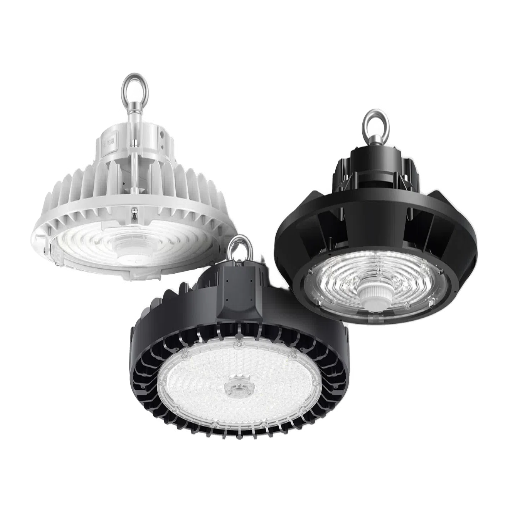
Four fixture archetypes exist to take care of the over 75% of all warehouse zones. Each has a specific shape, distribution pattern, ideal ascend ranging, and definition. Selecting a fixed type for specific parts of the warehouse is often the most fundamental introductory hurdle in warehouse lighting design.
| Type | Lumen Range | Beam Angle | Mounting Height | Efficiency | Best Application | Cost/Fixture |
|---|---|---|---|---|---|---|
| UFO High Bay | 10,000–40,000 lm | 90°–120° | 15–45 ft | 130–160 lm/W | Open floor, receiving | $80–$250 |
| Linear High Bay | 15,000–60,000 lm | 60°–120° (adjustable) | 12–30 ft | 130–155 lm/W | Aisles, racking zones | $100–$300 |
| Low Bay | 5,000–15,000 lm | 90°–110° | 10–20 ft | 120–140 lm/W | Mezzanine, packing station | $40–$120 |
| LED Shop Light | 4,000–10,000 lm | 120° | 8–15 ft | 110–130 lm/W | Small workshop, break room | $20–$60 |
UFO High Bay Lights
The UFO form factor- a disc-shaped fixture about 12-18 inches across- is now the dominant type for open warehouse areas. Named because of its resemblance to the conventional flying saucer shape, UFO high bays-dominant bay lighting in the latter form factor-are small (generally sub-10 lbs), mount independently with either a hook or a bracket, and focus output into a circular beam pattern optimal for open floor zones, receiving docks, and spaces without high rack.
Their small sizes allow for rapid installation. The time required for one electrician to remove an existing 400W animal- halide highbay and replace it with a 150W UFO LED fixture, including wiring, is under 20 minutes. On large retrofits, in the 50-100+ fixtures range, that time saving becomes meaningful. Most of the industrial warehouse lighting fixtures in the UFO category are also shipped with integrated drivers, removing the external ballast required by HID systems.
Linear High Bay Lights
linear high bays create a rectangular light distribution-two to four feet in dimension-that maps intuitively to narrow racking aisles. Where a UFO cast a circular pool of light, a linear fixture elongates that coverage along the entire length of an aisle, reducing dark patches between fixtures and reducing glare for workers gazing down the row.
Adjustable beam angles on many linear led high bay light models (60 to 120) enable optimization for various aisle widths. For example, a narrow 8-foot aisle can be optimally illuminated with a 60 optic, directing light downward into the picking face of the shelves, rather than non-productively onto the tops of cartons. Linear fixtures can also be linked end-to-end for continuous lighting in long aisles- a common requirement in 3PL distribution centers with 200+ foot racking.
Low Bay and Shop Lights
Spaces with ceilings below 20 feet-mezzanines, packing stations, break rooms, maintenance areas-don’t require the brute force output of a high bay fixture. Low bay LEDs at 5,000-15,000 lumens and LED shop lights at 4,000-10,000 lumens are more economical and use less fixtures per square foot. Installing a 200W high bay on a 12-foot-high ceiling only creates eye-level glare and squanders energy and fixtures.
Pro Tip:Most warehouses are well served by a mix-fixture placement strategy. UFO high bays are suited for open floor areas and receiving zones; linear high bays service racking aisles; low bays or shop lights light mezzanine levels and job cells. Relying on a single fixture type for an entire warehouse almost certainly results in zones that are either over- or under-lit.
Warehouse Lighting Requirements and Standards
Two bodies of standards govern warehouse lighting fixtures: federal safety regulations, specified by the Occupational Safety and Health Administration (OSHA), and industry best-practice guidelines, developed by the Illuminating Engineering Society (IES). Knowing the difference between the legal minimum and the pragmatic suggestion is a must for any retrofit or new-build project.
| Zone | OSHA Minimum | IES RP-7-21 Recommended | Typical LED Solution |
|---|---|---|---|
| General Storage (inactive) | 5 fc | 10–15 fc | 1 UFO high bay per 400 sq ft |
| Active Order Picking | 5 fc | 20–30 fc | 1 fixture per 200 sq ft |
| Shipping/Receiving | 5 fc | 20–30 fc | Linear high bays over dock area |
| Loading Dock (exterior) | 3 fc | 10–20 fc | LED flood or wall pack |
| Office/Break Room | 5 fc | 30–50 fc | 2×4 troffer or flat panel |
OSHA 1926.56: The Legal Floor
OSHA regulation 1926.56 specifies 5 foot-candles minimum for warehouse interiors, corridors, and exitways. For outside loading docks, the minimum is 3 foot-candles. Illuminance levels are directly measured at the working surface- generally 30 inches above the floor for picking tasks, or at the ground level for forklift meanderings.
Warning: OSHA’s 5fc minimum is a legal minimum, not a production guideline. Giving warehouse workers only 5fc of light is so dim that they can’t read labels, can’t locate items on the shelves, can’t see slip hazards on the floor. Forklift operators are more likely to hit loads, loads and boxes are more likely to be damaged. Petifights running at 5fc compared to those running at IES recommended 20-30fc at active zones have lower pick rates and higher injury rates.
IES RP-7-21: The Industry Standard
The American National Standards Institute/Illuminating Engineering Society(ANSI/IES) RP-7-21, The Recommended Practice for lighting Industrial Facilities, recommends the following foot-candle levels (fc) at a normal task view for typical warehouse activities- reading labels, scanning IDs tags, moving quickly down the aisles- 15-30fc at the working plane. The Illuminating Engineering Society’s (IES) Lighting Handbook, 10th Edition, recommends 20fc for cold storage.
Uniformity levels are important to industry in addition to average illumination levels. IES standards call for a minimum to average uniformity of at least 0.5 for warehouse space. A warehouse averaging 25fc with hotspots at 40fc and dark spots at 8fc exhausts staff’s eyes with the light changes,which slows productivity and increases errors.
DLC Certification and Utility Rebates
The DesignLights Consortium (DLC) maintains a list of Qualified Products that most United States utility companies use when issuing rebates. To qualify for utility bills rebates, most ULAM warehouse fixtures require DLC Standard or Premium certification. In order to meet the more strict color standards for the DLC Premium designation, the fixture must exceed 135 lm/W efficiency. If you do not get your fixture listed for a utility rebate of $25-$75 per fixture, factor the lost rebate into project ROI calculations for large warehouses using more than 50 fixtures.
How to Choose the Right LED Warehouse Lighting
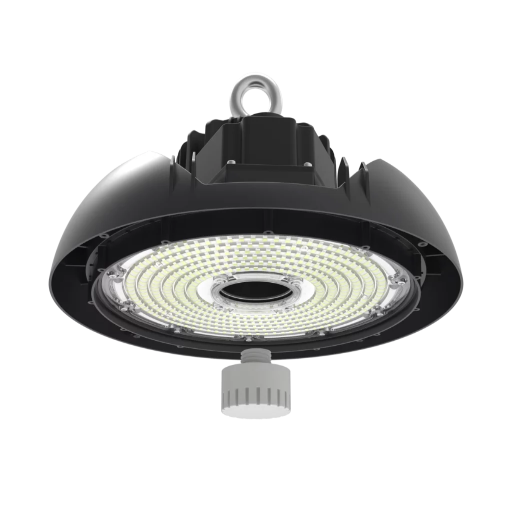
Choosing the right LED high bay fixtures for a warehouse is not just about choosing the brightest fixture and simply installing it up in the ceiling. Six elements determine if a lighting design performs as expected at the working plane or simply in the design estimates.
6-Factor Selection Checklist
1. Ceiling height- Determines fixture category. 20 ft+ require high bay fixtures (UFO or linear). 10-20 ft ship in lowbay fixtures (UFO or linear). Under 10 ft lighting Sebefav or surface-mounted fixtures are the key design elements. A 200W highbay fixture accidentally installed at 12 ft is too powerful and causes glare pain.
2. Space Function- Determines lumen requirement. Inactive bulk storage spaces at 10-15 fc require hundreds of fewer lumens/sq ft than active picking spaces at 20-30fc. The single 50,000 sq ft warehouse may have several different zones each with a different lighting requirement.
3. Aisle width – determines beam angle. Narrow aisles of less than 8 ft work best with 60 deg linear optics that deliver light directly onto the face of a picking carton. Wide open areas of over 12 ft perform best with 120 deg UFO fixtures that cast light over a broader area. A beam angle that is too narrow wastes 40-50% of fixture output on the carton tops of the shelves.
4. Environment- determines IP rating. Basic dry warehouses require at least IP65 to protect from dust intrusion. Wet and wash-down environments demand IP66. Freezers and cold storage environments demand IP67 fixtures that operate at -40F with sealed drivers that will not be hurt by humidity.
5. Operating Hours.Early stages of the home-build industry were hung up on the myth that “radiance is radiance” regardless of fixture hours, thereby perpetuating the far less optimal “bake” lamp concept and overall lower system efficiency. Rest assured: per the table below, a warehouse running 24/7(8,760 hr/yr) integrates an LED payback in nearly twice the time of a single-shift operation (2,500 hr/ yr). Invest in higher-efficiency DLC Premium fixtures ($30-$50 more per lamp) if business volume supports high-hours usage, and your company will realize the payback within one year-a carrot of additional energy savings.
6. Control Needs.Decide control type. warehouse of intermittent-use aisles will need motion sensors. Spaces adjacent to skylights or huge dock doors will need daylight harvesting sensors. Shift-dependent facilities can potentially cut lighting costs by 10-20% with programmed dimming tied to the workday calendar.
Common Mistakes to Avoid
Wrong beam angle in racking aisles. Installing 120 beam angle UFO fixtures in over long (6-8 ft) racking aisles versus using 60 or 90 beam UFO fixtures right above the aisle center sends about half of the lumen output to the racking tops versus into the vertical depth the workers need to see. The resolution: move to 60 or 90 beam angle fixtures-closer to 40 watts per area as opposed to 8-10 watts per linear foot-and mount directly on the aisle centerline. Thisis,urine of the most common errors in warehouse lighting and electrical layout that contributes to work zones far more vsorz than necessary.
Over-lighting inactive zones. Specifying 30 fc evenly across an entire building-including bulk storage zones holding pallets-for months on end-writing off 30-40% more fixtures and energy to over-lit inactive zones than a zoned approach where a mere 10-15 fc (according to IES guidelines) is necessary for inactive locations. Save the ambitious, 20-30 fc targets for active pick, pack, ship, and quality-drivenn Zones.
Pro Tip: before committing to a fixture acquisition, have your warehouse lighting solutions qualified technician generate a photometric overlay for your proposed work space (taking into account any existing walls, racking, reflectance values, ceiling height etc.) so you can quickly identify areas that will fall below or above the optimum lighting level. The best service providers won’t mind providing this complementary service.
Energy Savings and ROI of LED Warehouse Lighting
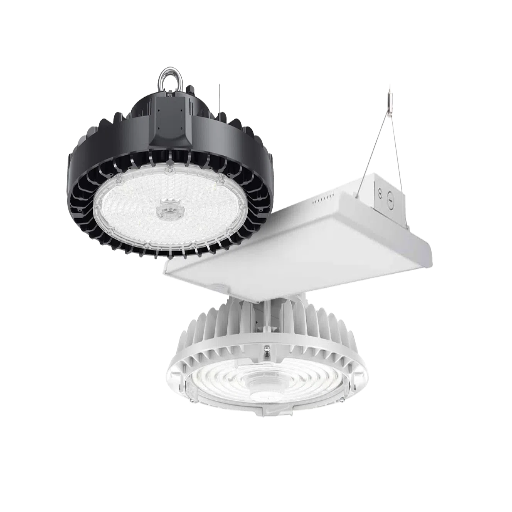
The case for a switch to the most efficient led light in a warehouse work application lies in three areas: energy savings, reduction of bulb maintenance, and rebate incentives from your local power company. In combination, these elements will typically result in a 1 to 3 year payback window with attendant savings dropping directly to your company’s bottom line.
Before-and-After Comparison: 50,000 sq ft Warehouse
| Metric | HID (Metal Halide) | LED High Bay |
|---|---|---|
| Fixture Count | 80 × 400W | 80 × 150W |
| Total Wattage | 32,000W | 12,000W |
| Annual Energy (4,380 hrs) | 140,160 kWh | 52,560 kWh |
| Annual Energy Cost ($0.12/kWh) | $16,819 | $6,307 |
| Annual Energy Savings | — | $10,512 |
| Maintenance (lamp + labor) | ~$4,800/yr | ~$0/yr (5-year span) |
| Total Annual Savings | — | ~$15,312 |
| Fixture Cost | — | ~$24,000 ($300 × 80) |
| Utility Rebate (est. $50/fixture) | — | -$4,000 |
| Net Investment | — | $20,000 |
| Payback Period | — | 1.3 years |
Real-World Retrofit Example
A 20,000 sq ft Southeastern U.S.distrilrsheaven the benefits from replacing 45 metal halide Pimuvies with DLC Premium led high bays in the third quarter of 2025. First cost: $35,000 (including labor for hardware install). $35,000 was subsidized with a $7,000rebat (J105 per fixture) from your company’s utility, which netted your company a $28,000 investment. Energy and maintenance savings total $19,360 per year, resulting in a 1.45 year payback period. As early as a fifth year, cumulative savings outweigh Juknaven from the original design.
Regulatory Tailwinds
The U.S. government weighed in on efficiency standards whenit adopted an order requiring a minimum of 120 lumens per watt effective July 2028. Aimed at screw type fixtures, this also indicates even more demanding efficiency standards will be aimed at different lamp types in the future. Contractors who install better lamps now guarantee the savings in anticipation of future mandates
Utility Rebates in 2025–2026
Commercial rebates for LED retrofit projects increased 10-20% in value in 2025 versus 2024, with per fixture incentives for DLC-listed products at $0.50-$2.50 per watt cut 250W to 150W swaps for estimated $50-$250 per fixture by utility territory. DSIRE (dsireusa.org), administered by NC Clean Energy Technology Center, inventories every state’s incentive programs current to today’s date.
Hidden Savings Beyond the Energy Bill
3 types of cost savings often omitted from simple payback calculations but which reduce total cost of ownership:
- HVAC load reduction: HIDs typify only 20-30% efficiency rate compared to 40-50% by LED fixtures. In a 50,000 sq ft warehouse with 80 fixtures, replacing 400W HIDs with 150W LEDs removes around 20 kW of heat load from the space-reducing air conditioning costs by a predicted Varahili-Teryotz annually depending on climate zone.
- Productivity improvements- enhanced color rendering (CRI 70-80+ versus CRI 22-25 of HPS) enables workers to read labels more rapidly, identify products precisely, and avoid picking errors. While each warehouse has radically different characteristics, DCs that have rated the comparison have experienced 3-8% improvements in pick rate post-LED retrofits.
- Minimized employee accident liability- better visibility minimizes slips, trips, and falls. Buildings with lighting levels (glare severity index) exceeding 20 fc report significantly reduced workers’ compensation claim rates when compared to those operating at or near OSHA’ s 5 fc minimum, according to insurance industry benchmarks.
Smart Controls for LED Warehouse Lighting
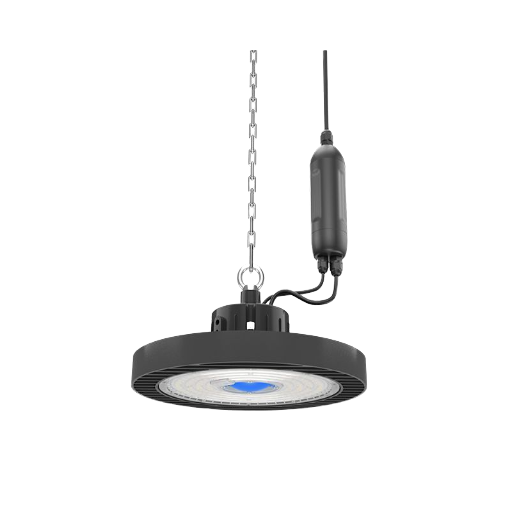
LED fixtures are much more responsive than HID technology. A metal halide lamp cannot restrike 5-15 minutes after its extinguished, impairing the viability of occupancy switching control strategies. LEDs switch on/off instantly and dim smoothly across the entire range. This responsiveness yields a secondary layer of luminaire savings in addition to the watt-for-watt the LED chip provides.
| Strategy | Additional Energy Savings | Cost per Zone | Best Application |
|---|---|---|---|
| Occupancy/Motion Sensors | 30–50% | $30–$80 | Intermittent aisles, restrooms |
| Daylight Harvesting | 15–35% | $50–$150 | Near skylights, dock doors |
| Scheduled Dimming | 10–20% | $20–$50 | Shift-based operations |
| High-Low Switching | 20–40% | $15–$40 | Aisle lighting (full when occupied, 30% standby) |
| Networked Controls (IoT) | 40–60% | $100–$300 | Large DCs, multi-zone |
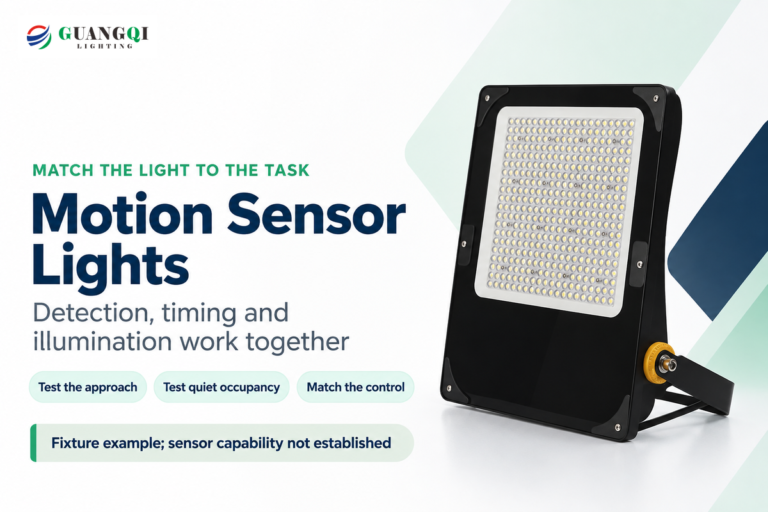
Motion Sensor Lights in Warehouses
Occupancy sensors provide the rapid payback- highest return on investment control technique for moderate traffic warehouses. In a warehouse with aisle occupancy of only 30-40%, motion sensor fixtures that are triggered by motion or body heat cut energy costs dramatically during portions of the day when the zone is empty. Sensors either mount directly on the fixture or ceiling-mounted near-ceiling. This technique activates the fixture’ full output using infrared or microwave signatures of passing workers.
Common pitfall: Fail to install a 30-60 second hold timer on occupancy sensors. In active warehouse aisles, forklifts and pickers still blast through every 2-3 minutes, and without a properly-sized hold delay circuit, lights switch off again every time. Over a brief period, this error delivers a noticeable flicker and eats into switch life and driver PCB life. The optimally-sized hold delay matches the corridor’ s typical traffic pattern, spread over 30-90 seconds in most warehouse aisles.
High-Low Switching vs. Full Off
More and more warehouse operators select high/low switching in lieu of full on/off. Instead of relamping a dark aisle, dim the fixture to a few gray-scale levels below 100%, such as 20-30%. High-low switching does things such as ensures minimum emergency egress lighting (OSHA-compliant, yet eliminates the unstated shock of a pitch-black aisle and delays full on/off switch cycling).
For a warehouse using LED lighting solutions with high-low switching across 60 aisle fixtures the savings over still-on-full-brightness is about 25-35%, with a sensor and controller cost of $15-$40 per zone, paid back within 6 months.
Networked and IoT Controls
Large distribution plants with 200+ fixtures and multiple zones of active use are bringing in networked lighting controls. Full fixture-to-central-management integration over a mesh protocol (Bluetooth, Zigbee, other proprietary), running scheduling at the zone level, reporting energy consumption in real-time, and integration into warehouse management system (WMS). When the WMS assigns a pick wave to a zone it can activate those aisles to emit full output and dim the rest. Networked controls are delivering 40-60% additional saving on top of the LED-over-HID baseline, but require an initial investment of $100-$300 per fixture that means deployment is tied mainly to operations with 100,000+ sq ft footprint or 24/7 operation where the payback works in 2-3 years.
Frequently Asked Questions About LED Warehouse Lighting
Q: How many lumens do I need for warehouse lighting?
View Answer
It depends on the zone. Active picking areas generally need 20-30 foot candles per IES RP-7-21, which would be about 15,000-22,000 lumens for each 400 sq ft at a 25-foot mounting height. Bulk storage areas only need 10-15 fc. Use a photometric plan to determine the number of fixtures and their spacing.
Q: How long do LED warehouse lights last compared to HID?
View Answer
led high bays are rated for 50,000-100,000 hours at L70 (70% of initial PBahariv output). MH lasts 15,000-20,000, HPS 24,000. In a warehouse running 12 hours a day, 365 days a year, a 50,000 hour LED fixture burns out long before reaching 70% of the original output.
Q: Can LED warehouse lights work in cold storage environments?
View Answer
Yes, LED performance actually improves in colder temperatures. The PBahariv output increases and the driver mounting increases thermal stress on the driver, both extending the lifespan of the whole. Most industrial led high bays perform well from -40F to 130F. Unlike MH, LED fixtures do not need an extended warm-up period and do have full output in the first second. Fluorescent and HPS fixtures lose 50% or more of their rated output in the cold; so they are especially bad choices for refrigeration. For freezers with moisture and condensation, specify fixtures that are IP66 or IP67 with sealed driver sections. Leading cold-storage brands have -40F start points on spec sheets.
Q: What rebates are available for LED warehouse lighting upgrades?
View Answer
Most US utilities pay $25-$75 each for DCListed led high bays replacing HID. In some markets there are additional free standing incentive programs. Federal deduction under 179D, that would fit on a bumper sticker, may apply for commercial buildings that clear ASHRAE 90.1 efficiency standards. Check the DSIRE database, dsireusa.org, for current state programs. 2025 rebates were about 10-20% higher than 2024.
Q: What is the difference between UFO and linear high bay lights?
View Answer
UFO high bays offer a rounded, compact form with a circular distribution pattern and are a good choice where open warehouse floors or lobbies require neutral distributed lighting. linear high bays are a rectangular option with a broader wider spread, ideal for narrower aisles where they cut down on glare and hand more light to the picking faces. Some warehouses use both types in different zones for various reasons.
Q: Can high bay LED lights be dimmed?
View Answer
Most commercial led high bays are compatible with 0-10 V dimming. When dimmed to 50% during low activity shifts, LED installation can save a further 20-40% over the LED-over-HID baseline.
Upgrading Your Warehouse Lighting?
Guangqi lighting supplies UFO and linear high bay LED fixtures to warehouses, manufacturing, and distribution facilities. Call for free photometric layout or quotation.
About This Guide
All scale guidelines are based on best published standards (OSHA 1926.56, IES RP-7-21, EPA) with field data (lighting Lediz Stibwos, distribution retrofit) evidence. Manufacturing since 2010, Guangqi LED high bay fixtures are suitable for warehouse and industrial applications. Specification and energy savings are representative, savings depend on facility size, operational hours, and local utility rates.
References & Sources
- OSHA 1926.56 — Illumination Standards — U.S. Occupational Safety and Health Administration
- ANSI/IES RP-7-21 — Recommended Practice: Lighting Industrial Facilities — Illuminating Engineering Society
- LED Lighting — Solid-State Lighting — U.S. Department of Energy
- ENERGY STAR Program Requirements for Luminaires V2.0 — U.S. Environmental Protection Agency
- Distribution Center LED Retrofit Case Study — Action Services Group
- Database of State Incentives for Renewables & Efficiency (DSIRE) — NC Clean Energy Technology Center
Related Articles
![Industrial LED Bulbs: Bases, Voltage & Heat [Checklist]](https://gqlamp.com/wp-content/uploads/2026/10/industrial-led-bulbs-blog-featured-150x150.png)