Get in Touch with GUANGQI



Quick Specs
| Voltage Options | 12V (low voltage) or 120V (line voltage) |
| LED Wattage Range | 9W – 75W (replaces 100W – 500W incandescent) |
| Lifespan (LED) | 30,000 – 50,000 hours |
| Waterproof Rating | IP68 (submersible) |
| Color Options | White LED, RGB, RGBW, RGBWW |
| Installation Depth | 18–24 inches below waterline (standard) |
| Code Standard | NEC Article 680 / UL 676 |
Your swimming pool light is much more than a source of illumination for your nighttime swim. Your swimming pool light is the defining romantic element, designed to illuminate your pool in the darkness, and just as importantly preventing you and your guests from getting injured when you step outside after the sun goes down. Whether you are installing your new first inground pool or replacing the 20 year old halogen lights you used to have, deciding on your ideal swimming pool light impacts your savings, your safety, and your backyard oasis at night.
Here are all the answers to your decision making questions with regard to swimming pool lighting: types of lights, electrical voltage and codes, lighting options and sizing, installation, and the test of time.
Table of Contents
- A Swimming Pool Light What Is It?Different Types and How Do They Work
- 12V compared to 120V pool lights. Voltage, safety and the Need for the NMESC Code.
- Pool Light Colors: White LED, RGB, and RGBW Simply Put
- How to Select the Appropriate Pool Light for Your Pool
- Pool Light Mounting: Old and new. Position and spacing. Wiring operation.
- Pool Light Maintenance, Troubleshooting and Replacement
- Frequently Asked Questions
What Is a Swimming Pool Light? Types and How They Work
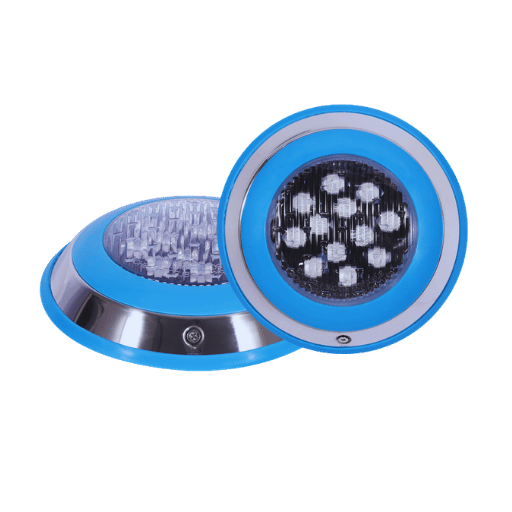
Pool lights are underwater lights that can be attached to the interior walls, floors, or stairs of a swimming pool in order to light the water from within. Underwater pool lights must be either 12 Volts or 120 Volts, have a proper waterproof rating (IP68), and be integrated into a separate electrical circuit with GFCI protection. They 3 uses are for visibility and safety for swimmers, aesthetic ambiance, and Nighttime security.
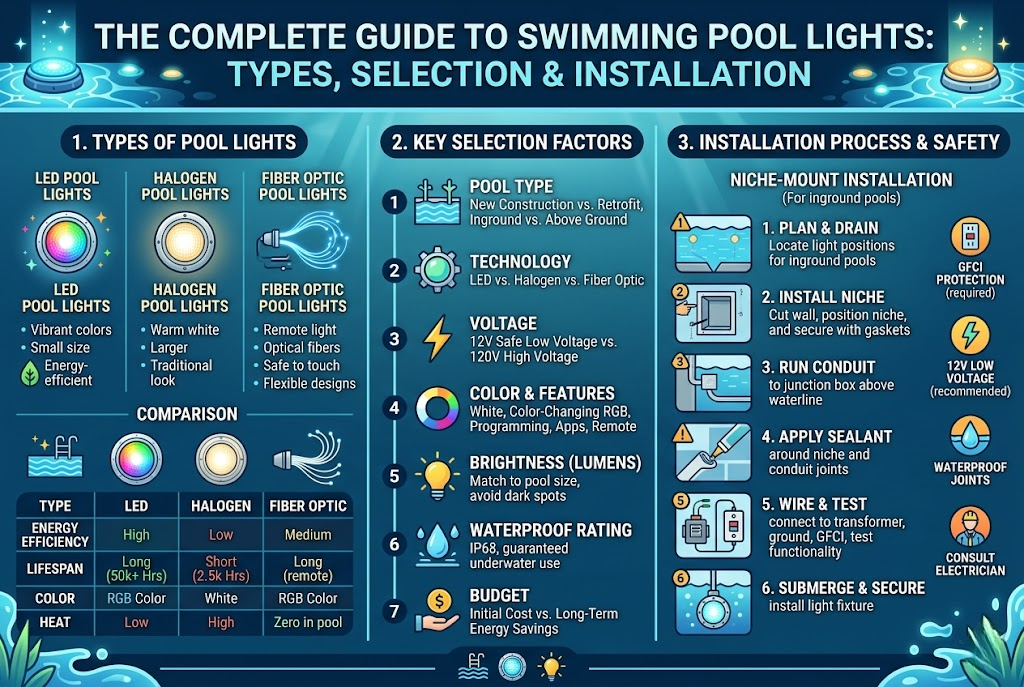
Professional pool builders identify five types of pool lighting depending on how it is installed. Each type is able to accommodate a different type of pool built, retrofit pool as well as related to various budgets. Moving away from incandescent lights and halogen pool lights to LED have been remarkable in magnitude: 90% of US households are now using LED as their primary lighting source according to the U.S.
Energy Information Administration, and a 45W LED pool light is approximately equivalent to 300W of incandescent in terms of light output, but 85% less energy. U.S. Department of Energy testing states so.
Here is a comparison of the five major types. For a complete list of swimming pool light features and options see the pool lights product resource page.
| Type | Installation | Wattage (LED) | Best For | Price Range |
|---|---|---|---|---|
| Inground Niche | Large recessed housing set in pool wall during construction | 25–75W | New inground pool builds, high-output needs | $300–$800+ |
| Nicheless | Fits into standard 1.5″ return fitting; no large niche needed | 9–30W | Retrofits, spas, tanning shelves, tight spaces | $150–$400 |
| Surface-Mount | Bolted to pool wall or floor surface; no recess | 12–40W | Commercial pools, concrete/fiberglass retrofits | $100–$350 |
| Floating | Battery- or solar-powered; sits on water surface | 1–5W | Parties, temporary décor, above-ground pools | $15–$80 |
| Above-Ground | Clips or magnets attach to pool wall; low-voltage cord | 10–25W | Above-ground pools without built-in niche | $30–$120 |
Inground niche lights are still the default choice for new pools. The niche—a plastic or metal housing—is installed in the shell before the plaster coat is applied. A rectangular junction box is mounted a minimum of 4″ above the pool waterline.
Nicheless pool lights revolutionized the retrofit market. As they screw into the existing 1½” return fittings, they allow pool owners to add lighting, rather than requiring them to hack into the pool shell. They work particularly well as spa lights and on tanning ledges—where a traditional niche would not fit.
Floating pool lights—super easy. No wires needed, run on rechargeable batteries or tiny solar panels, and add color changing light effects to any pool (forget in-ground and inflatable pools too!). Not a replacement for installed underwater lights, but it fills a lot of gaps for renters and seasonal pools.
💡 Pro Tip
If you are building a new inground pool, install niche housings even if you plan on using nicheless lights initially. Installing a niche down the road requires draining the pool and cutting into the shell–a $2,000-$4,000 project. Pre-installed niches cost less than $200 during construction.
12V vs 120V Pool Lights: Voltage, Safety and NEC Code Requirements
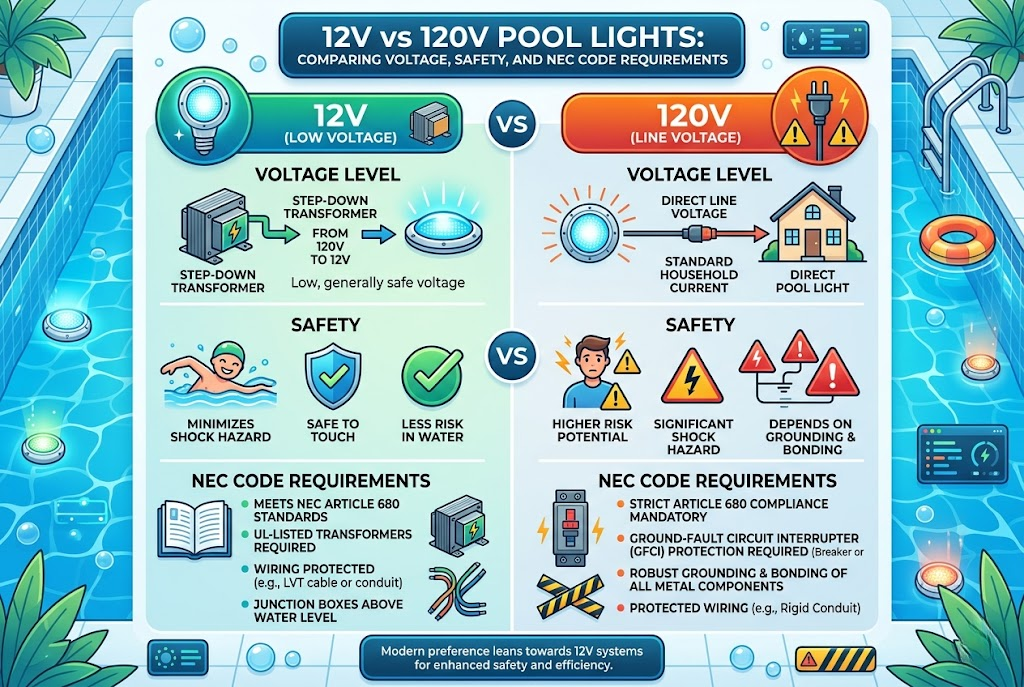
Voltage is the topic of every discussion about swimming pool lights. While 12 V introduces your swimming pool light to a power step-down transformer that drops 120 V household current to a safer 12 volts before it reaches the water, 120V operates at full line voltage beneath the surface. Both are Up to Code, NEC Article 680. But they offer very different risks, wiring requirements, and price tags.
| Feature | 12V Pool Light | 120V Pool Light |
|---|---|---|
| Operating Voltage | 12 volts AC/DC | 120 volts AC |
| Transformer Required | Yes — mounted ≥5 ft from pool edge | No |
| Shock Risk (if fault occurs) | Low — 12V rarely causes lethal shock | High — 120V can be fatal in water |
| GFCI Protection | Required by NEC 680 | Required by NEC 680 |
| Typical Use | Residential pools and spas | Large commercial pools, older residential installs |
| NEC Requirement | 680.23(A)(2) — transformer listed for pool use | 680.23(A)(1) — GFCI + sealed fixture |
The scope of NEC Article 680 includes all components that sit in or near swimming pools, hot tubs, and spas. Its primary demands shape your swimming pool light install:
- GFCI protection is required on all swimming pool lighting circuits–both 12V and 120V. The GFCI breaker must trip at 5 milliamps.
- Bonding: run a #8 AWG solid copper conductor to bond all metal-to-metal parts within five feet of the pool–including light niches, ladder anchors, and handrails.
- Fixture depth: the top of the light lens must be 18 inches or more below the normal waterline.
- Wiring of the light fixture: wires must be run through rigid metal conduit, intermediate metal conduit, or Schedule 40 PVC conduit from the junction box to the forming shell.
Aquatic certifying laboratories like ETL and UL rate all pool fixture products sold in the United States. All displays of UL 676 (underwater luminaires) on packaging indicate a product is tested and safe for swimming pool use. Fixtures rated IP68 waterproof which have polycarbonate lenses and corrosion-resistant stainless steel housings excel in chlorinated and salt water pools.
⚠️ Important
Controlling the worst error of pool lighting: installing or servicing a 120 V fixture on a circuit without GFCI protection. Should the fixture’s seal fail and water touch live conductors, lethal current will flow directly into the pool. GFCI breakers are a reasonable $30-$50 expense and will trip in under 25 milliseconds. Operating a pool lighting circuit without a GFCI is reckless.
📐 Engineering Note
NEC 680 wiring for pool light projects: (1) Bond the light niche shell to the pool bonding grid. (2) run a solid copper #8 AWG wire to your bonding lug from the niche shell–no splices allowed underwater. (3) Bond the junction box. (4) Measure the continuity to your pool equipment pad using a low-resistance ohmmeter. (5) Confirm your transformer (if 12 V) is manufacturer listed for underwater pool use and at least five feet from the water’s edge.
Pool Light Color Options: White LED, RGB and RGBW Explained
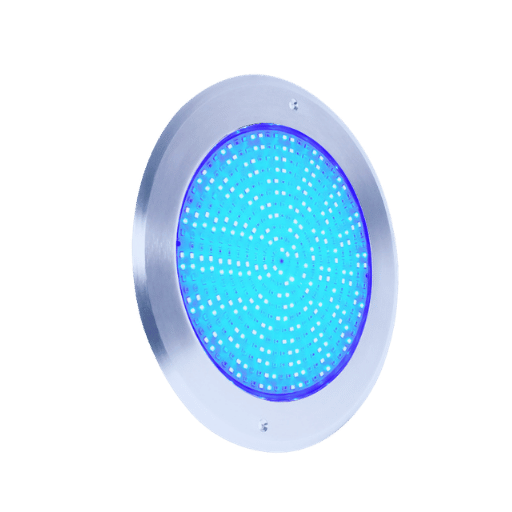
Color choice does more than set the mood–it affects your swimming pool light’s ability to penetrate water, the darkness and clarity of your nighttime pool, and the reflectivity and interaction of your pool with its finish color. LED pool lights are currently available in four diode arrangements:
| Technology | Diodes | White Capability | Color Range | Best For |
|---|---|---|---|---|
| White LED | White phosphor-coated | Pure white (2700K–6000K) | White only | Lap pools, classic aesthetic |
| RGB | Red + Green + Blue | Mixed white (washed-out) | ~7 base colors + blends | Budget color-changing setups |
| RGBW | Red + Green + Blue + White | Dedicated pure white | Full spectrum + true white | Pools that need both color shows and daily white light |
| RGBWW | RGB + Cool White + Warm White | Tunable white (2700K–6000K) | Full spectrum + adjustable white | High-end residential, commercial |
Color Temperature and Water Penetration
Color temperature has more significance under water than it does on land. Cool white LED illumination (5000-6000K) penetrates water considerably more than warm white (2700-3000K). Explanation: water absorbs red light more than blue light and this is well known, the lower the color temperature of an illumination source (higher the K at 5500K) the greater the penetration into the pool, therefore most commercial installations and competitors pools almost always specify cool white.
See Wibre research.
The residential comes where the neutral 4000K white is working on a happy medium (bright enough for safe swimming but not so cold as the 6000K). Quite often, homeowners will have RGBW lighting so that they can switch it to a color changing mode (for parties) when necessary.
Control Systems
The way in which you control colour of the LED varies on the protocol of the system. There are three main layers;
- DMX512 – the commercial standard. Capable of controlling hundreds of fixtures individually with accurate color blending, has been used in large scale applications such as resort pools, fountains and water features with coordinated lighting effects,
- Wi-fi / Bluetooth- the residential standard. Controlled using phone app, voice assistant or integrated into other home automation. The size of range is from 30 feet (BT) to the whole house (Wi-Fi).
- RF Remote- mid-range. Remote control that has range of 50-100 ft. Requires no app or network.Best for pool owners that want color changing feature without the hassle of being more than a smart home.
Our methods of choosing colors: Select the appropriate color systems for your main uses of your pool. Fixed Cool White LEDs are optimal for lap swimmers. Occasional use pools for families should consider buying RGBW with WIFI controls.
For spas and commercial pools, DMX512 is a great option for dynamic effects and zone controls.
💡 Pro Tip
Test burn in for warmth white?
Check-out if for you pool finish – dark plaster (pebble/dark blue) suck in light like insane -WW, looks dull and muddy,coz white is weak in the water. Cool white/neutral white very good in dark finish pool.
How to Choose the Right Pool Light for Your Pool
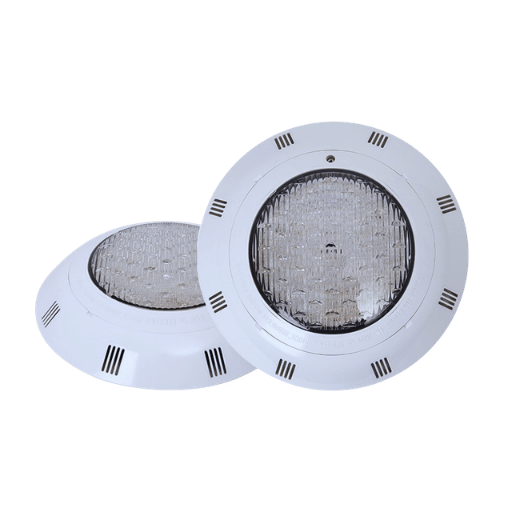
The decision to select the appropriate swimming pool light is a summary of three choices. Make the right decision and the rest will simply click into place—brand, shade, system control.
Care in these three areas will guide you toward the perfect swimming pool light.
Step 1: Identify Your Pool Type and Construction
All of your available light types depend on your pool’s construction. Gunite or concrete inground pools can accept all three—niche, nicheless, or surface-mount. Fiberglass pools may have pre-molded niche openings, but not necessarily.
Vinyl liner pools need a designated mounting plate behind the liner. Above-ground pools are limited to clip-on, magnetic or floating lights. For pool and spa lights installed together, nicheless fixtures are typically the best choice because they fit into the smaller radius walls, which will be able to go into the smaller radius walls that most full niches will not fit.
Step 2: Calculate Quantity
And here is the baseline calculation: 1 pool light for every 400 square feet of pool surface area. A typical residential in-ground pool measuring 15ft x 30ft (450 sq ft) requires at least two lights. For nicheless lights, consider approximately 1 light for every 8 ft of wall length.
A larger pool, an L-shaped pool, and a pool with an attached spa will require more fixtures to illuminate all sections of the pool and prevent darkened corners. A dark pool at night is no fun.
Step 3: Set Your Budget
| Budget Tier | Price per Light | Type | What You Get |
|---|---|---|---|
| Entry | $30–$80 | Floating / Above-Ground | Basic illumination, color-changing, no permanent wiring |
| Mid-Range | $150–$400 | Nicheless LED | Permanent install, RGB/RGBW color, energy-efficient |
| Premium | $300–$800+ | Niche LED (Inground) | High lumen output, RGBWW, automation-ready, 50,000h lifespan |
The three biggest names in the pool light game today are Pentair, Hayward, and Jandy- all who produce niche and nicheless lights at various price points. When making a comparison between brands, consider lumens per watt, warranty, and proprietary versus universal mounting system.
💡 Pro Tip
Lumens ratings on packaging are rated for air. Underwater, effective brightness is reduced by 30-40% due to refraction and absorption. A light rated at 3,000 lumens will be producing approximately 1,800-2,100 lumens once underwater.
When in doubt, size up.
Energy efficiency, if you can, should also be taken into account in your long term cost analysis. A 45W LED light for 4 hours each night will cost in the region of $6-8/year in electricity, whereas a 300W incandescent can cost between $40-55/year, over 10 years in you can save between $800-1,200 in electricity costs alone, even factoring in replacement bulb costs. For an insight into the perfect lighting solutions for your project, take a look at professional LED swimming pool lights with full spec sheets and installation instructions.
Pool Light Installation: Placement, Spacing and Wiring Basics
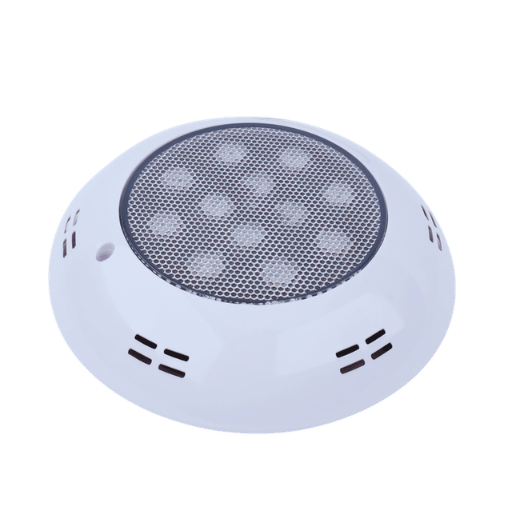
Where you position the swimming pool light matters if you want the whole swimming pool to be illuminated or just half of it to be illuminated. Have a look at these 5 considerations to help you a little more.
1. Mounting Depth
Position lights 18″ to 24″ up the deep end wall from the waterline. For the shallow areas and tanning shelves, 4″ to 9″ below the waterline is appropriate. NEC 680 allows a minimum of 18″ below the normal water surface at the top of the lens.but check with your building department.
2. Wall Position and Glare Control
Mount lights on the house side (deep end) wall. Lighting on the house side deep end wall is best for directing light toward the shallow end where the bulk of swimmers are. Also, the blinding glare is shunned from gathering areas and eating in the house.
This is the most common mistake in placement-a series of blinding glares across the surface of the pool while you are trying to enjoy it.
3. Spacing
For nicheless lights, average one fixture per side of the wall, about every 8′. For niche lights, higher wattage makes for fewer fixtures, so one or two fixtures ideally spaced throughout the pool would suffice. In the case of an L-shaped or a freeform pool, shoot to include at least one light in each section to avoid any dark zones.
Features such as spillovers and grottos need their own accent lights.
4. Cord Length and Junction Box
The pool light is supplied with either a 50ft cord or 100ft cord. The excess cord is wound up in the junction box—this extra length is used to be able to pull the fixture up to the deck level for maintenance without draining the pool. Do not cut the cord to length.
Junction box must be a minimum of 4 inches above water level of pool and 8 inches above ground level in accordance with NEC regulations. All wiring is run through rigid metal or Schedule 40 PVC conduit.
5. Niche vs. Nicheless: Timing Matters
Niche Lights should be planned during pool construction — the forming shell is set into the forming shell before the concrete is poured and the plaster is applied. Nicheless lights are retrofittable afterwards through the existing 1.5-inch return fitting, making it available for existing lighting systems and upgrades. If your systems are scheduled for expansion in the future, nicheless offers the flexibility avoiding additional cut-in work.
18–24″
Standard Depth Below Waterline
8 ft
Nicheless Spacing Interval
≥5 ft
Transformer Distance from Pool Edge
📐 Engineering Note
Always install the transformer at least 5 feet from the pool edge per NEC 680.23. The transformer must be rated for both pool and spa use; a generic landscape rated transformer will not suffice. Use THWN rated conductors in the conduit runs, and slope the conduit away from the pool so that any migration of water is towards the junction box. Consult PHTA standards regarding spacing and structure in the pool to allow for best practices.
Pool Light Maintenance, Troubleshooting and Replacement
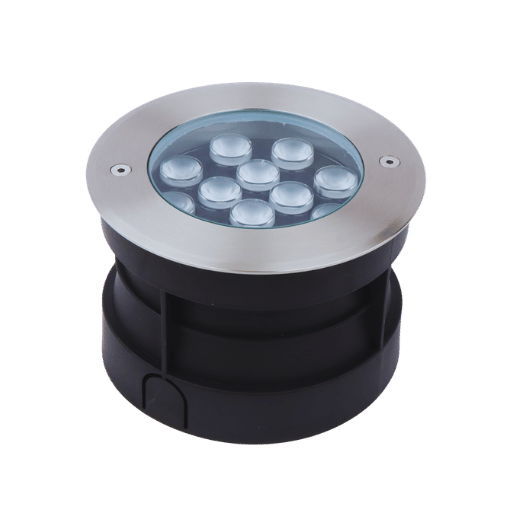
Wear and tear levels on a swimming pool light are governed almost exclusively by the type of bulb installed. The emergence of LEDs has reshuffled this equation drastically: the once annually tasking maintenance work has now become it task of monitoring a few seconds per month at most.
| Type | Lifespan | Annual Energy Cost (4h/day) | Replacement Frequency |
|---|---|---|---|
| LED | 30,000–50,000 hours | $6–$12 | Every 20–34 years |
| Halogen | 3,000–5,000 hours | $30–$50 | Every 2–3 years |
| Incandescent | ~1,000 hours | $40–$55 | Every 8–12 months |
LED pool lights can last anywhere from 30,000 – 50,000 hours. At 4 hours of nightly use that results in 20 – 34 years of service. Compare to the typical halogen lamp at 3,000-5,000 hours and 1,000 hours for ordinary incandescent pool lights. This premium for LED lights will amortize itself within 2-3 years in the energy savings alone.
No-Drain Replacement
A long held mistaken belief is that you have to drain the pool in order to replace a pool light. You do not. Many inground pool lights are rated with 50 – 100 feet of cordstoring in the junction box. Shut of the circuit breaker, unscrew the single mounting screw to the face ring of the fixture, and carefully pull the light to the deck. The longer cord gives you ample slack to work on the fixture outside in the pool area. Replace the bulb or entire fixture, reseat the gasket, and lower it back into the niche.
Troubleshooting Checklist
- Flickering – Inspect wiring at the junction box and look at the LED driver for corrosion on the terminal poles.
- Condensation in the lens – small traces of moisture is normal for significant temperature changes. Standing water indicates the gasket seal has failed — replace before corrosion destroys the LED.
- Color drift – LEDs change color slightly during their life span often in excess of 10,000 hours. If one is significantly different than the others, it is at the end of its life.
- Complete failure – test the circuit breaker, then test the GFCI. If both are operational, the LED driver or bulb itself has failed.
Water Chemistry and Fixture Longevity
pH balance of 7.2 – 7.6 keeps your fixture sealed, lens clear and metal parts from corroding. Acidic water (below 7.0) attacks gaskets and hastens the corrosion process of stainless steel. Salt pool chlorine generator systems require 316-grade stainless steel housing; standard 304 stainless will rust in 1-2 years. Check your pool lights yearly during the swim season for flickering, discoloration or the presence of water behind the lens to make sure they are functional for nighttime lighting.
💡 Pro Tip
When retrofitting a previous incandescent/Halogen fixture with LED ask if your existing transformer (assuming 12V) can handle the lower wattage. Often, older magnetic transformers require a minimum load, for example a 300W transformer may not reliably fire a 30W LED. A new transformer rated for use with LEDs might be needed.
Frequently Asked Questions
Can a pool light electrocute you?
View Answer
The use of GFCI circuit breaker for modern pool lights is rarely risky. The GFCI trips within milliseconds at detecting a fault. But many old installations also had 120V non-GFCI circuits with degrading grade wiring present risks for pools. By the National Electrical Code (NEC) all pool lighting circuits should be GFCI protected. Call an EL to get your older non-GFCI powered pool checked out.
How long do LED pool lights last?
View Answer
Quality LED pool lights are rated for life spans of 30,000-50,000 hours. At around 4 hours/day that equates to a lifespan of about 20-34 years before the LED module will need replaced. Halogen bulbs last from 3000-5000 hours, and incandescent only around 1000 hours.
Can you replace a pool light without draining the pool?
View Answer
Yes. Most inground pool lights ship with 50-100 feet of cord rolled up in the junction box. Turn off the breaker, pull the fixture to the deck, and replace parts right there.
What is a nicheless pool light?
View Answer
A nicheless pool light is a one piece, high quality LED light mounted into the regular return fitting between the pool shell and deck. Because they do not require an entire niche they can be added into existing pools without having to chip out large chunks of the shell. Highly desirable for tight locations like tanning shelves, spa spillovers, narrow cantilevered decks and grotto walls. Most nicheless pool lights run on 12V and use a low 9W-30W.
How many pool lights do I need?
View Answer
Generally, one light per 400sq ft. of pool surface area. A 15X30ft. (450sq ft.) pool will require a minimum of 2 lights. For nicheless fixtures plan a fixture along each 8-10 ft. of the pool wall. Various factors like an L-shape, increase in size, additional deep end or shallow end, may require you to install lights in additional locations.
Are LED pool lights worth it?
View Answer
While they are a bit more expensive to purchase ($150-$850 vs only $20-$50 for incandescent bulbs) a LED light system will also result in lower long term energy savings. A 45W LED shines the same as a 300W incandescent bulb, but consumes 85% less electricity. On average over 10 years a standard residential pool will end up saving about $800.
Should I leave my pool light on all night?
View Answer
Safety is not an issue. The LED units only draw between 12 and 45W, which costs about $0.50-$1.50 per month if left on overnight. If security is a concern set a timer for peak evening hours.
Is water inside a pool light fixture dangerous?
View Answer
The normal condensation inside the front lens is nothing to be worried about, and while it will burn off on its own if you have the water stuck inside the lens it is cause for concern. Turn off the pool light circuit immediately and pull the fixture to the deck to check for a cracked lens or faulty gasket. Operating a flooded LED will damage the reflector coating and lead to corroding the LED driver. For 120V lights operate the new fixture after replacing lens gasket.
Ready to Find the Right Pool Light?
View our entire selection of LED swimming pool lights – from the small JTV nicheless 12W LEDpool lights, through to the huge 150W commercial units. See our complete range of pool lights to compare their specifications, prices, and their various installation methods.
Brow
Our Perspective on Pool Lighting
z.
Guangqi Lighting has been producing LED pool lights for more than 40 countries to serve customer projects from 2005. The technical information mentioned in this guide is based on relevant NEC electrical regulations, DOE energy surveys, and field observations of installing hundreds of underwater fixtures. If you find any mentioned products, please note that Guangqi is just one of qualified brands, we endeavor to help you make a best purchasing decision whether that is our brand or not.
Brow
References & Sources
- U.S. Department of Energy — LED Lighting — https://www.energy.gov/energysaver/led-lighting
- U.S. Energy Information Administration — LED Adoption in U.S. Homes 2024 — https://www.eia.gov/todayinenergy/detail.php?id=67368
- EC&M — NEC Rules on Swimming Pools and Spas — https://www.ecmweb.com/national-electrical-code/code-basics/article/20896897/nec-rules-on-swimming-pools-and-spas
- Electrical Contractor Magazine — Special Swimming Pool Requirements: Article 680 Guide — https://www.ecmag.com/magazine/articles/article-detail/special-swimming-pool-requirements-let-article-680-be-your-guide
- Pool & Hot Tub Alliance (PHTA) — Standards and Codes — https://www.phta.org/standards-and-codes/phta-standards/
- Wibre — Colour Temperature and Water — https://www.wibre.de/en/posts/colour-temperature-and-water.html