
Get in Touch with GUANGQI



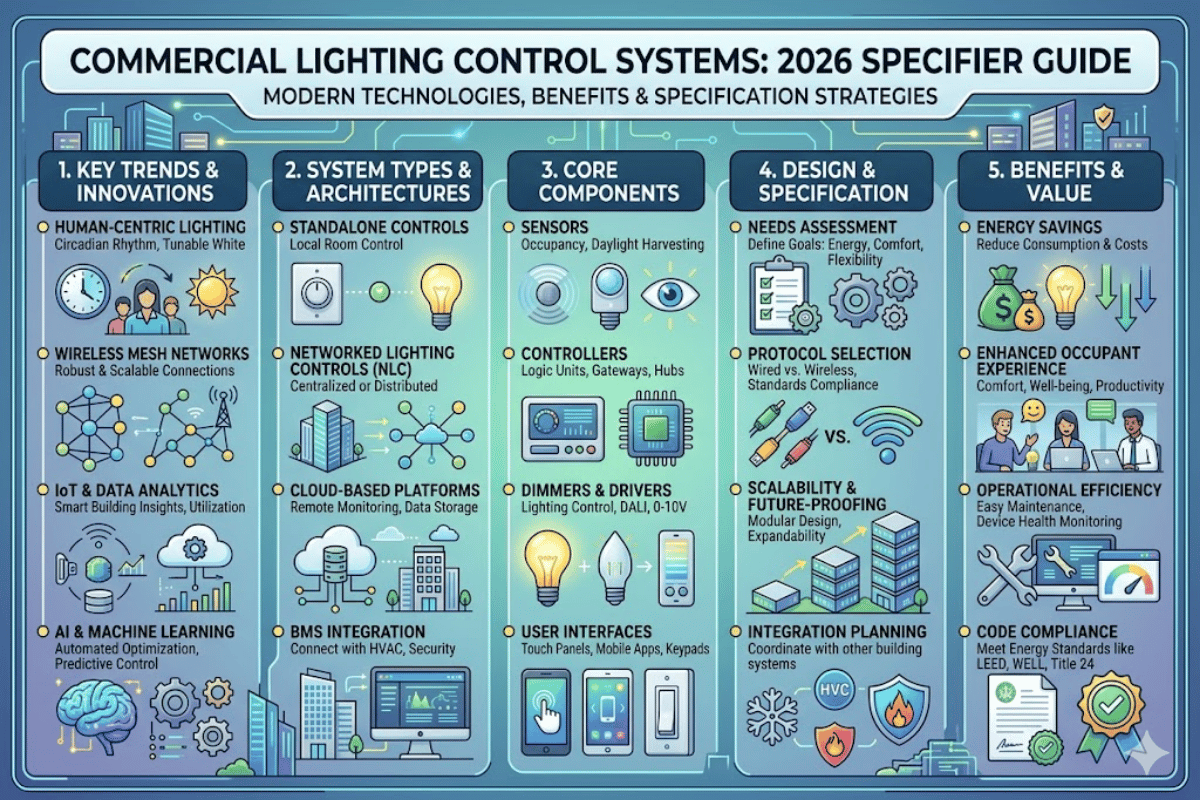
A vendor-neutral practitioner’s manual for specifiers, property managers, and facility engineers. Protocols, codes mandates, the selection process, and where the real economics of energy-controls retrofits are to be found.
A commercial lighting control system is the hardware and logic which determines where, when, and how much lights operate in a building. A financial discussion of purchasing a single-room stand-alone sensor versus a campus-wide networked platform is over – energy codes require automatic control in almost every commercial space, and the difference in cost between traditional “code-minimum” and optimized system is growing larger each utility cycle.
This primer will take you through the modern lighting control system architecture, the 6 dominant control protocols, the unavoidable energy code mandates (ASRAE 90.1-2022, California Title 24, IECC), the building-type strategies that work, the 4-Layer Selection Matri× to facilitate defensible specification, the pitfalls in installation that take projects down, and the 5-year ROI mathematics you will be asked to defend. Well-designed energy-efficient lighting systems are also among the most affordable ways to save energy in an existing building. It does not attempt to nominate a “best brand”.
It will empower you to make that choice.
Quick Specs
| Typical scope | 50 to 50,000 fi×tures per system |
| Major protocols | DALI-2, 0-10V, DMX, Wireless Mesh (Zigbee / BLE), KNX, BACnet |
| Code drivers (US) | ASHRAE 90.1-2022, IECC 2024, California Title 24 Part 6 |
| Typical energy savings | 30 – 65% over uncontrolled LED baseline; up to 80% vs uncontrolled fluorescent |
| Typical payback | 1 – 3 years (LED + controls retrofit, with utility rebate) |
| Driver MTBF target | 50,000 hours @ Tc 75 °C (typical specification) |
| Required certifications | UL 8750, DLC NLC QPL, IEC 61347, IEC 62386 (DALI-2) |
What Is a Commercial Lighting Control System?
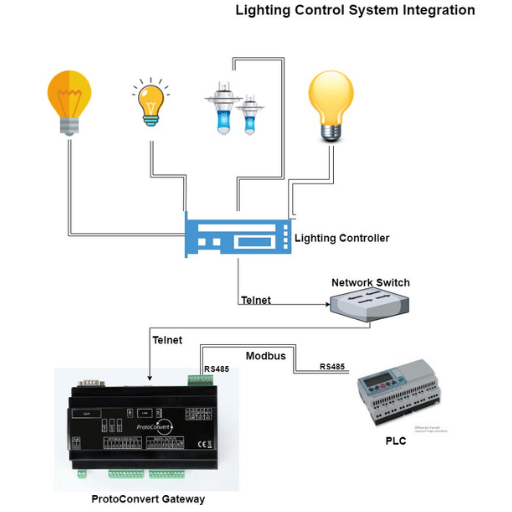
To think of a commercial lighting control system as one body with four levels stacked behind every wall switch, and to be frustrated that projects always seem to go awry because you haven’t considered all four levels—would thus be an accurate first step.
The 4-Layer Architecture Framework
- Power conversion (drivers) – converts, from the line, power into the constant-current or constant-voltage required by an LED. Usually very efficient, between 90 and 95%. It carries, on a fi×tures, 100% of the failure risk, despite accounting for 10-15% of bill of materials.
- Protocol signaling – DALI-2, 0-10 V, DMX, PWM or wireless mesh. Effectively, the “language” each of the fixtures communicates with. This is where vendor lock-in occurs or is avoided.
- Sensing – occupancy/vacancy sensors, daylight photocells, ambient light sensors, sometimes temperature or air-quality sensors. Inputs that control intelligently.
- Integration— gateways to BACnet, Modbus, KNX, or proprietary BMS head-ends (Honeywell, Johnson Controls, Siemens, Schneider). A layer that makes lighting into an addressable sub-system of the building’s broader building systems stack, rather than an island.
These systems are broken out based on the building architecture: single function, (one fi×ture, one device and one decision), distributed (no central head-end one-to-one per-zone controllers), networked (DLC NLC-class whereby all fi×tures are addressable), centralized (relay panels are controlling huge dimming loads from one or more electrical rooms). Most modern commercial projects today sit in the networked or distributed quadrants; centralized panels have only persisted in the stadiums, data halls and parking structures where switch loads are immense.
Why Commercial Lighting Controls Matter — Code, Energy, and the Real Failure Cost
In three different ways, commercial lighting controls are headed toward being mandated and an owner who considers any one of those pathways in isolation will under-estimate the requirements. 15 – 20% of a typical commercial building’s bill is a result of lighting – U.S. Department of Energy has recorded significant 60 – 80% savings when combined control methods are applied.
Force 1- Protocol is no longer a choice. ASHRAE 90.1-2022 and IECC 2021/2024 require fully-automatic occupancy, daylight response and scheduling control in nearly every commercial space type. Inspectors check. DOE Building Energy Codes Program states 90.1-2022 alone yields around 9.8% more site-energy savings versus 90.1-2019 – almost all of that through controls, not fixtures.
Force 2- Energy bill escalator. Annual escalation in the fuel bill has always led to incremental savings from control sophistication. Combining a handful of controls measures can yield 60-80% energy savings versus a baseline lighting system using only a simple occupant sensor and multi-level daylight harvesting. A DesignLights Consortium NLC Savings Study tracked 103 buildings and found networked lighting controls add nearly 50% additional savings on top of the LED retrofit alone.
Force 3- Driver fault cost stack. Driver is only 10-15% of a fixture’s BOM but takes on 100% of the risk of failure. People in the trade say flicker progression is the best indicator of impending failure – the lamp does not simply go dark like a filament, it lingers and glowers like a banshee.
The Driver Failure Cost Stack
| Failure caught at | Per-driver replacement cost |
|---|---|
| Factory burn-in | $0.50 – $2 (scrap value of the unit) |
| Local inventory swap (ground-floor fixture) | $15 – $30 (labor + part) |
| Aerial lift, occupied retail / office ceiling | $80 – $150 (lift, two-person crew, scheduled downtime) |
| 10 m street pole or 5-star hotel feature ceiling | $200 – $400+ (lift, traffic control, after-hours premium) |
Typical 1-2% driver failure rate. For 10,000 fixtures that is 100-200 dark lamps a year and maintenance dollars are budgeted for the worst case fail scenario, not the average.
Control Protocols Compared — DALI-2, 0-10V, DMX, Wireless, KNX, BACnet
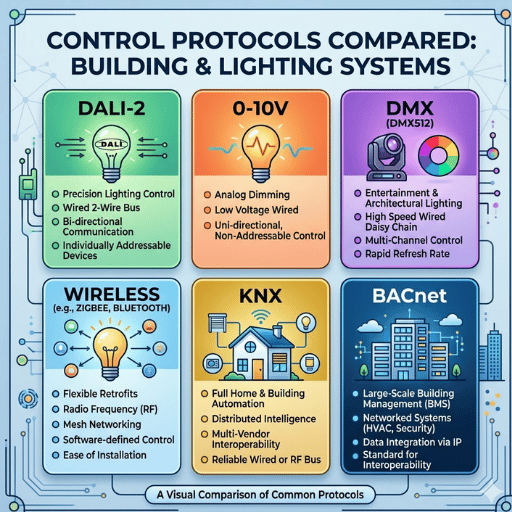
It is really the protocol decision that carries the greatest consequence for the fixture-to-BMS run because it locks-in all the way down through the life of the building. By and large specifiers look at DALI-2 against 0-10V side by side on a cost measure; a better question is which protocol fits the space granularity it actually requires.
| Protocol | Wiring | Devices / segment | Dim depth | Two-way? | Best for |
|---|---|---|---|---|---|
| DALI-2 | 2-wire bus, polarity-free | 64 / bus, unlimited via gateway | 0.1 – 100% | Yes — per-fixture status | Office, healthcare, museums, hospitality |
| 0-10V | 2 extra control wires, polarity-sensitive | Unlimited (parallel drop) | 10 – 100% typical, 1% with matched driver | No | Warehouse, parking, industrial, outdoor |
| DMX-512 | RS-485 differential pair | 512 channels / universe | 0 – 100% with high refresh | No (RDM extension adds it) | Stage, architectural color-changing, theme |
| PWM | Low-voltage DC | Per driver | 1 – 100% | No | LED strips, cove, signage, channel letters |
| Wireless Mesh (Zigbee, BLE, Casambi) | None — RF mesh | 200+ nodes / network | 1 – 100% | Yes — mesh health reporting | Retrofit, occupied buildings, no-conduit installs |
| KNX / BACnet | Bus or IP, BMS-class | Building-wide | Per-device dependent | Yes | Building-wide BMS integration, smart campuses |
DALI vs 0-10V — Which Protocol Should I Choose?
If a space requires individual fixture addressing, scene recall, or bi- directional fixture status reporting back to the BMS, then DALI-2 is simply the protocol of record in the IEC 62386 protocol set maintained by the DALI Alliance. If a space requires zone level dimming but no fixture addressing, most warehouses, parking garages and outdoor locations actually find 0-10V simpler and roughly half the controls hardware cost.
Financial inflection for any profile generally occurs around 50 fixtures per zone. Below that 0-10V is hard to top. Above that, the back charge for re-zoning flexibility of DALI-2 (all reprogramming, no re-wiring) pays back by the first major occupancy change out.
“DALI-2 conformance certification is necessary but it is not a guarantee or a filter for a good application. Certification simply means the product successfully went through a lab test against the IEC 62386 protocol, two vendors successfully commissioning on a single physical bus on a real project site remains a de facto QA requirement for a bulk purchase. Skip that step and one can expect to find oneself a visitor to the troubleshooting forums.”
For a project-contextual protocol decision-example and how to apply it when considering fixture count, BMS integration level and budget tier, check out our Lighting Control Protocol Selector. Manufacturer-specific LED drivers and DALI-2 controllers for each protocol layer are presented on our commercial lighting control systems page.
Sensors, Dimmers, and the Driver Layer
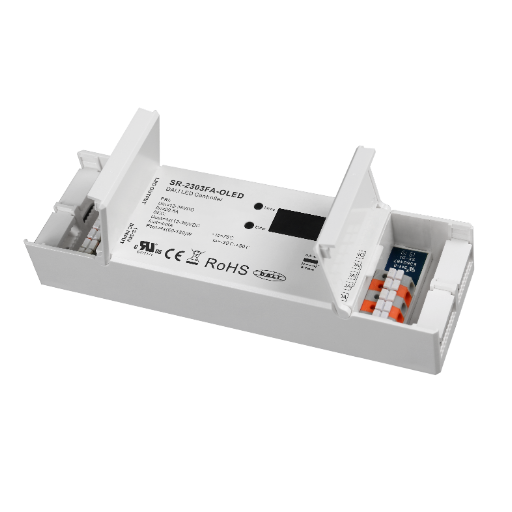
First, the protocol is the language which the building is using. Sensors, dimmer and drivers are the individual terms which the building is using. Three types of language are handling this:
| Sensor type | Detection range | False-trigger profile | Best for |
|---|---|---|---|
| PIR (passive infrared) | Direct line of sight, ~10 m | Misses still occupants; HVAC drafts can trigger | Open offices, corridors, restrooms with motion |
| Ultrasonic | Around obstacles, ~12 m | Sensitive to airflow and partition vibration | Restroom stalls, partitioned offices |
| Dual-tech (PIR + ultrasonic) | Combined | Lowest false-trigger rate; both must agree to switch | Conference rooms, classrooms, healthcare |
| Daylight photocell (open-loop) | Reads exterior daylight only | Less responsive to actual interior task plane | Skylit warehouses, atriums |
| Daylight photocell (closed-loop) | Reads task-plane illuminance | Requires per-zone calibration to actual setpoint | Sidelit perimeter offices, classrooms |
This driver itself is behind all of this, and determines what flicker, how many milliseconds of dimming smoothness, and how much surge survival the occupant receives. IEEE 1789-2015 tells you what frequency range is no-effect, low-risk, or a high-risk zone as a function of flicker generation frequency. At 120Hz — the harmonic that does the majority of perceptual flickering for North American AC-driven LEDs — at modulation depths of about 13.2% or less the driver falls within the low-risk band; high-quality electronic drivers hover around 1% or so.
Cheap electronic drivers commonly operate at 15 – 30% modulation during low bits of dimming; and that is where the headaches, eye strain and ‘the lights are flickering and going down before they burn out’ complaints come from. Driver selection is the critical factor that will determine if a fixture in code compliance, yet still provides long-term operational energy efficiency.
The second design decision is driver sizing. A general rule of thumb is total LED load wattage plus 20% for surge and long-term derating; for constant-current loads best match driver mA to LED datasheet, and for constant-voltage loads match the bus voltage (12 V, 24 V, 48 V) that the module series anticipates. One niche has an LED Driver Sizing Calculator that makes it a snap, and our manufacturer-direct LED driver category files cover the full CC, CV, dimmable, and outdoor-rated families.
Energy Code Compliance — Title 24, ASHRAE 90.1, IECC, and EN 15193 Decoded
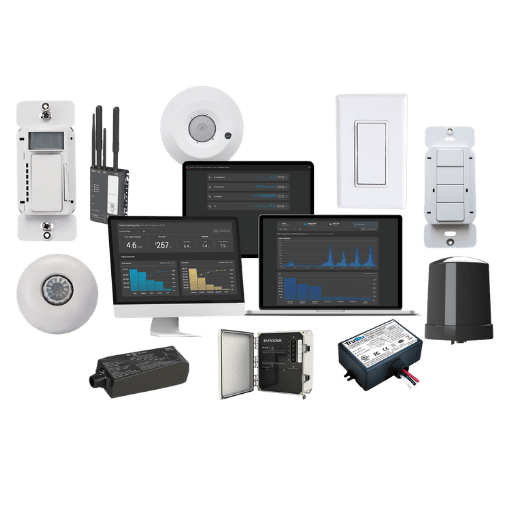
The energy code requirements that your project would need to comply with are jurisdictional and not globally applicable. The DOE adoption map illustrates which version of ASHRAE 90.1 or IECC is governing in every state. California has its own Title 24 Part 6 cycle which is presently the 2022 cycle.
| Requirement | ASHRAE 90.1-2022 mandate | Where it bites |
|---|---|---|
| Occupancy sensing | Auto-OFF within 20 min of vacancy. Open offices: 600 ft² max control zone per sensor. | Most existing open-office designs were built around 1,500 – 3,000 ft² zones; retrofits typically need 2 – 3× more sensors than budgeted. |
| Daylight response | Auto dimming or switching in primary sidelit zones (within 15 ft of qualifying windows) and toplit zones under skylights, per Section 9.4.1.5. | Triggers when daylight zone has ≥75 W of general lighting. Smaller perimeter strips are exempt. |
| Scheduling / auto-OFF | Time clock, EMS, or BMS signal. Programming must survive ≥10 hr power loss. | Required for all interior lighting in buildings >5,000 ft². |
| Multi-level control | At least one step between 30 – 70% and OFF, or continuous dimming. | Most occupied spaces. Bi-level switching alone is no longer sufficient. |
| Exterior auto-OFF | All exterior lights: OFF control plus ≥50% dimming via schedule or 15-min occupancy timeout. | New in 2022 cycle. Site lighting that was previously photocell-only now needs scheduling overlay. |
California Title 24 Part 6 adds a whole new acceptance-testing scheme to this pile of requirements. The CALCTP-AT 2025 Handbook defines an acceptance test for occupancy controls, daylight controls, demand-responsive controls, and automatic shutoff that the certified technician needs to pass before the project is handed over. Even plan-review cities outside California are beginning to adopt similar functional-test requirements–the arrow points toward “show me the commissioning report” as a standard query, not a surprise.
Elsewhere, EN 15193 for lighting energy in EU buildings is already using the Lighting Energy Numeric Indicator (LENI) that rolls control credits into a single building-level measure. UKCA still adopts controls according to EN 15193-class requirements until the next round of harmonization.
📐 Engineering Note — DLC NLC QPL and Utility Rebates
Most US Utility commercial-lighting rebate programs will only rebate controls listed on the DLC Networked Lighting Controls Qualified Products List (NLC5.1 at publication time). QPL-listed networked controls systems can offset 30 – 50% of controls hardware cost through prescriptive or custom utility incentives. Validation of QPL status for spec lock down – DLC delisting cycles have snagged more than one project mid-procurement.
For a quick read on the code-by-jurisdiction, check our Energy Code Compliance Checker.
Do I Need a Lighting Control System to Meet Title 24?
For day-to-day, yes. California Title 24 Part 6 has make every nonresidential occupancy include auto shutoff, daylight response in qualifying zones, multi-level control and demand responsive control–a wall switch does not fulfill any of these. A minimal-compliant path includes a distributed system (building code-rated occupancy sensors plus 0-10V or DALI dimmable drivers); the practical path that most projects choose (because it also qualifies for the utility rebate) is a networked DLC QPL system.
Use Cases by Building Type — What Actually Fits Where
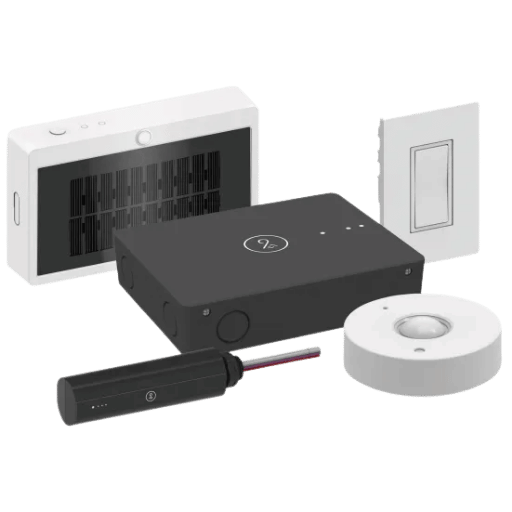
Different building types will have different occupant activity patterns, daylighting profiles, and tenant-experience priorities.
This table provides a starting point; it is not a set of directives–your code cycle, your tenant lease model will alter some entries.
| Building type | Recommended architecture | Typical protocol | Sensor density | Beyond-code add-on |
|---|---|---|---|---|
| Open office >300 ft² | Networked (LLLC preferred) | DALI-2 or BLE mesh | High (600 ft² zones) | Personal dimming, task tuning |
| Healthcare | Networked, BMS-integrated | DALI-2 | Per-room | Tunable white, circadian profile |
| Warehouse / manufacturing | Distributed | 0-10V | Aisle-by-aisle | Skylit daylight harvesting, task tuning |
| Retail sales floor | Distributed or networked | 0-10V or DALI-2 | Zone-level | Tunable white merchandising, scene recall |
| Hospitality (hotel, restaurant) | Standalone room + central scheduling | TRIAC + DALI hybrid | Per-room | Scene presets, BMS room controllers |
| K-12 / higher education | Networked, classroom-scoped | DALI-2 | Per-classroom | Multi-scene preset (instruction / video / collaboration) |
| Parking lot / garage | Distributed | 0-10V + photocell | Per-aisle vehicle detect | Bi-level dimming (30% standby → full bright on detect) |
How to Choose — The 4-Layer Selection Matrix
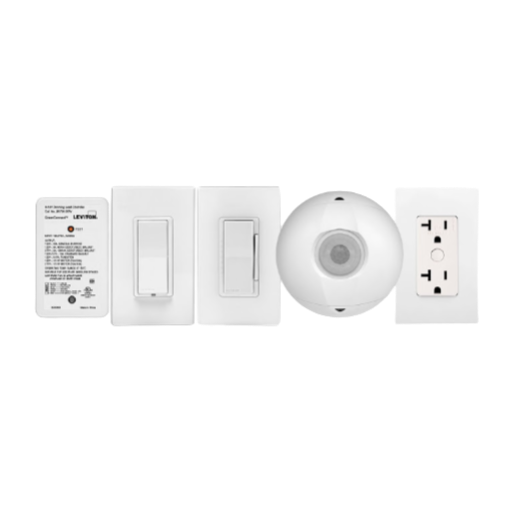
Most “best system” newspaper articles focus on end product selection, a single brand. That is the wrong decision layer. Defensible specification means going through four layers in order — four layers with constraints.
If you do not do it in the right order, projects end up with fixtures that cannot communicate to the BMS the owner leased them to you with.
The 4-Layer Selection Matrix
- Layer 1 — required control depth. On / off only? Bi-level? Continuous dimming to 10%? To 1%? Per-fixture status reporting? Your code minimum is the floor; the tenant experience and ESG reporting needs are the ceiling. Write both down before you talk to a vendor.
- Layer 2 — architecture. Standalone (one device, one decision) → distributed (per-zone controllers) → networked (DLC NLC-class, every fixture addressable) → centralized (relay panels). Driven by Layer 1 plus your tolerance for future rezoning. Layer 2 is what determines whether a tenant change-out is a software task or a rewire.
- Layer 3 — protocol. Now and only now do you pick DALI-2, 0-10V, DMX, wireless mesh, or a hybrid. Each protocol must support the architecture you locked in Layer 2. Cross-protocol within the same architecture is fine if the control drawings document it; mixing without documentation is the #3 install pitfall in the next section.
- Layer 4 — vendor class. Single-source proprietary (Lutron Quantum, Crestron, Acuity nLight) trades flexibility for guaranteed support and a single throat to choke. Open-spec multi-vendor (DALI-2 from any DALI Alliance member) trades vendor lock-in for higher installer-skill requirements. Mixed (proprietary controllers driving open-spec drivers) is the most common real-world outcome.
Worked example — 200-fixture medium office, new construction: Layer 1 calls for continuous dimming to 1% with per-fixture failure reporting (tenant ESG mandate). Layer 2 forces a networked architecture (Layer 1 needs addressing). Layer 3 narrows to DALI-2 or BLE mesh. Layer 4, given a 15-year hold, favors DALI-2 over wireless on durability of the wired bus. Spec lands on DALI-2 with a DALI-to-BACnet gateway feeding the building’s Siemens Desigo head-end. Total controls hardware budget: roughly $2.50 – $4.00/sqft installed before utility rebate.
Installation, Commissioning, and BMS Integration
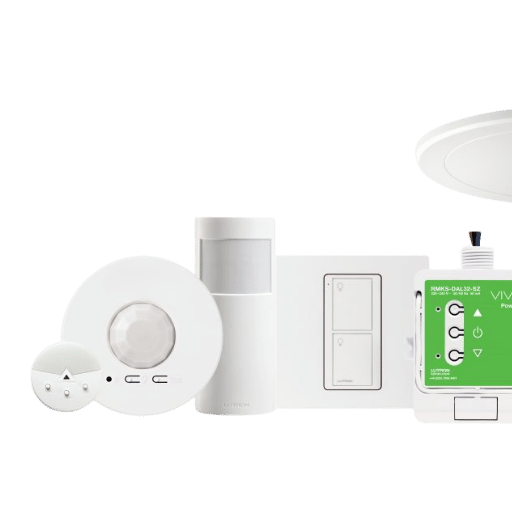
Electronics control hardware is about half the total deliverable. Another half is the soft layer (sequence of operations, commissioning walk, BMS integration point), and this is where most projects lose money.
Six pitfalls account for the majority of building after occupation dissatisfaction:
⚠ The Six Most Common Install Pitfalls
- Sensors installed but not commissioned. Factory defaults rarely match real space. Walk-test every zone for sensitivity, timeout and coverage. Code demands it—field experience demonstrates why.
- Daylight setpoints left at factory default. Photosensors usually require 200 – 300 lux at the work plane as a starting set point, followed by two weeks of occupant feedback to fine tune. Skip this step and building occupants will override or disable the daylighting system within the first month.
- Mixed protocols with no clear control documentation. 0-10V in the storage warehouse plus DALI-2 in the conference rooms is OK—as long as the installation team doesn’t cross-wire the systems. One protocol throughout each zone, clearly documented, no exceptions.
- No after-hours override. Schedule shuts down everything at 6PM, but a cleaning crew arrives at 7PM. Do you know where to find the breaker panel? Codes now require a clearly marked override located near every building entry.
- Specification without a written sequence of operations. Hardware counts for half the task. Without a written narrative describing the response of spaces to occupancy, daylight, and schedule, the commissioning agent has no way to ensure a successful commissioning process.
- Fixture-driver dimming compatibility not tested prior to procurement. A luminaire rated for 0-10V dimming down to 10% may flicker below 20% when paired with a specific brand of sensor. Research the dimming compatibility data from luminaire manufacturers, pilot one zone before large batch purchases.
Building management system integration is the sixth potential mine lying beneath the first five. DALI-to-BACnet and DALI-to-Modbus gateways are the standard hand off path for building automation head-ends coming from Honeywell, Johnson Controls, Siemens, and Schneider. Confirm the specific gateway version with the actual BMS firmware version; this is the conformance step that separates clean turnover from a six-month integration debug.
Energy Savings, ROI, and the Hidden Cost of Driver Failure
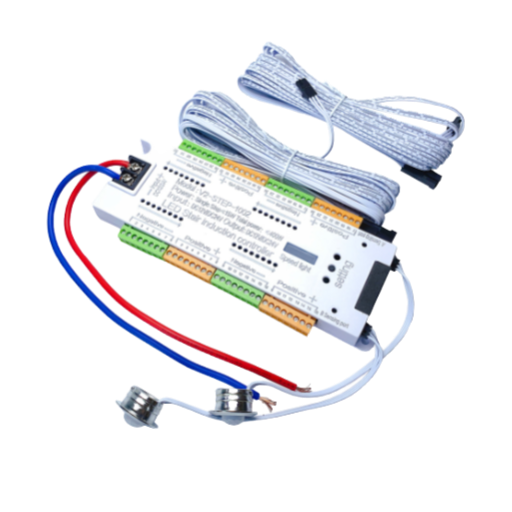
Finance managers expect a number—not a promise. Our 5-year TCO model below represents the financial analysis that purchase order approvers are accustomed to seeing, with the hidden costs incorporated that most vendor proposals omit.
5-Year TCO Formula
TCO5y = (Capex + Install + Commissioning) − (Annual kWh saved × tariff × 5) − (Utility rebate) + (Driver replacement reserve) + (Maintenance carry)
A simple payback under three years usually passes project approval without escalation; a period of 3 to 5 years requires a data-driven ESG or compliance justification to support it; above 5 years the scope is usually re-evaluated.
Working example—office with 200 fixtures, 50W average, 2,800 hours/year typical operation:
- Estimated baseline annual kWh: 200 fixtures × 50 W × 2,800 hours = 28,000 kWh
- Estimated combined controls savings (occupancy + daylight + scheduling + task tuning): ~55%
- Annual kWh saved: 15,400 kWh
- At $0.12/kWh: $1,848/yr energy savings; 5-year energy savings = $9,240
- Networked DALI-2 controls hardware + install: ~$8,000
- Utility rebate (DLC NLC QPL listed, ~40% offset): −$3,200 → net hardware $4,800
- Driver replacement reserve (1.5%/yr × 200 fixtures × $40 average labor + part) over 5 yr: ≈$600
- Net 5-yr TCO: $4,800 + $600 − $9,240 = −$3,840 (system pays for itself + delivers $3,840 net positive)
- Simple payback: ~2.6 years before rebate, ~1.6 years after
Two hidden costs are regularly left out of vendor proposals. Power factor penalty: drawing power with the driver PF below 0.9 is charged as a utility surcharge in most commercial tariffs—good electronic drivers draw >0.95 with PF correction built in from 25 W upward. Cheap drivers do not. Outdoors moisture ingress: the Arrhenius principle is a strict requirement—a 10 C increase in operating temperature will cut driver life in half. An underspecified ingress protection rating (IP65 where IP66 is required; IP66 where IP67 is required) will determine failure clusters of 12 to 18 months, crushing the savings model that lighting upgrades were implemented to fund.
Within a project for a simple lighting upgrade, the LED Driver Energy Savings Calculator inputs a fixture count, wattage, runtime, and tariff, and outputs the annual savings, payback period, and 5-year net benefit.
2026 Industry Outlook — Where Lighting Controls Are Heading
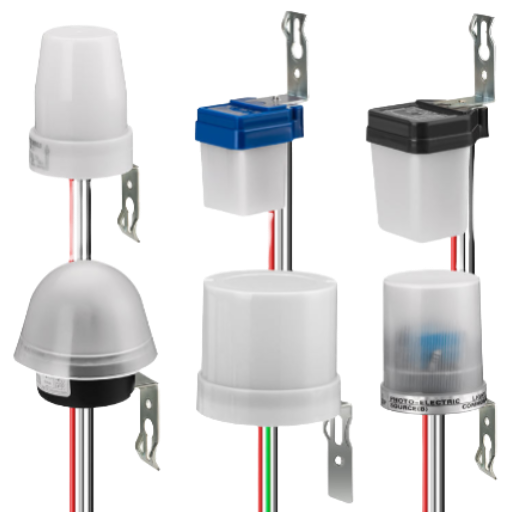
Between now and 2027, five commercial lighting controls trends are taking hold. Three are mature enough to specify today; two are still in pilot territory and should be tracked, not specified, unless the project has explicit IT-led infrastructure ambitions.
| Trend | Maturity (1–5) | Spec it today? | Evidence basis |
|---|---|---|---|
| DLC NLC-class networked control | 5 / 5 — mature | Yes — default for new build >5,000 sqft | DLC NLC5.1 active; ~50% incremental savings on top of LED documented across 103 buildings. |
| Wireless BLE mesh / Casambi | 4 / 5 — mature for retrofit | Yes — preferred for occupied retrofit | Multiple manufacturers shipping; commissioning app-based. |
| Human-Centric Lighting (tunable white, circadian) | 4 / 5 — certification-driven demand | Yes for healthcare / hospitality / WELL-targeted | WELL Building Standard mandates circadian-class design. Search demand for HCL terms ~+50% YoY. |
| PoE (Power-over-Ethernet) lighting | 3 / 5 — accelerating | Pilot — IT-led new builds only | Market growing ~2.8× from 2018 to 2026 (commercial market research). NEC 2026 explicitly adds PoE lighting provisions. |
| Matter protocol for commercial lighting | 2 / 5 — early | Track only — limited commercial deployments | Specification published; commercial vendor commits limited to 2026 pilot announcements. |
The single most impactful spec change for projects starting in 2026 is to anchor on a DLC NLC5.1 listed networked system as the default, with wireless mesh considered an attractive retrofit alternative and not a fallback position. If the IT side of the project is paying for conduit, the conversation about PoE should occur, and nothing else. As a one-page addon to the spec narrative, it is helpful to include the thereis an industry rollout coming up in the pretty near future.t account—it shows the owner that it is being looked into—it should not be load-bearing yet.
For organizations considering manufacturer-direct controls—the solutions we have tested internally including drivers and DALI-2 controllers designed specifically for code-driven commercial installations—see our in-house manufacturer solutions for commercial lighting control.
Frequently Asked Questions
Q: What are the main types of commercial lighting control systems?
View Answer
Based on architecture: standalone (one fixture, one decision), distributed (zone controllers), networked (DLC NLC-compliant where every fixture has an address), and centralized relay panels. Based on signal: wired (DALI-2, 0-10V, DMX) and wireless (Zigbee, BLE mesh, KNX-RF). Most new commercial projects fall into the networked or distributed quadrant.
Q: How much does a commercial lighting control system cost?
View Answer
The installed cost of a wireless mesh retrofit varies from $0.50 – $2.00 sqft; new construction—DALI-2 networked controls costs can be in the range of $2.00 – $6.00 per sqft; centrally control led relay panel installations also tend to be in that range. Other than commercial LED fixtures, utility rebates usually cover 30 – 50% of controls hardware costs for DLC NLC QPL listed systems. Include the rebate in the project funding model prior to selecting control vendors, because the numbers change quickly.
Q: DALI-2 or 0-10V — which should I choose?
View Answer
Choose DALI-2 for fixture-by-fixture addressing, status, and scene recall—this level of control is typical for offices, healthcare, museum, and hospitality applications. Choose 0-10V for yards, parking structure, and most outdoor applications where zone dimming will be acceptable. Otherwise, the fiscal inflection point is about 50 fixtures to a zone.
Q: Can I retrofit commercial lighting controls into an existing building without rewiring?
View Answer
Yes – wireless mesh (Zigbee, BLE, Casambi) is the dominant retrofit solution because it removes the control-wire pull, the cost driver in occupied buildings. Anticipate 25 – 35 day OEM lead time for wireless control nodes vs 15 – 20 days for stocked wired drivers, budget for one occupied-zone pilot, then roll out bulk deployment. However the wireless-flavored Commissioning process relies on RF site survey and not wiring diagrams; in steel-stud or concrete-deck buildings mesh density may need to be 1.5 – 2 times wired equivalent.
Q: How long do commercial lighting control systems last?
View Answer
Drivers are targeted 50,000 hours MTBF at Tc 75 C, which is ~17 years operational at 8h/d office operating hours. Control panels (e.g. DALI) are targeted 15 – 20 years. Sensors are targeted 10 – 15 years, but drift gives eventual recalibration. Outdoor service life is significantly shorter, with moisture ingress and the Arrhenius rule (10 C above ambient roughly halves service life) dominant.
Q: What is networked lighting control (NLC) and is it required by code?
View Answer
Non-Linear-Controls is a system where each fixture is addressable and reports back to shared network (wired, DALI-2 or wireless, BLE mesh, Zigbee). DesignLights Consortium maintains the NLC Qualified Products List, and most modern US utility rebate programs require by rule equipment to be listed on that list to be eligible for incentive rebates. ASHRAE 90.1-2022 does not technically require NLC be named in each space, but the pull of its explicit occupancy, daylighting, and scheduling mandates effectively justify deploying networked-class fixture capability in any occupancy over 5,000 sq ft. California Title 24 Part 6 builds its acceptance testing layer on top, placing a premium on NLC-class systems because they make functional testing software-driven rather than panel-by-panel.
Q: How do I integrate lighting controls with my BMS (Honeywell, Johnson Controls, Siemens, or Schneider)?
View Answer
DALI-to-BACnet gateways are the default pathway for web-enabled BMS PCs; DALI-to-Modbus gateways provide cover for the remainder. Confirm the gateway has been conformance-tested against current BMS firmware, not just the relative parameters provided by the vendor – Honeywell WEBs-AX, Johnson Controls Metasys, Siemens Desigo, and Schneider EcoStruxure all have version-compatible peculiarities. Confirm in writing conformance with vendor for the gateway prior to bulk buy.
The Team Behind This Report
This document was authored by the expert team at Guangqi Lighting (GQLamp) from five years of direct manufacturing of DALI-2, 0-10V and outdoor rated drivers, 3 documented case histories encompassing a 12-floor commercial office retrofit (42% energy saving vs T8 baseline), 850 IP67 outdoor drivers operating at 55 C ambient (zero failures at three years), and 220,000 luminaire municipal LED retrofit (zero failures at 14 months on 6 kV / 8 kV surge-protected drivers). Protocol comparison, code outline, and TCO approach in this report are vendor-neutral; the engineering knowledge provided is based on on-stream manufacturer pre-shipment testing, ASHRAE 90.1-2022, IEC 61347, IEC 62386, IEEE 1789-2015, and DLC NLC5.1 compliance standards.
Request a Project Spec Review →
References & Sources
- ASHRAE Standard 90.1-2022, Section 9.4 — Lighting Controls — American Society of Heating, Refrigerating and Air-Conditioning Engineers
- DOE Building Energy Codes Program — Code Adoption Status Map — U.S. Department of Energy
- Energy Savings from Networked Lighting Control (NLC) Systems With and Without LLLC, 2020 — DesignLights Consortium / Northwest Energy Efficiency Alliance
- DLC Networked Lighting Controls Technical Requirements (NLC5.1) — DesignLights Consortium
- Flicker: Understanding the New IEEE Recommended Practice (IEEE 1789-2015) — U.S. Department of Energy / Lehman, Wilkins, Miller
- CALCTP-AT 2025 Acceptance Testing Handbook — California Energy Commission
- Electric Lighting Controls — Whole Building Design Guide — National Institute of Building Sciences
- WELL Building Standard — Circadian Lighting Design — International WELL Building Institute
- DALI Alliance — IEC 62386 Standard Body — Digital Illumination Interface Alliance
Related Articles
- Commercial pool and water lighting — IP68 driver selection and lumen-density methodology
- Facade and architectural lighting — wall washing vs grazing vs flood vs spot vs linear
- Solar street lights — selection, sizing, and installation guide
- Solar flood lights — specs, types, and installation explained
![Industrial LED Bulbs: Bases, Voltage & Heat [Checklist]](https://gqlamp.com/wp-content/uploads/2026/10/industrial-led-bulbs-blog-featured-150x150.png)